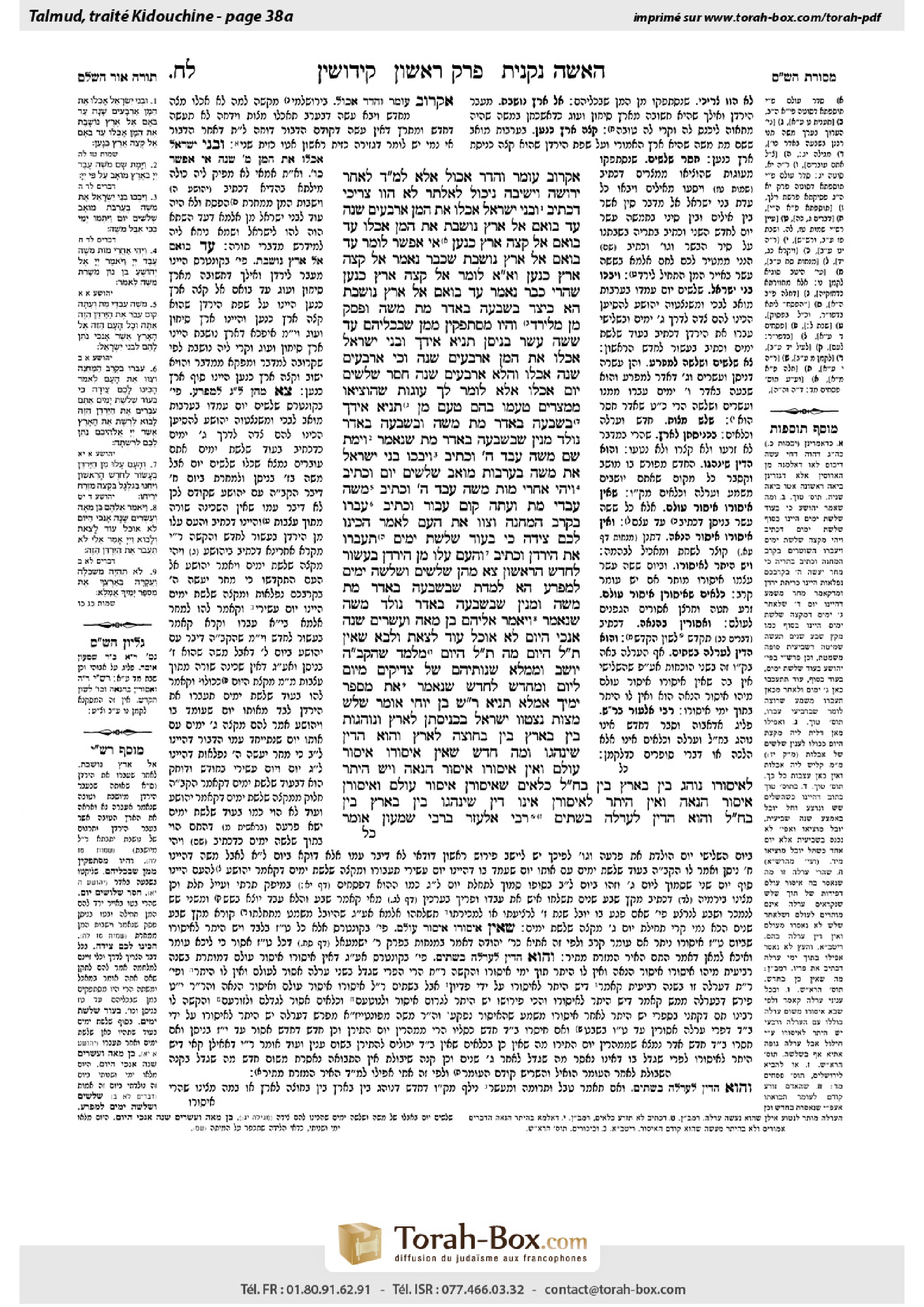
Kiddushin 38a: Talmud study for Daf Yomi
Daf Yomi is the daily study of one Talmud folio. Explore 37 tractates with scans, Hebrew text, Sefaria English and AI-generated French translations where annotated.
Passage selection and English or AI-generated French translation are available where the scan has annotations. Daf Study is independent of Torah-Box and Sefaria.
Browse Kiddushin · קידושין · All tractatesKiddushin 38a text and translations
This page of Kiddushin includes the Aramaic text, an English translation and an AI-generated French translation, alongside the scan above.
קידושין ל״ח א · Aramaic and Hebrew text
אַקְרוּב עוֹמֶר וַהֲדַר אֲכוּל.
אֶלָּא לְמַאן דְּאָמַר לְאַחַר יְרוּשָּׁה וִישִׁיבָה, נֵיכוֹל לְאַלְתַּר! לָא הֲווֹ צְרִיכִי,
דִּכְתִיב ״וּבְנֵי יִשְׂרָאֵל אָכְלוּ אֶת הַמָּן אַרְבָּעִים שָׁנָה עַד בֹּאָם אֶל אֶרֶץ נוֹשָׁבֶת, אֶת הַמָּן אָכְלוּ עַד בֹּאָם אֶל קְצֵה אֶרֶץ כְּנָעַן״. אִי אֶפְשָׁר לוֹמַר ״עַד בֹּאָם אֶל אֶרֶץ נוֹשָׁבֶת״, שֶׁכְּבָר נֶאֱמַר ״אֶל קְצֵה אֶרֶץ כְּנָעַן״. וְאִי אֶפְשָׁר לוֹמַר ״אֶל קְצֵה אֶרֶץ כְּנָעַן״, שֶׁהֲרֵי כְּבָר נֶאֱמַר: ״עַד בֹּאָם אֶל אֶרֶץ נוֹשָׁבֶת״. הָא כֵּיצַד? בְּשִׁבְעָה בַּאֲדָר מֵת מֹשֶׁה וּפָסַק מָן מִלֵּירֵד, וְהָיוּ מִסְתַּפְּקִין מִמָּן שֶׁבִּכְלֵיהֶם עַד שִׁשָּׁה עָשָׂר בְּנִיסָן.
תַּנְיָא אִידַּךְ: ״וּבְנֵי יִשְׂרָאֵל אָכְלוּ אֶת הַמָּן אַרְבָּעִים שָׁנָה״. וְכִי אַרְבָּעִים שָׁנָה אָכְלוּ? וַהֲלֹא אַרְבָּעִים שָׁנָה חָסֵר שְׁלֹשִׁים יוֹם אָכְלוּ! אֶלָּא לוֹמַר לְךָ: עוּגוֹת שֶׁהוֹצִיאוּ מִמִּצְרַיִם, טָעֲמוּ בָּהֶם טַעַם מָן.
תַּנְיָא אִידַּךְ: בְּשִׁבְעָה בַּאֲדָר מֵת מֹשֶׁה, וּבְשִׁבְעָה בַּאֲדָר נוֹלַד. מִנַּיִן שֶׁבְּשִׁבְעָה בַּאֲדָר מֵת – שֶׁנֶּאֱמַר: ״וַיָּמׇת שָׁם מֹשֶׁה עֶבֶד ה׳״, וּכְתִיב: ״וַיִּבְכּוּ בְנֵי יִשְׂרָאֵל אֶת מֹשֶׁה בְּעַרְבֹת מוֹאָב שְׁלֹשִׁים יוֹם״, וּכְתִיב: ״וַיְהִי אַחֲרֵי מוֹת מֹשֶׁה עֶבֶד ה׳״, וּכְתִיב: ״מֹשֶׁה עַבְדִּי מֵת וְעַתָּה קוּם עֲבֹר״
וּכְתִיב: ״עִבְרוּ בְּקֶרֶב הַמַּחֲנֶה וְצַוּוּ אֶת הָעָם לֵאמֹר הָכִינוּ לָכֶם צֵדָה כִּי בְּעוֹד שְׁלֹשֶׁת יָמִים תַּעַבְרוּ אֶת הַיַּרְדֵּן״ וּכְתִיב: ״וְהָעָם עָלוּ מִן הַיַּרְדֵּן בֶּעָשׂוֹר לַחֹדֶשׁ הָרִאשׁוֹן״, צֵא מֵהֶן שְׁלֹשִׁים וּשְׁלֹשָׁה יָמִים לְמַפְרֵעַ, הָא לָמַדְתָּ שֶׁבְּשִׁבְעָה בַּאֲדָר מֵת מֹשֶׁה.
וּמִנַּיִן שֶׁבְּשִׁבְעָה בַּאֲדָר נוֹלַד מֹשֶׁה – שֶׁנֶּאֱמַר: ״וַיֹּאמֶר אֲלֵהֶם בֶּן מֵאָה וְעֶשְׂרִים שָׁנָה אָנֹכִי הַיּוֹם לֹא אוּכַל עוֹד לָצֵאת וְלָבוֹא״, שֶׁאֵין תַּלְמוּד לוֹמַר ״הַיּוֹם״, מָה תַּלְמוּד לוֹמַר ״הַיּוֹם״? מְלַמֵּד שֶׁהַקָּדוֹשׁ בָּרוּךְ הוּא יוֹשֵׁב וּמְמַלֵּא שְׁנוֹתֵיהֶם שֶׁל צַדִּיקִים מִיּוֹם לְיוֹם וּמֵחֹדֶשׁ לְחֹדֶשׁ, שֶׁנֶּאֱמַר: ״אֶת מִסְפַּר יָמֶיךָ אֲמַלֵּא״.
תַּנְיָא, רַבִּי שִׁמְעוֹן בֶּן יוֹחַי אוֹמֵר: שָׁלֹשׁ מִצְוֹת נִצְטַוּוּ יִשְׂרָאֵל בִּכְנִיסָתָן לָאָרֶץ, וְנוֹהֲגוֹת בֵּין בָּאָרֶץ בֵּין בְּחוּצָה לָאָרֶץ.
וְהוּא הַדִּין שֶׁיִּנְהֲגוּ, וּמָה חָדָשׁ, שֶׁאֵין אִיסּוּרוֹ אִיסּוּר עוֹלָם, וְאֵין אִיסּוּרוֹ אִיסּוּר הֲנָאָה, וְיֵשׁ הֶיתֵּר לְאִיסּוּרוֹ, נוֹהֵג בֵּין בָּאָרֶץ בֵּין בְּחוּצָה לָאָרֶץ –
כִּלְאַיִם, שֶׁאִיסּוּרָן אִיסּוּר עוֹלָם, וְאִיסּוּרָן אִיסּוּר הֲנָאָה, וְאֵין הֶיתֵּר לְאִיסּוּרָן – אֵינוֹ דִּין שֶׁיִּנְהֲגוּ בֵּין בָּאָרֶץ בֵּין בְּחוּצָה לָאָרֶץ? וְהוּא הַדִּין לְעׇרְלָה בִּשְׁתַּיִם.
רַבִּי אֶלְעָזָר בְּרַבִּי שִׁמְעוֹן אוֹמֵר:
Kiddushin 38a · English translation
they sacrificed the omer and only afterward did they eat.
But according to the one who says that the term dwelling indicates that the prohibition of the new crop applies only after inheritance and settlement of Eretz Yisrael, let the Jews eat the produce of the land immediately. The Gemara answers: They did not need to eat the new produce, as they still had manna. Although they did not eat the new crop of Eretz Yisrael, the reason was not that it was prohibited.
This is as it is written: “And the children of Israel ate the manna forty years until they came to a settled land; they ate the manna until they came to the borders of the land of Canaan” (Exodus 16:35). The Gemara analyzes this verse: One cannot say they ate “until they came to a settled land,” i.e., that they were still eating the manna when they entered Eretz Yisrael, as it is already stated: “To the borders of the land of Canaan,” which indicates that they stopped eating manna before entering Eretz Yisrael, on the plains of Moab. And one cannot say that they ate manna only until they reached “to the borders of the land of Canaan,” as it is already stated: “Until they came to a settled land.” How can these clauses be reconciled? Moses died on the seventh of Adar and the manna ceased falling, and they ate the manna that was left in their vessels until the sixteenth of Nisan, even after they entered Eretz Yisrael.
It is taught in another baraita with regard to the verse: “And the children of Israel ate the manna forty years” (Exodus 16:35). But did they really eat it for forty years? But didn’t they eat it for forty years less thirty days? The manna began to fall on the sixteenth of Iyyar in the first year in the wilderness, and they stopped eating it on the sixteenth of Nisan in the fortieth year. Rather, this verse comes to tell you that they tasted the taste of manna in the unleavened cakes that they took out from Egypt on the fifteenth of Nisan in their first year, and this sustained them until the manna fell.
It is taught in another baraita: Moses died on the seventh of Adar, and he was likewise born on the seventh of Adar. From where is it derived that Moses died on the seventh of Adar? As it is stated: “So Moses, the servant of the Lord, died there” (Deuteronomy 34:5), and it is written: “And the children of Israel wept for Moses in the plains of Moab thirty days” (Deuteronomy 34:8). And it is written: “Now it came to pass after the death of Moses, the servant of the Lord” (Joshua 1:1), and it is written: “Moses, My servant, is dead; now arise, cross this Jordan” (Joshua 1:2).
The baraita continues: And it is written: “Pass through the midst of the camp and command the people, saying: Prepare your victuals, for within three days you are to cross the Jordan” (Joshua 1:11). And it is written: “And the people came up out of the Jordan on the tenth day of the first month” (Joshua 4:19). Subtract retroactively from that date, the tenth of Nisan, the last thirty-three days, i.e., the thirty days of mourning for Moses and the three days of preparation before crossing the Jordan, and you learn from here that Moses died on the seventh of Adar.
The baraita continues: And from where is it derived that Moses was born on the seventh of Adar? It is as it is stated: “And he said to them, I am one hundred and twenty years old today; I can no more go out and come in” (Deuteronomy 31:2). As there is no need for the verse to state “today,” since Moses could have said simply: I am one hundred and twenty years old. What is the meaning when the verse states “today”? One can learn from it that Moses was born on that date, i.e., he was exactly one hundred and twenty years old. This teaches that the Holy One, Blessed be He, sits and completes the years of the righteous from day to day and from month to month, as it is stated: “The number of your days I will fulfill” (Exodus 23:26).
It is taught in a baraita that Rabbi Shimon ben Yoḥai says: The Jewish people were commanded to perform three mitzvot immediately upon entering Eretz Yisrael: The new crop, diverse kinds, and orla, and these apply both in Eretz Yisrael and outside of Eretz Yisrael.
And it is logical, i.e., one can derive through an a fortiori argument that each of these mitzvot should apply everywhere. If the prohibition of the new crop, whose prohibition is not a permanent prohibition, as it does not apply to grain that grows after the omer has been sacrificed on the sixteenth of Nisan, and whose prohibition is not a prohibition against deriving benefit, since usages other than eating are permitted, and there is dissolution for its prohibition, i.e., grain that grew before the sixteenth of Nisan becomes permitted after the omer offering has been brought, applies both in Eretz Yisrael and outside of Eretz Yisrael, the same halakha should certainly apply to diverse kinds.
Rabbi Shimon ben Yoḥai elaborates: With regard to diverse kinds, whose prohibition is a permanent prohibition, as it never expires, and whose prohibition is a prohibition against deriving benefit, since one may not benefit in any manner from diverse kinds of the vine, and there is no dissolution for its prohibition, is it not logical that it should apply both in Eretz Yisrael and outside of Eretz Yisrael? And the same is true of orla with regard to two of those points. Orla is not a permanent prohibition, as it applies only for the first three years that a tree produces fruit, but one may not derive benefit from it, and produce from the first three years never becomes permitted.
Rabbi Elazar, son of Rabbi Shimon, says:
Kiddushin 38a · Traduction française (IA)
Ils offrirent le omer, et ne mangèrent qu’ensuite.
Mais, selon celui qui affirme que le terme « résidence » indique que l’interdiction de la nouvelle récolte ne s’applique qu’après la prise de possession et l’installation en Eretz Israël, les Juifs auraient donc dû manger immédiatement les produits du pays. La Guemara répond : Ils n’avaient pas besoin de manger les nouveaux produits, car ils avaient encore la manne. S’ils ne mangèrent pas la nouvelle récolte d’Eretz Israël, ce n’était pas parce qu’elle était interdite.
C’est ce qui est écrit : « Les enfants d’Israël mangèrent la manne pendant quarante ans, jusqu’à leur arrivée dans un pays habité ; ils mangèrent la manne jusqu’à leur arrivée aux frontières du pays de Canaan » (Exode 16,35). La Guemara analyse ce verset : on ne peut pas dire qu’ils mangèrent la manne « jusqu’à leur arrivée dans un pays habité », c’est-à-dire qu’ils en mangeaient encore lorsqu’ils entrèrent en Eretz Israël, car il est déjà écrit : « jusqu’à leur arrivée aux frontières du pays de Canaan », ce qui indique qu’ils cessèrent de manger la manne avant d’entrer en Eretz Israël, dans les plaines de Moab. Et on ne peut pas dire qu’ils ne mangèrent la manne que jusqu’à ce qu’ils arrivent « aux frontières du pays de Canaan », car il est déjà écrit : « jusqu’à leur arrivée dans un pays habité ». Comment concilier ces propositions ? Moïse mourut le sept Adar et la manne cessa de tomber ; ils mangèrent alors la manne qui restait dans leurs récipients jusqu’au seize Nissan, même après être entrés en Eretz Israël.
Une autre baraïta enseigne au sujet du verset : « Les enfants d’Israël mangèrent la manne pendant quarante ans » (Exode 16,35). Mais l’ont-ils vraiment mangée pendant quarante ans ? Ne l’ont-ils pas mangée pendant quarante ans moins trente jours ? La manne commença à tomber le seize Iyar de la première année dans le désert, et ils cessèrent de la manger le seize Nissan de la quarantième année. Ce verset vient plutôt t’apprendre qu’ils goûtèrent la saveur de la manne dans les galettes azymes qu’ils emportèrent d’Égypte le quinze Nissan de leur première année, et qui les nourrirent jusqu’à ce que la manne tombe.
Une autre baraïta enseigne : Moïse mourut le sept Adar, et il naquit également le sept Adar. D’où déduit-on que Moïse mourut le sept Adar ? Comme il est dit : « Moïse, serviteur de l’Éternel, mourut là » (Deutéronome 34,5), et il est écrit : « Les enfants d’Israël pleurèrent Moïse dans les plaines de Moab pendant trente jours » (Deutéronome 34,8). Et il est écrit : « Après la mort de Moïse, serviteur de l’Éternel » (Josué 1,1), et il est écrit : « Moïse, mon serviteur, est mort ; maintenant, lève-toi, traverse ce Jourdain » (Josué 1,2).
La baraïta poursuit : Et il est écrit : « Parcourez le camp et ordonnez au peuple en disant : Préparez vos provisions, car dans trois jours vous traverserez le Jourdain » (Josué 1,11). Et il est écrit : « Le peuple sortit du Jourdain le dix du premier mois » (Josué 4,19). En remontant à partir de cette date, le dix Nissan, retranche les trente-trois derniers jours, c’est-à-dire les trente jours de deuil pour Moïse et les trois jours de préparatifs avant la traversée du Jourdain ; tu apprends ainsi que Moïse mourut le sept Adar.
La baraïta poursuit : Et d’où déduit-on que Moïse naquit le sept Adar ? Comme il est dit : « Il leur dit : J’ai aujourd’hui cent vingt ans ; je ne peux plus sortir ni entrer » (Deutéronome 31,2). Il n’était pas nécessaire que le verset précise « aujourd’hui », car Moïse aurait pu dire simplement : « J’ai cent vingt ans ». Que vient donc enseigner le verset en disant « aujourd’hui » ? On peut en déduire que Moïse naquit à cette date, c’est-à-dire qu’il avait exactement cent vingt ans. Cela enseigne que le Saint, béni soit-Il, achève les années des justes, de jour en jour et de mois en mois, comme il est dit : « J’accomplirai le nombre de tes jours » (Exode 23,26).
Une baraïta enseigne que Rabbi Shimon ben Yoḥai dit : Le peuple juif reçut l’ordre d’accomplir trois mitsvot dès son entrée en Eretz Israël : la nouvelle récolte, les espèces mélangées et l’orla ; elles s’appliquent aussi bien en Eretz Israël qu’en dehors d’Eretz Israël.
Et cela est logique : on peut déduire par un raisonnement a fortiori que chacune de ces mitsvot doit s’appliquer partout. Si l’interdiction de la nouvelle récolte — qui n’est pas permanente, puisqu’elle ne s’applique pas aux céréales qui poussent après l’offrande du omer, le seize Nissan ; qui n’interdit pas de tirer profit, puisque les usages autres que la consommation sont permis ; et qui peut être levée, puisque les céréales ayant poussé avant le seize Nissan deviennent permises après que l’offrande du omer a été apportée — s’applique aussi bien en Eretz Israël qu’en dehors d’Eretz Israël, la même halakha doit à plus forte raison s’appliquer aux espèces mélangées.
Rabbi Shimon ben Yoḥai développe : En ce qui concerne les espèces mélangées, dont l’interdiction est permanente, puisqu’elle ne prend jamais fin, qui interdit d’en tirer profit, puisqu’on ne peut tirer aucun profit des espèces mélangées de la vigne, et qui ne peut être levée, n’est-il pas logique qu’elle s’applique aussi bien en Eretz Israël qu’en dehors d’Eretz Israël ? Il en va de même pour l’orla eu égard à deux de ces points. L’orla n’est pas une interdiction permanente, puisqu’elle ne s’applique qu’aux trois premières années où un arbre produit des fruits ; mais il est interdit d’en tirer profit, et les produits des trois premières années ne deviennent jamais permis.
Rabbi Elazar, fils de Rabbi Shimon, dit :
Traduction française générée par IA à partir de l’édition anglaise de Sefaria. Vérifie toujours un passage avec le texte source.
Text from Sefaria: William Davidson Edition - Vocalized Aramaic (CC BY NC); William Davidson Edition - English (CC BY NC).