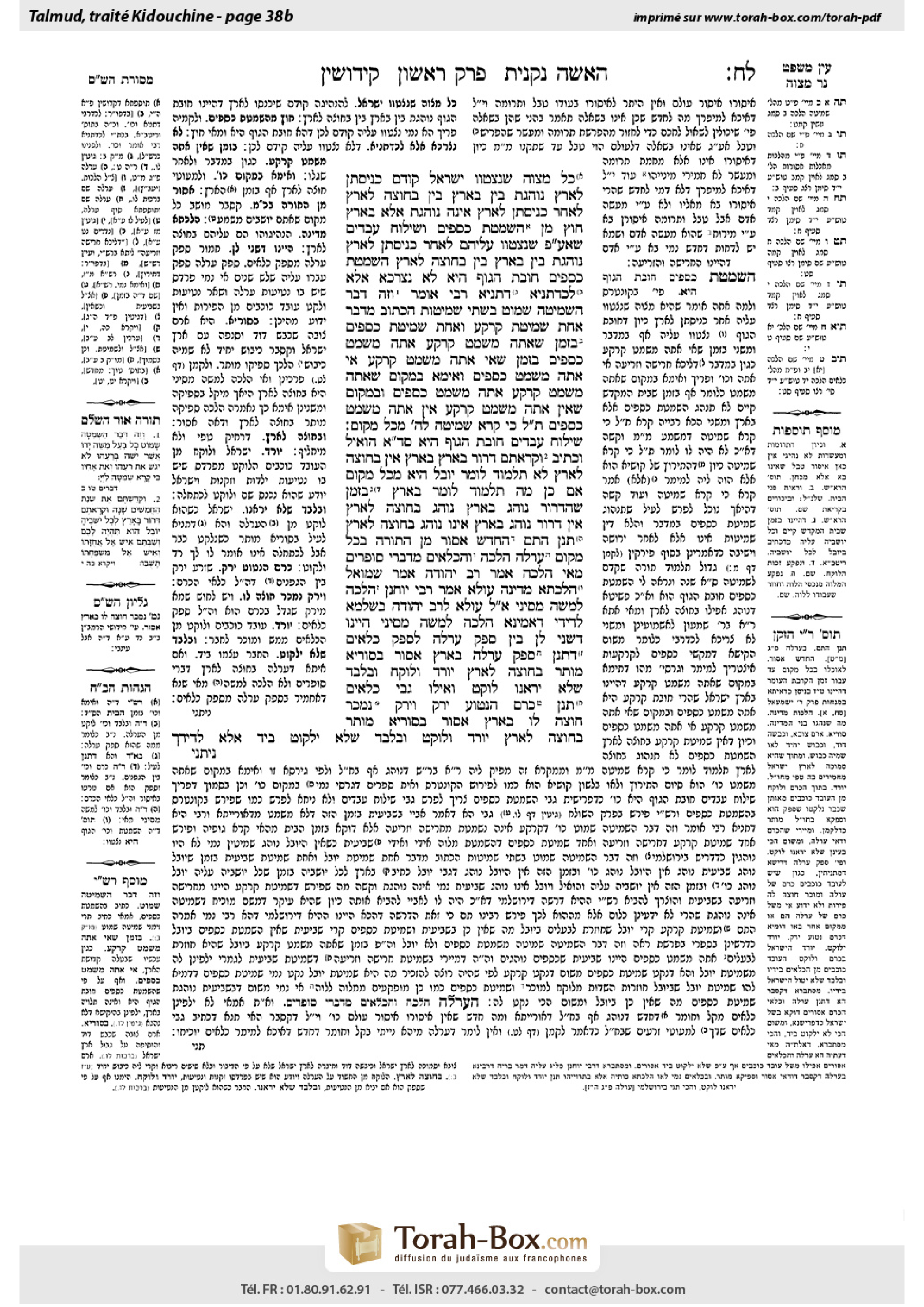
Kiddushin 38b: Talmud study for Daf Yomi
Daf Yomi is the daily study of one Talmud folio. Explore 37 tractates with scans, Hebrew text, Sefaria English and AI-generated French translations where annotated.
Passage selection and English or AI-generated French translation are available where the scan has annotations. Daf Study is independent of Torah-Box and Sefaria.
Browse Kiddushin · קידושין · All tractatesKiddushin 38b text and translations
This page of Kiddushin includes the Aramaic text, an English translation and an AI-generated French translation, alongside the scan above.
קידושין ל״ח ב · Aramaic and Hebrew text
כׇּל מִצְוָה שֶׁנִּצְטַוּוּ יִשְׂרָאֵל קוֹדֶם כְּנִיסָתָן לָאָרֶץ – נוֹהֶגֶת בֵּין בָּאָרֶץ בֵּין בְּחוּצָה לָאָרֶץ. לְאַחַר כְּנִיסָתָן לָאָרֶץ – אֵינָהּ נוֹהֶגֶת אֶלָּא בָּאָרֶץ, חוּץ מִן הַשְׁמָטַת כְּסָפִים וְשִׁילּוּחַ עֲבָדִים, שֶׁאַף עַל פִּי שֶׁנִּצְטַוּוּ עֲלֵיהֶם לְאַחַר כְּנִיסָתָן לָאָרֶץ – נוֹהֶגֶת בֵּין בָּאָרֶץ בֵּין בְּחוּצָה לָאָרֶץ.
הַשְׁמָטַת כְּסָפִים חוֹבַת הַגּוּף הִיא!
לֹא נִצְרְכָא אֶלָּא לְכִדְתַנְיָא. דְּתַנְיָא, רַבִּי אוֹמֵר: ״וְזֶה דְּבַר הַשְּׁמִטָּה שָׁמוֹט״ – בִּשְׁתֵּי שְׁמִיטוֹת הַכָּתוּב מְדַבֵּר: אַחַת שְׁמִיטַּת קַרְקַע, וְאַחַת שְׁמִיטַּת כְּסָפִים. בִּזְמַן שֶׁאַתָּה מְשַׁמֵּט קַרְקַע – אַתָּה מְשַׁמֵּט כְּסָפִים, בִּזְמַן שֶׁאִי אַתָּה מְשַׁמֵּט קַרְקַע – אִי אַתָּה מְשַׁמֵּט כְּסָפִים.
וְאֵימָא: בִּמְקוֹם שֶׁאַתָּה מְשַׁמֵּט קַרְקַע – אַתָּה מְשַׁמֵּט כְּסָפִים, וּבִמְקוֹם שֶׁאֵין אַתָּה מְשַׁמֵּט קַרְקַע – אֵין אַתָּה מְשַׁמֵּט כְּסָפִים! תַּלְמוּד לוֹמַר: ״כִּי קָרָא שְׁמִטָּה לַה׳״ מִכׇּל מָקוֹם.
שִׁילּוּחַ עֲבָדִים חוֹבַת הַגּוּף הִיא! סָלְקָא דַּעְתָּךְ אָמֵינָא: הוֹאִיל וּכְתִיב ״וּקְרָאתֶם דְּרוֹר בָּאָרֶץ״, בָּאָרֶץ – אִין, בְּחוּצָה לָאָרֶץ – לָא, תַּלְמוּד לוֹמַר: ״יוֹבֵל הִיא״ – מִכׇּל מָקוֹם.
אִם כֵּן מָה תַּלְמוּד לוֹמַר ״בָּאָרֶץ״? בִּזְמַן שֶׁהַדְּרוֹר נוֹהֵג בָּאָרֶץ – נוֹהֵג בְּחוּצָה לָאָרֶץ, אֵין דְּרוֹר נוֹהֵג בָּאָרֶץ – אֵינוֹ נוֹהֵג בְּחוּצָה לָאָרֶץ.
תְּנַן הָתָם: הֶחָדָשׁ אָסוּר מִן הַתּוֹרָה בְּכׇל מָקוֹם, עׇרְלָה הֲלָכָה, וְהַכִּלְאַיִם מִדִּבְרֵי סוֹפְרִים. מַאי הֲלָכָה? אָמַר רַב יְהוּדָה אָמַר שְׁמוּאֵל: הִלְכְתָא מְדִינָה. עוּלָּא אָמַר רַבִּי יוֹחָנָן: הֲלָכָה לְמֹשֶׁה מִסִּינַי.
אֲמַר לֵיהּ עוּלָּא לְרַב יְהוּדָה: בִּשְׁלָמָא לְדִידִי, דְּאָמֵינָא הֲלָכָה לְמֹשֶׁה מִסִּינַי – הַיְינוּ דְּשָׁנֵי לַן בֵּין סְפֵק עׇרְלָה לִסְפֵק כִּלְאַיִם.
דִּתְנַן: סְפֵק עׇרְלָה, בָּאָרֶץ – אָסוּר, בְּסוּרְיָא – מוּתָּר. בְּחוּצָה לָאָרֶץ יוֹרֵד וְלוֹקֵחַ, וּבִלְבַד שֶׁלֹּא יִרְאֶנּוּ לוֹקֵט.
וְאִילּוּ גַּבֵּי כִלְאַיִם תְּנַן: כֶּרֶם הַנָּטוּעַ יָרָק, וְיָרָק נִמְכָּר חוּצָה לוֹ, בָּאָרֶץ – אָסוּר, בְּסוּרְיָא – מוּתָּר,
בְּחוּצָה לָאָרֶץ – יוֹרֵד וְלוֹקֵט. וּבִלְבַד שֶׁלֹּא יִלְקוֹט בַּיָּד.
אֶלָּא לְדִידָךְ
Kiddushin 38b · English translation
Any mitzva that the Jewish people were commanded to perform before entering Eretz Yisrael, i.e., it was not linked to entry into the land, applies both in Eretz Yisrael and outside of Eretz Yisrael. Conversely, any mitzva that they were commanded to perform after they entered Eretz Yisrael applies only in Eretz Yisrael, except for the abrogation of monetary debts in the Sabbatical Year (see Deuteronomy 15:1–2), and the emancipation of slaves in the Jubilee Year (see Leviticus 25:39–41). Even though the Jews were commanded with regard to these mitzvot that they were to perform them only after their entry into Eretz Yisrael, these mitzvot apply both in Eretz Yisrael and outside of Eretz Yisrael.
The Gemara questions the need for this ruling: The abrogation of monetary debts is an obligation of the body. Since this mitzva is not referring to the land, what is the novelty of the ruling that it applies even outside of Eretz Yisrael?
The Gemara answers: It is necessary to mention the cancellation of debts only for that which is taught in a baraita. As it is taught in a baraita that Rabbi Yehuda HaNasi says: The verse states in the context of the cancellation of debts: “And this is the manner of the abrogation: He shall abrogate” (Deuteronomy 15:2). The verse speaks of two types of abrogation: One is the release of land and one is the abrogation of monetary debts. Since the two are juxtaposed, one can learn the following: At a time when you release land, when the Jubilee Year is practiced, you abrogate monetary debts; at a time when you do not release land, such as the present time, when the Jubilee Year is no longer practiced, you also do not abrogate monetary debts.
The Gemara asks: But why not say that one can learn the following from this juxtaposition: In a place where you release land, i.e., in Eretz Yisrael, you abrogate monetary debts, and in a place where you do not release land, you do not abrogate monetary debts. If so, the abrogation of debts would apply only in Eretz Yisrael, despite the fact that this obligation is not related to the land. Therefore, the verse states: “Because the Lord’s abrogation has been proclaimed” (Deuteronomy 15:2), to indicate that this obligation applies in any case, even outside of Eretz Yisrael. This is the novelty of the statement of Rabbi Elazar, son of Rabbi Shimon.
The Gemara questions the need for the second ruling of Rabbi Elazar, son of Rabbi Shimon: The emancipation of slaves is also an obligation of the body, not one that applies to the land. What is novel about this ruling? The Gemara answers that it might enter your mind to say: Since it is written: “And proclaim liberty throughout the land unto all the inhabitants thereof” (Leviticus 25:10), one could say: “Throughout the land,” yes, this mitzva applies, but outside of Eretz Yisrael, no, the emancipation does not take effect. Therefore the same verse also states the seemingly superfluous phrase: “It shall be a Jubilee” (Leviticus 25:10), to indicate that it applies in any case, in all places.
The Gemara asks: If so, what is the meaning when the verse states: “Throughout the land”? The Gemara answers that this phrase teaches: When the liberty of slaves applies in Eretz Yisrael, it also applies outside of Eretz Yisrael, and when the liberty of slaves does not apply in Eretz Yisrael, it does not apply outside of Eretz Yisrael. The mitzva depends on whether the Jubilee Year is in effect, not on the place in question.
We learned in a mishna there (Orla 3:9): The new crop is forbidden by Torah law everywhere; orla is forbidden outside of Eretz Yisrael according to a halakha, as the Gemara will immediately explain; and diverse kinds are forbidden outside the land by rabbinic law. The Gemara asks: What is this halakha, mentioned with regard to orla? Rav Yehuda says that Shmuel says: It is the local halakha, i.e., this was the practice of Jews in places where they settled. Ulla says that Rabbi Yoḥanan says: It is a halakha transmitted to Moses from Sinai.
Ulla said to Rav Yehuda: Granted, according to my opinion, as I say in the name of Rabbi Yoḥanan that the mishna means that this is a halakha transmitted to Moses from Sinai, this is the reason why we distinguish between fruit whose status as orla is uncertain, which is forbidden outside of Eretz Yisrael according to the halakha transmitted to Moses from Sinai, and produce whose status as diverse kinds is uncertain, which is permitted outside of Eretz Yisrael, as the prohibition of diverse kinds applies outside of Eretz Yisrael only by rabbinic law.
This is as we learned in a mishna (Orla 3:9): Fruit whose status as orla is uncertain is forbidden in Eretz Yisrael, and it is permitted in Syria with no concern about its uncertain status. Outside of Eretz Yisrael, a Jew may go down into the gentile’s field and purchase fruit that is orla from the gentile, provided that the Jew does not see him gather it.
Nevertheless, we learned in a mishna with regard to the halakhot of diverse kinds (Orla 3:9): If a vineyard has vegetables planted in it, and there are vegetables being sold outside the vineyard, but there is no proof that these vegetables came from the vineyard, in Eretz Yisrael they are forbidden. The reason is that as it is possible that the vegetables came from the vineyard, the halakha is stringent in a case involving a prohibition by Torah law. In Syria these vegetables are permitted.
Outside of Eretz Yisrael, if the gentile owner of a field containing diverse kinds goes down into his field and gathers produce, then, provided that the Jew does not gather it by hand, he may purchase the produce from the gentile. This indicates that outside of Eretz Yisrael there is a difference between orla of uncertain status and diverse kinds of uncertain status. This is understandable if orla is forbidden by a halakha transmitted to Moses from Sinai, while diverse kinds are forbidden by rabbinic law.
But according to your opinion, that neither orla nor diverse kinds is forbidden by Torah law,
Kiddushin 38b · Traduction française (IA)
Toute mitsva que le peuple juif a reçu l’ordre d’accomplir avant d’entrer en Eretz Yisrael, c’est-à-dire qui n’était pas liée à l’entrée dans le pays, s’applique aussi bien en Eretz Yisrael qu’en dehors d’Eretz Yisrael. À l’inverse, toute mitsva qu’il a reçu l’ordre d’accomplir après être entré en Eretz Yisrael ne s’applique qu’en Eretz Yisrael, à l’exception de l’annulation des dettes pécuniaires pendant l’année sabbatique (voir Deutéronome 15:1–2) et de l’affranchissement des esclaves pendant l’année du Jubilé (voir Lévitique 25:39–41). Bien que les Juifs aient reçu l’ordre d’accomplir ces mitsvot uniquement après leur entrée en Eretz Yisrael, elles s’appliquent aussi bien en Eretz Yisrael qu’en dehors d’Eretz Yisrael.
La Guemara s’interroge sur la nécessité de cette règle : l’annulation des dettes pécuniaires est une obligation qui incombe à la personne. Puisque cette mitsva ne concerne pas la terre, quelle nouveauté y a-t-il à enseigner qu’elle s’applique même en dehors d’Eretz Yisrael ?
La Guemara répond : il est nécessaire de mentionner l’annulation des dettes uniquement en raison de ce qui est enseigné dans une baraïta. En effet, une baraïta enseigne que Rabbi Yehouda HaNassi dit : le verset déclare, au sujet de l’annulation des dettes : « Voici la manière de l’annulation : il annulera » (Deutéronome 15:2). Le verset parle de deux types d’annulation : la libération des terres et l’annulation des dettes pécuniaires. Puisque ces deux notions sont rapprochées, on peut en déduire ce qui suit : lorsque les terres sont libérées, c’est-à-dire lorsque l’année du Jubilé est observée, on annule les dettes pécuniaires ; lorsque les terres ne sont pas libérées, comme à l’époque actuelle, où l’année du Jubilé n’est plus observée, on n’annule pas non plus les dettes pécuniaires.
La Guemara demande : Mais pourquoi ne pas déduire de ce rapprochement ce qui suit : là où les terres sont libérées, c’est-à-dire en Eretz Yisrael, on annule les dettes pécuniaires, et là où les terres ne sont pas libérées, on n’annule pas les dettes pécuniaires ? Dans ce cas, l’annulation des dettes ne s’appliquerait qu’en Eretz Yisrael, bien que cette obligation ne soit pas liée à la terre. Le verset déclare donc : « Car l’annulation de l’Éternel a été proclamée » (Deutéronome 15:2), pour indiquer que cette obligation s’applique quoi qu’il en soit, même en dehors d’Eretz Yisrael. Telle est la nouveauté de l’enseignement de Rabbi Elazar, fils de Rabbi Shimon.
La Guemara s’interroge sur la nécessité du second enseignement de Rabbi Elazar, fils de Rabbi Shimon : l’affranchissement des esclaves est lui aussi une obligation qui incombe à la personne, et non une obligation liée à la terre. Quelle est donc la nouveauté de cet enseignement ? La Guemara répond qu’on aurait pu penser : puisqu’il est écrit « et proclamez la liberté dans tout le pays pour tous ses habitants » (Lévitique 25:10), on aurait pu dire : « dans tout le pays », oui, cette mitsva s’applique, mais en dehors d’Eretz Yisrael, non, l’affranchissement ne prend pas effet. Le même verset énonce donc aussi l’expression apparemment superflue « ce sera un Jubilé » (Lévitique 25:10), pour indiquer que la mitsva s’applique quoi qu’il en soit, en tous lieux.
La Guemara demande : Si tel est le cas, que signifie l’expression « dans tout le pays » ? La Guemara répond que cette expression enseigne ceci : lorsque l’affranchissement des esclaves s’applique en Eretz Yisrael, il s’applique également en dehors d’Eretz Yisrael ; et lorsque l’affranchissement des esclaves ne s’applique pas en Eretz Yisrael, il ne s’applique pas non plus en dehors d’Eretz Yisrael. La mitsva dépend de l’application de l’année du Jubilé, et non du lieu considéré.
Nous avons appris dans une Michna, là-bas (Orla 3:9) : les produits de la nouvelle récolte sont interdits par la Torah partout ; l’orla est interdite en dehors d’Eretz Yisrael en vertu d’une halakha, comme la Guemara va l’expliquer immédiatement ; et les mélanges d’espèces sont interdits en dehors du pays par décret rabbinique. La Guemara demande : quelle est cette halakha mentionnée à propos de l’orla ? Rav Yehouda dit au nom de Shmuel : c’est une halakha locale, c’est-à-dire la pratique des Juifs dans les lieux où ils se sont établis. Oula dit au nom de Rabbi Yo’hanan : c’est une halakha transmise à Moïse au Sinaï.
Oula dit à Rav Yehouda : Selon mon opinion, puisque je dis au nom de Rabbi Yo’hanan que la Michna signifie qu’il s’agit d’une halakha transmise à Moïse au Sinaï, on comprend pourquoi on distingue les fruits dont le statut d’orla est incertain, qui sont interdits en dehors d’Eretz Yisrael en vertu de cette halakha transmise à Moïse au Sinaï, des produits dont le statut de mélanges d’espèces est incertain, qui sont permis en dehors d’Eretz Yisrael, puisque l’interdiction des mélanges d’espèces ne s’applique en dehors d’Eretz Yisrael qu’en vertu d’un décret rabbinique.
C’est ce que nous avons appris dans une Michna (Orla 3:9) : un fruit dont le statut d’orla est incertain est interdit en Eretz Yisrael, mais il est permis en Syrie, sans qu’il y ait lieu de tenir compte de l’incertitude. En dehors d’Eretz Yisrael, un Juif peut entrer dans le champ d’un non-Juif et lui acheter des fruits qui sont de l’orla, à condition de ne pas le voir les cueillir.
Néanmoins, nous avons appris dans une Michna, au sujet des halakhot des mélanges d’espèces (Orla 3:9) : si des légumes sont plantés dans un vignoble et que des légumes sont vendus à l’extérieur du vignoble, sans qu’il soit prouvé qu’ils en proviennent, ils sont interdits en Eretz Yisrael. En effet, puisqu’il est possible que les légumes proviennent du vignoble, la halakha se montre rigoureuse dans un cas relevant d’une interdiction de la Torah. En Syrie, ces légumes sont permis.
En dehors d’Eretz Yisrael, si le propriétaire non juif d’un champ contenant des mélanges d’espèces entre dans son champ et en récolte les produits, le Juif peut les lui acheter, à condition de ne pas les récolter lui-même à la main. Cela indique qu’en dehors d’Eretz Yisrael, il existe une différence entre l’orla au statut incertain et les mélanges d’espèces au statut incertain. Cela se comprend si l’orla est interdite en vertu d’une halakha transmise à Moïse au Sinaï, tandis que les mélanges d’espèces sont interdits par décret rabbinique.
Mais selon ton opinion, selon laquelle ni l’orla ni les mélanges d’espèces ne sont interdits par la Torah,
Traduction française générée par IA à partir de l’édition anglaise de Sefaria. Vérifie toujours un passage avec le texte source.
Text from Sefaria: William Davidson Edition - Vocalized Aramaic (CC BY NC); William Davidson Edition - English (CC BY NC).