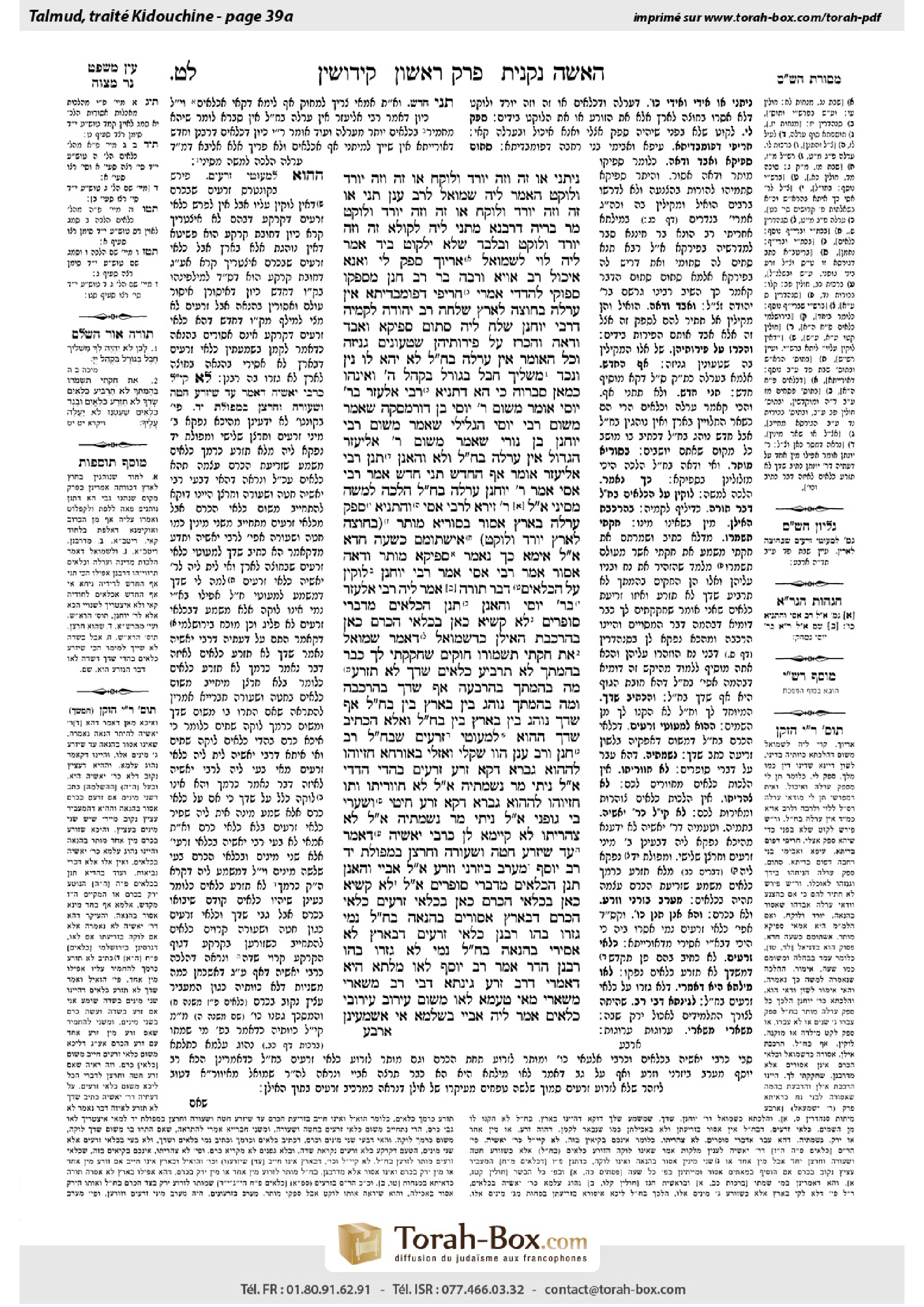
Kiddushin 39a: Talmud study for Daf Yomi
Daf Yomi is the daily study of one Talmud folio. Explore 37 tractates with scans, Hebrew text, Sefaria English and AI-generated French translations where annotated.
Passage selection and English or AI-generated French translation are available where the scan has annotations. Daf Study is independent of Torah-Box and Sefaria.
Browse Kiddushin · קידושין · All tractatesKiddushin 39a text and translations
This page of Kiddushin includes the Aramaic text, an English translation and an AI-generated French translation, alongside the scan above.
קידושין ל״ט א · Aramaic and Hebrew text
נִיתְנֵי אוֹ: ״זֶה וָזֶה יוֹרֵד וְלוֹקֵחַ״, אוֹ: ״זֶה וָזֶה יוֹרֵד וְלוֹקֵט״! הָאָמַר לֵיהּ שְׁמוּאֵל לְרַב עָנָן: תְּנִי אוֹ: ״זֶה וָזֶה יוֹרֵד וְלוֹקֵחַ״ אוֹ: ״זֶה וָזֶה יוֹרֵד וְלוֹקֵט״. מָר בְּרֵיהּ דְּרַבְנָא מַתְנֵי לֵיהּ לְקוּלָּא: ״זֶה וָזֶה יוֹרֵד וְלוֹקֵט, וּבִלְבַד שֶׁלֹּא יִלְקוֹט בַּיָּד״.
אֲמַר לֵיהּ לֵוִי לִשְׁמוּאֵל: אַרְיוֹךְ, סַפֵּק לִי, וַאֲנָא אֵיכוֹל. רַב אַוְיָא וְרַבָּה בַּר רַב חָנָן מְסַפְּקוּ סַפּוֹקֵי לַהֲדָדֵי. אָמְרִי חֲרִיפֵי דְפוּמְבְּדִיתָא: אֵין עׇרְלָה בְּחוּצָה לָאָרֶץ.
שַׁלְחַהּ רַב יְהוּדָה לְקַמֵּיהּ דְּרַבִּי יוֹחָנָן. שְׁלַח לֵיהּ: סְתוֹם סְפֵיקָהּ, וְאַבֵּד וַדָּאַהּ, וְהַכְרֵז עַל פֵּירוֹתֵיהֶן שֶׁטְּעוּנִים גְּנִיזָה. וְכׇל הָאוֹמֵר אֵין עׇרְלָה בְּחוּצָה לָאָרֶץ – לֹא יְהֵא לוֹ נִין וָנֶכֶד, ״מַשְׁלִיךְ חֶבֶל בְּגוֹרָל בִּקְהַל ה׳״.
וְאִינְהוּ כְּמַאן סַבְרוּהָ? כִּי הָא דְּתַנְיָא: רַבִּי אֶלְעָזָר בְּרַבִּי יוֹסֵי אוֹמֵר מִשּׁוּם רַבִּי יוֹסֵי בֶּן דּוֹרְמַסְקִית, שֶׁאָמַר מִשּׁוּם רַבִּי יוֹסֵי הַגְּלִילִי, שֶׁאָמַר מִשּׁוּם רַבִּי יוֹחָנָן בֶּן נוּרִי, שֶׁאָמַר מִשּׁוּם רַבִּי אֱלִיעֶזֶר הַגָּדוֹל: אֵין עׇרְלָה בְּחוּצָה לָאָרֶץ.
וְלָא? וְהָאֲנַן תְּנַן רַבִּי אֱלִיעֶזֶר אוֹמֵר: אַף הֶחָדָשׁ! תְּנִי: ״חָדָשׁ״.
אָמַר רַבִּי אַסִּי אָמַר רַבִּי יוֹחָנָן: עׇרְלָה בְּחוּצָה לָאָרֶץ הֲלָכָה לְמֹשֶׁה מִסִּינַי. אֲמַר לֵיהּ רַבִּי זֵירָא לְרַבִּי אַסִּי: וְהָתַנְיָא: סְפֵק עׇרְלָה בָּאָרֶץ – אָסוּר, בְּסוּרְיָא – מוּתָּר, בְּחוּצָה לָאָרֶץ – יוֹרֵד וְלוֹקֵט! ״אֶשְׁתּוֹמַם כְּשָׁעָה חֲדָה״ אֲמַר לֵיהּ: אֵימָא כָּךְ נֶאֶמְרָה: סְפֵיקָהּ מוּתָּר, וַדָּאָהּ אָסוּר.
אָמַר רַבִּי אַסִּי אָמַר רַבִּי יוֹחָנָן: לוֹקִין עַל הַכִּלְאַיִם דְּבַר תּוֹרָה. אֲמַר לֵיהּ רַבִּי אֶלְעָזָר בְּרַבִּי יוֹסֵי: וְהָאֲנַן תְּנַן: הַכִּלְאַיִם מִדִּבְרֵי סוֹפְרִים! לָא קַשְׁיָא, כָּאן בְּכִלְאֵי הַכֶּרֶם, כָּאן בְּהַרְכָּבַת הָאִילָן.
כְּדִשְׁמוּאֵל, דְּאָמַר שְׁמוּאֵל: ״אֶת חֻקֹּתַי תִּשְׁמֹרוּ״ – חוּקִּים שֶׁחָקַקְתִּי לְךָ כְּבָר, ״בְּהֶמְתְּךָ לֹא תַרְבִּיעַ כִּלְאַיִם שָׂדְךָ לֹא תִזְרַע״
– מָה בְּהֶמְתְּךָ בְּהַרְבָּעָה, אַף שָׂדְךָ בְּהַרְכָּבָה. וּמָה בְּהֶמְתְּךָ נוֹהֵג בֵּין בָּאָרֶץ בֵּין בְּחוּצָה לָאָרֶץ, אַף שָׂדְךָ נוֹהֵג בֵּין בָּאָרֶץ בֵּין בְּחוּצָה לָאָרֶץ.
וְאֶלָּא הָכְתִיב: ״שָׂדְךָ״! הָהוּא לְמַעוֹטֵי זְרָעִים שֶׁבְּחוּצָה לָאָרֶץ.
רַב חָנָן וְרַב עָנָן הֲווֹ שָׁקְלִי וְאָזְלִי בְּאוֹרְחָא. חַזְיוּהּ לְהָהוּא גַּבְרָא דְּקָא זָרַע זְרָעִים בַּהֲדֵי הֲדָדֵי. אֲמַר לֵיהּ: נֵיתֵי מָר נְשַׁמְּתֵיהּ. אֲמַר לֵיהּ: לָא חָוְורִיתוּ.
וְתוּ, חַזְיוּהּ לְהָהוּא גַּבְרָא דְּקָא זָרַע חִטֵּי וּשְׂעָרֵי בֵּי גוּפְנֵי. אֲמַר לֵיהּ: נֵיתֵי מָר נְשַׁמְּתֵיהּ. אֲמַר לֵיהּ: לָא צָהֲרִיתוּ, לָא קַיְימָא לַן כְּרַבִּי יֹאשִׁיָּה דְּאָמַר: עַד שֶׁיִּזְרַע חִטָּה וּשְׂעוֹרָה וְחַרְצָן בְּמַפּוֹלֶת יָד?!
רַב יוֹסֵף מְעָרֵב בִּיזְרָנֵי וְזָרַע. אֲמַר לֵיהּ אַבָּיֵי: וְהָאֲנַן תְּנַן: הַכִּלְאַיִם מִדִּבְרֵי סוֹפְרִים! אֲמַר לֵיהּ: לָא קַשְׁיָא, כָּאן בְּכִלְאֵי הַכֶּרֶם, כָּאן בְּכִלְאֵי זְרָעִים. כִּלְאֵי הַכֶּרֶם דְּבָאָרֶץ אֲסוּרִים בַּהֲנָאָה – בְּחוּצָה לָאָרֶץ נָמֵי גְּזַרוּ בְּהוּ רַבָּנַן. כִּלְאֵי זְרָעִים דְּבָאָרֶץ לָא אֲסִירִי בַּהֲנָאָה – בְּחוּצָה לָאָרֶץ נָמֵי לָא גְּזַרוּ בְּהוּ רַבָּנַן.
הֲדַר אָמַר רַב יוֹסֵף: לָאו מִלְּתָא הִיא דְּאָמְרִי, דְּרַב זָרַע גִּינְּתָא דְּבֵי רַב מְשָׁארֵי מְשָׁארֵי, מַאי טַעְמָא – לָאו מִשּׁוּם עֵירוּב עֵירוּבֵי כִלְאַיִם? אָמַר לֵיהּ אַבָּיֵי: בִּשְׁלָמָא אִי אַשְׁמְעִינַן
Kiddushin 39a · English translation
let the mishna teach in the same manner in both cases, either by stating in both this case and that case that one may go down and purchase the produce, or by stating in both this case and that case that one may go down and gather the produce. The Gemara answers: Didn’t Shmuel say to Rav Anan that one should teach it either as stating in both this case and that case that one may go down and purchase the produce, or in both this case and that case that one may go down and gather the produce? Mar, son of Rabbana, taught this mishna according to the following lenient version: In both this case and that case one may go down and gather the produce, provided that he does not gather it with his own hand.
§ With regard to the prohibition of orla outside of Eretz Yisrael, the Gemara relates that Levi said to Shmuel: Aryokh, Shmuel’s nickname, supply me with such food, as I will not pick it on my own, and if you do so I will eat it. There is no reason for concern with regard to orla outside of Eretz Yisrael. Rav Avya and Rabba bar Rav Ḥanan would supply produce whose orla status was uncertain for each other, as it is forbidden only if one takes the orla on his own. The sharp Sages of Pumbedita said: The prohibition of orla does not apply at all outside of Eretz Yisrael.
Rav Yehuda sent a question to Rabbi Yoḥanan concerning the halakha with regard to orla outside of Eretz Yisrael. Rabbi Yoḥanan sent him the following response: Conceal, i.e., do not publicize, the halakha that produce whose orla status is uncertain is permitted; and destroy, i.e., prohibit entirely, produce whose orla status is certain; and with regard to the produce of those who are lenient in this halakha, declare that it requires interment, as it is prohibited to derive benefit from such produce. And whoever says that there is no prohibition of orla outside of Eretz Yisrael will have neither a child nor a grandchild “who shall cast the line by lot in the congregation of the Lord” (Micah 2:5).
The Gemara asks: And in accordance with whose opinion do the sharp Sages of Pumbedita hold when they state this halakha? The Gemara answers: They hold in accordance with that which is taught in a baraita: Rabbi Elazar, son of Rabbi Yosei, says in the name of Rabbi Yosei ben Durmaska, who said in the name of Rabbi Yosei HaGelili, who said in the name of Rabbi Yoḥanan ben Nuri, who said in the name of Rabbi Eliezer the Great: The prohibition of orla does not apply outside of Eretz Yisrael.
The Gemara expresses surprise at this ruling: But does it not apply? Does Rabbi Eliezer maintain that the prohibition of orla does not apply outside of Eretz Yisrael? But didn’t we learn in the mishna that Rabbi Eliezer says: Even the new crop, which indicates that he agrees that orla and diverse kinds are forbidden outside of Eretz Yisrael? The Gemara answers that one should not teach that Rabbi Eliezer said: Even the new crop, but rather teach only the words: The new crop, i.e., Rabbi Eliezer maintains that only this prohibition applies outside of Eretz Yisrael.
Rabbi Asi says that Rabbi Yoḥanan says: Orla is forbidden outside of Eretz Yisrael by a halakha transmitted to Moses from Sinai. Rabbi Zeira said to Rabbi Asi: But isn’t it taught in a baraita: With regard to produce whose status concerning orla is uncertain, in Eretz Yisrael it is forbidden, in Syria it is permitted, and outside of Eretz Yisrael one goes down and gathers it? And if orla is forbidden outside of Eretz Yisrael by a halakha transmitted to Moses from Sinai, why is produce whose status concerning orla is uncertain permitted in Syria? Rabbi Zeira “was dismayed for a while” (Daniel 4:16), and then Rabbi Asi said to him: Say that it is stated like this, i.e., explain that the halakha transmitted to Moses from Sinai was that outside of Eretz Yisrael produce whose status concerning orla is uncertain is permitted, and produce whose status concerning orla is certain is forbidden.
§ Rabbi Asi says that Rabbi Yoḥanan says: Offenders are flogged for transgressing the prohibition of diverse kinds outside of Eretz Yisrael by Torah law. Rabbi Elazar, son of Rabbi Yosei, said to him: But didn’t we learn in the mishna (Orla 3:9) that the prohibition of diverse kinds applies by rabbinic law outside of Eretz Yisrael? The Gemara answers: This is not difficult. The mishna here is referring to diverse kinds in a vineyard, which is prohibited outside of Eretz Yisrael by rabbinic law, whereas there, Rabbi Yoḥanan’s statement is referring to the grafting of a tree onto a different species.
The Gemara adds that this halakha is in accordance with the opinion of Shmuel. As Shmuel says: The verse states: “You shall keep My statutes” (Leviticus 19:19), which means that one must keep even the statutes that I have already instituted for you when you were merely descendants of Noah, before the giving of the Torah. Shmuel elaborates: This is referring to the prohibitions stated in that same verse: “You shall not let your cattle gender with a diverse kind; you shall not sow your field with two kinds of seed” (Leviticus 19:19).
Additionally, the juxtaposition of these prohibitions teaches that just as the prohibition of diverse kinds stated with regard to your animal applies only to mating one species with another, so too, the prohibition of diverse kinds with regard to your field is referring only to grafting one type of tree to another type, and it does not apply to planting two species together. Furthermore, just as the prohibition of diverse kinds with regard to your animal applies both in Eretz Yisrael and outside of Eretz Yisrael, as this prohibition does not relate to the land, so too, the prohibition against grafting your field applies both in Eretz Yisrael and outside of Eretz Yisrael.
The Gemara asks: But isn’t it written: “Your field,” which indicates that the field belongs to you in your portion of Eretz Yisrael? The Gemara answers: That verse serves to exclude the prohibition of diverse kinds of seeds, which does not apply outside of Eretz Yisrael. Planting different types of seeds together is prohibited only in Eretz Yisrael.
§ The Gemara relates: Rav Ḥanan and Rav Anan were once going together on a road outside of Eretz Yisrael and they saw a certain man planting seeds of diverse kinds together. One of them said to the other: Let the Master come and ostracize him, as he is performing a prohibited act. The other said to him: These halakhot are not understood by you.
And furthermore, they also saw a certain man who was planting wheat and barley between grapevines. One of them said to the other: Let the Master come and ostracize him. He again said to him: These halakhot are not clear to you. He explained: Don’t we hold in accordance with the opinion of Rabbi Yoshiya, who says: One who sows diverse kinds is not liable by Torah law until he sows wheat, and barley, and a grape seed with a single hand motion, i.e., by sowing in the vineyard he violates the prohibition of diverse kinds that applies to seeds and to the vineyard simultaneously. Since this man was not planting in that manner, he should not be ostracized.
The Gemara relates: Rav Yosef was mixing diverse seeds and planting them. Abaye said to him: But didn’t we learn in the mishna that mixing diverse kinds is prohibited outside of Eretz Yisrael by rabbinic law? Rav Yosef said to him: This is not difficult, as here, the mishna is referring to diverse kinds in a vineyard, and there, I am planting legally because I am planting only diverse kinds of seeds. The reason for the difference between these two cases is as follows: With regard to planting diverse kinds in a vineyard, which in Eretz Yisrael is prohibited even with regard to deriving benefit, the Sages issued a decree prohibiting this mixture outside of Eretz Yisrael as well. Conversely, with regard to planting diverse kinds of seeds, which in Eretz Yisrael is not prohibited with regard to deriving benefit, the Sages did not issue a decree prohibiting them outside of Eretz Yisrael.
Rav Yosef then said: The matter that I said, i.e., that diverse kinds of seeds are entirely permitted outside of Eretz Yisrael, is not so. The proof is that Rav planted the garden around the study hall in rows [mesharei] of different species. What is the reason that he did that rather than plant different species together? Is it not because he was concerned about mixtures of diverse kinds? Abaye said to him: That is not proof. Granted, if he taught us this halakha through his actions,
Kiddushin 39a · Traduction française (IA)
Que la Michna enseigne de la même manière dans les deux cas : soit qu’on peut descendre et acheter les fruits, soit qu’on peut descendre et les cueillir. La Guemara répond : Shmuel n’a-t-il pas dit à Rav Anan qu’il fallait l’enseigner soit en disant, dans les deux cas, qu’on peut descendre et acheter les fruits, soit en disant, dans les deux cas, qu’on peut descendre et les cueillir ? Mar, fils de Rabbana, enseignait cette Michna selon la version indulgente suivante : dans les deux cas, on peut descendre et cueillir les fruits, à condition de ne pas les cueillir de sa propre main.
§ À propos de l’interdiction de l’orla en dehors de la Terre d’Israël, la Guemara rapporte que Levi dit à Shmuel : « Aryokh », surnom de Shmuel, procure-moi de tels fruits ; je ne les cueillerai pas moi-même, et si tu le fais, j’en mangerai. Il n’y a pas lieu de s’inquiéter de l’orla en dehors de la Terre d’Israël. Rav Avya et Rabba bar Rav Ḥanan se procuraient l’un pour l’autre des fruits dont le statut d’orla était incertain, car l’interdiction ne s’applique que si l’on cueille soi-même les fruits d’orla. Les Sages avisés de Pumbedita dirent : l’interdiction de l’orla ne s’applique pas du tout en dehors de la Terre d’Israël.
Rav Yehuda adressa une question à Rabbi Yoḥanan concernant la halakha relative à l’orla en dehors de la Terre d’Israël. Rabbi Yoḥanan lui répondit : « Cache », c’est-à-dire ne divulgue pas, la halakha selon laquelle les fruits dont le statut d’orla est incertain sont permis ; « détruis », c’est-à-dire interdis entièrement, les fruits dont le statut d’orla est certain ; et, au sujet des fruits de ceux qui se montrent indulgents à l’égard de cette halakha, déclare qu’ils doivent être enterrés, car il est interdit d’en tirer profit. Quiconque affirme que l’interdiction de l’orla ne s’applique pas en dehors de la Terre d’Israël n’aura ni fils ni petit-fils « qui tirera au sort une part dans l’assemblée du Seigneur » (Michée 2:5).
La Guemara demande : De l’avis de qui les Sages avisés de Pumbedita tiennent-ils cette halakha ? La Guemara répond : Ils se conforment à ce qui est enseigné dans une baraïta : Rabbi Elazar, fils de Rabbi Yosei, dit au nom de Rabbi Yosei ben Durmaska, qui l’a dit au nom de Rabbi Yosei HaGelili, qui l’a dit au nom de Rabbi Yoḥanan ben Nuri, qui l’a dit au nom de Rabbi Eliezer le Grand : l’interdiction de l’orla ne s’applique pas en dehors de la Terre d’Israël.
La Guemara s’étonne de cette décision : Mais ne s’y applique-t-elle pas ? Rabbi Eliezer soutient-il que l’interdiction de l’orla ne s’applique pas en dehors de la Terre d’Israël ? Pourtant, n’avons-nous pas appris dans la Michna que Rabbi Eliezer dit : « Même la nouvelle récolte », ce qui indique qu’il reconnaît que l’orla et les mélanges interdits sont interdits en dehors de la Terre d’Israël ? La Guemara répond qu’il ne faut pas enseigner que Rabbi Eliezer a dit : « Même la nouvelle récolte », mais seulement : « La nouvelle récolte », c’est-à-dire que, selon Rabbi Eliezer, seule cette interdiction s’applique en dehors de la Terre d’Israël.
Rabbi Asi dit au nom de Rabbi Yoḥanan : l’orla est interdite en dehors de la Terre d’Israël en vertu d’une halakha transmise à Moïse au Sinaï. Rabbi Zeira dit à Rabbi Asi : Pourtant, n’est-il pas enseigné dans une baraïta qu’au sujet des fruits dont le statut d’orla est incertain, ils sont interdits en Terre d’Israël, permis en Syrie et, en dehors de la Terre d’Israël, on descend et on les cueille ? Si l’orla est interdite en dehors de la Terre d’Israël en vertu d’une halakha transmise à Moïse au Sinaï, pourquoi les fruits dont le statut d’orla est incertain sont-ils permis en Syrie ? Rabbi Zeira « fut stupéfait pendant un moment » (Daniel 4:16), puis Rabbi Asi lui dit : « Dis que c’est formulé ainsi », c’est-à-dire explique que la halakha transmise à Moïse au Sinaï établit qu’en dehors de la Terre d’Israël, les fruits dont le statut d’orla est incertain sont permis, tandis que ceux dont le statut d’orla est certain sont interdits.
§ Rabbi Asi dit au nom de Rabbi Yoḥanan : ceux qui transgressent l’interdiction des mélanges interdits en dehors de la Terre d’Israël sont passibles de la flagellation selon la Torah. Rabbi Elazar, fils de Rabbi Yosei, lui dit : Pourtant, n’avons-nous pas appris dans la Michna (Orla 3:9) que l’interdiction des mélanges interdits s’applique en dehors de la Terre d’Israël selon la loi rabbinique ? La Guemara répond : Il n’y a pas de difficulté. La Michna ici parle des mélanges interdits dans une vigne, qui sont interdits en dehors de la Terre d’Israël par la loi rabbinique, tandis que la déclaration de Rabbi Yoḥanan concerne la greffe d’un arbre sur une espèce différente.
La Guemara ajoute que cette halakha est conforme à l’opinion de Shmuel. En effet, Shmuel dit : le verset « Vous observerez Mes statuts » (Lévitique 19:19) signifie qu’il faut observer même les statuts que J’avais déjà institués pour vous lorsque vous n’étiez que des descendants de Noé, avant le don de la Torah. Shmuel précise que cela concerne les interdictions énoncées dans ce même verset : « Tu ne feras pas accoupler ton bétail avec une espèce différente ; tu n’ensemenceras pas ton champ de deux sortes de semences » (Lévitique 19:19).
De plus, le rapprochement de ces interdictions enseigne que, de même que l’interdiction des mélanges concernant ton animal ne s’applique qu’à l’accouplement d’une espèce avec une autre, de même, l’interdiction des mélanges concernant ton champ vise uniquement la greffe d’une sorte d’arbre sur une autre et ne s’applique pas à la plantation de deux espèces ensemble. En outre, de même que l’interdiction des mélanges concernant ton animal s’applique aussi bien en Terre d’Israël qu’en dehors de celle-ci, puisque cette interdiction n’est pas liée à la terre, de même, l’interdiction de greffer ton champ s’applique aussi bien en Terre d’Israël qu’en dehors de celle-ci.
La Guemara demande : Pourtant, n’est-il pas écrit « ton champ », ce qui indique qu’il s’agit d’un champ situé dans la part qui t’appartient en Terre d’Israël ? La Guemara répond : Ce verset sert à exclure l’interdiction des mélanges de semences, qui ne s’applique pas en dehors de la Terre d’Israël. La plantation de différentes sortes de semences ensemble n’est interdite qu’en Terre d’Israël.
§ La Guemara rapporte : Rav Ḥanan et Rav Anan voyageaient un jour ensemble sur une route en dehors de la Terre d’Israël et virent un homme qui semait différentes espèces ensemble. L’un dit à l’autre : « Que le Maître vienne l’excommunier, puisqu’il commet un acte interdit. » L’autre lui dit : « Tu ne comprends pas ces halakhot. »
De plus, ils virent également un homme qui semait du blé et de l’orge entre des vignes. L’un dit à l’autre : « Que le Maître vienne l’excommunier. » L’autre lui dit de nouveau : « Ces halakhot ne te sont pas claires. » Il expliqua : Ne sommes-nous pas d’avis comme Rabbi Yoshiya, qui dit : celui qui sème des espèces différentes n’est passible de la sanction prévue par la Torah que s’il sème du blé, de l’orge et un pépin de raisin d’un seul geste, c’est-à-dire en semant dans la vigne, il transgresse simultanément l’interdiction des mélanges de semences et celle qui s’applique à la vigne ? Puisque cet homme ne semait pas de cette manière, il ne fallait pas l’excommunier.
La Guemara rapporte : Rav Yosef mélangeait des semences de différentes espèces et les plantait. Abaye lui dit : Pourtant, n’avons-nous pas appris dans la Michna que les mélanges interdits sont prohibés en dehors de la Terre d’Israël par la loi rabbinique ? Rav Yosef lui répondit : Il n’y a pas de difficulté : la Michna parle ici des mélanges interdits dans une vigne, tandis que moi, je plante conformément à la halakha, car je ne plante que des mélanges de semences. La différence entre ces deux cas s’explique ainsi : la plantation de mélanges interdits dans une vigne, qui en Terre d’Israël est interdite même quant au profit qu’on peut en tirer, a fait l’objet d’un décret des Sages interdisant également ce mélange en dehors de la Terre d’Israël. En revanche, pour la plantation de mélanges de semences, qui en Terre d’Israël n’est pas interdite quant au profit qu’on peut en tirer, les Sages n’ont pas décrété qu’elle serait interdite en dehors de la Terre d’Israël.
Rav Yosef dit alors : Ce que j’ai dit, à savoir que les mélanges de semences sont entièrement permis en dehors de la Terre d’Israël, n’est pas exact. La preuve en est que Rav planta le jardin autour de la salle d’étude en rangées [mesharei] de différentes espèces. Pourquoi fit-il cela au lieu de planter différentes espèces ensemble ? N’est-ce pas parce qu’il se souciait des mélanges interdits ? Abaye lui dit : Cela ne constitue pas une preuve. Certes, s’il nous avait enseigné cette halakha par ses actes,
Traduction française générée par IA à partir de l’édition anglaise de Sefaria. Vérifie toujours un passage avec le texte source.
Text from Sefaria: William Davidson Edition - Vocalized Aramaic (CC BY NC); William Davidson Edition - English (CC BY NC).