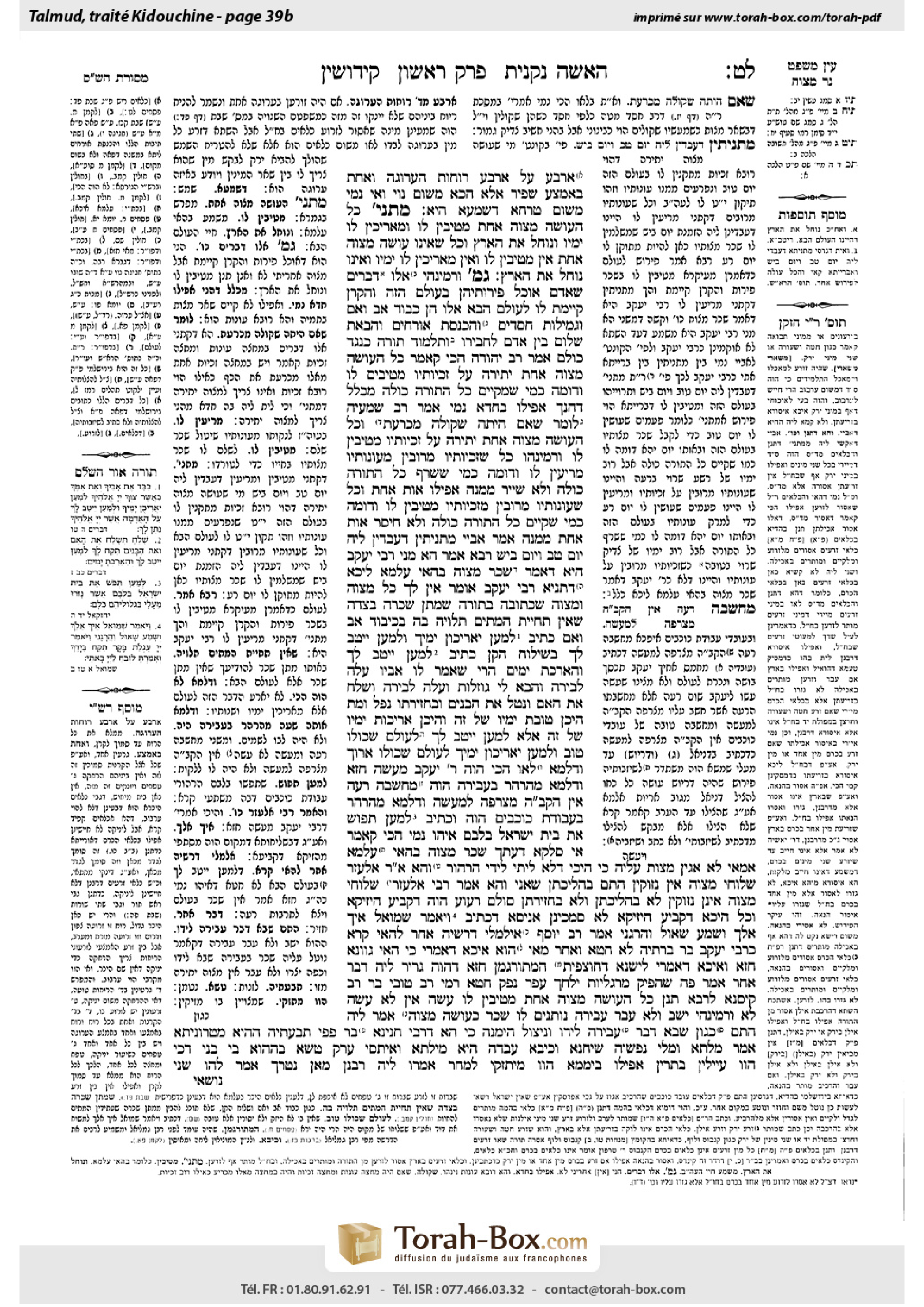
Kiddushin 39b: Talmud study for Daf Yomi
Daf Yomi is the daily study of one Talmud folio. Explore 37 tractates with scans, Hebrew text, Sefaria English and AI-generated French translations where annotated.
Passage selection and English or AI-generated French translation are available where the scan has annotations. Daf Study is independent of Torah-Box and Sefaria.
Browse Kiddushin · קידושין · All tractatesKiddushin 39b text and translations
This page of Kiddushin includes the Aramaic text, an English translation and an AI-generated French translation, alongside the scan above.
קידושין ל״ט ב · Aramaic and Hebrew text
אַרְבַּע עַל אַרְבַּע רוּחוֹת הָעֲרוּגָה וְאַחַת בָּאֶמְצַע – שַׁפִּיר. אֶלָּא הָכָא, מִשּׁוּם נוֹי. וְאִי נָמֵי מִשּׁוּם טִרְחָא דְּשַׁמָּעָא הִיא.
מַתְנִי׳ כׇּל הָעוֹשֶׂה מִצְוָה אַחַת – מְטִיבִין לוֹ, וּמַאֲרִיכִין לוֹ יָמָיו, וְנוֹחֵל אֶת הָאָרֶץ. וְכֹל שֶׁאֵינוֹ עוֹשֶׂה מִצְוָה אַחַת – אֵין מְטִיבִין לוֹ, וְאֵין מַאֲרִיכִין לוֹ יָמָיו, וְאֵינוֹ נוֹחֵל אֶת הָאָרֶץ.
גְּמָ׳ וּרְמִינְהִי: אֵלּוּ דְּבָרִים שֶׁאָדָם אוֹכֵל פֵּירוֹתֵיהֶן בָּעוֹלָם הַזֶּה וְהַקֶּרֶן קַיֶּימֶת לוֹ לָעוֹלָם הַבָּא, אֵלּוּ הֵן: כִּבּוּד אָב וָאֵם, וּגְמִילוּת חֲסָדִים, וְהַכְנָסַת אוֹרְחִים, וַהֲבָאַת שָׁלוֹם בֵּין אָדָם לַחֲבֵירוֹ, וְתַלְמוּד תּוֹרָה כְּנֶגֶד כּוּלָּם.
אָמַר רַב יְהוּדָה: הָכִי קָאָמַר: כׇּל הָעוֹשֶׂה מִצְוָה אַחַת יְתֵירָה עַל זְכִיּוֹתָיו מְטִיבִים לוֹ, וְדוֹמֶה כְּמִי שֶׁמְּקַיֵּים כׇּל הַתּוֹרָה כּוּלָּהּ. מִכְּלָל דְּהָנָךְ אֲפִילּוּ בַּחֲדָא נָמֵי? אָמַר רַב שְׁמַעְיָה: לוֹמַר שֶׁאִם הָיְתָה שְׁקוּלָה – מַכְרַעַת.
וְכׇל הָעוֹשֶׂה מִצְוָה אַחַת יְתֵירָה עַל זְכִיּוֹתָיו מְטִיבִין לוֹ? וּרְמִינְהוּ: כֹּל שֶׁזְּכִיּוֹתָיו מְרוּבִּין מֵעֲוֹנוֹתָיו – מְרִיעִין לוֹ, וְדוֹמֶה כְּמִי שֶׁשָּׂרַף כׇּל הַתּוֹרָה כּוּלָּהּ וְלֹא שִׁיֵּיר מִמֶּנָּה אֲפִילּוּ אוֹת אַחַת. וְכֹל שֶׁעֲוֹנוֹתָיו מְרוּבִּין מִזְּכִיּוֹתָיו – מְטִיבִין לוֹ, וְדוֹמֶה כְּמִי שֶׁקִּיֵּים כׇּל הַתּוֹרָה כּוּלָּהּ וְלֹא חִיסֵּר אוֹת אַחַת מִמֶּנָּה!
אָמַר אַבָּיֵי: מַתְנִיתִין דְּעָבְדִין לֵיהּ יוֹם טָב וָיוֹם בִּישׁ. רָבָא אָמַר: הָא מַנִּי – רַבִּי יַעֲקֹב הִיא, דְּאָמַר: שְׂכַר מִצְוָה בְּהַאי עָלְמָא לֵיכָּא.
דְּתַנְיָא, רַבִּי יַעֲקֹב אוֹמֵר: אֵין לָךְ כׇּל מִצְוָה וּמִצְוָה שֶׁכְּתוּבָה בַּתּוֹרָה שֶׁמַּתַּן שְׂכָרָהּ בְּצִדָּהּ שֶׁאֵין תְּחִיַּית הַמֵּתִים תְּלוּיָה בָּהּ. בְּכִיבּוּד אָב וָאֵם כְּתִיב: ״לְמַעַן יַאֲרִיכֻן יָמֶיךָ וּלְמַעַן יִיטַב לָךְ״, בְּשִׁילּוּחַ הַקֵּן כְּתִיב: ״לְמַעַן יִיטַב לָךְ וְהַאֲרַכְתָּ יָמִים״.
הֲרֵי שֶׁאָמַר לוֹ אָבִיו: עֲלֵה לַבִּירָה וְהָבֵא לִי גּוֹזָלוֹת, וְעָלָה לַבִּירָה וְשִׁלַּח אֶת הָאֵם וְנָטַל אֶת הַבָּנִים וּבַחֲזִירָתוֹ נָפַל וָמֵת – הֵיכָן טוֹבַת יָמָיו שֶׁל זֶה, וְהֵיכָן אֲרִיכוּת יָמָיו שֶׁל זֶה? אֶלָּא: ״לְמַעַן יִיטַב לָךְ״ – לְעוֹלָם שֶׁכּוּלּוֹ טוֹב, ״וּלְמַעַן יַאֲרִיכֻן יָמֶיךָ״ – לְעוֹלָם שֶׁכּוּלּוֹ אָרוֹךְ.
וְדִלְמָא לָאו הָכִי הֲוָה? רַבִּי יַעֲקֹב מַעֲשֶׂה חֲזָא. וְדִלְמָא מְהַרְהֵר בַּעֲבֵירָה הֲוָה? מַחְשָׁבָה רָעָה אֵין הַקָּדוֹשׁ בָּרוּךְ הוּא מְצָרְפָהּ לְמַעֲשֶׂה.
וְדִלְמָא מְהַרְהֵר בַּעֲבוֹדָה זָרָה הֲוָה, וּכְתִיב: ״לְמַעַן תְּפֹשׂ אֶת בֵּית יִשְׂרָאֵל בְּלִבָּם״?! אִיהוּ נָמֵי הָכִי קָאָמַר: אִי סָלְקָא דַעְתָּךְ שְׂכַר מִצְוָה בְּהַאי עָלְמָא, אַמַּאי לָא אַגִּין מִצְוֹת עֲלֵיהּ כִּי הֵיכִי דְּלָא לֵיתֵי לִידֵי הִרְהוּר?
וְהָא אָמַר רַבִּי אֶלְעָזָר: שְׁלוּחֵי מִצְוָה אֵין נִזּוֹקִין! הָתָם בַּהֲלִיכָתָן שָׁאנֵי.
וְהָא אָמַר רַבִּי אֶלְעָזָר: שְׁלוּחֵי מִצְוָה אֵינָן נִזּוֹקִין לֹא בַּהֲלִיכָתָן וְלֹא בַּחֲזִירָתָן! סוּלָּם רָעוּעַ הֲוָה, דִּקְבִיעַ הֶיזֵּיקָא, וְכׇל הֵיכָא דִּקְבִיעַ הֶיזֵּיקָא לָא סָמְכִינַן אַנִּיסָּא. דִּכְתִיב: ״וַיֹּאמֶר שְׁמוּאֵל אֵיךְ אֵלֵךְ וְשָׁמַע שָׁאוּל וַהֲרָגָנִי״.
אָמַר רַב יוֹסֵף: אִילְמָלֵי דַּרְשֵׁיהּ אַחֵר לְהַאי קְרָא כְּרַבִּי יַעֲקֹב בַּר בְּרַתֵּיה – לָא חֲטָא. וְאַחֵר מַאי הוּא? אִיכָּא דְּאָמְרִי: כִּי הַאי גַוְונָא חֲזָא.
וְאִיכָּא דְּאָמְרִי: לִישָּׁנָא דְּחוּצְפִּית הַמְתוּרְגְּמָן חֲזָא דַּהֲוָה גָּרַיר לֵיהּ דָּבָר אַחֵר. אֲמַר: פֶּה שֶׁהֵפִיק מַרְגָּלִיּוֹת יְלַחֵךְ עָפָר?! נְפַק חֲטָא.
רָמֵי רַב טוֹבִי בַּר רַב קִיסְנָא לְרָבָא: תְּנַן כׇּל הָעוֹשֶׂה מִצְוָה אַחַת מְטִיבִין לוֹ: עָשָׂה – אִין, לֹא עָשָׂה – לָא. וּרְמִינְהִי: יָשַׁב וְלֹא עָבַר עֲבֵירָה – נוֹתְנִים לוֹ שָׂכָר כְּעוֹשֶׂה מִצְוָה! אֲמַר לֵיהּ: הָתָם, כְּגוֹן שֶׁבָּא דְּבַר עֲבֵירָה לְיָדוֹ וְנִיצּוֹל הֵימֶנָּה.
כִּי הָא דְּרַבִּי חֲנִינָא בַּר פַּפֵּי תְּבַעְתֵּיהּ הָהִיא מַטְרוֹנִיתָא. אֲמַר מִלְּתָא וּמַלִּי נַפְשֵׁיהּ שִׁיחְנָא וְכִיבָא, עֲבַדָה הִיא מִילְּתָא וְאִיתַּסִּי. עֲרַק, טְשָׁא בְּהָהוּא בֵּי בָנֵי דְּכִי הֲווֹ עָיְילִין בִּתְרֵין אֲפִילּוּ בִּימָמָא הֲווֹ מִיתַּזְּקִי. לִמְחַר אֲמַרוּ לֵיהּ רַבָּנַן: מַאן נַטְרָךְ? אֲמַר לְהוּ: שְׁנֵי
Kiddushin 39b · English translation
and he was careful to plant four different species along the four sides of the garden bed and one in the middle, so that there would be space between them, it works out well. This would show that Rav was cautious not to plant diverse kinds together. But here, where Rav actually planted each species in its own bed, he did so due to beautification, i.e., to improve the appearance of the garden in front of the study hall. Alternatively, the reason Rav planted this way is due to the trouble that would be caused to the attendant. When his attendant would be sent to fetch a certain type of vegetable from the garden he would not need to search for it, but would know where the different vegetables were planted. Therefore, this does not prove that Rav was concerned about diverse kinds outside of Eretz Yisrael.
MISHNA: Anyone who performs one mitzva has goodness bestowed upon him, his life is lengthened, and he inherits the land, i.e., life in the World-to-Come. And anyone who does not perform one mitzva does not have goodness bestowed upon him, his life is not lengthened, and he does not inherit the land of the World-to-Come.
GEMARA: And the Gemara raises a contradiction from a mishna (Pe’a 1:1): These are the matters that a person engages in and enjoys their profits in this world, and the principal reward remains for him for the World-to-Come, and they are: Honoring one’s father and mother, acts of loving kindness, hospitality toward guests, and bringing peace between one person and another; and Torah study is equal to all of them. This indicates that one is rewarded in this world only for fulfilling these mitzvot, but not for fulfilling all mitzvot.
Rav Yehuda said that this is what the mishna is saying: Anyone who performs one mitzva in addition to his other merits, and thereby tips the scale of all his deeds to the side of righteousness, has goodness bestowed upon him and is compared to one who fulfills the entire Torah. The Gemara asks: One can learn by inference from here that with regard to those mitzvot listed in the mishna in Pe’a one is rewarded even for one of them, notwithstanding the fact that overall his sins are more numerous. Rav Shemaya said: The other mishna serves to say that if one’s sins and merits were of equal balance, i.e., he has accrued an equal amount of merit and sin, one of these mitzvot tilts the scale in his favor.
The Gemara further asks: And does anyone who performs one mitzva in addition to his other merits have goodness bestowed upon him in this world? The Gemara raises a contradiction from a baraita: Anyone whose merits are greater than his sins is punished with suffering in order to cleanse his sins in this world and enable him to merit full reward for his mitzvot in the World-to-Come. And due to this punishment he appears to observers like one who burned the entire Torah without leaving even one letter remaining of it. Conversely, anyone whose sins are greater than his merits has goodness bestowed upon him in this world, and he appears like one who has fulfilled the entire Torah without lacking the fulfillment of even one letter of it.
Abaye said: When the mishna said that he is rewarded, it means that he has one good day and one bad day. He is rewarded for the mitzvot he performs; nevertheless, occasionally he also has bad days which cleanse him of his sins, and the baraita is referring to those days. Rava said that the mishna and this baraita represent two different opinions. In accordance with whose opinion is this baraita? It is in accordance with the opinion of Rabbi Ya’akov, who says: There is no reward for performance of a mitzva in this world, as one is rewarded for mitzvot only World-to-Come.
As it is taught in a baraita that Rabbi Ya’akov says: There is not a single mitzva written in the Torah whose reward is stated alongside it, which is not dependent on the resurrection of the dead, i.e., the reward is actually bestowed in the World-to-Come, after the resurrection of the dead. How so? With regard to honoring one’s father and mother it is written: “That your days may be long, and that it may go well with you” (Deuteronomy 5:16). With regard to the dispatch of the mother bird from the nest it is written: “That it may be well with you, and that you may prolong your days” (Deuteronomy 22:7).
Despite this, it occurred that there was one whose father said to him: Climb to the top of the building and fetch me chicks. And he climbed to the top of the building and dispatched the mother bird and took the young, thereby simultaneously fulfilling the mitzva to dispatch the mother bird from the nest and the mitzva to honor one’s parents, but upon his return he fell and died. Where is the goodness of the days of this one, and where is the length of days of this one? Rather, the verse “that it may be well with you” means in the world where all is well, and “that your days may be long” is referring to the world that is entirely long.
The Gemara asks: But perhaps this incident never occurred? It is possible that everyone who performs these mitzvot is rewarded in this world, and the situation described by Rabbi Ya’akov never happened. The Gemara answers: Rabbi Ya’akov himself saw an incident of this kind. The Gemara asks: But perhaps that man was contemplating sin at the time, and he was punished for his thoughts? The Gemara answers that there is a principle that the Holy One, Blessed be He, does not link a bad thought to an action, i.e., one is not punished for thoughts alone.
The Gemara asks: But perhaps he was contemplating idol worship at the time, and it is written with regard to idol worship: “So I may take the house of Israel in their own heart” (Ezekiel 14:5), which indicates that one is punished for idolatrous thoughts. The Gemara answers: Rabbi Ya’akov was saying this as well: If it enters your mind that there is reward for performing a mitzva in this world, why didn’t these mitzvot protect him so that he should not come to contemplate idol worship? Since that man was not protected from thoughts of idol worship at the time, this indicates that the performance of mitzvot does not entitle one to merit reward in this world.
The Gemara asks: But didn’t Rabbi Elazar say that those on the path to perform a mitzva are not susceptible to harm? How is it possible that this individual, who was sent by his father to perform a mitzva, could have died? The Gemara answers: There, Rabbi Elazar is referring those on their way to perform a mitzva, which is different, as one is not susceptible to harm when he is on his way to fulfill a mitzva. In this case the individual was harmed on his return, and one is not afforded protection after having performed a mitzva.
The Gemara asks: But didn’t Rabbi Elazar say that those on the path to perform a mitzva are not susceptible to harm, neither when they are on their way to perform the mitzva nor when they are returning from performing the mitzva? The Gemara answers: In that case it was a rickety ladder, and therefore the danger was established; and anywhere that the danger is established one may not rely on a miracle, as it is written with regard to God’s command to Samuel to anoint David as king in place of Saul: “And Samuel said: How will I go, and Saul will hear and kill me; and God said: Take in your hand a calf and say: I have come to sacrifice an offering to God” (I Samuel 16:2). Although God Himself issued the command, there was concern with regard to the established dangers.
Rav Yosef said: Had Aḥer, literally Other, the appellation of the former Sage Elisha ben Avuya, interpreted this aforementioned verse: “That it may go well with you” (Deuteronomy 5:16), homiletically, as referring to the World-to-Come, as did Rabbi Ya’akov, son of his daughter, he would not have sinned. The Gemara asks: And what caused Aḥer to sin? There are those who say he saw a case like this, where a son went up to the roof on his father’s command, dispatched the mother bird, and then died. It was witnessing this episode that led Elisha ben Avuya astray.
And there are those who say that he saw the tongue of Ḥutzpit the disseminator after the latter was executed by the government, thrown in the street, and dragged along by something else, a euphemism for a pig. He said: Shall a mouth that produced pearls lap up dirt? For this reason he went out and sinned.
§ Rav Tuvi bar Rav Kisna raises a contradiction to Rava and asked: We learned in the mishna that anyone who performs one mitzva has goodness bestowed upon him. This indicates that if one actually performed the mitzva, yes, he is rewarded, but if he did not perform the mitzva, no, he does not receive a reward. He raises a contradiction based on the following statement: If one sits and does not transgress, he receives a reward as one who performs a mitzva, despite the fact that he does not actually perform a mitzva. Rava said to him: There, when it is referring to one who sits and does not transgress, it does not mean that he was merely sitting; rather, it is speaking of a case where an opportunity to commit a sinful act presents itself to him and he is saved from it.
This is like an incident involving Rabbi Ḥanina bar Pappi, who was enticed by a certain noblewoman [matronita] to engage in sexual intercourse with her. He said a formula of an incantation and was covered with boils and scabs so as to render himself unattractive to her. She performed an act of magic and he was healed. He fled and hid in a bathhouse that was so dangerous, due to the demons that frequented the place, that when two people entered together even during the day they would be harmed. The next day the Sages said to him: Who protected you in that dangerous place? Rabbi Ḥanina bar Pappi said to them: There were angels who appeared like two
Kiddushin 39b · Traduction française (IA)
S’il avait pris soin de planter quatre espèces différentes le long des quatre côtés de la planche, et une au milieu, de façon à laisser de l’espace entre elles, cela aurait été permis. Cela montrerait que Rav veillait à ne pas planter ensemble des espèces différentes. Mais ici, Rav avait effectivement planté chaque espèce dans une planche distincte pour embellir le jardin, c’est-à-dire pour en améliorer l’aspect devant la maison d’étude. Une autre explication est que Rav avait procédé ainsi pour éviter des difficultés à son assistant. Lorsqu’on l’envoyait chercher une certaine sorte de légume dans le jardin, il n’avait pas besoin de le chercher : il savait où les différents légumes étaient plantés. Par conséquent, cela ne prouve pas que Rav se préoccupait des espèces différentes en dehors d’Eretz Israël.
Michna : Quiconque accomplit une mitsva reçoit du bien, voit ses jours se prolonger et hérite de la terre, c’est-à-dire de la vie dans le Monde à venir. Quiconque n’accomplit pas de mitsva ne reçoit pas de bien, ne voit pas ses jours se prolonger et n’hérite pas de la terre du Monde à venir.
Guemara : La Guemara soulève une contradiction à partir d’une Michna (Pea 1:1) : « Voici les choses dont l’homme s’occupe et dont il jouit des fruits en ce monde, tandis que le capital de la récompense lui est réservé pour le Monde à venir : honorer son père et sa mère, accomplir des actes de bonté, accueillir des invités et faire régner la paix entre une personne et une autre ; et l’étude de la Torah équivaut à toutes ces choses. » Cela indique qu’on n’est récompensé en ce monde que pour l’accomplissement de ces mitsvot, et non pour l’accomplissement de toutes les mitsvot.
Rav Yehouda dit que voici ce qu’enseigne la Michna : quiconque accomplit une mitsva en plus de ses autres mérites, et fait ainsi pencher la balance de l’ensemble de ses actes du côté du mérite, reçoit du bien et est considéré comme ayant accompli toute la Torah. La Guemara demande : Peut-on en déduire que, pour les mitsvot énumérées dans la Michna de Pea, on est récompensé même pour l’accomplissement d’une seule d’entre elles, bien que, dans l’ensemble, ses fautes soient plus nombreuses ? Rav Shemaya dit : L’autre Michna vient enseigner que si ses fautes et ses mérites sont en équilibre, c’est-à-dire s’il a accumulé autant de mérites que de fautes, l’une de ces mitsvot fait pencher la balance en sa faveur.
La Guemara demande encore : Quiconque accomplit une mitsva en plus de ses autres mérites reçoit-il du bien en ce monde ? La Guemara soulève une contradiction à partir d’une baraïta : quiconque a plus de mérites que de fautes est puni par des souffrances afin que ses fautes soient expiées en ce monde et qu’il puisse mériter la pleine récompense de ses mitsvot dans le Monde à venir. À cause de cette punition, il apparaît aux observateurs comme quelqu’un qui aurait brûlé toute la Torah sans en laisser subsister une seule lettre. À l’inverse, quiconque a plus de fautes que de mérites reçoit du bien en ce monde et apparaît aux observateurs comme quelqu’un qui aurait accompli toute la Torah sans omettre l’accomplissement d’une seule lettre.
Abayé dit : Lorsque la Michna dit qu’il est récompensé, cela signifie qu’il a un bon jour et un mauvais jour. Il est récompensé pour les mitsvot qu’il accomplit ; néanmoins, il lui arrive aussi d’avoir de mauvais jours, qui expient ses fautes, et c’est de ces jours que parle la baraïta. Rava dit que la Michna et cette baraïta expriment deux opinions différentes. Selon l’opinion de qui cette baraïta est-elle formulée ? Selon celle de Rabbi Yaakov, qui dit qu’il n’y a pas de récompense pour l’accomplissement d’une mitsva en ce monde, car on n’est récompensé pour les mitsvot que dans le Monde à venir.
Comme il est enseigné dans une baraïta, Rabbi Yaakov dit : « Il n’est pas une seule mitsva de la Torah dont la récompense soit mentionnée à côté d’elle qui ne dépende de la résurrection des morts », c’est-à-dire que la récompense n’est accordée qu’en réalité dans le Monde à venir, après la résurrection des morts. Comment cela ? Concernant l’honneur dû à son père et à sa mère, il est écrit : « Afin que tes jours se prolongent et que tu sois heureux » (Deutéronome 5:16). Concernant le renvoi de la mère oiseau hors du nid, il est écrit : « Afin que tu sois heureux et que tes jours se prolongent » (Deutéronome 22:7).
Malgré cela, il arriva qu’un homme entendit son père lui dire : « Monte au sommet du bâtiment et rapporte-moi des oisillons. » Il monta au sommet du bâtiment, renvoya la mère oiseau et prit les petits, accomplissant ainsi à la fois la mitsva de renvoyer la mère oiseau hors du nid et celle d’honorer ses parents ; mais, à son retour, il tomba et mourut. Où est le bonheur promis à cet homme, et où est la longévité de ses jours ? En réalité, l’expression « afin que tu sois heureux » désigne le monde où tout est heureux, et l’expression « afin que tes jours se prolongent » désigne le monde qui est entièrement long.
La Guemara demande : Mais peut-être cet incident ne s’est-il jamais produit ? Il est possible que quiconque accomplit ces mitsvot soit récompensé en ce monde et que la situation décrite par Rabbi Yaakov ne se soit jamais présentée. La Guemara répond : Rabbi Yaakov lui-même vit un incident de ce genre. La Guemara demande : Mais peut-être cet homme songeait-il à commettre une faute à ce moment-là et a-t-il été puni pour ses pensées ? La Guemara répond qu’il existe un principe selon lequel le Saint, béni soit-Il, n’associe pas une mauvaise pensée à un acte, c’est-à-dire qu’on n’est pas puni pour de simples pensées.
La Guemara demande : Mais peut-être songeait-il à pratiquer l’idolâtrie à ce moment-là, et il est écrit au sujet de l’idolâtrie : « Afin que je saisisse la maison d’Israël dans son propre cœur » (Ézéchiel 14:5), ce qui indique qu’on est puni pour des pensées idolâtres. La Guemara répond que Rabbi Yaakov disait également ceci : si tu penses qu’il existe une récompense pour l’accomplissement d’une mitsva en ce monde, pourquoi ces mitsvot ne l’ont-elles pas protégé afin qu’il ne songe pas à pratiquer l’idolâtrie ? Puisque cet homme n’a pas été protégé contre des pensées idolâtres à ce moment-là, cela indique que l’accomplissement des mitsvot ne permet pas de mériter une récompense en ce monde.
La Guemara demande : Mais Rabbi Elazar n’a-t-il pas dit que ceux qui sont en chemin pour accomplir une mitsva ne sont pas exposés au danger ? Comment est-il possible que cet homme, envoyé par son père accomplir une mitsva, ait pu mourir ? La Guemara répond : Là, Rabbi Elazar parle de ceux qui sont en chemin pour accomplir une mitsva ; leur situation est différente, car on n’est pas exposé au danger lorsqu’on se rend accomplir une mitsva. Dans ce cas, l’homme a été frappé par le malheur sur le chemin du retour, et l’on n’est pas protégé après avoir accompli une mitsva.
La Guemara demande : Mais Rabbi Elazar n’a-t-il pas dit que ceux qui sont en chemin pour accomplir une mitsva ne sont exposés au danger ni lorsqu’ils vont accomplir la mitsva ni lorsqu’ils en reviennent ? La Guemara répond : Dans ce cas, l’échelle était branlante, et le danger était donc avéré ; or, partout où le danger est avéré, on ne peut pas compter sur un miracle, comme il est écrit au sujet de l’ordre donné par Dieu à Samuel d’oindre David roi à la place de Saül : « Samuel dit : Comment irai-je ? Saül l’apprendra et me tuera. Dieu dit : Prends avec toi un veau et dis : Je suis venu offrir un sacrifice à Dieu » (I Samuel 16:2). Bien que Dieu lui-même ait donné l’ordre, il y avait lieu de se préoccuper des dangers avérés.
Rav Yossef dit : Si Aḥer, littéralement « Autre », surnom de l’ancien Sage Elisha ben Avouya, avait interprété par homilétique le verset susmentionné, « Afin que tu sois heureux » (Deutéronome 5:16), comme se rapportant au Monde à venir, à l’instar de Rabbi Yaakov, le fils de sa fille, il n’aurait pas péché. La Guemara demande : Et qu’est-ce qui a conduit Aḥer à pécher ? Certains disent qu’il vit un cas semblable, où un fils monta sur le toit à la demande de son père, renvoya la mère oiseau, puis mourut. C’est le fait d’avoir été témoin de cet épisode qui égara Elisha ben Avouya.
Et certains disent qu’il vit la langue de Ḥoutspit le traducteur après que celui-ci eut été exécuté par le gouvernement, jeté dans la rue et traîné par quelque chose d’autre — un euphémisme pour désigner un porc. Il dit : « Une bouche qui produisait des perles doit-elle lécher la poussière ? » C’est pour cette raison qu’il s’en alla et pécha.
§ Rav Tuvi bar Rav Kisna soulève une contradiction à Rava et lui demande : Nous avons appris dans la Michna que quiconque accomplit une mitsva reçoit du bien. Cela indique que si l’on a effectivement accompli la mitsva, oui, on est récompensé ; mais si l’on n’a pas accompli la mitsva, non, on ne reçoit pas de récompense. Il soulève une contradiction à partir de l’enseignement suivant : si quelqu’un reste assis sans transgresser, il reçoit une récompense comme s’il avait accompli une mitsva, bien qu’il n’accomplisse pas effectivement de mitsva. Rava lui dit : Là, lorsqu’il est question de quelqu’un qui reste assis sans transgresser, cela ne signifie pas qu’il est simplement resté assis ; il s’agit plutôt d’un cas où l’occasion de commettre un acte coupable se présente à lui et où il y échappe.
Cela ressemble à un incident concernant Rabbi Ḥanina bar Pappi, qu’une certaine dame noble [matronita] tenta de séduire pour qu’il ait des relations sexuelles avec elle. Il prononça une formule d’incantation et fut couvert de furoncles et de croûtes, afin de la repousser. Elle pratiqua un acte de magie et le guérit. Il s’enfuit et se cacha dans un bain public si dangereux, à cause des démons qui le fréquentaient, que lorsque deux personnes y entraient ensemble, même en plein jour, elles étaient frappées. Le lendemain, les Sages lui dirent : Qui t’a protégé dans cet endroit dangereux ? Rabbi Ḥanina bar Pappi leur dit : Des anges apparurent, sous l’apparence de deux
Traduction française générée par IA à partir de l’édition anglaise de Sefaria. Vérifie toujours un passage avec le texte source.
Text from Sefaria: William Davidson Edition - Vocalized Aramaic (CC BY NC); William Davidson Edition - English (CC BY NC).