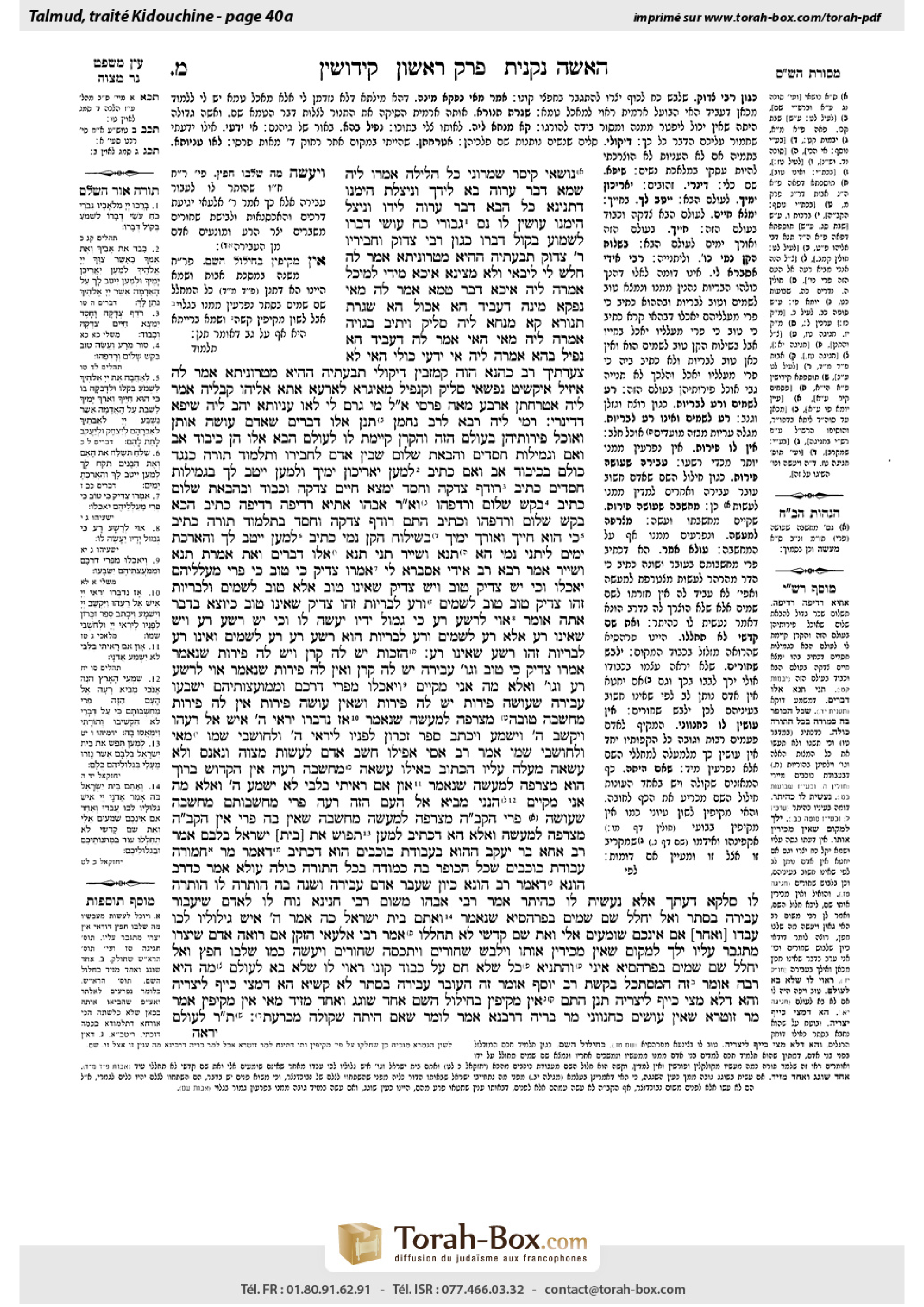
Kiddushin 40a: Talmud study for Daf Yomi
Daf Yomi is the daily study of one Talmud folio. Explore 37 tractates with scans, Hebrew text, Sefaria English and AI-generated French translations where annotated.
Passage selection and English or AI-generated French translation are available where the scan has annotations. Daf Study is independent of Torah-Box and Sefaria.
Browse Kiddushin · קידושין · All tractatesKiddushin 40a text and translations
This page of Kiddushin includes the Aramaic text, an English translation and an AI-generated French translation, alongside the scan above.
קידושין מ׳ א · Aramaic and Hebrew text
נוֹשְׂאֵי קֵיסָר שְׁמָרוּנִי כׇּל הַלַּיְלָה. אֲמַרוּ לֵיהּ: שֶׁמָּא דְּבַר עֶרְוָה בָּא לְיָדְךָ וְנִיצַּלְתָּ הֵימֶנּוּ, דִּתְנֵינָא: כׇּל הַבָּא דְּבַר עֶרְוָה לְיָדוֹ וְנִיצַּל הֵימֶנּוּ – עוֹשִׂין לוֹ נֵס. ״גִּבֹּרֵי כֹחַ עֹשֵׂי דְבָרוֹ לִשְׁמֹעַ בְּקוֹל דְּבָרוֹ״ – כְּגוֹן רַבִּי צָדוֹק וַחֲבֵירָיו.
רַבִּי צָדוֹק תְּבַעְתֵּיהּ הָהִיא מַטְרוֹנִיתָא, אֲמַר לַהּ: חֲלַשׁ לִי לִיבַּאי וְלָא מָצֵינָא, אִיכָּא מִידֵּי לְמֵיכַל? אֲמַרָה לֵיהּ: אִיכָּא דָּבָר טָמֵא. אֲמַר לַהּ: מַאי נָפְקָא מִינַּהּ? דְּעָבֵיד הָא – אָכֵול הָא. שְׁגַרַת תַּנּוּרָא, קָא מַנְּחָא לֵיהּ. סָלֵיק וְיָתֵיב בְּגַוֵּיהּ. אֲמַרָה לֵיהּ: מַאי הַאי? אֲמַר לַהּ: דְּעָבֵיד הָא – נָפֵיל בְּהָא. אַמְרַהּ לֵיהּ: אִי יָדְעִי כּוּלֵּי הַאי – לָא צַעַרְתָּיךְ.
רַב כָּהֲנָא הֲוָה קָמְזַבֵּין דִּיקּוּלֵי, תְּבַעְתֵּיהּ הָהִיא מַטְרוֹנִיתָא. אֲמַר לַהּ: אֵיזִיל אֱיקַשֵּׁיט נַפְשַׁאי, סָלֵיק וְקָנָפֵיל מֵאִיגָּרָא לְאַרְעָא. אֲתָא אֵלִיָּהוּ קַבְּלֵיהּ. אֲמַר לֵיהּ: אַטְרַחְתַּן אַרְבַּע מְאָה פַּרְסֵי! אֲמַר לֵיהּ: מִי גְּרַם לִי, לָאו עַנְיוּתָא? יְהַב לֵיהּ שִׁיפָא דְּדִינָרֵי.
רָמֵי לֵיהּ רָבָא לְרַב נַחְמָן: תְּנַן: אֵלּוּ דְּבָרִים שֶׁאָדָם עוֹשֶׂה אוֹתָן וְאוֹכֵל פֵּירוֹתֵיהֶן בְּעוֹלָם הַזֶּה וְהַקֶּרֶן קַיֶּימֶת לוֹ לָעוֹלָם הַבָּא, אֵלּוּ הֵן: כִּיבּוּד אָב וְאֵם, וּגְמִילוּת חֲסָדִים, וַהֲבָאַת שָׁלוֹם שֶׁבֵּין אָדָם לַחֲבֵירוֹ, וְתַלְמוּד תּוֹרָה כְּנֶגֶד כּוּלָּם.
בְּכִיבּוּד אָב וָאֵם כְּתִיב: ״לְמַעַן יַאֲרִיכֻן יָמֶיךָ וּלְמַעַן יִיטַב לָךְ״, בִּגְמִילוּת חֲסָדִים כְּתִיב: ״רֹדֵף צְדָקָה וָחָסֶד יִמְצָא חַיִּים צְדָקָה וְכָבוֹד״,
וּבַהֲבָאַת שָׁלוֹם כְּתִיב: ״בַּקֵּשׁ שָׁלוֹם וְרׇדְפֵהוּ״, וְאָמַר רַבִּי אֲבָהוּ: אָתְיָא ״רְדִיפָה״ ״רְדִיפָה״. כְּתִיב הָכָא: ״בַּקֵּשׁ שָׁלוֹם וְרׇדְפֵהוּ״, וּכְתִיב הָתָם: ״רֹדֵף צְדָקָה וָחֶסֶד״. בְּתַלְמוּד תּוֹרָה כְּתִיב: ״כִּי הוּא חַיֶּיךָ וְאֹרֶךְ יָמֶיךָ״.
בְּשִׁילּוּחַ הַקֵּן נָמֵי כְּתִיב: ״לְמַעַן יִיטַב לָךְ וְהַאֲרַכְתָּ יָמִים״, לִיתְנֵי נָמֵי הָא! תְּנָא וְשַׁיַּיר. תָּנֵי תַּנָּא: ״אֵלּוּ דְּבָרִים״, וְאַתְּ אָמְרַתְּ תְּנָא וְשַׁיַּיר?!
אָמַר רָבָא: רַב אִידִי אַסְבְּרַאּ לִי: ״אִמְרוּ צַדִּיק כִּי טוֹב כִּי פְרִי מַעַלְלֵיהֶם יֹאכֵלוּ״ – וְכִי יֵשׁ צַדִּיק טוֹב וְיֵשׁ צַדִּיק שֶׁאֵינוֹ טוֹב? אֶלָּא: טוֹב לַשָּׁמַיִם וְלַבְּרִיּוֹת – זֶהוּ צַדִּיק טוֹב, טוֹב לַשָּׁמַיִם וְרַע לַבְּרִיּוֹת – זֶהוּ צַדִּיק שֶׁאֵינוֹ טוֹב.
כַּיּוֹצֵא בַּדָּבָר אַתָּה אוֹמֵר: ״אוֹי לְרָשָׁע רָע כִּי גְמוּל יָדָיו יֵעָשֶׂה לוֹ״. וְכִי יֵשׁ רָשָׁע רַע וְיֵשׁ שֶׁאֵינוֹ רַע? אֶלָּא: רַע לַשָּׁמַיִם וְרַע לַבְּרִיּוֹת – הוּא רָשָׁע רַע, רַע לַשָּׁמַיִם וְאֵינוֹ רַע לַבְּרִיּוֹת – זֶהוּ רָשָׁע שֶׁאֵינוֹ רַע.
הַזְּכוּת יֵשׁ לָהּ קֶרֶן וְיֵשׁ לָהּ פֵּירוֹת, שֶׁנֶּאֱמַר: ״אִמְרוּ צַדִּיק כִּי טוֹב וְגוֹ׳״ – עֲבֵירָה יֵשׁ לָהּ קֶרֶן וְאֵין לָהּ פֵּירוֹת, שֶׁנֶּאֱמַר: ״אוֹי לָרָשָׁע רָע וְגוֹ׳״
וְאֶלָּא מָה אֲנִי מְקַיֵּים: ״וְיֹאכְלוּ מִפְּרִי דַרְכָּם וּמִמֹּעֲצֹתֵיהֶם יִשְׂבָּעוּ״? עֲבֵירָה שֶׁעוֹשָׂה פֵּירוֹת – יֵשׁ לָהּ פֵּירוֹת. וְשֶׁאֵין עוֹשָׂה פֵּירוֹת – אֵין לָהּ פֵּירוֹת.
מַחְשָׁבָה טוֹבָה מְצָרְפָהּ לְמַעֲשֶׂה, שֶׁנֶּאֱמַר: ״אָז נִדְבְּרוּ יִרְאֵי ה׳ אִישׁ אֶל רֵעֵהוּ וַיַּקְשֵׁב ה׳ וַיִּשְׁמָע וַיִּכָּתֵב סֵפֶר זִכָּרוֹן לְפָנָיו לְיִרְאֵי ה׳ וּלְחֹשְׁבֵי שְׁמוֹ״. מַאי: ״ולְחֹשְׁבֵי שְׁמוֹ״? אָמַר רַב אַסִּי: אֲפִילּוּ חָשַׁב אָדָם לַעֲשׂוֹת מִצְוָה וְנֶאֱנַס וְלֹא עֲשָׂאָהּ – מַעֲלֶה עָלָיו הַכָּתוּב כְּאִילּוּ עֲשָׂאָהּ.
מַחְשָׁבָה רָעָה אֵין הַקָּדוֹשׁ בָּרוּךְ הוּא מְצָרְפָהּ לְמַעֲשֶׂה, שֶׁנֶּאֱמַר: ״אָוֶן אִם רָאִיתִי בְלִבִּי לֹא יִשְׁמַע ה׳״. וְאֶלָּא מָה אֲנִי מְקַיֵּם: ״הִנְנִי מֵבִיא אֶל הָעָם הַזֶּה רָעָה פְּרִי מַחְשְׁבוֹתָם״? מַחְשָׁבָה שֶׁעוֹשָׂה פְּרִי הַקָּדוֹשׁ בָּרוּךְ הוּא מְצָרְפָהּ לְמַעֲשֶׂה, מַחְשָׁבָה שֶׁאֵין בָּהּ פְּרִי – אֵין הַקָּדוֹשׁ בָּרוּךְ הוּא מְצָרְפָהּ לְמַעֲשֶׂה.
וְאֶלָּא הָא דִּכְתִיב: ״לְמַעַן תְּפֹשׂ אֶת [בֵּית] יִשְׂרָאֵל בְּלִבָּם״? אָמַר רַב אַחָא בַּר יַעֲקֹב: הָהוּא בַּעֲבוֹדָה זָרָה הוּא דִּכְתִיב, דְּאָמַר מָר: חֲמוּרָה עֲבוֹדָה זָרָה, שֶׁכׇּל הַכּוֹפֵר בָּהּ כְּמוֹדֶה בְּכׇל הַתּוֹרָה כּוּלָּהּ.
עוּלָּא אָמַר: כִּדְרַב הוּנָא, דְּאָמַר רַב הוּנָא: כֵּיוָן שֶׁעָבַר אָדָם עֲבֵירָה וְשָׁנָה בָּהּ – הוּתְּרָה לוֹ. הוּתְּרָה לוֹ סָלְקָא דַּעְתָּךְ?! אֶלָּא: נַעֲשֵׂית לוֹ כְּהֶיתֵּר.
אָמַר רַבִּי אֲבָהוּ מִשּׁוּם רַבִּי חֲנִינָא: נוֹחַ לוֹ לָאָדָם שֶׁיַּעֲבוֹר עֲבֵירָה בַּסֵּתֶר וְאַל יְחַלֵּל שֵׁם שָׁמַיִם בְּפַרְהֶסְיָא, שֶׁנֶּאֱמַר: ״וְאַתֶּם בֵּית יִשְׂרָאֵל כֹּה אָמַר ה׳ אִישׁ גִּלּוּלָיו לְכוּ עֲבֹדוּ [וְאַחַר] אִם אֵינְכֶם שֹׁמְעִים אֵלָי, וְאֶת שֵׁם קׇדְשִׁי לֹא תְחַלְּלוּ״.
אָמַר רַבִּי אִלְעַאי הַזָּקֵן: אִם רוֹאֶה אָדָם שֶׁיִּצְרוֹ מִתְגַּבֵּר עָלָיו – יֵלֵךְ לְמָקוֹם שֶׁאֵין מַכִּירִין אוֹתוֹ, וְיִלְבַּשׁ שְׁחוֹרִים, וְיִתְכַּסֶּה שְׁחוֹרִים, וְיַעֲשֶׂה כְּמוֹ שֶׁלִּבּוֹ חָפֵץ, וְאַל יְחַלֵּל שֵׁם שָׁמַיִם בְּפַרְהֶסְיָא.
אִינִי? וְהָתַנְיָא: כׇּל שֶׁלֹּא חָס עַל כְּבוֹד קוֹנוֹ – רָאוּי לוֹ שֶׁלֹּא בָּא לָעוֹלָם. מָה הִיא? רַבָּה אוֹמֵר: זֶה הַמִּסְתַּכֵּל בַּקֶּשֶׁת. רַב יוֹסֵף אוֹמֵר: זֶה הָעוֹבֵר עֲבֵירָה בַּסֵּתֶר!
לָא קַשְׁיָא, הָא – דְּמָצֵי כָּיֵיף לְיִצְרֵיהּ, וְהָא – דְּלָא מָצֵי כָּיֵיף לְיִצְרֵיהּ.
תְּנַן הָתָם: אֵין מַקִּיפִין בְּחִילּוּל הַשֵּׁם, אֶחָד שׁוֹגֵג וְאֶחָד מֵזִיד. מַאי ״אֵין מַקִּיפִין״? אָמַר מָר זוּטְרָא: שֶׁאֵין עוֹשִׂים כְּחֶנְווֹנִי. מָר בְּרֵיהּ דְּרַבְנָא אָמַר: לוֹמַר שֶׁאִם הָיְתָה שְׁקוּלָה – מַכְרַעַת.
תָּנוּ רַבָּנַן: לְעוֹלָם
Kiddushin 40a · English translation
soldiers [nosei keisar] who guarded me all night. They said to him: Perhaps a matter of forbidden intercourse presented itself to you and you were saved from it, which is why a miracle occurred for you. As we learned: With regard to anyone to whom a matter of forbidden intercourse presented itself to him and he was saved from it, a miracle is performed for him. As it says: “Mighty in strength who fulfill His word, hearkening to the voice of His word” (Psalms 103:20). This is referring to one such as Rabbi Tzadok and his colleagues.
To what is this referring? Rabbi Tzadok was enticed by a certain noblewoman to engage in sexual intercourse with her. He said to her: My heart is weak and I am incapable at present; is there something to eat that can strengthen me? She said to him: There is something non-kosher. He said to her: What difference is there? One who performs such an act eats such food as well. She lit the oven and placed the non-kosher food in it to roast. He climbed and sat in the oven. She said to him: What is the meaning of this? He said to her: One who performs this act falls into this, i.e., the fires of Gehenna. She said to him: If I had known that the matter was so serious for you, I would not have caused you such anguish.
The Gemara further relates: Rav Kahana would sell baskets woven from palm leaves to women. He was enticed by a certain noblewoman to engage in intercourse with her. He said to her: Let me go and adorn myself beforehand. He ascended to the roof and fell from the roof toward the ground. Elijah the prophet came and caught him. Elijah the prophet said to Rav Kahana: You have troubled me to travel four hundred parasangs [parsei] to save you. Rav Kahana said to him: What caused me to be in this situation of temptation? Was it not poverty, as I am forced to engage in a trade that leads me to come into contact with women? Elijah gave him a basket [shifa] full of dinars, to spare him from having to work as a salesman.
§ Rava raises a contradiction to Rav Naḥman and asks: We learned in a mishna (Pe’a 1:1): These are the matters that a person engages in and enjoys their profits in this world, and the principal reward remains for him for the World-to-Come, and they are: Honoring one’s father and mother, acts of loving kindness, and bringing peace between one person and another; and Torah study is equal to all of them.
Rava cites the source for each of these assertions. With regard to honoring one’s father and mother, it is written: “That your days may be long, and that it may go well with you” (Deuteronomy 5:16), which indicates that one is rewarded in this world. With regard to acts of loving kindness it is written: “He who pursues righteousness and kindness shall find life, prosperity, and honor” (Proverbs 21:21), all of which apply in this world.
And with regard to bringing peace it is written: “Seek peace and pursue it” (Psalms 34:15). And Rabbi Abbahu says: This is derived through a verbal analogy between the term pursuing written with regard to pursuing peace and the term pursuing written in another verse. It is written here: “Seek peace and pursue it,” and it is written there, with regard to acts of kindness: “Pursues righteousness and kindness.” This teaches that one who pursues peace will also merit life, prosperity, and honor. With regard to Torah study it is written: “For that is your life and the length of your days” (Deuteronomy 30:20).
Rava asked: With regard to the dispatch of the mother bird from the nest it is also written: “That it may be well with you, and that you may prolong your days” (Deuteronomy 22:7), so let him also teach this mitzva. Rav Naḥman answered: He taught some cases and omitted others, i.e., the tanna did not list everything. Rava said to him: The tanna taught: These are the matters, which indicates that only these mitzvot are included, and yet you say that he taught some and omitted others?
Rather, Rava said: Rav Idi explained the matter to me. The verse states: “Say you of the righteous who is good, that they shall eat the fruit of their actions” (Isaiah 3:10). And this verse is difficult, as is there a righteous person who is good and is there a righteous person who is not good? Rather, this verse should be understood as follows: One who is good both toward Heaven and toward people is a good righteous person; one who is good toward Heaven but bad toward people is a righteous person who is not good.
Rava continues: On a similar note, it is written: “Woe to the evil wicked one, for the work of his hands shall be done to him” (Isaiah 3:11). And is there a wicked man who is evil and is there one who is not evil? Rather, one who is evil toward Heaven and evil toward people is an evil wicked person; and one who is evil toward Heaven and not evil toward people is a wicked person who is not evil. With regard to the issue at hand, only one who performs mitzvot that benefit others receives the profits of his mitzvot in this world. This does not apply to dispatching the mother bird, which is an act that does not benefit other people.
§ With regard to the mishna in Pe’a, the Gemara states: An act of merit has a principal reward and it has profits, i.e., one receives additional reward beyond that which is granted for the mitzva itself, parallel to a principal sum and profits, as it is stated: “Say you of the righteous who is good, that they shall eat the fruit of their actions” (Isaiah 3:10). A sin has a principal penalty but it has no profits, i.e., no punishment beyond that, as it is stated: “Woe to the evil wicked one, for the work of his hands shall be done to him” (Isaiah 3:11), but no more than the work of his hands.
But how do I realize the meaning of the following verse that deals with sinners: “Therefore they shall eat of the fruit of their own way, and be filled with their own devices” (Proverbs 1:31)? This verse indicates that the penalty for sin goes beyond its principal, and the wicked receive additional punishments. The Gemara answers that this applies to a sin that produces profits, i.e., a case where there are practical consequences to one’s sin. For example, if others learn to act in a similar manner, one’s actions have profits with regard to punishment as well. Conversely, a sin that does not produce profits does not have profits as a punishment either.
The Gemara further teaches: The Holy One, Blessed be He, links a good thought to an action, as it is stated: “Then they that feared the Lord spoke one with the other, and the Lord listened, and heard, and a book of remembrance was written before Him, for them that fear the Lord, and that think upon His name” (Malachi 3:16). The Gemara explains: What is the meaning of the phrase “and that think upon His name”? Rav Asi said: Even if a person intended to perform a mitzva but due to circumstances beyond his control he did not perform it, the verse ascribes him credit as if he performed the mitzva, as he is among those that think upon His name.
But the Holy One, Blessed be He, does not link an evil thought to an action, as it is stated: “If I had regarded iniquity in my heart, the Lord would not hear” (Psalms 66:18). But how do I realize the meaning of the verse: “Behold I will bring upon these people evil, even the fruit of their thoughts” (Jeremiah 6:19)? In the case of an evil thought that produces fruit, i.e., that leads to an action, the Holy One, Blessed be He, links it to the action and one is punished for the thought as well. If it is a thought that does not produce fruit, the Holy One, Blessed be He, does not link it to the action.
The Gemara asks: But with regard to that which is written: “So I may take the house of Israel in their own heart” (Ezekiel 14:5), which indicates that one can be punished for thoughts alone, to what is this verse referring? Rav Aḥa bar Ya’akov said: That is written with regard to idol worship, as the Master says: Idol worship is very severe, as anyone who denies it is like one who admits the truth of the entire Torah. Conversely, one who embraces idolatry is considered to have rejected the entire Torah. Due to the severity of idol worship, one is punished even for contemplating this transgression.
Ulla said: This should be explained in accordance with a statement of Rav Huna, as Rav Huna says: When a person transgresses and repeats his transgression, it is permitted to him. The Gemara questions this statement: Can it enter your mind that the transgression is permitted to him because he has sinned twice? Rather, it becomes as if it were permitted to him, as he becomes accustomed to this behavior and no longer senses that it is a sin.
Rabbi Abbahu says in the name of Rabbi Ḥanina: It is preferable for a person to transgress in secret and not to desecrate the name of Heaven in public [befarhesya], as it is stated: “As for you, house of Israel, so says the Lord God: Go you, serve everyone his idols, even because you will not hearken to Me, but My sacred name you shall not profane” (Ezekiel 20:39).
Rabbi Ilai the Elder says: If a person sees that his evil inclination is overcoming him, he should go to a place where he is not known, and wear black clothes, and he should cover himself in simple black garments, and he should do as his heart desires, but he should not desecrate the name of Heaven in public.
The Gemara asks: Is that so? But isn’t it taught in a baraita: With regard to anyone who does not care about his Creator’s honor, it is fitting for him not to have come into the world. What is this? Who is considered to be one who does not care about his Creator’s honor? Rabba says: This is one who gazes at a rainbow, which is described as: “The likeness of the glory of the Lord” (Ezekiel 1:28). Rav Yosef says: This is one who transgresses in secret, which shows that he fears other people but does not care about the honor of his Creator.
The Gemara answers: This is not difficult, as this source, which says that one who transgresses in secret does not care about his Creator’s honor, is referring to one who can overcome his evil inclination but nevertheless chooses to transgress in secret. And that source, which states that it is preferable for him to transgress in secret, is referring to one who cannot overcome his evil inclination.
We learned in a mishna there (see Avot 4:4): Credit is not given with regard to the desecration of God’s name, whether one sinned unintentionally or intentionally. The Gemara asks: What is the meaning of the phrase: Credit is not given [makkifin]? Mar Zutra says: This means that God does not act like a storekeeper and provide credit. Rather, one is punished without delay. Mar, son of Rabbana, says: This means to say that if one’s merit and sins were equal, the sin of the desecration of God’s name tilts the balance of the scales toward the side of his sins. In other words, if his sins include the transgression of desecrating God’s name, God does not wait for this individual to perform a mitzva to balance out the sin.
The Sages taught: Always
Kiddushin 40a · Traduction française (IA)
des soldats [nosei keisar] qui m’avaient gardé toute la nuit. Ils lui dirent : « Peut-être une occasion de commettre une relation interdite s’est-elle présentée à toi et en as-tu été préservé, raison pour laquelle un miracle s’est produit pour toi. » En effet, nous avons appris : Toute personne à qui une occasion de commettre une relation interdite s’est présentée et qui en a été préservée bénéficie d’un miracle. Comme il est dit : « Puissants par leur force, qui accomplissent Sa parole, attentifs à la voix de Sa parole » (Psaumes 103,20). Cela désigne des hommes tels que Rabbi Tzadok et ses collègues.
À quoi cela fait-il référence ? Rabbi Tzadok fut tenté par une certaine noble dame, qui voulait avoir des relations sexuelles avec lui. Il lui dit : « J’ai le cœur faible et j’en suis incapable pour le moment ; y a-t-il quelque chose à manger qui puisse me fortifier ? » Elle lui répondit : « Il y a quelque chose de non cacher. » Il lui dit : « Quelle différence cela fait-il ? Celui qui commet un tel acte mange aussi de tels aliments. » Elle alluma le four et y plaça l’aliment non cacher pour le faire rôtir. Rabbi Tzadok grimpa dans le four et s’y assit. Elle lui demanda : « Qu’est-ce que cela signifie ? » Il lui répondit : « Celui qui commet cet acte tombe dans cela, c’est-à-dire dans les feux de la Géhenne. » Elle lui dit : « Si j’avais su que cette affaire était si grave pour toi, je ne t’aurais pas causé une telle détresse. »
La Guemara rapporte encore : Rav Kahana vendait aux femmes des paniers tressés en feuilles de palmier. Une certaine noble dame le tenta afin d’avoir des relations sexuelles avec lui. Il lui dit : « Laisse-moi partir me parer auparavant. » Il monta sur le toit et en tomba vers le sol. Le prophète Élie vint le rattraper. Le prophète Élie dit à Rav Kahana : « Tu m’as obligé à parcourir quatre cents parasanges [parsei] pour te sauver. » Rav Kahana lui dit : « Qu’est-ce qui m’a placé dans cette situation de tentation ? N’est-ce pas la pauvreté, qui m’oblige à exercer un métier me mettant en contact avec des femmes ? » Élie lui donna un panier [shifa] rempli de dinars, afin de lui éviter d’avoir à travailler comme vendeur.
§ Rava soulève une contradiction à Rav Naḥman et lui demande : Nous avons appris dans une Michna (Péa 1,1) : « Voici les choses dont une personne accomplit les actes et dont elle jouit des fruits en ce monde, tandis que la récompense principale lui reste réservée pour le Monde à venir : honorer son père et sa mère, accomplir des actes de bonté et rétablir la paix entre une personne et une autre ; et l’étude de la Torah équivaut à toutes ces choses. »
Rava cite la source de chacune de ces affirmations. Pour ce qui est d’honorer son père et sa mère, il est écrit : « Afin que tes jours se prolongent et que tu sois heureux » (Deutéronome 5,16), ce qui indique que l’on est récompensé en ce monde. Pour les actes de bonté, il est écrit : « Celui qui poursuit la justice et la bonté trouvera la vie, la prospérité et l’honneur » (Proverbes 21,21), qui sont tous accordés en ce monde.
Pour ce qui est de rétablir la paix, il est écrit : « Recherche la paix et poursuis-la » (Psaumes 34,15). Rabbi Abbahou dit : Cela se déduit par une analogie verbale entre le terme « poursuivre », employé à propos de la poursuite de la paix, et le terme « poursuivre » employé dans un autre verset. Il est écrit ici : « Recherche la paix et poursuis-la », et il est écrit là, à propos des actes de bonté : « Celui qui poursuit la justice et la bonté ». Cela enseigne que celui qui poursuit la paix méritera lui aussi la vie, la prospérité et l’honneur. Pour ce qui est de l’étude de la Torah, il est écrit : « Car c’est là ta vie et la longueur de tes jours » (Deutéronome 30,20).
Rava demanda : À propos du renvoi de l’oiseau mère de son nid, il est également écrit : « Afin que tu sois heureux et que tu prolonges tes jours » (Deutéronome 22,7) ; pourquoi le tanna n’enseigne-t-il pas aussi cette mitsva ? Rav Naḥman répondit : Il a enseigné certains cas et en a omis d’autres, c’est-à-dire que le tanna n’a pas tout énuméré. Rava lui dit : Le tanna enseigne : « Voici les choses », ce qui indique que seules ces mitsvot sont incluses ; et pourtant, tu dis qu’il en a enseigné certaines et en a omis d’autres ?
Rava dit plutôt : « Rav Idi m’a expliqué la question. » Le verset dit : « Dites au juste qu’il est bon, car ils mangeront le fruit de leurs actions » (Isaïe 3,10). Ce verset pose une difficulté : existe-t-il un juste qui soit bon et un juste qui ne soit pas bon ? Il faut plutôt comprendre ainsi le verset : celui qui est bon envers le Ciel et envers les hommes est un juste bon ; celui qui est bon envers le Ciel mais mauvais envers les hommes est un juste qui n’est pas bon.
Rava poursuit : De même, il est écrit : « Malheur au méchant, au mauvais, car il lui sera fait selon l’œuvre de ses mains » (Isaïe 3,11). Existe-t-il un méchant qui soit mauvais et un méchant qui ne soit pas mauvais ? Celui qui est mauvais envers le Ciel et envers les hommes est un méchant mauvais ; celui qui est mauvais envers le Ciel mais pas envers les hommes est un méchant qui n’est pas mauvais. Pour ce qui nous occupe, seul celui qui accomplit des mitsvot qui profitent à autrui reçoit en ce monde les fruits de ses mitsvot. Cela ne s’applique pas au renvoi de l’oiseau mère, qui ne profite pas aux autres.
§ À propos de la Michna de Péa, la Guemara enseigne : Un acte méritoire comporte une récompense principale et des bénéfices, c’est-à-dire qu’on reçoit une récompense supplémentaire au-delà de celle accordée pour la mitsva elle-même, à l’image d’un capital et de ses fruits, comme il est dit : « Dites au juste qu’il est bon, car ils mangeront le fruit de leurs actions » (Isaïe 3,10). Un péché comporte une peine principale, mais n’entraîne pas de peine supplémentaire, comme il est dit : « Malheur au méchant, au mauvais, car il lui sera fait selon l’œuvre de ses mains » (Isaïe 3,11), mais pas davantage que selon l’œuvre de ses mains.
Mais comment comprendre le verset suivant, qui traite des pécheurs : « Ils mangeront donc le fruit de leur conduite et seront rassasiés de leurs propres desseins » (Proverbes 1,31) ? Ce verset indique que la peine encourue pour un péché dépasse sa peine principale et que les méchants reçoivent des punitions supplémentaires. La Guemara répond que cela s’applique à un péché qui produit des conséquences, c’est-à-dire à un cas où le péché entraîne des effets concrets. Par exemple, si d’autres apprennent à agir de la même manière, les actes de cette personne produisent aussi des conséquences en matière de punition. À l’inverse, un péché qui n’a pas de telles conséquences n’entraîne pas non plus de peine supplémentaire.
La Guemara enseigne encore : Le Saint, béni soit-Il, associe une bonne intention à un acte, comme il est dit : « Alors ceux qui craignaient l’Éternel se parlèrent les uns aux autres, et l’Éternel écouta et entendit ; un livre de souvenir fut écrit devant Lui, pour ceux qui craignent l’Éternel et qui méditent sur Son nom » (Malachie 3,16). La Guemara explique : Que signifie l’expression « qui méditent sur Son nom » ? Rav Asi dit : Même si une personne avait l’intention d’accomplir une mitsva, mais que des circonstances indépendantes de sa volonté l’en ont empêchée, le verset lui en attribue le mérite comme si elle avait accompli la mitsva, car elle fait partie de ceux qui méditent sur Son nom.
Mais le Saint, béni soit-Il, n’associe pas une mauvaise intention à un acte, comme il est dit : « Si j’avais eu égard à l’iniquité dans mon cœur, le Seigneur ne m’aurait pas écouté » (Psaumes 66,18). Mais comment comprendre le verset : « Voici, je fais venir le malheur sur ce peuple, fruit de leurs pensées » (Jérémie 6,19) ? Il s’agit d’une mauvaise pensée qui porte des fruits, c’est-à-dire qui conduit à un acte : le Saint, béni soit-Il, l’associe alors à l’acte, et la personne est également punie pour cette pensée. Si la pensée ne porte pas de fruits, le Saint, béni soit-Il, ne l’associe pas à l’acte.
La Guemara demande : Mais qu’en est-il de ce qui est écrit : « Afin de saisir la maison d’Israël dans leur propre cœur » (Ézéchiel 14,5), ce qui indique qu’on peut être puni pour de simples pensées ? À quoi ce verset fait-il référence ? Rav Aḥa bar Ya’akov dit : Il est écrit au sujet de l’idolâtrie, car le Maître dit : L’idolâtrie est très grave, car quiconque la nie est comme s’il reconnaissait la vérité de toute la Torah. À l’inverse, celui qui adopte l’idolâtrie est considéré comme ayant rejeté toute la Torah. En raison de la gravité de l’idolâtrie, on est puni même pour avoir envisagé cette transgression.
Oulla dit : Cela doit être expliqué conformément à une déclaration de Rav Houna, car Rav Houna dit : Lorsqu’une personne transgresse puis répète sa transgression, celle-ci lui devient permise. La Guemara met cette déclaration en question : Peut-on penser que la transgression lui est permise parce qu’elle a péché deux fois ? En réalité, elle devient comme si elle lui était permise, car la personne s’habitue à ce comportement et ne le ressent plus comme un péché.
Rabbi Abbahou dit au nom de Rabbi Ḥanina : Il est préférable pour une personne de transgresser en secret plutôt que de profaner le Nom du Ciel en public [befarhesya], comme il est dit : « Quant à vous, maison d’Israël, ainsi parle le Seigneur Dieu : Allez, servez chacun vos idoles, puisque vous ne m’écoutez pas ; mais vous ne profanerez pas Mon saint nom » (Ézéchiel 20,39).
Rabbi Ilai l’Ancien dit : Si une personne voit que son mauvais penchant prend le dessus sur elle, elle doit se rendre dans un endroit où elle n’est pas connue, revêtir des vêtements noirs et se couvrir de simples vêtements noirs ; elle peut alors faire ce que son cœur désire, mais ne doit pas profaner le Nom du Ciel en public.
La Guemara demande : Est-ce vraiment le cas ? N’est-il pas enseigné dans une baraïta : « Quiconque ne se soucie pas de l’honneur de son Créateur aurait mieux fait de ne pas venir au monde. » De qui s’agit-il ? Qui est considéré comme ne se souciant pas de l’honneur de son Créateur ? Rabba dit : Il s’agit de celui qui contemple un arc-en-ciel, lequel est décrit comme « la ressemblance de la gloire du Seigneur » (Ézéchiel 1,28). Rav Yossef dit : Il s’agit de celui qui transgresse en secret, ce qui montre qu’il craint les autres mais ne se soucie pas de l’honneur de son Créateur.
La Guemara répond : Il n’y a pas de difficulté, car la source qui affirme que celui qui transgresse en secret ne se soucie pas de l’honneur de son Créateur parle de quelqu’un qui peut maîtriser son mauvais penchant, mais choisit néanmoins de transgresser en secret. L’autre source, qui affirme qu’il est préférable pour lui de transgresser en secret, parle de quelqu’un qui ne peut pas maîtriser son mauvais penchant.
Nous avons appris dans une Michna, là-bas (voir Avot 4,4) : « On n’accorde aucun crédit en matière de profanation du Nom de Dieu, que l’on ait péché involontairement ou intentionnellement. » La Guemara demande : Que signifie l’expression « on n’accorde aucun crédit » [makkifin] ? Mar Zoutra dit : Cela signifie que Dieu n’agit pas comme un commerçant qui fait crédit ; on est puni sans délai. Mar, fils de Rabbana, dit : Cela signifie que si les mérites et les péchés d’une personne sont équivalents, le péché consistant à profaner le Nom de Dieu fait pencher la balance du côté de ses péchés. Autrement dit, si ses péchés comprennent la profanation du Nom de Dieu, Dieu n’attend pas que cette personne accomplisse une mitsva pour compenser ce péché.
Les Sages ont enseigné : Toujours
Traduction française générée par IA à partir de l’édition anglaise de Sefaria. Vérifie toujours un passage avec le texte source.
Text from Sefaria: William Davidson Edition - Vocalized Aramaic (CC BY NC); William Davidson Edition - English (CC BY NC).