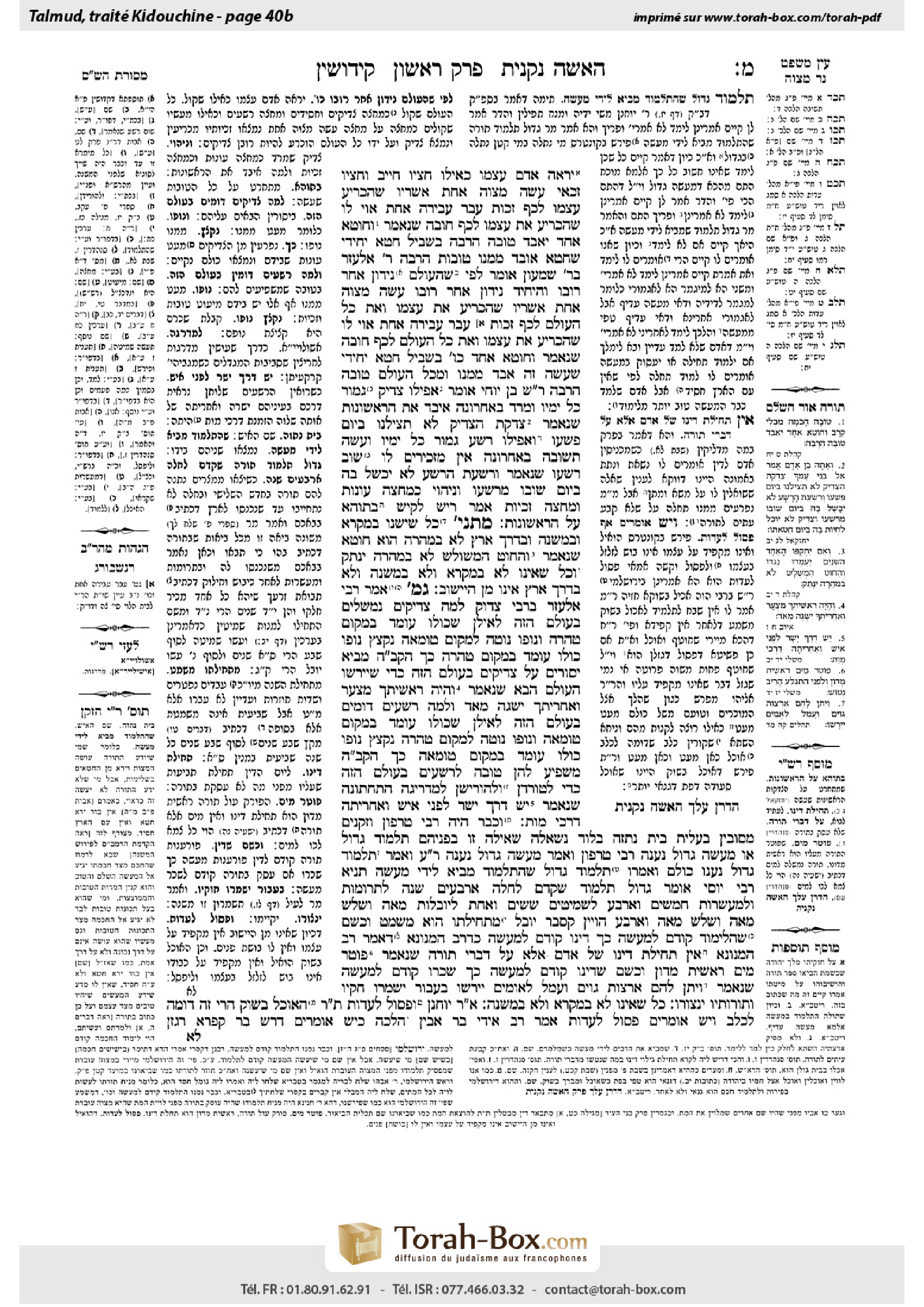
Kiddushin 40b: Talmud study for Daf Yomi
Daf Yomi is the daily study of one Talmud folio. Explore 37 tractates with scans, Hebrew text, Sefaria English and AI-generated French translations where annotated.
Passage selection and English or AI-generated French translation are available where the scan has annotations. Daf Study is independent of Torah-Box and Sefaria.
Browse Kiddushin · קידושין · All tractatesKiddushin 40b text and translations
This page of Kiddushin includes the Aramaic text, an English translation and an AI-generated French translation, alongside the scan above.
קידושין מ׳ ב · Aramaic and Hebrew text
יִרְאֶה אָדָם עַצְמוֹ כְּאִילּוּ חֶצְיוֹ חַיָּיב וְחֶצְיוֹ זַכַּאי. עָשָׂה מִצְוָה אַחַת – אַשְׁרָיו, שֶׁהִכְרִיעַ עַצְמוֹ לְכַף זְכוּת, עָבַר עֲבֵירָה אַחַת – אוֹי לוֹ, שֶׁהִכְרִיעַ אֶת עַצְמוֹ לְכַף חוֹבָה, שֶׁנֶּאֱמַר: ״וְחוֹטֶא אֶחָד יְאַבֵּד טוֹבָה הַרְבֵּה״ – בִּשְׁבִיל חֵטְא יְחִידִי שֶׁחָטָא אוֹבֵד מִמֶּנּוּ טוֹבוֹת הַרְבֵּה.
רַבִּי אֶלְעָזָר בְּרַבִּי שִׁמְעוֹן אוֹמֵר: לְפִי שֶׁהָעוֹלָם נִידּוֹן אַחַר רוּבּוֹ, וְהַיָּחִיד נִידּוֹן אַחַר רוּבּוֹ, עָשָׂה מִצְוָה אַחַת – אַשְׁרָיו, שֶׁהִכְרִיעַ אֶת עַצְמוֹ וְאֶת כָּל הָעוֹלָם לְכַף זְכוּת, עָבַר עֲבֵירָה אַחַת – אוֹי לוֹ, שֶׁהִכְרִיעַ אֶת עַצְמוֹ וְאֶת כָּל הָעוֹלָם לְכַף חוֹבָה, שֶׁנֶּאֱמַר: ״וְחוֹטֵא אֶחָד כּוּ׳״ – בִּשְׁבִיל חֵטְא יְחִידִי שֶׁעָשָׂה זֶה אָבַד מִמֶּנּוּ וּמִכׇּל הָעוֹלָם טוֹבָה הַרְבֵּה.
רַבִּי שִׁמְעוֹן בֶּן יוֹחַי אוֹמֵר: אֲפִילּוּ צַדִּיק גָּמוּר כׇּל יָמָיו וּמָרַד בָּאַחֲרוֹנָה – אִיבֵּד אֶת הָרִאשׁוֹנוֹת, שֶׁנֶּאֱמַר: ״צִדְקַת הַצַּדִּיק לֹא תַצִּילֶנּוּ בְּיוֹם פִּשְׁעוֹ״. וַאֲפִילּוּ רָשָׁע גָּמוּר כׇּל יָמָיו וְעָשָׂה תְּשׁוּבָה בָּאַחֲרוֹנָה – אֵין מַזְכִּירִים לוֹ שׁוּב רִשְׁעוֹ, שֶׁנֶּאֱמַר: ״וְרִשְׁעַת הָרָשָׁע לֹא יִכָּשֶׁל בָּהּ בְּיוֹם שׁוּבוֹ מֵרִשְׁעוֹ״.
וְנִיהְוֵי כְּמֶחֱצָה עֲוֹנוֹת וּמֶחֱצָה זְכִיּוֹת? אָמַר רֵישׁ לָקִישׁ: בְּתוֹהֶא עַל הָרִאשׁוֹנוֹת.
מַתְנִי׳ כֹּל שֶׁיֶּשְׁנוֹ בַּמִּקְרָא וּבַמִּשְׁנָה וּבְדֶרֶךְ אֶרֶץ – לֹא בִּמְהֵרָה הוּא חוֹטֵא, שֶׁנֶּאֱמַר: ״וְהַחוּט הַמְשֻׁלָּשׁ לֹא בִמְהֵרָה יִנָּתֵק״. וְכֹל שֶׁאֵינוֹ לֹא בַּמִּקְרָא וְלֹא בַּמִּשְׁנָה וְלֹא בְּדֶרֶךְ אֶרֶץ – אֵינוֹ מִן הַיִּישּׁוּב.
גְּמָ׳ אָמַר רַבִּי אֶלְעָזָר בְּרַבִּי צָדוֹק: לְמָה צַדִּיקִים נִמְשָׁלִים בָּעוֹלָם הַזֶּה – לְאִילָן שֶׁכּוּלּוֹ עוֹמֵד בִּמְקוֹם טׇהֳרָה, וְנוֹפוֹ נוֹטֶה לִמְקוֹם טוּמְאָה. נִקְצַץ נוֹפוֹ – כּוּלּוֹ עוֹמֵד בִּמְקוֹם טׇהֳרָה. כָּךְ הַקָּדוֹשׁ בָּרוּךְ הוּא מֵבִיא יִסּוּרִים עַל צַדִּיקִים בָּעוֹלָם הַזֶּה, כְּדֵי שֶׁיִּירְשׁוּ הָעוֹלָם הַבָּא, שֶׁנֶּאֱמַר: ״וְהָיָה רֵאשִׁיתְךָ מִצְעָר וְאַחֲרִיתְךָ יִשְׂגֶּה מְאֹד״.
וּלְמָה רְשָׁעִים דּוֹמִים בָּעוֹלָם הַזֶּה – לְאִילָן שֶׁכּוּלּוֹ עוֹמֵד בִּמְקוֹם טוּמְאָה וְנוֹפוֹ נוֹטֶה לִמְקוֹם טׇהֳרָה. נִקְצַץ נוֹפוֹ – כּוּלּוֹ עוֹמֵד בִּמְקוֹם טוּמְאָה. כָּךְ הַקָּדוֹשׁ בָּרוּךְ הוּא מְשַׁפֵּיעַ לָהֶן טוֹבָה לָרְשָׁעִים בְּעוֹלָם הַזֶּה כְּדֵי לְטוֹרְדָן וּלְהוֹרִישָׁן לְמַדְרֵיגָה הַתַּחְתּוֹנָה, שֶׁנֶּאֱמַר: ״יֵשׁ דֶּרֶךְ יָשָׁר לִפְנֵי אִישׁ וְאַחֲרִיתָהּ דַּרְכֵי מָוֶת״.
וּכְבָר הָיָה רַבִּי טַרְפוֹן וּזְקֵנִים מְסוּבִּין בַּעֲלִיַּת בֵּית נַתְּזָה בְּלוֹד. נִשְׁאֲלָה שְׁאֵילָה זוֹ בִּפְנֵיהֶם: תַּלְמוּד גָּדוֹל אוֹ מַעֲשֶׂה גָּדוֹל? נַעֲנָה רַבִּי טַרְפוֹן וְאָמַר: מַעֲשֶׂה גָּדוֹל. נַעֲנָה רַבִּי עֲקִיבָא וְאָמַר: תַּלְמוּד גָּדוֹל. נַעֲנוּ כּוּלָּם וְאָמְרוּ: תַּלְמוּד גָּדוֹל, שֶׁהַתַּלְמוּד מֵבִיא לִידֵי מַעֲשֶׂה.
תַּנְיָא, רַבִּי יוֹסֵי אוֹמֵר: גָּדוֹל תַּלְמוּד שֶׁקָּדַם לְחַלָּה אַרְבָּעִים שָׁנָה, לִתְרוּמוֹת וּלְמַעַשְׂרוֹת חֲמִשִּׁים וְאַרְבַּע, לִשְׁמִיטִּים שִׁשִּׁים וְאַחַת, לְיוֹבְלוֹת מֵאָה וְשָׁלֹשׁ.
מֵאָה וְשָׁלֹשׁ? מֵאָה וְאַרְבַּע הָוְיָין! קָסָבַר: יוֹבֵל מִתְּחִילָּתוֹ הוּא מְשַׁמֵּט.
וּכְשֵׁם שֶׁהַלִּימּוּד קוֹדֵם לְמַעֲשֶׂה כָּךְ דִּינוֹ קוֹדֵם לְמַעֲשֶׂה, כִּדְרַב הַמְנוּנָא. דְּאָמַר רַב הַמְנוּנָא: אֵין תְּחִילַּת דִּינוֹ שֶׁל אָדָם אֶלָּא עַל דִּבְרֵי תוֹרָה, שֶׁנֶּאֱמַר: ״פּוֹטֵר מַיִם רֵאשִׁית מָדוֹן״.
וּכְשֵׁם שֶׁדִּינוֹ קוֹדֵם לְמַעֲשֶׂה כָּךְ שְׂכָרוֹ קוֹדֵם לְמַעֲשֶׂה, שֶׁנֶּאֱמַר: ״וַיִּתֵּן לָהֶם אַרְצוֹת גּוֹיִם וַעֲמַל לְאֻמִּים יִירָשׁוּ. בַּעֲבוּר יִשְׁמְרוּ חֻקָּיו וְתוֹרֹתָיו יִנְצֹרוּ״.
כֹּל שֶׁאֵינוֹ לֹא בַּמִּקְרָא וְלֹא בַּמִּשְׁנָה. אָמַר רַבִּי יוֹחָנָן: וּפָסוּל לְעֵדוּת. תָּנוּ רַבָּנַן: הָאוֹכֵל בַּשּׁוּק הֲרֵי זֶה דּוֹמֶה לְכֶלֶב. וְיֵשׁ אוֹמְרִים פָּסוּל לְעֵדוּת. אָמַר רַבִּי אִידִי בַּר אָבִין: הֲלָכָה כְּיֵשׁ אוֹמְרִים.
דָּרַשׁ בַּר קַפָּרָא: רַגְזָן
Kiddushin 40b · English translation
a person should view himself as though he were exactly half-liable and half-meritorious. In other words he should act as though the plates of his scale are balanced, so that if he performs one mitzva he is fortunate, as he tilts his balance to the scale of merit. If he transgresses one prohibition, woe to him, as he tilts his balance to the scale of liability, as it is stated: “But one sin destroys much good” (Ecclesiastes 9:18), which means that due to one sin that a person transgresses he squanders much good.
Rabbi Elazar, son of Rabbi Shimon, says: Since the world is judged by its majority, i.e., depending on whether people have performed a majority of mitzvot or a majority of sins, and an individual is likewise judged by his majority, each person must consider that if he performs one mitzva he is praiseworthy, as he tilts the balance of himself and the entire world to the scale of merit. Conversely, if he transgresses one prohibition, woe to him, as he tilts the balance for himself and the entire world to the scale of liability, as it is stated: “But one sin destroys much good,” i.e., due to one sin that this individual commits, he squanders much goodness from himself and from the entire world.
Rabbi Shimon ben Yoḥai says: Even if one was completely righteous all his life and he rebelled by sinning at the end of his life, he loses his early merit, as it is stated: “The righteousness of the righteous shall not deliver him on the day of his transgression” (Ezekiel 33:12). And similarly, even if one was completely wicked all his life and repented in the end, he is no longer reminded of his wickedness, as it is stated in the continuation of the verse: “And as for the wickedness of the wicked, he shall not stumble over it on the day that he turns from his wickedness.”
The Gemara asks: But an individual who performed mitzvot all of his life and then sins should at least be like one whose acts have been half sins and half merits, i.e., each should be of equal weight. Why, then, is he pronounced guilty? Reish Lakish said: This is not referring to an individual who has merely sinned but to one who regrets all the initial mitzvot he performed in the past. In this case the mitzvot he performed are not taken into account.
MISHNA: Anyone who is engaged in the study of Bible, and in the study of Mishna, and in the desired mode of behavior, i.e., he performs labor and generally acts in an appropriate manner, will not be quick to sin, as it is stated: “And a threefold cord is not quickly broken” (Ecclesiastes 4:12). One who is involved in all three of these activities will not sin easily. And anyone who does not engage in the study of Bible, nor the study of Mishna, nor the desired mode of behavior, is not part of society, i.e., he is not considered a civilized person at all.
GEMARA: Rabbi Elazar, son of Rabbi Tzadok, says: To what are the righteous in this world compared? To a tree that is standing entirely in a pure place and its branches hang over an impure place. If its branches are cut, it will stand entirely in a pure place. So too, the Holy One, Blessed be He, brings afflictions upon the righteous in this world to cleanse them of their few sins. He makes them suffer so that they will inherit the World-to-Come entirely, as it is stated: “And your beginning was in pain, your end shall greatly increase” (Job 8:7).
And to what are the wicked in this world compared? To a tree that stands entirely in an impure place and whose branches hang over a pure place. If its branches are cut off, it stands entirely in an impure place. So too, the Holy One, Blessed be He, bestows good upon the wicked in this world for the few mitzvot they have performed, in order to expel them and banish them to the lowest level of Gehenna in the future, as it is stated: “There is a way which seems right to a man, but its end are the ways of death” (Proverbs 14:12).
In connection to the mishna’s statement about the importance of Torah study, the Gemara relates the following incident: And there already was an incident in which Rabbi Tarfon and the Elders were reclining in the loft of the house of Nit’za in Lod, when this question was asked of them: Is study greater or is action greater? Rabbi Tarfon answered and said: Action is greater. Rabbi Akiva answered and said: Study is greater. Everyone answered and said: Study is greater, but not as an independent value; rather, it is greater as study leads to action.
It is taught in a baraita that Rabbi Yosei says: Torah study is greater, as it preceded the mitzva of separating ḥalla by forty years. The Torah was given to the Jewish people soon after they left Egypt, whereas the mitzva of separating ḥalla came into effect only after they entered Eretz Yisrael. And it preceded the mitzva of terumot and tithes by fifty-four years, as the Jews become obligated in these mitzvot only fourteen years after they entered Eretz Yisrael, once they had conquered and divided the land. Furthermore, the Torah preceded the observance of Sabbatical Years by sixty-one years, as they began to count the seven-year cycle only once they had divided the land. Finally, it preceded the Jubilee Years by 103 years, as the fifty-year count to the first Jubilee Year began only after they had divided Eretz Yisrael.
The Gemara asks: Why does the baraita state 103 years? It was actually 104 years. If one adds fifty to the fifty-four years that passed before the Jews began fulfilling the mitzvot dependent on the land, one arrives at a total of 104. The Gemara answers: This tanna maintains that the Jubilee Year releases slaves and returns fields to their original owners from the start of the year. Therefore, 103 years passed before the mitzva of the Jubilee Year took effect.
And just as study comes before action, i.e., the mitzva of Torah study takes precedence over other mitzvot, so too, the judgment concerning Torah study precedes the judgment for an action of the performance of a mitzva. This is in accordance with the statement of Rav Hamnuna, as Rav Hamnuna says: The beginning of a person’s judgment is only concerning matters of Torah, as it is stated: “The beginning of judgment is as one lets out water” (Proverbs 17:14). This is understood to refer to the sin of neglecting Torah, as the Torah is compared to water, which brings life to the world.
And just as the judgment concerning Torah study precedes the judgment for an action of the performance of a mitzva, so too does the reward for Torah study precede the reward for an action of the performance of a mitzva, as it is stated: “And He gave them the lands of nations, and they took the labor of peoples in possession, that they might observe His statutes and protect His laws” (Psalms 105:44–45). The first reward is for observing the statutes, and as explained on 37a, this is a reference to Torah study.
§ The mishna teaches that anyone who does not engage in the study of Bible, nor the study of Mishna, nor the desired mode of behavior, is not part of society. Rabbi Yoḥanan says: And he is disqualified from bearing witness, as this individual cannot be trusted. The Sages taught: One who eats in the marketplace is comparable to a dog, as he disrespects himself through his lack of embarrassment over eating in public. And some say he is even disqualified from bearing witness. Rabbi Idi bar Avin said: The halakha is in accordance with the opinion cited in the name of: Some say.
Similarly, bar Kappara taught: An angry person
Kiddushin 40b · Traduction française (IA)
Une personne doit se considérer comme ayant exactement autant de fautes que de mérites. Autrement dit, elle doit agir comme si les plateaux de sa balance étaient en équilibre, de sorte que si elle accomplit une mitsva, elle est heureuse, car elle fait pencher sa balance du côté du mérite. Si elle transgresse une interdiction, malheur à elle, car elle fait pencher sa balance du côté de la culpabilité, comme il est dit : « Mais un seul péché détruit beaucoup de bien » (Ecclésiaste 9, 18), ce qui signifie qu’à cause d’un seul péché qu’elle commet, une personne gaspille beaucoup de bien.
Rabbi Elazar, fils de Rabbi Shimon, dit : Puisque le monde est jugé selon la majorité — c’est-à-dire selon que les gens ont accompli une majorité de mitsvot ou commis une majorité de péchés — et qu’un individu est lui aussi jugé selon la majorité de ses actes, chacun doit considérer que s’il accomplit une mitsva, il est digne d’éloges, car il fait pencher sa propre balance et celle du monde entier du côté du mérite. À l’inverse, s’il transgresse une interdiction, malheur à lui, car il fait pencher sa propre balance et celle du monde entier du côté de la culpabilité, comme il est dit : « Mais un seul péché détruit beaucoup de bien », c’est-à-dire qu’à cause d’un seul péché commis par cet individu, il gaspille beaucoup de bien, pour lui-même et pour le monde entier.
Rabbi Shimon ben Yohaï dit : Même si quelqu’un a été entièrement juste toute sa vie et qu’il se rebelle en péchant à la fin de sa vie, il perd ses mérites passés, comme il est dit : « La justice du juste ne le délivrera pas au jour de sa transgression » (Ézéchiel 33, 12). De même, même si quelqu’un a été entièrement méchant toute sa vie et se repent à la fin, on ne lui tient plus compte de sa méchanceté, comme le dit la suite du verset : « Et quant à la méchanceté du méchant, il ne trébuchera pas à cause d’elle le jour où il se détournera de sa méchanceté. »
La Guemara demande : Mais un individu qui a accompli des mitsvot toute sa vie puis pèche ne devrait-il pas au moins être considéré comme quelqu’un dont les actes se répartissent à parts égales entre péchés et mérites, les deux ayant alors le même poids ? Pourquoi est-il donc déclaré coupable ? Reish Lakish dit : Il ne s’agit pas ici d’un individu qui a simplement péché, mais de quelqu’un qui regrette toutes les mitsvot qu’il avait accomplies auparavant. Dans ce cas, les mitsvot qu’il a accomplies ne sont pas prises en compte.
Michna : Quiconque s’adonne à l’étude de la Torah écrite, à l’étude de la Michna et à une conduite souhaitable — c’est-à-dire travaille et se comporte généralement de façon convenable — ne sera pas prompt à pécher, comme il est dit : « Un cordon triple ne se rompt pas rapidement » (Ecclésiaste 4, 12). Celui qui s’adonne à ces trois activités ne péchera pas facilement. Et quiconque ne s’adonne ni à l’étude de la Torah écrite, ni à celle de la Michna, ni à une conduite souhaitable ne fait pas partie de la société, c’est-à-dire qu’il n’est pas considéré comme une personne civilisée.
Guemara : Rabbi Elazar, fils de Rabbi Tsadok, dit : À quoi les justes de ce monde sont-ils comparables ? À un arbre qui se trouve entièrement dans un lieu pur et dont les branches surplombent un lieu impur. Si ses branches sont coupées, il se trouvera entièrement dans un lieu pur. De même, le Saint, béni soit-Il, inflige des épreuves aux justes dans ce monde afin de les purifier de leurs quelques péchés. Il les fait souffrir pour qu’ils héritent entièrement du Monde futur, comme il est dit : « Ton commencement fut dans la douleur, mais ta fin s’accroîtra grandement » (Job 8, 7).
Et à quoi les méchants de ce monde sont-ils comparables ? À un arbre qui se trouve entièrement dans un lieu impur et dont les branches surplombent un lieu pur. Si ses branches sont coupées, il se trouvera entièrement dans un lieu impur. De même, le Saint, béni soit-Il, accorde du bien aux méchants dans ce monde en raison des quelques mitsvot qu’ils ont accomplies, afin de les expulser et de les reléguer au niveau le plus bas de la Géhenne dans l’avenir, comme il est dit : « Il est une voie qui paraît droite à un homme, mais son terme mène aux voies de la mort » (Proverbes 14, 12).
À propos de la déclaration de la Michna sur l’importance de l’étude de la Torah, la Guemara rapporte l’incident suivant : Il arriva que Rabbi Tarfon et les Anciens étaient allongés dans le grenier de la maison de Nit’za, à Lod, lorsqu’on leur posa cette question : L’étude est-elle supérieure, ou l’action ? Rabbi Tarfon répondit : L’action est supérieure. Rabbi Akiva répondit : L’étude est supérieure. Tous répondirent : L’étude est supérieure, mais non en tant que valeur indépendante ; elle est supérieure parce que l’étude mène à l’action.
Il est enseigné dans une baraïta que Rabbi Yosei dit : L’étude de la Torah est supérieure, car elle précéda de quarante ans la mitsva du prélèvement de la ḥalla. La Torah fut donnée au peuple juif peu après sa sortie d’Égypte, tandis que la mitsva du prélèvement de la ḥalla ne prit effet qu’après son entrée en Eretz Israël. L’étude de la Torah précéda de cinquante-quatre ans les mitsvot des prélèvements de terouma et des dîmes, car les Juifs ne furent astreints à ces mitsvot que quatorze ans après leur entrée en Eretz Israël, une fois le pays conquis et partagé. En outre, la Torah précéda de soixante et un ans l’observance des années sabbatiques, car on ne commença à compter le cycle de sept ans qu’une fois le pays partagé. Enfin, elle précéda de cent trois ans les années de jubilé, car le décompte des cinquante ans menant au premier jubilé ne commença qu’après le partage d’Eretz Israël.
La Guemara demande : Pourquoi la baraïta indique-t-elle cent trois ans ? Il s’est en réalité écoulé cent quatre ans. Si l’on ajoute cinquante ans aux cinquante-quatre années écoulées avant que les Juifs commencent à accomplir les mitsvot liées à la terre, on obtient un total de cent quatre ans. La Guemara répond : Ce tanna considère que l’année de jubilé libère les esclaves et rend les champs à leurs propriétaires d’origine dès le début de l’année. Par conséquent, cent trois ans se sont écoulés avant que la mitsva de l’année de jubilé prenne effet.
Et de même que l’étude précède l’action, c’est-à-dire que la mitsva de l’étude de la Torah a priorité sur les autres mitsvot, de même le jugement concernant l’étude de la Torah précède celui qui porte sur l’accomplissement d’une mitsva. Cela concorde avec l’enseignement de Rav Hamnouna, car Rav Hamnouna dit : Le jugement d’une personne commence uniquement par les questions de Torah, comme il est dit : « Le commencement d’une querelle, c’est comme le déversement des eaux » (Proverbes 17, 14). Cela se comprend comme une référence au péché consistant à négliger la Torah, car la Torah est comparée à l’eau, qui apporte la vie au monde.
Et de même que le jugement concernant l’étude de la Torah précède celui qui porte sur l’accomplissement d’une mitsva, de même la récompense de l’étude de la Torah précède celle de l’accomplissement d’une mitsva, comme il est dit : « Il leur donna les terres des nations, et ils prirent possession du fruit du labeur des peuples, afin qu’ils observent Ses lois et gardent Ses enseignements » (Psaumes 105, 44-45). La première récompense concerne l’observance des lois et, comme cela a été expliqué en 37a, il s’agit d’une référence à l’étude de la Torah.
§ La Michna enseigne que quiconque ne s’adonne ni à l’étude de la Torah écrite, ni à celle de la Michna, ni à une conduite souhaitable ne fait pas partie de la société. Rabbi Yoḥanan dit : Il est également inapte à témoigner, car on ne peut pas faire confiance à cet individu. Les Sages ont enseigné : Celui qui mange sur la place publique est comparable à un chien, car il se déshonore en ne ressentant aucune gêne à manger en public. Certains disent qu’il est même inapte à témoigner. Rabbi Idi bar Avin dit : La halakha suit l’opinion citée au nom de « certains disent ».
De même, bar Kappara enseignait : Une personne colérique
Traduction française générée par IA à partir de l’édition anglaise de Sefaria. Vérifie toujours un passage avec le texte source.
Text from Sefaria: William Davidson Edition - Vocalized Aramaic (CC BY NC); William Davidson Edition - English (CC BY NC).