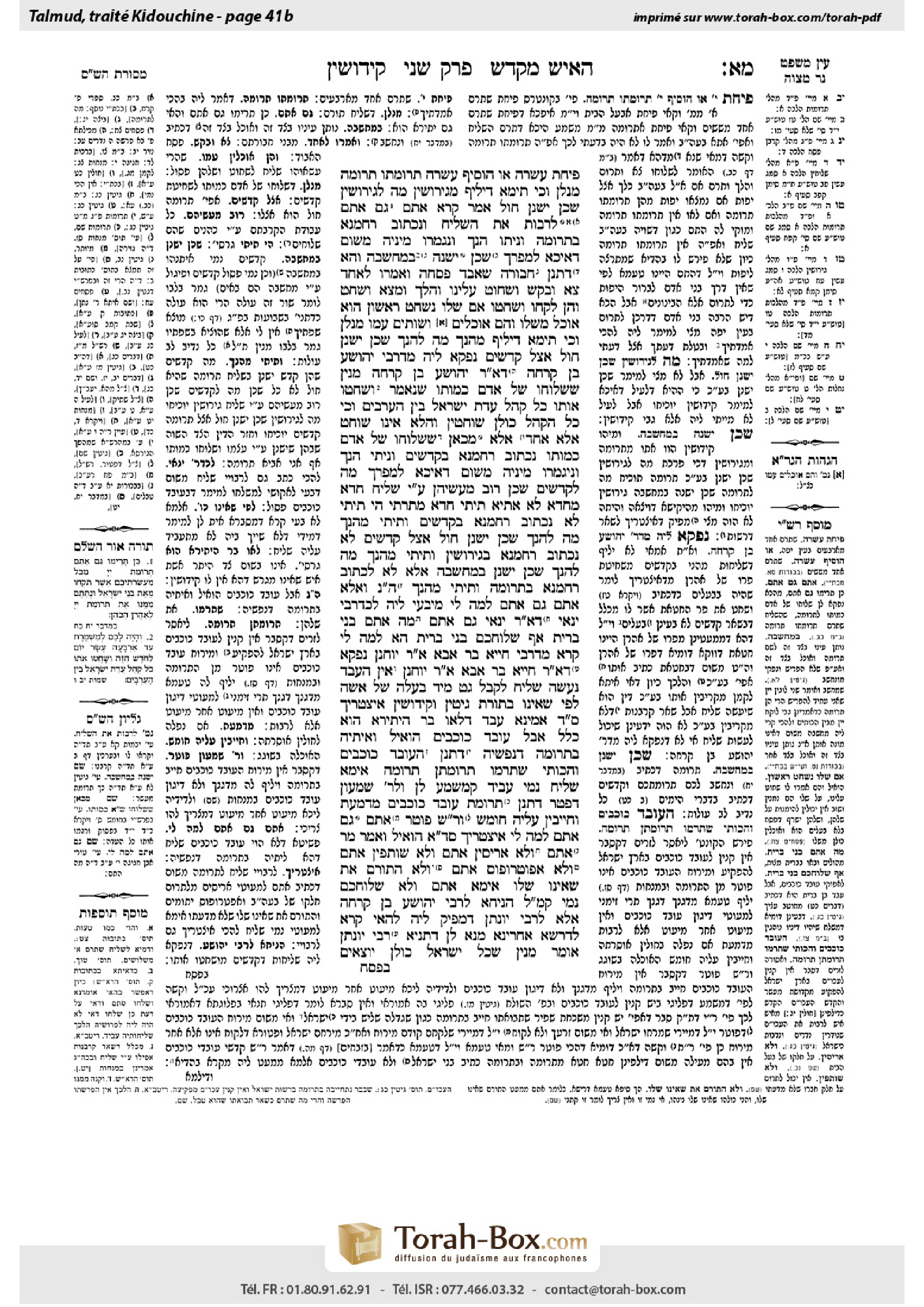
Kiddushin 41b: Talmud study for Daf Yomi
Daf Yomi is the daily study of one Talmud folio. Explore 37 tractates with scans, Hebrew text, Sefaria English and AI-generated French translations where annotated.
Passage selection and English or AI-generated French translation are available where the scan has annotations. Daf Study is independent of Torah-Box and Sefaria.
Browse Kiddushin · קידושין · All tractatesKiddushin 41b text and translations
This page of Kiddushin includes the Aramaic text, an English translation and an AI-generated French translation, alongside the scan above.
קידושין מ״א ב · Aramaic and Hebrew text
פִּיחֵת עֲשָׂרָה אוֹ הוֹסִיף עֲשָׂרָה – תְּרוּמָתוֹ תְּרוּמָה. מְנָלַן? וְכִי תֵּימָא דְּיָלֵיף מִגֵּירוּשִׁין – מָה לְגֵירוּשִׁין, שֶׁכֵּן יֶשְׁנָן חוֹל! אָמַר קְרָא: ״אַתֶּם״, ״גַּם אַתֶּם״ – לְרַבּוֹת אֶת הַשָּׁלִיחַ.
וְנִכְתּוֹב רַחֲמָנָא בִּתְרוּמָה, וְנֵיתוֹ הָנָךְ וְנִגְמְרוּ מִינֵּיהּ! מִשּׁוּם דְּאִיכָּא לְמִפְרַךְ: שֶׁכֵּן יֶשְׁנָהּ בְּמַחְשָׁבָה.
וְהָא דִּתְנַן: חֲבוּרָה שֶׁאָבַד פִּסְחָהּ, וְאָמְרוּ לְאֶחָד: ״צֵא וּבַקֵּשׁ וּשְׁחוֹט עָלֵינוּ״, וְהָלַךְ וּמָצָא וְשָׁחַט, וְהֵן לָקְחוּ וְשָׁחֲטוּ, אִם שֶׁלּוֹ נִשְׁחַט רִאשׁוֹן – הוּא אוֹכֵל מִשֶּׁלּוֹ, וְהֵם אוֹכְלִים וְשׁוֹתִים עִמּוֹ.
מְנָלַן? וְכִי תֵּימָא דְּיָלֵיף מֵהָנָךְ – מָה לְהָנָךְ, שֶׁכֵּן יֶשְׁנָן חוֹל אֵצֶל קָדָשִׁים!
נָפְקָא לֵיהּ מִדְּרַבִּי יְהוֹשֻׁעַ בֶּן קׇרְחָה, דְּאָמַר רַבִּי יְהוֹשֻׁעַ בֶּן קׇרְחָה: מִנַּיִן שֶׁשְּׁלוּחוֹ שֶׁל אָדָם כְּמוֹתוֹ? שֶׁנֶּאֱמַר: ״וְשָׁחֲטוּ אֹתוֹ כֹּל קְהַל עֲדַת יִשְׂרָאֵל בֵּין הָעַרְבָּיִם״, וְכִי כָּל הַקָּהָל כּוּלָּן שׁוֹחֲטִין? וַהֲלֹא אֵינוֹ שׁוֹחֵט אֶלָּא אֶחָד! אֶלָּא מִכָּאן שֶׁשְּׁלוּחוֹ שֶׁל אָדָם כְּמוֹתוֹ.
נִכְתּוֹב רַחֲמָנָא בְּקָדָשִׁים, וְנֵיתֵי הָנָךְ וְנִיגְמְרוּ מִינֵּיהּ! מִשּׁוּם דְּאִיכָּא לְמִפְרַךְ: מָה לְקָדָשִׁים, שֶׁכֵּן רוֹב מַעֲשֵׂיהֶן עַל יְדֵי שָׁלִיחַ.
חֲדָא מֵחֲדָא לָא אָתְיָא, תֵּיתֵי חֲדָא מִתַּרְתֵּי? – הֵי תֵּיתֵי?
לָא נִכְתּוֹב רַחֲמָנָא בְּקָדָשִׁים וְתֵיתֵי מֵהָנָךְ – מָה לְהָנָךְ, שֶׁכֵּן יֶשְׁנָן חוֹל אֵצֶל קֳדָשִׁים. לָא נִכְתּוֹב רַחֲמָנָא בְּגֵירוּשִׁין וְתֵיתֵי מֵהָנָךְ – מָה לְהָנָךְ, שֶׁכֵּן יֶשְׁנָן בְּמַחְשָׁבָה.
אֶלָּא: לָא לִכְתּוֹב רַחֲמָנָא בִּתְרוּמָה, וְתֵיתֵי מֵהָנָךְ! הָכִי נָמֵי.
וְאֶלָּא ״אַתֶּם״ ״גַּם אַתֶּם״ לְמָה לִי? מִיבְּעֵי לֵיהּ לְכִדְרַבִּי יַנַּאי. דְּאָמַר רַבִּי יַנַּאי ״גַּם אַתֶּם״ – מָה אַתֶּם בְּנֵי בְּרִית, אַף שְׁלוּחֲכֶם בְּנֵי בְּרִית.
הָא לְמָה לִי קְרָא? מִדְּרַבִּי חִיָּיא בַּר אַבָּא אָמַר רַבִּי יוֹחָנָן נָפְקָא! דְּאָמַר רַבִּי חִיָּיא בַּר אַבָּא אָמַר רַבִּי יוֹחָנָן: אֵין הָעֶבֶד נַעֲשֶׂה שָׁלִיחַ לְקַבֵּל גֵּט מִיַּד בַּעְלָהּ שֶׁל אִשָּׁה, לְפִי שֶׁאֵינוֹ בְּתוֹרַת גִּיטִּין וְקִידּוּשִׁין.
אִיצְטְרִיךְ, סָלְקָא דַּעְתָּךְ אָמֵינָא: עֶבֶד, דְּלָאו בַּר הֶיתֵּירָא הוּא כְּלָל. אֲבָל נׇכְרִי, הוֹאִיל וְאִיתֵיהּ בִּתְרוּמָה דְּנַפְשֵׁיהּ, דִּתְנַן: הַנׇּכְרִי וְהַכּוּתִי שֶׁתָּרְמוּ – תְּרוּמָתָן תְּרוּמָה, אֵימָא שָׁלִיחַ נָמֵי עָבֵיד, קָמַשְׁמַע לַן.
וּלְרַבִּי שִׁמְעוֹן, דְּפָטַר, דִּתְנַן: תְּרוּמַת נׇכְרִי מְדַמַּעַת וְחַיָּיבִין עָלֶיהָ חוֹמֶשׁ וְרַבִּי שִׁמְעוֹן פּוֹטֵר, ״אַתֶּם״ ״גַּם אַתֶּם״ לְמָה לִי?
אִיצְטְרִיךְ, סָלְקָא דַּעְתָּךְ אָמֵינָא: הוֹאִיל וְאָמַר מָר: ״אַתֶּם״ – וְלֹא אֲרִיסִין, ״אַתֶּם״ – וְלֹא שׁוּתָּפִין, ״אַתֶּם״ – וְלֹא אַפּוֹטְרוֹפּוֹס, ״אַתֶּם״ – וְלֹא הַתּוֹרֵם אֶת שֶׁאֵינוֹ שֶׁלּוֹ, אֵימָא: ״אַתֶּם״ – וְלֹא שְׁלוּחֲכֶם נָמֵי, קָא מַשְׁמַע לַן.
הָנִיחָא לְרַבִּי יְהוֹשֻׁעַ בֶּן קׇרְחָה. אֶלָּא לְרַבִּי יוֹנָתָן, דְּמַפֵּיק לֵיהּ לְהַאי קְרָא לִדְרָשָׁא אַחֲרִינָא, מְנָא לַן? דְּתַנְיָא, רַבִּי יוֹנָתָן אוֹמֵר: מִנַּיִן שֶׁכׇּל יִשְׂרָאֵל כּוּלָּן יוֹצְאִים
Kiddushin 41b · English translation
If the agent subtracted ten from the denominator and separated one-fortieth or added ten to the denominator and separated one-sixtieth, thereby giving more or less than the owner intended, his teruma is teruma. From where do we derive that one can appoint an agent to separate teruma? And if you would say that it is derived from divorce, one could argue: What is an aspect unique to divorce is that it is considered a non-sacred matter in relation to teruma and will have different halakhot, so one cannot learn from divorce that one can appoint an agent to separate teruma. The Gemara answers: The verse states with regard to teruma: “So you also shall set apart a gift unto the Lord of all your tithes” (Numbers 18:28). Once the verse states “you,” the addition of the word “also” in the term “you also” serves to include an agent.
The Gemara asks: And let the Merciful One write in the passage concerning teruma that one can appoint an agent, and the halakha that one can appoint an agent to act on his behalf in these other matters, i.e., divorce and betrothal, can come and be derived from it. The Gemara answers: Agency in these matters cannot be derived in this manner because the derivation can be refuted: Separating teruma is different, in that it is able to be separated by mere thought. It is enough for one to decide that a certain portion of his produce shall be teruma to have that status take effect. Just as there is this leniency unique to separating teruma, perhaps the leniency that enables one to appoint an agent is also unique to separating teruma.
The Gemara further clarifies the source for agency: Generally, the Paschal offering was brought by a group of people together. But there is that which we learned in a mishna (Pesaḥim 98b): In the case of a group whose Paschal offering was lost before it was sacrificed, and they said to one member of the group: Go and search for our Paschal offering, and when you find it, slaughter it on our behalf; and this person went and found the lost animal and slaughtered it on behalf of the entire group, but meanwhile, despairing of his return, they took a different animal and slaughtered it as a Paschal offering, the halakha is as follows: If his Paschal offering was slaughtered first, he eats from his offering, and they eat and drink with him. This demonstrates that one can act as an agent to slaughter the Paschal offering.
From where do we derive this halakha, that one can appoint an agent to slaughter an offering? And if you would say that it is derived from these other instances of agency, i.e., divorce and teruma, one could refute this derivation by saying: What is unique about these is that they are considered non-sacred matters relative to offerings, and perhaps offerings have their own set of halakhot.
The Gemara answers: He derives it from that which Rabbi Yehoshua ben Korḥa says, as Rabbi Yehoshua ben Korḥa says: From where is it derived that the legal status of a person’s agent is like that of himself? As it is stated with regard to the Paschal offering: “And the whole assembly of the congregation of Israel shall slaughter it in the afternoon” (Exodus 12:6). Is it so that the whole assembly slaughters the offering? But only one person from each group slaughters it. Rather, it can be derived from here that the legal status of a person’s agent is like that of himself.
In light of that exposition, the Gemara asks: Let the Merciful One write in the Torah the halakha of an agent with regard to offerings, and these, i.e., agency in the cases of betrothal, divorce, and teruma, can come and be derived from it. The Gemara answers: Agency in these matters cannot be derived in this manner because the derivation can be refuted: What is unique about offerings is that the majority of their actions are performed by means of an agent. Since most of the sacrificial service is performed by priests, who serve as the agents of those bringing the offerings, the general halakha of agency cannot be derived from there.
The Gemara continues to ask: For the reasons stated, the halakha of agency cannot be derived for any one of these from any other one of them. Still, derive one of these from the other two. The Gemara clarifies: Which of them will be derived from the others?
If you say: Let the Merciful One not write the halakha of agency with regard to offerings and derive agency with regard to offerings from these, i.e., divorce and teruma, that derivation can be refuted: What is unique about these is that they are considered non-sacred matters relative to offerings, as even teruma is not sacred compared to offerings, and sacred procedures such as offerings may have their own halakhot. If you say: Let the Merciful One not write the halakha of agency with regard to divorce, and derive agency with regard to divorce from these, i.e., teruma and offerings, this too can be refuted: What is unique about these is they can be designated by means of thought, and therefore may be easier to effect than divorce.
Rather, it is the third derivation that is possible: Let the Merciful One not write the halakha of agency with regard to teruma, and derive agency from these, i.e., offerings and divorce. Although teruma is sacred, offerings are more sacred, and yet the halakha of agency applies to them. Although the separating of teruma can be accomplished by means of thought, as opposed to divorce, offerings can also be designated by means of thought. The Gemara answers: It is indeed so; this is the derivation for the applicability of agency to teruma.
The Gemara asks: But then why do I need the derivation that once the verse states “you,” the addition of the word “also” in the term “you also” serves to include an agent? The Gemara answers: It is necessary to function as the source of the statement of Rabbi Yannai, as Rabbi Yannai says that from the term “you also,” the following is derived: Just as you, those who appoint agents, are members of the covenant, i.e., Jews, so too, your agents must be members of the covenant. A gentile cannot separate teruma even if appointed as an agent by a Jew.
The Gemara asks: Why do I need a verse to teach this halakha? It is derived from that which Rabbi Ḥiyya bar Abba says that Rabbi Yoḥanan says, as Rabbi Ḥiyya bar Abba says that Rabbi Yoḥanan says: A slave cannot become an agent to receive a bill of divorce from the hand of a woman’s husband on her behalf because he is not included in the laws of bills of divorce and betrothal. This indicates that there is a principle that if certain matters do not apply to a person, he cannot act as an agent with regard to those matters. Therefore, since gentiles are not commanded to separate teruma, they cannot be agents for its separation.
The Gemara answers: It was nevertheless necessary to derive this halakha for the case of teruma, because it cannot be derived from the statement of Rabbi Yoḥanan. This is as it might enter your mind to say: It is a slave who cannot serve as an agent to receive a bill of divorce, since he cannot release a woman by divorce at all; but a gentile, since he is included in his own teruma, as we learned in a mishna (Terumot 3:9): A gentile or a Samaritan who separated teruma from their own produce, their teruma is considered teruma, despite the fact that they are not obligated to do so, I will say that he can also be appointed as an agent. To counter this argument, the term “you also” teaches us that only members of the covenant can act as agents for separating teruma; gentiles cannot.
The Gemara asks: But according to Rabbi Shimon, who exempts one from paying an additional penalty for the teruma of a gentile, this explanation cannot be stated. As we learned in a mishna (Terumot 3:9): If the teruma of a gentile gets mixed with regular produce, it is considered to be a mixture of teruma and non-sacred produce, and if a non-priest eats this mixture unwittingly he is liable to pay for it an additional one-fifth beyond its value, just as is the halakha with regard to one who unwittingly eats teruma. But Rabbi Shimon exempts him from paying the additional one-fifth, as he holds that the teruma of a gentile possesses no sanctity and is considered a mere gift to a priest. If so, if there is no need to learn the additional halakha that a gentile cannot act as an agent with regard to the separating of teruma, why do I need the derivation from “you” and “you also”?
The Gemara answers: It was necessary to state this additional term, as it might enter your mind to say: Since the Master says that the word “you” is interpreted as a limitation, it means that “you,” but not sharecroppers, can separate teruma, as a sharecropper cannot separate teruma from the produce of the owner of the field; “you” can separate teruma but not partners from shared property without the consent of the other; “you” can separate teruma but not a steward [apotropos] from the estate that he is administering; and “you” can separate teruma but not one who separates teruma from produce that is not his, you might also say: “You” can separate teruma and not your agents. The verse therefore teaches us that “you also” indicates that one can appoint an agent to separate teruma.
The Gemara poses a question with regard to the basic derivation of the halakha of agency: This works out well according to the opinion of Rabbi Yehoshua ben Korḥa, who explains that the verse: “And the whole assembly of the congregation of Israel shall slaughter it in the afternoon” (Exodus 12:6), teaches the halakha of agency with regard to offerings. But according to the opinion of Rabbi Yonatan, who derives a different exposition from this verse, from where do we derive the halakha of agency with regard to offerings? As it is taught in a baraita that Rabbi Yonatan says: From where do we derive that all of the Jews can fulfill their obligations
Kiddushin 41b · Traduction française (IA)
Si l’agent retranche dix du dénominateur et prélève un quarantième, ou ajoute dix au dénominateur et prélève un soixantième, donnant ainsi plus ou moins que ce que le propriétaire avait l’intention de prélever, sa terouma est valide. D’où déduisons-nous que l’on peut désigner un agent pour prélever la terouma ? Et si tu dis que cela se déduit du divorce, on pourrait objecter que le divorce a ceci de particulier qu’il est considéré comme une affaire profane par rapport à la terouma et relève donc de lois différentes ; on ne peut donc pas déduire du divorce que l’on peut désigner un agent pour prélever la terouma. La Guemara répond : Le verset dit au sujet de la terouma : « Vous prélèverez aussi un prélèvement pour le Seigneur sur toutes vos dîmes » (Nombres 18:28). Puisque le verset dit déjà « vous », l’ajout du mot « aussi » dans l’expression « vous aussi » sert à inclure un agent.
La Guemara demande : Pourquoi le Miséricordieux n’écrit-il pas dans le passage relatif à la terouma qu’on peut désigner un agent, puis déduire de là la halakha permettant de désigner un agent pour agir au nom d’une personne dans ces autres domaines, à savoir le divorce et les fiançailles ? La Guemara répond : On ne peut pas déduire de cette manière l’agence dans ces domaines, car cette déduction peut être réfutée : le prélèvement de la terouma a ceci de particulier qu’il peut être accompli par la seule pensée. Il suffit de décider qu’une certaine partie de ses produits sera de la terouma pour que ce statut prenne effet. Puisque le prélèvement de la terouma comporte cette facilité particulière, peut-être la possibilité de désigner un agent lui est-elle également propre.
La Guemara précise encore la source de l’agence : en général, le sacrifice pascal était offert par un groupe de personnes réunies. Or, nous avons appris dans une Michna (Pessa’him 98b) : dans le cas d’un groupe dont le sacrifice pascal avait été perdu avant d’être offert, et qui avait dit à l’un de ses membres : « Va chercher notre sacrifice pascal et, quand tu l’auras trouvé, égorge-le en notre nom », celui-ci alla retrouver l’animal perdu et l’égorgea au nom de tout le groupe ; mais, entre-temps, comme ils désespéraient de son retour, les autres prirent un autre animal et l’égorgèrent comme sacrifice pascal. La halakha est la suivante : si son sacrifice pascal fut égorgé le premier, il mange de son sacrifice, et les autres mangent et boivent avec lui. Cela démontre que l’on peut agir comme agent pour égorger le sacrifice pascal.
D’où déduisons-nous cette halakha, selon laquelle on peut désigner un agent pour égorger un sacrifice ? Et si tu dis qu’elle se déduit de ces autres cas d’agence, à savoir le divorce et la terouma, on pourrait réfuter cette déduction en disant : ces cas ont ceci de particulier qu’ils sont considérés comme des affaires profanes par rapport aux sacrifices ; les sacrifices relèvent peut-être de leur propre ensemble de lois.
La Guemara répond : Il la déduit de ce que dit Rabbi Yehoshua ben Korḥa. En effet, Rabbi Yehoshua ben Korḥa dit : D’où déduit-on que le statut juridique de l’agent d’une personne est comme le sien ? Car il est dit au sujet du sacrifice pascal : « Toute l’assemblée de la communauté d’Israël l’égorgera au crépuscule » (Exode 12:6). Est-ce que toute l’assemblée égorge le sacrifice ? Or, seul un membre de chaque groupe l’égorge. On peut donc déduire de là que le statut juridique de l’agent d’une personne est comme le sien.
À la lumière de cette interprétation, la Guemara demande : Pourquoi le Miséricordieux n’écrit-il pas dans la Torah la halakha de l’agence à propos des sacrifices, puis déduire de là les autres cas, à savoir l’agence pour les fiançailles, le divorce et la terouma ? La Guemara répond : On ne peut pas déduire de cette manière l’agence dans ces domaines, car cette déduction peut être réfutée : les sacrifices ont ceci de particulier que la plupart des actes les concernant sont accomplis par un agent. Comme la majeure partie du service sacrificiel est accomplie par les prêtres, qui agissent comme agents de ceux qui apportent les sacrifices, on ne peut pas en déduire la règle générale de l’agence.
La Guemara poursuit sa question : pour les raisons exposées, on ne peut déduire la halakha de l’agence, pour chacun de ces cas, d’un seul des autres. Néanmoins, déduis l’un d’eux des deux autres. La Guemara précise : Lequel d’entre eux déduira-t-on des autres ?
Si tu dis : que le Miséricordieux n’écrive pas la halakha de l’agence à propos des sacrifices, et que l’on déduise l’agence concernant les sacrifices de ces autres cas, à savoir le divorce et la terouma, cette déduction peut être réfutée : ces cas ont ceci de particulier qu’ils sont considérés comme des affaires profanes par rapport aux sacrifices ; même la terouma n’est pas sacrée comparée aux sacrifices, et les procédures sacrées, comme les sacrifices, peuvent relever de leurs propres lois. Si tu dis : que le Miséricordieux n’écrive pas la halakha de l’agence à propos du divorce, et que l’on déduise l’agence concernant le divorce de ces autres cas, à savoir la terouma et les sacrifices, cela aussi peut être réfuté : ces cas ont ceci de particulier qu’ils peuvent être désignés par la pensée et peuvent donc être plus faciles à accomplir que le divorce.
C’est donc la troisième déduction qui est possible : que le Miséricordieux n’écrive pas la halakha de l’agence à propos de la terouma, et que l’on déduise l’agence de ces autres cas, à savoir les sacrifices et le divorce. Bien que la terouma soit sacrée, les sacrifices sont plus sacrés encore, et pourtant la halakha de l’agence s’y applique. Bien que le prélèvement de la terouma puisse être accompli par la pensée, contrairement au divorce, les sacrifices peuvent eux aussi être désignés par la pensée. La Guemara répond : C’est effectivement ainsi ; voilà la déduction qui établit que l’agence s’applique à la terouma.
La Guemara demande : Mais alors, pourquoi ai-je besoin de la déduction selon laquelle, puisque le verset dit « vous », l’ajout du mot « aussi » dans l’expression « vous aussi » sert à inclure un agent ? La Guemara répond : Elle est nécessaire comme source de l’enseignement de Rabbi Yannai. En effet, Rabbi Yannai dit qu’on déduit de l’expression « vous aussi » ce qui suit : de même que vous, ceux qui désignent des agents, êtes membres de l’Alliance, c’est-à-dire juifs, vos agents doivent eux aussi être membres de l’Alliance. Un non-Juif ne peut pas prélever la terouma, même s’il a été désigné comme agent par un Juif.
La Guemara demande : Pourquoi ai-je besoin d’un verset pour enseigner cette halakha ? Elle se déduit de ce que Rabbi Ḥiyya bar Abba dit au nom de Rabbi Yoḥanan. En effet, Rabbi Ḥiyya bar Abba dit au nom de Rabbi Yoḥanan : un esclave ne peut pas être désigné comme agent pour recevoir, au nom d’une femme, un acte de divorce de son mari, car il n’est pas concerné par les lois des actes de divorce et des fiançailles. Cela indique qu’il existe un principe selon lequel, lorsqu’une personne n’est pas concernée par certaines affaires, elle ne peut pas agir comme agent dans ces affaires. Par conséquent, puisque les non-Juifs ne sont pas tenus de prélever la terouma, ils ne peuvent pas être agents pour son prélèvement.
La Guemara répond : Il était néanmoins nécessaire de déduire cette halakha pour le cas de la terouma, car elle ne peut pas être déduite de l’enseignement de Rabbi Yoḥanan. En effet, tu pourrais penser que c’est l’esclave qui ne peut pas agir comme agent pour recevoir un acte de divorce, puisqu’il ne peut lui-même mettre fin à un mariage par le divorce ; mais, pour le non-Juif, puisqu’il est concerné par sa propre terouma — comme nous l’avons appris dans une Michna (Teroumot 3:9) : si un non-Juif ou un Samaritain prélève la terouma sur ses propres produits, sa terouma est considérée comme valide, bien qu’il n’y soit pas tenu —, je pourrais dire qu’il peut lui aussi être désigné comme agent. Pour réfuter cet argument, l’expression « vous aussi » nous enseigne que seuls les membres de l’Alliance peuvent agir comme agents pour prélever la terouma ; les non-Juifs ne le peuvent pas.
La Guemara demande : Mais selon Rabbi Shimon, qui dispense du paiement d’une pénalité supplémentaire pour la terouma d’un non-Juif, cette explication ne peut pas être avancée. En effet, nous avons appris dans une Michna (Teroumot 3:9) : si la terouma d’un non-Juif se mêle à des produits ordinaires, le mélange est considéré comme un mélange de terouma et de produits profanes ; si un non-prêtre mange ce mélange par inadvertance, il est tenu de payer, en plus de sa valeur, un cinquième supplémentaire, conformément à la halakha concernant celui qui mange de la terouma par inadvertance. Mais Rabbi Shimon le dispense de payer ce cinquième supplémentaire, car, selon lui, la terouma d’un non-Juif ne possède aucune sainteté et n’est considérée que comme un simple don à un prêtre. Dans ce cas, s’il n’est pas nécessaire d’apprendre en outre qu’un non-Juif ne peut pas agir comme agent pour prélever la terouma, pourquoi ai-je besoin de la déduction tirée de « vous » et de « vous aussi » ?
La Guemara répond : Il était nécessaire de mentionner cette expression supplémentaire, car tu pourrais penser ceci : puisque le Maître dit que le mot « vous » s’interprète comme une restriction, cela signifie que « vous », mais pas les métayers, pouvez prélever la terouma, car un métayer ne peut pas prélever la terouma sur les produits du propriétaire du champ ; « vous » pouvez prélever la terouma, mais pas les associés sur des biens communs sans le consentement de l’autre ; « vous » pouvez prélever la terouma, mais pas un administrateur [apotropos] sur les biens qu’il administre ; et « vous » pouvez prélever la terouma, mais pas quelqu’un qui prélève la terouma sur des produits qui ne lui appartiennent pas. Tu pourrais alors également dire : « Vous » pouvez prélever la terouma, mais pas vos agents. Le verset nous enseigne donc que l’expression « vous aussi » indique qu’on peut désigner un agent pour prélever la terouma.
La Guemara soulève une question au sujet de la déduction fondamentale de la halakha de l’agence : cela s’accorde bien avec l’opinion de Rabbi Yehoshua ben Korḥa, qui explique que le verset « Toute l’assemblée de la communauté d’Israël l’égorgera au crépuscule » (Exode 12:6) enseigne la halakha de l’agence concernant les sacrifices. Mais, selon l’opinion de Rabbi Yonatan, qui déduit de ce verset une autre interprétation, d’où déduisons-nous la halakha de l’agence concernant les sacrifices ? En effet, il est enseigné dans une baraïta que Rabbi Yonatan dit : D’où déduisons-nous que tous les Juifs peuvent s’acquitter de leurs obligations
Traduction française générée par IA à partir de l’édition anglaise de Sefaria. Vérifie toujours un passage avec le texte source.
Text from Sefaria: William Davidson Edition - Vocalized Aramaic (CC BY NC); William Davidson Edition - English (CC BY NC).