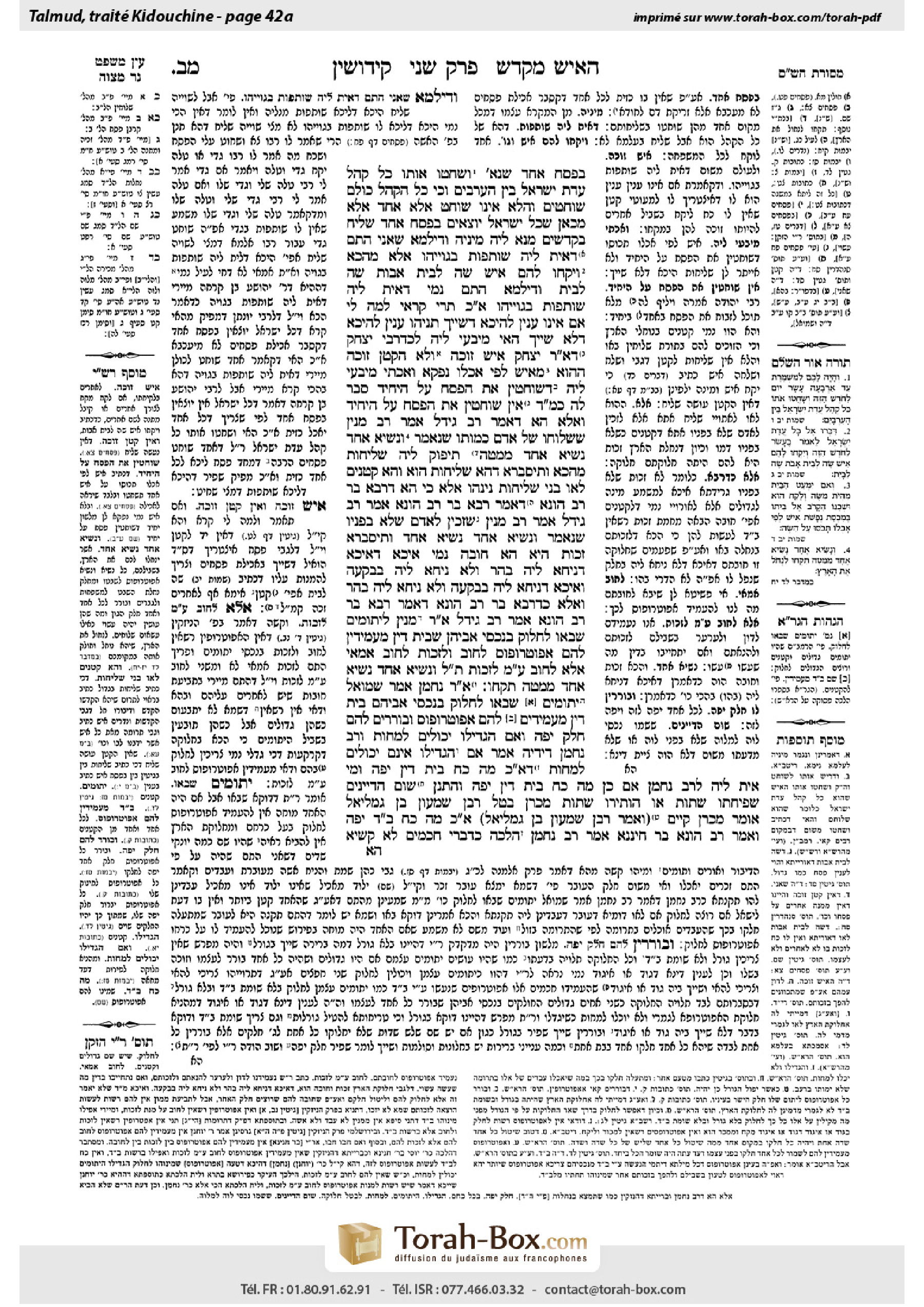
Kiddushin 42a: Talmud study for Daf Yomi
Daf Yomi is the daily study of one Talmud folio. Explore 37 tractates with scans, Hebrew text, Sefaria English and AI-generated French translations where annotated.
Passage selection and English or AI-generated French translation are available where the scan has annotations. Daf Study is independent of Torah-Box and Sefaria.
Browse Kiddushin · קידושין · All tractatesKiddushin 42a text and translations
This page of Kiddushin includes the Aramaic text, an English translation and an AI-generated French translation, alongside the scan above.
קידושין מ״ב א · Aramaic and Hebrew text
בְּפֶסַח אֶחָד? שֶׁנֶּאֱמַר: ״וְשָׁחֲטוּ אֹתוֹ כֹּל קְהַל עֲדַת יִשְׂרָאֵל בֵּין הָעַרְבָּיִם״, וְכִי כׇּל הַקָּהָל כּוּלָּם שׁוֹחֲטִים? וַהֲלֹא אֵינוֹ שׁוֹחֵט אֶלָּא אֶחָד! אֶלָּא מִכָּאן שֶׁכׇּל יִשְׂרָאֵל יוֹצְאִים בְּפֶסַח אֶחָד – שָׁלִיחַ בְּקָדָשִׁים מְנָא לֵיהּ?
– מִינֵּיהּ. וְדִילְמָא שָׁאנֵי הָתָם, דְּאִית לֵיהּ שׁוּתָּפוּת בְּגַוַּיְיהוּ.
אֶלָּא מֵהָכָא: ״וְיִקְחוּ לָהֶם אִישׁ שֶׂה לְבֵית אָבֹת שֶׂה לַבָּיִת״. וְדִילְמָא הָתָם נָמֵי, דְּאִית לֵיהּ שׁוּתָּפוּת בְּגַוַּיְיהוּ? אִם כֵּן תְּרֵי קְרָאֵי לְמָה לִי? אִם אֵינוֹ עִנְיָן לְהֵיכָא דְּשָׁיֵיךְ תְּנֵיהוּ עִנְיָן לְהֵיכָא דְּלָא שָׁיֵיךְ.
הַאי מִיבְּעֵי לֵיהּ לְכִדְרַבִּי יִצְחָק. דְּאָמַר רַבִּי יִצְחָק: ״אִישׁ״ זוֹכֶה, וְלֹא הַקָּטָן זוֹכֶה. הָהוּא מֵ״אִישׁ לְפִי אׇכְלוֹ״ נָפְקָא.
וְאַכַּתִּי מִיבְּעֵי לֵיהּ דְּשׁוֹחֲטִין אֶת הַפֶּסַח עַל הַיָּחִיד. סָבַר לַהּ כְּמַאן דְּאָמַר: אֵין שׁוֹחֲטִין אֶת הַפֶּסַח עַל הַיָּחִיד.
וְאֶלָּא הָא דְּאָמַר רַב גִּידֵּל אָמַר רַב: מִנַּיִן שֶׁשְּׁלוּחוֹ שֶׁל אָדָם כְּמוֹתוֹ? שֶׁנֶּאֱמַר: ״וְנָשִׂיא אֶחָד נָשִׂיא אֶחָד מִמַּטֶּה״. תִּיפּוֹק לֵיהּ שְׁלִיחוּת מֵהָכָא! וְתִיסְבְּרָא דְּהָא שְׁלִיחוּת הוּא? וְהָא קְטַנִּים לָאו בְּנֵי שְׁלִיחוּת נִינְהוּ!
אֶלָּא, כִּי הָא דְּרָבָא בַּר רַב הוּנָא. דְּאָמַר רָבָא בַּר רַב הוּנָא אָמַר רַב גִּידֵּל אָמַר רַב: מִנַּיִן שֶׁזָּכִין לְאָדָם שֶׁלֹּא בְּפָנָיו? שֶׁנֶּאֱמַר: ״וְנָשִׂיא אֶחָד נָשִׂיא אֶחָד״. וְתִיסְבְּרַאּ זְכוּת הִיא? הָא חוֹבָה נָמֵי אִיכָּא, דְּאִיכָּא דְּנִיחָא לֵיהּ בְּהַר, וְלָא נִיחָא לֵיהּ בְּבִקְעָה, וְאִיכָּא דְּנִיחָא לֵיהּ בְּבִקְעָה וְלָא נִיחָא לֵיהּ בְּהַר!
וְאֶלָּא כִּדְרָבָא בַּר רַב הוּנָא. דְּאָמַר רָבָא בַּר רַב הוּנָא אָמַר רַב גִּידֵּל אָמַר רַב: מִנַּיִן לִיתוֹמִים שֶׁבָּאוּ לַחֲלוֹק בְּנִכְסֵי אֲבִיהֶן שֶׁבֵּית דִּין מַעֲמִידִין לָהֶם אַפּוֹטְרוֹפּוֹס לָחוּב וְלִזְכּוֹת? ״לָחוּב״ אַמַּאי? אֶלָּא: ״לָחוּב עַל מְנָת לִזְכּוֹת״ – תַּלְמוּד לוֹמַר: ״וְנָשִׂיא אֶחָד נָשִׂיא אֶחָד מִמַּטֶּה תִּקְחוּ״.
אָמַר רַב נַחְמָן אָמַר שְׁמוּאֵל: יְתוֹמִים שֶׁבָּאוּ לַחְלוֹק בְּנִכְסֵי אֲבִיהֶם – בֵּית דִּין מַעֲמִידִים לָהֶם אַפּוֹטְרוֹפּוֹס, וּבוֹרְרִים לָהֶם חֵלֶק יָפֶה, וְאִם הִגְדִּילוּ – יְכוֹלִים לְמַחוֹת. וְרַב נַחְמָן דִּידֵיהּ אָמַר: אִם הִגְדִּילוּ אֵינָם יְכוֹלִים לְמַחוֹת, דְּאִם כֵּן מָה כֹּחַ בֵּית דִּין יָפֶה?
וּמִי אִית לֵיהּ לְרַב נַחְמָן ״אִם כֵּן מָה כֹּחַ בֵּית דִּין יָפֶה״? וְהָתְנַן: שׁוּם הַדַּיָּינִים שֶׁפִּיחֲתוּ שְׁתוּת אוֹ הוֹתִירוּ שְׁתוּת – מִכְרָן בָּטֵל. רַבָּן שִׁמְעוֹן בֶּן גַּמְלִיאֵל אוֹמֵר: מִכְרָן קַיָּים. (וְאָמַר רַבָּן שִׁמְעוֹן בֶּן גַּמְלִיאֵל): אִם כֵּן – מָה כֹּחַ בֵּית דִּין יָפֶה! וְאָמַר רַב הוּנָא בַּר חִינָּנָא אָמַר רַב נַחְמָן: הֲלָכָה כְּדִבְרֵי חֲכָמִים.
לָא קַשְׁיָא:
Kiddushin 42a · English translation
with one Paschal offering? Although it is impossible for all of the Jewish people to each eat an olive-bulk from one offering, they nevertheless fulfill their obligation to sacrifice the Paschal offering by sacrificing one animal, as it is stated with regard to the Paschal offering: “And the whole assembly of the congregation of Israel shall slaughter it in the afternoon” (Exodus 12:6). Is it so that the whole assembly slaughters it? But only one person from each group slaughters. Rather, it can be derived from here that all of the Jews can fulfill their obligations with one Paschal offering, despite the fact that not everyone will be able to eat from it. Since Rabbi Yonatan derives from this verse that one offering suffices, from where does he derive the halakha of agency with regard to offerings?
The Gemara answers: He derives it from that very same verse, as it can be seen that one person slaughters the animal on behalf of the rest of the assembly. The Gemara rejects this: But perhaps it is different there, since the one slaughtering the animal has partnership with them in the offering. This does not prove that there is agency when the agent has no share in the offering.
Rather, he derives agency with regard to offerings from here: “And they shall take to them every man a lamb, according to their fathers’ houses, a lamb for a household” (Exodus 12:3). This demonstrates that one person takes a lamb and slaughters it on behalf of the entire family. The Gemara asks: But perhaps there too there is agency since the one slaughtering the animal has partnership with them? The Gemara rejects this: If so, why do I need two verses to teach the same halakha? If the halakha stated in this verse is not applicable for where it belongs, i.e., with regard to an agent who is a partner in the offering, apply it to where it does not belong, so that even one who does not have a share in the offering can act as an agent.
The Gemara rejects this: This verse is required for him to teach another halakha, that of Rabbi Yitzḥak, as Rabbi Yitzḥak says: This verse is the source for the halakha that a man, i.e., an adult, can acquire an item on behalf of others, but that a minor cannot acquire an item on behalf of others. The Gemara answers: That halakha, that only an adult can acquire an item on behalf of others, is derived from the verse: “According to every man’s eating you shall make your count for the lamb” (Exodus 12:4). By employing the term “man,” which indicates an adult, the verse teaches that only an adult can acquire an item on behalf of others.
The Gemara asks another question: And still the verse “according to every man’s eating” is required for him to teach the halakha that one may slaughter a Paschal offering for an individual. It does not have to be “a lamb, according to their fathers’ houses,” as implied by the previous verse. A lamb may be slaughtered even by one person, i.e., “every man” for himself. The Gemara answers: Rabbi Yonatan holds in accordance with the opinion of the one who says that one may not slaughter a Paschal offering for an individual.
The Gemara asks a question from a different source: But consider that which Rav Giddel says that Rav says: From where is it derived that the legal status of a person’s agent is like that of himself? It is as it is stated with regard to the division of Eretz Yisrael among the Jewish people: “And you shall take one prince of every tribe, to take possession of the land” (Numbers 34:18). This indicates that the prince of each tribe acted as the agent to claim the land for each member of his tribe. Let the halakha of agency be derived from here; why is there a need to have the sources quoted above? The Gemara answers: And how can you understand that this process of the princes claiming the land was due to agency? But minors cannot be involved in agency, and the princes claimed the land for all members of their tribe, adults and minors alike.
Rather, the distribution of the land by the princes follows a different principle, like that statement of Rava bar Rav Huna, as Rava bar Rav Huna says that Rav Giddel says that Rav says: From where is it derived that one can act in a person’s interest in his absence? It is as it is stated: “And you shall take one prince.” The princes were not appointed as agents and could act for the benefit of the minors. The Gemara asks: And how can you understand that it is a benefit? But it was also to their disadvantage, as there is one person for whom it is preferable to him to receive a portion on a hill and it is not preferable to him to receive a portion in a valley, and there is one person for whom it is preferable to him to receive a portion in a valley and it is not preferable to him to receive a portion on a hill. The prince might claim land for members of his tribe that they do not want, and one cannot act to another’s disadvantage in his absence.
Rather, the verse is required to teach a different halakha, like that statement of Rava bar Rav Huna, as Rava bar Rav Huna says that Rav Giddel says that Rav says: From where is it derived that if orphans came to divide their father’s property, that the court appoints a steward for them, both to their disadvantage and to their benefit? Before the Gemara completes the quote, it analyzes the statement: Why would the court appoint a steward to their disadvantage? Rather, it means to their disadvantage in order to achieve their eventual benefit. Once a steward has been appointed to control the orphans’ estate, he has the authority to act to their temporary disadvantage if they are ultimately likely to benefit from the action. And the source of this halakha is as the verse states: “And you shall take one prince of every tribe” (Numbers 34:18).
§ With regard to the halakhot of stewardship, Rav Naḥman says that Shmuel says: If orphans came to divide their father’s property, the court appoints a steward for them, and they select for them, i.e., for each of the orphans, a fine portion. And when they have grown up, the orphans can protest the division and demand redistribution of the property. And Rav Naḥman said his own statement: When they have grown up, they cannot protest, as if so, what advantage is there to the power of the court over an ordinary person? In other words, to strengthen the authority of the court, it is required that its decisions not be questioned later on.
The Gemara asks: And is Rav Naḥman of the opinion that there is a consideration of: If so, what advantage does the court have over an ordinary person? But didn’t we learn in a mishna (Ketubot 99b): The halakha with regard to the appraisal by the judges of the value of a piece of property in order to sell it is as follows: Where they decreased the price by one-sixth of its market value or added one-sixth to its market value, their sale is void. Rabban Shimon ben Gamliel says: Their sale is valid. And Rabban Shimon ben Gamliel said: If so, if the sale is void, then what advantage is there to the power of the court over an ordinary person? And Rav Huna bar Ḥinnana says that Rav Naḥman says: The halakha is in accordance with the statement of the Rabbis. This indicates that Rav Naḥman does not accept the consideration of: What advantage is there to the power of the court over an ordinary person?
The Gemara answers: This is not difficult.
Kiddushin 42a · Traduction française (IA)
avec un seul sacrifice pascal ? Bien qu’il soit impossible que chaque membre du peuple juif mange le volume d’une olive provenant d’un seul sacrifice, ils s’acquittent néanmoins de leur obligation d’offrir le sacrifice pascal en sacrifiant un seul animal, comme il est dit à propos du sacrifice pascal : « Toute l’assemblée de la communauté d’Israël l’égorgera au crépuscule » (Exode 12, 6). Est-ce toute l’assemblée qui l’égorge ? Or, seule une personne de chaque groupe l’égorge. Il faut donc en déduire que tous les Juifs peuvent s’acquitter de leurs obligations au moyen d’un seul sacrifice pascal, même si tous ne pourront pas en manger. Puisque Rabbi Yonatan déduit de ce verset qu’un seul sacrifice suffit, d’où déduit-il la halakha de la représentation en matière de sacrifices ?
La Guemara répond : Il la déduit de ce même verset, puisqu’on voit qu’une personne égorge l’animal pour le reste de l’assemblée. La Guemara rejette cette réponse : Mais peut-être ce cas est-il différent, puisque celui qui égorge l’animal est associé aux autres pour le sacrifice. Cela ne prouve pas qu’il y a représentation lorsque le représentant n’a aucune part dans le sacrifice.
Il déduit plutôt la représentation en matière de sacrifices de ce verset : « Qu’ils prennent pour eux un agneau, chaque homme selon la maison de ses pères, un agneau par famille » (Exode 12, 3). Cela montre qu’une personne prend un agneau et l’égorge pour toute la famille. La Guemara demande : Mais peut-être y a-t-il aussi représentation dans ce cas, puisque celui qui égorge l’animal est associé aux autres ? La Guemara rejette cette réponse : Si tel est le cas, pourquoi me faut-il deux versets pour enseigner la même halakha ? Si la halakha enseignée par ce verset ne s’applique pas au cas auquel elle devrait s’appliquer, c’est-à-dire à celui d’un représentant qui est associé au sacrifice, appliquons-la au cas auquel elle ne devrait pas s’appliquer, de sorte que même celui qui n’a aucune part dans le sacrifice puisse agir comme représentant.
La Guemara rejette cette réponse : Ce verset lui est nécessaire pour enseigner une autre halakha, celle de Rabbi Yitzḥak. En effet, Rabbi Yitzḥak dit que ce verset est la source de la halakha selon laquelle un homme, c’est-à-dire un adulte, peut acquérir un bien pour le compte d’autrui, tandis qu’un mineur ne peut pas acquérir un bien pour le compte d’autrui. La Guemara répond : Cette halakha, selon laquelle seul un adulte peut acquérir un bien pour le compte d’autrui, est déduite du verset : « Selon ce que chacun peut manger, vous ferez le compte pour l’agneau » (Exode 12, 4). En employant le terme « homme », qui désigne un adulte, le verset enseigne que seul un adulte peut acquérir un bien pour le compte d’autrui.
La Guemara pose une autre question : Pourtant, le verset « selon ce que chacun peut manger » est nécessaire pour enseigner la halakha selon laquelle on peut égorger un sacrifice pascal pour un seul individu. Il n’est pas nécessaire d’avoir « un agneau selon la maison de ses pères », comme le suggère le verset précédent. Un agneau peut être égorgé même pour une seule personne, c’est-à-dire que « chacun » peut en avoir un pour lui-même. La Guemara répond : Rabbi Yonatan suit l’opinion de celui qui dit qu’on ne peut pas égorger un sacrifice pascal pour un seul individu.
La Guemara soulève une objection tirée d’une autre source : Mais considérez ce que Rav Giddel dit au nom de Rav : D’où déduit-on que le statut juridique du représentant d’une personne est celui de cette personne elle-même ? C’est ce qui est dit à propos du partage de la terre d’Israël entre les Juifs : « Vous prendrez un prince de chaque tribu pour prendre possession du pays » (Nombres 34, 18). Cela indique que le prince de chaque tribu a agi comme représentant pour réclamer le pays au nom de chacun des membres de sa tribu. Déduisons donc d’ici la halakha de la représentation ; pourquoi faut-il les sources citées plus haut ? La Guemara répond : Comment peut-on comprendre que les princes aient réclamé le pays en qualité de représentants ? Les mineurs ne peuvent pas agir par représentation, or les princes ont réclamé le pays pour tous les membres de leur tribu, adultes et mineurs.
Il faut plutôt dire que la répartition du pays par les princes repose sur un autre principe, conformément à cette déclaration de Rava bar Rav Huna. En effet, Rava bar Rav Huna dit au nom de Rav Giddel, qui le dit au nom de Rav : D’où déduit-on qu’on peut agir dans l’intérêt d’une personne en son absence ? C’est ce qui est dit : « Vous prendrez un prince. » Les princes n’étaient pas nommés comme représentants et pouvaient agir dans l’intérêt des mineurs. La Guemara demande : Comment peut-on comprendre qu’il s’agisse d’un avantage ? Cela pouvait aussi être à leur désavantage : pour l’un, il est préférable de recevoir une parcelle sur une colline plutôt que dans une vallée ; pour un autre, il est préférable de recevoir une parcelle dans une vallée plutôt que sur une colline. Le prince pouvait réclamer pour les membres de sa tribu des terres qu’ils ne voulaient pas, et on ne peut pas agir en l’absence d’une personne à son désavantage.
Il faut plutôt dire que le verset est nécessaire pour enseigner une autre halakha, conformément à cette déclaration de Rava bar Rav Huna. En effet, Rava bar Rav Huna dit au nom de Rav Giddel, qui le dit au nom de Rav : D’où déduit-on que, lorsque des orphelins viennent partager les biens de leur père, le tribunal leur nomme un administrateur, à la fois à leur désavantage et à leur avantage ? Avant de terminer la citation, la Guemara analyse cette déclaration : Pourquoi le tribunal leur nommerait-il un administrateur à leur désavantage ? Il faut plutôt comprendre qu’il agit à leur désavantage afin de parvenir à leur avantage ultérieur. Dès lors qu’un administrateur a été nommé pour gérer le patrimoine des orphelins, il est habilité à agir à leur désavantage temporaire si, en définitive, ils sont susceptibles d’en tirer profit. La source de cette halakha est le verset, comme il est dit : « Vous prendrez un prince de chaque tribu » (Nombres 34, 18).
§ Concernant les halakhot relatives à l’administration des biens des orphelins, Rav Naḥman dit au nom de Shmuel : Lorsque des orphelins viennent partager les biens de leur père, le tribunal leur nomme un administrateur, qui choisit pour eux, c’est-à-dire pour chacun des orphelins, une belle part. Lorsqu’ils auront grandi, les orphelins pourront contester le partage et demander une nouvelle répartition des biens. Rav Naḥman a formulé sa propre déclaration : Lorsqu’ils auront grandi, ils ne pourront pas contester le partage. En effet, dans le cas contraire, quel avantage le pouvoir du tribunal aurait-il sur celui d’une personne ordinaire ? Autrement dit, pour renforcer l’autorité du tribunal, il faut que ses décisions ne puissent pas être remises en question par la suite.
La Guemara demande : Rav Naḥman tient-il donc compte de la considération suivante : « Dans ce cas, quel avantage le tribunal aurait-il sur une personne ordinaire ? » N’avons-nous pas appris dans une Michna (Ketoubot 99b) : La halakha concernant l’estimation de la valeur d’un bien par les juges en vue de sa vente est la suivante : s’ils ont diminué le prix d’un sixième de sa valeur marchande, ou l’ont augmenté d’un sixième, leur vente est annulée. Rabban Shimon ben Gamliel dit : Leur vente est valable. Et Rabban Shimon ben Gamliel a dit : Si la vente est annulée, quel avantage le pouvoir du tribunal a-t-il sur celui d’une personne ordinaire ? Or Rav Huna bar Ḥinnana dit au nom de Rav Naḥman que la halakha est conforme à l’opinion des rabbins. Cela indique que Rav Naḥman ne retient pas la considération suivante : « Quel avantage le pouvoir du tribunal a-t-il sur celui d’une personne ordinaire ? »
La Guemara répond : Il n’y a pas de difficulté.
Traduction française générée par IA à partir de l’édition anglaise de Sefaria. Vérifie toujours un passage avec le texte source.
Text from Sefaria: William Davidson Edition - Vocalized Aramaic (CC BY NC); William Davidson Edition - English (CC BY NC).