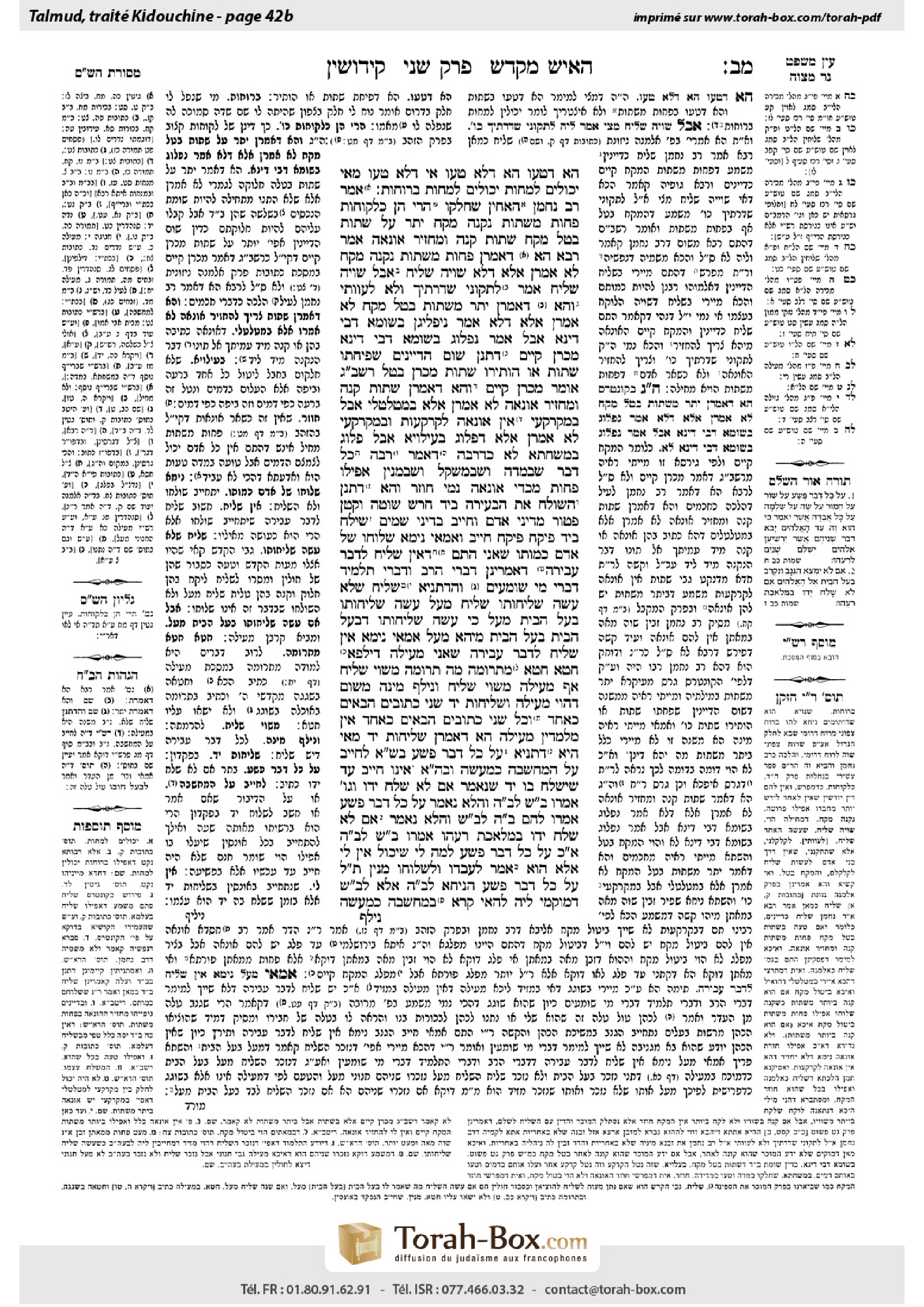
Kiddushin 42b: Talmud study for Daf Yomi
Daf Yomi is the daily study of one Talmud folio. Explore 37 tractates with scans, Hebrew text, Sefaria English and AI-generated French translations where annotated.
Passage selection and English or AI-generated French translation are available where the scan has annotations. Daf Study is independent of Torah-Box and Sefaria.
Browse Kiddushin · קידושין · All tractatesKiddushin 42b text and translations
This page of Kiddushin includes the Aramaic text, an English translation and an AI-generated French translation, alongside the scan above.
קידושין מ״ב ב · Aramaic and Hebrew text
הָא – דִּטְעוֹ, הָא – דְּלָא טְעוֹ. אִי דְּלָא טְעוֹ, מַאי יְכוֹלִים לְמַחוֹת? יְכוֹלִים לְמַחוֹת בְּרוּחוֹת.
אָמַר רַב נַחְמָן: הָאַחִין שֶׁחָלְקוּ הֲרֵי הֵן כְּלָקוֹחוֹת. פָּחוֹת מִשְּׁתוּת – נִקְנֶה מִקָּח. יָתֵר עַל שְׁתוּת – בָּטֵל מִקָּח. שְׁתוּת – קָנָה, וּמַחְזִיר אוֹנָאָה.
אָמַר רָבָא: הָא דַּאֲמַרַן ״פָּחוֹת מִשְּׁתוּת – נִקְנֶה מִקָּח״ – לָא אֲמַרַן אֶלָּא דְּלָא שַׁוְּיֵהּ שָׁלִיחַ, אֲבָל שַׁוְּיֵהּ שָׁלִיחַ, אָמַר: לְתַקּוֹנֵי שַׁדַּרְתָּיךָ וְלָא לְעַוּוֹתֵי.
וְהָא דַּאֲמַרַן ״יָתֵר מִשְּׁתוּת – בָּטֵל מִקָּח״ – לָא אֲמַרַן אֶלָּא דְּלָא אָמַר (נִיפְלִיגַן) [נִפְלוֹג] בְּשׁוּמָא דְּבֵי דִינָא, אֲבָל אָמַר נִפְלוֹג בְּשׁוּמָא דְּבֵי דִינָא – מִכְרָן קַיָּים, דִּתְנַן: שׁוּם הַדַּיָּינִים שֶׁפִּיחֲתוּ שְׁתוּת אוֹ הוֹתִירוּ שְׁתוּת – מִכְרָן בָּטֵל. רַבָּן שִׁמְעוֹן בֶּן גַּמְלִיאֵל אוֹמֵר: מִכְרָן קַיָּים.
וְהָא דַּאֲמַרַן ״שְׁתוּת – קָנָה, וּמַחְזִיר אוֹנָאָה״ – לָא אֲמַרַן אֶלָּא בְּמִטַּלְטְלֵי, אֲבָל בִּמְקַרְקְעֵי – אֵין אוֹנָאָה לְקַרְקָעוֹת. וּבִמְקַרְקְעֵי לָא אֲמַרַן, אֶלָּא דִּפְלוּג בְּעִילּוּיָא, אֲבָל פְּלוּג בְּמִשְׁחֲתָא – לָא, כִּדְרַבָּה. דְּאָמַר רַבָּה: כׇּל דָּבָר שֶׁבְּמִדָּה וְשֶׁבְּמִשְׁקָל וְשֶׁבְּמִנְיָן, אֲפִילּוּ פָּחוֹת מִכְּדֵי אוֹנָאָה – נָמֵי חוֹזֵר.
וְהָא דִּתְנַן: הַשּׁוֹלֵחַ אֶת הַבְּעֵירָה בְּיַד חֵרֵשׁ שׁוֹטֶה וְקָטָן – פָּטוּר מִדִּינֵי אָדָם, וְחַיָּיב בְּדִינֵי שָׁמַיִם. שִׁילַּח בְּיַד פִּיקֵּחַ – פִּיקֵּחַ חַיָּיב.
וְאַמַּאי? נֵימָא: שְׁלוּחוֹ שֶׁל אָדָם כְּמוֹתוֹ! שָׁאנֵי הָתָם דְּאֵין שָׁלִיחַ לִדְבַר עֲבֵירָה. דְּאָמְרִינַן: דִּבְרֵי הָרַב וְדִבְרֵי תַּלְמִיד – דִּבְרֵי מִי שׁוֹמְעִים?
וְהָדְתַנְיָא: שָׁלִיחַ שֶׁלֹּא עָשָׂה שְׁלִיחוּתוֹ – שָׁלִיחַ מָעַל, עָשָׂה שְׁלִיחוּתוֹ – בַּעַל הַבַּיִת מָעַל. כִּי עָשָׂה שְׁלִיחוּתוֹ דְּבַעַל הַבַּיִת – בַּעַל הַבַּיִת מִיהָא מָעַל. אַמַּאי? נֵימָא: אֵין שָׁלִיחַ לִדְבַר עֲבֵירָה!
שָׁאנֵי מְעִילָה, דְּיָלְפָא ״חֵטְא״ ״חֵטְא״ מִתְּרוּמָה: מָה תְּרוּמָה מְשַׁוֵּי שָׁלִיחַ – אַף מְעִילָה מְשַׁוֵּי שָׁלִיחַ.
וְנֵילַף מִינַּהּ! מִשּׁוּם דְּהָוֵי מְעִילָה וּשְׁלִיחוּת יָד שְׁנֵי כְּתוּבִים הַבָּאִים כְּאֶחָד, וְכֹל שְׁנֵי כְתוּבִים הַבָּאִים כְּאֶחָד אֵין מְלַמְּדִין. מְעִילָה – הָא דַּאֲמַרַן. שְׁלִיחוּת יָד מַאי הִיא?
דְּתַנְיָא: ״עַל כׇּל דְּבַר פֶּשַׁע״, בֵּית שַׁמַּאי אוֹמְרִים: לְחַיֵּיב עַל הַמַּחְשָׁבָה כְּמַעֲשֶׂה. וּבֵית הִלֵּל אוֹמְרִים: אֵינוֹ חַיָּיב עַד שֶׁיִּשְׁלַח בּוֹ יָד, שֶׁנֶּאֱמַר: ״אִם לֹא שָׁלַח יָדוֹ וְגוֹ׳״.
אָמְרוּ בֵּית שַׁמַּאי לְבֵית הִלֵּל: וַהֲלֹא נֶאֱמַר ״עַל כׇּל דְּבַר פֶּשַׁע״! אָמְרוּ לָהֶם בֵּית הִלֵּל לְבֵית שַׁמַּאי: וַהֲלֹא נֶאֱמַר ״אִם לֹא שָׁלַח יָדוֹ בִּמְלֶאכֶת רֵעֵהוּ״! אָמְרוּ בֵּית שַׁמַּאי לְבֵית הִלֵּל: אִם כֵּן, ״עַל כׇּל דְּבַר פֶּשַׁע״ לְמָה לִי? שֶׁיָּכוֹל אֵין לִי אֶלָּא הוּא, אָמַר לְעַבְדּוֹ וְלִשְׁלוּחוֹ מִנַּיִן – תַּלְמוּד לוֹמַר: ״עַל כׇּל דְּבַר פֶּשַׁע״.
הָנִיחָא לְבֵית הִלֵּל. אֶלָּא לְבֵית שַׁמַּאי, דְּמוֹקְמִי לֵיהּ לְהַאי קְרָא בְּמַחְשָׁבָה כְּמַעֲשֶׂה,
Kiddushin 42b · English translation
In this case, where Rav Naḥman ruled that their transaction is void, in accordance with the Rabbis, the court erred by one-sixth. But in that case, where Rav Naḥman ruled that the orphans cannot protest when they grow up, they did not err by one-sixth. The Gemara asks: If Rav Naḥman’s ruling that the orphans cannot protest is referring to a case where they did not err by one-sixth, why did Shmuel say that they can later protest; what is the nature of their protest? The Gemara answers: They can protest with regard to the locations. One of the orphans can contend that he prefers property in a different location than he was given.
§ Rav Naḥman says: With regard to brothers who divided property received as an inheritance, they are considered like they are purchasers from each other, and the halakhot of fraud are like those for regular transactions: If there was an error of less than one-sixth in the distribution, the transaction is acquired, i.e., valid. If it was more than one-sixth, the transaction is void. If the error was precisely one-sixth, it is acquired, and the one who received more than his fair share must return the amount of the fraud.
Rava says: That which we said, that with regard to less than one-sixth the transaction is valid and the item is acquired, we said only in a case where the brother receiving a smaller share did not appoint an agent to deal with the distribution on his behalf. But if the brother receiving a smaller share appointed an agent, this halakha does not apply, as the one who appointed the agent can say: I sent you to act for my benefit and not to my detriment. The agent’s right to act in this capacity did not extend to a case where it was to the detriment of the one who appointed him.
Rava continues: And that which we said, that if the brothers erred by more than one-sixth the transaction is void, we said only when the brother receiving a smaller share did not say: Let us divide the estate by an appraisal of the court. But if he said: Let us divide it by an appraisal of the court, the transaction is valid, as we learned in a mishna (Ketubot 99b): This is the halakha with regard to the appraisal of an article’s value in order to sell it, as done by the judges: In a case where they decreased the price by one-sixth of its market value or added one-sixth to its market value, their sale is void. Rabban Shimon ben Gamliel says: Their sale is valid.
Rava continues: And that which we said, that if the brothers erred by one-sixth the one receiving a larger share acquired it and he must return the amount of the fraud, we said only with regard to movable property. But with regard to land, the halakha is that there is no fraud with regard to land. And with regard to land, we said that the halakha of fraud does not apply only when they divided it according to the value of the land. But if they divided it by measure and erred in the measurement, we do not say that there is no fraud. This is in accordance with the statement of Rabba, as Rabba said: Any matter that is according to measure, or according to weight, or according to number, if it turned out to be in error, even if the error was less than the amount that constitutes fraud, it is also returned.
§ The Gemara returns to discuss various aspects of agency. And there is a difficulty from that which we learned in a mishna (Bava Kamma 59b): In the case of one who sends an item that causes a fire in the hands of a deaf-mute, an imbecile, or a minor, the one who sent it is exempt according to human laws but liable according to the laws of Heaven. If he sent it in the hands of a halakhically competent person, only the halakhically competent person is liable.
But why is the halakhically competent person liable? Let us say that the legal status of a person’s agent is like that of himself. The Gemara answers: There it is different, as there is no agency for transgression, as we say: When there is a conflict between the words of the Master, i.e., God, and the words of the student, i.e., a human being, whose words should be listened to? Consequently, the agent is considered to have acted of his own accord, and the one who sent him bears no responsibility.
The Gemara comments: And there is a difficulty from that which is taught in a baraita with regard to the halakhot of misuse of consecrated property: In the case of an agent who did not perform his agency but deviated from the instructions of the one who appointed him and made use of consecrated property, the agent has misused consecrated property and is liable to bring the guilt-offering for that sin. In the case of an agent who performed his agency, the owner has misused consecrated property and is liable to bring the offering. The Gemara asks: The baraita states that when the agent performed the agency of the owner, the owner has in any event misused consecrated property. Why? Let us say that there is no agency for transgression.
The Gemara answers: The case of misuse of consecrated property is different, as it is derived by means of a verbal analogy of “sin” in this case and “sin” from teruma, as the verse states: “And sin through error” (Leviticus 5:15), with regard to misuse of consecrated property, and it states: “Lest they bear sin for it” (Leviticus 22:9) with regard to teruma: Just as with teruma one can appoint an agent, so too with misuse of consecrated property one can appoint an agent, although the latter is a transgression.
The Gemara suggests: And let us derive a principle from misuse of consecrated property, that one can appoint an agent even to perform a transgression. The Gemara explains: This is not done because misuse of consecrated property and misappropriation of a deposit, i.e., a bailee using an item that was deposited with him, are two verses that come as one, i.e., they teach the same matter, that an agent can be appointed to perform a transgression. And any two verses that come as one do not teach their common aspect to apply to other cases. The Gemara clarifies this statement: The verse pertaining to misuse of consecrated property is that which we said, but what is the verse pertaining to misappropriation?
This is as it is taught in a baraita: The Torah uses the inclusive term “every” with regard to one suspected of misappropriating a deposit: “For every matter of trespass” (Exodus 22:8). Beit Shammai say: This inclusive term “every” serves to render one liable for speech and thought, i.e., intent to misappropriate, like action. And Beit Hillel say: One is liable only if he actually misappropriates it, as it is stated: “Whether he has not put his hand unto his neighbor’s goods” (Exodus 22:7).
Beit Shammai said to Beit Hillel: But isn’t it stated: “For every matter of trespass,” which indicates that one is liable without actually misappropriating the deposit? Beit Hillel said to Beit Shammai: But isn’t it stated: “Whether he has not put his hand unto his neighbor’s goods”? Beit Shammai said to Beit Hillel: If so, if one is liable only for actual misappropriation, why do I need: “For every matter of trespass”? Beit Hillel replied: It is necessary, as one might have thought that I have derived liability only if he himself misappropriated it; from where do I derive that he is liable also if he told his slave or his agent to do so? The verse states: “For every matter of trespass,” to teach that the bailee is liable if one acting on his behalf misappropriates the deposit.
The Gemara explains further: This answer, that misuse of consecrated property and misappropriation are two verses that come to teach the same matter, works out well according to the opinion of Beit Hillel. But according to the opinion of Beit Shammai, who establish this verse as rendering one liable for thought like action and do not learn from here that the bailee is liable if one acting on his behalf misappropriates the deposit,
Kiddushin 42b · Traduction française (IA)
Dans ce cas, où Rav Naḥman a statué que leur transaction est annulée, conformément à l’avis des Rabbins, le tribunal s’est trompé d’un sixième. Mais dans l’autre cas, où Rav Naḥman a statué que les orphelins ne peuvent pas contester le partage lorsqu’ils grandissent, il n’y a pas eu d’erreur d’un sixième. La Guemara demande : si la décision de Rav Naḥman selon laquelle les orphelins ne peuvent pas contester concerne un cas où il n’y a pas eu d’erreur d’un sixième, pourquoi Shmuel a-t-il dit qu’ils peuvent contester par la suite ? En quoi consiste alors leur contestation ? La Guemara répond : ils peuvent contester le choix des emplacements. L’un des orphelins peut soutenir qu’il préfère des biens situés ailleurs que ceux qui lui ont été attribués.
§ Rav Naḥman dit : Lorsque des frères se partagent des biens reçus en héritage, ils sont considérés comme des acquéreurs l’un auprès de l’autre, et les règles de la fraude sont les mêmes que pour les transactions ordinaires : si l’erreur dans le partage est inférieure à un sixième, la transaction est acquise, c’est-à-dire valide. Si elle dépasse un sixième, la transaction est annulée. Si l’erreur est exactement d’un sixième, la transaction est acquise, et celui qui a reçu plus que sa juste part doit restituer le montant de la fraude.
Rava dit : Ce que nous avons dit, à savoir que si l’erreur est inférieure à un sixième, la transaction est valide et le bien est acquis, ne s’applique que si le frère qui a reçu une part plus petite n’a pas désigné d’agent pour s’occuper du partage en son nom. Mais s’il a désigné un agent, cette halakha ne s’applique pas, car celui qui l’a désigné peut lui dire : « Je t’ai envoyé pour agir dans mon intérêt, et non à mon détriment. » Le mandat de l’agent ne s’étendait pas à un cas où son action portait préjudice à celui qui l’avait désigné.
Rava poursuit : Ce que nous avons dit, à savoir que si les frères se sont trompés de plus d’un sixième, la transaction est annulée, ne s’applique que si le frère qui a reçu une part plus petite n’a pas dit : « Partageons la succession selon l’estimation du tribunal. » Mais s’il a dit : « Partageons-la selon l’estimation du tribunal », la transaction est valide, comme nous l’avons appris dans une Michna (Ketoubot 99b) : Voici la halakha concernant l’estimation de la valeur d’un article par les juges en vue de sa vente : si ceux-ci ont diminué le prix d’un sixième de sa valeur marchande ou l’ont augmenté d’un sixième, leur vente est annulée. Rabban Shimon ben Gamliel dit : Leur vente est valide.
Rava poursuit : Ce que nous avons dit, à savoir que si les frères se sont trompés d’un sixième, celui qui a reçu la part la plus importante l’acquiert et doit restituer le montant de la fraude, ne s’applique qu’aux biens meubles. Pour les biens fonciers, la halakha est qu’il n’y a pas de fraude. Nous avons dit que cette règle s’applique aux biens fonciers uniquement lorsqu’ils ont été partagés selon leur valeur. Mais s’ils les ont partagés selon leur superficie et qu’ils se sont trompés dans la mesure, nous ne disons pas qu’il n’y a pas de fraude. Cela concorde avec l’avis de Rabba, car Rabba a dit : Tout ce qui est vendu à la mesure, au poids ou au nombre doit être rendu si une erreur est constatée, même si celle-ci est inférieure au seuil constitutif de la fraude.
§ La Guemara revient sur différents aspects de la représentation. Une difficulté se pose à partir de ce que nous avons appris dans une Michna (Bava Kama 59b) : si quelqu’un confie un objet susceptible de provoquer un incendie à un sourd-muet, à un déficient mental ou à un mineur, celui qui le lui a confié est exonéré selon le droit humain, mais responsable selon les lois du Ciel. S’il le confie à une personne juridiquement compétente, seule cette personne est responsable.
Mais pourquoi la personne juridiquement compétente est-elle responsable ? Ne devrait-on pas dire que le statut juridique de l’agent est semblable à celui de celui qui l’a désigné ? La Guemara répond : Ce cas est différent, car il n’y a pas de représentation pour une transgression, comme nous le disons : lorsqu’il y a conflit entre les paroles du Maître, c’est-à-dire Dieu, et celles de l’élève, c’est-à-dire un être humain, auxquelles doit-on obéir ? Par conséquent, on considère que l’agent a agi de son propre chef, et celui qui l’a envoyé n’en porte pas la responsabilité.
La Guemara fait remarquer : Une difficulté se pose à partir de ce qui est enseigné dans une baraïta concernant les règles du détournement de biens consacrés : si un agent n’exécute pas le mandat qui lui a été confié, mais s’écarte des instructions de celui qui l’a désigné et fait usage de biens consacrés, c’est l’agent qui a détourné ces biens et qui doit apporter le sacrifice de culpabilité pour cette faute. Si l’agent exécute son mandat, c’est le propriétaire qui a détourné les biens consacrés et qui doit apporter le sacrifice. La Guemara demande : la baraïta affirme que lorsque l’agent a exécuté le mandat du propriétaire, c’est dans tous les cas le propriétaire qui a détourné les biens consacrés. Pourquoi ? Ne devrait-on pas dire qu’il n’y a pas de représentation pour une transgression ?
La Guemara répond : Le cas du détournement de biens consacrés est différent, car on le déduit au moyen d’une analogie verbale entre le terme « faute », employé ici, et le terme « faute » à propos de la terouma. En effet, il est dit, à propos du détournement de biens consacrés : « et commet une faute par inadvertance » (Lévitique 5:15), et, à propos de la terouma : « de peur qu’ils ne portent la responsabilité d’une faute à son sujet » (Lévitique 22:9). De même qu’on peut désigner un agent pour la terouma, on peut également en désigner un pour détourner des biens consacrés, bien que cela constitue une transgression.
La Guemara suggère : Déduisons du détournement de biens consacrés le principe selon lequel on peut désigner un agent même pour accomplir une transgression. La Guemara explique : On ne le fait pas, car le détournement de biens consacrés et le détournement d’un dépôt — lorsqu’un dépositaire fait usage d’un objet qui lui a été confié — sont deux versets qui viennent enseigner la même chose, à savoir qu’on peut désigner un agent pour accomplir une transgression. Or, deux versets qui viennent enseigner la même chose ne permettent pas d’étendre leur principe commun à d’autres cas. La Guemara précise : Le verset relatif au détournement de biens consacrés est celui que nous avons cité ; mais quel est le verset relatif au détournement d’un dépôt ?
C’est ce qui est enseigné dans une baraïta : la Torah emploie le terme inclusif « tout » à propos de celui qui est soupçonné d’avoir détourné un dépôt : « pour toute affaire de détournement » (Exode 22:8). Beit Shammaï dit : ce terme inclusif « tout » rend responsable pour la parole et la pensée, c’est-à-dire pour l’intention de détourner le dépôt, comme pour l’acte. Beit Hillel dit : on n’est responsable que si l’on détourne effectivement le dépôt, comme il est dit : « s’il n’a pas porté la main sur le bien de son prochain » (Exode 22:7).
Beit Shammaï dit à Beit Hillel : « Mais n’est-il pas écrit : “pour toute affaire de détournement”, ce qui indique qu’on est responsable sans avoir effectivement détourné le dépôt ? » Beit Hillel dit à Beit Shammaï : « Mais n’est-il pas écrit : “s’il n’a pas porté la main sur le bien de son prochain” ? » Beit Shammaï dit à Beit Hillel : « Dans ce cas, si l’on n’est responsable que pour un détournement effectif, pourquoi ai-je besoin de l’expression “pour toute affaire de détournement” ? » Beit Hillel répondit : « Cette expression est nécessaire, car on aurait pu penser que je n’ai déduit la responsabilité que lorsque la personne a elle-même détourné le dépôt. D’où déduis-je qu’elle est également responsable si elle a ordonné à son esclave ou à son agent de le faire ? Le verset dit : “pour toute affaire de détournement”, pour enseigner que le dépositaire est responsable si une personne agissant en son nom détourne le dépôt. »
La Guemara explique encore : Cette réponse, selon laquelle le détournement de biens consacrés et le détournement d’un dépôt sont deux versets qui viennent enseigner la même chose, convient bien selon l’avis de Beit Hillel. Mais selon l’avis de Beit Shammaï, qui considère que ce verset rend responsable la pensée comme l’acte et ne déduit pas de ce passage que le dépositaire est responsable si une personne agissant en son nom détourne le dépôt,
Traduction française générée par IA à partir de l’édition anglaise de Sefaria. Vérifie toujours un passage avec le texte source.
Text from Sefaria: William Davidson Edition - Vocalized Aramaic (CC BY NC); William Davidson Edition - English (CC BY NC).