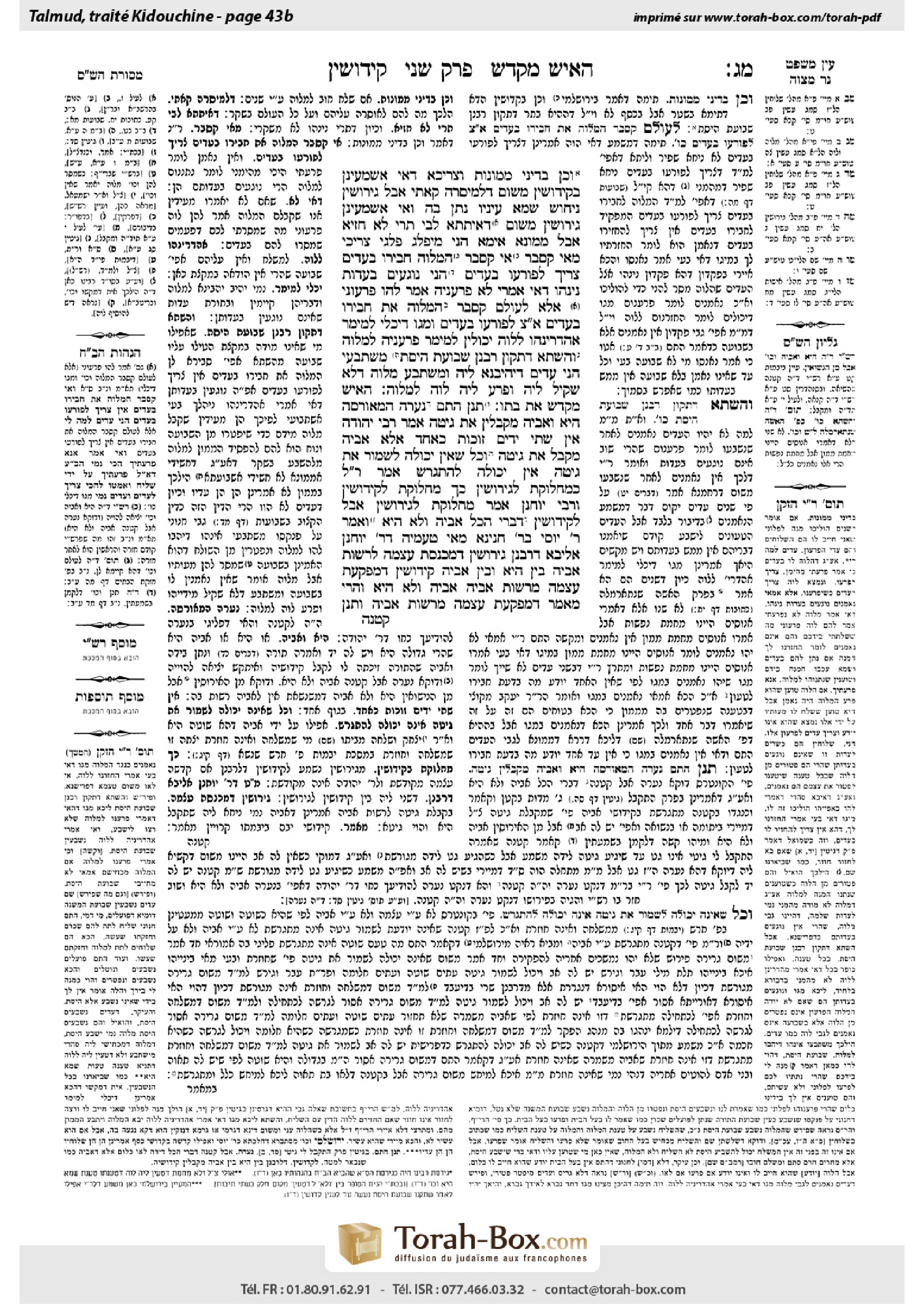
Kiddushin 43b: Talmud study for Daf Yomi
Daf Yomi is the daily study of one Talmud folio. Explore 37 tractates with scans, Hebrew text, Sefaria English and AI-generated French translations where annotated.
Passage selection and English or AI-generated French translation are available where the scan has annotations. Daf Study is independent of Torah-Box and Sefaria.
Browse Kiddushin · קידושין · All tractatesKiddushin 43b text and translations
This page of Kiddushin includes the Aramaic text, an English translation and an AI-generated French translation, alongside the scan above.
קידושין מ״ג ב · Aramaic and Hebrew text
וְכֵן בְּדִינֵי מָמוֹנוֹת.
וּצְרִיכָא דְּאִי אַשְׁמְעִינַן בְּקִידּוּשִׁין – מִשּׁוּם דִּלְמֵיסְרַהּ קָאָתֵי, אֲבָל גֵּירוּשִׁין – נֵיחוּשׁ שֶׁמָּא עֵינָיו נָתַן בָּהּ.
וְאִי אַשְׁמְעִינַן גֵּירוּשִׁין – מִשּׁוּם דְּאִיתְּתָא לְבֵי תְרֵי לָא חַזְיָא, אֲבָל מָמוֹנָא – אֵימָא: הָנֵי מִיפְלָג פָּלְגִי. צְרִיכִי.
מַאי קָסָבַר? אִי קָסָבַר הַמַּלְוֶה חֲבֵירוֹ בְּעֵדִים צָרִיךְ לְפוֹרְעוֹ בְּעֵדִים – הָנֵי נוֹגְעִים בְּעֵדוּת נִינְהוּ, דְּאִי אָמְרִי: ״לָא פְּרַעְנֵיהּ״ אָמַר לְהוּ: ״פְּרָעוּנִי״!
אֶלָּא לְעוֹלָם קָסָבַר: הַמַּלְוֶה אֶת חֲבֵירוֹ בְּעֵדִים אֵין צָרִיךְ לְפוֹרְעוֹ בְּעֵדִים, וּמִגּוֹ דְּיָכְלִי לְמֵימַר: ״אַהְדְּרִינְהוּ לְלֹוֶה״, יְכוֹלִין לְמֵימַר: ״פְּרַעְנֵיהּ לְמַלְוֶה״.
וְהַשְׁתָּא דְּתַקּוּן רַבָּנַן שְׁבוּעַת הֶיסֵּת – מִשְׁתַּבְעִי הָנֵי עֵדִים דְּיָהֵיבְנָא לֵיהּ, וּמִשְׁתְּבַע מַלְוֶה דְּלָא שָׁקֵיל לֵיהּ, וּפָרַע לֵיהּ לֹוֶה לְמַלְוֶה.
הָאִישׁ מְקַדֵּשׁ אֶת בִּתּוֹ. תְּנַן הָתָם: נַעֲרָה הַמְאוֹרָסָה – הִיא וְאָבִיהָ מְקַבְּלִין אֶת גִּיטָּהּ. אָמַר רַבִּי יְהוּדָה: אֵין שְׁתֵּי יָדַיִם זוֹכוֹת כְּאֶחָד, אֶלָּא אָבִיהָ מְקַבֵּל אֶת גִּיטָּהּ. וְכֹל שֶׁאֵין יְכוֹלָה לִשְׁמוֹר אֶת גִּיטָּהּ – אֵין יְכוֹלָה לְהִתְגָּרֵשׁ.
אָמַר רֵישׁ לָקִישׁ: כְּמַחְלוֹקֶת לְגֵירוּשִׁין, כָּךְ מַחְלוֹקֶת לְקִידּוּשִׁין. וְרַבִּי יוֹחָנָן אָמַר: מַחְלוֹקֶת לְגֵירוּשִׁין, אֲבָל לְקִידּוּשִׁין – דִּבְרֵי הַכֹּל אָבִיהָ וְלֹא הִיא.
וְאָמַר רַבִּי יוֹסֵי בְּרַבִּי חֲנִינָא: מַאי טַעְמֵיהּ דְּרַבִּי יוֹחָנָן אַלִּיבָּא דְּרַבָּנַן? גֵּירוּשִׁין, דְּמַכְנֶסֶת עַצְמָהּ לִרְשׁוּת אָבִיהָ – בֵּין הִיא וּבֵין אָבִיהָ. קִידּוּשִׁין, דְּמַפְקַעַת עַצְמָהּ מֵרְשׁוּת אָבִיהָ – אָבִיהָ וְלֹא הִיא.
וַהֲרֵי מַאֲמָר, דְּמַפְקַעַת עַצְמָהּ מֵרְשׁוּת אָבִיהָ, וּתְנַן:
Kiddushin 43b · English translation
And a similar halakha applies with regard to cases of monetary law. If one appoints agents to perform a transaction for him, e.g., paying a debt to his creditor, they can testify that he has paid.
The Gemara comments: And it is necessary for Rav Naḥman to teach this halakha in each of these legal domains, as had he taught us this halakha only in the case of betrothal one could say that the agents can serve as witnesses because they are coming to render her forbidden to everyone else, and therefore there is no reason to suspect them of lying, as their testimony renders her forbidden to them as well. But with regard to divorce, we should be concerned that perhaps the agent cast his eyes upon her and is testifying falsely so that he can marry her.
And had Rav Naḥman taught us this halakha only in the case of divorce, it could have been said that the agents are not suspected of lying because a woman is not fit for marrying two people, and since they testify as a pair there is no concern that they both might have designs upon her. But with regard to money, one might say that these two can divide it between them, and perhaps they never paid the debt but kept the money themselves. Therefore, all the examples are necessary.
The Gemara asks: What does Rav Naḥman hold? If he holds that in the case of one who lends money to another in the presence of witnesses, the debtor must repay him in the presence of witnesses, then these agents are affected by their testimony. As, if they say: We did not repay him but returned the money to the one who appointed us, then the one who appointed them will say to them: Pay me back the money I gave you to repay the debt. The agents are considered as the debtors of the one who appointed them, as they took money from him. They would not be deemed credible to state that they returned the money to the one who appointed them, as they do not have witnesses that they did so. Consequently, they have a financial incentive to testify falsely that they fulfilled their agency and repaid the debt.
Rather, Rav Naḥman actually holds that in the case of one who lends money to another in the presence of witnesses, the debtor does not need to repay him in the presence of witnesses. And since the agents are able to say: We returned the money to the debtor, even without there being witnesses to substantiate their claim, they can also be deemed credible to say: We repaid the creditor, as they have no financial incentive to lie.
The Gemara comments: And now, since the time of Rav Naḥman, when the Sages instituted an oath of inducement, an oath instituted by the Sages in a case where a defendant completely denies a claim, these witnesses are affected by their testimony. If they were to claim that they returned the money to the one who appointed them, they would be required to take an oath of inducement to that effect. Consequently, they have an incentive to lie and claim that they fulfilled their agency and repaid the loan. Therefore, their testimony that they fulfilled their agency is not deemed credible. Instead, these witnesses take an oath in court that they gave the money to him, i.e., the lender, and the lender in turn takes an oath that he did not take the money owed to him, and then the debtor pays the lender his debt a second time, as the Sages ruled in similar cases.
§ The mishna teaches that a man can betroth his daughter to a man when she is a young woman. We learned in a mishna there (Gittin 64b): With regard to a betrothed young woman, she and her father are each eligible to receive her bill of divorce. Rabbi Yehuda said: Two hands do not have the right to acquire an item on behalf of one person as one. If the young woman is able to acquire an item on her own, her father cannot receive her bill of divorce. Conversely, if she is not able to acquire an item on her own, only her father can receive the bill of divorce. Rather, her father alone receives her bill of divorce on her behalf. The mishna states another principle: And any female who is unable to safeguard her bill of divorce, either due to her young age or mental incompetence, is unable to be divorced, since a bill of divorce is effective only for one who understands the severing of ties that a divorce engenders.
Reish Lakish says: Just as there is a dispute with regard to divorce, as to whether both a young woman and her father can accept her bill of divorce or only the father can do so, so too there is a dispute with regard to betrothal. And Rabbi Yoḥanan says: The dispute is with regard to divorce, but with regard to betrothal everyone agrees that her father has the right to accept it but not her.
And Rabbi Yosei, son of Rabbi Ḥanina, said: What is the reason of Rabbi Yoḥanan, in accordance with the opinion of the Rabbis, that there is a distinction between divorce and betrothal? In the case of divorce, when she brings herself back into her father’s authority by means of the bill of divorce, it is considered as though the father has obtained the bill of divorce via his daughter, and therefore either she or her father can receive it. In the case of betrothal, where she removes herself from her father’s authority, she cannot do this by herself. Consequently, only her father can accept the betrothal, but not her.
The Gemara asks: But isn’t there the case of levirate betrothal, where the yevama removes herself from her father’s authority, and yet we learned in a baraita:
Kiddushin 43b · Traduction française (IA)
Une halakha similaire s’applique également aux affaires pécuniaires. Si quelqu’un désigne des mandataires pour effectuer une transaction en son nom, par exemple pour rembourser une dette à son créancier, ils peuvent témoigner qu’il a payé.
La Guemara fait remarquer : Rav Naḥman devait enseigner cette halakha dans chacun de ces domaines juridiques. En effet, s’il nous avait enseigné cette halakha uniquement dans le cas des fiançailles, on aurait pu dire que les mandataires peuvent servir de témoins parce qu’ils viennent la rendre interdite à tous les autres ; il n’y aurait donc aucune raison de les soupçonner de mentir, puisque leur témoignage la rend également interdite à eux-mêmes. Mais, en matière de divorce, on pourrait craindre que le mandataire ait jeté son dévolu sur elle et témoigne faussement afin de pouvoir l’épouser.
Et si Rav Naḥman nous avait enseigné cette halakha uniquement dans le cas du divorce, on aurait pu dire que les mandataires ne sont pas soupçonnés de mentir, car une femme ne peut pas épouser deux hommes et, puisqu’ils témoignent en tant que paire, on ne craint pas qu’ils aient tous deux des vues sur elle. Mais, en matière pécuniaire, on pourrait dire que ces deux hommes peuvent se partager l’argent et qu’ils n’ont peut-être jamais remboursé la dette, mais ont gardé l’argent pour eux. Par conséquent, tous les exemples sont nécessaires.
La Guemara demande : Quelle est la position de Rav Naḥman ? S’il estime que, lorsqu’une personne prête de l’argent à une autre en présence de témoins, le débiteur doit la rembourser en présence de témoins, alors ces mandataires ont un intérêt personnel dans leur témoignage. En effet, s’ils disent : « Nous ne l’avons pas remboursé, mais avons rendu l’argent à celui qui nous a désignés », celui-ci leur dira : « Rendez-moi l’argent que je vous ai donné pour rembourser la dette. » Les mandataires sont considérés comme les débiteurs de celui qui les a désignés, puisqu’ils ont reçu de l’argent de sa part. On ne les croirait pas s’ils affirmaient lui avoir rendu l’argent, car ils n’ont pas de témoins pour établir qu’ils l’ont fait. Par conséquent, ils ont un intérêt financier à témoigner faussement qu’ils ont exécuté leur mandat et remboursé la dette.
En réalité, Rav Naḥman estime que, lorsqu’une personne prête de l’argent à une autre en présence de témoins, le débiteur n’a pas besoin de la rembourser en présence de témoins. Et puisque les mandataires peuvent dire : « Nous avons rendu l’argent au débiteur », même sans témoins pour étayer leur affirmation, on peut aussi les croire lorsqu’ils disent : « Nous avons remboursé le créancier », car ils n’ont aucun intérêt financier à mentir.
La Guemara fait remarquer : Or, depuis l’époque de Rav Naḥman, les Sages ont institué un serment d’indemnité, un serment rabbinique imposé dans le cas où un défendeur nie totalement une réclamation ; ces témoins ont donc un intérêt personnel dans leur témoignage. S’ils prétendaient avoir rendu l’argent à celui qui les a désignés, ils devraient prêter un serment d’indemnité à ce sujet. Ils ont donc intérêt à mentir et à prétendre qu’ils ont exécuté leur mandat et remboursé le prêt. Par conséquent, leur témoignage selon lequel ils ont exécuté leur mandat n’est pas jugé crédible. Ces témoins prêtent plutôt devant le tribunal le serment d’avoir remis l’argent au créancier, et le créancier prête à son tour le serment de ne pas avoir reçu l’argent qui lui était dû ; le débiteur rembourse alors une seconde fois sa dette au créancier, conformément à la décision des Sages dans des cas similaires.
§ La Michna enseigne qu’un homme peut fiancer sa fille lorsqu’elle est une jeune fille. Nous avons appris dans une Michna ailleurs (Guittin 64b) : S’agissant d’une jeune fille fiancée, elle et son père peuvent chacun recevoir son acte de divorce. Rabbi Yehouda a dit : Deux mains ne peuvent pas acquérir ensemble un bien pour une même personne. Si la jeune fille est capable d’acquérir un bien par elle-même, son père ne peut pas recevoir son acte de divorce. À l’inverse, si elle n’est pas capable d’acquérir un bien par elle-même, seul son père peut recevoir l’acte de divorce. Son père reçoit donc seul l’acte de divorce en son nom. La Michna énonce un autre principe : Toute femme incapable de garder son acte de divorce, que ce soit en raison de son jeune âge ou d’une déficience mentale, ne peut pas être répudiée, car un acte de divorce n’est valable que pour celle qui comprend la rupture des liens qu’entraîne le divorce.
Reish Lakish dit : De même qu’il existe une controverse au sujet du divorce — à savoir si la jeune fille et son père peuvent tous deux accepter son acte de divorce ou si seul son père le peut —, il existe également une controverse au sujet des fiançailles. Rabbi Yoḥanan dit : La controverse concerne le divorce, mais, en matière de fiançailles, tous conviennent que son père a le droit de les accepter, et non elle.
Et Rabbi Yosei, fils de Rabbi Ḥanina, a dit : Quelle est la raison de Rabbi Yoḥanan, selon l’opinion des Rabbins, pour établir une distinction entre le divorce et les fiançailles ? Dans le cas du divorce, lorsqu’elle réintègre l’autorité de son père au moyen de l’acte de divorce, c’est comme si le père avait obtenu cet acte par l’intermédiaire de sa fille ; elle ou son père peut donc le recevoir. Dans le cas des fiançailles, où elle se soustrait à l’autorité de son père, elle ne peut pas le faire par elle-même. Par conséquent, seul son père peut accepter les fiançailles, et non elle.
La Guemara demande : Mais le cas des fiançailles léviratiques ne fait-il pas difficulté ? La yevama se soustrait alors à l’autorité de son père, et pourtant nous avons appris dans une baraïta :
Traduction française générée par IA à partir de l’édition anglaise de Sefaria. Vérifie toujours un passage avec le texte source.
Text from Sefaria: William Davidson Edition - Vocalized Aramaic (CC BY NC); William Davidson Edition - English (CC BY NC).