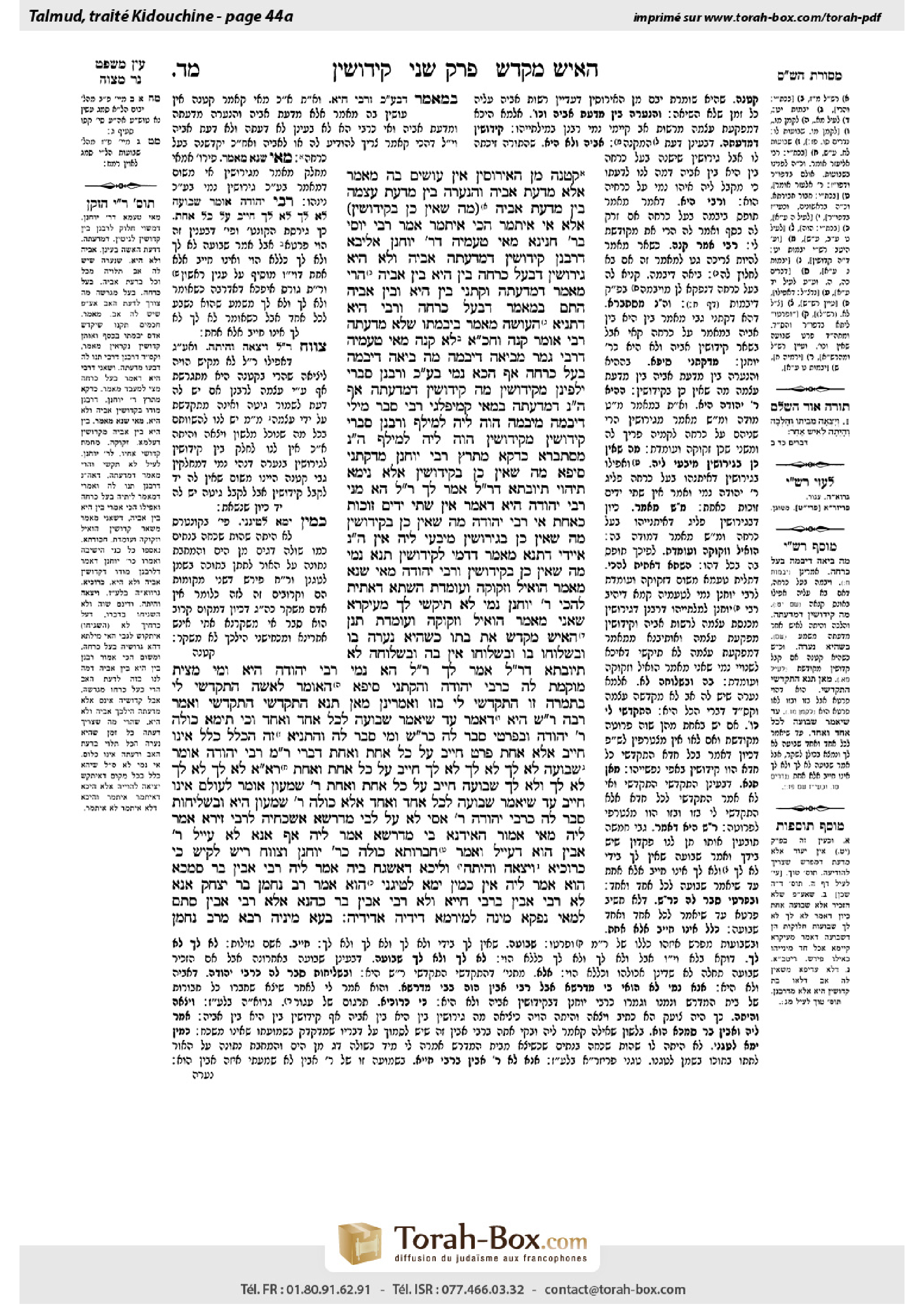
Kiddushin 44a: Talmud study for Daf Yomi
Daf Yomi is the daily study of one Talmud folio. Explore 37 tractates with scans, Hebrew text, Sefaria English and AI-generated French translations where annotated.
Passage selection and English or AI-generated French translation are available where the scan has annotations. Daf Study is independent of Torah-Box and Sefaria.
Browse Kiddushin · קידושין · All tractatesKiddushin 44a text and translations
This page of Kiddushin includes the Aramaic text, an English translation and an AI-generated French translation, alongside the scan above.
קידושין מ״ד א · Aramaic and Hebrew text
קְטַנָּה מִן הָאֵירוּסִין – אֵין עוֹשִׂים בָּהּ מַאֲמָר אֶלָּא מִדַּעַת אָבִיהָ. וְהַנַּעֲרָה – בֵּין מִדַּעַת עַצְמָהּ בֵּין מִדַּעַת אָבִיהָ, (מַה שֶּׁאֵין כֵּן בְּקִידּוּשִׁין).
אֶלָּא אִי אִיתְּמַר, הָכִי אִיתְּמַר: אָמַר רַבִּי יוֹסֵי בְּרַבִּי חֲנִינָא: מַאי טַעְמֵיהּ דְּרַבִּי יוֹחָנָן אַלִּיבָּא דְּרַבָּנַן? קִידּוּשִׁין, דְּמִדַּעְתַּהּ – אָבִיהָ וְלָא הִיא. גֵּירוּשִׁין, דִּבְעַל כֻּרְחַהּ – בֵּין הִיא בֵּין אָבִיהָ.
הֲרֵי מַאֲמָר, דְּמִדַּעְתַּהּ, וְקָתָנֵי: בֵּין הִיא וּבֵין אָבִיהָ! הָתָם בְּמַאֲמָר דִּבְעַל כֻּרְחַהּ, וְרַבִּי הִיא. דְּתַנְיָא: הָעוֹשֶׂה מַאֲמָר בִּיבִמְתּוֹ שֶׁלֹּא מִדַּעְתָּהּ, רַבִּי אוֹמֵר: קָנָה, וַחֲכָמִים אוֹמְרִים לֹא קָנָה.
מַאי טַעְמֵיהּ דְּרַבִּי? גָּמַר מִבִּיאָה דִיבָמָה, מָה בִּיאָה דִיבָמָה בְּעַל כֻּרְחַהּ – אַף הָכָא נָמֵי בְּעַל כֻּרְחַהּ. וְרַבָּנַן סָבְרִי: יָלְפִינַן מִקִּידּוּשִׁין, מָה קִידּוּשִׁין דְּמִדַּעְתַּהּ – אַף הָכָא נָמֵי דְּמִדַּעְתַּהּ.
בְּמַאי קָמִיפַּלְגִי? רַבִּי סָבַר: מִילֵּי דִיבָמָה מִיבָמָה הֲוָה לֵיהּ לְמֵילַף. וְרַבָּנַן סָבְרִי: קִידּוּשִׁין מִקִּידּוּשִׁין הֲוָה לֵיהּ לְמֵילַף.
הָכִי נָמֵי מִסְתַּבְּרָא כִּדְקָא מְתָרֵץ רַבִּי יוֹחָנָן, מִדְּקָתָנֵי סֵיפָא: ״מַה שֶּׁאֵין כֵּן בְּקִידּוּשִׁין״. אֶלָּא נֵימָא תֶּיהְוֵי תְּיוּבְתָּא דְּרֵישׁ לָקִישׁ? אָמַר לָךְ רֵישׁ לָקִישׁ: הָא מַנִּי – רַבִּי יְהוּדָה הִיא, דְּאָמַר: אֵין שְׁתֵּי יָדַיִם זוֹכוֹת כְּאַחַת.
אִי רַבִּי יְהוּדָה, מַה שֶּׁאֵין כֵּן בְּקִידּוּשִׁין?! מַה שֶּׁאֵין כֵּן בְּגֵירוּשִׁין מִיבְּעֵי לֵיהּ! אִין הָכִי נָמֵי, אַיְּידֵי דִּתְנָא מַאֲמָר דְּדָמֵי לְקִידּוּשִׁין, תְּנָא נָמֵי: מַה שֶּׁאֵין כֵּן בְּקִידּוּשִׁין.
וְרַבִּי יְהוּדָה, מַאי שְׁנָא מַאֲמָר? הוֹאִיל וּזְקוּקָה וְעוֹמֶדֶת. הַשְׁתָּא דְּאָתֵית לְהָכִי, רַבִּי יוֹחָנָן נָמֵי לָא תִּיקְשֵׁי לָךְ מֵעִיקָּרָא: שָׁאנֵי מַאֲמָר, הוֹאִיל וּזְקוּקָה וְעוֹמֶדֶת.
תְּנַן: הָאִישׁ מְקַדֵּשׁ אֶת בִּתּוֹ כְּשֶׁהִיא נַעֲרָה, בּוֹ וּבִשְׁלוּחוֹ. בּוֹ וּבִשְׁלוּחוֹ – אִין, בָּהּ וּבִשְׁלוּחָהּ – לָא, תְּיוּבְתָּא דְּרֵישׁ לָקִישׁ! אָמַר לָךְ רֵישׁ לָקִישׁ: הָא נָמֵי רַבִּי יְהוּדָה הִיא.
וּמִי מָצֵית מוֹקְמַתְּ לַהּ כְּרַבִּי יְהוּדָה? וְהָקָתָנֵי סֵיפָא: הָאוֹמֵר לְאִשָּׁה: ״הִתְקַדְּשִׁי לִי בִּתְמָרָה זוֹ״, ״הִתְקַדְּשִׁי לִי בָּזוֹ״ וְאָמְרִינַן: מַאן תַּנָּא ״הִתְקַדְּשִׁי״ ״הִתְקַדְּשִׁי״?
וְאָמַר רַבָּה: רַבִּי שִׁמְעוֹן הִיא, דְּאָמַר: עַד שֶׁיֹּאמַר שְׁבוּעָה לְכׇל אֶחָד וְאֶחָד!
וְכִי תֵּימָא כּוּלַּהּ רַבִּי יְהוּדָה, וּבִפְרָטֵי סָבַר לַהּ כְּרַבִּי שִׁמְעוֹן, וּמִי סָבַר לַהּ?
וְהָתַנְיָא: זֶה הַכְּלָל: כָּלַל – אֵינוֹ חַיָּיב אֶלָּא אַחַת, פָּרַט – חַיָּיב עַל כׇּל אַחַת וְאַחַת, דִּבְרֵי רַבִּי מֵאִיר. רַבִּי יְהוּדָה אוֹמֵר: ״שְׁבוּעָה לֹא לָךְ, לֹא לָךְ, לֹא לָךְ״ – חַיָּיב עַל כׇּל אַחַת וְאַחַת. רַבִּי אֱלִיעֶזֶר אוֹמֵר: ״לֹא לָךְ, לֹא לָךְ, לֹא לָךְ וְלֹא לָךְ שְׁבוּעָה״ – חַיָּיב עַל כׇּל אַחַת וְאַחַת. רַבִּי שִׁמְעוֹן אוֹמֵר: לְעוֹלָם אֵינוֹ חַיָּיב עַד שֶׁיֹּאמַר שְׁבוּעָה לְכׇל אֶחָד וְאֶחָד.
אֶלָּא: כּוּלַּהּ רַבִּי שִׁמְעוֹן הִיא, וּבִשְׁלִיחוּת סָבַר לַהּ כְּרַבִּי יְהוּדָה.
רַבִּי אַסִּי לָא עָל לְבֵי מִדְרְשָׁא. אַשְׁכְּחֵיהּ לְרַבִּי זֵירָא, אֲמַר לֵיהּ: מַאי אֲמוּר הָאִידָּנָא בֵּי מִדְרְשָׁא? אֲמַר לֵיהּ: אַף אֲנָא לָא עֲיַילִ[י], רַבִּי אָבִין הוּא דְּעָיֵיל וַאֲמַר: חַבְרוּתָא כּוּלַּהּ כְּרַבִּי יוֹחָנָן. וּצְוַוח רֵישׁ לָקִישׁ כִּי כְרוּכְיָא: ״וְיָצְאָה. וְהָיְתָה״, וְלֵיכָּא דְּאַשְׁגַּח בֵּיהּ. אֲמַר לֵיהּ: רַבִּי אָבִין בַּר סַמְכָא הוּא? אֲמַר לֵיהּ: אִין, כְּמִין יַמָּא לְטִיגְנֵי הוּא.
אָמַר רַב נַחְמָן בַּר יִצְחָק: אֲנָא, לָא רַבִּי אָבִין בְּרַבִּי חִיָּיא, וְלָא רַבִּי אָבִין בַּר כָּהֲנָא, אֶלָּא רַבִּי אָבִין סְתָם. לְמַאי נָפְקָא מִינַּהּ? לְמִירְמֵא דִּידֵיהּ אַדִּידֵיהּ.
בְּעָא מִינֵּיהּ רָבָא מֵרַב נַחְמָן:
Kiddushin 44a · English translation
If a minor girl was widowed after her betrothal, a surviving brother of her betrothed can perform levirate betrothal only with the consent of her father. And in the case of a young woman, he can do so either with her consent [mida’at atzmah] or with the consent of her father, unlike the halakha with regard to standard betrothal. This indicates that a young woman can accept levirate betrothal on her own, despite the fact that it removes her from her father’s authority.
Rather, if it was stated, it was stated like this: Rabbi Yosei, son of Rabbi Ḥanina, says: What is the reason of Rabbi Yoḥanan, in accordance with the opinion of the Rabbis? With regard to betrothal, which takes effect only with the consent of the one who accepts the betrothal, her father can accept it but not her, since betrothal requires his approval. With regard to a bill of divorce, which can be given without her consent, either she or her father can receive it.
The Gemara asks: But isn’t levirate betrothal valid only with her consent, like other betrothals, and yet it teaches in the baraita that either she or her father can accept it? The Gemara answers: There it is referring to levirate betrothal that is performed against her will, and it is in accordance with the opinion of Rabbi Yehuda HaNasi. As it is taught in a baraita: If a yavam performs levirate betrothal with his yevama without her consent, Rabbi Yehuda HaNasi says: The yavam acquires her. And the Rabbis say: He does not acquire her.
The Gemara clarifies: What is the reason of Rabbi Yehuda HaNasi? He derives the halakha of levirate betrothal from the halakha of sexual intercourse that a yavam engages in with a yevama: Just as intercourse with the yevama renders her acquired even if it is done against her will, so too here, in the case of levirate betrothal, the yavam can betroth her against her will. And the Rabbis hold that we derive the halakha of levirate betrothal from standard betrothal: Just as betrothal can be performed only with her consent, so too here, levirate betrothal can be performed only with her consent.
The Gemara clarifies: With regard to what do they disagree? Rabbi Yehuda HaNasi holds that one should derive matters involving a yevama from other matters involving a yevama, and the marriage between a yevama and a yavam can be formalized against her will. And the Rabbis hold that one should derive matters involving betrothal from the halakhot of betrothal, as levirate betrothal is structured like standard betrothal in other respects.
The Gemara comments: So too, it is reasonable to rule with regard to betrothal as Rabbi Yoḥanan explains, that only the father can accept betrothal, from the fact that it teaches in the latter clause of the baraita that with regard to levirate betrothal, in the case of a young woman, the yavam can perform it either with her consent or with the consent of her father, unlike the halakha with regard to standard betrothal. This indicates that she can be betrothed in standard betrothal only with her father’s agreement. The Gemara asks: Then shall we say that this should be a conclusive refutation of the opinion of Reish Lakish, who holds that according to the Rabbis a young woman can also accept her own betrothal? The Gemara answers: Reish Lakish could have said to you: In accordance with whose opinion is this baraita? It is in accordance with the opinion of Rabbi Yehuda, who says: Two hands do not acquire an item as one.
The Gemara asks: If it is in accordance with the opinion of Rabbi Yehuda, why does the baraita state: Unlike the halakha with regard to standard betrothal? It should have stated: Unlike the halakha with regard to divorce, as Rabbi Yehuda stated his opinion in the mishna with regard to divorce, not betrothal. The Gemara answers: Yes, it is indeed so, it should have referred to divorce, but since it taught the halakha of levirate betrothal, which is similar to betrothal, it also taught: Unlike the halakha with regard to standard betrothal.
The Gemara asks: And according to the opinion of Rabbi Yehuda, in what way is levirate betrothal different from divorce? Why can a young woman accept the former but not receive a bill of divorce, when both levirate betrothal and divorce can be performed without her consent? The Gemara answers: The halakha of levirate betrothal is different. Since she is bonded to the yavam and standing in wait for him, acceptance of the betrothal money by the yevama suffices to effect the levirate betrothal. The Gemara comments: Now that you have arrived at this explanation, the statement of Rabbi Yoḥanan also should not pose a difficulty for you from the outset. One cannot question his statement with regard to the Rabbis’ opinion in the case of betrothal. Levirate betrothal is different, since the yevama is bonded to the yavam and standing in wait for him.
We learned in the mishna that a man can betroth his daughter to a man when she is a young woman, by himself or by means of his agent. The Gemara analyzes this: Yes, he can betroth her by himself or by means of his agent, but no, she cannot become betrothed by herself or by means of her agent. This is a conclusive refutation of Reish Lakish, who holds that according to the opinion of the Rabbis a young woman can accept her own betrothal. The Gemara answers: Reish Lakish could have said to you: This mishna too is in accordance with the opinion of Rabbi Yehuda.
The Gemara asks: But can you establish this mishna in accordance with the opinion of Rabbi Yehuda? But the last clause, in the following mishna (46b), teaches: In the case of one who says to a woman: Be betrothed to me with this date and adds: Be betrothed to me with that date, she is betrothed only if one of them is worth one peruta on its own. And we say: Who is the tanna who taught that the two dates are valued separately only if he said: Become betrothed and: Become betrothed, in a separate statement when giving each date, but that if he said: Become betrothed, only once, the value of the two dates are added together?
And Rabba said: It is Rabbi Shimon, who says that one is not liable to bring multiple offerings for taking false oaths to multiple people in the same utterance. For example, if one says: I take an oath that I do not have your item, nor yours, nor yours, he brings a single offering. This is the halakha unless one states an expression of an oath to each and every one of the plaintiffs, by stating: I take an oath I do not have yours; I take an oath I do not have yours, in which case he brings multiple offerings. Consequently, the tanna of this mishna is Rabbi Shimon, not Rabbi Yehuda.
And if you would say that the tanna of the entire mishna concerning betrothal is Rabbi Yehuda, and that with regard to the specification of separate oaths he holds in accordance with the opinion of Rabbi Shimon, this cannot be. But does he in fact hold in accordance with the opinion of Rabbi Shimon with regard to the specification of separate oaths?
But isn’t it taught in a baraita: This is the principle with regard to one’s liability to bring offerings for a false oath: If he included all the statements in one oath he is liable for only one oath, but if he specified them, he is liable for each and every one; this is the statement of Rabbi Meir. Rabbi Yehuda says: If one said: I take an oath that I do not have your deposit, nor yours, nor yours, nor yours, and he was found to have taken a false oath, he is liable to bring an offering for each and every one. Rabbi Eliezer says: If he said: I do not have yours, nor yours, nor yours, and nor yours, I take an oath, then he is liable for each and every one. Since he stated the oath at the end, it refers back to each element of his statement. Rabbi Shimon says: He is liable to bring more than one offering only if he states an expression of an oath for each and every one. This indicates that Rabbi Yehuda disagrees with Rabbi Shimon with regard to the question of when oaths are considered distinct.
Rather, the Gemara explains in the opposite manner: The tanna of the entire mishna concerning betrothal is Rabbi Shimon, and with regard to the halakha of agency he holds in accordance with the opinion of Rabbi Yehuda, that only the father of a young woman can appoint an agent to accept her betrothal or receive her bill of divorce.
The Gemara relates: One day Rabbi Asi did not go to the study hall. He found Rabbi Zeira and said to him: What was said today in the study hall? Rabbi Zeira said to him: I too did not go, but Rabbi Avin is the one who went, and he said: The entire coterie sided with the opinion of Rabbi Yoḥanan that there is a difference between betrothal and divorce in the case of a young woman. And Reish Lakish screamed at them like a crane: Doesn’t the verse state: “And she departs out of his house and goes and becomes another man’s wife” (Deuteronomy 24:2), juxtaposing the halakhot of divorce and betrothal? But no one paid any attention to him. Rabbi Asi said to him: Is Rabbi Avin reliable? Can one be sure that he transmitted an accurate report? Rabbi Zeira said to him: Yes, in this case he can be trusted, since the elapsed time was only like the interval between catching a fish from the sea and bringing it to a frying pan [tignei].
Rav Naḥman bar Yitzḥak says: When I quote this statement, I do not state it in the name of Rabbi Avin, son of Rabbi Ḥiyya, nor Rabbi Avin bar Kahana, but in the name of Rabbi Avin, without specification. The Gemara asks: What difference is there? Why does it matter which Rabbi Avin is cited as the source of this statement? The Gemara answers: It would matter if one were to raise a contradiction between one of his rulings and another one of his rulings. If there were to be a conflicting opinion attributed to a specific Rabbi Avin, e.g., Rabbi Avin, son of Rabbi Ḥiyya, it would not be a true contradiction, as this statement might have been issued by a different Rabbi Avin.
Rava asked Rav Naḥman:
Kiddushin 44a · Traduction française (IA)
Si une fille mineure est devenue veuve après ses fiançailles, le frère survivant de son fiancé peut procéder aux fiançailles léviratiques uniquement avec le consentement de son père. Dans le cas d’une jeune fille majeure, il peut le faire soit avec son consentement [mida’at atzmah], soit avec celui de son père, contrairement à la halakha relative aux fiançailles ordinaires. Cela indique qu’une jeune fille majeure peut accepter elle-même les fiançailles léviratiques, bien que celles-ci la soustraient à l’autorité de son père.
Au contraire, si cette explication a été donnée, elle l’a été ainsi : Rabbi Yosei, fils de Rabbi Ḥanina, dit : Quelle est la raison de Rabbi Yoḥanan, conformément à l’opinion des Rabbins ? En matière de fiançailles, qui ne prennent effet qu’avec le consentement de celle qui les accepte, son père peut les accepter, mais pas elle, car les fiançailles requièrent son approbation. En matière d’acte de divorce, qui peut être remis sans son consentement, elle-même ou son père peuvent le recevoir.
La Guemara demande : Mais les fiançailles léviratiques ne sont-elles pas valables uniquement avec son consentement, comme les autres fiançailles, alors que la baraïta enseigne qu’elle-même ou son père peuvent les accepter ? La Guemara répond : Là, il s’agit de fiançailles léviratiques accomplies contre sa volonté, conformément à l’opinion de Rabbi Yehuda HaNasi. En effet, il est enseigné dans une baraïta : Si un yavam procède aux fiançailles léviratiques avec sa yevama sans son consentement, Rabbi Yehuda HaNasi dit : Le yavam l’acquiert. Et les Rabbins disent : Il ne l’acquiert pas.
La Guemara précise : Quelle est la raison de Rabbi Yehuda HaNasi ? Il déduit la halakha des fiançailles léviratiques de celle du rapport sexuel qu’un yavam a avec une yevama : de même que le rapport avec la yevama fait qu’elle est acquise même s’il a lieu contre sa volonté, de même, dans le cas des fiançailles léviratiques, le yavam peut la fiancer contre sa volonté. Les Rabbins, eux, estiment que l’on déduit la halakha des fiançailles léviratiques de celle des fiançailles ordinaires : de même que les fiançailles ne peuvent être conclues qu’avec son consentement, de même, les fiançailles léviratiques ne peuvent être conclues qu’avec son consentement.
La Guemara précise : Sur quoi portent leurs divergences ? Rabbi Yehuda HaNasi estime qu’il faut déduire les règles relatives à une yevama d’autres règles relatives à une yevama, et que le mariage entre une yevama et un yavam peut être conclu contre sa volonté. Les Rabbins estiment qu’il faut déduire les règles relatives aux fiançailles des lois concernant les fiançailles, car les fiançailles léviratiques sont structurées comme les fiançailles ordinaires à d’autres égards.
La Guemara fait remarquer : Il est donc également raisonnable de statuer, en matière de fiançailles, comme l’explique Rabbi Yoḥanan, à savoir que seul le père peut les accepter, puisque la dernière clause de la baraïta enseigne qu’en matière de fiançailles léviratiques, dans le cas d’une jeune fille majeure, le yavam peut les accomplir soit avec son consentement, soit avec celui de son père, contrairement à la halakha relative aux fiançailles ordinaires. Cela indique que, pour des fiançailles ordinaires, elle ne peut être fiancée qu’avec l’accord de son père. La Guemara demande : Faut-il donc dire que cela constitue une réfutation décisive de l’opinion de Reish Lakish, qui estime que, selon les Rabbins, une jeune fille majeure peut également accepter elle-même ses fiançailles ? La Guemara répond : Reish Lakish aurait pu te dire : De l’opinion de qui relève cette baraïta ? De celle de Rabbi Yehuda, qui dit : Deux mains ne peuvent acquérir un même objet simultanément.
La Guemara demande : Si cette baraïta relève de l’opinion de Rabbi Yehuda, pourquoi dit-elle : « contrairement à la halakha relative aux fiançailles ordinaires » ? Elle aurait dû dire : « contrairement à la halakha relative au divorce », puisque Rabbi Yehuda a exprimé son opinion dans la Michna à propos du divorce, et non des fiançailles. La Guemara répond : Oui, c’est exact, elle aurait dû faire référence au divorce ; mais comme elle a enseigné la halakha des fiançailles léviratiques, qui sont comparables aux fiançailles, elle a également enseigné : « contrairement à la halakha relative aux fiançailles ordinaires ».
La Guemara demande : Et selon l’opinion de Rabbi Yehuda, en quoi les fiançailles léviratiques diffèrent-elles du divorce ? Pourquoi une jeune fille majeure peut-elle accepter les premières, mais non recevoir un acte de divorce, alors que les fiançailles léviratiques comme le divorce peuvent avoir lieu sans son consentement ? La Guemara répond : La halakha des fiançailles léviratiques est différente. Puisqu’elle est liée au yavam et se tient dans l’attente de lui, l’acceptation par la yevama de l’argent des fiançailles suffit à réaliser les fiançailles léviratiques. La Guemara fait remarquer : Maintenant que cette explication a été donnée, la déclaration de Rabbi Yoḥanan ne devrait pas non plus te poser de difficulté dès le départ. On ne peut pas contester sa déclaration concernant l’opinion des Rabbins en matière de fiançailles : les fiançailles léviratiques sont différentes, puisque la yevama est liée au yavam et se tient dans l’attente de lui.
Nous avons appris dans la Michna qu’un homme peut fiancer sa fille à un homme lorsqu’elle est une jeune fille majeure, lui-même ou par l’intermédiaire de son mandataire. La Guemara analyse cette formulation : oui, il peut la fiancer lui-même ou par l’intermédiaire de son mandataire, mais elle ne peut pas se fiancer elle-même ou par l’intermédiaire de son mandataire. Cela constitue une réfutation décisive de Reish Lakish, qui estime que, selon l’opinion des Rabbins, une jeune fille majeure peut accepter elle-même ses fiançailles. La Guemara répond : Reish Lakish aurait pu te dire : Cette Michna également relève de l’opinion de Rabbi Yehuda.
La Guemara demande : Mais peut-on établir que cette Michna relève de l’opinion de Rabbi Yehuda ? La dernière clause, dans la Michna suivante (46b), enseigne pourtant : Dans le cas de celui qui dit à une femme : « Sois fiancée à moi avec cette datte », puis ajoute : « Sois fiancée à moi avec cette autre datte », elle n’est fiancée que si l’une des dattes vaut à elle seule une perouta. Et nous disons : Quel est le tanna qui a enseigné que les deux dattes sont évaluées séparément uniquement s’il a dit : « Deviens fiancée », puis « Deviens fiancée », dans deux déclarations distinctes au moment de donner chaque datte, mais que s’il a dit une seule fois : « Deviens fiancée », la valeur des deux dattes est additionnée ?
Et Rabba a dit : C’est Rabbi Shimon, qui dit qu’on n’est pas tenu d’apporter plusieurs sacrifices pour avoir prêté de faux serments à plusieurs personnes dans une même déclaration. Par exemple, si quelqu’un dit : « Je jure que je n’ai pas ton objet, ni le tien, ni le tien », il apporte un seul sacrifice. Telle est la halakha, à moins qu’il ne formule une expression de serment pour chacun des plaignants, en disant : « Je jure que je n’ai pas le tien ; je jure que je n’ai pas le tien », auquel cas il apporte plusieurs sacrifices. Par conséquent, le tanna de cette Michna est Rabbi Shimon, et non Rabbi Yehuda.
Et si tu disais que le tanna de toute la Michna concernant les fiançailles est Rabbi Yehuda, mais que, pour ce qui est de la formulation de serments distincts, il suit l’opinion de Rabbi Shimon, cela ne tient pas. Mais suit-il effectivement l’opinion de Rabbi Shimon au sujet de la formulation de serments distincts ?
Mais n’est-il pas enseigné dans une baraïta : Voici le principe concernant l’obligation d’apporter des sacrifices pour un faux serment : s’il a inclus toutes les déclarations dans un seul serment, il n’est tenu que pour un seul serment ; mais s’il les a formulées séparément, il est tenu pour chacune d’elles. Telle est la déclaration de Rabbi Meir. Rabbi Yehuda dit : Si quelqu’un a dit : « Je jure que je n’ai pas ton dépôt, ni le tien, ni le tien, ni le tien », et qu’il s’avère qu’il a prêté un faux serment, il est tenu d’apporter un sacrifice pour chacun d’eux. Rabbi Eliezer dit : S’il a dit : « Je n’ai pas le tien, ni le tien, ni le tien, ni le tien, je le jure », il est tenu pour chacun d’eux. Puisqu’il a énoncé le serment à la fin, celui-ci se rapporte à chacun des éléments de sa déclaration. Rabbi Shimon dit : Il n’est tenu d’apporter plus d’un sacrifice que s’il formule une expression de serment pour chacun d’eux. Cela indique que Rabbi Yehuda est en désaccord avec Rabbi Shimon sur la question de savoir à quel moment les serments sont considérés comme distincts.
Au contraire, la Guemara explique la question en sens inverse : le tanna de toute la Michna concernant les fiançailles est Rabbi Shimon, et, en matière de mandat, il suit l’opinion de Rabbi Yehuda, selon laquelle seul le père d’une jeune fille majeure peut désigner un mandataire pour accepter ses fiançailles ou recevoir son acte de divorce.
La Guemara rapporte : Un jour, Rabbi Asi ne se rendit pas à la maison d’étude. Il rencontra Rabbi Zeira et lui dit : Qu’a-t-on enseigné aujourd’hui à la maison d’étude ? Rabbi Zeira lui répondit : Moi non plus, je n’y suis pas allé, mais Rabbi Avin, lui, y est allé, et il a dit : Tout le groupe s’est rangé à l’opinion de Rabbi Yoḥanan, selon laquelle il existe une différence entre les fiançailles et le divorce dans le cas d’une jeune fille majeure. Et Reish Lakish leur a crié dessus comme une grue : Le verset ne dit-il pas : « Elle sort de sa maison, s’en va et devient la femme d’un autre homme » (Deutéronome 24, 2), mettant ainsi en relation les lois du divorce et des fiançailles ? Mais personne ne lui a prêté attention. Rabbi Asi lui dit : Rabbi Avin est-il fiable ? Peut-on être sûr qu’il a transmis un compte rendu exact ? Rabbi Zeira lui répondit : Oui, en l’occurrence on peut lui faire confiance, car le temps écoulé n’a été que celui qui sépare le moment où l’on prend un poisson dans la mer de celui où on le met dans une poêle à frire [tignei].
Rav Naḥman bar Yitzḥak dit : Lorsque je rapporte cette déclaration, je ne l’attribue ni à Rabbi Avin, fils de Rabbi Ḥiyya, ni à Rabbi Avin bar Kahana, mais à Rabbi Avin, sans autre précision. La Guemara demande : Quelle différence cela fait-il ? Pourquoi importe-t-il de savoir quel Rabbi Avin est cité comme source de cette déclaration ? La Guemara répond : Cela importerait si l’on soulevait une contradiction entre l’une de ses décisions et une autre. Si une opinion contradictoire était attribuée à un Rabbi Avin en particulier, par exemple Rabbi Avin, fils de Rabbi Ḥiyya, il ne s’agirait pas d’une véritable contradiction, puisque cette déclaration pourrait provenir d’un autre Rabbi Avin.
Rava demanda à Rav Naḥman :
Traduction française générée par IA à partir de l’édition anglaise de Sefaria. Vérifie toujours un passage avec le texte source.
Text from Sefaria: William Davidson Edition - Vocalized Aramaic (CC BY NC); William Davidson Edition - English (CC BY NC).