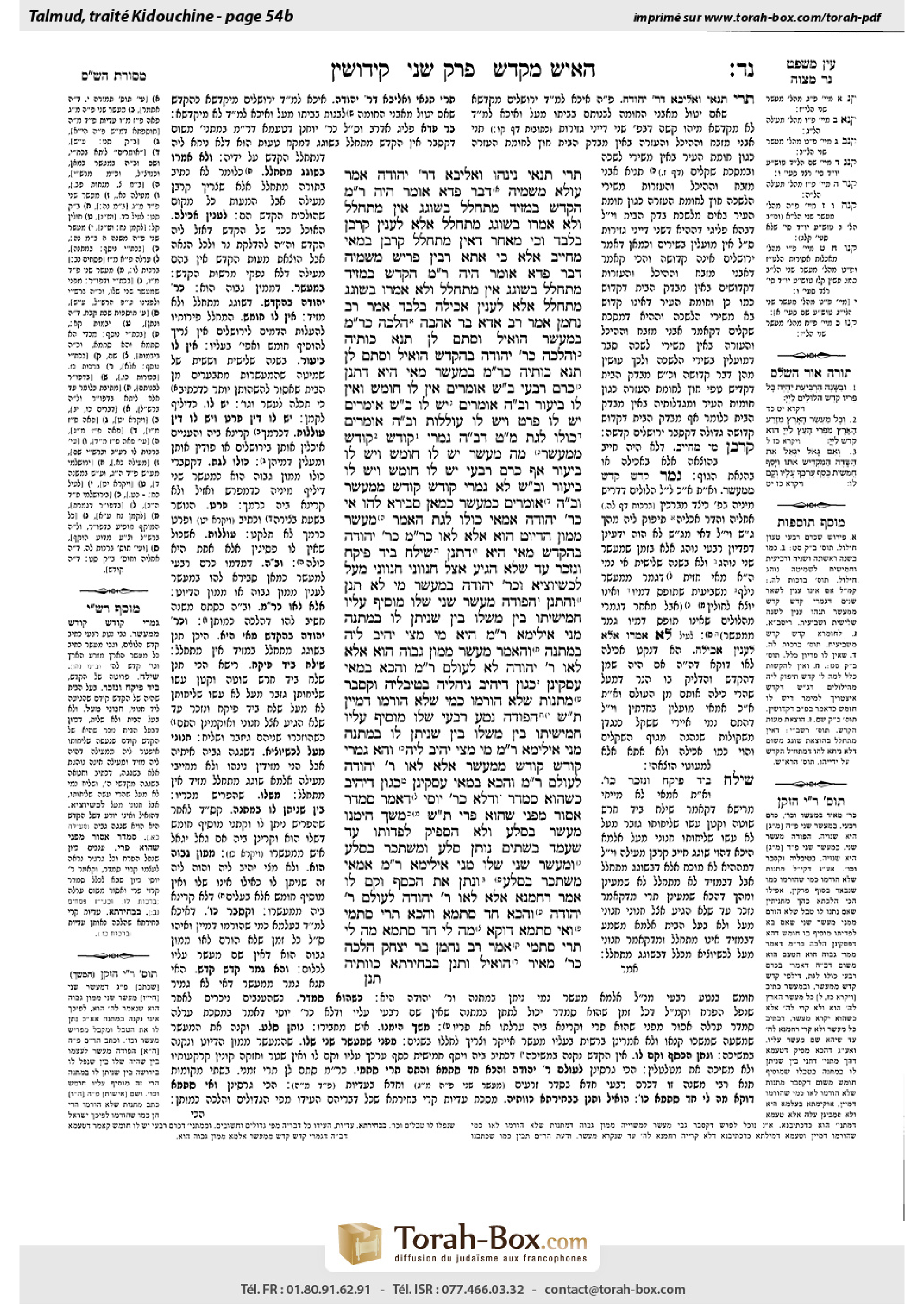
Kiddushin 54b: Talmud study for Daf Yomi
Daf Yomi is the daily study of one Talmud folio. Explore 37 tractates with scans, Hebrew text, Sefaria English and AI-generated French translations where annotated.
Passage selection and English or AI-generated French translation are available where the scan has annotations. Daf Study is independent of Torah-Box and Sefaria.
Browse Kiddushin · קידושין · All tractatesKiddushin 54b text and translations
This page of Kiddushin includes the Aramaic text, an English translation and an AI-generated French translation, alongside the scan above.
קידושין נ״ד ב · Aramaic and Hebrew text
תְּרֵי תַּנָּאֵי נִינְהוּ וְאַלִּיבָּא דְּרַבִּי יְהוּדָה.
אָמַר עוּלָּא מִשְּׁמֵיהּ דְּבַר פְּדָא, אוֹמֵר הָיָה רַבִּי מֵאִיר: הֶקְדֵּשׁ בְּמֵזִיד – מִתְחַלֵּל, בְּשׁוֹגֵג – אֵין מִתְחַלֵּל. וְלֹא אָמְרוּ בְּשׁוֹגֵג מִתְחַלֵּל אֶלָּא לְעִנְיַן קׇרְבָּן בִּלְבָד. וְכִי מֵאַחַר דְּאֵין מִתְחַלֵּל, קׇרְבָּן בְּמַאי מִחַיַּיב?!
אֶלָּא כִּי אֲתָא רָבִין פָּרֵישׁ מִשְּׁמֵיהּ דְּבַר פְּדָא, אוֹמֵר הָיָה רַבִּי מֵאִיר: הֶקְדֵּשׁ בְּמֵזִיד – מִתְחַלֵּל, בְּשׁוֹגֵג – אֵין מִתְחַלֵּל. וְלֹא אָמְרוּ בְּשׁוֹגֵג מִתְחַלֵּל אֶלָּא לְעִנְיַן אֲכִילָה בִּלְבָד.
אָמַר רַב נַחְמָן אָמַר רַב אַדָּא בַּר אַהֲבָה: הֲלָכָה כְּרַבִּי מֵאִיר בְּמַעֲשֵׂר הוֹאִיל וּסְתַם לַן תְּנָא כְּוָתֵיהּ, וַהֲלָכָה כְּרַבִּי יְהוּדָה בְּהֶקְדֵּשׁ הוֹאִיל וּסְתַם לַן תְּנָא כְּוָתֵיהּ.
כְּרַבִּי מֵאִיר בְּמַעֲשֵׂר, מַאי הִיא – דִּתְנַן: כֶּרֶם רְבָעִי, בֵּית שַׁמַּאי אוֹמְרִים: אֵין לוֹ חוֹמֶשׁ וְאֵין לוֹ בִּיעוּר. וּבֵית הִלֵּל אוֹמְרִים: יֵשׁ לוֹ.
בֵּית שַׁמַּאי אוֹמְרִים: יֵשׁ לוֹ פֶּרֶט וְיֵשׁ לוֹ עוֹלֵלוֹת. וּבֵית הִלֵּל אוֹמְרִים: כּוּלּוֹ לַגַּת.
מַאי טַעְמָא דְּבֵית הִלֵּל – גָּמְרִי ״קֹדֶשׁ״ ״קֹדֶשׁ״ מִמַּעֲשֵׂר, מָה מַעֲשֵׂר יֵשׁ לוֹ חוֹמֶשׁ וְיֵשׁ לוֹ בִּיעוּר – אַף כֶּרֶם רְבָעִי יֵשׁ לוֹ חוֹמֶשׁ וְיֵשׁ לוֹ בִּיעוּר. וּבֵית שַׁמַּאי לָא גָּמְרִי ״קֹדֶשׁ״ ״קֹדֶשׁ״ מִמַּעֲשֵׂר.
וּבֵית הִלֵּל אוֹמְרִים כְּמַעֲשֵׂר, כְּמַאן סְבִירָא לְהוּ? אִי כְּרַבִּי יְהוּדָה, אַמַּאי כּוּלּוֹ לַגַּת? הָאָמַר מַעֲשֵׂר מָמוֹן הֶדְיוֹט הוּא! אֶלָּא לָאו כְּרַבִּי מֵאִיר!
כְּרַבִּי יְהוּדָה בְּהֶקְדֵּשׁ מַאי הִיא – דִּתְנַן: שִׁילַּח בְּיַד פִּיקֵּחַ וְנִזְכַּר עַד שֶׁלֹּא הִגִּיעַ אֵצֶל חֶנְווֹנִי – חֶנְווֹנִי מָעַל לִכְשֶׁיּוֹצִיא.
וּכְרַבִּי יְהוּדָה בְּמַעֲשֵׂר מִי לָא תְּנַן? וְהָתְנַן: הַפּוֹדֶה מַעֲשֵׂר שֵׁנִי שֶׁלּוֹ – מוֹסִיף עָלָיו חֲמִישִׁיתוֹ, בֵּין מִשֶּׁלּוֹ בֵּין שֶׁנִּיתַּן לוֹ בְּמַתָּנָה. מַנִּי? אִילֵימָא רַבִּי מֵאִיר הִיא – מִי מָצֵי יָהֵיב לֵיהּ בְּמַתָּנָה? וְהָאָמַר: מַעֲשֵׂר מָמוֹן גָּבוֹהַּ הוּא! אֶלָּא לָאו רַבִּי יְהוּדָה!
לָא, לְעוֹלָם רַבִּי מֵאִיר וְהָכָא בְּמַאי עָסְקִינַן, כְּגוֹן דְּיָהֵיב נִיהֲלֵיהּ בְּטִיבְלֵיהּ, וְקָסָבַר: מַתָּנוֹת שֶׁלֹּא הוּרְמוּ כְּמִי שֶׁלֹּא הוּרְמוּ דָּמְיָין.
תָּא שְׁמַע: הַפּוֹדֶה נֶטַע רְבָעִי שֶׁלּוֹ – מוֹסִיף עָלָיו חֲמִישִׁיתוֹ, בֵּין מִשֶּׁלּוֹ, בֵּין שֶׁנִּיתַּן לוֹ בְּמַתָּנָה. מַנִּי? אִילֵימָא רַבִּי מֵאִיר – מִי מָצֵי יָהֵיב לֵיהּ? וְהָא גָּמְרִי ״קֹדֶשׁ״ ״קֹדֶשׁ״ מִמַּעֲשֵׂר! אֶלָּא לָאו רַבִּי יְהוּדָה?
לְעוֹלָם רַבִּי מֵאִיר, וְהָכָא בְּמַאי עָסְקִינַן, כְּגוֹן דְּיָהֵיב כְּשֶׁהוּא סְמָדַר. וּדְלָא כְּרַבִּי יוֹסֵי, דְּאָמַר: סְמָדַר אָסוּר, מִפְּנֵי שֶׁהוּא פֶּרִי.
תָּא שְׁמַע: מָשַׁךְ הֵימֶנּוּ מַעֲשֵׂר בְּסֶלַע וְלֹא הִסְפִּיק לִפְדּוֹתוֹ עַד שֶׁעָמַד בִּשְׁתַּיִם – נוֹתֵן סֶלַע, וּמִשְׂתַּכֵּר בְּסֶלַע, וּמַעֲשֵׂר שֵׁנִי שֶׁלּוֹ. מַנִּי? אִילֵימָא רַבִּי מֵאִיר, אַמַּאי מִשְׂתַּכֵּר בְּסֶלַע? ״וְנָתַן אֶת הַכֶּסֶף וְקָם לוֹ״ אָמַר רַחֲמָנָא! אֶלָּא לָאו רַבִּי יְהוּדָה!
לְעוֹלָם רַבִּי יְהוּדָה, וְהָכָא חַד סְתָמָא, וְהָכָא תְּרֵי סְתָמֵי.
וְאִי סְתָמָא דַּוְקָא, מָה לִי חַד סְתָמָא מָה לִי תְּרֵי סְתָמֵי?! אָמַר רַב נַחְמָן בַּר יִצְחָק: הֲלָכָה כְּרַבִּי מֵאִיר הוֹאִיל וּתְנַן בִּבְחִירָתָא כְּווֹתֵיהּ.
Kiddushin 54b · English translation
The Gemara answers: The baraita and the mishna in tractate Nedarim are two tanna’im and they disagree with regard to the opinion of Rabbi Yehuda concerning whether or not he holds that Jerusalem itself was sanctified.
Ulla said a different opinion in the name of bar Padda: Rabbi Meir would say: Consecrated property is desacralized if misused intentionally; it is not desacralized if misused unwittingly. And they said that consecrated property that is misused unwittingly is desacralized only with regard to an offering, i.e., the one who misused it is liable to bring a guilt-offering for his action, but the property remains consecrated. The Gemara asks: But since it is not desacralized when misused unwittingly, for what reason is he rendered liable to bring an offering, as the action had no effect?
Rather, when Ravin came from Eretz Yisrael he explained it this way in the name of bar Padda: Rabbi Meir would say: Consecrated property is desacralized if misused intentionally; it is not desacralized if misused unwittingly. And they said that consecrated property that is misused unwittingly is desacralized only with regard to eating. If one ate consecrated food, thereby consuming it completely, he is liable to bring an offering. If he merely misused consecrated money it retains its sanctity and is not desacralized, and he is not liable to bring an offering.
§ Rav Naḥman says that Rav Adda bar Ahava says: The halakha is in accordance with the opinion of Rabbi Meir with regard to second tithe in that it is considered consecrated, as the tanna taught us an unattributed mishna in accordance with his opinion. And the halakha is in accordance with the opinion of Rabbi Yehuda with regard to consecrated property, as the tanna taught us an unattributed mishna in accordance with his opinion.
The Gemara clarifies this statement: What is the unattributed mishna that is in accordance with the opinion of Rabbi Meir with regard to second tithe? It is as we learned (Pe’a 7:6): It is prohibited to eat or derive benefit from fruit during the first three years after the tree is planted. The fruit of the fourth year is to be taken to Jerusalem and eaten there. With regard to a vineyard in its fourth year, Beit Shammai say: It does not have the halakha of adding one-fifth, i.e., if the owner himself redeems the fruit to bring money to Jerusalem to spend on food there, as one may also do with second tithe, he does not add one-fifth to its value but redeems it for its true value. And it also does not have the halakha of disposal, i.e., there is no obligation to dispose of it on the eve of Passover of the fourth year of the Sabbatical cycle, when all tithes that have not yet been separated must be disposed of. And Beit Hillel say: It does have the halakha of adding one-fifth and the halakha of disposal.
That mishna continues: Furthermore, Beit Shammai say: It has the mitzva requiring the owner of the vineyard to leave individual fallen grapes for the poor [peret], and it has the mitzva requiring the owner to leave incompletely formed clusters of grapes for the poor [olelot]. Since the vineyard is considered the owner’s property during this year, he must leave these gifts for the poor. And Beit Hillel say: All of it goes to the winepress to make wine. Since the grapes have sanctity, he is not obligated to leave these gifts for the poor.
The Gemara explains: What is the reason for the opinion of Beit Hillel? They derive a verbal analogy from the word “holy” stated with regard to a fourth-year vineyard, as the verse states: “Holy, for giving praise to the Lord” (Leviticus 19:24), from “holy” stated with regard to second tithe, as the verse states: “Holy to the Lord” (Leviticus 27:30). This verbal analogy teaches the following: Just as second tithe has the halakha of adding one-fifth and it has the halakha of disposal, so too, the fourth-year vineyard has the halakha of adding one-fifth and it has the halakha of disposal. And Beit Shammai do not derive the verbal analogy of “holy” with regard to a fourth-year vineyard and “holy” from second tithe.
The Gemara proceeds to clarify the opinions of Beit Hillel and Beit Shammai with regard to the obligation to leave peret and olelot from a fourth-year vineyard. And with regard to Beit Hillel, who say that the halakha of fourth-year produce is like the halakha of second tithe, in accordance with whose opinion do they hold with regard to second tithe? If they hold in accordance with the opinion of Rabbi Yehuda, why does all of it go to the winepress? Didn’t Rabbi Yehuda say that second tithe is itself common, i.e., non-sacred, property, and the owner must therefore leave peret and olelot? Rather, is it not the case that they hold in accordance with the opinion of Rabbi Meir, who says that second tithe is consecrated property? The mishna aligning the opinion of Beit Hillel with that of Rabbi Meir is tantamount to there being an unattributed mishna in accordance with Rabbi Meir’s opinion, as the halakha is generally in accordance with the opinion of Beit Hillel.
The Gemara continues with the explanation of Rav Naḥman’s statement: What is the unattributed mishna that is in accordance with the opinion of Rabbi Yehuda with regard to consecrated property? As we learned (Me’ila 21a): In a case where one sent an agent to buy something on his behalf and unwittingly gave him consecrated money to use, if he sent it in the possession of a halakhically competent person and remembered that it was consecrated money before the agent reached the storekeeper, the storekeeper will have misused consecrated property when he will later spend the money. This indicates that one is liable for misuse of consecrated property even when one acts unwittingly, as the storekeeper did.
The Gemara asks: But didn’t we learn an unattributed mishna in accordance with the opinion of Rabbi Yehuda with regard to second tithe? But didn’t we learn (Ma’aser Sheni 4:3): With regard to one who redeems his own second tithe, he adds to it its one-fifth, whether the tithe was from his crop or given to him as a gift. The Gemara clarifies: In accordance with whose opinion is this mishna? If we say it is in accordance with the opinion of Rabbi Meir, can one give second tithe to another as a gift? But didn’t he say that second tithe is property belonging to the Most High, which means it is not one’s own to give to another as a gift? Rather, is it not in accordance with the opinion of Rabbi Yehuda, who holds that second tithe is common property, and consequently this unattributed mishna is in accordance with the opinion of Rabbi Yehuda with regard to second tithe?
The Gemara answers: No, actually it is in accordance with the opinion of Rabbi Meir, and with what are we dealing here? It is not a situation where one gave second tithe itself as a gift, but where he gave him his entire crop in its state of being untithed produce. Consequently, the portion he gave him included tithes that had not yet been separated, and he holds that gifts that have not been separated are not considered as though they have been separated. One does not categorize the untithed produce as a mixture of regular produce and tithes, but as a non-sacred category in and of itself. Since the second tithe has not yet been separated, the produce has no sanctity, and he can give it as a gift.
The Gemara continues its line of inquiry: Come and hear another unattributed mishna in accordance with the opinion of Rabbi Yehuda (Ma’aser Sheni 4:6): With regard to one who redeems his own fourth-year produce, he adds to it its one-fifth, whether the produce was from his crop or was given to him as a gift. The Gemara inquires: In accordance with whose opinion is this mishna? If we say it is in accordance with the opinion of Rabbi Meir, can one give produce of the fourth year to another as a gift? But didn’t he derive that one must add one-fifth from the verbal analogy of “holy” for fourth-year fruit from “holy” from second tithe? This would mean that fourth-year fruit, like second tithe, is property of the Most High and cannot be given as a gift. Rather, is it not in accordance with the opinion of Rabbi Yehuda?
The Gemara answers: Actually, it is in accordance with the opinion of Rabbi Meir, and with what are we dealing here? It is not a situation where one gave fully grown fourth-year fruit but where he gave him the fruit when it was a bud. And this is not in accordance with the opinion of Rabbi Yosei, who says: A bud of a fruit is forbidden as orla, because it is already considered a fruit. Rabbi Meir, by contrast, holds that a fruit bud is not considered fruit. Therefore, the halakhot of orla and fourth-year fruit apply only to fruit that has grown, whereas beforehand it can be given as a gift.
The Gemara continues its line of inquiry: Come and hear another unattributed mishna in accordance with the opinion of Rabbi Yehuda (Ma’aser Sheni 4:6): If one was selling second-tithe produce, and the buyer pulled tithe worth a sela from him, thereby acquiring it, and did not manage to redeem it until its value stood at two sela, and he had not yet paid the seller, the buyer gives a sela to the seller, and he thereby gains a sela and the second tithe is his, since he acquired it when he pulled it and the price was fixed at that point. The Gemara inquires: In accordance with whose opinion is this mishna? If we say it is in accordance with the opinion of Rabbi Meir, why does the buyer gain a sela? The Merciful One states in the Torah with regard to the redemption of consecrated property: And he will give the money and it will be assured to him (see Leviticus 27:19), from which it is derived that one acquires consecrated property only after paying money. This means that the value of the second tithe increased before he acquired it. Rather, is it not in accordance with the opinion of Rabbi Yehuda, who holds that second tithe is common property, and it is acquired from the moment he pulled it?
The Gemara confirms: Actually, this mishna is in accordance with the opinion of Rabbi Yehuda. Nevertheless, Rav Naḥman’s statement that the halakha with regard to second tithe is in accordance with the opinion of Rabbi Meir is still correct, as here there is one unattributed mishna that is in accordance with the opinion of Rabbi Yehuda, while here there are two unattributed mishnayot that indicate that Beit Hillel’s opinion is in accordance with the opinion of Rabbi Meir, the one in tractate Ma’aser Sheni, and one in tractate Eduyyot (4:2).
The Gemara asks: But if an unattributed mishna is stated that way specifically to teach the halakha, what difference is there to me if it is one unattributed mishna or two unattributed mishnayot? The Gemara suggests an alternate reasoning. Rav Naḥman bar Yitzḥak said: The halakha is in accordance with the opinion of Rabbi Meir, since we learned in a mishna in the preferred tractate, Eduyyot, in accordance with his opinion. Since the halakha is ruled in accordance with all of the mishnayot in Eduyyot, the fact that the opinion of Beit Hillel in that tractate is in accordance with the opinion of Rabbi Meir means that the halakha should be decided accordingly.
Kiddushin 54b · Traduction française (IA)
La Guemara répond : La baraïta et la Michna du traité Nedarim reflètent les opinions de deux tannaïm, qui sont en désaccord sur la position de Rabbi Yehuda : selon lui, Jérusalem elle-même a-t-elle été sanctifiée ou non ?
Ulla rapporte une autre opinion au nom de bar Padda : Rabbi Meir dirait que les biens consacrés perdent leur sainteté lorsqu’on en fait un usage abusif intentionnellement, mais non par inadvertance. Or, les Sages ont dit que les biens consacrés dont on fait un usage abusif par inadvertance ne perdent leur sainteté qu’en ce qui concerne l’offrande : celui qui en a fait un usage abusif est tenu d’apporter un sacrifice de culpabilité pour son acte, mais les biens restent consacrés. La Guemara demande : Mais puisqu’ils ne perdent pas leur sainteté lorsqu’on en fait un usage abusif par inadvertance, pourquoi est-il tenu d’apporter une offrande, alors que son acte n’a eu aucun effet ?
Cependant, lorsque Ravin vint d’Eretz Israël, il expliqua ainsi cette opinion au nom de bar Padda : Rabbi Meir dirait que les biens consacrés perdent leur sainteté lorsqu’on en fait un usage abusif intentionnellement, mais non par inadvertance. Or, les Sages ont dit que les biens consacrés dont on fait un usage abusif par inadvertance ne perdent leur sainteté qu’en cas de consommation. Si quelqu’un a mangé un aliment consacré et l’a ainsi entièrement consommé, il est tenu d’apporter une offrande. S’il a simplement fait un usage abusif d’argent consacré, celui-ci conserve sa sainteté et n’est pas désacralisé, et il n’est pas tenu d’apporter une offrande.
§ Rav Naḥman dit au nom de Rav Adda bar Ahava : La halakha suit l’opinion de Rabbi Meir concernant la seconde dîme, en ce qu’elle est considérée comme consacrée, car le tanna nous a enseigné une Michna anonyme conforme à son opinion. Et la halakha suit l’opinion de Rabbi Yehuda concernant les biens consacrés, car le tanna nous a enseigné une Michna anonyme conforme à son opinion.
La Guemara précise cette déclaration : Quelle est la Michna anonyme qui est conforme à l’opinion de Rabbi Meir concernant la seconde dîme ? C’est celle que nous avons apprise (Pe’a 7:6) : Il est interdit de manger les fruits des trois premières années suivant la plantation de l’arbre ou d’en tirer profit. Les fruits de la quatrième année doivent être portés à Jérusalem et y être consommés. À propos d’une vigne dans sa quatrième année, Beit Shammaï disent : Elle n’est pas soumise à la règle de l’ajout d’un cinquième. Autrement dit, si le propriétaire rachète lui-même les fruits afin d’apporter de l’argent à Jérusalem pour y acheter de la nourriture, comme il peut également le faire pour la seconde dîme, il n’ajoute pas un cinquième à leur valeur, mais les rachète à leur valeur exacte. Elle n’est pas non plus soumise à la règle de l’élimination : il n’est pas nécessaire de l’éliminer la veille de Pessa’h de la quatrième année du cycle sabbatique, lorsque toutes les dîmes qui n’ont pas encore été prélevées doivent être éliminées. Et Beit Hillel disent : Elle est soumise à la règle de l’ajout d’un cinquième et à celle de l’élimination.
Cette Michna poursuit : En outre, Beit Shammaï disent : Elle est soumise à la mitsva qui oblige le propriétaire de la vigne à laisser aux pauvres les grains de raisin tombés un à un [peret], ainsi qu’à celle qui l’oblige à leur laisser les grappes incomplètes [olelot]. Puisque la vigne est considérée comme la propriété de son propriétaire durant cette année, il doit laisser ces dons aux pauvres. Et Beit Hillel disent : Tout va au pressoir pour faire du vin. Puisque les raisins ont un statut de sainteté, il n’est pas tenu de laisser ces dons aux pauvres.
La Guemara explique : Quelle est la raison de l’opinion de Beit Hillel ? Ils établissent une analogie verbale entre le terme « saint », employé à propos d’une vigne de quatrième année — comme le dit le verset : « Saint, pour donner louange au Seigneur » (Lévitique 19:24) — et le terme « saint », employé à propos de la seconde dîme, comme le dit le verset : « Saint pour le Seigneur » (Lévitique 27:30). Cette analogie verbale enseigne ceci : de même que la seconde dîme est soumise à la règle de l’ajout d’un cinquième et à celle de l’élimination, la vigne de quatrième année y est elle aussi soumise. Beit Shammaï, eux, n’établissent pas d’analogie verbale entre le terme « saint » concernant une vigne de quatrième année et le terme « saint » concernant la seconde dîme.
La Guemara poursuit en clarifiant les opinions de Beit Hillel et de Beit Shammaï concernant l’obligation de laisser le peret et les olelot d’une vigne de quatrième année. À propos de Beit Hillel, qui disent que la halakha des produits de quatrième année est semblable à celle de la seconde dîme, quelle opinion suivent-ils concernant cette dernière ? S’ils suivent l’opinion de Rabbi Yehuda, pourquoi tout va-t-il au pressoir ? Rabbi Yehuda n’a-t-il pas dit que la seconde dîme est elle-même un bien ordinaire, c’est-à-dire non consacré, et que le propriétaire doit donc laisser le peret et les olelot ? N’est-ce pas plutôt qu’ils suivent l’opinion de Rabbi Meir, qui dit que la seconde dîme est un bien consacré ? La Michna qui associe l’opinion de Beit Hillel à celle de Rabbi Meir équivaut à une Michna anonyme conforme à l’opinion de Rabbi Meir, puisque la halakha suit généralement l’opinion de Beit Hillel.
La Guemara poursuit l’explication de la déclaration de Rav Naḥman : Quelle est la Michna anonyme conforme à l’opinion de Rabbi Yehuda concernant les biens consacrés ? C’est celle que nous avons apprise (Me’ila 21a) : Si quelqu’un envoie un mandataire acheter quelque chose pour lui et lui remet par inadvertance de l’argent consacré à utiliser, si le mandataire est une personne juridiquement compétente et que l’expéditeur se rappelle que l’argent est consacré avant que le mandataire n’arrive chez le commerçant, c’est le commerçant qui fera un usage abusif de biens consacrés lorsqu’il dépensera ensuite cet argent. Cela indique qu’on est responsable d’un usage abusif de biens consacrés même lorsque l’on agit par inadvertance, comme l’a fait le commerçant.
La Guemara demande : Mais n’avons-nous pas appris une Michna anonyme conforme à l’opinion de Rabbi Yehuda concernant la seconde dîme ? N’avons-nous pas appris (Ma’aser Sheni 4:3) : Celui qui rachète sa propre seconde dîme y ajoute son cinquième, que la dîme provienne de sa récolte ou qu’elle lui ait été donnée en cadeau. La Guemara précise : Quelle opinion cette Michna suit-elle ? Si l’on dit qu’elle suit celle de Rabbi Meir, peut-on donner la seconde dîme à quelqu’un en cadeau ? N’a-t-il pas dit que la seconde dîme est un bien appartenant au Très-Haut, ce qui signifie qu’elle ne nous appartient pas en propre et qu’on ne peut donc pas la donner à quelqu’un en cadeau ? N’est-ce pas plutôt qu’elle suit l’opinion de Rabbi Yehuda, selon laquelle la seconde dîme est un bien ordinaire ? Cette Michna anonyme est donc conforme à l’opinion de Rabbi Yehuda concernant la seconde dîme.
La Guemara répond : Non, en réalité, elle suit l’opinion de Rabbi Meir. De quelle situation s’agit-il ici ? Il ne s’agit pas de quelqu’un qui a donné la seconde dîme elle-même en cadeau, mais de quelqu’un qui a donné à une autre personne toute sa récolte alors qu’elle était encore à l’état de produits non dîmés. La part qu’il lui a donnée comprenait donc des dîmes qui n’avaient pas encore été prélevées ; or, il considère que les dons qui n’ont pas été prélevés ne sont pas considérés comme s’ils l’avaient été. On ne considère pas les produits non dîmés comme un mélange de produits ordinaires et de dîmes, mais comme une catégorie non consacrée à part entière. Puisque la seconde dîme n’a pas encore été prélevée, les produits ne sont pas sanctifiés et il peut les donner en cadeau.
La Guemara poursuit son raisonnement : Viens et écoute une autre Michna anonyme conforme à l’opinion de Rabbi Yehuda (Ma’aser Sheni 4:6) : Celui qui rachète ses propres produits de quatrième année y ajoute un cinquième, que les produits proviennent de sa récolte ou qu’ils lui aient été donnés en cadeau. La Guemara demande : Quelle opinion cette Michna suit-elle ? Si l’on dit qu’elle suit celle de Rabbi Meir, peut-on donner à quelqu’un des produits de quatrième année en cadeau ? N’a-t-il pas déduit l’obligation d’ajouter un cinquième de l’analogie verbale entre le terme « saint » concernant les fruits de quatrième année et le terme « saint » concernant la seconde dîme ? Cela signifierait que les fruits de quatrième année, comme la seconde dîme, sont un bien appartenant au Très-Haut et ne peuvent être donnés en cadeau. N’est-ce pas plutôt qu’elle suit l’opinion de Rabbi Yehuda ?
La Guemara répond : En réalité, elle suit l’opinion de Rabbi Meir. De quelle situation s’agit-il ici ? Il ne s’agit pas de quelqu’un qui a donné des fruits de quatrième année arrivés à maturité, mais de quelqu’un qui les a donnés alors qu’ils étaient encore au stade de bourgeon. Cette opinion n’est pas celle de Rabbi Yosei, qui dit qu’un bourgeon de fruit est interdit au titre de l’orla, car il est déjà considéré comme un fruit. Rabbi Meir, en revanche, considère qu’un bourgeon n’est pas un fruit. Par conséquent, les lois de l’orla et des fruits de quatrième année ne s’appliquent qu’aux fruits qui ont poussé ; auparavant, on peut les donner en cadeau.
La Guemara poursuit son raisonnement : Viens et écoute une autre Michna anonyme conforme à l’opinion de Rabbi Yehuda (Ma’aser Sheni 4:6) : Si quelqu’un vendait des produits de seconde dîme et que l’acheteur lui en a pris pour une valeur d’un séla, en les acquérant ainsi, mais n’a pas réussi à les racheter avant que leur valeur n’atteigne deux séla, et qu’il n’avait pas encore payé le vendeur, l’acheteur donne un séla au vendeur ; il gagne ainsi un séla et la seconde dîme lui appartient, puisqu’il l’a acquise au moment où il l’a prise et que le prix a été fixé à ce moment-là. La Guemara demande : Quelle opinion cette Michna suit-elle ? Si l’on dit qu’elle suit celle de Rabbi Meir, pourquoi l’acheteur gagne-t-il un séla ? Le Miséricordieux dit dans la Torah, à propos du rachat des biens consacrés : « Il donnera l’argent et cela lui sera acquis » (voir Lévitique 27:19). On en déduit que l’on n’acquiert des biens consacrés qu’après en avoir payé le prix. Cela signifie que la valeur de la seconde dîme a augmenté avant qu’il ne l’acquière. N’est-ce pas plutôt qu’elle suit l’opinion de Rabbi Yehuda, selon laquelle la seconde dîme est un bien ordinaire et s’acquiert dès qu’il l’a prise ?
La Guemara confirme : En réalité, cette Michna suit l’opinion de Rabbi Yehuda. Néanmoins, la déclaration de Rav Naḥman selon laquelle la halakha concernant la seconde dîme suit l’opinion de Rabbi Meir reste valable : d’un côté, une Michna anonyme suit l’opinion de Rabbi Yehuda ; de l’autre, deux Michnayot anonymes indiquent que l’opinion de Beit Hillel suit celle de Rabbi Meir, l’une dans le traité Ma’aser Sheni et l’autre dans le traité Eduyyot (4:2).
La Guemara demande : Mais si une Michna anonyme est formulée ainsi précisément pour enseigner la halakha, quelle différence cela fait-il qu’il y ait une Michna anonyme ou deux Michnayot anonymes ? La Guemara propose un autre raisonnement. Rav Naḥman bar Yitzḥak dit : La halakha suit l’opinion de Rabbi Meir, puisque nous avons appris une Michna conforme à son opinion dans le traité de référence, Eduyyot. Puisque la halakha est tranchée conformément à toutes les Michnayot d’Eduyyot, le fait que l’opinion de Beit Hillel dans ce traité soit conforme à celle de Rabbi Meir signifie que la halakha doit être tranchée ainsi.
Traduction française générée par IA à partir de l’édition anglaise de Sefaria. Vérifie toujours un passage avec le texte source.
Text from Sefaria: William Davidson Edition - Vocalized Aramaic (CC BY NC); William Davidson Edition - English (CC BY NC).