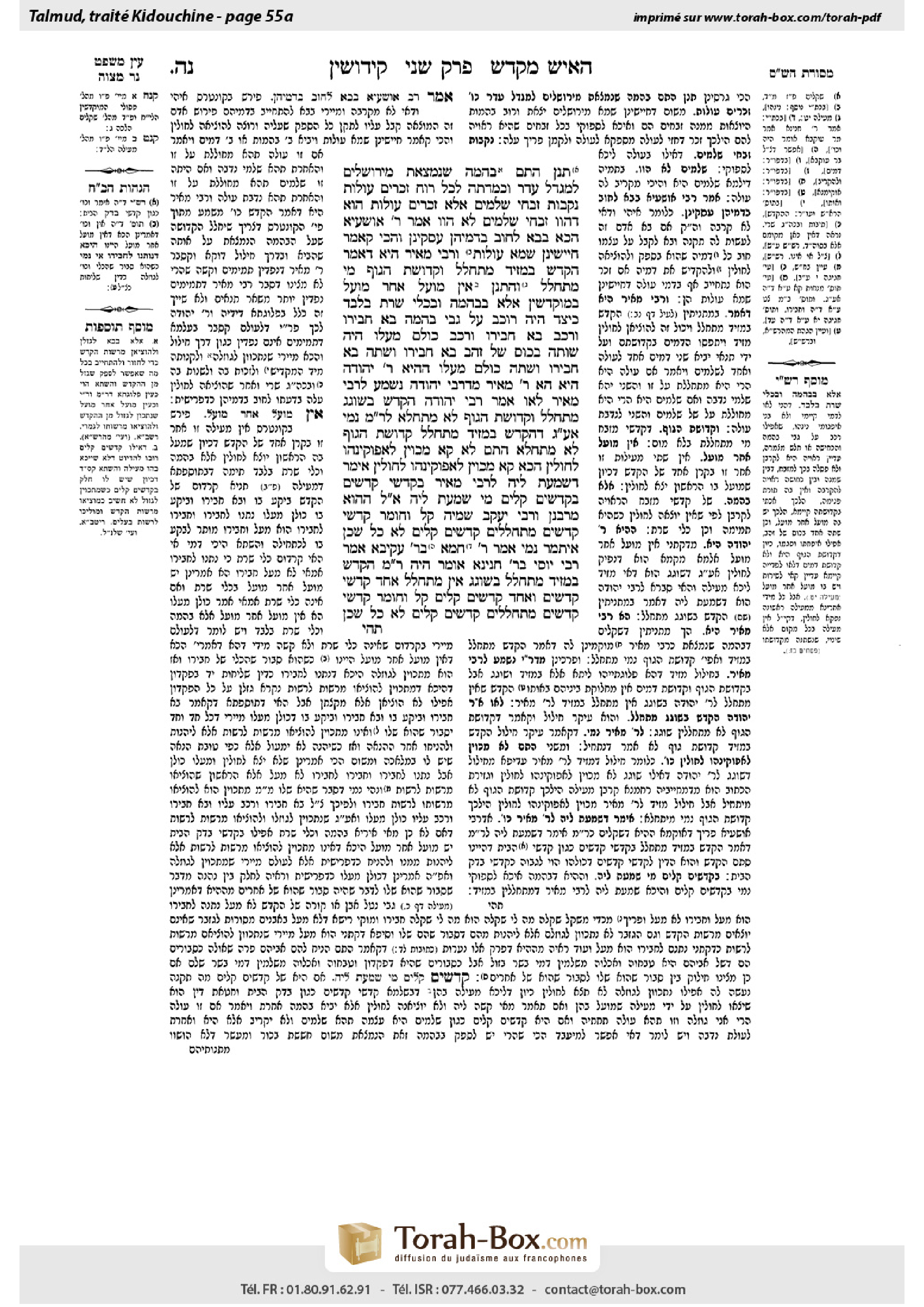
Kiddushin 55a: Talmud study for Daf Yomi
Daf Yomi is the daily study of one Talmud folio. Explore 37 tractates with scans, Hebrew text, Sefaria English and AI-generated French translations where annotated.
Passage selection and English or AI-generated French translation are available where the scan has annotations. Daf Study is independent of Torah-Box and Sefaria.
Browse Kiddushin · קידושין · All tractatesKiddushin 55a text and translations
This page of Kiddushin includes the Aramaic text, an English translation and an AI-generated French translation, alongside the scan above.
קידושין נ״ה א · Aramaic and Hebrew text
תְּנַן הָתָם: בְּהֵמָה שֶׁנִּמְצֵאת מִירוּשָׁלַיִם לְמִגְדַּל עֵדֶר וּכְמִדָּתָהּ לְכׇל רוּחַ, זְכָרִים – עוֹלוֹת, נְקֵבוֹת – זִבְחֵי שְׁלָמִים.
אֶלָּא זְכָרִים, עוֹלוֹת הוּא דְּהָווּ, זִבְחֵי שְׁלָמִים לָא הָווּ? אָמַר רַבִּי אוֹשַׁעְיָא: הָכָא בָּבָא לָחוּב בִּדְמֵיהֶן עָסְקִינַן, וְהָכִי קָאָמַר: חָיְישִׁינַן שֶׁמָּא עוֹלוֹת, וְרַבִּי מֵאִיר הִיא, דְּאָמַר: הֶקְדֵּשׁ בְּמֵזִיד מִתְחַלֵּל.
וּקְדוּשַּׁת הַגּוּף מִי מִתְחַלֵּל? וְהָתְנַן: אֵין מוֹעֵל אַחַר מוֹעֵל בְּמוּקְדָּשִׁין אֶלָּא בִּבְהֵמָה וּבִכְלִי שָׁרֵת בִּלְבַד.
כֵּיצַד? הָיָה רוֹכֵב עַל גַּבֵּי בְּהֵמָה, בָּא חֲבֵירוֹ וְרָכַב, בָּא חֲבֵירוֹ וְרָכַב – כּוּלָּם מָעֲלוּ. הָיָה שׁוֹתֶה בְּכוֹס שֶׁל זָהָב, בָּא חֲבֵירוֹ וְשָׁתָה, בָּא חֲבֵירוֹ וְשָׁתָה – כּוּלָּם מָעֲלוּ! הָהִיא – רַבִּי יְהוּדָה הִיא, הָא רַבִּי מֵאִיר.
מִדְּרַבִּי יְהוּדָה נִשְׁמַע לְרַבִּי מֵאִיר – לָאו אָמַר רַבִּי יְהוּדָה: הֶקְדֵּשׁ בְּשׁוֹגֵג מִתְחַלֵּל וּקְדוּשַּׁת הַגּוּף לָא מִתַּחֲלָא. לְרַבִּי מֵאִיר נָמֵי, אַף עַל גַּב דְּהֶקְדֵּשׁ בְּמֵזִיד מִתְחַלֵּל קְדוּשַּׁת הַגּוּף לָא מִתַּחֲלָא! הָתָם לָא קָא מְכַוֵּין לְאַפּוֹקִינְהוּ לְחוּלִּין. הָכָא – קָא מְכַוֵּין לְאַפּוֹקִינְהוּ לְחוּלִּין.
אֵימַר דְּשָׁמְעַתְּ לֵיהּ לְרַבִּי מֵאִיר בְּקׇדְשֵׁי קֳדָשִׁים, בְּקָדָשִׁים קַלִּים מִי שָׁמְעַתְּ לֵיהּ? – אֲמַר לֵיהּ הָהוּא מֵרַבָּנַן וְרַבִּי יַעֲקֹב שְׁמֵיהּ: קַל וָחוֹמֶר: קׇדְשֵׁי קֳדָשִׁים מִתְחַלְּלִים – קֳדָשִׁים קַלִּים לֹא כׇּל שֶׁכֵּן?!
אִיתְּמַר נָמֵי, אָמַר רַבִּי חָמָא בְּרַבִּי עֲקִיבָא, אָמַר רַבִּי יוֹסֵי בְּרַבִּי חֲנִינָא: אוֹמֵר הָיָה רַבִּי מֵאִיר: הֶקְדֵּשׁ בְּמֵזִיד – מִתְחַלֵּל, בְּשׁוֹגֵג – אֵין מִתְחַלֵּל, אֶחָד קׇדְשֵׁי קֳדָשִׁים וְאֶחָד קֳדָשִׁים קַלִּים. קַל וָחוֹמֶר: קׇדְשֵׁי קֳדָשִׁים מִתְחַלְּלִים – קֳדָשִׁים קַלִּים לֹא כׇּל שֶׁכֵּן?!
Kiddushin 55a · English translation
The Gemara continues its discussion of the desacralizing of consecrated property. We learned in a mishna there (Shekalim 20a): If there was an animal fit for the altar that was found straying, from Jerusalem and as far as Migdal Eder, and similarly if it was found within that distance from Jerusalem in any other direction, it is presumed that the animal came from Jerusalem. Most of the animals in Jerusalem were designated for offerings, and presumably this one was as well. Males are presumed to be burnt-offerings, as only males can be brought as burnt-offerings. Females are presumed to be peace-offerings, as it is permitted to bring a female peace-offering.
The Gemara questions this: But are males only burnt-offerings and not also peace-offerings? As peace-offerings can be male or female, a male animal that was found might have been designated as a peace-offering. Rabbi Oshaya said: We are not speaking here of bringing the animals themselves as offerings. Rather, we are dealing with one who comes to obligate himself to consecrate their value. The finder wants to consecrate the value of the animal in case it had been designated as an offering, thereby redeeming the animal and desacralizing it, and this is what the mishna is saying: In the case of males we are concerned that perhaps they are burnt-offerings, so the money must be consecrated for the purpose of burnt-offerings as well as peace-offerings. And this is in accordance with the opinion of Rabbi Meir, who says: Consecrated property is desacralized if it is misused intentionally. Therefore, he may redeem the animal and must use the money to purchase both a peace-offering and a burnt-offering, thereby avoiding all uncertainty.
The Gemara asks: And can something that has inherent sanctity, such as an animal that has been designated as an offering, be desacralized? But didn’t we learn in a mishna (Me’ila 19b): There is no misuse after misuse with regard to consecrated property? This means that if one misuses consecrated property, the item is immediately desacralized and the prohibition of misuse no longer applies to it. This is so apart from the case of the misuse of an animal designated as an offering and apart from the case of the misuse of service vessels alone. These do not become desacralized when misused, because they have inherent sanctity.
That mishna continues: How so? If someone was riding on a consecrated animal, and another came after him and also rode on it, and yet another came and rode on it, they have all misused consecrated property. Similarly, if one was drinking from a golden cup used in the Temple service, and another came and drank from it, and yet another came and drank from it, they have all misused consecrated property. The Gemara asks: As this indicates that an item that has inherent sanctity is never desacralized, how can it be redeemed? The Gemara answers: That mishna, from tractate Me’ila, is in accordance with the opinion of Rabbi Yehuda, whereas this mishna, from tractate Shekalim, is in accordance with the opinion of Rabbi Meir.
The Gemara asks: Let us hear, i.e., infer, from the opinion of Rabbi Yehuda to the opinion of Rabbi Meir: Didn’t Rabbi Yehuda say that consecrated property is desacralized if used unwittingly, and yet those items that have inherent sanctity are not desacralized. According to Rabbi Meir as well, although consecrated property is desacralized if used intentionally, items that have inherent sanctity should not be desacralized. The Gemara answers that there is a difference between the two opinions. There, in the case underlying Rabbi Yehuda’s opinion, the one who misuses the consecrated item unwittingly does not intend to withdraw it to a non-sacred state but merely to use it, which is why an item that has inherent sanctity is not desacralized; whereas here, in the case underlying Rabbi Meir’s opinion, one who acts intentionally does intend to withdraw it to a non-sacred state, so even an item that has inherent sanctity can be desacralized.
The Gemara questions Rav Oshaya’s explanation of the mishna: Say that you have heard Rabbi Meir express the opinion that one can desacralize a consecrated item in the case of offerings of the most sacred order, but did you hear him express this opinion in the case of offerings of lesser sanctity, e.g., a peace-offering? If Rabbi Meir holds that offerings of lesser sanctity cannot be desacralized, the explanation of Rabbi Oshaya would be insufficient, as it does not account for the possibility that the animal is a peace-offering. One of the Sages, and his name was Rabbi Ya’akov, said to him: This is learned by means of an a fortiori inference: If offerings of the most sacred order can be desacralized, is it not all the more so the case that this halakha would apply to offerings of lesser sanctity?
It was also stated: Rabbi Ḥama, son of Rabbi Akiva, says that Rabbi Yosei, son of Rabbi Ḥanina, says that Rabbi Meir would say: Consecrated property is desacralized when misused intentionally, but it is not desacralized when misused unwittingly. This applies both to offerings of the most sacred order and to offerings of lesser sanctity, by means of an a fortiori inference: If offerings of the most sacred order can be desacralized, is it not all the more so the case that this halakha would apply to offerings of lesser sanctity?
Kiddushin 55a · Traduction française (IA)
La Guemara poursuit son examen de la désacralisation des biens consacrés. Nous avons appris dans une Michna de Chekalim (20a) : Si l’on trouve un animal apte à être offert sur l’autel qui s’est égaré entre Jérusalem et Migdal Eder, ou, de même, à cette distance de Jérusalem dans toute autre direction, on présume que l’animal vient de Jérusalem. La plupart des animaux de Jérusalem étaient destinés à des sacrifices, et l’on présume que celui-ci l’était également. On présume que les mâles sont destinés à des holocaustes, puisque seuls les mâles peuvent être offerts en holocauste. On présume que les femelles sont destinées à des sacrifices de paix, puisqu’il est permis d’offrir une femelle en sacrifice de paix.
La Guemara soulève une objection : Mais les mâles ne sont-ils destinés qu’aux holocaustes, et non aussi aux sacrifices de paix ? Puisque les sacrifices de paix peuvent être mâles ou femelles, l’animal mâle trouvé a pu être destiné à un sacrifice de paix. Rabbi Oshaya dit : Il n’est pas question ici d’offrir les animaux eux-mêmes en sacrifice. Il s’agit plutôt d’une personne qui s’engage à consacrer leur valeur. Celui qui a trouvé l’animal veut en consacrer la valeur au cas où il aurait été destiné à un sacrifice, afin de le racheter et de le désacraliser. Voici donc ce que dit la Michna : Dans le cas des mâles, nous craignons qu’ils ne soient des holocaustes ; l’argent doit donc être consacré à l’achat aussi bien d’un holocauste que d’un sacrifice de paix. Cela correspond à l’avis de Rabbi Meïr, selon lequel les biens consacrés sont désacralisés lorsqu’on en fait un usage illicite intentionnel. Par conséquent, il peut racheter l’animal et doit utiliser l’argent pour acheter à la fois un sacrifice de paix et un holocauste, écartant ainsi toute incertitude.
La Guemara demande : Mais peut-on désacraliser un bien doté d’une sainteté intrinsèque, tel qu’un animal qui a été désigné comme sacrifice ? N’avons-nous pas appris dans une Michna de Meïla (19b) : Il n’y a pas d’usage illicite après un premier usage illicite concernant les biens consacrés ? Cela signifie que si quelqu’un fait un usage illicite d’un bien consacré, celui-ci est immédiatement désacralisé et l’interdiction d’en faire un usage illicite ne s’applique plus à lui. Cette règle connaît deux exceptions : le cas d’un animal désigné comme sacrifice et celui des ustensiles du Service du Temple. Ceux-ci ne sont pas désacralisés lorsqu’on en fait un usage illicite, car ils possèdent une sainteté intrinsèque.
Cette Michna poursuit : Comment cela se produit-il ? Si quelqu’un chevauche un animal consacré, qu’un autre vient ensuite et le chevauche à son tour, puis qu’un troisième vient et le chevauche, ils ont tous fait un usage illicite d’un bien consacré. De même, si quelqu’un boit dans une coupe d’or utilisée pour le Service du Temple, qu’un autre vient ensuite et y boit, puis qu’un troisième vient et y boit, ils ont tous fait un usage illicite d’un bien consacré. La Guemara demande : Puisqu’il ressort de là qu’un bien doté d’une sainteté intrinsèque n’est jamais désacralisé, comment peut-il être racheté ? La Guemara répond : Cette Michna, du traité Meïla, est conforme à l’avis de Rabbi Yehouda, tandis que cette Michna, du traité Chekalim, est conforme à l’avis de Rabbi Meïr.
La Guemara demande : Déduisons de l’avis de Rabbi Yehouda ce qu’il en est de celui de Rabbi Meïr. Rabbi Yehouda n’a-t-il pas dit que les biens consacrés sont désacralisés lorsqu’on en fait un usage illicite involontaire, alors que les biens dotés d’une sainteté intrinsèque ne le sont pas ? Selon Rabbi Meïr également, bien que les biens consacrés soient désacralisés lorsqu’on en fait un usage illicite intentionnel, les biens dotés d’une sainteté intrinsèque ne devraient pas l’être. La Guemara répond qu’il existe une différence entre les deux avis. Dans le cas qui sous-tend l’avis de Rabbi Yehouda, celui qui fait involontairement un usage illicite du bien consacré n’a pas l’intention de le faire passer à l’état profane, mais seulement de l’utiliser ; c’est pourquoi un bien doté d’une sainteté intrinsèque n’est pas désacralisé. En revanche, dans le cas qui sous-tend l’avis de Rabbi Meïr, celui qui agit intentionnellement a bien l’intention de le faire passer à l’état profane ; ainsi, même un bien doté d’une sainteté intrinsèque peut être désacralisé.
La Guemara met en question l’explication de Rav Oshaya concernant la Michna : Admettons que tu aies entendu Rabbi Meïr exprimer l’avis qu’on peut désacraliser un bien consacré dans le cas des sacrifices de sainteté supérieure, mais l’as-tu entendu exprimer cet avis à propos des sacrifices de sainteté moindre, par exemple un sacrifice de paix ? Si Rabbi Meïr estime que les sacrifices de sainteté moindre ne peuvent pas être désacralisés, l’explication de Rabbi Oshaya serait insuffisante, car elle ne tient pas compte de la possibilité que l’animal soit un sacrifice de paix. L’un des Sages, qui s’appelait Rabbi Yaakov, lui dit : Cela se déduit au moyen d’un raisonnement a fortiori : si les sacrifices de sainteté supérieure peuvent être désacralisés, n’est-il pas d’autant plus vrai que cette halakha s’applique aux sacrifices de sainteté moindre ?
Il a également été rapporté : Rabbi Ḥama, fils de Rabbi Akiva, dit au nom de Rabbi Yosei, fils de Rabbi Ḥanina, que Rabbi Meïr disait : Les biens consacrés sont désacralisés lorsqu’on en fait un usage illicite intentionnel, mais ne le sont pas lorsqu’on en fait un usage illicite involontaire. Cela s’applique aussi bien aux sacrifices de sainteté supérieure qu’aux sacrifices de sainteté moindre, par un raisonnement a fortiori : si les sacrifices de sainteté supérieure peuvent être désacralisés, n’est-il pas d’autant plus vrai que cette halakha s’applique aux sacrifices de sainteté moindre ?
Traduction française générée par IA à partir de l’édition anglaise de Sefaria. Vérifie toujours un passage avec le texte source.
Text from Sefaria: William Davidson Edition - Vocalized Aramaic (CC BY NC); William Davidson Edition - English (CC BY NC).