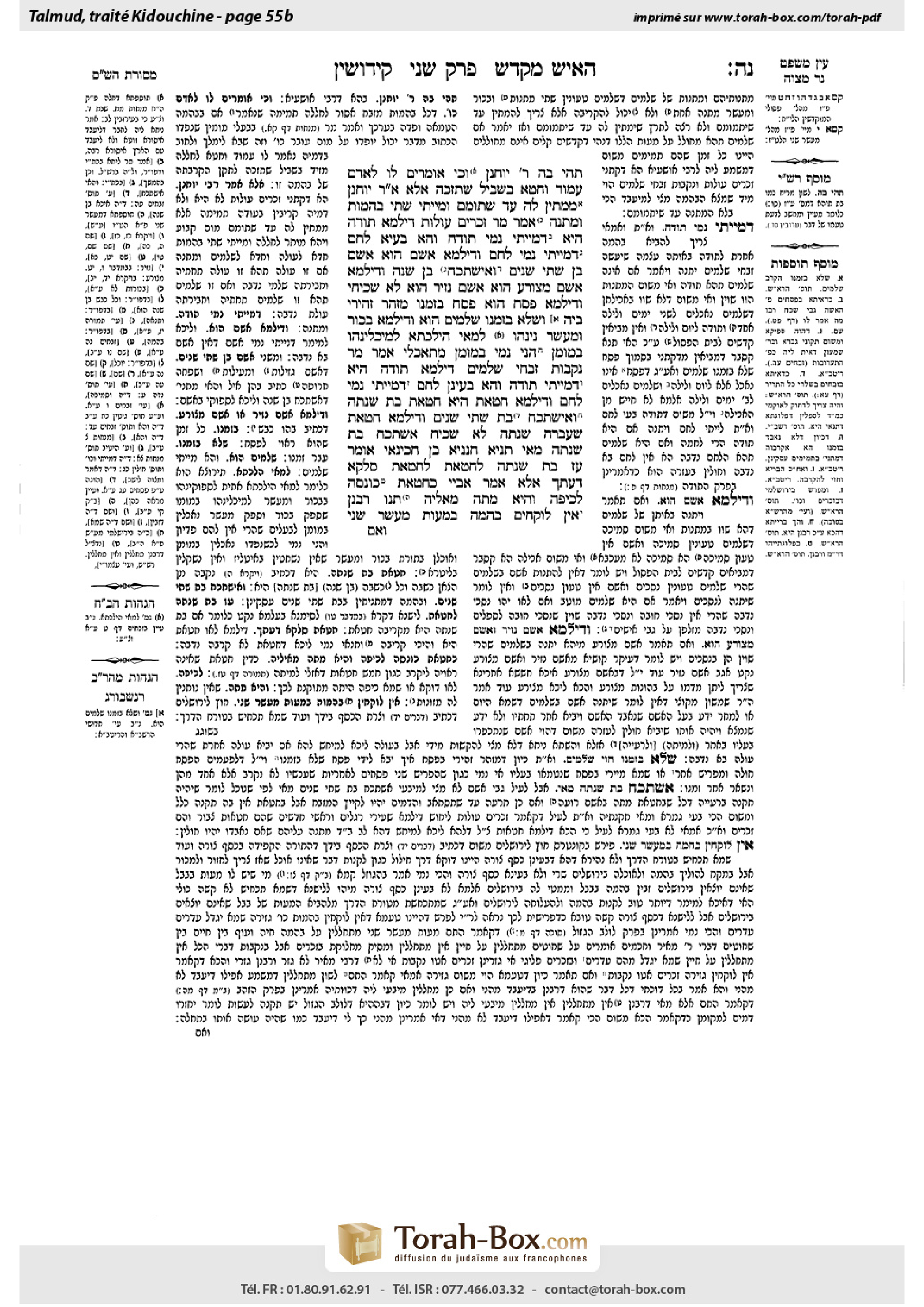
Kiddushin 55b: Talmud study for Daf Yomi
Daf Yomi is the daily study of one Talmud folio. Explore 37 tractates with scans, Hebrew text, Sefaria English and AI-generated French translations where annotated.
Passage selection and English or AI-generated French translation are available where the scan has annotations. Daf Study is independent of Torah-Box and Sefaria.
Browse Kiddushin · קידושין · All tractatesKiddushin 55b text and translations
This page of Kiddushin includes the Aramaic text, an English translation and an AI-generated French translation, alongside the scan above.
קידושין נ״ה ב · Aramaic and Hebrew text
תָּהֵי בַּהּ רַבִּי יוֹחָנָן: וְכִי אוֹמְרִים לוֹ לָאָדָם: עֲמוֹד וַחֲטָא בִּשְׁבִיל שֶׁתִּזְכֶּה? אֶלָּא אָמַר רַבִּי יוֹחָנָן: מַמְתִּין לַהּ עַד שֶׁתּוּמַם, וּמַיְיתֵי שְׁתֵּי בְּהֵמוֹת וּמַתְנֶה.
אָמַר מָר: זְכָרִים – עוֹלוֹת. דִּילְמָא תּוֹדָה הִיא? דְּמַיְיתֵי נָמֵי תּוֹדָה. וְהָא בָּעֲיָא לֶחֶם! דְּמַיְיתֵי נָמֵי לֶחֶם.
וְדִילְמָא אָשָׁם הוּא? אָשָׁם בֶּן שְׁתֵּי שָׁנִים, וְאִישְׁתְּכַח בֶּן שָׁנָה. וְדִילְמָא אֲשַׁם מְצוֹרָע הוּא, אֲשַׁם נָזִיר הוּא? לָא שְׁכִיחִי.
וְדִילְמָא פֶּסַח הוּא? פֶּסַח בִּזְמַנּוֹ, מִזְהָר זְהִירִי בֵּיהּ, וְשֶׁלֹּא בִּזְמַנּוֹ – שְׁלָמִים הוּא.
וְדִילְמָא בְּכוֹר וּמַעֲשֵׂר נִינְהוּ? לְמַאי הִילְכְתָא, לְמֵיכְלִינְהוּ בְּמוּמָן? הָכִי נָמֵי בְּמוּמָן מִתְאַכְלִי!
אָמַר מָר: נְקֵבוֹת – זִבְחֵי שְׁלָמִים. דִּילְמָא תּוֹדָה הִיא? דְּמַיְיתֵי תּוֹדָה. וְהָא בָּעֲיָא לֶחֶם! דְּמַיְיתֵי נָמֵי לֶחֶם.
וְדִילְמָא חַטָּאת הִיא? חַטָּאת בַּת שְׁנָתָהּ, וְאִישְׁתְּכַח בַּת שְׁתֵּי שָׁנִים. וְדִילְמָא חַטָּאת שֶׁעָבְרָה שְׁנָתָהּ! לָא שְׁכִיחַ.
אִשְׁתְּכַח בַּת שְׁנָתָהּ, מַאי? תַּנְיָא, חֲנַנְיָא בֶּן חֲכִינַאי אוֹמֵר: עֵז בַּת שְׁנָתָהּ לְחַטָּאת. לְחַטָּאת סָלְקָא דַּעְתָּךְ?! אֶלָּא אָמַר אַבָּיֵי: כְּחַטָּאת – כּוֹנְסָהּ לְכִיפָּה וְהִיא מֵתָה מֵאֵלֶיהָ.
תָּנוּ רַבָּנַן: אֵין לוֹקְחִים בְּהֵמָה בִּמְעוֹת מַעֲשֵׂר שֵׁנִי,
Kiddushin 55b · English translation
Rabbi Yoḥanan wondered about Rabbi Oshaya’s explanation of the mishna: And does one say to a person: Arise and sin in order that you may gain? Even if consecrated property can be desacralized intentionally, one is not allowed to redeem an animal designated to be an offering. Rather, Rabbi Yoḥanan says: The mishna does not refer to redeeming an unblemished animal but to a case where the one who found the animal waits for it until it develops a blemish. At that point it would no longer have inherent sanctity but merely sanctity that inheres in its value, so the animal may be redeemed. And he brings two unblemished animals of the same value, and stipulates that if the animal he found was a burnt-offering, the first animal should be a burnt-offering in its stead while the other should be a voluntary peace-offering. And if the animal he found was a peace-offering, the second animal should be a peace-offering in its stead and the first should be a voluntary burnt-offering. After doing so he may eat the animal he found.
The Gemara continues to clarify the mishna. The Master says (55a): Males are presumed to be burnt-offerings, as only males may be brought as burnt-offerings. The Gemara asks: Why should a male necessarily be a burnt-offering; perhaps it is a thanks-offering, which can also be brought from a male animal? The Gemara answers: The mishna means that he must also bring a third animal and make a similar stipulation, that it should be either a thanks-offering in its stead or a voluntary one. The Gemara asks: But if he brings a third animal as a thanks-offering, doesn’t a thanks-offering require the bringing of bread as well? The Gemara answers: He brings bread as well.
The Gemara asks: But perhaps it is a guilt-offering, which is also brought only from male animals? The Gemara answers: The animal for a guilt-offering is in its second year, and the mishna is referring to a case where an animal in its first year was found. The Gemara asks: But perhaps it is the guilt-offering of a leper or the guilt-offering of a nazirite, which are brought from animals in their first year? The Gemara answers: Lepers and nazirites are not common, and there is no need to be concerned about that possibility.
The Gemara asks: But perhaps it is a Paschal offering, which is also brought from male animals? The Gemara answers: That is not likely, because with regard to a Paschal offering, if it is up to or in its time to be slaughtered, the owners carefully guard it to prevent it from going missing. And if it is a Paschal offering that is not offered in its proper time, but was left over and is offered later, it has the same halakha as a peace-offering.
The Gemara asks: And perhaps the animal he found is a firstborn animal, which can only be brought from male animals, or animal tithe, which can brought from male animals? The Gemara answers: With regard to which halakha would the possibility that it is a firstborn or animal tithe need to be taken into account? It is with regard to the halakha that one is permitted to eat them in their blemished state, as firstborns and animal tithes do not need to be redeemed if they develop a blemish, but are eaten as such. These found animals as well are eaten only in their blemished state, as one may not redeem and eat them until they develop a blemish, as explained previously.
The Master says above: Females are presumed to be peace-offerings, as it is permitted to bring a female peace-offering. The Gemara asks: Perhaps it is a thanks-offering, which can also be brought from female animals? The Gemara answers: The mishna means that he must also bring a third animal and make a similar stipulation, that it is either a thanks-offering in the stead of the found animal, or a gift offering. The Gemara asks: But if he brings a third animal as a thanks-offering, doesn’t a thanks-offering require the bringing of bread as well? The Gemara answers: He brings bread as well.
The Gemara asks: But perhaps it is a sin-offering, as it is permitted to bring a female sin-offering? The Gemara answers: The animal for a sin-offering is always in its first year, and the mishna is referring to a case where an animal in its second year was found. The Gemara asks: But perhaps it was a sin-offering whose year had passed without having been sacrificed? The halakha in such a case is that the animal is left to die. The Gemara answers: Such a case is not common, and there is no need to be concerned about such a possibility.
The Gemara asks: This is the case if the animal was in its second year, but what is the halakha if it was found when it was in its first year? The Gemara answers: It is taught in a baraita: Ḥananya ben Ḥakhinai says: If one found a goat in its first year, it is brought as a sin-offering. The Gemara asks: Can it enter your mind that it is brought as a sin-offering? How can he sacrifice the animal as a sin-offering due to a mere possibility that it had been designated as a sin-offering? One cannot bring a voluntary sin-offering. Rather, Abaye says: He treats it as though it were a sin-offering, i.e., he conveys it into a cell and it dies on its own. Since it might be a lost sin-offering, it must be left to die.
The Sages taught (Tosefta, Ma’aser Sheni 1:15): One may not purchase an animal with second-tithe money outside of Jerusalem,
Kiddushin 55b · Traduction française (IA)
Rabbi Yoḥanan s’interrogea sur l’explication de la Michna proposée par Rabbi Oshaya : « Dit-on à quelqu’un : “Lève-toi et commets une faute afin d’en tirer profit” ? » Même s’il est possible de désacraliser intentionnellement un bien consacré, il n’est pas permis de racheter un animal désigné comme offrande. Rabbi Yoḥanan dit plutôt : la Michna ne parle pas du rachat d’un animal sans défaut, mais d’un cas où celui qui a trouvé l’animal attend qu’il développe un défaut. À ce moment-là, l’animal n’aurait plus de sainteté intrinsèque, mais seulement une sainteté attachée à sa valeur ; il pourrait donc être racheté. Il apporte alors deux animaux sans défaut de même valeur et stipule que, si l’animal trouvé était un holocauste, le premier animal en tiendra lieu comme holocauste, tandis que l’autre sera un sacrifice de paix volontaire. Et si l’animal trouvé était un sacrifice de paix, le second animal en tiendra lieu comme sacrifice de paix, et le premier sera un holocauste volontaire. Après avoir procédé ainsi, il peut manger l’animal qu’il a trouvé.
La Guemara poursuit l’éclaircissement de la Michna. Le Maître dit (55a) : les mâles sont présumés être des holocaustes, car seuls des mâles peuvent être offerts en holocauste. La Guemara demande : pourquoi un mâle serait-il nécessairement un holocauste ? Peut-être est-ce un sacrifice d’action de grâce, qui peut également être offert à partir d’un animal mâle. La Guemara répond : la Michna signifie qu’il doit aussi apporter un troisième animal et formuler une condition semblable : celui-ci sera soit un sacrifice d’action de grâce à la place de l’animal trouvé, soit une offrande volontaire. La Guemara demande : mais s’il apporte un troisième animal comme sacrifice d’action de grâce, ne doit-il pas également apporter du pain ? La Guemara répond : il apporte aussi du pain.
La Guemara demande : mais peut-être s’agit-il d’un sacrifice de culpabilité, qui est lui aussi offert uniquement à partir d’animaux mâles ? La Guemara répond : l’animal destiné à un sacrifice de culpabilité est dans sa deuxième année, tandis que la Michna parle d’un cas où l’on a trouvé un animal dans sa première année. La Guemara demande : mais peut-être s’agit-il du sacrifice de culpabilité d’un lépreux ou d’un nazir, qui sont offerts à partir d’animaux dans leur première année ? La Guemara répond : les lépreux et les nazirim sont rares, et il n’est pas nécessaire de tenir compte de cette possibilité.
La Guemara demande : mais peut-être s’agit-il d’un sacrifice pascal, qui est lui aussi offert à partir d’animaux mâles ? La Guemara répond : cette éventualité est peu probable, car, pour un sacrifice pascal, si le moment de l’abattage est arrivé ou approche, les propriétaires le gardent soigneusement afin qu’il ne se perde pas. Et s’il s’agit d’un sacrifice pascal qui n’est pas offert au moment prescrit, mais qui a été laissé de côté et est offert plus tard, sa halakha est celle d’un sacrifice de paix.
La Guemara demande : et peut-être l’animal qu’il a trouvé est-il un premier-né, qui ne peut être offert qu’à partir d’animaux mâles, ou un animal de la dîme, qui peut être offert à partir d’animaux mâles ? La Guemara répond : pour quelle halakha faudrait-il tenir compte de la possibilité qu’il s’agisse d’un premier-né ou d’un animal de la dîme ? Pour la halakha selon laquelle il est permis de les manger lorsqu’ils ont un défaut : les premiers-nés et les animaux de la dîme n’ont pas besoin d’être rachetés s’ils développent un défaut, mais se mangent tels quels. Ces animaux trouvés ne se mangent eux aussi que lorsqu’ils ont un défaut, car il est interdit de les racheter et de les manger avant qu’ils n’en développent un, comme cela a été expliqué précédemment.
Le Maître dit plus haut : les femelles sont présumées être des sacrifices de paix, car il est permis d’offrir une femelle en sacrifice de paix. La Guemara demande : peut-être s’agit-il d’un sacrifice d’action de grâce, qui peut également être offert à partir d’animaux femelles ? La Guemara répond : la Michna signifie qu’il doit aussi apporter un troisième animal et formuler une condition semblable : celui-ci sera soit un sacrifice d’action de grâce à la place de l’animal trouvé, soit une offrande volontaire. La Guemara demande : mais s’il apporte un troisième animal comme sacrifice d’action de grâce, ne doit-il pas également apporter du pain ? La Guemara répond : il apporte aussi du pain.
La Guemara demande : mais peut-être s’agit-il d’un sacrifice expiatoire, puisqu’il est permis d’offrir une femelle en sacrifice expiatoire ? La Guemara répond : l’animal destiné à un sacrifice expiatoire est toujours dans sa première année, tandis que la Michna parle d’un cas où l’on a trouvé un animal dans sa deuxième année. La Guemara demande : mais peut-être s’agissait-il d’un sacrifice expiatoire dont l’année s’est écoulée sans qu’il ait été offert ? Dans ce cas, la halakha veut que l’animal soit laissé à mourir. La Guemara répond : un tel cas est rare, et il n’est pas nécessaire de tenir compte de cette possibilité.
La Guemara demande : cela concerne le cas où l’animal était dans sa deuxième année, mais quelle est la halakha s’il a été trouvé alors qu’il était dans sa première année ? La Guemara répond : il est enseigné dans une baraïta : Ḥananya ben Ḥakhinai dit : si quelqu’un a trouvé une chèvre dans sa première année, elle est offerte en sacrifice expiatoire. La Guemara demande : peut-on concevoir qu’elle soit offerte en sacrifice expiatoire ? Comment pourrait-il sacrifier l’animal en sacrifice expiatoire sur la seule possibilité qu’il ait été désigné comme tel ? On ne peut pas apporter de sacrifice expiatoire volontaire. Abaye dit plutôt : il le traite comme s’il s’agissait d’un sacrifice expiatoire, c’est-à-dire qu’il le place dans un enclos et le laisse mourir de lui-même. Puisqu’il pourrait s’agir d’un sacrifice expiatoire perdu, il faut le laisser mourir.
Les Sages ont enseigné (Tosefta, Ma’aser Sheni 1:15) : on ne peut pas acheter un animal avec l’argent de la seconde dîme en dehors de Jérusalem,
Traduction française générée par IA à partir de l’édition anglaise de Sefaria. Vérifie toujours un passage avec le texte source.
Text from Sefaria: William Davidson Edition - Vocalized Aramaic (CC BY NC); William Davidson Edition - English (CC BY NC).