Kiddushin 56a: Talmud study for Daf Yomi
Daf Yomi is the daily study of one Talmud folio. Explore 37 tractates with scans, Hebrew text, Sefaria English and AI-generated French translations where annotated.
Passage selection and English or AI-generated French translation are available where the scan has annotations. Daf Study is independent of Torah-Box and Sefaria.
Browse Kiddushin · קידושין · All tractatesKiddushin 56a text and translations
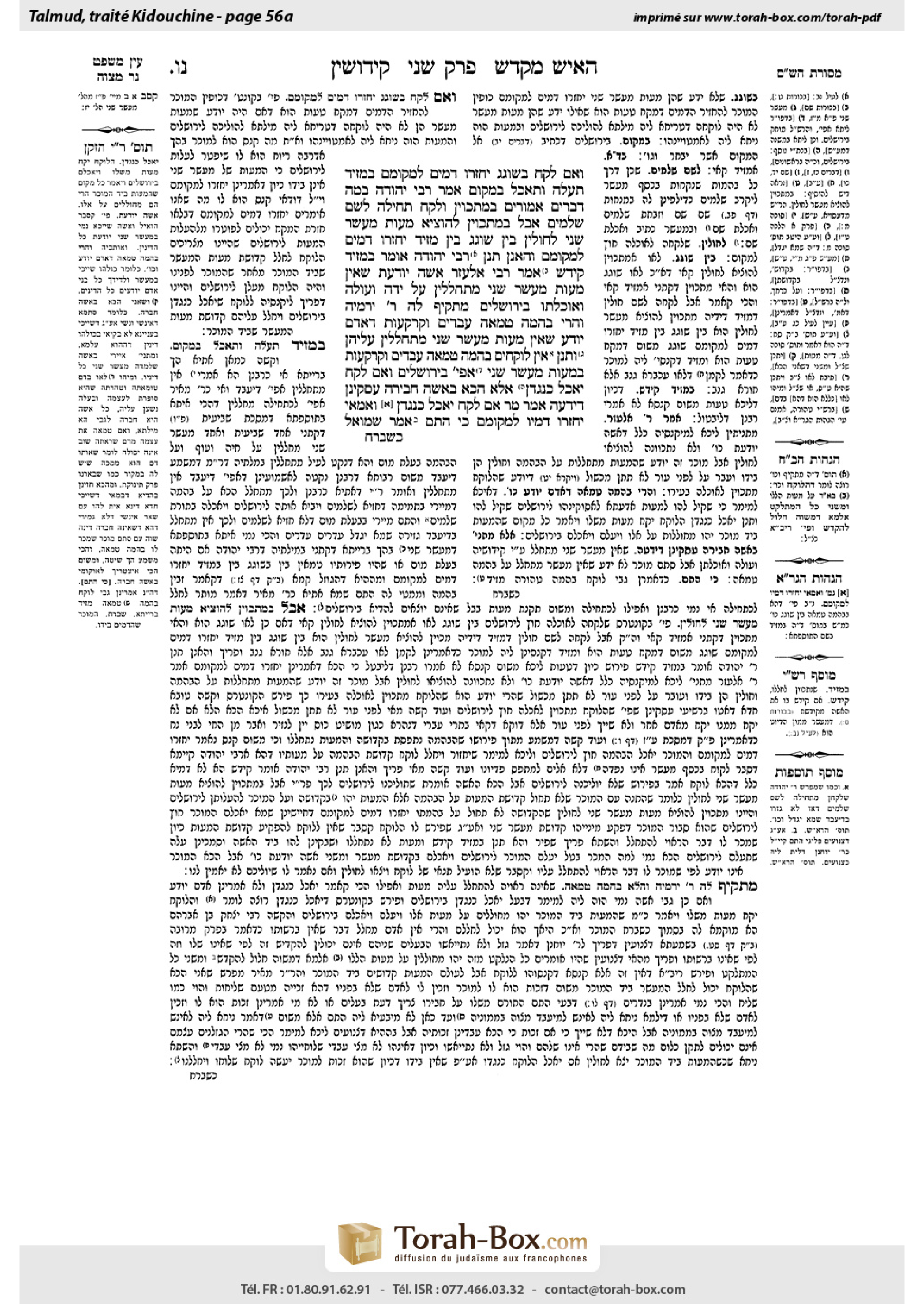
This page of Kiddushin includes the Aramaic text, an English translation and an AI-generated French translation, alongside the scan above.
קידושין נ״ו א · Aramaic and Hebrew text
וְאִם לָקַח בְּשׁוֹגֵג – יַחְזְרוּ דָּמִים לִמְקוֹמָם. בְּמֵזִיד – תַּעֲלֶה וְתֵאָכֵל בַּמָּקוֹם. אָמַר רַבִּי יְהוּדָה: בַּמֶּה דְּבָרִים אֲמוּרִים – בְּמִתְכַּוֵּין וְלָקַח תְּחִילָּה לְשֵׁם שְׁלָמִים, אֲבָל בְּמִתְכַּוֵּין לְהוֹצִיא מְעוֹת מַעֲשֵׂר שֵׁנִי לְחוּלִּין, בֵּין שׁוֹגֵג בֵּין מֵזִיד – יַחְזְרוּ דָּמִים לִמְקוֹמָם.
וְהָאֲנַן תְּנַן: רַבִּי יְהוּדָה אוֹמֵר: בְּמֵזִיד – קִידֵּשׁ! אָמַר רַבִּי אֶלְעָזָר: אִשָּׁה יוֹדַעַת שֶׁאֵין מְעוֹת מַעֲשֵׂר שֵׁנִי מִתְחַלְּלִין עַל יָדָהּ, וְעוֹלָה וְאוֹכַלְתּוֹ בִּירוּשָׁלַיִם.
מַתְקֵיף לַהּ רַבִּי יִרְמְיָה: וַהֲרֵי בְּהֵמָה טְמֵאָה, עֲבָדִים וְקַרְקָעוֹת, דְּאָדָם יוֹדֵעַ שֶׁאֵין מְעוֹת מַעֲשֵׂר שֵׁנִי מִתְחַלְּלִין עֲלֵיהֶן, וּתְנַן: אֵין לוֹקְחִים בְּהֵמָה טְמֵאָה עֲבָדִים וְקַרְקָעוֹת בִּמְעוֹת מַעֲשֵׂר שֵׁנִי אֲפִילּוּ בִּירוּשָׁלַיִם. וְאִם לָקַח – יֹאכַל כְּנֶגְדָּן!
אֶלָּא הָכָא בְּאִשָּׁה חֲבֵירָה עָסְקִינַן, דְּיָדְעָה.
אָמַר מָר: אִם לָקַח יֹאכַל כְּנֶגְדָּן. וְאַמַּאי? יַחְזְרוּ דָּמָיו לִמְקוֹמָם, כִּי הָתָם!
אָמַר שְׁמוּאֵל:
Kiddushin 56a · English translation
and if one purchased an animal unwittingly, without realizing he was using second tithe money, the money returns to its place, meaning that it is considered to be an erroneous transaction and is void, because the purchaser would prefer to bring the second tithe money to Jerusalem rather than to travel with an animal to bring as an offering. If he purchased it intentionally, the animal is brought up and eaten in its proper place, i.e., in Jerusalem. Rabbi Yehuda said: In what case is this statement said? It is said with regard to one who acted with intent, and purchased the animal from the outset for the sake of a peace-offering, and in any case had to bring the animal to Jerusalem. But with regard to one who acted with intent to withdraw the second-tithe money from its consecrated state to a desacralized state, whether his act was unwitting, in which case it is an erroneous transaction, or intentional, the money returns to its place.
The Gemara questions this statement: But didn’t we learn in the mishna that Rabbi Yehuda says: If the second tithe was used intentionally, he has betrothed the woman with it, and the betrothal, which is a type of acquisition, is effective? Rabbi Elazar said: The halakha in the mishna is based upon the assumption that a woman knows that second-tithe money is not desacralized by her acceptance of the betrothal, and it is as though she has agreed that she would ascend and eat it in Jerusalem.
Rabbi Yirmeya objects to this: But there are cases of a non-kosher animal, slaves, or land, with regard to which a person knows that second-tithe money is not desacralized by being used to purchase them, and we learned in a mishna (Ma’aser Sheni 1:7): One may not purchase a non-kosher animal, slaves, or land with second-tithe money, even in Jerusalem. And if one did purchase them, he must eat other food corresponding to their value. He must take an equivalent sum of money and use it to desacralize the money in the seller’s possession, after which he proceeds to bring this money to Jerusalem and use it to buy food, which he will then consume. In this case, the seller is also presumably aware that the money is second tithe and that he himself will need to take it to Jerusalem, as was presumed in the case of the betrothed woman, so why is the halakha not the same?
Rather, it must be that here, in the case of the mishna, we are dealing with a woman devoted to the meticulous observance of mitzvot, especially the halakhot of ritual purity, teruma, and tithes [ḥavera], who knows the laws of tithes, and accepts it for betrothal with the awareness that she must take it to Jerusalem. An ordinary person, however, is not well-versed in these halakhot, so in the case of the purchase of an animal the seller thinks that the second-tithe money has been desacralized through the purchase of the non-kosher animal.
The Master said: If one did purchase them, he must eat other food corresponding to their value. The Gemara asks: But why should he do so? Why not say that the money must return to its place, just as was the ruling there, as Rabbi Yehuda said with regard to one who acted with intent to desacralize the second tithe, where the seller was penalized for acquiescing to the sale?
Shmuel says:
Kiddushin 56a · Traduction française (IA)
Et si quelqu’un a acheté un animal sans le savoir, sans se rendre compte qu’il utilisait de l’argent de la seconde dîme, l’argent retourne à sa place, c’est-à-dire que la transaction est considérée comme erronée et est annulée, car l’acheteur préférerait apporter l’argent de la seconde dîme à Jérusalem plutôt que de devoir s’y rendre avec un animal pour l’offrir en sacrifice. S’il l’a acheté intentionnellement, l’animal est amené à Jérusalem et consommé à l’endroit approprié, c’est-à-dire à Jérusalem. Rabbi Yehouda a dit : Dans quel cas cette déclaration s’applique-t-elle ? Elle s’applique à celui qui a agi intentionnellement et a acheté l’animal dès le départ en vue d’en faire un sacrifice de paix, et qui, de toute façon, devait amener l’animal à Jérusalem. En revanche, celui qui a agi intentionnellement dans le but de faire passer l’argent de la seconde dîme de son statut consacré à un statut profane : que son acte ait été involontaire, auquel cas il s’agit d’une transaction erronée, ou intentionnel, l’argent retourne à sa place.
La Guemara conteste cette déclaration : Mais n’avons-nous pas appris dans la Michna que Rabbi Yehouda dit : Si l’argent de la seconde dîme a été utilisé intentionnellement, il l’a utilisée pour contracter le mariage de la femme, et le mariage, qui est une forme d’acquisition, est valide ? Rabbi Elazar a dit : La halakha de la Michna repose sur l’hypothèse que la femme sait que l’argent de la seconde dîme n’est pas désacralisé du fait qu’elle accepte le mariage ; c’est comme si elle avait accepté de monter à Jérusalem pour le consommer.
Rabbi Yirmeya objecte : Mais il existe des cas d’animaux non cachères, d’esclaves ou de terres, pour lesquels on sait que l’argent de la seconde dîme n’est pas désacralisé lorsqu’il sert à les acheter ; or nous avons appris dans une Michna (Ma’aser Sheni 1:7) : On ne peut pas acheter un animal non cachère, des esclaves ou des terres avec l’argent de la seconde dîme, même à Jérusalem. Et si quelqu’un en a acheté, il doit consommer d’autres aliments d’une valeur équivalente. Il doit prendre une somme équivalente et l’utiliser pour désacraliser l’argent qui se trouve en possession du vendeur ; ensuite, il apporte cet argent à Jérusalem et l’utilise pour acheter des aliments, qu’il consommera alors. Dans ce cas aussi, le vendeur sait probablement que l’argent est celui de la seconde dîme et qu’il devra lui-même l’apporter à Jérusalem, comme on le supposait dans le cas de la femme fiancée ; pourquoi la halakha n’est-elle donc pas la même ?
Il faut plutôt dire qu’ici, dans le cas de la Michna, il s’agit d’une femme qui observe scrupuleusement les mitsvot, en particulier les halakhot de pureté rituelle, de terouma et de dîmes [ḥavera], et qui connaît les lois des dîmes ; elle accepte l’argent en paiement du mariage en sachant qu’elle doit l’apporter à Jérusalem. Une personne ordinaire, en revanche, ne connaît pas bien ces halakhot ; dans le cas de l’achat d’un animal, le vendeur pense donc que l’argent de la seconde dîme a été désacralisé par l’achat de l’animal non cachère.
Le Maître a dit : Si quelqu’un en a acheté, il doit consommer d’autres aliments d’une valeur équivalente. La Guemara demande : Mais pourquoi devrait-il faire cela ? Pourquoi ne pas dire que l’argent doit retourner à sa place, comme dans le cas évoqué précédemment, selon la décision de Rabbi Yehouda concernant celui qui a agi dans le but de désacraliser l’argent de la seconde dîme, le vendeur étant pénalisé pour avoir consenti à la vente ?
Shmuel dit :
Traduction française générée par IA à partir de l’édition anglaise de Sefaria. Vérifie toujours un passage avec le texte source.
Text from Sefaria: William Davidson Edition - Vocalized Aramaic (CC BY NC); William Davidson Edition - English (CC BY NC).