Kiddushin 56b: Talmud study for Daf Yomi
Daf Yomi is the daily study of one Talmud folio. Explore 37 tractates with scans, Hebrew text, Sefaria English and AI-generated French translations where annotated.
Passage selection and English or AI-generated French translation are available where the scan has annotations. Daf Study is independent of Torah-Box and Sefaria.
Browse Kiddushin · קידושין · All tractatesKiddushin 56b text and translations
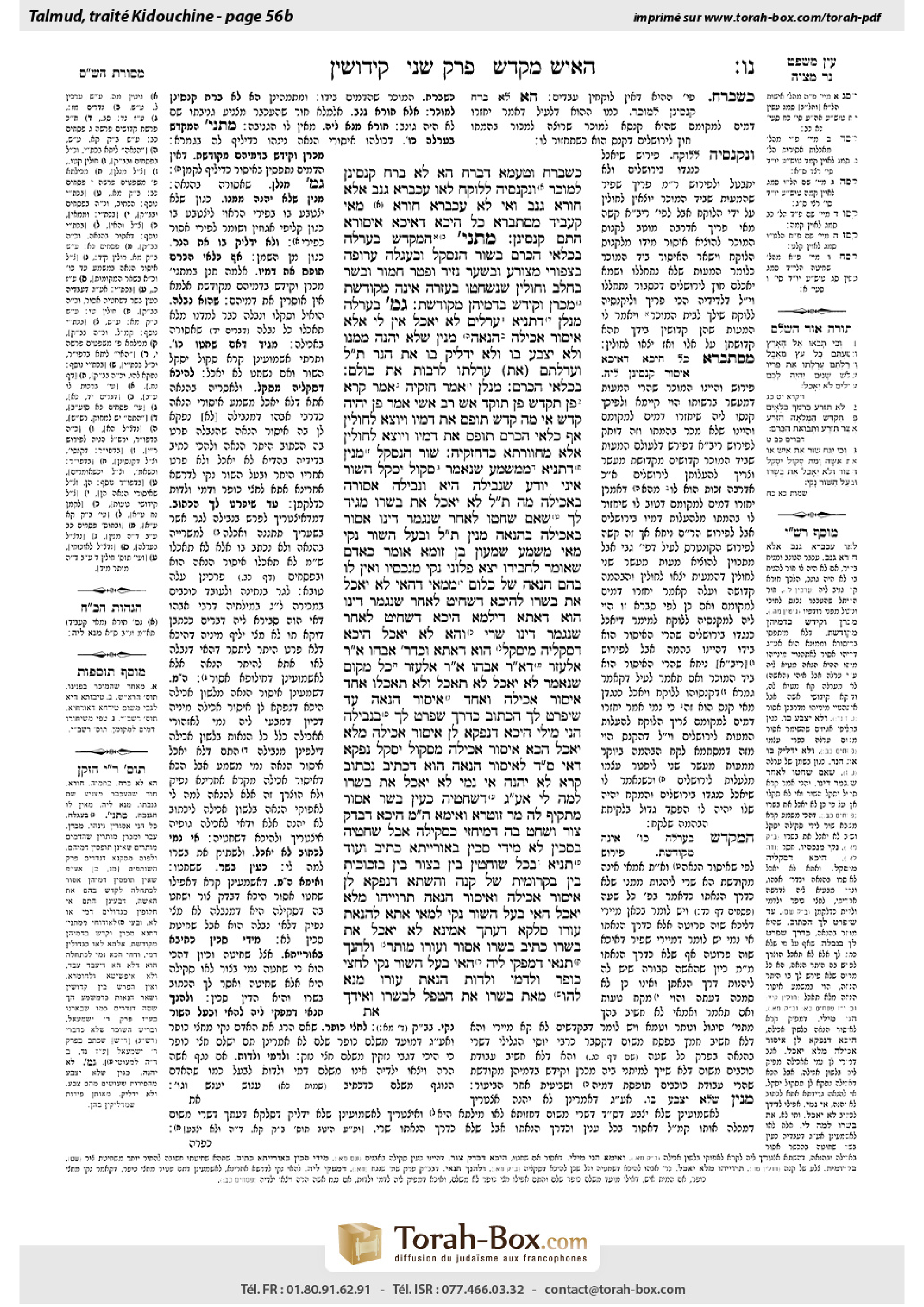
This page of Kiddushin includes the Aramaic text, an English translation and an AI-generated French translation, alongside the scan above.
קידושין נ״ו ב · Aramaic and Hebrew text
כְּשֶׁבָּרַח. וְטַעְמָא דְּבָרַח, הָא לֹא בָּרַח – קָנְסִינַן לְמוֹכֵר. וְנִקְנְסֵיהּ לְלוֹקֵחַ! לָאו עַכְבְּרָא גַּנָּב אֶלָּא חוֹרָא גַּנָּב.
וְאִי לָא עַכְבְּרָא, חוֹרָא מַאי קָעָבֵיד? מִסְתַּבְּרָא, כֹּל הֵיכָא דְּאִיכָּא אִיסּוּרָא – הָתָם קָנְסִינַן.
מַתְנִי׳ הַמְקַדֵּשׁ בְּעׇרְלָה, בְּכִלְאֵי הַכֶּרֶם, בְּשׁוֹר הַנִּסְקָל, וּבְעֶגְלָה עֲרוּפָה, בְּצִפּוֹרֵי מְצוֹרָע, וּבִשְׂעַר נָזִיר, וּפֶטֶר חֲמוֹר, וּבָשָׂר בְּחָלָב, וְחוּלִּין שֶׁנִּשְׁחֲטוּ בַּעֲזָרָה – אֵינָהּ מְקוּדֶּשֶׁת. מְכָרָן וְקִידֵּשׁ בִּדְמֵיהֶן – מְקוּדֶּשֶׁת.
גְּמָ׳ בְּעׇרְלָה מְנָלַן? דְּתַנְיָא: ״עֲרֵלִים לֹא יֵאָכֵל״ – אֵין לִי אֶלָּא אִיסּוּר אֲכִילָה, הֲנָאָה מִנַּיִן? שֶׁלֹּא יֵהָנֶה מִמֶּנּוּ, וְלֹא יִצְבַּע בּוֹ, וְלֹא יַדְלִיק בּוֹ אֶת הַנֵּר? תַּלְמוּד לוֹמַר: ״וַעֲרַלְתֶּם אֶת עׇרְלָתוֹ״ – לְרַבּוֹת אֶת כּוּלָּם.
בְּכִלְאֵי הַכֶּרֶם מְנָלַן? אָמַר חִזְקִיָּה: אָמַר קְרָא: ״פֶּן תִּקְדַּשׁ״ – פֶּן תּוּקַד אֵשׁ.
רַב אָשֵׁי אָמַר: ״פֶּן יִהְיֶה קֹדֶשׁ״. אִי מָה קֹדֶשׁ תּוֹפֵס אֶת דָּמָיו וְיוֹצֵא לְחוּלִּין – אַף כִּלְאֵי הַכֶּרֶם תּוֹפֵס אֶת דָּמָיו וְיוֹצֵא לְחוּלִּין! אֶלָּא מְחַוַּורְתָּא כִּדְחִזְקִיָּה.
״שׁוֹר הַנִּסְקָל״ מִנַּיִן? דְּתַנְיָא: מִמַּשְׁמָע שֶׁנֶּאֱמַר: ״סָקוֹל יִסָּקֵל הַשּׁוֹר״ – אֵינִי יוֹדֵעַ שֶׁנְּבֵילָה הִיא, וּנְבֵילָה אֲסוּרָה בַּאֲכִילָה? מָה תַּלְמוּד לוֹמַר: ״לֹא יֵאָכֵל אֶת בְּשָׂרוֹ״? מַגִּיד לָךְ שֶׁאִם שְׁחָטוֹ לְאַחַר שֶׁנִּגְמַר דִּינוֹ – אָסוּר בַּאֲכִילָה.
בַּהֲנָאָה מִנַּיִן? תַּלְמוּד לוֹמַר: ״וּבַעַל הַשּׁוֹר נָקִי״. מַאי מַשְׁמַע? שִׁמְעוֹן בֶּן זוֹמָא אוֹמֵר: כְּאָדָם שֶׁאוֹמֵר לַחֲבֵירוֹ: ״יָצָא פְּלוֹנִי נָקִי מִנְּכָסָיו וְאֵין לוֹ בָּהֶם הֲנָאָה שֶׁל כְּלוּם״.
מִמַּאי דְּהַאי ״לֹא יֵאָכֵל אֶת בְּשָׂרוֹ״ לְהֵיכָא דְּשָׁחֵיט לְאַחַר שֶׁנִּגְמַר דִּינוֹ הוּא דַּאֲתָא? דִּילְמָא הֵיכָא דְּשָׁחֵיט לְאַחַר שֶׁנִּגְמַר דִּינוֹ שְׁרֵי, וְהָא ״לֹא יֵאָכֵל״ – הֵיכָא דְּסַקְלֵיהּ מִיסְקָל הוּא דַּאֲתָא, וְכִדְרַבִּי אֲבָהוּ אָמַר רַבִּי אֶלְעָזָר.
דְּאָמַר רַבִּי אֲבָהוּ אָמַר רַבִּי אֶלְעָזָר: כׇּל מָקוֹם שֶׁנֶּאֱמַר: ״לֹא יֹאכַל״ ״לֹא תֹאכַל״ וְ״לֹא תֹאכְלוּ״ – אֶחָד אִיסּוּר אֲכִילָה וְאֶחָד אִיסּוּר הֲנָאָה, עַד שֶׁיִּפְרֹט לְךָ הַכָּתוּב כְּדֶרֶךְ שֶׁפָּרַט לְךָ בִּנְבֵילָה!
הָנֵי מִילֵּי הֵיכָא דְּנָפְקָא לַן אִיסּוּר אֲכִילָה מִ״לֹּא יֹאכַל״, הָכָא אִיסּוּר אֲכִילָה מִ״סָּקוֹל יִסָּקֵל״ נָפְקָא. דְּאִי סָלְקָא דַעְתָּךְ לְאִיסּוּר הֲנָאָה הוּא דִּכְתִיב, נִכְתּוֹב קְרָא: ״לֹא יֵהָנֶה״.
אִי נָמֵי: ״לֹא יֵאָכֵל״, ״אֶת בְּשָׂרוֹ״ לְמָה לִי?! אַף עַל גַּב דְּשַׁחְטֵיהּ כְּעֵין בָּשָׂר – אָסוּר.
מַתְקֵיף לַהּ מָר זוּטְרָא: וְאֵימָא הָנֵי מִילֵּי הֵיכָא דְּבָדַק צוּר וְשָׁחַט בָּהּ, דְּמִיחֲזֵי כִּסְקִילָה, אֲבָל שַׁחְטֵיהּ בְּסַכִּין – לָא! מִידֵּי סַכִּין בְּאוֹרָיְיתָא כְּתִיב? וְעוֹד תַּנְיָא: בַּכֹּל שׁוֹחֲטִין, בֵּין בְּצוֹר, בֵּין בִּזְכוּכִית, בֵּין בִּקְרוּמִית שֶׁל קָנֶה.
וְהַשְׁתָּא דְּנָפְקָא לַן אִיסּוּר אֲכִילָה וְאִיסּוּר הֲנָאָה תַּרְוַיְיהוּ מִ״לֹּא יֵאָכֵל״, הַאי ״בַּעַל הַשּׁוֹר נָקִי״ לְמַאי אֲתָא? לַהֲנָאַת עוֹרוֹ. סָלְקָא דַּעְתָּךְ אָמֵינָא: ״לֹא יֵאָכֵל אֶת בְּשָׂרוֹ״ כְּתִיב, בְּשָׂרוֹ אָסוּר וְעוֹרוֹ מוּתָּר.
וּלְהָנָךְ תַּנָּאֵי דְּמַפְּקִי לֵיהּ הַאי ״בַּעַל הַשּׁוֹר נָקִי״ לַחֲצִי כּוֹפֶר וְלִדְמֵי וַלְדוֹת, הֲנָאַת עוֹרוֹ מְנָא לְהוּ?
מֵ״אֶת בְּשָׂרוֹ״, אֶת הַטָּפֵל לִבְשָׂרוֹ. וְאִידַּךְ?
Kiddushin 56b · English translation
The case here is where the seller fled with the money, and there is no way of voiding the sale and returning the money to the purchaser. The Gemara comments: And the reason is that he fled, but had he not fled, we would penalize the seller by requiring him to return the money. The Gemara asks: And let us penalize the buyer and require him to take an equivalent sum of money to Jerusalem. The Gemara answers: It is not the mouse that steals, but the hole that steals. In other words, a mouse cannot steal an item unless he has a hole in which to hide it. Here too, the money would not have been desacralized without the help of the seller.
The Gemara questions this logic: But if not for the mouse, what has the hole done? Since they both are integral to the prohibited act, each of them is deserving of a penalty. The Gemara answers: It stands to reason that anywhere that the forbidden item is, i.e., anywhere that the money is, and in this case it is with the seller, there we should penalize.
MISHNA: With regard to one who betroths a woman with orla, i.e., fruit grown during a tree’s first three years, or with diverse kinds in a vineyard, i.e., grain and grapes planted together, or with an ox that is sentenced to be stoned, or with a heifer whose neck is broken, or with the leper’s birds which are designated for his offering, or with a nazirite’s hair, or with a firstborn donkey, or with meat cooked in milk, or with non-sacred animals that were slaughtered in the Temple courtyard, if he betroths her with any of these items, the woman is not betrothed, since it is prohibited to derive benefit from any of these items. By contrast, if one sold them and betrothed a woman with the money received from their sale, she is betrothed, as in these cases one may derive benefit from the money he receives in exchange for the forbidden item.
GEMARA: The Gemara explains the source of the halakha that it is prohibited to derive benefit from the items mentioned in the mishna. With orla: From where do we derive that one is prohibited from deriving benefit from orla? The Gemara answers: As it is taught in a baraita: “And shall have planted all manner of trees for food, then you shall count the fruit thereof as forbidden; three years shall it be as forbidden [arelim] to you; it shall not be eaten” (Leviticus 19:23). From this verse, I have derived only a prohibition against eating it. From where do I derive that one may not even derive benefit from it? From where do we derive that one may not derive benefit from it in another manner, and one may not paint with the dye that can be extracted from the fruit, and one may not light a lamp with its oil? The verse states: “Then you shall count the fruit thereof [orlato] as forbidden [araltem]” (Leviticus 19:23), to include all these types of benefit in the prohibition.
The mishna stated that one may not betroth a woman with diverse kinds in a vineyard. From where do we derive that one is prohibited from deriving benefit from diverse kinds in a vineyard? Ḥizkiyya said: The verse states: “You shall not sow your vineyard with diverse kinds; lest the growth of the seed that you have sown be forbidden [pen tikdash], together with the yield of the vineyard” (Deuteronomy 22:9). Ḥizkiyya expounds “lest the growth of the seed that you have sown be forbidden [pen tikdash]” as: Lest it be burned [pen tukad esh], indicating that the seed of diverse kinds must be destroyed by fire, so that no benefit is derived from it.
Rav Ashi says that the phrase “pen tikdash” indicates that it is comparable to consecrated property, as if it said: Lest it become consecrated [kodesh], and one is therefore prohibited from deriving benefit from it, just as one may not derive benefit from consecrated property. The Gemara questions Rav Ashi’s interpretation: If diverse kinds in a vineyard is compared to consecrated property, then just as consecrated property transfers its sanctity to the money with which it is redeemed and becomes desacralized, so too, diverse kinds in a vineyard should transfer their sanctity to the money with which they are redeemed and become desacralized. Contrary to this logic, the mishna taught that if one sells diverse kinds in a vineyard, the proceeds can be used for betrothal, indicating that it is not forbidden to derive benefit from this money. Rather, it is clear that the correct derivation is as that of Ḥizkiyya.
The Gemara continues its analysis of the mishna: From where is it derived that one is prohibited from deriving benefit from an ox that is sentenced to be stoned? The Gemara answers: As it is taught in a baraita: It is taught by inference from that which is stated with regard to an ox that killed a person: “And if an ox gore a man or a woman, that they die, the ox shall be stoned, and its flesh shall not be eaten; but the owner of the ox shall be clear” (Exodus 21:28). Don’t I know from this verse that the stoning makes it an unslaughtered animal carcass, and it is prohibited to eat an unslaughtered animal carcass? What is the meaning when the verse states: “Its flesh shall not be eaten”? The verse is telling you that even if one slaughtered the ox after its verdict had been reached but before it was stoned, it is still prohibited to eat it.
The baraita continues: From where is it derived that one is prohibited from deriving benefit from the ox as well? The verse states: “But the owner of the ox shall be clear.” The Gemara asks: From where may it be inferred that one may not derive benefit from this ox? Shimon ben Zoma says: This is like a person who says to another: So-and-so was left clear [naki] of his property, and he has no benefit from it at all. Similarly, “But the owner of the ox shall be clear” means that he may not derive any benefit from the ox.
The Gemara asks: From where is it known that this phrase: “Its flesh shall not be eaten,” comes to teach a halakha with regard to a case where he slaughtered the ox after its verdict was reached, but before it was stoned? Perhaps it is permitted to eat the ox if he slaughtered it after its verdict had been reached. And this phrase: “Shall not be eaten,” comes to teach a halakha with regard to a case where they had already stoned it, but not to teach a prohibition against eating it, as that is already known due to the fact that it was stoned. Rather, it comes to prohibit deriving benefit from the ox, and that would be in accordance with the statement of Rabbi Abbahu who says the following, citing Rabbi Elazar.
The Gemara continues the question: As Rabbi Abbahu says that Rabbi Elazar says that wherever it is stated: “It shall not be eaten”; or “you,” singular, “shall not eat”; or “you,” plural, “shall not eat”; both a prohibition against eating and a prohibition against deriving benefit are indicated. This is so unless the verse specifies for you that one may derive benefit, in the manner that it specified for you with regard to an animal carcass, from which the verse explicitly permits one to derive benefit, as it states: “You may sell it to a foreigner” (Deuteronomy 14:21). Here, too, with regard to the ox that is stoned, the phrase: “Its flesh shall not be eaten,” may serve to teach that one may not derive benefit from the stoned ox.
The Gemara answers: This statement of Rabbi Abbahu applies only to a case where we derive the prohibition against eating from the words: “It may not be eaten,” which is interpreted to include any manner of consumption. But here, the prohibition against eating is derived from: “It shall be stoned,” from which it is understood that since the ox becomes an unslaughtered animal carcass, it may not be eaten. As if it enters your mind that the phrase: “Its flesh may not be eaten,” is written to prohibit one from deriving benefit, let the verse state: “One may not derive benefit.” Why does it refer to eating if that prohibition has already been derived?
Alternatively, even if one would say that the phrase: “It shall not be eaten,” can be used to indicate that it is prohibited to derive benefit from the ox, why do I need the additional words “its flesh”? These words must teach that although he slaughtered the ox like one does with kosher meat, after it was condemned to be stoned, it remains forbidden and cannot be eaten.
Mar Zutra objects to this: But say that this prohibition against eating the ox applies only where he examined a sharp stone to ensure that it had no nicks, and slaughtered with it in a halakhically acceptable manner. That action could be considered like stoning, since in any event the ox was killed by a stone. The Torah teaches that even if it was killed in this manner, one is prohibited from eating it. But if he slaughtered it with a knife, he should not be prohibited from eating it. The Gemara expresses surprise at this reasoning: Was a knife written in the Torah? If one slaughters the animal in a halakhically acceptable manner, this is called slaughtering, not stoning. And moreover, it is taught in a baraita (Tosefta, Ḥullin 1:2): One may slaughter with anything that cuts cleanly, whether with a stone, whether with glass, whether with the stalk of a reed. Consequently, there is no difference in the halakha with regard to using a knife or a sharp stone.
The Gemara asks: And now that we have derived both the prohibition against eating and the prohibition against benefiting from an ox sentenced to be stoned from: “It shall not be eaten,” what halakha does that other phrase: “But the owner of the ox shall be clear,” come to teach? The Gemara answers: It comes to teach the prohibition against deriving benefit from its hide after it has been killed. Were it not for this phrase, it might enter your mind to say that since it is written: “Its flesh shall not be eaten,” only its flesh is forbidden, but its hide is permitted. Therefore, the words “and the owner of the ox is clean” teach that its hide is forbidden as well.
The Gemara asks: And according to those tanna’im who expound this phrase: “The owner of the ox shall be clear,” to teach that the owner of an innocuous ox, i.e., one that is not known to cause damage with the intent to injure, is exempt from the payment of half of the indemnity incurred if that ox killed a person, or that he is exempt from payment of damages for miscarried offspring if his ox gores a pregnant woman and causes her to miscarry; from where do they derive this prohibition against benefiting from the ox’s hide?
The Gemara answers: They derive it from the wording: “Its flesh may not be eaten [velo ye’akhel et besaro].” The verse could have been formulated: Velo ye’akhel besaro, which already means: And its flesh shall not be eaten. The addition of the word “et” teaches that the prohibition applies also to that which is secondary to the flesh, i.e., the hide. The Gemara asks: And the other tanna, who derives the prohibition against benefiting from the hide from the verse: “But the owner of the ox shall be clear,” what does he learn from the additional word “et”?
Kiddushin 56b · Traduction française (IA)
Le cas envisagé ici est celui où le vendeur s’est enfui avec l’argent, de sorte qu’il n’y a aucun moyen d’annuler la vente et de rendre l’argent à l’acheteur. La Guemara fait remarquer : La raison en est qu’il s’est enfui ; s’il ne l’avait pas fait, nous aurions sanctionné le vendeur en l’obligeant à rendre l’argent. La Guemara demande : Pourquoi ne pas sanctionner l’acheteur en l’obligeant à emporter à Jérusalem une somme équivalente ? La Guemara répond : Ce n’est pas la souris qui vole, mais le trou. Autrement dit, une souris ne peut pas voler un objet si elle n’a pas de trou où le cacher. De même ici, l’argent n’aurait pas été désacralisé sans l’intervention du vendeur.
La Guemara met en doute ce raisonnement : Mais si ce n’était la souris, qu’aurait fait le trou ? Puisque tous deux sont indispensables à l’acte interdit, chacun mérite une sanction. La Guemara répond : Il est logique de sanctionner là où se trouve l’objet interdit, c’est-à-dire là où se trouve l’argent ; or, dans ce cas, il se trouve chez le vendeur.
MICHNA : Celui qui fiance une femme avec de l’orla, c’est-à-dire des fruits produits au cours des trois premières années de vie d’un arbre, avec des espèces mélangées dans une vigne, c’est-à-dire des céréales et des raisins plantés ensemble, avec un bœuf condamné à être lapidé, avec une génisse dont on brise la nuque, avec les oiseaux du lépreux destinés à son offrande, avec les cheveux d’un nazir, avec un âne premier-né, avec de la viande cuite dans du lait, ou avec des animaux non consacrés abattus dans la cour du Temple, ne la fiance pas, car il est interdit de tirer profit de chacun de ces objets. En revanche, s’il les a vendus et l’a fiancée avec l’argent reçu de leur vente, elle est fiancée, car dans ces cas, on peut tirer profit de l’argent reçu en échange de l’objet interdit.
GUEMARA : La Guemara explique la source de la halakha selon laquelle il est interdit de tirer profit des objets mentionnés dans la Michna. Concernant l’orla, d’où déduisons-nous qu’il est interdit d’en tirer profit ? La Guemara répond : Comme il est enseigné dans une baraïta : « Lorsque vous aurez planté toutes sortes d’arbres fruitiers, vous considérerez leurs fruits comme interdits ; pendant trois ans, ils seront pour vous interdits [arelim] ; on n’en mangera pas » (Lévitique 19:23). De ce verset, je n’ai déduit qu’une interdiction de les manger. D’où déduis-je qu’il est même interdit d’en tirer profit ? D’où déduisons-nous qu’il est interdit d’en tirer profit d’une autre manière, de peindre avec le colorant extrait des fruits ou d’allumer une lampe avec leur huile ? Le verset dit : « Vous considérerez leurs fruits [orlato] comme interdits [araltem] » (Lévitique 19:23), afin d’inclure toutes ces formes de profit dans l’interdiction.
La Michna enseigne qu’il est interdit de fiancer une femme avec des espèces mélangées dans une vigne. D’où déduisons-nous qu’il est interdit de tirer profit de ces espèces mélangées ? Ḥizkiyya dit : Le verset dit : « Tu ne sèmeras pas diverses espèces dans ta vigne, de peur que la récolte de la semence que tu as semée ne soit interdite [pen tikdash], avec le produit de la vigne » (Deutéronome 22:9). Ḥizkiyya interprète l’expression « de peur que la récolte de la semence que tu as semée ne soit interdite [pen tikdash] » ainsi : « de peur qu’elle ne soit brûlée [pen tukad esh] », ce qui indique que les espèces mélangées doivent être détruites par le feu, afin qu’on n’en tire aucun profit.
Rav Ashi dit que l’expression « pen tikdash » indique que ces espèces sont comparables à un bien consacré, comme si le verset disait : « De peur qu’elles ne deviennent consacrées [kodesh] » ; il est donc interdit d’en tirer profit, comme il est interdit de tirer profit d’un bien consacré. La Guemara met en doute l’interprétation de Rav Ashi : si les espèces mélangées dans une vigne sont comparées à un bien consacré, alors, de même que le bien consacré transfère sa sainteté à l’argent contre lequel il est racheté et est désacralisé, ces espèces devraient, elles aussi, transférer leur sainteté à l’argent contre lequel elles sont rachetées et être désacralisées. Or, contrairement à cette logique, la Michna enseigne que si l’on vend des espèces mélangées dans une vigne, le produit de la vente peut servir à fiancer une femme, ce qui indique qu’il n’est pas interdit de tirer profit de cet argent. Il est donc clair que la déduction correcte est celle de Ḥizkiyya.
La Guemara poursuit son analyse de la Michna : d’où déduit-on qu’il est interdit de tirer profit d’un bœuf condamné à être lapidé ? La Guemara répond : Comme il est enseigné dans une baraïta : on déduit par inférence ce qui est dit au sujet d’un bœuf qui a tué une personne : « Si un bœuf encorne un homme ou une femme et que la victime meure, le bœuf sera lapidé et on ne mangera pas sa viande ; mais le propriétaire du bœuf sera quitte » (Exode 21:28). N’est-il pas évident, d’après ce verset, que la lapidation en fait une carcasse d’animal non abattu, et qu’il est interdit de manger une telle carcasse ? Que vient donc enseigner le verset en disant : « On ne mangera pas sa viande » ? Le verset t’enseigne que même si l’on a abattu le bœuf après que le verdict a été rendu, mais avant qu’il ne soit lapidé, il reste interdit de le manger.
La baraïta poursuit : d’où déduit-on qu’il est également interdit de tirer profit du bœuf ? Le verset dit : « Mais le propriétaire du bœuf sera quitte. » La Guemara demande : Comment déduire de là qu’il est interdit de tirer profit de ce bœuf ? Shimon ben Zoma dit : C’est comme si quelqu’un disait à un autre : « Untel a été débarrassé [naki] de ses biens, et il n’en tire absolument aucun profit. » De même, « mais le propriétaire du bœuf sera quitte » signifie qu’il ne peut tirer aucun profit du bœuf.
La Guemara demande : Comment sait-on que l’expression « On ne mangera pas sa viande » vient enseigner la halakha dans le cas où l’on a abattu le bœuf après que le verdict a été rendu, mais avant qu’il ne soit lapidé ? Peut-être est-il permis de manger le bœuf si on l’a abattu après que le verdict a été rendu. L’expression « On ne mangera pas » pourrait venir enseigner la halakha dans le cas où il a déjà été lapidé, non pas pour interdire de le manger — puisque cela est déjà connu du fait qu’il a été lapidé —, mais pour interdire d’en tirer profit. Ce serait alors conforme à l’enseignement de Rabbi Abbahu, qui rapporte les propos suivants au nom de Rabbi Elazar.
La Guemara poursuit la question : Rabbi Abbahu dit au nom de Rabbi Elazar que partout où il est dit : « On n’en mangera pas », ou « tu ne mangeras pas », au singulier, ou « vous ne mangerez pas », au pluriel, cela indique à la fois une interdiction de manger et une interdiction de tirer profit. Il en va ainsi, à moins que le verset ne précise qu’on peut en tirer profit, comme il le précise au sujet d’une carcasse d’animal, dont il autorise explicitement le profit en disant : « Tu la vendras à un étranger » (Deutéronome 14:21). Ici aussi, au sujet du bœuf lapidé, l’expression « On ne mangera pas sa viande » peut donc enseigner qu’il est interdit de tirer profit du bœuf lapidé.
La Guemara répond : Cet enseignement de Rabbi Abbahu ne s’applique que lorsque nous déduisons l’interdiction de manger des mots « on ne peut pas en manger », interprétés comme englobant toute forme de consommation. Mais ici, l’interdiction de manger est déduite des mots « il sera lapidé », dont on comprend que, puisque le bœuf devient une carcasse d’animal non abattu, il est interdit de le manger. Car si tu penses que l’expression « On ne mangera pas sa viande » est écrite pour interdire d’en tirer profit, que le verset dise : « Il est interdit d’en tirer profit. » Pourquoi parle-t-il de manger, alors que cette interdiction a déjà été déduite ?
Autre possibilité : même si l’on disait que l’expression « On n’en mangera pas » peut indiquer qu’il est interdit de tirer profit du bœuf, pourquoi ai-je besoin des mots supplémentaires « sa viande » ? Ces mots doivent enseigner que même si l’on a abattu le bœuf comme on le fait pour une viande cachère après qu’il a été condamné à être lapidé, il reste interdit et ne peut être mangé.
Mar Zutra objecte : Mais supposons que cette interdiction de manger le bœuf ne s’applique que dans le cas où l’on a examiné une pierre tranchante pour s’assurer qu’elle ne présentait aucune entaille, puis qu’on a abattu le bœuf d’une manière conforme à la halakha. Cet acte pourrait être considéré comme une lapidation, puisque, en tout état de cause, le bœuf a été tué par une pierre. La Torah enseigne qu’il est interdit de le manger même s’il a été tué de cette manière. Mais si on l’a abattu avec un couteau, il ne devrait pas être interdit de le manger. La Guemara exprime son étonnement devant ce raisonnement : Un couteau est-il mentionné dans la Torah ? Si l’on abat l’animal d’une manière conforme à la halakha, cela s’appelle un abattage rituel, et non une lapidation. De plus, il est enseigné dans une baraïta (Tosefta, Ḥullin 1:2) : on peut abattre avec tout objet qui tranche proprement, que ce soit une pierre, du verre ou la tige d’un roseau. Par conséquent, la halakha ne fait aucune différence entre l’emploi d’un couteau et celui d’une pierre tranchante.
La Guemara demande : Et maintenant que nous avons déduit des mots « On n’en mangera pas » à la fois l’interdiction de manger et celle de tirer profit d’un bœuf condamné à être lapidé, que vient enseigner cette autre expression : « Mais le propriétaire du bœuf sera quitte » ? La Guemara répond : Elle vient enseigner l’interdiction de tirer profit de sa peau après sa mise à mort. Sans cette expression, on aurait pu penser que, puisque le verset dit « On ne mangera pas sa viande », seule sa viande est interdite, tandis que sa peau est permise. C’est pourquoi les mots « et le propriétaire du bœuf est quitte » enseignent que sa peau est également interdite.
La Guemara demande : Et selon les tannaïm qui interprètent l’expression « Le propriétaire du bœuf sera quitte » comme enseignant que le propriétaire d’un bœuf inoffensif, c’est-à-dire d’un bœuf dont on ne sait pas qu’il cause des dommages avec l’intention de blesser, est exempt de payer la moitié de l’indemnité due si ce bœuf a tué une personne, ou qu’il est exempt de payer les dommages dus pour la fausse couche si son bœuf encorne une femme enceinte et provoque sa fausse couche, d’où déduisent-ils l’interdiction de tirer profit de la peau du bœuf ?
La Guemara répond : Ils la déduisent de la formulation « On ne mangera pas sa viande [velo ye’akhel et besaro] ». Le verset aurait pu être formulé ainsi : Velo ye’akhel besaro, ce qui signifie déjà : « On ne mangera pas sa viande. » L’ajout du mot « et » enseigne que l’interdiction s’applique également à ce qui est accessoire à la viande, c’est-à-dire la peau. La Guemara demande : Et l’autre tanna, qui déduit du verset « Mais le propriétaire du bœuf sera quitte » l’interdiction de tirer profit de la peau, que déduit-il du mot supplémentaire « et » ?
Traduction française générée par IA à partir de l’édition anglaise de Sefaria. Vérifie toujours un passage avec le texte source.
Text from Sefaria: William Davidson Edition - Vocalized Aramaic (CC BY NC); William Davidson Edition - English (CC BY NC).