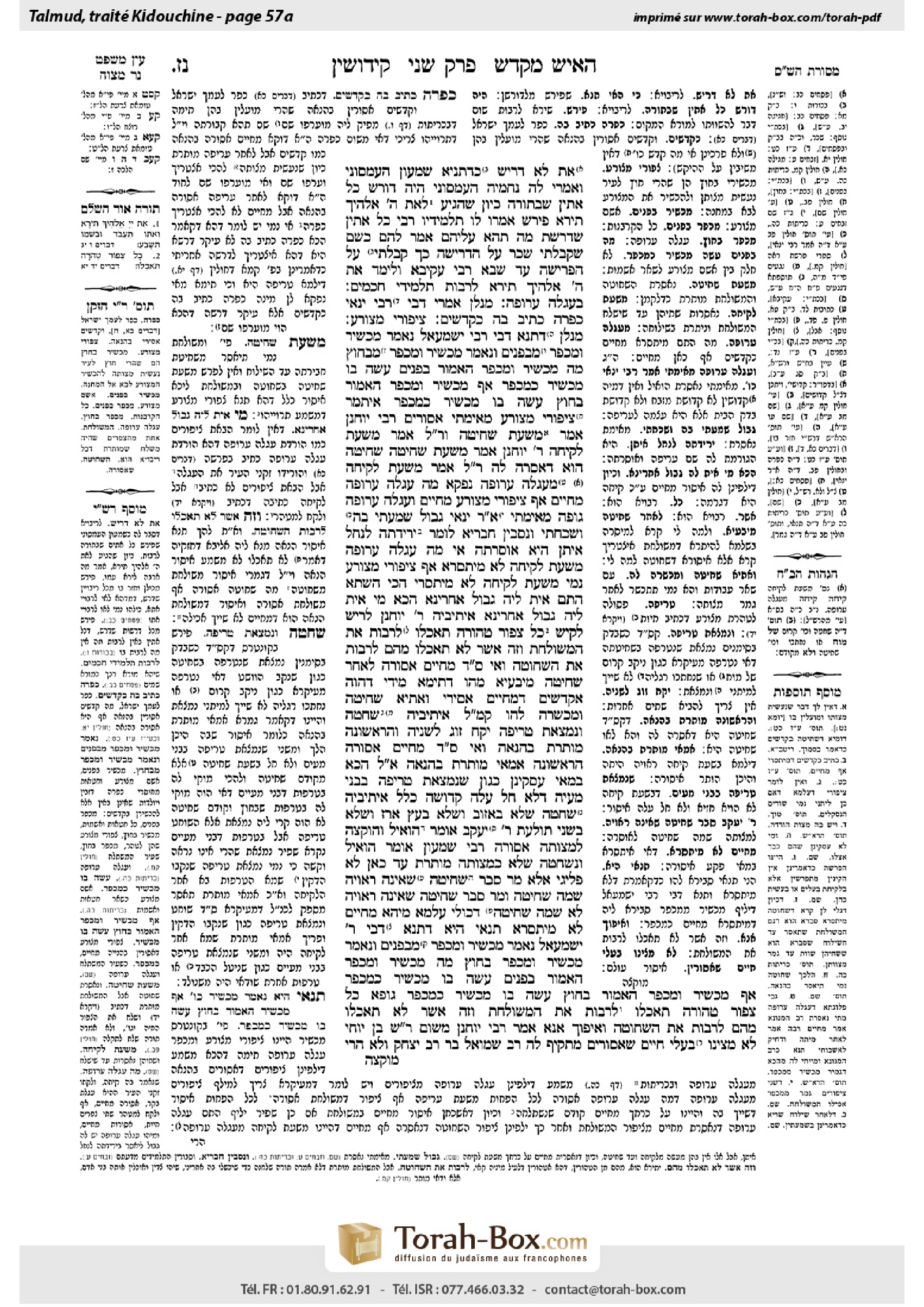
Kiddushin 57a: Talmud study for Daf Yomi
Daf Yomi is the daily study of one Talmud folio. Explore 37 tractates with scans, Hebrew text, Sefaria English and AI-generated French translations where annotated.
Passage selection and English or AI-generated French translation are available where the scan has annotations. Daf Study is independent of Torah-Box and Sefaria.
Browse Kiddushin · קידושין · All tractatesKiddushin 57a text and translations
This page of Kiddushin includes the Aramaic text, an English translation and an AI-generated French translation, alongside the scan above.
קידושין נ״ז א · Aramaic and Hebrew text
״אֶת״ לָא דָּרֵישׁ. כִּדְתַנְיָא: שִׁמְעוֹן הָעַמְסוֹנִי וְאָמְרִי לַהּ נְחֶמְיָה הָעַמְסוֹנִי הָיָה דּוֹרֵשׁ כׇּל אֶתִּין שֶׁבַּתּוֹרָה. כֵּיוָן שֶׁהִגִּיעַ לְ״אֶת ה׳ אֱלֹהֶיךָ תִּירָא״, פֵּירַשׁ.
אָמְרוּ לוֹ תַּלְמִידָיו: רַבִּי, כׇּל אֶתִּין שֶׁדָּרַשְׁתָּ מָה תְּהֵא עֲלֵיהֶם? אָמַר לָהֶם: כְּשֵׁם שֶׁקִּבַּלְתִּי שָׂכָר עַל הַדְּרִישָׁה, כָּךְ קִבַּלְתִּי עַל הַפְּרִישָׁה. עַד שֶׁבָּא רַבִּי עֲקִיבָא וְלִימֵּד: ״אֶת ה׳ אֱלֹהֶיךָ תִּירָא״ – לְרַבּוֹת תַּלְמִידֵי חֲכָמִים.
בְּעֶגְלָה עֲרוּפָה: מְנָלַן? אָמְרִי דְּבֵי רַבִּי יַנַּאי: ״כַּפָּרָה״ כְּתִיב בַּהּ, כְּקָדָשִׁים.
״צִיפּוֹרֵי מְצוֹרָע״ מְנָלַן? דְּתָנָא דְּבֵי רַבִּי יִשְׁמָעֵאל: נֶאֱמַר מַכְשִׁיר וּמְכַפֵּר מִבִּפְנִים, וְנֶאֱמַר מַכְשִׁיר וּמְכַפֵּר מִבַּחוּץ.
מָה מַכְשִׁיר וּמְכַפֵּר הָאָמוּר בִּפְנִים עָשָׂה בּוֹ מַכְשִׁיר כִּמְכַפֵּר – אַף מַכְשִׁיר וּמְכַפֵּר הָאָמוּר בַּחוּץ עָשָׂה בּוֹ מַכְשִׁיר כִּמְכַפֵּר.
אִיתְּמַר: צִיפּוֹרֵי מְצוֹרָע מֵאֵימָתַי אֲסוּרִים? רַבִּי יוֹחָנָן אָמַר: מִשְּׁעַת שְׁחִיטָה, וְרֵישׁ לָקִישׁ אָמַר: מִשְּׁעַת לְקִיחָה. רַבִּי יוֹחָנָן אָמַר מִשְּׁעַת שְׁחִיטָה, שְׁחִיטָה הוּא דְּאָסְרָה לַהּ. רֵישׁ לָקִישׁ אָמַר: מִשְּׁעַת לְקִיחָה, מֵעֶגְלָה עֲרוּפָה נָפְקָא, מָה עֶגְלָה עֲרוּפָה מֵחַיִּים – אַף צִיפּוֹרֵי מְצוֹרָע מֵחַיִּים.
וְעֶגְלָה עֲרוּפָה גּוּפַהּ מֵאֵימָתַי? אָמַר רַבִּי יַנַּאי: גְּבוּל שָׁמַעְתִּי בָּהּ וְשָׁכַחְתִּי, וְנָסְבִין חַבְרַיָּא לוֹמַר: יְרִידָתָהּ לְנַחַל אֵיתָן הִיא אוֹסַרְתָּהּ. אִי מָה עֶגְלָה עֲרוּפָה מִשְּׁעַת לְקִיחָה לָא מִיתַּסְרָא, אַף צִיפּוֹרֵי מְצוֹרָע נָמֵי מִשְּׁעַת לְקִיחָה לָא מִיתַּסְרִי! הָכִי הַשְׁתָּא?! הָתָם אִית לֵיהּ גְּבוּל אַחֲרִינָא, הָכָא מִי אִית לֵיהּ גְּבוּל אַחֲרִינָא?!
אֵיתִיבֵיהּ רַבִּי יוֹחָנָן לְרֵישׁ לָקִישׁ: ״כׇּל צִפּוֹר טְהֹרָה תֹּאכֵלוּ״ – לְרַבּוֹת אֶת הַמְשׁוּלַּחַת, ״וְזֶה אֲשֶׁר לֹא תֹאכְלוּ מֵהֶם״ – לְרַבּוֹת אֶת הַשְּׁחוּטָה. וְאִי סָלְקָא דַעְתָּךְ מֵחַיִּים אֲסוּרָה, לְאַחַר שְׁחִיטָה מִיבַּעְיָא?! מַהוּ דְּתֵימָא מִידֵּי דְּהָוֵה אַקֳּדָשִׁים, דְּמֵחַיִּים אֲסִירִי, וְאָתְיָא שְׁחִיטָה וּמַכְשְׁרָה לְהוּ, קָא מַשְׁמַע לַן.
אֵיתִיבֵיהּ: שְׁחָטָהּ וְנִמְצֵאת טְרֵיפָה – יִקַּח זוּג לַשְּׁנִיָּה, וְהָרִאשׁוֹנָה מוּתֶּרֶת בַּהֲנָאָה. וְאִי סָלְקָא דַעְתָּךְ מֵחַיִּים אֲסוּרָה, הָרִאשׁוֹנָה אַמַּאי מוּתֶּרֶת בַּהֲנָאָה? אֲמַר לֵיהּ: הָכָא בְּמַאי עָסְקִינַן, כְּגוֹן שֶׁנִּמְצֵאת טְרֵיפָה בִּבְנֵי מֵעֶיהָ, דְּלָא חָל עֲלַהּ קְדוּשָּׁה כְּלָל.
אֵיתִיבֵיהּ: שְׁחָטָהּ שֶׁלֹּא בְּאֵזוֹב וְשֶׁלֹּא בְּעֵץ אֶרֶז וְשֶׁלֹּא בִּשְׁנִי תוֹלַעַת, רַבִּי יַעֲקֹב אוֹמֵר: הוֹאִיל וְהוּקְצָה לְמִצְוָתָהּ – אֲסוּרָה, רַבִּי שִׁמְעוֹן אוֹמֵר: הוֹאִיל וְנִשְׁחֲטָה שֶׁלֹּא כְּמִצְוָתָהּ – מוּתֶּרֶת.
עַד כָּאן לָא פְּלִיגִי אֶלָּא מָר סָבַר: שְׁחִיטָה שֶׁאֵינָהּ רְאוּיָה – שְׁמָהּ שְׁחִיטָה, וּמָר סָבַר: שְׁחִיטָה שֶׁאֵינָהּ רְאוּיָה – לֹא שְׁמָהּ שְׁחִיטָה. דְּכוּלֵּי עָלְמָא מִיהָא מֵחַיִּים לָא מִיתַּסְרָא!
תַּנָּאֵי הִיא, דְּתָנָא דְּבֵי רַבִּי יִשְׁמָעֵאל: נֶאֱמַר מַכְשִׁיר וּמְכַפֵּר מִבִּפְנִים, וְנֶאֱמַר מַכְשִׁיר וּמְכַפֵּר בַּחוּץ.
מָה מַכְשִׁיר וּמְכַפֵּר הָאָמוּר בִּפְנִים – עָשָׂה בּוֹ מַכְשִׁיר כִּמְכַפֵּר, אַף מַכְשִׁיר וּמְכַפֵּר הָאָמוּר בַּחוּץ – עָשָׂה בּוֹ מַכְשִׁיר כִּמְכַפֵּר.
גּוּפָא: ״כָּל צִפּוֹר טְהֹרָה תֹּאכֵלוּ״ – לְרַבּוֹת אֶת הַמְשׁוּלַּחַת, ״וְזֶה אֲשֶׁר לֹא תֹאכְלוּ מֵהֶם״ – לְרַבּוֹת אֶת הַשְּׁחוּטָה.
וְאֵיפוֹךְ אֲנָא! אָמַר רַבִּי יוֹחָנָן מִשּׁוּם רַבִּי שִׁמְעוֹן בֶּן יוֹחַי: לֹא מָצִינוּ בַּעֲלֵי חַיִּים שֶׁאֲסוּרִים. מַתְקֵיף לַהּ רַב שְׁמוּאֵל בַּר רַב יִצְחָק: וְלָא הֲרֵי
Kiddushin 57a · English translation
The Gemara answers: This Sage does not interpret the word “et” as a means to derive new halakhot. He considers the word “et” to be an ordinary part of the sentence structure and not a source for exegetical exposition. As it is taught in a baraita: Shimon HaAmasoni, and some say that it was Neḥemya HaAmasoni, would interpret all occurrences of the word “et” in the Torah, deriving additional halakhot with regard to the particular subject matter. Once he reached the verse: “You shall fear the Lord your God” (Deuteronomy 6:13), which is written with the added word “et,” he withdrew from this method of exposition, as whose fear could be an extension of the fear of God?
His students said to him: Our teacher, what will be with all the occurrences of the word “et” that you interpreted until now? He said to them: Just as I received reward for the exposition, so I received reward for my withdrawal from using this method of exposition. The word “et” in this verse was not explained until Rabbi Akiva came and expounded: “You shall fear the Lord your God”: The word “et” serves to include Torah scholars, i.e., that one is commanded to fear them just as one fears God. In any event, Shimon HaAmasoni no longer derived additional halakhot from the word et.
§ The mishna teaches that if a man betroths a woman with a heifer whose neck is broken, she is not betrothed. The Gemara clarifies: From where do we derive that one is prohibited from deriving benefit from a heifer whose neck is broken? The school of Rabbi Yannai said: An expression of atonement was written with regard to it. The verse: “Atone for Your people Israel” (Deuteronomy 21:8), was written with regard to a heifer whose neck was broken, as was also written with regard to sacrificial animals. Therefore, one is prohibited from deriving benefit from it, just as one may not benefit from an offering.
§ The mishna teaches that if a man betroths a woman with the leper’s birds, she is not betrothed. The Gemara clarifies: From where do we derive that one is prohibited from deriving benefit from a leper’s birds? As the school of Rabbi Yishmael taught: A mitzva that enables is stated in the verses with regard to a leper, and the Torah also discusses a mitzva that atones, both of which are performed inside the Temple. Here, a mitzva that enables is a reference to the leper’s guilt-offering, which enables him to partake of offerings; and a mitzva that atones is a reference to all other offerings. And a mitzva that enables is stated in the verses with regard to a leper, and the Torah also discusses a mitzva that atones, both of which are performed outside the Temple. Here, a mitzva that enables is a reference to the leper’s birds, which permit him to reenter the camp; and a mitzva that atones is a reference to the heifer whose neck is broken, which atones for the inhabitants of the city nearest to an unsolved murder.
Just as in the case of the enabling and atoning rites stated in the Torah that are performed inside the Temple the Torah made the item of the enabling rite, i.e., the leper’s guilt-offering, from which one is prohibited from deriving benefit, like the item of the atoning rite, i.e., offerings in general, so too, in the case of the enabling and atoning rites stated in the Torah that are performed outside the Temple the Torah made the item of the enabling rite, i.e., the leper’s birds, from which one is prohibited from deriving benefit, like the item of the atoning rite, i.e., the heifer whose neck is broken.
It was stated that the amora’im disputed the following issue: From when is one prohibited from deriving benefit from the leper’s birds? Rabbi Yoḥanan says: From the moment of their slaughter; and Reish Lakish says: From the moment they are taken and designated to be a leper’s birds. The Gemara explains their respective opinions: Rabbi Yoḥanan says: From the moment of their slaughter, because it is the slaughter that prohibits them, since they are not consecrated beforehand. Reish Lakish says: From the moment they are taken, since this halakha is derived from the heifer whose neck is broken. Just as one is prohibited from deriving benefit from a heifer whose neck is broken during its lifetime, so too, one is prohibited from deriving benefit from the leper’s birds during their lifetime.
The Gemara asks: And with regard to it, the heifer whose neck is broken, itself, from when is it a forbidden item? Rabbi Yannai said: I heard the boundary, i.e., stage, beyond which it is forbidden, but I have forgotten what it is. But the group of scholars were inclined to say that its descent to a hard valley, where its neck is broken, is the action that renders it forbidden. The Gemara asks: If so, just as with a heifer whose neck is broken, it is not forbidden from the moment it is taken but only afterward, so too, the leper’s birds should also not be forbidden from the moment they are taken. The Gemara rejects this: How can these cases be compared? There, in the case of the heifer, it has another boundary that can render it forbidden, namely its descent to the valley; here, in the case of the leper’s birds, does it have another boundary? It is taken and immediately slaughtered.
Rabbi Yoḥanan raised an objection to Reish Lakish from a baraita: The verse states: “Of all clean birds you may eat” (Deuteronomy 14:11). The superfluous word “all” is stated to include one of the leper’s birds, which is sent away to freedom, while the words: “But these are they of which you shall not eat” (Deuteronomy 14:12), are stated to include in the prohibition the other, slaughtered bird. Rabbi Yoḥanan asks: And if it enters your mind to say that the bird is forbidden from when it is alive, is a verse necessary to teach that it is forbidden after its slaughter? The Gemara answers: The verse is necessary, lest you say: Just as it is in the case of sacrificial animals, where one is prohibited from deriving benefit from them when they are alive, and the act of slaughter comes and renders them fit to be eaten, so too with regard to the bird. The verse teaches us that with regard to the leper’s bird this is not the case, and it remains forbidden even after it has been slaughtered.
Rabbi Yoḥanan raised another objection to Reish Lakish: The mishna (Nega’im 14:5) teaches that if one slaughtered one of the leper’s birds and it was found to be a bird with a condition that would have caused it to die within twelve months [tereifa], a partner is taken for the second, i.e., remaining, bird, while with regard to the first bird, i.e., the tereifa, one is permitted to derive benefit from it. And if it enters your mind that the bird is forbidden from when it is alive, why is one permitted to derive benefit from the first one, if the prohibition took effect before it was slaughtered? Reish Lakish said to him: With what are we dealing here? We are dealing with a case where the slaughtered bird was found to be a tereifa in its inner organs, so that the consecration did not take effect at all, as the bird was not fit to be used for this purpose.
Rabbi Yoḥanan raised another objection to Reish Lakish from a baraita (Tosefta, Nega’im 8:8): If he slaughtered the bird without bringing a hyssop, or without bringing cedar wood, or without bringing a scarlet thread, which were all used in the rite, Rabbi Ya’akov says: Since the bird was set aside for its mitzva, it is forbidden anyway. Rabbi Shimon says: Since it was not slaughtered in accordance with its mitzva, it is permitted.
Rabbi Yoḥanan infers from this: They disagree only with regard to this issue, that one Sage, Rabbi Ya’akov, holds that an act of slaughter that is not fit for accomplishing its full ritual purpose is nevertheless considered an act of slaughter, and the bird is therefore forbidden; and one Sage, Rabbi Shimon, holds that an act of slaughter that is not fit for accomplishing its full ritual purpose is not considered an act of slaughter at all, and therefore one is permitted to derive benefit from the bird. But everyone agrees at least that one is not prohibited from deriving benefit from it when it is alive, but only after it has been slaughtered.
Reish Lakish replied: I concede that this baraita does not accord with my opinion, but this issue is a dispute between the tanna’im. As the school of Rabbi Yishmael taught: A mitzva that enables is stated in the verses with regard to a leper, and the Torah also discusses a mitzva that atones, both of which are performed inside the Temple. And a mitzva that enables is stated in the verses with regard to a leper, and the Torah also discusses a mitzva that atones, both of which are performed outside the Temple.
The baraita continues: Just as in the case of the enabling and atoning rites stated in the Torah that are performed inside the Temple the Torah made the item of the enabling rite like the item of the atoning rite, so too, in the case of the enabling and atoning rites stated in the Torah that are performed outside the Temple, the Torah made the item of the enabling rite like the item of the atoning rite. The baraita of the school of Rabbi Yishmael compares the leper’s birds to a heifer whose neck is broken, and therefore would also prohibit one from deriving benefit from the birds before they are slaughtered. The opinion of Reish Lakish is therefore in accordance with that baraita.
With regard to the matter itself, the baraita teaches: The verse states: “Of all clean birds you may eat” (Deuteronomy 14:11). The superfluous word “all” is stated to include one of the leper’s birds, which is sent away to freedom, while the words: “But these are they of which you shall not eat” (Deuteronomy 14:12), are stated to include in the prohibition the other, slaughtered bird.
The Gemara questions this interpretation: And I will reverse the exposition, and say that one may derive benefit from the slaughtered bird and not from the one that was sent away. Rabbi Yoḥanan says in the name of Rabbi Shimon ben Yoḥai: The reason to expound the verse as the baraita does is that we have not found kosher living creatures that are permanently forbidden with regard to eating. Therefore, it stands to reason that the slaughtered bird is forbidden, not the living one. Rav Shmuel bar Rav Yitzḥak objects to this explanation: But haven’t we found kosher living animals that are permanently forbidden? But there are
Kiddushin 57a · Traduction française (IA)
La Guemara répond : Ce Sage n’interprète pas le mot « et » comme un moyen de déduire de nouvelles halakhot. Il considère le mot « et » comme un simple élément de la structure de la phrase, et non comme une source d’interprétation exégétique. Car il est enseigné dans une baraïta : Shimon HaAmasoni — certains disent qu’il s’agissait de Neḥemya HaAmasoni — interprétait toutes les occurrences du mot « et » dans la Torah, en déduisant des halakhot supplémentaires concernant le sujet en question. Lorsqu’il arriva au verset « Tu craindras le Seigneur ton Dieu » (Deutéronome 6:13), où figure le mot « et » ajouté, il renonça à cette méthode d’interprétation, car la crainte de qui pourrait s’ajouter à la crainte de Dieu ?
Ses élèves lui dirent : « Notre maître, qu’adviendra-t-il de toutes les occurrences du mot « et » que tu as interprétées jusqu’à présent ? » Il leur répondit : « De même que j’ai reçu une récompense pour l’interprétation, j’ai reçu une récompense pour avoir renoncé à cette méthode d’interprétation. » Le mot « et » dans ce verset ne fut expliqué que lorsque Rabbi Akiva vint et enseigna : « Tu craindras le Seigneur ton Dieu » : le mot « et » sert à inclure les sages de la Torah, c’est-à-dire qu’il est ordonné de les craindre comme on craint Dieu. Quoi qu’il en soit, Shimon HaAmasoni ne déduisit plus de halakhot supplémentaires du mot « et ».
§ La Michna enseigne que si un homme épouse une femme au moyen d’une génisse dont on a brisé la nuque, elle n’est pas épousée. La Guemara précise : D’où déduisons-nous qu’il est interdit de tirer profit d’une génisse dont on a brisé la nuque ? L’école de Rabbi Yannai dit : Une expression d’expiation est employée à son sujet. Le verset « Fais expiation pour Ton peuple Israël » (Deutéronome 21:8) concerne une génisse dont on a brisé la nuque, tout comme une telle expression est employée à propos des animaux offerts en sacrifice. Par conséquent, il est interdit d’en tirer profit, comme il est interdit de tirer profit d’une offrande.
§ La Michna enseigne que si un homme épouse une femme au moyen des oiseaux du lépreux, elle n’est pas épousée. La Guemara précise : D’où déduisons-nous qu’il est interdit de tirer profit des oiseaux du lépreux ? Car l’école de Rabbi Yishmael a enseigné : La Torah mentionne, à propos du lépreux, une mitsva qui rend apte, ainsi qu’une mitsva qui expie ; toutes deux sont accomplies à l’intérieur du Temple. Ici, la mitsva qui rend apte désigne le sacrifice de culpabilité du lépreux, qui le rend apte à consommer des offrandes ; et la mitsva qui expie désigne tous les autres sacrifices. La Torah mentionne également, à propos du lépreux, une mitsva qui rend apte, ainsi qu’une mitsva qui expie ; toutes deux sont accomplies hors du Temple. Ici, la mitsva qui rend apte désigne les oiseaux du lépreux, qui lui permettent de réintégrer le camp ; et la mitsva qui expie désigne la génisse dont on a brisé la nuque, qui expie pour les habitants de la ville la plus proche d’un meurtre non élucidé.
De même que, dans le cas des rites qui rendent apte et qui expient, mentionnés dans la Torah et accomplis à l’intérieur du Temple, la Torah a assimilé l’objet du rite qui rend apte — c’est-à-dire le sacrifice de culpabilité du lépreux, dont il est interdit de tirer profit — à l’objet du rite qui expie — c’est-à-dire les sacrifices en général —, de même, dans le cas des rites qui rendent apte et qui expient, mentionnés dans la Torah et accomplis hors du Temple, la Torah a assimilé l’objet du rite qui rend apte — c’est-à-dire les oiseaux du lépreux, dont il est interdit de tirer profit — à l’objet du rite qui expie — c’est-à-dire la génisse dont on a brisé la nuque.
Il a été rapporté que les amoraïm sont en désaccord sur la question suivante : À partir de quand est-il interdit de tirer profit des oiseaux du lépreux ? Rabbi Yoḥanan dit : à partir du moment où ils sont égorgés ; et Reish Lakish dit : à partir du moment où ils sont pris et désignés comme oiseaux du lépreux. La Guemara explique leurs opinions respectives : Rabbi Yoḥanan dit : à partir du moment où ils sont égorgés, car c’est l’égorgement qui les rend interdits, puisqu’ils ne sont pas consacrés auparavant. Reish Lakish dit : à partir du moment où ils sont pris, puisque cette halakha est déduite de la génisse dont on a brisé la nuque. De même qu’il est interdit de tirer profit d’une génisse dont on a brisé la nuque de son vivant, de même il est interdit de tirer profit des oiseaux du lépreux de leur vivant.
La Guemara demande : Et la génisse dont on a brisé la nuque elle-même, à partir de quand est-elle interdite ? Rabbi Yannai dit : « J’ai entendu quelle est la limite, c’est-à-dire l’étape, au-delà de laquelle elle est interdite, mais je l’ai oubliée. » Toutefois, le groupe des sages était porté à dire que c’est sa descente dans une vallée escarpée, où l’on brise sa nuque, qui la rend interdite. La Guemara demande : Si tel est le cas, de même que la génisse dont on a brisé la nuque n’est pas interdite dès le moment où on la prend, mais seulement par la suite, les oiseaux du lépreux ne devraient-ils pas non plus être interdits dès le moment où on les prend ? La Guemara rejette cette comparaison : Comment comparer ces cas ? Là, dans le cas de la génisse, il existe une autre étape susceptible de la rendre interdite, à savoir sa descente dans la vallée ; ici, dans le cas des oiseaux du lépreux, existe-t-il une autre étape ? On les prend et on les égorge aussitôt.
Rabbi Yoḥanan souleva une objection contre Reish Lakish à partir d’une baraïta : Le verset dit : « De tous les oiseaux purs, vous pouvez manger » (Deutéronome 14:11). Le mot superflu « tous » sert à inclure l’un des oiseaux du lépreux, celui qui est relâché ; quant aux mots « Mais voici ceux que vous ne mangerez pas » (Deutéronome 14:12), ils servent à inclure l’autre oiseau, celui qui est égorgé, dans l’interdiction. Rabbi Yoḥanan demande : Si l’on venait à penser que l’oiseau est interdit dès lors qu’il est vivant, faudrait-il un verset pour enseigner qu’il est interdit après son égorgement ? La Guemara répond : Le verset est nécessaire, de peur que l’on dise : De même que, dans le cas des animaux offerts en sacrifice, dont il est interdit de tirer profit lorsqu’ils sont vivants, l’égorgement vient les rendre propres à la consommation, il en va de même pour cet oiseau. Le verset nous enseigne que ce n’est pas le cas pour l’oiseau du lépreux : il reste interdit même après avoir été égorgé.
Rabbi Yoḥanan souleva une autre objection contre Reish Lakish : la Michna (Negaïm 14:5) enseigne que si l’on égorge l’un des oiseaux du lépreux et que l’on découvre qu’il s’agit d’un oiseau atteint d’une affection qui l’aurait fait mourir dans les douze mois [tereifa], on prend un autre oiseau pour remplacer le second, c’est-à-dire l’oiseau restant ; quant au premier oiseau, c’est-à-dire le tereifa, il est permis d’en tirer profit. Si l’on venait à penser que l’oiseau est interdit dès lors qu’il est vivant, pourquoi est-il permis de tirer profit du premier, si l’interdiction a pris effet avant qu’il ne soit égorgé ? Reish Lakish lui dit : De quel cas s’agit-il ici ? D’un cas où l’oiseau égorgé s’est révélé être un tereifa en raison de ses organes internes, de sorte que la consécration n’a jamais pris effet, car l’oiseau n’était pas apte à cet usage.
Rabbi Yoḥanan souleva une autre objection contre Reish Lakish à partir d’une baraïta (Tosefta, Negaïm 8:8) : Si l’on égorge l’oiseau sans apporter d’hysope, sans apporter de bois de cèdre ou sans apporter de fil écarlate, qui sont tous utilisés dans le rite, Rabbi Ya’akov dit : « Puisque l’oiseau a été mis à part pour sa mitsva, il est de toute façon interdit. » Rabbi Shimon dit : « Puisqu’il n’a pas été égorgé conformément à sa mitsva, il est permis. »
Rabbi Yoḥanan déduit de là qu’ils ne sont en désaccord que sur ce point : selon Rabbi Ya’akov, un égorgement qui ne peut accomplir pleinement sa finalité rituelle est néanmoins considéré comme un égorgement, et l’oiseau est donc interdit ; selon Rabbi Shimon, un égorgement qui ne peut accomplir pleinement sa finalité rituelle n’est pas du tout considéré comme un égorgement, et il est donc permis de tirer profit de l’oiseau. Mais tous s’accordent au moins sur le fait qu’il n’est pas interdit d’en tirer profit tant qu’il est vivant et qu’il ne l’est qu’après son égorgement.
Reish Lakish répondit : « Je reconnais que cette baraïta ne concorde pas avec mon opinion, mais cette question fait l’objet d’un désaccord entre les tannaïm. » Car l’école de Rabbi Yishmael a enseigné : La Torah mentionne, à propos du lépreux, une mitsva qui rend apte, ainsi qu’une mitsva qui expie ; toutes deux sont accomplies à l’intérieur du Temple. La Torah mentionne également, à propos du lépreux, une mitsva qui rend apte, ainsi qu’une mitsva qui expie ; toutes deux sont accomplies hors du Temple.
La baraïta poursuit : De même que, dans le cas des rites qui rendent apte et qui expient, mentionnés dans la Torah et accomplis à l’intérieur du Temple, la Torah a assimilé l’objet du rite qui rend apte à l’objet du rite qui expie, de même, dans le cas des rites qui rendent apte et qui expient, mentionnés dans la Torah et accomplis hors du Temple, la Torah a assimilé l’objet du rite qui rend apte à l’objet du rite qui expie. La baraïta de l’école de Rabbi Yishmael compare les oiseaux du lépreux à une génisse dont on a brisé la nuque ; elle interdirait donc également de tirer profit des oiseaux avant leur égorgement. L’opinion de Reish Lakish concorde donc avec cette baraïta.
À propos de la question elle-même, la baraïta enseigne : Le verset dit : « De tous les oiseaux purs, vous pouvez manger » (Deutéronome 14:11). Le mot superflu « tous » sert à inclure l’un des oiseaux du lépreux, celui qui est relâché ; quant aux mots « Mais voici ceux que vous ne mangerez pas » (Deutéronome 14:12), ils servent à inclure l’autre oiseau, celui qui est égorgé, dans l’interdiction.
La Guemara remet en question cette interprétation : Je pourrais inverser l’interprétation et dire qu’il est permis de tirer profit de l’oiseau égorgé, mais non de celui qui a été relâché. Rabbi Yoḥanan dit au nom de Rabbi Shimon ben Yoḥai : La raison pour laquelle il faut interpréter le verset comme le fait la baraïta est que nous n’avons trouvé aucune créature vivante pure dont la consommation soit interdite de façon permanente. Il est donc logique que l’oiseau égorgé soit interdit, et non l’oiseau vivant. Rav Shmuel bar Rav Yitzḥak objecte à cette explication : Mais n’avons-nous pas trouvé des animaux vivants purs dont la consommation soit interdite de façon permanente ? Or, il y a…
Traduction française générée par IA à partir de l’édition anglaise de Sefaria. Vérifie toujours un passage avec le texte source.
Text from Sefaria: William Davidson Edition - Vocalized Aramaic (CC BY NC); William Davidson Edition - English (CC BY NC).