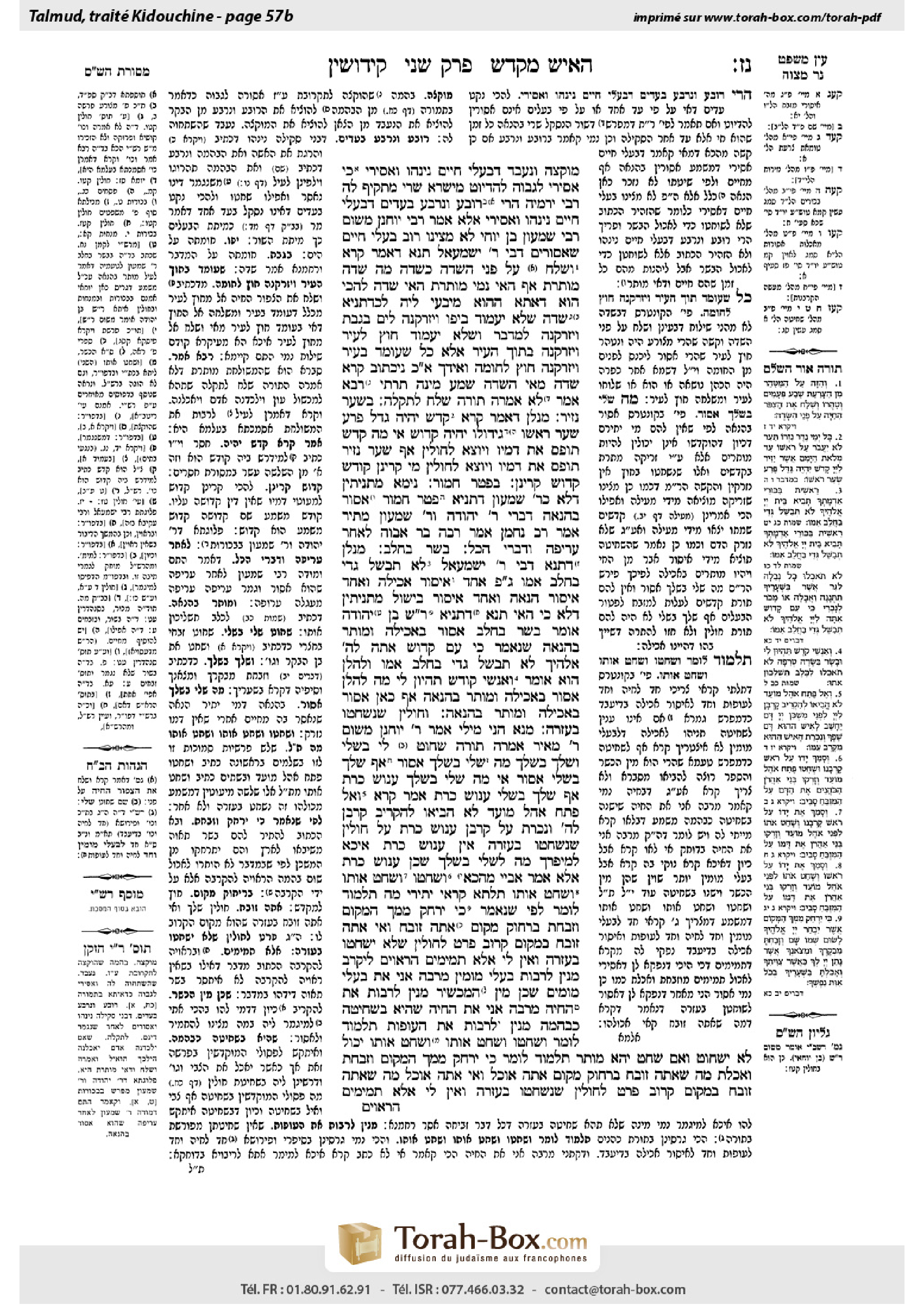
Kiddushin 57b: Talmud study for Daf Yomi
Daf Yomi is the daily study of one Talmud folio. Explore 37 tractates with scans, Hebrew text, Sefaria English and AI-generated French translations where annotated.
Passage selection and English or AI-generated French translation are available where the scan has annotations. Daf Study is independent of Torah-Box and Sefaria.
Browse Kiddushin · קידושין · All tractatesKiddushin 57b text and translations
This page of Kiddushin includes the Aramaic text, an English translation and an AI-generated French translation, alongside the scan above.
קידושין נ״ז ב · Aramaic and Hebrew text
מוּקְצֶה וְנֶעֱבָד, דְּבַעֲלֵי חַיִּים נִינְהוּ וַאֲסִירִי! כִּי אֲסִירִי – לְגָבוֹהַּ, לְהֶדְיוֹט – מִישְׁרֵא שְׁרֵי.
מַתְקֵיף לַהּ רַבִּי יִרְמְיָה: הֲרֵי רוֹבֵעַ וְנִרְבָּע בְּעֵדִים, דְּבַעֲלֵי חַיִּים נִינְהוּ וַאֲסִירִי! אֶלָּא: אָמַר רַבִּי יוֹחָנָן מִשּׁוּם רַבִּי שִׁמְעוֹן בֶּן יוֹחַי: לֹא מָצִינוּ רוֹב בַּעֲלֵי חַיִּים שֶׁאֲסוּרִים.
דְּבֵי רַבִּי יִשְׁמָעֵאל תָּנָא: דְּאָמַר קְרָא: ״וְשִׁלַּח עַל פְּנֵי הַשָּׂדֶה״ – כְּשָׂדֶה, מָה שָׂדֶה מוּתֶּרֶת – אַף הַאי נָמֵי מוּתֶּרֶת. הַאי ״שָׂדֶה״ לְהָכִי הוּא דַּאֲתָא? הַהוּא מִיבְּעֵי לֵיהּ לְכִדְתַנְיָא: ״שָׂדֶה״ – שֶׁלֹּא יַעֲמוֹד בְּיָפוֹ וְיִזְרְקֶנָּה לַיָּם, בִּגְבָת וְיִזְרְקֶנָּה לַמִּדְבָּר, וְשֶׁלֹּא יַעֲמוֹד חוּץ לָעִיר וְיִזְרְקֶנָּה בְּתוֹךְ הָעִיר. אֶלָּא כֹּל שֶׁעוֹמֵד בָּעִיר וְיִזְרְקֶנָּה חוּץ לַחוֹמָה.
וְאִידַּךְ? אִם כֵּן נִיכְתּוֹב קְרָא: ״שָׂדֶה״, מַאי ״הַשָּׂדֶה״? שְׁמַע מִינַּהּ תַּרְתֵּי.
רָבָא אָמַר: לֹא אָמְרָה תּוֹרָה: ״שַׁלַּח״ לְתַקָּלָה.
בִּשְׂעַר נָזִיר. מְנָלַן? דְּאָמַר קְרָא ״קָדֹשׁ יִהְיֶה גַּדֵּל פֶּרַע שְׂעַר רֹאשׁוֹ״ – גִּידּוּלוֹ יִהְיֶה קָדוֹשׁ.
אִי מָה קֹדֶשׁ תּוֹפֵס אֶת דָּמָיו, וְיוֹצֵא לְחוּלִּין – אַף שְׂעַר נָזִיר תּוֹפֵס אֶת דָּמָיו וְיוֹצֵא לְחוּלִּין! מִי קָרֵינַן ״קוֹדֶשׁ״? ״קָדוֹשׁ״ קָרֵינַן.
בְּפֶטֶר חֲמוֹר. נֵימָא מַתְנִיתִין דְּלָא כְּרַבִּי שִׁמְעוֹן, דְּתַנְיָא: פֶּטֶר חֲמוֹר אָסוּר בַּהֲנָאָה, דִּבְרֵי רַבִּי יְהוּדָה, וְרַבִּי שִׁמְעוֹן מַתִּיר. אָמַר רַב נַחְמָן אָמַר רַבָּה בַּר אֲבוּהּ: לְאַחַר עֲרִיפָה, וְדִבְרֵי הַכֹּל.
בָּשָׂר בְּחָלָב. מְנָלַן? דְּתָנָא דְּבֵי רַבִּי יִשְׁמָעֵאל: ״לֹא תְבַשֵּׁל גְּדִי בַּחֲלֵב אִמּוֹ״ שָׁלֹשׁ פְּעָמִים: אֶחָד אִיסּוּר אֲכִילָה, וְאֶחָד אִיסּוּר הֲנָאָה, וְאֶחָד אִיסּוּר בִּישּׁוּל.
מַתְנִיתִין דְּלָא כִּי הַאי תַּנָּא. דְּתַנְיָא, רַבִּי שִׁמְעוֹן בֶּן יְהוּדָה אוֹמֵר: בָּשָׂר בְּחָלָב אָסוּר בַּאֲכִילָה וּמוּתָּר בַּהֲנָאָה, שֶׁנֶּאֱמַר: ״כִּי עַם קָדוֹשׁ אַתָּה לַה׳ אֱלֹהֶיךָ לֹא תְבַשֵּׁל גְּדִי בַּחֲלֵב אִמּוֹ״, וּלְהַלָּן הוּא אוֹמֵר: ״וְאַנְשֵׁי קֹדֶשׁ תִּהְיוּן לִי״. מָה לְהַלָּן אָסוּר בַּאֲכִילָה וּמוּתָּר בַּהֲנָאָה – אַף כָּאן אָסוּר בַּאֲכִילָה וּמוּתָּר בַּהֲנָאָה.
וְחוּלִּין שֶׁנִּשְׁחֲטוּ בַּעֲזָרָה. מְנָא הָנֵי מִילֵּי? אָמַר רַבִּי יוֹחָנָן מִשּׁוּם רַבִּי מֵאִיר: אָמְרָה תּוֹרָה: שְׁחוֹט לִי – בְּשֶׁלִּי. וְשֶׁלָּךְ – בְּשֶׁלָּךְ. מַה שֶׁלִּי בְּשֶׁלָּךְ – אָסוּר, אַף שֶׁלָּךְ בְּשֶׁלִּי – אָסוּר.
אִי מָה שֶׁלִּי בְּשֶׁלָּךְ עָנוּשׁ כָּרֵת, אַף שֶׁלָּךְ בְּשֶׁלִּי עָנוּשׁ כָּרֵת? אָמַר קְרָא: ״וְאֶל פֶּתַח אֹהֶל מוֹעֵד לֹא הֱבִיאוֹ לְהַקְרִיב קׇרְבָּן לַה׳... וְנִכְרַת״, עַל קׇרְבָּן – עָנוּשׁ כָּרֵת, עַל חוּלִּין שֶׁנִּשְׁחֲטוּ בַּעֲזָרָה – אֵין עָנוּשׁ כָּרֵת.
אִיכָּא לְמִיפְרַךְ: מָה לְשֶׁלִּי בְּשֶׁלָּךְ – שֶׁכֵּן עָנוּשׁ כָּרֵת!
אֶלָּא אָמַר אַבָּיֵי: מֵהָכָא: ״וּשְׁחָטוֹ״ ״וְשָׁחַט אֹתוֹ״ ״וְשָׁחַט אֹתוֹ״. תְּלָתָא קְרָאֵי יַתִּירֵי, מָה תַּלְמוּד לוֹמַר?
לְפִי שֶׁנֶּאֱמַר: ״כִּי יִרְחַק מִמְּךָ הַמָּקוֹם... וְזָבַחְתָּ״, בְּרִחוּק מָקוֹם אַתָּה זוֹבֵחַ וְאִי אַתָּה זוֹבֵחַ בְּמָקוֹם קָרוֹב, פְּרָט לְחוּלִּין שֶׁלֹּא יִשָּׁחֲטוּ בַּעֲזָרָה.
וְאֵין לִי אֶלָּא תְּמִימִים הָרְאוּיִם לִיקָּרֵב, מִנַּיִן לְרַבּוֹת בַּעֲלֵי מוּמִין? מְרַבֶּה אֲנִי אֶת בַּעֲלֵי מוּמִים, שֶׁכֵּן: מִין הַמַּכְשִׁיר. מִנַּיִן לְרַבּוֹת אֶת הַחַיָּה? מְרַבֶּה אֲנִי אֶת הַחַיָּה, שֶׁהִיא בִּשְׁחִיטָה כִּבְהֵמָה. מִנַּיִן לְרַבּוֹת אֶת הָעוֹפוֹת? תַּלְמוּד לוֹמַר: ״וּשְׁחָטוֹ״ ״וְשָׁחַט אוֹתוֹ״ ״וְשָׁחַט אוֹתוֹ״.
יָכוֹל לֹא יִשְׁחוֹט, וְאִם שָׁחַט יְהֵא מוּתָּר? תַּלְמוּד לוֹמַר: ״כִּי יִרְחַק מִמְּךָ הַמָּקוֹם... וְזָבַחְתָּ... וְאָכַלְתָּ״, מַה שֶּׁאַתָּה זוֹבֵחַ בְּרִחוּק מָקוֹם – אַתָּה אוֹכֵל, וְאִי אַתָּה אוֹכֵל מַה שֶּׁאַתָּה זוֹבֵחַ בְּמָקוֹם קָרוֹב, פְּרָט לְחוּלִּין שֶׁנִּשְׁחֲטוּ בַּעֲזָרָה.
וְאֵין לִי אֶלָּא תְּמִימִים
Kiddushin 57b · English translation
the cases of an animal set aside as an offering to an idol, and an animal that was itself worshipped as an idol, which are living creatures and yet are permanently forbidden. The Gemara answers: There is a difference, as when they are forbidden, they are forbidden only to be used for the Most High, i.e., to be used as offerings in the Temple service, but it is permitted for a common Jew to derive benefit from them.
Rabbi Yirmeya objects to the explanation of Rabbi Yoḥanan: But an animal that copulated with a woman, and an animal that copulated with a man, in the presence of witnesses, they are living creatures and yet they are permanently forbidden, as the halakha is that these animals are killed, and one is prohibited from deriving benefit from them once they have been sentenced. Rather, the above explanation should be emended to say: Rabbi Yoḥanan says in the name of Rabbi Shimon ben Yoḥai: We have not found most kosher living creatures that are permanently forbidden while they are still alive, and it can be assumed that the inclusion of the verse is referring to that which is generally forbidden, even if there are exceptions.
The Gemara offers another answer to the question of how the baraita knew which bird the verse is permitting. The school of Rabbi Yishmael taught: The verse states: “And shall let go the living bird into the open field” (Leviticus 14:7), which indicates that the bird is like a field: Just as a field is permitted, so too, this bird is also permitted. The Gemara asks: Is that word “field” coming to teach this? That word is necessary for that which is taught in a baraita: The word “field” teaches that one may not stand in Jaffa and throw the bird that is set free to the sea, or stand in Gevat and throw it to the desert, and that he may not stand outside the city and throw it inside the city. Rather, any manner in which he is standing in the city and throws it outside the wall to the field is valid. The word “field” teaches that one must set it free only to the field and nowhere else, not to teach that the bird is permitted.
And the other tanna, the school of Rabbi Yishmael, who derives that one is permitted to derive benefit from the bird based on the word “field,” replies: If so, that this was the only halakha the word is teaching, let the Torah write “field”; what is the significance of “the field”? Conclude two conclusions from it, i.e., both the place to throw the bird and the permission to derive benefit.
Rava says a different answer to the question of how the baraita knew which bird the verse is permitting: The Torah did not say “let go” for it to serve as a stumbling block. If the bird sent free was forbidden, the Torah would not have commanded him to send it away, since people might eat it unwittingly.
§ The mishna teaches that if a man betroths a woman with a nazirite’s hair, she is not betrothed. The Gemara asks: From where do we derive that one is prohibited from deriving benefit from a nazirite’s hair? The Gemara answers: As the verse states with regard to a nazirite: “He shall be holy [kadosh], he shall let the locks of the hair of his head grow long” (Numbers 6:5), which teaches: His hair growth shall be holy.
The Gemara asks: If the hair of a nazirite can be compared to consecrated property by use of the term “holy,” then just as with regard to consecrated property, it transfers its sanctity to the money with which it is redeemed and it becomes desacralized, so too, a nazirite’s hair should transfer its sanctity to the money with which it is redeemed and the hair itself should become desacralized. This is not the halakha. The Gemara answers: Do we read holy [kodesh] in this verse, which is the term the verse uses for a consecrated item (see Leviticus 22:14)? We read “holy [kadosh].” Since a different conjugation of the term is used, the halakhot of the hair of a nazirite are not derived from those of consecrated property.
§ The mishna teaches that if a man betroths a woman with a firstborn donkey, she is not betrothed. The Gemara suggests: Shall we say the mishna is not in accordance with the opinion of Rabbi Shimon? As it is taught in a baraita: With regard to a firstborn donkey, deriving benefit from it is prohibited; this is the statement of Rabbi Yehuda. And Rabbi Shimon permits it. Rav Naḥman said that Rabba bar Avuh said: The mishna can be referring to one who betrothed a woman with a firstborn donkey after it has had its neck broken, and everyone agrees that it is prohibited to derive benefit from the donkey once its neck is broken.
§ The mishna teaches that if a man betroths a woman with meat cooked in milk, she is not betrothed. The Gemara asks: From where do we derive that one is prohibited from deriving benefit from meat cooked in milk? The school of Rabbi Yishmael taught: The Torah states three times: “You shall not cook a kid in its mother’s milk” (Exodus 23:19; Exodus 34:26; Deuteronomy 14:21). One verse serves to teach the prohibition against eating meat cooked in milk, and one verse serves to teach the prohibition against deriving benefit from meat cooked in milk, and one verse serves to teach the prohibition against cooking meat in milk.
The Gemara comments: The mishna is not in accordance with the opinion of this tanna, as it is taught in a baraita: Rabbi Shimon ben Yehuda says: It is prohibited to eat meat cooked in milk but one is permitted to derive benefit from it, as it is stated: “For you are a holy people to the Lord your God. You shall not cook a kid in its mother’s milk” (Deuteronomy 14:21), and it states there with regard to the prohibition of an unslaughtered animal carcass: “And you shall be holy men to Me” (Exodus 22:30). Since both verses employ the term “holy” he derives: Just as there, in the case of an animal carcass, it is prohibited to eat it but one is permitted to derive benefit from it, as the Torah explicitly states that it may be sold to a gentile, so too here, with regard to meat cooked in milk, it is prohibited to eat it but one is permitted to derive benefit from it.
§ The mishna teaches that if a man betroths a woman with the items it enumerated, or with non-sacred animals that were slaughtered in the Temple courtyard, she is not betrothed. The Gemara asks: From where are these matters, i.e., that one is prohibited from deriving benefit from a non-sacred animal that was slaughtered in the Temple courtyard, derived? Rabbi Yoḥanan said in the name of Rabbi Meir: The Torah said: Slaughter for Me, i.e., for offerings to God, in My place, inside the Temple courtyard, and your non-sacred animals that are intended for eating should be slaughtered in your place, outside the Temple courtyard. Just as one is prohibited from deriving benefit from My consecrated animals if they were slaughtered in your place, as one is prohibited from deriving benefit from a consecrated animal slaughtered outside the Temple, so too, one is prohibited from deriving benefit from your non-sacred animals if they were slaughtered in My place.
The Gemara asks: If so, just as the act of slaughtering My consecrated animals in your place is punishable by karet, so too, to the act of slaughtering your non-sacred animals in My place should be punishable by karet. To counter this logic, the verse states: “If a man from the house of Israel slaughters an ox or lamb…and has not brought it to the door of the Tent of Meeting to sacrifice an offering to the Lord…and that man shall be cut off” (Leviticus 17:3–4). This teaches that it is only for an offering that one slaughtered outside the Tent of Meeting of the Tabernacle, or the Temple courtyard, that he is punishable with karet, but for non-sacred animals that one slaughtered in the Temple courtyard he is not punishable with karet.
The Gemara asks: In light of the above difference in halakha between these two cases, the entire comparison can be refuted in the following manner: What is an aspect unique to slaughtering My consecrated animals in your place? It is that it is punishable by karet, and is therefore a severe prohibition, which could explain the halakha that one is prohibited from deriving benefit from them. The prohibition against slaughtering a non-sacred animal in the Temple courtyard, which is not punishable by karet, could be regarded as a less severe prohibition, and perhaps in this case it is permitted to derive benefit from the slaughtered animal. Therefore, the halakha that one is prohibited from deriving benefit from a non-sacred animal that was slaughtered in the Temple courtyard still does not have a source.
Abaye quotes a lengthy baraita that serves as a source for the halakha that one is prohibited from deriving benefit from a non-sacred animal slaughtered in the Temple courtyard. Rather, Abaye said it is derived from here: The Torah states three verses that have a superfluous element with regard to the various species from which one may bring a peace-offering: The verse “and he slaughters it” (Leviticus 3:2), the verse “and he shall slaughter it” (Leviticus 3:8), and the verse “and he shall slaughter it” (Leviticus 3:13). The Torah could simply have stated: “And he shall slaughter,” without adding: “It.” Why must the verse state the term “it” these three times?
The baraita continues: The source for the halakha is because it is stated with regard to the ritual slaughter of animals for meat consumption: “If the place which the Lord your God shall choose to put His name there be too far from you, then you shall slaughter of your herd and of your flock” (Deuteronomy 12:21), from which it is derived: When you are far from the place, i.e., the Temple, you may slaughter non-sacred animals for meat consumption, but you may not slaughter non-sacred animals in a near place, i.e., in the Temple. The verse serves to exclude non-sacred animals, thereby teaching that they may not be slaughtered in the Temple courtyard.
The baraita continues: And I have derived the prohibition against slaughtering a non-sacred animal in the Temple courtyard only with regard to unblemished animals, which are fit to be sacrificed. From where do I know to include even blemished animals, which are not fit to be sacrificed, in this prohibition? I include blemished animals since they are at least of the type that is fit to be sacrificed. From where do I know to include the undomesticated animal, which is never sacrificed as an offering, in this prohibition? I include the undomesticated animal since it is rendered fit for consumption by means of slaughtering, like a domesticated animal. From where do I know to include fowl, as the Torah does not mention slaughter with regard to fowl, in this prohibition? The verse states: “And he slaughters it,” “and he shall slaughter it,” as well as “and he shall slaughter it,” employing the additional term “it” each time. These three verses teach that one may not slaughter any non-sacred animal in the Temple courtyard.
The baraita continues: One might have thought that one may not slaughter ab initio but if he did slaughter it would be permitted for him to eat it. Therefore, the verse states: “If the place which the Lord your God shall choose to put His name there be too far from you, then you shall slaughter of your herd and of your flock, which the Lord has given you, as I have commanded you, and you shall eat within your gates, after all the desire of your soul” (Deuteronomy 12:21), which is expounded as follows: That which you slaughter in a far place, outside the Temple, you may eat, but you may not eat that which you slaughter in a near place, which excludes non-sacred animals that were slaughtered in the Temple courtyard. Therefore, it is prohibited to eat a non-sacred animal slaughtered in the Temple courtyard even after the fact.
The baraita continues: And I have derived only that the prohibition against eating the meat after the fact applies to unblemished animals,
Kiddushin 57b · Traduction française (IA)
les cas d’un animal destiné à être offert à une idole et d’un animal qui a lui-même été adoré comme une idole : ce sont des êtres vivants, et pourtant ils sont interdits définitivement. La Guemara répond : Il y a une différence, car lorsqu’ils sont interdits, ils le sont uniquement pour être utilisés à des fins sacrées, c’est-à-dire comme offrandes dans le service du Temple ; un particulier peut toutefois en tirer profit.
Rabbi Yirmeya objecte à l’explication de Rabbi Yoḥanan : Mais un animal qui s’est accouplé avec une femme et un animal qui s’est accouplé avec un homme, en présence de témoins, sont des êtres vivants et pourtant ils sont interdits définitivement, puisque, selon la halakha, ces animaux doivent être mis à mort et il est interdit d’en tirer profit dès qu’ils ont été condamnés. Il faut plutôt corriger l’explication précédente ainsi : Rabbi Yoḥanan dit au nom de Rabbi Shimon ben Yoḥai : Nous n’avons pas trouvé que la plupart des êtres vivants purs soient interdits définitivement alors qu’ils sont encore vivants, et l’on peut supposer que l’inclusion opérée par le verset vise ce qui est généralement interdit, même s’il existe des exceptions.
La Guemara propose une autre réponse à la question de savoir comment la baraïta a déterminé quel oiseau le verset autorise. L’école de Rabbi Yishmael enseignait : Le verset dit : « Il lâchera l’oiseau vivant en pleine campagne » (Lévitique 14:7), ce qui indique que l’oiseau est comme un champ : de même qu’un champ est permis, cet oiseau aussi est permis. La Guemara demande : Le mot « champ » sert-il à enseigner cela ? Ce mot est nécessaire pour ce qui est enseigné dans une baraïta : le mot « champ » enseigne qu’on ne peut pas se tenir à Jaffa et lancer vers la mer l’oiseau remis en liberté, ni se tenir à Gevat et le lancer vers le désert, et qu’on ne peut pas se tenir hors de la ville et le lancer à l’intérieur. Au contraire, toute façon de procéder est valide si l’on se tient dans la ville et lance l’oiseau par-dessus le rempart, vers le champ. Le mot « champ » enseigne qu’on doit le remettre en liberté uniquement dans un champ et nulle part ailleurs ; il ne sert pas à enseigner que l’oiseau est permis.
Et l’autre tanna, celui de l’école de Rabbi Yishmael, qui déduit du mot « champ » qu’il est permis de tirer profit de l’oiseau, répond : Si tel était le seul enseignement de ce mot, que la Torah écrive « champ » ; pourquoi préciser « le champ » ? On en déduit deux enseignements : à la fois l’endroit où lancer l’oiseau et la permission d’en tirer profit.
Rava donne une autre réponse à la question de savoir comment la baraïta a déterminé quel oiseau le verset autorise : la Torah n’a pas ordonné de le « lâcher » pour qu’il serve de piège. Si l’oiseau remis en liberté était interdit, la Torah ne lui aurait pas ordonné de le relâcher, car les gens pourraient le manger par inadvertance.
§ La Michna enseigne que si un homme épouse une femme au moyen des cheveux d’un nazir, elle n’est pas épousée. La Guemara demande : D’où déduisons-nous qu’il est interdit de tirer profit des cheveux d’un nazir ? La Guemara répond : Le verset dit au sujet du nazir : « Il sera saint [kadosh], il laissera pousser les mèches de ses cheveux » (Nombres 6:5), ce qui enseigne : la pousse de ses cheveux sera sainte.
La Guemara demande : Si l’on peut assimiler les cheveux d’un nazir à un bien consacré en raison du terme « saint », alors, de même que pour un bien consacré, sa sainteté est transférée à l’argent contre lequel il est racheté et il est désacralisé, de même la sainteté des cheveux d’un nazir devrait être transférée à l’argent contre lequel ils sont rachetés, et les cheveux eux-mêmes devraient être désacralisés. Telle n’est pas la halakha. La Guemara répond : Lisons-nous « saint » [kodesh] dans ce verset, terme que le verset emploie pour désigner un objet consacré (voir Lévitique 22:14) ? Nous lisons « saint » [kadosh]. Puisqu’une forme différente du terme est employée, les halakhot relatives aux cheveux d’un nazir ne sont pas déduites de celles des biens consacrés.
§ La Michna enseigne que si un homme épouse une femme au moyen d’un âne premier-né, elle n’est pas épousée. La Guemara suggère : Faut-il dire que la Michna ne suit pas l’opinion de Rabbi Shimon ? Car il est enseigné dans une baraïta : Il est interdit de tirer profit d’un âne premier-né ; telle est l’opinion de Rabbi Yehuda. Mais Rabbi Shimon le permet. Rav Naḥman dit au nom de Rabba bar Avuh : La Michna peut se référer à quelqu’un qui a épousé une femme au moyen d’un âne premier-né après qu’on lui a brisé la nuque, et tous reconnaissent qu’il est interdit d’en tirer profit une fois sa nuque brisée.
§ La Michna enseigne que si un homme épouse une femme au moyen de viande cuite dans du lait, elle n’est pas épousée. La Guemara demande : D’où déduisons-nous qu’il est interdit de tirer profit de viande cuite dans du lait ? L’école de Rabbi Yishmael enseignait : La Torah dit trois fois : « Tu ne feras pas cuire un chevreau dans le lait de sa mère » (Exode 23:19 ; Exode 34:26 ; Deutéronome 14:21). Un verset enseigne l’interdiction de manger de la viande cuite dans du lait, un autre enseigne l’interdiction d’en tirer profit et un autre encore enseigne l’interdiction de cuire de la viande dans du lait.
La Guemara commente : La Michna ne suit pas l’opinion de ce tanna, car il est enseigné dans une baraïta : Rabbi Shimon ben Yehuda dit : Il est interdit de manger de la viande cuite dans du lait, mais il est permis d’en tirer profit, comme il est dit : « Car vous êtes un peuple saint pour le Seigneur votre Dieu. Tu ne feras pas cuire un chevreau dans le lait de sa mère » (Deutéronome 14:21), et il est dit là, à propos de l’interdiction relative à la carcasse d’un animal non abattu rituellement : « Vous serez pour moi des hommes saints » (Exode 22:30). Puisque les deux versets emploient le terme « saint », il en déduit : de même que là, dans le cas d’une carcasse, il est interdit de la manger mais permis d’en tirer profit, comme la Torah dit explicitement qu’on peut la vendre à un non-Juif, de même ici, à propos de viande cuite dans du lait, il est interdit de la manger mais permis d’en tirer profit.
§ La Michna enseigne que si un homme épouse une femme au moyen des objets qu’elle a énumérés, ou d’animaux non consacrés abattus dans la cour du Temple, elle n’est pas épousée. La Guemara demande : D’où déduit-on ces règles, c’est-à-dire l’interdiction de tirer profit d’un animal non consacré abattu dans la cour du Temple ? Rabbi Yoḥanan dit au nom de Rabbi Meir : La Torah a dit : Abattez pour Moi, c’est-à-dire pour les offrandes destinées à Dieu, en Mon lieu, dans la cour du Temple ; quant à vos animaux non consacrés destinés à la consommation, ils doivent être abattus dans votre lieu, hors de la cour du Temple. De même qu’il est interdit de tirer profit de Mes animaux consacrés s’ils ont été abattus dans votre lieu, puisqu’il est interdit de tirer profit d’un animal consacré abattu hors du Temple, de même il est interdit de tirer profit de vos animaux non consacrés s’ils ont été abattus dans Mon lieu.
La Guemara demande : Dans ce cas, de même que l’acte d’abattre Mes animaux consacrés dans votre lieu est passible de karet, l’acte d’abattre vos animaux non consacrés dans Mon lieu devrait lui aussi être passible de karet. Pour réfuter ce raisonnement, le verset dit : « Si un homme de la maison d’Israël égorge un bœuf ou un agneau… et ne l’a pas amené à l’entrée de la Tente d’assignation pour en faire une offrande au Seigneur… cet homme sera retranché » (Lévitique 17:3–4). Cela enseigne qu’on n’est passible de karet que pour un animal destiné à une offrande et abattu hors de la Tente d’assignation du Tabernacle, ou hors de la cour du Temple ; mais on n’est pas passible de karet pour des animaux non consacrés abattus dans la cour du Temple.
La Guemara demande : À la lumière de la différence de halakha exposée plus haut entre ces deux cas, toute la comparaison peut être réfutée de la manière suivante : Quelle est la caractéristique propre à l’abattage de Mes animaux consacrés dans votre lieu ? C’est qu’il est passible de karet et constitue donc une interdiction grave, ce qui pourrait expliquer la halakha interdisant d’en tirer profit. L’interdiction d’abattre un animal non consacré dans la cour du Temple, qui n’est pas passible de karet, pourrait être considérée comme moins grave ; peut-être serait-il donc permis, dans ce cas, de tirer profit de l’animal abattu. La halakha interdisant de tirer profit d’un animal non consacré abattu dans la cour du Temple n’a donc toujours pas de source.
Abaye cite une longue baraïta qui sert de source à la halakha interdisant de tirer profit d’un animal non consacré abattu dans la cour du Temple. Abaye dit plutôt qu’on la déduit d’ici : la Torah énonce trois versets comportant un élément superflu au sujet des différentes espèces dont on peut apporter une offrande de paix : le verset « et il l’abat » (Lévitique 3:2), le verset « et il l’abattra » (Lévitique 3:8) et le verset « et il l’abattra » (Lévitique 3:13). La Torah aurait pu se contenter de dire : « Et il abattra », sans ajouter « il ». Pourquoi le verset emploie-t-il trois fois ce terme « il » ?
La baraïta poursuit : La source de cette halakha est le verset relatif à l’abattage rituel des animaux destinés à la consommation : « Si le lieu que le Seigneur ton Dieu choisira pour y faire résider Son nom est trop éloigné de toi, tu abattras de ton gros et de ton petit bétail » (Deutéronome 12:21). On en déduit : lorsque tu es loin du lieu, c’est-à-dire du Temple, tu peux abattre des animaux non consacrés pour les consommer, mais tu ne peux pas abattre des animaux non consacrés dans un lieu proche, c’est-à-dire dans le Temple. Le verset sert à exclure les animaux non consacrés et enseigne ainsi qu’on ne peut pas les abattre dans la cour du Temple.
La baraïta poursuit : J’ai déduit l’interdiction d’abattre un animal non consacré dans la cour du Temple uniquement à propos des animaux sans défaut, qui sont aptes à être offerts en sacrifice. D’où sais-je que cette interdiction inclut aussi les animaux présentant un défaut, qui ne sont pas aptes à être offerts en sacrifice ? Je les inclus parce qu’ils appartiennent au moins à une espèce apte à être offerte en sacrifice. D’où sais-je que cette interdiction inclut les animaux sauvages, qui ne sont jamais offerts en sacrifice ? Je les inclus parce que l’abattage rituel les rend propres à la consommation, comme les animaux domestiques. D’où sais-je que cette interdiction inclut les oiseaux, puisque la Torah ne mentionne pas l’abattage rituel à leur propos ? Le verset dit : « et il l’abat », « et il l’abattra », ainsi que « et il l’abattra », en employant chaque fois le terme supplémentaire « il ». Ces trois versets enseignent qu’on ne peut abattre aucun animal non consacré dans la cour du Temple.
La baraïta poursuit : On aurait pu penser qu’il est interdit de les abattre a priori, mais que, si quelqu’un l’a fait, il lui est permis de les manger. Le verset dit donc : « Si le lieu que le Seigneur ton Dieu choisira pour y faire résider Son nom est trop éloigné de toi, tu abattras de ton gros et de ton petit bétail, que le Seigneur t’a donné, comme je te l’ai ordonné, et tu en mangeras dans tes portes, selon tout le désir de ton âme » (Deutéronome 12:21). On l’interprète ainsi : ce que tu abats dans un lieu éloigné, hors du Temple, tu peux le manger ; mais tu ne peux pas manger ce que tu abats dans un lieu proche, ce qui exclut les animaux non consacrés abattus dans la cour du Temple. Il est donc interdit de manger un animal non consacré abattu dans la cour du Temple, même après coup.
La baraïta poursuit : J’ai déduit uniquement que l’interdiction de manger la viande après coup s’applique aux animaux sans défaut,
Traduction française générée par IA à partir de l’édition anglaise de Sefaria. Vérifie toujours un passage avec le texte source.
Text from Sefaria: William Davidson Edition - Vocalized Aramaic (CC BY NC); William Davidson Edition - English (CC BY NC).