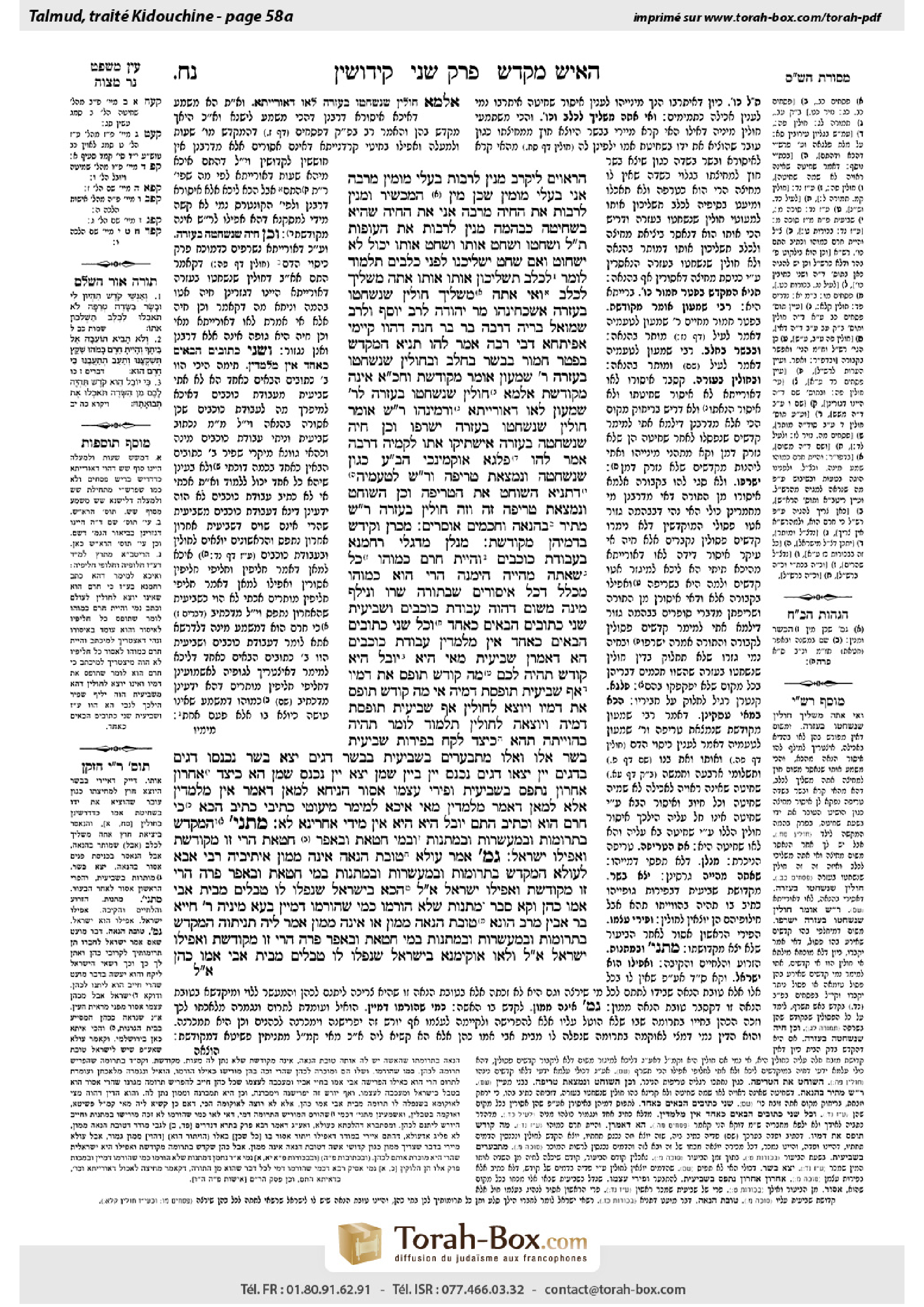
Kiddushin 58a: Talmud study for Daf Yomi
Daf Yomi is the daily study of one Talmud folio. Explore 37 tractates with scans, Hebrew text, Sefaria English and AI-generated French translations where annotated.
Passage selection and English or AI-generated French translation are available where the scan has annotations. Daf Study is independent of Torah-Box and Sefaria.
Browse Kiddushin · קידושין · All tractatesKiddushin 58a text and translations
This page of Kiddushin includes the Aramaic text, an English translation and an AI-generated French translation, alongside the scan above.
קידושין נ״ח א · Aramaic and Hebrew text
הָרְאוּיִם לִיקְרַב, מִנַּיִן לְרַבּוֹת בַּעֲלֵי מוּמִין? מְרַבֶּה אֲנִי בַּעֲלֵי מוּמִין, שֶׁכֵּן: מִין הַמַּכְשִׁיר. וּמִנַּיִן לְרַבּוֹת אֶת הַחַיָּה? מְרַבֶּה אֲנִי אֶת הַחַיָּה, שֶׁהִיא בִּשְׁחִיטָה כִּבְהֵמָה. מִנַּיִן לְרַבּוֹת אֶת הָעוֹפוֹת? תַּלְמוּד לוֹמַר: ״וּשְׁחָטוֹ״ ״וְשָׁחַט אוֹתוֹ״ ״וְשָׁחַט אוֹתוֹ״.
יָכוֹל לֹא יִשְׁחוֹט, וְאִם שָׁחַט יַשְׁלִיכֶנּוּ לִפְנֵי כְלָבִים? תַּלְמוּד לוֹמַר: ״לַכֶּלֶב תַּשְׁלִכוּן אֹתוֹ״ – אוֹתוֹ אַתָּה מַשְׁלִיךְ לַכֶּלֶב, וְאִי אַתָּה מַשְׁלִיךְ חוּלִּין שֶׁנִּשְׁחֲטוּ בַּעֲזָרָה.
אַשְׁכְּחִינְהוּ מָר יְהוּדָה לְרַב יוֹסֵף וּלְרַב שְׁמוּאֵל בְּרֵיהּ דְּרַבָּה בַּר בַּר חָנָה דַּהֲווֹ קָיְימִי אַפִּיתְחָא דְּבֵי רַבָּה. אֲמַר לְהוּ: תַּנְיָא: הַמְקַדֵּשׁ בְּפֶטֶר חֲמוֹר, בְּבָשָׂר בְּחָלָב, וּבְחוּלִּין שֶׁנִּשְׁחֲטוּ בָּעֲזָרָה, רַבִּי שִׁמְעוֹן אוֹמֵר: מְקוּדֶּשֶׁת, וַחֲכָמִים אוֹמְרִים: אֵינָהּ מְקוּדֶּשֶׁת. אַלְמָא חוּלִּין שֶׁנִּשְׁחֲטוּ בַּעֲזָרָה לְרַבִּי שִׁמְעוֹן לָאו דְּאוֹרָיְיתָא.
וּרְמִינְהוּ: רַבִּי שִׁמְעוֹן אוֹמֵר: חוּלִּין שֶׁנִּשְׁחֲטוּ בַּעֲזָרָה – יִשָּׂרְפוּ, וְכֵן חַיָּה שֶׁנִּשְׁחֲטָה בַּעֲזָרָה. אִישְׁתִּיקוּ.
אֲתוֹ לְקַמֵּיהּ דְּרַבָּה. אֲמַר לְהוּ: פָּלְגָאָ[ה] אוֹקְמִינְכוּ, הָכָא בְּמַאי עָסְקִינַן – כְּגוֹן שֶׁנִּשְׁחֲטָה וְנִמְצֵאת טְרֵיפָה. וְרַבִּי שִׁמְעוֹן לְטַעְמֵיהּ.
דְּתַנְיָא: הַשּׁוֹחֵט אֶת הַטְּרֵיפָה וְכֵן הַשּׁוֹחֵט וְנִמְצֵאת טְרֵיפָה – זֶה וָזֶה חוּלִּין בַּעֲזָרָה. רַבִּי שִׁמְעוֹן מַתִּיר בַּהֲנָאָה, וַחֲכָמִים אוֹסְרִים.
מְכָרָן וְקִידֵּשׁ בִּדְמֵיהֶן – מְקוּדֶּשֶׁת. מְנָלַן? מִדְּגַלִּי רַחֲמָנָא בַּעֲבוֹדָה זָרָה: ״וְהָיִיתָ חֵרֶם כָּמֹהוּ״, כֹּל שֶׁאַתָּה מְהַיֶּיה הֵימֶנָּה – הֲרֵי הוּא כָּמוֹהוּ, מִכְּלָל דְּכׇל אִיסּוּרִים שֶׁבַּתּוֹרָה שְׁרוּ.
וְנֵילַף מִינַּהּ! מִשּׁוּם דְּהָוֵה עֲבוֹדָה זָרָה וּשְׁבִיעִית שְׁנֵי כְתוּבִים הַבָּאִים כְּאֶחָד, וְכֹל שְׁנֵי כְתוּבִים הַבָּאִים כְּאֶחָד אֵין מְלַמְּדִין.
עֲבוֹדָה זָרָה – הָא דַּאֲמַרַן. שְׁבִיעִית מַאי הִיא? ״יוֹבֵל הִיא קֹדֶשׁ תִּהְיֶה לָכֶם״ – מָה קוֹדֶשׁ תּוֹפֵס אֶת דָּמָיו, אַף שְׁבִיעִית תּוֹפֶסֶת דָּמֶיהָ.
אִי מָה קוֹדֶשׁ תּוֹפֵס אֶת דָּמָיו וְיוֹצֵא לְחוּלִּין, אַף שְׁבִיעִית תּוֹפֶסֶת דָּמֶיהָ וְיוֹצְאָה לְחוּלִּין? תַּלְמוּד לוֹמַר: ״תִּהְיֶה״ – בַּהֲוָיָיתָהּ תְּהֵא.
כֵּיצַד? לָקַח בְּפֵירוֹת שְׁבִיעִית בָּשָׂר – אֵלּוּ וָאֵלּוּ מִתְבַּעֲרִים בַּשְּׁבִיעִית. בַּבָּשָׂר דָּגִים – יָצָא בָּשָׂר נִכְנְסוּ דָּגִים. בְּדָגִים יַיִן – יָצְאוּ דָּגִים נִכְנַס יַיִן. בְּיַיִן שֶׁמֶן – יָצָא יַיִן נִכְנַס שֶׁמֶן. הָא כֵּיצַד? אַחֲרוֹן אַחֲרוֹן נִתְפָּס בַּשְּׁבִיעִית, וּפְירִי עַצְמוֹ אָסוּר.
הָנִיחָא לְמַאן דְּאָמַר אֵין מְלַמְּדִין, אֶלָּא לְמַאן דְּאָמַר מְלַמְּדִין מַאי אִיכָּא לְמֵימַר? [תְּרֵי] מִיעוּטֵי כְּתִיבִי, כְּתִיב הָכָא: ״כִּי חֵרֶם הוּא״, וּכְתִיב הָתָם: ״יוֹבֵל הִיא״ – הִיא אִין, מִידֵּי אַחֲרִינָא לָא.
מַתְנִי׳ הַמְקַדֵּשׁ בִּתְרוּמוֹת וּבַמַּעַשְׂרוֹת, וּבַמַּתָּנוֹת, וּבְמֵי חַטָּאת, וּבְאֵפֶר חַטָּאת – הֲרֵי זוֹ מְקוּדֶּשֶׁת, וַאֲפִילּוּ יִשְׂרָאֵל.
גְּמָ׳ אָמַר עוּלָּא: טוֹבַת הֲנָאָה אֵינָהּ מָמוֹן. אֵיתִיבֵיהּ רַבִּי אַבָּא לְעוּלָּא: הַמְקַדֵּשׁ בִּתְרוּמוֹת, וּבְמַעַשְׂרוֹת, וּבַמַּתָּנוֹת בְּמֵי חַטָּאת, וּבְאֵפֶר פָּרָה – הֲרֵי זוֹ מְקוּדֶּשֶׁת, וַאֲפִילּוּ יִשְׂרָאֵל.
אֲמַר לֵיהּ: הָכָא בְּיִשְׂרָאֵל שֶׁנָּפְלוּ לוֹ טְבָלִים מִבֵּית אֲבִי אִמּוֹ כֹּהֵן. וְקָא סָבַר: מַתָּנוֹת שֶׁלֹּא הוּרְמוּ כְּמִי שֶׁהוּרְמוּ דָּמְיָין.
בְּעָא מִינֵּיהּ רַבִּי חִיָּיא בַּר אָבִין מֵרַב הוּנָא: טוֹבַת הֲנָאָה מָמוֹן אוֹ אֵינָהּ מָמוֹן? אֲמַר לֵיהּ: תְּנֵיתוּהָ: הַמְקַדֵּשׁ בִּתְרוּמוֹת וּבְמַעַשְׂרוֹת וּבְמַתָּנוֹת בְּמֵי חַטָּאת וּבְאֵפֶר פָּרָה – הֲרֵי זוֹ מְקוּדֶּשֶׁת, וַאֲפִילּוּ יִשְׂרָאֵל! אֲמַר לֵיהּ: וְלָאו אוֹקֵימְנָא בְּיִשְׂרָאֵל שֶׁנָּפְלוּ לוֹ טְבָלִים מִבֵּית אֲבִי אִמּוֹ כֹּהֵן?
Kiddushin 58a · English translation
which are fit to be sacrificed. From where do I know to include blemished animals in this prohibition? I include blemished animals since they are at least of the type that is fit to be sacrificed. And from where do I know to include the undomesticated animal in this prohibition? I include the undomesticated animal since it is rendered fit for consumption by means of slaughtering, like a domesticated animal. From where do I know to include birds, as the Torah does not mention slaughter with regard to birds, in this prohibition? The verse states: “And he slaughters it,” “and he shall slaughter it,” as well as “and he shall slaughter it,” employing the additional term “it” each time. These three verses teach that one may not eat from a non-sacred animal that was slaughtered in the Temple courtyard
The baraita continues: One might have thought that he may not slaughter a non-sacred animal in the Temple courtyard ab initio, but if he did slaughter it, he may cast it before the dogs, i.e., derive benefit from it. The verse states: “Therefore you shall not eat any flesh that is torn of beasts in the field; you shall cast it to the dogs” (Exodus 22:30), which teaches that although one is prohibited from eating the meat of a tereifa, one may derive benefit from it. The word “it” serves to emphasize and exclude: You may cast it, i.e., a tereifa, to the dogs, but you may not cast non-sacred animals that have been slaughtered in the Temple courtyard, as it is prohibited to derive any benefit from them.
The Gemara relates: Mar Yehuda found Rav Yosef and Rav Shmuel, son of Rabba bar bar Ḥana, standing at the entrance of Rabba’s study hall. He said to them: It is taught in a baraita: With regard to one who betroths a woman with a firstborn donkey, with meat cooked in milk, or with non-sacred animals slaughtered in the Temple courtyard, Rabbi Shimon says she is betrothed, and the Rabbis say she is not betrothed. Apparently, according to Rabbi Shimon, the prohibition against deriving benefit from non-sacred animals slaughtered in the Temple courtyard is not by Torah law, which is why the betrothal takes effect.
And Mar Yehuda raises a contradiction against this inference from a different baraita: Rabbi Shimon says: Non-sacred, domesticated, animals slaughtered in the Temple courtyard must be burned, as well as a non-sacred undomesticated animal slaughtered in the Temple courtyard. This indicates that it is prohibited to derive benefit from them. They were silent and had no answer.
They came before Rabba and told him about this difficulty. He said to them: A quarrelsome person has put you up to asking this question. With what are we dealing here in the first baraita? We are dealing with a case where it was slaughtered and found to be a tereifa, and Rabbi Shimon conforms to his standard line of reasoning that an act of slaughter which does not render the animal permitted to be eaten is not called slaughter, so the animal does not have the status of a non-sacred animal slaughtered in the Temple courtyard.
As it is taught in a baraita (Tosefta, Ḥullin 2:4): With regard to one who slaughters a known tereifa, as well as one who slaughters an animal and it was found to be a tereifa, and this and that were non-sacred animals slaughtered in the Temple courtyard, Rabbi Shimon permits one to derive benefit from them, as explained previously. And the Rabbis prohibit one from deriving benefit from them, since they do not distinguish between an act of slaughter that does render the animal permitted to be eaten and one that does not. It is only in a case where the man betrothed her with a tereifa that was slaughtered in the Temple courtyard that Rabbi Shimon says she is betrothed, but not when the animal was not a tereifa.
§ The mishna teaches that if one sold any of the items from which one is prohibited to derive benefit and betrothed a woman with the money received from their sale, she is betrothed. With regard to the possibility of deriving benefit from money received in exchange for items from which benefit is forbidden, the Gemara asks: From where do we derive that this is permitted? The Gemara answers: It is from the fact that the Merciful One reveals in the Torah with regard to an object of idol worship: “And you shall be banned like it” (Deuteronomy 7:26), which teaches that anything that you cause to come from it, i.e., in exchange for it, is like it. It can be understood by inference that with regard to all the other prohibitions of the Torah, monies received for items from which benefit is forbidden are permitted.
The Gemara suggests: But let us derive a general principle concerning other prohibitions from the case of idolatry. The Gemara answers: This derivation is not applied, because an object of idol worship and produce of the Sabbatical Year are two verses that come as one, i.e., to teach the same matter, since both prohibitions also extend to the money obtained for them, and any two verses that come as one do not teach their common aspect to apply to other cases.
The Gemara clarifies: The source indicating that this is true of an object of idol worship is what we said. What is the source indicating that this halakha applies to produce of the Sabbatical Year? The verse states: “It is a Jubilee, it shall be holy to you” (Leviticus 25:12), from which it is derived: Just as consecrated property transfers its sanctity to the money with which it is redeemed, so too, produce of the Sabbatical Year, which has the same status as the Jubilee Year, transfers its sanctity to the money with which it is redeemed. Consequently, money used to acquire the produce of the Sabbatical Year will be subject to the same halakhot as the produce itself.
If so, one could also say that just as with consecrated property, it transfers its sanctity to the money with which it is redeemed and becomes desacralized, so too, produce of the Sabbatical Year should transfer its sanctity to the money with which it is redeemed and becomes desacralized. Nevertheless, the verse states: “Shall be,” meaning: As it is, so it shall be, indicating that the Sabbatical-Year produce does not become desacralized.
The Gemara explains: How so? If one purchased meat with produce of the Sabbatical Year, both these and those, i.e., the meat and the produce, are disposed of in the Sabbatical Year. The sanctity of the Sabbatical Year takes effect with regard to the meat as well. It is treated like the produce, and must be disposed of when the obligation to dispose of the Sabbatical-Year produce goes into effect. If he then purchases fish with this meat, the meat loses its consecrated status, and the fish assumes the consecrated state. If he then purchases wine with these fish, the fish loses its consecrated status and the wine assumes the consecrated state. If he then purchases oil with the wine, the wine loses has its consecrated status and the oil assumes the consecrated state. How so? The final item purchased has the sanctity of the Sabbatical Year transferred to it, and the Sabbatical-Year produce itself remains forbidden.
The Gemara asks: This works out well according to the one who says that any two verses that come as one do not teach their common aspect to apply to other cases. But according to the one who says that they do teach their common aspect to apply to other cases, what can be said? Why is it not learned from these examples that money received from the sale of an item from which benefit is forbidden, is likewise forbidden? The Gemara answers: Expressions of restriction are written in both cases. Here, with regard to idol worship, it is written: “For it is banned” (Deuteronomy 7:26), which indicates only that it is banned, i.e., has its prohibition extend to money received from its sale, while other prohibited items are not. And there, with regard to produce of the Sabbatical Year, it is written: “It is a Jubilee” (Leviticus 25:12), which teaches that with regard to “it,” yes, this halakha applies; but this halakha does not apply to anything else.
MISHNA: With regard to one who betroths a woman with terumot, or with tithes, or with the foreleg, cheeks, and stomach of an animal, which are given as gifts to priests, or with the water of purification, which is sprinkled on an impure person during the purification rite for impurity imparted by a corpse, or with the ashes of purification, which were mixed with the water sprinkled on an impure person during the purification rite for impurity imparted by a corpse, in all of these cases she is betrothed, and this is so even if the man betrothing her is an Israelite, not a priest or a Levite.
GEMARA: Ulla says: The benefit of discretion, i.e., the benefit accrued from the option of giving teruma and tithes to whichever priest or Levite one chooses, does not have monetary value. Rabbi Abba raised an objection to Ulla from the mishna: With regard to one who betroths a woman with terumot, or with tithes, or with gifts, with the water of purification, or with the ashes of the red heifer, she is betrothed, and this is so even if the man betrothing her is an Israelite. This indicates that although an Israelite cannot consume the priestly gifts, he may nevertheless betroth a woman with them, since he possesses the option to give them to the priest or Levite of his choice. That benefit has monetary value, and it is that value that he uses to betroth a woman, who can then give them to whichever priest or Levite she chooses.
Ulla said to him: You have misunderstood the case of the mishna, since here the case is with an Israelite who came into possession of untithed produce as an inheritance from the household of his mother’s father, who was a priest, and the tanna of the mishna holds that gifts that have not been separated are considered as though they have been separated. The untithed produce is not viewed as one entity, but rather is viewed as a mixture of regular produce, teruma, and tithes. This teruma belonged to his grandfather, who was a priest. Since he has inherited this teruma, he has ownership rights to it in addition to the benefit of discretion. While he cannot consume this produce because he is an Israelite, he can sell it to a priest and keep the money. Since it has actual value, it can be used to betroth a woman.
With regard to this issue, Rabbi Ḥiyya bar Avin inquired of Rav Huna: Does the benefit of discretion have monetary value, or does it not have monetary value? Rav Huna said to him: You learned it in the mishna: With regard to one who betroths a woman with terumot, or with tithes, or with gifts, or with the water of purification, or with the ashes of the red heifer, she is betrothed, and this is so even if the man betrothing her is an Israelite. This indicates that the benefit of discretion has monetary value. Rabbi Ḥiyya bar Avin said to him: But didn’t we establish it, in accordance with the opinion of Ulla, as referring to an Israelite who came into possession of untithed produce as an inheritance from the household of his mother’s father, who was a priest?
Kiddushin 58a · Traduction française (IA)
qui peuvent être offerts en sacrifice. D’où sait-on qu’il faut inclure les animaux présentant un défaut dans cette interdiction ? On les inclut, puisqu’ils appartiennent au moins à une catégorie d’animaux pouvant être offerts en sacrifice. Et d’où sait-on qu’il faut inclure les animaux sauvages dans cette interdiction ? On les inclut, puisqu’ils deviennent propres à la consommation par l’abattage, comme les animaux domestiques. D’où sait-on qu’il faut inclure les oiseaux dans cette interdiction, alors que la Torah ne mentionne pas leur abattage ? Le verset dit : « Et il l’abat », « et il l’abattra », ainsi que « et il l’abattra », en employant chaque fois le terme supplémentaire « il ». Ces trois versets enseignent qu’il est interdit de manger un animal non consacré abattu dans le parvis du Temple.
La baraïta poursuit : On aurait pu penser qu’il est interdit d’abattre d’emblée un animal non consacré dans le parvis du Temple, mais que, si on l’a abattu, on peut le jeter aux chiens, c’est-à-dire en tirer profit. Le verset dit : « Vous ne mangerez donc aucune chair déchirée par les bêtes dans les champs ; vous la jetterez aux chiens » (Exode 22, 30), ce qui enseigne que, bien qu’il soit interdit de manger la chair d’une tereifa, on peut en tirer profit. Le mot « la » sert à souligner et à exclure : on peut jeter aux chiens une tereifa, mais on ne peut pas y jeter des animaux non consacrés abattus dans le parvis du Temple, car il est interdit d’en tirer le moindre profit.
La Guemara rapporte : Mar Yehouda trouva Rav Yossef et Rav Chmouel, fils de Rabba bar bar Ḥana, debout à l’entrée de la maison d’étude de Rabba. Il leur dit : Il est enseigné dans une baraïta : Celui qui donne à une femme, pour la consacrer, un âne premier-né, de la viande cuite dans du lait ou des animaux non consacrés abattus dans le parvis du Temple : Rabbi Chimon dit qu’elle est consacrée, tandis que les Sages disent qu’elle ne l’est pas. Apparemment, selon Rabbi Chimon, l’interdiction de tirer profit d’animaux non consacrés abattus dans le parvis du Temple ne relève pas de la Torah, ce qui explique pourquoi la consécration de la femme prend effet.
Mar Yehouda soulève une contradiction à l’encontre de cette déduction à partir d’une autre baraïta : Rabbi Chimon dit que les animaux domestiques non consacrés abattus dans le parvis du Temple doivent être brûlés, de même qu’un animal sauvage non consacré abattu dans le parvis du Temple. Cela indique qu’il est interdit d’en tirer profit. Ils gardèrent le silence et n’eurent pas de réponse.
Ils se rendirent auprès de Rabba et lui exposèrent cette difficulté. Il leur dit : Un querelleur vous a incités à poser cette question. De quel cas traite la première baraïta ? D’un cas où l’animal a été abattu et s’est révélé être une tereifa. Rabbi Chimon suit alors son raisonnement habituel : un acte d’abattage qui ne rend pas l’animal propre à la consommation n’est pas considéré comme un abattage ; l’animal n’a donc pas le statut d’un animal non consacré abattu dans le parvis du Temple.
Car il est enseigné dans une baraïta (Tosefta, Ḥullin 2:4) : Celui qui abat une tereifa connue, ainsi que celui qui abat un animal qui se révèle être une tereifa, et dans les deux cas il s’agit d’animaux non consacrés abattus dans le parvis du Temple : Rabbi Chimon permet d’en tirer profit, comme expliqué précédemment. Les Sages interdisent d’en tirer profit, car ils ne font pas de distinction entre un acte d’abattage qui rend l’animal propre à la consommation et un acte qui ne le rend pas propre à la consommation. C’est uniquement dans le cas où l’homme lui a donné, pour la consacrer, une tereifa abattue dans le parvis du Temple que Rabbi Chimon dit qu’elle est consacrée, et non lorsque l’animal n’était pas une tereifa.
§ La Michna enseigne que si quelqu’un vend l’un des objets dont il est interdit de tirer profit et donne à une femme, pour la consacrer, l’argent reçu de la vente, elle est consacrée. Au sujet de la possibilité de tirer profit de l’argent reçu en échange d’objets dont il est interdit de tirer profit, la Guemara demande : D’où déduisons-nous que cela est permis ? La Guemara répond : Cela ressort du fait que le Miséricordieux révèle dans la Torah, à propos d’un objet d’idolâtrie : « Tu le voueras à l’interdit comme lui » (Deutéronome 7, 26), ce qui enseigne que tout ce que tu en tires, c’est-à-dire en échange de lui, est comme lui. On peut en déduire que, pour toutes les autres interdictions de la Torah, l’argent reçu en échange d’objets dont il est interdit de tirer profit est permis.
La Guemara suggère : Mais ne pouvons-nous pas déduire un principe général concernant les autres interdictions à partir du cas de l’idolâtrie ? La Guemara répond : Cette déduction ne s’applique pas, car l’objet d’idolâtrie et les produits de l’année sabbatique sont deux versets qui viennent enseigner une seule et même chose, puisque les deux interdictions s’étendent également à l’argent obtenu en échange de ces objets ou produits ; or, deux versets qui viennent enseigner une seule et même chose ne transmettent pas leur principe commun aux autres cas.
La Guemara précise : La source indiquant que cela s’applique à un objet d’idolâtrie est celle que nous avons citée. Quelle est la source indiquant que cette halakha s’applique aux produits de l’année sabbatique ? Le verset dit : « C’est une année de Jubilé, elle sera sainte pour vous » (Lévitique 25, 12), d’où l’on déduit : de même que les biens consacrés transmettent leur sainteté à l’argent contre lequel ils sont rachetés, de même les produits de l’année sabbatique, qui ont le même statut que ceux de l’année du Jubilé, transmettent leur sainteté à l’argent contre lequel ils sont rachetés. Par conséquent, l’argent utilisé pour acquérir les produits de l’année sabbatique est soumis aux mêmes halakhot que ces produits.
Dans ce cas, on pourrait aussi dire que, de même que les biens consacrés transmettent leur sainteté à l’argent contre lequel ils sont rachetés et perdent leur caractère sacré, de même les produits de l’année sabbatique devraient transmettre leur sainteté à l’argent contre lequel ils sont rachetés et perdre leur caractère sacré. Néanmoins, le verset dit : « elle sera », c’est-à-dire : elle restera telle qu’elle est, ce qui indique que les produits de l’année sabbatique ne perdent pas leur caractère sacré.
La Guemara explique : Comment cela se passe-t-il ? Si quelqu’un achète de la viande avec des produits de l’année sabbatique, les deux, c’est-à-dire la viande et les produits, doivent être éliminés pendant l’année sabbatique. La sainteté de l’année sabbatique s’applique également à la viande. Celle-ci est traitée comme les produits et doit être éliminée lorsque l’obligation d’éliminer les produits de l’année sabbatique entre en vigueur. S’il achète ensuite du poisson avec cette viande, la viande perd son statut sacré et le poisson acquiert ce statut. S’il achète ensuite du vin avec ce poisson, le poisson perd son statut sacré et le vin acquiert ce statut. S’il achète ensuite de l’huile avec le vin, le vin perd son statut sacré et l’huile acquiert ce statut. Comment cela s’explique-t-il ? C’est le dernier article acheté qui reçoit la sainteté de l’année sabbatique, tandis que les produits de l’année sabbatique eux-mêmes restent interdits.
La Guemara demande : Cela s’explique bien selon celui qui dit que deux versets qui viennent enseigner une seule et même chose ne transmettent pas leur principe commun aux autres cas. Mais, selon celui qui dit qu’ils le transmettent aux autres cas, que peut-on répondre ? Pourquoi ne déduirait-on pas de ces exemples que l’argent reçu de la vente d’un objet dont il est interdit de tirer profit est lui aussi interdit ? La Guemara répond : Dans les deux cas, des expressions restrictives sont écrites. Ici, à propos de l’idolâtrie, il est écrit : « Car il est voué à l’interdit » (Deutéronome 7, 26), ce qui indique que seul cet objet est voué à l’interdit, c’est-à-dire que l’interdiction s’étend à l’argent reçu de sa vente, tandis que les autres objets interdits ne le sont pas. Et là, à propos des produits de l’année sabbatique, il est écrit : « C’est une année de Jubilé » (Lévitique 25, 12), ce qui enseigne que cette halakha s’applique à « elle », oui, mais pas à quoi que ce soit d’autre.
MICHNA : Celui qui donne à une femme, pour la consacrer, des teroumot, des dîmes, ou la cuisse antérieure, les joues et la caillette d’un animal, qui sont remis aux prêtres, ou l’eau de purification, aspergée sur une personne impure lors du rite de purification de l’impureté transmise par un cadavre, ou les cendres de purification, mélangées à l’eau aspergée sur une personne impure lors du rite de purification de l’impureté transmise par un cadavre, la consacre dans tous ces cas, même si l’homme qui la consacre est un Israélite, et non un prêtre ou un lévite.
GUEMARA : Oulla dit : L’avantage du choix, c’est-à-dire celui que procure la possibilité de remettre la terouma et les dîmes au prêtre ou au lévite de son choix, n’a pas de valeur monétaire. Rabbi Abba soulève une objection contre Oulla à partir de la Michna : Celui qui donne à une femme, pour la consacrer, des teroumot, des dîmes, des dons, de l’eau de purification ou les cendres de la vache rousse la consacre, même si l’homme qui la consacre est un Israélite. Cela indique que, bien qu’un Israélite ne puisse pas consommer les dons destinés aux prêtres, il peut néanmoins consacrer une femme avec eux, puisqu’il a la possibilité de les remettre au prêtre ou au lévite de son choix. Cet avantage a une valeur monétaire, et c’est cette valeur qu’il utilise pour consacrer une femme, qui peut ensuite les remettre au prêtre ou au lévite de son choix.
Oulla lui dit : Tu as mal compris le cas de la Michna, car il s’agit ici d’un Israélite qui a hérité de produits non soumis à la dîme dans la maison du père de sa mère, qui était prêtre. Le tanna de la Michna considère que les dons qui n’ont pas été prélevés sont réputés l’avoir été. Les produits non soumis à la dîme ne sont pas considérés comme une seule entité, mais comme un mélange de produits ordinaires, de terouma et de dîmes. Cette terouma appartenait à son grand-père, qui était prêtre. Puisqu’il a hérité de cette terouma, il en est propriétaire, en plus de bénéficier de l’avantage du choix. Bien qu’il ne puisse pas consommer ces produits puisqu’il est Israélite, il peut les vendre à un prêtre et garder l’argent. Comme ils ont une valeur réelle, ils peuvent servir à consacrer une femme.
À propos de cette question, Rabbi Ḥiyya bar Avin demanda à Rav Houna : L’avantage du choix a-t-il une valeur monétaire ou non ? Rav Houna lui dit : Tu l’as appris dans la Michna : Celui qui donne à une femme, pour la consacrer, des teroumot, des dîmes, des dons, de l’eau de purification ou les cendres de la vache rousse la consacre, même si l’homme qui la consacre est un Israélite. Cela indique que l’avantage du choix a une valeur monétaire. Rabbi Ḥiyya bar Avin lui dit : Mais n’avons-nous pas établi, conformément à l’opinion d’Oulla, que le cas concerne un Israélite qui a hérité de produits non soumis à la dîme dans la maison du père de sa mère, qui était prêtre ?
Traduction française générée par IA à partir de l’édition anglaise de Sefaria. Vérifie toujours un passage avec le texte source.
Text from Sefaria: William Davidson Edition - Vocalized Aramaic (CC BY NC); William Davidson Edition - English (CC BY NC).