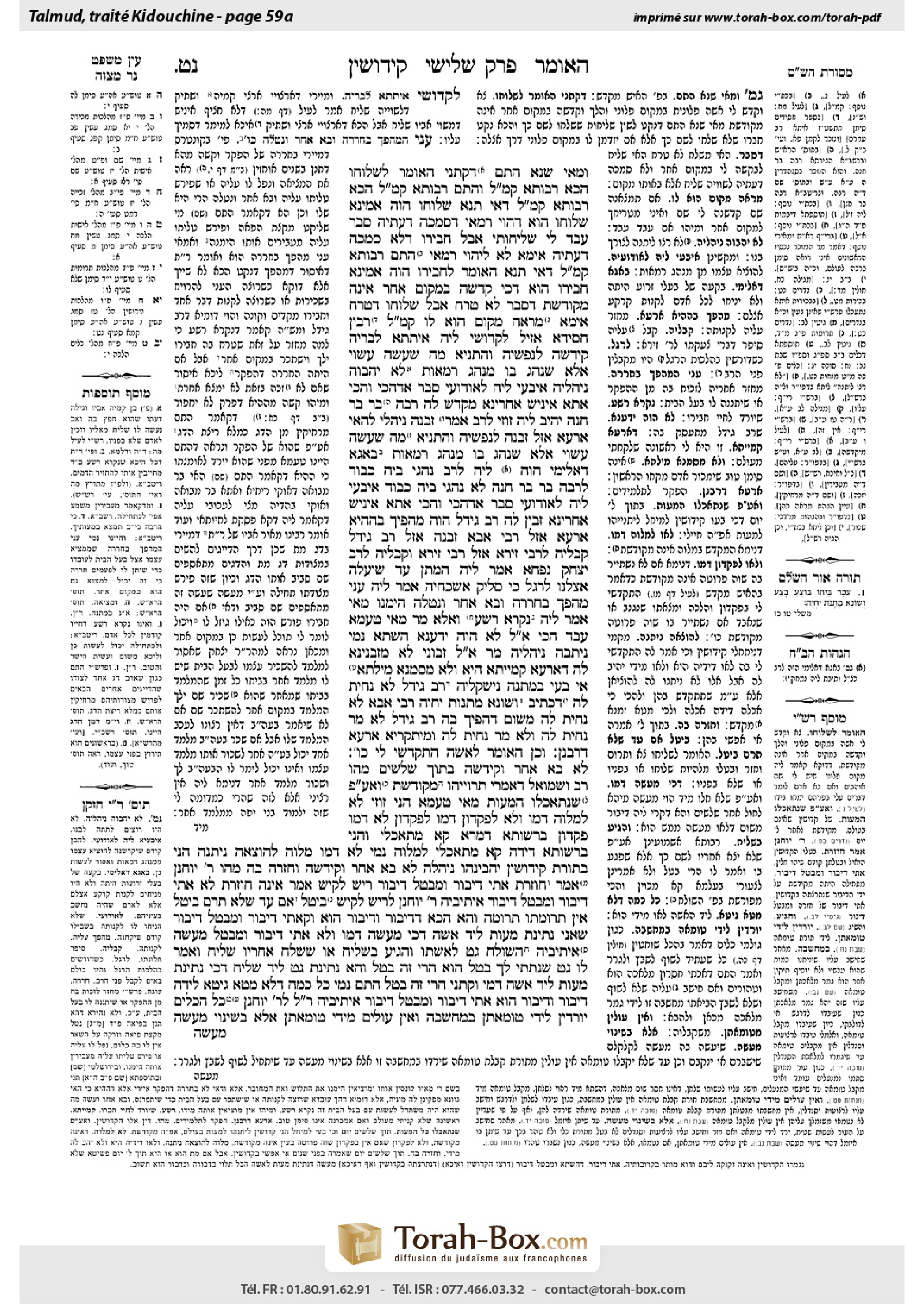
Kiddushin 59a: Talmud study for Daf Yomi
Daf Yomi is the daily study of one Talmud folio. Explore 37 tractates with scans, Hebrew text, Sefaria English and AI-generated French translations where annotated.
Passage selection and English or AI-generated French translation are available where the scan has annotations. Daf Study is independent of Torah-Box and Sefaria.
Browse Kiddushin · קידושין · All tractatesKiddushin 59a text and translations
This page of Kiddushin includes the Aramaic text, an English translation and an AI-generated French translation, alongside the scan above.
קידושין נ״ט א · Aramaic and Hebrew text
וּמַאי שְׁנָא הָתָם דְּקָתָנֵי ״הָאוֹמֵר לִשְׁלוּחוֹ״?
הָכָא רְבוּתָא קָא מַשְׁמַע לַן, וְהָתָם רְבוּתָא קָא מַשְׁמַע לַן. הָכָא רְבוּתָא קָא מַשְׁמַע לַן: דְּאִי תְּנָא ״שְׁלוּחוֹ״ הֲוָה אָמֵינָא: שְׁלוּחוֹ הוּא דְּהָוֵי רַמַּאי, דְּסָמְכָה דַּעְתֵּיהּ, סָבַר: עָבֵד לִי שְׁלִיחוּתַי, אֲבָל חֲבֵירוֹ, דְּלָא סָמְכָה דַּעְתֵּיהּ, אֵימָא לָא לֶיהֱוֵי רַמַּאי.
הָתָם רְבוּתָא קָא מַשְׁמַע לַן: דְּאִי תְּנָא: ״הָאוֹמֵר לַחֲבֵירוֹ״ הֲוָה אָמֵינָא: חֲבֵירוֹ הוּא דְּכִי קִדְּשָׁהּ בְּמָקוֹם אַחֵר אֵינָהּ מְקוּדֶּשֶׁת, דְּסָבַר: לָא טָרַח, אֲבָל שְׁלוּחוֹ דְּטָרַח אֵימָא: מַרְאֶה מָקוֹם הוּא לוֹ, קָא מַשְׁמַע לַן.
רָבִין חֲסִידָא אֲזַיל לְקַדּוֹשֵׁי לֵיהּ אִיתְּתָא לִבְרֵיהּ, קַידְּשַׁהּ לְנַפְשֵׁיהּ. וְהָתַנְיָא: מַה שֶּׁעָשָׂה – עָשׂוּי, אֶלָּא שֶׁנָּהַג בּוֹ מִנְהַג רַמָּאוּת! לָא יַהֲבוּהּ נִיהֲלֵיהּ. אִיבְּעִי לֵיהּ לְאוֹדוֹעֵי! סָבַר: אַדְּהָכִי וְהָכִי אֲתָא אִינִישׁ אַחֲרִינָא מְקַדֵּשׁ לַהּ.
רַבָּה בַּר בַּר חָנָה יְהַיב לֵיהּ זוּזֵי לְרַב, אֲמַר: זִבְנַהּ נִיהֲלִי לְהַאי אַרְעָא. אֲזַל זַבְנַהּ לְנַפְשֵׁיהּ. וְהָתַנְיָא: מַה שֶּׁעָשָׂה – עָשׂוּי, אֶלָּא שֶׁנָּהַג בּוֹ מִנְהַג רַמָּאוּת! בָּאגָא דְאַלִּימֵי הֲוָה (לֵיהּ), לְרַב – נָהֲגִי בֵּיהּ כָּבוֹד, לְרַבָּה בַּר בַּר חָנָה – לָא נָהֲגִי בֵּיהּ כָּבוֹד. אִיבְּעִי לֵיהּ לְאוֹדוֹעֵי! סְבַר: אַדְּהָכִי וְהָכִי אֲתָא אִינִישׁ אַחֲרִינָא זַבֵּין לַהּ.
רַב גִּידֵּל הֲוָה מְהַפֵּיךְ בְּהַהִיא אַרְעָא. אֲזַל רַבִּי אַבָּא זַבְנַהּ. אֲזַל רַב גִּידֵּל קַבְלֵיהּ לְרַבִּי זֵירָא. אֲזַל רַבִּי זֵירָא וְקַבְלֵיהּ לְרַב יִצְחָק נַפָּחָא. אָמַר לֵיהּ: הַמְתֵּן עַד שֶׁיַּעֲלֶה אֶצְלֵנוּ לָרֶגֶל. כִּי סְלֵיק, אַשְׁכְּחֵיהּ, אֲמַר לֵיהּ: עָנִי מְהַפֵּךְ בַּחֲרָרָה, וּבָא אַחֵר וּנְטָלָהּ הֵימֶנּוּ, מַאי?
אֲמַר לֵיהּ: נִקְרָא רָשָׁע. וְאֶלָּא מָר מַאי טַעְמָא עֲבַד הָכִי? אֲמַר לֵיהּ: לָא הֲוָה יָדַעְנָא. הַשְׁתָּא נָמֵי נִיתְּבַהּ נִיהֲלֵיהּ מָר. אֲמַר לֵיהּ: זַבּוֹנֵי לָא מְזַבֵּינְנָא לַהּ, דְּאַרְעָא קַמַּיְיתָא הִיא, וְלָא מְסַמְּנָא מִילְּתָא. אִי בָּעֵי בְּמַתָּנָה – נִישְׁקְלֵיהּ.
רַב גִּידֵּל לָא נָחֵית לַהּ, דִּכְתִיב: ״וְשׂוֹנֵא מַתָּנֹת יִחְיֶה״. רַבִּי אַבָּא לָא נָחֵית לַהּ מִשּׁוּם דְּהַפֵּיךְ בַּהּ רַב גִּידֵּל. לָא מָר נָחֵית לַהּ וְלָא מָר נָחֵית לַהּ וּמִיתְקָרְיָא אַרְעָא דְרַבָּנַן.
וְכֵן הָאוֹמֵר לְאִשָּׁה הִתְקַדְּשִׁי לִי כּוּ׳. לֹא בָּא אַחֵר וְקִידְּשָׁה בְּתוֹךְ שְׁלֹשִׁים, מַהוּ? רַב וּשְׁמוּאֵל דְּאָמְרִי תַּרְוַיְיהוּ: מְקוּדֶּשֶׁת, וְאַף עַל פִּי שֶׁנִּתְאַכְּלוּ הַמָּעוֹת.
מַאי טַעְמָא? הָנֵי זוּזֵי לָא לְמִלְוָה דָּמוּ וְלָא לְפִקָּדוֹן דָּמוּ.
לְפִקָּדוֹן לָא דָּמוּ – פִּקָּדוֹן בִּרְשׁוּתָא דְמָרֵיהּ קָא מִתְאַכְּלִי, וְהָנֵי בִּרְשׁוּתָא דִידַהּ קָא מִתְאַכְּלִי. לְמַלְוֶה נָמֵי לָא דָּמוּ – מִלְוָה לְהוֹצָאָה נִיתְּנָה, הָנֵי בְּתוֹרַת קִידּוּשִׁין יַהֲבִינְהוּ נִיהֲלַהּ.
לֹא בָּא אַחֵר וְקִידְּשָׁהּ, וְחָזְרָה בָּהּ, מַהוּ? רַבִּי יוֹחָנָן אָמַר: חוֹזֶרֶת – אָתֵי דִּיבּוּר, וּמְבַטֵּל דִּיבּוּר. רֵישׁ לָקִישׁ אָמַר: אֵינָהּ חוֹזֶרֶת – לָא אָתֵי דִּיבּוּר וּמְבַטֵּל דִּיבּוּר.
אֵיתִיבֵיהּ רַבִּי יוֹחָנָן לְרֵישׁ לָקִישׁ: בִּיטֵּל, אִם עַד שֶׁלֹּא תָּרַם בִּיטֵּל – אֵין תְּרוּמָתוֹ תְּרוּמָה. וְהָא הָכָא דְּדִיבּוּר וְדִיבּוּר הוּא, וְקָאָתֵי דִּיבּוּר וּמְבַטֵּל דִּיבּוּר! שָׁאנֵי נְתִינַת מָעוֹת לְיַד אִשָּׁה, דְּכִי מַעֲשֶׂה דָּמוּ, וְלָא אָתֵי דִּיבּוּר וּמְבַטֵּל מַעֲשֶׂה.
אֵיתִיבֵיהּ: הַשּׁוֹלֵחַ גֵּט לְאִשְׁתּוֹ וְהִגִּיעַ בַּשָּׁלִיחַ אוֹ שֶׁשָּׁלַח אַחֲרָיו שָׁלִיחַ וְאָמַר לוֹ: ״גֵּט שֶׁנָּתַתִּי לְךָ בָּטֵל הוּא״ – הֲרֵי זֶה בָּטֵל. וְהָא נְתִינַת גֵּט לְיַד שָׁלִיחַ, דְּכִי נְתִינַת מָעוֹת לְיַד אִשָּׁה דָּמֵי, וְקָתָנֵי הֲרֵי זֶה בָּטֵל!
הָתָם נָמֵי, כֹּל כַּמָּה דְּלָא מְטָא גִּיטָּא לִידַהּ – דִּיבּוּר וְדִיבּוּר הוּא, אָתֵי דִּיבּוּר וּמְבַטֵּל דִּיבּוּר.
אֵיתִיבֵיהּ רֵישׁ לָקִישׁ לְרַבִּי יוֹחָנָן: כׇּל הַכֵּלִים יוֹרְדִין לִידֵי טוּמְאָתָן בְּמַחְשָׁבָה, וְאֵין עוֹלִים מִידֵּי טוּמְאָתָן אֶלָּא בְּשִׁינּוּי מַעֲשֶׂה.
Kiddushin 59a · English translation
and what is different there, in the previous chapter (50a), that the tanna teaches: With regard to one who says to his agent, go and betroth a certain woman for me in such and such a place, and he went and betrothed her in a different place, she is not betrothed? Why does the mishna there label him an agent, and here it labels him simply another?
The Gemara answers: Here the mishna teaches us a novel element and there it teaches us a novel element, through its use of these terms. The Gemara elaborates: The mishna here teaches us a novel element, as had it taught: His agent, I would say that it is his agent who is considered a scoundrel in that case, as one who sends an agent relies upon him, thinking: He will perform my agency for me, since he was sent for that purpose. But with regard to the use of the term: Another, who was not appointed and upon whom he does not rely, as he is not his agent, you might say that he should not be considered a scoundrel.
Similarly, the mishna there teaches us a novel element, as had it taught: One who says to another, I would say that it is in the case of another that she is not betrothed if he betrothed her in a different place, as he thinks that this person would not go to the trouble of looking for her elsewhere, and therefore he authorized him to betroth the woman only in that particular place. But with regard to his agent, who is assumed to take special trouble to fulfill his agency, you might say he is merely showing him the place where she is likely to be found, and she is betrothed in any case. The mishna therefore teaches us that even when he appointed an agent she is not betrothed if he does not find her in the place the putative husband specified.
The Gemara relates: Ravin the Pious was appointed an agent and went to betroth a woman to his son, but in the end he betrothed her to himself. The Gemara raises a difficulty: But isn’t it taught in the aforementioned baraita: What he did is done, but he has treated him in a deceitful manner? How could a pious individual act in this fashion? The Gemara answers: The woman’s family would not give her to the son, and agreed only to let her marry the father. The Gemara further asks: Even so, before betrothing her he should have first informed his son that they refuse to let her marry him. The Gemara explains that Ravin thought: In the meantime, while I am busy reporting back to my son, someone else will come and betroth her.
The Gemara relates a similar story: Rabba bar bar Ḥana gave money to Rav and said: Purchase this land for me. Rav went and purchased it for himself. The Gemara asks: But isn’t it taught in the baraita with regard to an agent who acts in this manner: What he did is done, but he has treated him in a deceitful manner? The Gemara answers: The land was located in a valley inhabited by violent men, who treated Rav with respect and were prepared to sell the land to him, but who did not treat Rabba bar bar Ḥana with respect. As in the case of Ravin, the Gemara questions this behavior: Nevertheless, Rav should have informed him. The Gemara responds that Rav thought: In the meantime someone else will come and purchase the land.
The Gemara further relates: Rav Giddel was engaging in the acquisition of a certain plot of land. In the meantime Rabbi Abba went and purchased it. Rav Giddel went and complained about Rabbi Abba to Rabbi Zeira. Rabbi Zeira went and complained about Rabbi Abba to Rav Yitzḥak Nappaḥa. Rav Yitzḥak Nappaḥa said to him: Wait until Rabbi Abba ascends to visit us for the pilgrimage Festival, when all come to hear the Festival sermon, on which occasion we can discuss this matter with him. When Rabbi Abba ascended Rav Yitzḥak Nappaḥa found him and said to him: If a pauper is engaging in the acquisition of a loaf of bread that he found, and another came and took it from him, what is the halakha?
Rabbi Abba said to him: The one who took it away is called wicked. Rabbi Yitzḥak Nappaḥa replied: But if so, what is the reason that the Master acted this way? Rav Giddel was negotiating the purchase of this land and you purchased it. Rabbi Abba said to him: I did not know that Rav Giddel was trying to acquire the land. Rabbi Yitzḥak Nappaḥa retorted: Now too, the Master should give it to him, since you have been made aware that he submitted the first offer. Rabbi Abba said to him: As for selling, I will not sell it, as it is the first land I have ever purchased, and this matter of selling one’s first acquisition is not a good omen. If he wants to accept it as a gift, let him take it.
Rav Giddel did not descend to claim this plot of land, as it is written: “But he who hates gifts shall live” (Proverbs 15:27), and therefore he did not wish to accept the land as a gift. Rabbi Abba also did not descend to it, because Rav Giddel was already engaging in the acquisition of it when he acquired the land. In this manner, this Sage did not descend to take the plot of land, and that Sage did not descend to take care of it, and it was called the land of the Sages.
§ The mishna teaches: And similarly, with regard to one who says to a woman: Be betrothed to me after thirty days, and another came and betrothed her within this period, she is betrothed to the second man. The Gemara asks: In a case where another did not come and betroth her within the thirty days, what is the halakha? Rav and Shmuel both say: She is betrothed after thirty days, even if the money he gave for her betrothal has been used before the end of this period, as the betrothal takes effect from when the money is given.
The Gemara clarifies: What is the reason that she is betrothed despite the lack of money at the end of the thirty days? The Gemara explains that these dinars given for her betrothal are not comparable to a loan, nor are they comparable to a deposit that was transferred into her possession and subsequently lost. In both of these cases she would not be betrothed.
The Gemara elaborates: They are not comparable to a deposit, as a deposit is used in its owner’s possession, i.e., any loss is incurred by the owner, whereas these are used in her own possession, as he gave her the money to keep. These dinars are also not comparable to a loan; a loan is given for spending and therefore no money remains at the time of the betrothal, whereas these dinars were given to her from the outset for the purpose of betrothal.
The Gemara asks: If another did not come and betroth her, and she retracted her consent to the betrothal within thirty days, what is the halakha? Rabbi Yoḥanan said: She can retract her consent. Why? This statement, by which she changes her mind, comes and nullifies her previous statement when she agreed to the betrothal. Reish Lakish said: She cannot retract her consent, as her second statement does not come and nullify her previous statement.
Rabbi Yoḥanan raised an objection to Reish Lakish from a mishna (Terumot 3:4): In a case where someone appointed an agent to separate teruma from his produce on his behalf, and he subsequently canceled the agency, the halakha depends on the following: If he canceled the appointment before the agent separated the teruma, his teruma is not teruma. And here it is a case involving one statement and a second statement, as the owner of the produce appointed the agent and rescinded his appointment by speech. This shows that a statement comes and nullifies a previous statement. Reish Lakish replied: Giving money to a woman is different, as it is considered like an action, and a mere statement does not come and nullify the action of the transfer of money.
Rabbi Yoḥanan raised a further objection to Reish Lakish: With regard to one who sends a bill of divorce to his wife, and later the husband encountered the agent or sent another agent after him and in this manner said to him: The bill of divorce that I gave you is nullified, it is thereby nullified. And giving a bill of divorce to an agent is considered to be like giving money to a woman, and yet this baraita teaches that it is nullified, which indicates that speech can override even an action.
Reish Lakish answered: There too, as long as the bill of divorce has not reached the woman’s hand it is considered a case of one statement and a second statement. There is no halakhic significance to the transmitting of a bill of divorce to an agent, as only its delivery to the wife is considered an action. Therefore, the act of transferring the bill of divorce to the agent is of no consequence and in this particular case a statement comes and nullifies a previous statement.
Reish Lakish raised an objection to Rabbi Yoḥanan: All vessels descend into their state of contracting ritual impurity by means of thought. Although an unfinished vessel cannot become ritually impure, if the craftsman decided not to work on it any further, it immediately assumes the status of a completed vessel and can become ritually impure. But they ascend from their state of ritual impurity only by means of a change resulting from an action. A ritually impure vessel, once it undergoes physical change, is no longer ritually impure.
Kiddushin 59a · Traduction française (IA)
Et en quoi ce cas diffère-t-il de celui du chapitre précédent (50a), où le tanna enseigne : « Celui qui dit à son agent : “Va me fiancer une certaine femme à tel endroit”, et qui va la fiancer ailleurs, ne la fiance pas » ? Pourquoi la Michna le désigne-t-elle là comme un agent, tandis qu’ici elle le désigne simplement comme un autre ?
La Guemara répond : Ici, la Michna nous enseigne un élément nouveau, et là aussi, elle nous en enseigne un, par le choix de ces termes. La Guemara développe : Ici, la Michna nous enseigne un élément nouveau, car si elle avait enseigné « son agent », j’aurais dit que, dans ce cas, seul son agent est considéré comme un malhonnête, puisque celui qui envoie un agent se fie à lui, en pensant : « Il accomplira ma mission, puisqu’il a été envoyé à cette fin. » Mais pour ce qui est du terme « un autre », qui n’a pas été désigné et sur qui il ne compte pas, puisqu’il n’est pas son agent, on aurait pu dire qu’il ne doit pas être considéré comme malhonnête.
De même, là-bas, la Michna nous enseigne un élément nouveau, car si elle avait enseigné « celui qui dit à un autre », j’aurais dit que c’est dans le cas d’un autre qu’elle n’est pas fiancée s’il la fiance ailleurs, car il pense que cette personne ne prendra pas la peine de la chercher ailleurs ; il ne l’a donc autorisé à la fiancer qu’à cet endroit précis. Mais pour ce qui est de son agent, dont on suppose qu’il prendra particulièrement soin d’accomplir sa mission, on aurait pu dire qu’il lui indique seulement l’endroit où elle a des chances de se trouver, et qu’elle est fiancée dans tous les cas. La Michna nous enseigne donc que même lorsqu’il a désigné un agent, elle n’est pas fiancée si celui-ci ne la trouve pas à l’endroit indiqué par le futur mari.
La Guemara rapporte : Ravin le Pieux fut désigné comme agent et se rendit pour fiancer une femme au nom de son fils, mais finit par la fiancer à lui-même. La Guemara soulève une difficulté : Mais n’est-il pas enseigné dans la baraïta mentionnée précédemment : « Ce qu’il a fait est valable, mais il l’a traité de façon déloyale » ? Comment un homme pieux a-t-il pu agir ainsi ? La Guemara répond : La famille de la femme ne voulait pas la donner en mariage au fils et acceptait seulement qu’elle épouse le père. La Guemara demande encore : Même ainsi, avant de la fiancer, il aurait dû informer son fils qu’ils refusaient de la lui donner en mariage. La Guemara explique que Ravin pensait : « Pendant ce temps, tandis que je m’occupe d’en informer mon fils, quelqu’un d’autre viendra la fiancer. »
La Guemara rapporte une histoire semblable : Rabba bar bar Ḥana donna de l’argent à Rav et lui dit : « Achète-moi ce terrain. » Rav s’en alla et l’acheta pour lui-même. La Guemara demande : Mais n’est-il pas enseigné dans la baraïta, au sujet d’un agent qui agit ainsi : « Ce qu’il a fait est valable, mais il l’a traité de façon déloyale » ? La Guemara répond : Le terrain se trouvait dans une vallée habitée par des hommes violents, qui traitaient Rav avec respect et étaient prêts à lui vendre le terrain, mais ne témoignaient pas le même respect à Rabba bar bar Ḥana. Comme dans le cas de Ravin, la Guemara met ce comportement en question : Rav aurait néanmoins dû l’en informer. La Guemara répond que Rav pensait : « Pendant ce temps, quelqu’un d’autre viendra acheter le terrain. »
La Guemara rapporte encore : Rav Giddel cherchait à acquérir une certaine parcelle de terrain. Entre-temps, Rabbi Abba alla l’acheter. Rav Giddel alla se plaindre de Rabbi Abba auprès de Rabbi Zeira. Rabbi Zeira alla se plaindre de Rabbi Abba auprès de Rav Yitzḥak Nappaḥa. Rav Yitzḥak Nappaḥa lui dit : « Attends que Rabbi Abba monte nous rendre visite pour la fête de pèlerinage, lorsque tous viennent écouter le sermon de la fête ; nous pourrons alors discuter de cette affaire avec lui. » Lorsque Rabbi Abba monta, Rav Yitzḥak Nappaḥa le trouva et lui dit : « Si un pauvre est en train d’essayer d’acquérir une miche de pain qu’il a trouvée, et qu’un autre vienne la lui prendre, quelle est la halakha ? »
Rabbi Abba lui dit : « Celui qui la lui a prise est qualifié de méchant. » Rabbi Yitzḥak Nappaḥa répliqua : « Dans ce cas, pourquoi le Maître a-t-il agi ainsi ? Rav Giddel cherchait à acheter ce terrain, et vous l’avez acheté. » Rabbi Abba lui dit : « Je ne savais pas que Rav Giddel cherchait à acquérir le terrain. » Rabbi Yitzḥak Nappaḥa rétorqua : « Maintenant aussi, le Maître devrait le lui céder, puisque vous avez appris qu’il avait fait la première offre. » Rabbi Abba lui dit : « Quant à le vendre, je ne le vendrai pas, car c’est le premier terrain que j’aie jamais acheté, et vendre sa première acquisition n’est pas de bon augure. S’il veut l’accepter en cadeau, qu’il le prenne. »
Rav Giddel ne descendit pas prendre possession de cette parcelle, car il est écrit : « Mais celui qui hait les cadeaux vivra » (Proverbes 15,27) ; il ne voulait donc pas accepter le terrain en cadeau. Rabbi Abba non plus ne descendit pas en prendre possession, parce que Rav Giddel cherchait déjà à l’acquérir lorsqu’il acheta le terrain. Ainsi, ce Sage ne descendit pas prendre possession de la parcelle, et cet autre Sage ne descendit pas s’en occuper ; on l’appela le terrain des Sages.
§ La Michna enseigne : « De même, celui qui dit à une femme : “Sois fiancée à moi dans trente jours”, et qu’un autre vienne la fiancer pendant ce délai, elle est fiancée au second homme. » La Guemara demande : Quelle est la halakha si personne d’autre ne vient la fiancer pendant les trente jours ? Rav et Shmuel disent tous deux : Elle est fiancée au terme des trente jours, même si l’argent qu’il lui a donné pour la fiancer a été dépensé avant la fin de ce délai, car les fiançailles prennent effet à partir du moment où l’argent est donné.
La Guemara précise : Pourquoi est-elle fiancée malgré l’absence d’argent au terme des trente jours ? La Guemara explique que les dinars donnés pour la fiancer ne sont comparables ni à un prêt ni à un dépôt qui aurait été transféré en sa possession puis perdu. Dans ces deux cas, elle ne serait pas fiancée.
La Guemara développe : Ces dinars ne sont pas comparables à un dépôt, car un dépôt est utilisé sous la responsabilité de son propriétaire, c’est-à-dire que toute perte est à la charge du propriétaire, tandis que ces dinars sont utilisés sous sa propre responsabilité, puisqu’il lui a donné l’argent pour qu’elle le garde. Ils ne sont pas non plus comparables à un prêt : un prêt est donné pour être dépensé et, par conséquent, il ne reste plus d’argent au moment des fiançailles, tandis que ces dinars lui ont été remis dès le départ dans le but de la fiancer.
La Guemara demande : Si personne d’autre ne vient la fiancer et qu’elle revienne sur son consentement aux fiançailles dans les trente jours, quelle est la halakha ? Rabbi Yoḥanan a dit : Elle peut revenir sur son consentement. Pourquoi ? Cette déclaration, par laquelle elle change d’avis, vient annuler sa déclaration précédente, par laquelle elle avait accepté les fiançailles. Reish Lakish a dit : Elle ne peut pas revenir sur son consentement, car sa seconde déclaration ne vient pas annuler sa déclaration précédente.
Rabbi Yoḥanan objecta à Reish Lakish à partir d’une Michna (Teroumot 3,4) : Lorsqu’une personne a désigné un agent pour prélever la terouma sur ses produits en son nom, puis annule cette délégation, la halakha dépend de ce qui suit : si elle a annulé la désignation avant que l’agent ne prélève la terouma, celle-ci n’est pas valide. Or, ici, il s’agit d’une déclaration suivie d’une seconde déclaration, puisque le propriétaire des produits a désigné l’agent puis révoqué cette désignation par la parole. Cela montre qu’une déclaration vient annuler une déclaration précédente. Reish Lakish répondit : Donner de l’argent à une femme est différent, car cela est considéré comme un acte, et une simple déclaration ne vient pas annuler l’acte que constitue le transfert de l’argent.
Rabbi Yoḥanan objecta encore à Reish Lakish : Celui qui envoie un acte de divorce à sa femme, puis la rencontre de nouveau ou envoie un autre agent à sa suite et lui dit : « L’acte de divorce que je t’ai remis est annulé », annule ainsi cet acte. Or, remettre un acte de divorce à un agent est considéré comme équivalent à donner de l’argent à une femme ; pourtant, cette baraïta enseigne que l’acte est annulé, ce qui indique que la parole peut l’emporter même sur un acte.
Reish Lakish répondit : Là aussi, tant que l’acte de divorce n’est pas parvenu entre les mains de la femme, il s’agit d’une déclaration suivie d’une seconde déclaration. La remise d’un acte de divorce à un agent n’a aucune portée halakhique, car seule sa remise à l’épouse est considérée comme un acte. Par conséquent, le fait de remettre l’acte de divorce à l’agent est sans conséquence, et dans ce cas précis, une déclaration vient annuler une déclaration précédente.
Reish Lakish objecta à Rabbi Yoḥanan : Tous les ustensiles acquièrent leur statut d’objets susceptibles de contracter l’impureté rituelle par la pensée. Bien qu’un ustensile inachevé ne puisse pas contracter l’impureté rituelle, si l’artisan décide de ne plus le travailler, il prend immédiatement le statut d’un ustensile achevé et peut contracter l’impureté rituelle. Mais ils ne perdent leur statut d’objets rituellement impurs que par une transformation résultant d’un acte. Une fois qu’un ustensile rituellement impur a subi une transformation physique, il n’est plus rituellement impur.
Traduction française générée par IA à partir de l’édition anglaise de Sefaria. Vérifie toujours un passage avec le texte source.
Text from Sefaria: William Davidson Edition - Vocalized Aramaic (CC BY NC); William Davidson Edition - English (CC BY NC).