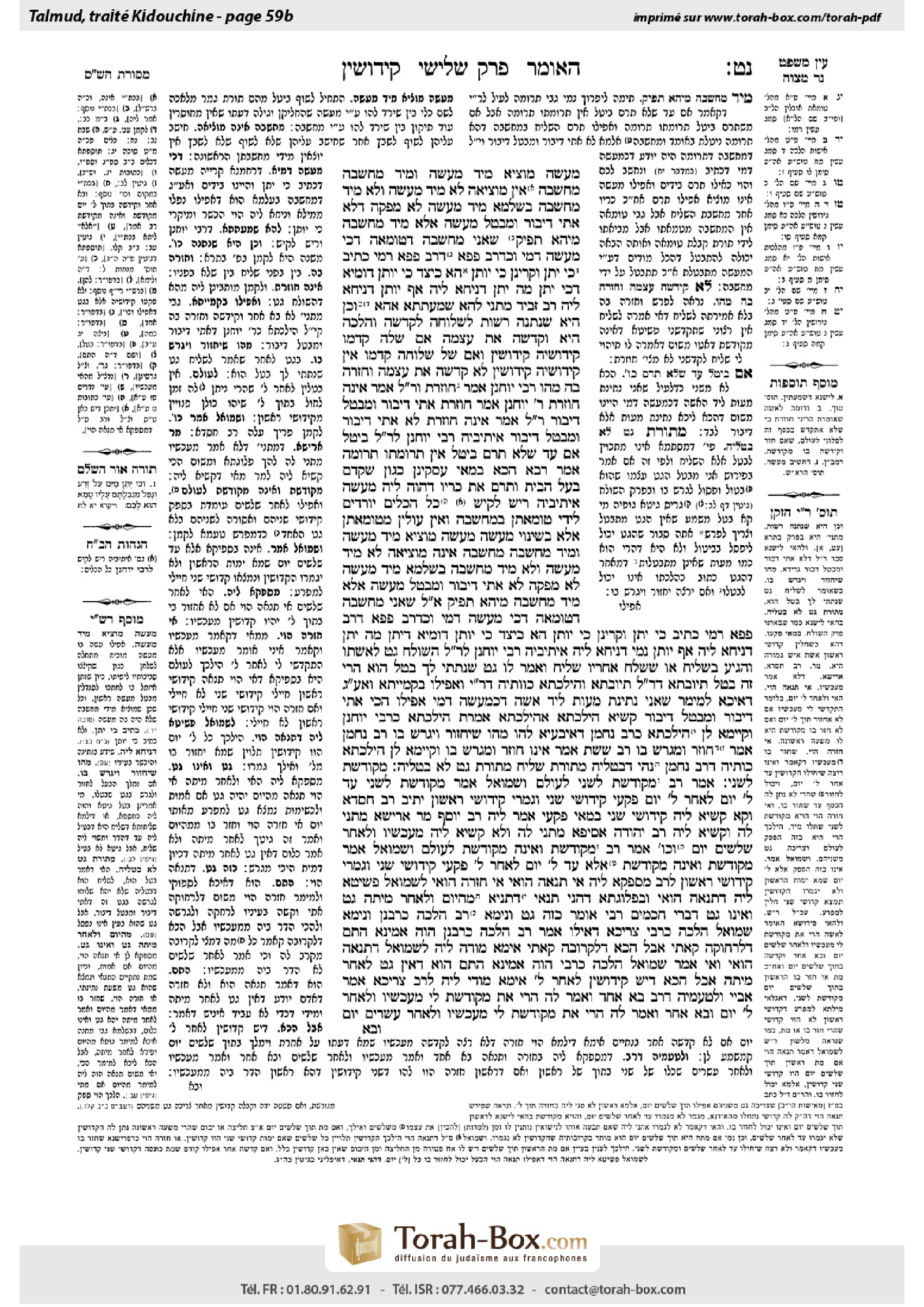
Kiddushin 59b: Talmud study for Daf Yomi
Daf Yomi is the daily study of one Talmud folio. Explore 37 tractates with scans, Hebrew text, Sefaria English and AI-generated French translations where annotated.
Passage selection and English or AI-generated French translation are available where the scan has annotations. Daf Study is independent of Torah-Box and Sefaria.
Browse Kiddushin · קידושין · All tractatesKiddushin 59b text and translations
This page of Kiddushin includes the Aramaic text, an English translation and an AI-generated French translation, alongside the scan above.
קידושין נ״ט ב · Aramaic and Hebrew text
מַעֲשֶׂה מוֹצִיא מִיַּד מַעֲשֶׂה וּמִיַּד מַחְשָׁבָה, מַחְשָׁבָה אֵין מוֹצִיאָה לֹא מִיַּד מַעֲשֶׂה וְלֹא מִיַּד מַחְשָׁבָה. בִּשְׁלָמָא מִיַּד מַעֲשֶׂה לָא מַפְּקָה, דְּלָא אָתֵי דִּיבּוּר וּמְבַטֵּל מַעֲשֶׂה, אֶלָּא מִיַּד מַחְשָׁבָה מִיהָא תַּפֵּיק!
שָׁאנֵי מַחְשָׁבָה דְּטוּמְאָה, דְּכִי מַעֲשֶׂה דָּמֵי, וְכִדְרַב פָּפָּא. דְּרַב פָּפָּא רָמֵי: כְּתִיב: ״כִּי יִתֵּן״, וְקָרֵינַן: ״כִּי יוּתַּן״. הָא כֵּיצַד?
״כִּי יוּתַּן״ דֻּומְיָא ״דְּכִי יִתֵּן״. מָה ״יִתֵּן״ דְּנִיחָא לֵיהּ, אַף ״יוּתַּן״, דְּנִיחָא לֵיהּ.
רַב זְבִיד מַתְנֵי לְהָא שְׁמַעְתְּתָא אַהָא: וְכֵן הִיא שֶׁנָּתְנָה רְשׁוּת לִשְׁלוּחָהּ לְקַדְּשָׁהּ, וְהָלְכָה הִיא וְקִדְּשָׁהּ אֶת עַצְמָהּ, אִם שֶׁלָּהּ קָדְמוּ – קִידּוּשֶׁיהָ קִידּוּשִׁין, וְאִם שֶׁל שְׁלוּחָהּ קָדְמוּ – אֵין קִידּוּשֶׁיהָ קִידּוּשִׁין.
לֹא קִדְּשָׁהּ אֶת עַצְמָהּ וְחָזְרָה בָּהּ, מַהוּ? רַבִּי יוֹחָנָן אָמַר: חוֹזֶרֶת, וְרֵישׁ לָקִישׁ אָמַר: אֵינָהּ חוֹזֶרֶת. רַבִּי יוֹחָנָן אָמַר: חוֹזֶרֶת, אָתֵי דִּיבּוּר וּמְבַטֵּל דִּיבּוּר. רֵישׁ לָקִישׁ אָמַר: אֵינָהּ חוֹזֶרֶת, לָא אָתֵי דִּיבּוּר וּמְבַטֵּל דִּיבּוּר.
אֵיתִיבֵיהּ רַבִּי יוֹחָנָן לְרֵישׁ לָקִישׁ: בִּיטֵּל, אִם עַד שֶׁלֹּא תָּרַם בִּיטֵּל – אֵין תְּרוּמָתוֹ תְּרוּמָה! אָמַר רָבָא: הָכָא בְּמַאי עָסְקִינַן, כְּגוֹן שֶׁקָּדַם בַּעַל הַבַּיִת וְתָרַם אֶת כִּרְיוֹ, דְּהָוֵה לֵיהּ מַעֲשֶׂה.
אֵיתִיבֵיהּ רֵישׁ לָקִישׁ: כׇּל הַכֵּלִים יוֹרְדִים לִידֵי טוּמְאָתָן בְּמַחְשָׁבָה, וְאֵין עוֹלִין מִטּוּמְאָתָן אֶלָּא בְּשִׁינּוּי מַעֲשֶׂה. מַעֲשֶׂה מוֹצִיא מִיַּד מַעֲשֶׂה וּמִיַּד מַחְשָׁבָה, מַחְשָׁבָה אֵינָהּ מוֹצִיאָה לֹא מִיַּד מַעֲשֶׂה וְלֹא מִיַּד מַחְשָׁבָה. בִּשְׁלָמָא מִיַּד מַעֲשֶׂה לָא מַפְּקָה, לָא אָתֵי דִּיבּוּר וּמְבַטֵּל מַעֲשֶׂה, אֶלָּא מִיַּד מַחְשָׁבָה מִיהָא תַּפֵּיק!
אֲמַר לֵיהּ: שָׁאנֵי מַחְשָׁבָה דְּטוּמְאָה דְּכִי מַעֲשֶׂה דָּמֵי, וְכִדְרַב פָּפָּא. דְּרַב פָּפָּא רָמֵי: כְּתִיב: ״כִּי יִתֵּן״, וְקָרֵינַן: ״כִּי יוּתַּן״. הָא כֵּיצַד? ״כִּי יוּתַּן״ דֻּומְיָא ״דָּיִתֵּן״, מָה ״יִתֵּן״ דְּנִיחָא לֵיהּ אַף ״יוּתַּן״ נָמֵי דְּנִיחָא לֵיהּ.
אֵיתִיבֵיהּ רַבִּי יוֹחָנָן לְרֵישׁ לָקִישׁ: הַשּׁוֹלֵחַ גֵּט לְאִשְׁתּוֹ וְהִגִּיעַ בַּשָּׁלִיחַ אוֹ שֶׁשָּׁלַח אַחֲרָיו שָׁלִיחַ וְאָמַר לוֹ: ״גֵּט שֶׁנָּתַתִּי לְךָ בָּטֵל הוּא״ – הֲרֵי זֶה בָּטֵל תְּיוּבְתָּא דְּרֵישׁ לָקִישׁ, תְּיוּבְתָּא.
וְהִילְכְתָא כְּווֹתֵיהּ דְּרַבִּי יוֹחָנָן, וַאֲפִילּוּ בְּקַמַּיְיתָא. וְאַף עַל גַּב דְּאִיכָּא לְמֵימַר: שָׁאנֵי נְתִינַת מָעוֹת לְיַד אִשָּׁה דִּכְמַעֲשֶׂה דָּמֵי, אֲפִילּוּ הָכִי אָתֵי דִּיבּוּר וּמְבַטֵּל דִּיבּוּר.
קַשְׁיָא הִילְכְתָא אַהִילְכְתָא. אָמְרַתְּ: הִילְכְתָא כְּרַבִּי יוֹחָנָן, וְקַיְימָא לַן הִילְכְתָא כְּרַב נַחְמָן, דְּאִיבַּעְיָא לְהוּ: מַהוּ שֶׁיַּחֲזוֹר וִיגָרֵשׁ בּוֹ?
רַב נַחְמָן אָמַר: חוֹזֵר וּמְגָרֵשׁ בּוֹ, רַב שֵׁשֶׁת אָמַר: אֵינוֹ חוֹזֵר וּמְגָרֵשׁ בּוֹ. וְקַיְימָא לַן הִילְכְתָא כְּוָתֵיהּ דְּרַב נַחְמָן! נְהִי דְּבַטְּלֵיהּ מִתּוֹרַת שְׁלִיחַ, מִתּוֹרַת גֵּט לָא בַּטְּלֵיהּ.
מְקוּדֶּשֶׁת לַשֵּׁנִי. אָמַר רַב: מְקוּדֶּשֶׁת לַשֵּׁנִי לְעוֹלָם, וּשְׁמוּאֵל אֲמַר: מְקוּדֶּשֶׁת לַשֵּׁנִי עַד שְׁלֹשִׁים יוֹם, לְאַחַר שְׁלֹשִׁים יוֹם פָּקְעִי קִידּוּשֵׁי שֵׁנִי וְגָמְרִי קִידּוּשֵׁי רִאשׁוֹן.
יָתֵיב רַב חִסְדָּא וְקָא קַשְׁיָא לֵיהּ: קִידּוּשֵׁי שֵׁנִי בְּמַאי פָּקְעִי? אֲמַר לֵיהּ רַב יוֹסֵף: מָר אַרֵישָׁא מַתְנֵי לַהּ וְקַשְׁיָא לֵיהּ, רַב יְהוּדָה אַסֵּיפָא מַתְנֵי לַהּ וְלָא קַשְׁיָא לֵיהּ:
״מֵעַכְשָׁיו וּלְאַחַר שְׁלֹשִׁים יוֹם״ וְכוּ׳. אָמַר רַב: מְקוּדֶּשֶׁת וְאֵינָהּ מְקוּדֶּשֶׁת לְעוֹלָם. וּשְׁמוּאֵל אָמַר: מְקוּדֶּשֶׁת וְאֵינָהּ מְקוּדֶּשֶׁת אֶלָּא עַד שְׁלֹשִׁים יוֹם, לְאַחַר שְׁלֹשִׁים פָּקְעִי קִידּוּשֵׁי שֵׁנִי וְגָמְרִי קִידּוּשֵׁי רִאשׁוֹן.
לְרַב מְסַפְּקָא לֵיהּ אִי תְּנָאָה הֲוַאי, אִי חֲזָרָה הֲוַאי. לִשְׁמוּאֵל פְּשִׁיטָא לֵיהּ דִּתְנָאָה הֲוַאי.
וּבִפְלוּגְתָּא דְּהָנֵי תַּנָּאֵי, דְּתַנְיָא: ״מֵהַיּוֹם וּלְאַחַר מִיתָה״ – גֵּט וְאֵינוֹ גֵּט, דִּבְרֵי חֲכָמִים. רַבִּי אוֹמֵר: כָּזֶה גֵּט.
וְנֵימָא רַב: הֲלָכָה כְּרַבָּנַן, וְנֵימָא שְׁמוּאֵל הֲלָכָה כְּרַבִּי! צְרִיכָא. דְּאִילּוּ אָמַר רַב: הֲלָכָה כְּרַבָּנַן, הֲוָה אָמֵינָא: הָתָם דִּלְרַחוֹקַהּ קָאָתֵי, אֲבָל הָכָא, דִּלְקָרוֹבַהּ קָאָתֵי, אֵימָא מוֹדֶה לֵיהּ לִשְׁמוּאֵל דִּתְנָאָהּ הֲוַאי.
וְאִי אָמַר שְׁמוּאֵל: הֲלָכָה כְּרַבִּי, הֲוָה אָמֵינָא: הָתָם הוּא דְּאֵין גֵּט לְאַחַר מִיתָה. אֲבָל הָכָא דְּיֵשׁ קִידּוּשִׁין לְאַחַר שְׁלֹשִׁים, אֵימָא מוֹדֵי לֵיהּ לְרַב, צְרִיכָא.
אָמַר אַבָּיֵי: וּלְטַעְמֵיהּ דְּרַב, בָּא אֶחָד וְאָמַר לָהּ: ״הֲרֵי אַתְּ מְקוּדֶּשֶׁת לִי מֵעַכְשָׁיו וּלְאַחַר שְׁלֹשִׁים יוֹם״, וּבָא אַחֵר וְאָמַר לָהּ: ״הֲרֵי אַתְּ מְקוּדֶּשֶׁת לִי מֵעַכְשָׁיו וּלְאַחַר עֶשְׂרִים יוֹם״
Kiddushin 59b · English translation
An action undertaken to improve the vessel negates both the status created by an earlier action that supposedly completed the vessel and the status created by the thought not to perform more work on the vessel. In that case the vessel cannot contract ritual impurity until the craftsman has finished working on it. By contrast, a thought to improve the vessel negates neither status created by action nor status created by thought. Reish Lakish finds this difficult for the following reason: Granted, thought does not negate action, as a statement does not come and nullify action. But it should at least offset thought. This halakha indicates that a statement does not nullify a previous statement.
The Gemara answers: Thought in the case of ritual impurity is different, as it is considered like action, and this is in accordance with the opinion of Rav Pappa. As Rav Pappa raises a contradiction: With regard to the halakha that produce must become wet in order for it to contract ritual impurity, the verse states: “But if water is placed [vekhi yuttan] upon the seed, and any part of a carcass falls upon it, it is impure” (Leviticus 11:38). The word yuttan is written defective, and is written as if it says ki yitten. Accordingly, this would mean that one must actively place the water on the produce. Yet we read it, based on the tradition as to its correct pronunciation, “ki yuttan,” which includes any situation where the produce becomes wet. How so? How can the way the verse is written and the way it is read be reconciled?
Rav Pappa explains that the standard of “if water is placed [ki yuttan]” is similar to: If one places [ki yitten]; just as the term places [yitten] indicates that it is satisfactory to the owner for the produce to become wet, as he himself is placing the water, so too, the term “is placed [yuttan]” means that it is satisfactory to the owner that the produce becomes wet, despite the fact that he did not place the water himself. This is proof that thought is equivalent to action with regard to ritual impurity, as if one is satisfied with the produce becoming wet it is considered as though he actively placed the water himself. By the same reasoning, thought which renders a vessel susceptible to ritual impurity is powerful enough to require an action to counteract its effect.
The Gemara presents another version of the discussion: Rav Zevid taught this dispute with regard to this halakha: And similarly, in a case where she gave permission to her agent to accept betrothal for her and she subsequently went and accepted betrothal herself from someone else, if her betrothal came first, her betrothal is a valid betrothal, but if the betrothal of her agent came first, her betrothal is not a betrothal.
The Sages discuss this halakha: If she did not accept betrothal herself and retracted her appointment of the agent, what is the halakha? Rabbi Yoḥanan says: She can retract her appointment; and Reish Lakish says: She cannot retract her appointment. The Gemara clarifies their respective opinions. Rabbi Yoḥanan said: She can retract her appointment, as a statement comes and nullifies a previous statement, by which she appointed the agent. Reish Lakish said: She cannot retract her appointment, as a statement does not come and nullify a previous statement.
Rabbi Yoḥanan raised an objection to Reish Lakish from the aforementioned mishna (Terumot 3:4) with regard to one who appointed an agent to separate teruma on his behalf and subsequently canceled the agency: If he canceled the appointment before the agent separated teruma, his teruma is not teruma. This shows that a statement nullifies a previous statement. Rava says: With what are we dealing here? With a case where the homeowner preceded the agent and separated teruma from his heap himself, which is an action, and an action certainly nullifies a statement.
Reish Lakish raised an objection to Rabbi Yoḥanan: All vessels descend into their state of contracting ritual impurity by means of thought. But they ascend from their state of ritual impurity only by means of a change resulting from an action. An action undertaken to improve the vessel negates both the status created by an earlier action that supposedly completed the vessel and the status created by the thought not to perform more work on the vessel. By contrast, a thought to improve the vessel negates neither status created by action nor status created by thought. Reish Lakish explains his objection: Granted, thought does not negate action, as a statement does not come and nullify action. But it should at least offset thought.
Rabbi Yoḥanan said to Reish Lakish: Thought in the case of ritual impurity is different, as it is considered like action, and this is in accordance with the opinion of Rav Pappa. As Rav Pappa raises a contradiction: The word yuttan is written defective, and is written as if it says ki yitten. Yet we read it “ki yuttan.” How so? The standard of “if water is placed [ki yuttan]” is similar to: If one places [ki yitten]; just as the term places [yitten] indicates that it is satisfactory to the owner for the produce to become wet, as he himself is placing the water, so too, the term “is placed [yuttan]” means that it is satisfactory to the owner that the produce becomes wet, despite the fact that he did not place the water himself.
Rabbi Yoḥanan raised an objection to Reish Lakish: With regard to one who sends a bill of divorce to his wife, and later the husband encountered the agent or sent another agent after him and in this manner said to him: The bill of divorce that I gave you is nullified, it is thereby nullified. This indicates that the appointment of an agent can be nullified even by a statement. The Gemara concludes: The refutation of the opinion of Reish Lakish is in fact a conclusive refutation.
The Gemara adds: And the halakha is in accordance with the opinion of Rabbi Yoḥanan, and this is even according to the first version of their dispute, with regard to a woman who retracts from her betrothal after accepting the money for it. And even though there is room to say that giving money to a woman for betrothal is different, as it is considered like an action, even so, a statement comes and nullifies a previous statement with regard to her consent to the betrothal, provided that the betrothal has yet to take effect.
The Gemara asks: The halakha recorded here is difficult with regard to the halakha recorded elsewhere. You said that the halakha is in accordance with the opinion of Rabbi Yoḥanan, and yet we maintain that the halakha is in accordance with the opinion of Rav Naḥman. As a dilemma was raised before the Sages: What is the halakha in the case of a bill of divorce sent by an agent that the husband nullified before it was received by his wife? Can the husband return and divorce his wife with the very same bill of divorce?
Rav Naḥman says: He can return and divorce her with it, and Rav Sheshet says: He cannot return and divorce her with it. And we maintain that the halakha is in accordance with the opinion of Rav Naḥman in this case. By contrast, according to the ruling of Rabbi Yoḥanan, since the husband has nullified the bill of divorce it should no longer be valid. The Gemara answers: This is not difficult, as, although the husband has nullified the agent from his status as an agent, he has not nullified the bill of divorce itself from its status as a bill of divorce.
§ The mishna teaches that if a man betroths a woman and stipulates that the betrothal will take effect in thirty days’ time and another man betroths her within that period, she is betrothed to the second man. Rav says: She is betrothed to the second forever, i.e., the betrothal is fully effective, and Shmuel says: She is betrothed to the second until the thirty days pass. After thirty days have passed, the betrothal of the second lapses, and the earlier betrothal of the first man is completed.
Rav Ḥisda sat and found this difficult: By what means is the betrothal of the second man abrogated? When the second betrothal took effect, the first betrothal was not yet in effect. Why, then, is the second betrothal abrogated? Rav Yosef said to him: The Master teaches this dispute with regard to the first clause of the mishna, and therefore he finds it difficult, whereas Rav Yehuda teaches it with regard to the latter clause of the mishna, and consequently he does not find it difficult.
Rav Yehuda’s version of the dispute is as follows: The mishna teaches that if the first man says to her: You are hereby betrothed to me from now and after thirty days, and another man betrothed her within those thirty days, there is uncertainty whether she is betrothed or whether she is not betrothed. Rav says: This means that there is uncertainty whether she is betrothed or whether she is not betrothed forever, and her only option is to receive a bill of divorce from both men. And Shmuel says: There is uncertainty whether she is betrothed or whether she is not betrothed only until thirty days have elapsed, whereas after thirty days the betrothal of the second is abrogated, and the betrothal of the first is completed.
The Gemara explains their respective opinions: Rav is uncertain what the first man meant. Is it a condition, i.e., the man is saying: If I do not change my mind within thirty days, you are betrothed to me from now, or is it a retraction, that is, he immediately retracted after he said: From now, in favor of a betrothal that will take effect only after thirty days have elapsed. This uncertainty remains even after the end of the thirty days. It is obvious to Shmuel that it is a condition. Consequently, the uncertainty whether or not she is betrothed to the second man applies during the thirty-day period, as the first man might yet change his mind. After the completion of thirty days, the betrothal from the first man retroactively takes effect from the moment he gave it, and therefore the betrothal of the second man is abrogated.
The Gemara comments: And Rav and Shmuel disagree in the dispute between these tanna’im. As it is taught in a baraita: If one says to his wife upon giving her a bill of divorce that it should take effect: From today and after my death, there is uncertainty whether it is a valid bill of divorce or whether it is not a valid bill of divorce. This is the statement of the Rabbis. The Rabbis are uncertain whether he meant that the bill of divorce should take effect retroactively from that moment, in which case it is valid; or whether he changed his mind and meant for it to take effect only after his death, which would mean that it is not a valid bill of divorce. Rabbi Yehuda HaNasi says: A document like this is a valid bill of divorce. The husband meant his statement as a condition that the bill of divorce should, after his death, take effect retroactively from now, and therefore it is a valid bill of divorce.
The Gemara asks: And let Rav, instead of explaining his own opinion, say that the halakha is in accordance with the opinion of the Rabbis, and let Shmuel say that the halakha is in accordance with the opinion of Rabbi Yehuda HaNasi. The Gemara answers: It is necessary for Rav and Shmuel to state their disagreement explicitly. As had Rav merely said that the halakha is in accordance with the opinion of the Rabbis, I would say: There, in the case of a bill of divorce, when he comes to distance her from himself, one can say that he has changed his mind with regard to the divorce. But here, in the case of betrothal, when he comes to draw her near, you might say that Rav concedes to Shmuel that it is certainly a condition, as he wants to betroth her as soon as possible.
And conversely, had Shmuel said only that the halakha is in accordance with the opinion of Rabbi Yehuda HaNasi, I would say: It is in that case there that Rabbi Yehuda HaNasi said it is a valid bill of divorce, as there is no bill of divorce after death, and therefore it is unlikely that he changed his mind and attempted to give a bill of divorce that will take effect only after the death of the husband. But here, where there is the possibility of betrothal after thirty days, and he might well have intended to retract the betrothal, you might say that Shmuel concedes to Rav. Consequently, it was necessary to state the dispute between Rav and Shmuel concerning betrothal in explicit terms.
Abaye said: And according to the reasoning of Rav, if one man came and said the following ambiguous statement to her: You are hereby betrothed to me from now and after thirty days. And another man came during these thirty days and said to her: You are hereby betrothed to me from now and after twenty days,
Kiddushin 59b · Traduction française (IA)
Une action entreprise pour améliorer le récipient annule à la fois le statut créé par une action antérieure qui était censée avoir achevé le récipient et celui créé par la pensée de ne plus travailler sur le récipient. Dans ce cas, le récipient ne peut contracter l’impureté rituelle tant que l’artisan n’a pas achevé son travail. En revanche, la pensée d’améliorer le récipient n’annule ni le statut créé par une action ni celui créé par une pensée. Reish Lakish soulève une difficulté à ce sujet : certes, une pensée n’annule pas une action, car une parole ne vient pas annuler une action. Mais elle devrait au moins neutraliser une autre pensée. Cette halakha indique qu’une parole n’annule pas une parole antérieure.
La Guemara répond : dans le cas de l’impureté rituelle, la pensée est différente, car elle est considérée comme une action, conformément à l’avis de Rav Pappa. En effet, Rav Pappa soulève une contradiction : selon la halakha relative aux produits qui doivent être mouillés pour contracter l’impureté rituelle, le verset dit : « Mais si de l’eau est placée [vekhi yuttan] sur la semence, et qu’une partie quelconque d’une carcasse tombe dessus, elle est impure » (Lévitique 11, 38). Le mot yuttan est écrit de façon défective, comme s’il était écrit ki yitten. Cela signifierait donc qu’il faut placer activement l’eau sur les produits. Pourtant, selon la tradition quant à sa prononciation correcte, nous le lisons « ki yuttan », ce qui inclut toute situation où les produits deviennent mouillés. Comment cela s’explique-t-il ? Comment concilier la manière dont le verset est écrit et celle dont il se lit ?
Rav Pappa explique que la formulation « si de l’eau est placée [ki yuttan] » est analogue à « si quelqu’un place [ki yitten] » : de même que le terme « place [yitten] » indique que le propriétaire consent à ce que les produits soient mouillés, puisqu’il place lui-même l’eau, de même, le terme « est placée [yuttan] » signifie que le propriétaire consent à ce que les produits soient mouillés, bien qu’il n’ait pas placé l’eau lui-même. Cela prouve qu’en matière d’impureté rituelle, la pensée équivaut à une action : si quelqu’un consent à ce que les produits soient mouillés, c’est comme s’il avait lui-même placé l’eau. Selon le même raisonnement, une pensée qui rend un récipient susceptible de contracter l’impureté rituelle est assez puissante pour qu’une action soit nécessaire afin d’en contrer l’effet.
La Guemara présente une autre version de la discussion : Rav Zevid enseigna ce désaccord à propos de la halakha suivante : de même, si elle avait autorisé son mandataire à accepter des fiançailles en son nom, puis était allée accepter elle-même des fiançailles d’un autre homme, si ses propres fiançailles avaient eu lieu en premier, elles étaient valides ; mais si celles acceptées par son mandataire avaient eu lieu en premier, ses propres fiançailles n’étaient pas valides.
Les Sages discutent de cette halakha : si elle n’a pas accepté elle-même des fiançailles, mais qu’elle a révoqué la désignation de son mandataire, quelle est la halakha ? Rabbi Yoḥanan dit : elle peut révoquer sa désignation ; et Reish Lakish dit : elle ne peut pas la révoquer. La Guemara précise leurs avis respectifs. Rabbi Yoḥanan dit : elle peut révoquer sa désignation, car une parole vient annuler une parole antérieure, par laquelle elle avait désigné son mandataire. Reish Lakish dit : elle ne peut pas révoquer sa désignation, car une parole ne vient pas annuler une parole antérieure.
Rabbi Yoḥanan soulève contre Reish Lakish une objection tirée de la Michna précitée (Teroumot 3, 4), à propos de celui qui a désigné un mandataire pour prélever la terouma en son nom, puis a annulé cette délégation : s’il a révoqué la désignation avant que le mandataire ne prélève la terouma, celle-ci n’est pas valide. Cela montre qu’une parole annule une parole antérieure. Rava dit : de quel cas s’agit-il ici ? D’un cas où le propriétaire a devancé le mandataire et prélevé lui-même la terouma de son tas ; or, il s’agit d’une action, et une action annule certainement une parole.
Reish Lakish soulève contre Rabbi Yoḥanan une objection : tous les récipients acquièrent la capacité de contracter l’impureté rituelle par la pensée. Mais ils ne sortent de leur état d’impureté rituelle que par une modification résultant d’une action. Une action entreprise pour améliorer le récipient annule à la fois le statut créé par une action antérieure qui était censée avoir achevé le récipient et celui créé par la pensée de ne plus travailler sur le récipient. En revanche, la pensée d’améliorer le récipient n’annule ni le statut créé par une action ni celui créé par une pensée. Reish Lakish explique son objection : certes, une pensée n’annule pas une action, car une parole ne vient pas annuler une action. Mais elle devrait au moins neutraliser une autre pensée.
Rabbi Yoḥanan dit à Reish Lakish : dans le cas de l’impureté rituelle, la pensée est différente, car elle est considérée comme une action, conformément à l’avis de Rav Pappa. En effet, Rav Pappa soulève une contradiction : le mot yuttan est écrit de façon défective, comme s’il était écrit ki yitten. Pourtant, nous le lisons « ki yuttan ». Comment cela s’explique-t-il ? La formulation « si de l’eau est placée [ki yuttan] » est analogue à « si quelqu’un place [ki yitten] » : de même que le terme « place [yitten] » indique que le propriétaire consent à ce que les produits soient mouillés, puisqu’il place lui-même l’eau, de même, le terme « est placée [yuttan] » signifie que le propriétaire consent à ce que les produits soient mouillés, bien qu’il n’ait pas placé l’eau lui-même.
Rabbi Yoḥanan soulève contre Reish Lakish une objection : à propos de celui qui envoie à sa femme un acte de divorce, si, plus tard, le mari rencontre le mandataire ou en envoie un autre à sa suite et lui dit alors : « L’acte de divorce que je t’ai remis est annulé », celui-ci est ainsi annulé. Cela indique que la désignation d’un mandataire peut être annulée même par une parole. La Guemara conclut : la réfutation de l’avis de Reish Lakish est bel et bien décisive.
La Guemara ajoute : la halakha est conforme à l’avis de Rabbi Yoḥanan, et ce même selon la première version de leur désaccord, à propos d’une femme qui revient sur ses fiançailles après en avoir accepté l’argent. Et bien que l’on puisse soutenir que le versement d’argent à une femme en vue de fiançailles est différent, car il est considéré comme une action, malgré tout, une parole vient annuler une parole antérieure concernant son consentement aux fiançailles, à condition que celles-ci n’aient pas encore pris effet.
La Guemara demande : la halakha rapportée ici est difficile à concilier avec celle rapportée ailleurs. Vous avez dit que la halakha est conforme à l’avis de Rabbi Yoḥanan, alors que nous retenons que la halakha est conforme à l’avis de Rav Naḥman. En effet, les Sages ont soulevé le dilemme suivant : quelle est la halakha dans le cas d’un acte de divorce envoyé par un mandataire et annulé par le mari avant que sa femme ne le reçoive ? Le mari peut-il ensuite divorcer sa femme au moyen de ce même acte de divorce ?
Rav Naḥman dit : il peut ensuite divorcer sa femme au moyen de cet acte ; et Rav Sheshet dit : il ne le peut pas. Or, nous retenons que, dans ce cas, la halakha est conforme à l’avis de Rav Naḥman. En revanche, selon la décision de Rabbi Yoḥanan, puisque le mari a annulé l’acte de divorce, celui-ci ne devrait plus être valide. La Guemara répond : il n’y a pas de difficulté, car, bien que le mari ait révoqué le mandataire en tant que mandataire, il n’a pas annulé l’acte de divorce lui-même en tant qu’acte de divorce.
§ La Michna enseigne que si un homme fiance une femme en stipulant que les fiançailles prendront effet dans trente jours, et qu’un autre homme la fiance pendant ce délai, elle est fiancée au second homme. Rav dit : elle est fiancée au second pour toujours, c’est-à-dire que les fiançailles sont pleinement effectives ; et Shmuel dit : elle est fiancée au second jusqu’à l’expiration des trente jours. Une fois les trente jours écoulés, les fiançailles du second prennent fin et les premières fiançailles, celles du premier homme, prennent effet.
Rav Ḥisda était assis et trouvait cela difficile : par quel moyen les fiançailles du second homme sont-elles annulées ? Lorsque les secondes fiançailles ont pris effet, les premières n’avaient pas encore pris effet. Pourquoi, alors, les secondes fiançailles sont-elles annulées ? Rav Yosef lui dit : le Maître enseigne ce désaccord à propos de la première clause de la Michna, et c’est pourquoi il trouve cela difficile, tandis que Rav Yehuda l’enseigne à propos de la dernière clause de la Michna ; par conséquent, il ne trouve pas cela difficile.
Voici la version du désaccord selon Rav Yehuda : la Michna enseigne que si le premier homme lui dit : « Tu m’es fiancée dès maintenant et à l’issue de trente jours », et qu’un autre homme la fiance pendant ces trente jours, il y a incertitude quant à savoir si elle est fiancée ou non. Rav dit : cela signifie qu’il y a incertitude quant à savoir si elle est fiancée ou non pour toujours, et sa seule possibilité est de recevoir un acte de divorce des deux hommes. Shmuel dit : il y a incertitude quant à savoir si elle est fiancée ou non uniquement jusqu’à l’expiration des trente jours ; ensuite, les fiançailles du second sont annulées et celles du premier prennent effet.
La Guemara explique leurs avis respectifs : Rav ne sait pas ce que voulait dire le premier homme. S’agissait-il d’une condition, c’est-à-dire que l’homme disait : « Si je ne change pas d’avis dans les trente jours, tu m’es fiancée dès maintenant », ou d’une rétractation, c’est-à-dire qu’il est immédiatement revenu sur ses paroles après avoir dit « dès maintenant », en faveur de fiançailles qui ne prendraient effet qu’à l’issue des trente jours ? Cette incertitude demeure même après l’expiration des trente jours. Pour Shmuel, il est évident qu’il s’agit d’une condition. Par conséquent, l’incertitude quant à savoir si elle est fiancée au second homme ou non s’applique pendant les trente jours, car le premier homme peut encore changer d’avis. À l’expiration des trente jours, les fiançailles du premier homme prennent effet rétroactivement à partir du moment où il les a prononcées ; les fiançailles du second homme sont donc annulées.
La Guemara fait remarquer : Rav et Shmuel sont en désaccord au sujet de la controverse entre ces tannaïm. En effet, il est enseigné dans une baraïta : si quelqu’un dit à sa femme, en lui remettant un acte de divorce, que celui-ci prendra effet « à partir d’aujourd’hui et après ma mort », on ne sait pas avec certitude si l’acte de divorce est valide ou non. Telle est l’opinion des Rabbins. Les Rabbins ne savent pas avec certitude s’il voulait dire que l’acte de divorce prendrait effet rétroactivement à partir de ce moment, auquel cas il est valide, ou s’il a changé d’avis et voulait qu’il ne prenne effet qu’après sa mort, auquel cas il n’est pas valide. Rabbi Yehuda HaNasi dit : un tel document est un acte de divorce valide. Le mari voulait exprimer une condition : après sa mort, l’acte de divorce prendrait effet rétroactivement à partir de maintenant ; il s’agit donc d’un acte de divorce valide.
La Guemara demande : au lieu d’expliquer son propre avis, Rav n’aurait-il pas pu dire que la halakha est conforme à l’avis des Rabbins, et Shmuel que la halakha est conforme à l’avis de Rabbi Yehuda HaNasi ? La Guemara répond : il était nécessaire que Rav et Shmuel énoncent explicitement leur désaccord. En effet, si Rav s’était contenté de dire que la halakha est conforme à l’avis des Rabbins, j’aurais dit : dans ce cas-là, celui de l’acte de divorce, puisqu’il cherche à l’éloigner de lui, on peut dire qu’il a changé d’avis au sujet du divorce. Mais ici, dans le cas des fiançailles, puisqu’il cherche à la rapprocher de lui, on pourrait penser que Rav concède à Shmuel qu’il s’agit certainement d’une condition, puisqu’il veut la fiancer dès que possible.
Inversement, si Shmuel s’était contenté de dire que la halakha est conforme à l’avis de Rabbi Yehuda HaNasi, j’aurais dit : c’est dans ce cas-là, celui de l’acte de divorce, que Rabbi Yehuda HaNasi a déclaré que l’acte est valide, car il n’existe pas d’acte de divorce après la mort ; il est donc peu probable que le mari ait changé d’avis et tenté de donner un acte de divorce qui ne prendrait effet qu’après sa mort. Mais ici, où des fiançailles après trente jours sont possibles et où il se peut fort bien qu’il ait voulu revenir sur les fiançailles, on pourrait penser que Shmuel concède à Rav. Il était donc nécessaire d’énoncer explicitement le désaccord entre Rav et Shmuel au sujet des fiançailles.
Abaye dit : et selon le raisonnement de Rav, si un homme vient et lui fait cette déclaration ambiguë : « Tu m’es fiancée dès maintenant et à l’issue de trente jours », puis qu’un autre homme vient pendant ces trente jours et lui dit : « Tu m’es fiancée dès maintenant et à l’issue de vingt jours »,
Traduction française générée par IA à partir de l’édition anglaise de Sefaria. Vérifie toujours un passage avec le texte source.
Text from Sefaria: William Davidson Edition - Vocalized Aramaic (CC BY NC); William Davidson Edition - English (CC BY NC).