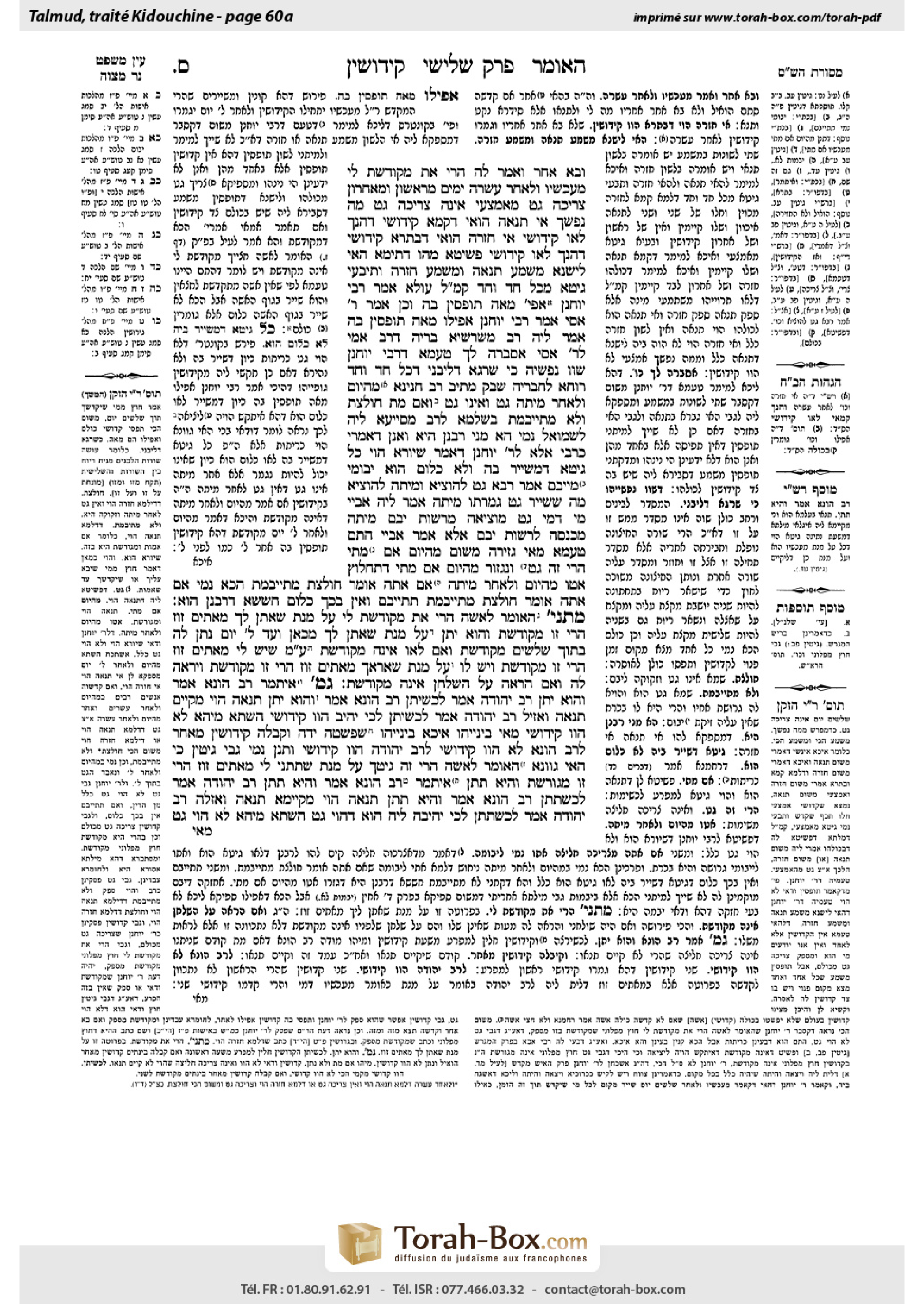
Kiddushin 60a: Talmud study for Daf Yomi
Daf Yomi is the daily study of one Talmud folio. Explore 37 tractates with scans, Hebrew text, Sefaria English and AI-generated French translations where annotated.
Passage selection and English or AI-generated French translation are available where the scan has annotations. Daf Study is independent of Torah-Box and Sefaria.
Browse Kiddushin · קידושין · All tractatesKiddushin 60a text and translations
This page of Kiddushin includes the Aramaic text, an English translation and an AI-generated French translation, alongside the scan above.
קידושין ס׳ א · Aramaic and Hebrew text
וּבָא אַחֵר וְאָמַר לָהּ: ״הֲרֵי אַתְּ מְקוּדֶּשֶׁת לִי מֵעַכְשָׁיו וּלְאַחַר עֲשָׂרָה יָמִים״, מֵרִאשׁוֹן וּמֵאַחֲרוֹן – צְרִיכָה גֵּט, מֵאֶמְצָעִי – אֵינָהּ צְרִיכָה גֵּט.
מָה נַפְשָׁךְ – אִי תְּנָאָה הֲוַאי, דְּקַמָּא קִידּוּשֵׁי, דְּהָנָךְ לָאו קִידּוּשֵׁי. אִי חֲזָרָה הֲוַאי, דְּבָתְרָא קִידּוּשֵׁי, דְּהָנָךְ לָאו קִידּוּשֵׁי.
פְּשִׁיטָא! מַהוּ דְּתֵימָא: הַאי לִישָּׁנָא מַשְׁמַע תְּנָאָה וּמַשְׁמַע חֲזָרָה וְתִיבְעֵי גִּיטָּא מִכֹּל חַד וְחַד, קָא מַשְׁמַע לַן.
עוּלָּא אָמַר רַבִּי יוֹחָנָן: אֲפִילּוּ מֵאָה תּוֹפְסִין בָּהּ. וְכֵן אָמַר רַבִּי אַסִּי אָמַר רַבִּי יוֹחָנָן: אֲפִילּוּ מֵאָה תּוֹפְסִין בָּהּ. אֲמַר לֵיהּ רַב מְשַׁרְשְׁיָא בְּרֵיהּ דְּרַב אַמֵּי לְרַבִּי אַסִּי: אַסְבְּרַהּ לָךְ טַעְמָא דְּרַבִּי יוֹחָנָן: שַׁוּוֹ נַפְשַׁיְהוּ כִּי שִׁרְגָּא דְלִיבְנֵי, דְּכֹל חַד וְחַד רְוָחָא לְחַבְרֵיהּ שְׁבַק.
מֵתִיב רַב חֲנִינָא: ״מֵהַיּוֹם וּלְאַחַר מִיתָה״ – גֵּט וְאֵינוֹ גֵּט, וְאִם מֵת – חוֹלֶצֶת וְלֹא מִתְיַיבֶּמֶת.
בִּשְׁלָמָא לְרַב – מְסַיְּיעָא לֵיהּ, לִשְׁמוּאֵל נָמֵי: הָא מַנִּי – רַבָּנַן הִיא, וַאֲנַן דְּאָמְרִי כְּרַבִּי.
אֶלָּא לְרַבִּי יוֹחָנָן, דְּאָמַר שִׁיּוּרָא הָוֵי, כֹּל גִּיטָּא דִּמְשַׁיַּיר בַּהּ וְלָא כְּלוּם הוּא. יַבּוֹמֵי מְיַיבֵּם!
אָמַר רָבָא: גֵּט לְהוֹצִיא, וּמִיתָה לְהוֹצִיא, מַה שֶּׁשִּׁיֵּיר גֵּט, גְּמָרַתּוּ מִיתָה. אֲמַר לֵיהּ אַבָּיֵי: מִי דָּמֵי? גֵּט מוֹצִיאה מֵרְשׁוּת יָבָם, מִיתָה מַכְנֶסֶת לִרְשׁוּת יָבָם!
אֶלָּא אָמַר אַבָּיֵי: הָתָם טַעְמָא מַאי? גְּזֵירָה ״מִשּׁוּם מֵהַיּוֹם אִם מַתִּי״ – הֲרֵי זֶה גֵּט.
וְנִגְזוֹר ״מֵהַיּוֹם אִם מַתִּי״ דְּתַחְלוֹץ, אַטּוּ ״מֵהַיּוֹם וּלְאַחַר מִיתָה״! אִם אַתָּה אוֹמֵר חוֹלֶצֶת – מִתְיַיבֶּמֶת.
הָכָא נָמֵי אִם אַתָּה אוֹמֵר חוֹלֶצֶת – מִתְיַיבֶּמֶת! תִּתְיַיבֵּם וְאֵין בְּכָךְ כְּלוּם, חֲשָׁשָׁא דְרַבָּנַן הוּא.
מַתְנִי׳ הָאוֹמֵר לְאִשָּׁה ״הֲרֵי אַתְּ מְקוּדֶּשֶׁת לִי עַל מְנָת שֶׁאֶתֵּן לִךְ מָאתַיִם זוּז״ – הֲרֵי זוֹ מְקוּדֶּשֶׁת, וְהוּא יִתֵּן. ״עַל מְנָת שֶׁאֶתֵּן לִךְ מִכָּאן וְעַד שְׁלֹשִׁים יוֹם״, נָתַן לָהּ בְּתוֹךְ שְׁלֹשִׁים – מְקוּדֶּשֶׁת, וְאִם לָאו – אֵינָהּ מְקוּדֶּשֶׁת.
״עַל מְנָת שֶׁיֵּשׁ לִי מָאתַיִם זוּז״ – הֲרֵי זוֹ מְקוּדֶּשֶׁת, וְיֵשׁ לוֹ. ״עַל מְנָת שֶׁאַרְאֵךְ מָאתַיִם זוּז״ – הֲרֵי זוֹ מְקוּדֶּשֶׁת, וְיַרְאֶה לָהּ. וְאִם הֶרְאָה עַל הַשֻּׁלְחָן – אֵינָהּ מְקוּדֶּשֶׁת.
גְּמָ׳ אִיתְּמַר, רַב הוּנָא אָמַר: ״וְהוּא יִתֵּן״. רַב יְהוּדָה אָמַר: ״לִכְשֶׁיִּתֵּן״. רַב הוּנָא אָמַר: ״וְהוּא יִתֵּן״ תְּנָאָה הָוֵי, מְקַיֵּים תְּנָאָה וְאָזֵיל. רַב יְהוּדָה אָמַר: ״לִכְשֶׁיִּתֵּן״ לְכִי יָהֵיב הָווּ קִידּוּשֵׁי, הַשְׁתָּא מִיהָא לָא הָווּ קִידּוּשֵׁי.
מַאי בֵּינַיְיהוּ? אִיכָּא בֵּינַיְיהוּ שֶׁפָּשְׁטָה יָדָהּ וְקִבְּלָה קִידּוּשִׁין מֵאַחֵר. לְרַב הוּנָא לָא הָווּ קִידּוּשֵׁי, לְרַב יְהוּדָה הָווּ קִידּוּשֵׁי.
וּתְנַן נָמֵי גַּבֵּי גִיטִּין כִּי הַאי גַוְונָא: הָאוֹמֵר לְאִשָּׁה ״הֲרֵי זֶה גִּיטִּיךְ עַל מְנָת שֶׁתִּתְּנִי לִי מָאתַיִם זוּז״ – הֲרֵי זוֹ מְגוֹרֶשֶׁת, וְהִיא תִּתֵּן. אִיתְּמַר רַב הוּנָא אָמַר: ״וְהִיא תִּתֵּן״. רַב יְהוּדָה אָמַר: ״לִכְשֶׁתִּתֵּן״. רַב הוּנָא אָמַר: ״וְהִיא תִּתֵּן״, תְּנָאָה הָוֵי, מְקַיְּימָא תְּנָאָה וְאָזְלָה. רַב יְהוּדָה אָמַר: ״לִכְשֶׁתִּתֵּן״, לְכִי יָהֲבָה לֵיהּ הוּא דְּהָוֵי גֵּט, הַשְׁתָּא מִיהָא לָא הָוֵי גֵּט.
Kiddushin 60a · English translation
and another man came and said to her: You are hereby betrothed to me from now and after ten days, she requires a bill of divorce from the first man and last man, but she does not require a bill of divorce from the middle one.
Abaye explains: This is the halakha whichever way you look at this case: If this expression is a condition that she should be betrothed from now if he does not retract within thirty days, the betrothal of the first man is a betrothal, whereas the betrothals of those other men are not betrothals. If it is a retraction, i.e., if after saying: From now, he changed his mind and delayed the moment of betrothal, then only that betrothal of the last one is a betrothal, whereas the betrothals of those first two men are not betrothals, as they both postponed their betrothals to a later date. Either way, the betrothal of the middle man is of no consequence.
The Gemara asks: It is obvious that this is the case; what is the novelty of Abaye’s statement? The Gemara answers: Lest you say that this formulation means a condition and also means a retraction, and therefore she should require a bill of divorce from each and every one of them, including the middle man, due to the uncertainty. It is possible the first man retracted while the second one imposed a condition, in which case only the betrothal of the second person takes effect. Abaye therefore teaches us that according to the opinion of Rav, the uncertainty concerns the meaning of this expression itself, and there is no uncertainty with regard to the intention of each individual person who says this formula. Consequently, there is no possibility that this woman is betrothed to the middle man.
Ulla says that Rabbi Yoḥanan says: Even if one hundred betrothed her in this manner, their betrothal is effective with regard to her. And similarly, Rabbi Asi says that Rabbi Yoḥanan says: Even the betrothal of one hundred is effective with regard to her. Rav Mesharshiyya, son of Rav Ami, said to Rabbi Asi: I will explain to you the reason of Rabbi Yoḥanan: These one hundred men have rendered themselves like a row [sheraga] of bricks, each and every one of whom leaves a gap for the other. Since there is a period of time before the betrothal of each man takes effect, another betrothal can intervene in the meantime.
Rav Ḥanina raises an objection to this ruling from a baraita: If one says to his wife: This is your bill of divorce from today and after my death, there is uncertainty whether it is a valid bill of divorce or whether it is not a valid bill of divorce. And therefore if he dies she performs ḥalitza, but does not enter into levirate marriage. Since she might not be divorced, the obligation of levirate marriage applies to her, but in practice she cannot perform levirate marriage in case she was in fact divorced and is thereby forbidden to her late husband’s brother, a transgression which is punishable by karet.
Rav Ḥanina explains his objection: Granted, according to the opinion of Rav, the baraita supports him, as Rav maintains that the meaning of this expression is uncertain. According to the opinion of Shmuel as well, although he claims that the phrase is a condition rather than a retraction, he can explain as follows: In accordance with whose opinion is this baraita? It is in accordance with the opinion of the Rabbis, who claim in that case that it is uncertain if she is divorced, and I, Shmuel, say my ruling in accordance with the opinion of Rabbi Yehuda HaNasi.
But according to the opinion of Rabbi Yoḥanan, who said that this is a phrase that leaves room for additional betrothals, in a case where he uses this phrase with regard to a bill of divorce, this should not be the halakha, as there is a principle: Any bill of divorce that leaves a remnant of the marital bond is not worth anything, as a bill of divorce must completely sever the marital bond between the husband and the wife. If this bond is not fully severed, she is not divorced. Therefore, her late husband’s brother should be allowed to enter into levirate marriage with her.
Rava said: Since a bill of divorce serves to remove a wife from her husband, and death also serves to remove her and dissolve their marital ties, permitting the woman to remarry, one can say that whatever part is left over from that bill of divorce is nevertheless completed by death, and therefore there is a complete act of severance. Abaye said to him: Are the two comparable; can these stages be viewed as completing one another? A bill of divorce removes her not only from her husband’s authority but also from the authority of the yavam, as a divorced woman does not perform levirate marriage, whereas death brings her into the authority of the yavam, because it renders her obligated in levirate marriage.
Rather, Abaye said: One must reject the above explanation, and ask what is the reason there for the concern about that bill of divorce, according to the opinion of Rabbi Yoḥanan? It is not because the bill of divorce is in any way valid. Rather, it is a rabbinic decree due to the case of one who says to his wife: This is hereby your bill of divorce from today if I die. Everyone agrees that this is a bill of divorce that goes into effect from that day if he dies. Since one might confuse the two cases, the Sages decreed that if one says: This is hereby your bill of divorce from today and after my death, the bill of divorce is considered valid to the extent that the woman does not enter into levirate marriage.
The Gemara asks: But let us also issue a decree in a case where he said: This is hereby your bill of divorce from today if I die, that she should perform ḥalitza, due to its similarity to a bill of divorce that includes the stipulation: This is hereby your bill of divorce from today and after my death. The Gemara answers: The Sages do not require her to perform ḥalitza, as, if you say that she performs ḥalitza, people will mistakenly think that the yavam performed ḥalitza because he did not want to marry her, and if he had wanted to she could have entered into levirate marriage. In fact, she is divorced and is forbidden to the yavam, and a decree of this kind could mislead people and result in a later transgression.
The Gemara asks: Here too, in the case of where he says: This is hereby your bill of divorce from today and after my death, if you say that she performs ḥalitza, people will mistakenly say that she could have entered into levirate marriage. The Gemara answers: This concern is not important, as let her perform levirate marriage and there is no problem with that. The fact that she is treated as a divorcée and is forbidden to the brother-in-law is merely a concern of the Sages, who enacted a decree due to the similarity of the case where one says: This is hereby your bill of divorce from today if I die, whereas it is in fact not a bill of divorce and it is permitted for her to enter into levirate marriage.
MISHNA: With regard to one who says to a woman: You are hereby betrothed to me with this peruta on the condition that I will give you two hundred dinars, she is betrothed immediately and he shall give her the money. If he said to her that the betrothal is: On the condition that I will give you a particular sum of money from now and until thirty days, if he gave the money to her within thirty days she is betrothed, but if not, she is not betrothed.
If he said to her that the betrothal is: On the condition that I have two hundred dinars, she is betrothed if he has this sum. If he said to her that the betrothal is: On the condition that I will show you two hundred dinars, she is betrothed, and he shall show the money to her. And if he is a moneychanger and shows her money belonging to others on the moneychangers’ table, she is not betrothed, as his statement means that he will show her money of his own.
GEMARA: It was stated that the amora’im disagreed with regard to the text of this mishna: Rav Huna says that it reads: And he shall give, i.e., it is a valid betrothal from the outset, and the man is obligated to give her the promised amount. Rav Yehuda says that the correct version of the mishna is: When he gives, meaning that the betrothal takes effect only when he actually gives her the money. The Gemara elaborates: Rav Huna says that the phrase: And he shall give, indicates that this is a condition stipulated by the man, which means that the woman is immediately betrothed and he merely proceeds to fulfill the condition. Rav Yehuda says that the mishna reads: When he gives, which indicates that when he will give the money it will be a betrothal, but for now at least it is not a betrothal.
The Gemara asks: What is the difference between the explanations of Rav Huna and Rav Yehuda? Both agree that if he does not give her the money she is not betrothed. The Gemara answers: The difference between them is in a case where she extended her hand and accepted betrothal from another man during the period between the initial betrothal and the delivery of the money. According to the opinion of Rav Huna the betrothal of the second man is not a valid betrothal, as he maintains that when the first man gives her the money the betrothal takes effect retroactively from the time of his earlier statement. According to the opinion of Rav Yehuda, the betrothal of the second man is a valid betrothal, as the betrothal of the first man does not take effect until after he actually gives her the money.
The Gemara comments: And we also learned a mishna concerning bills of divorce like this case (Gittin 74a): With regard to one who says to a woman: This is your bill of divorce on the condition that you will give me two hundred dinars, she is divorced and she shall give him the two hundred dinars. It was stated that the amora’im disputed the correct version of this statement. Rav Huna says: And she shall give; Rav Yehuda says: When she gives. The reasons are as stated above in the discussion about betrothal: Rav Huna says: And she shall give, as it is a condition, and therefore she proceeds to fulfill the condition. Rav Yehuda says: When she gives, as when she will give the money to him it will be a valid bill of divorce, but now, in any event, it is not a valid bill of divorce.
Kiddushin 60a · Traduction française (IA)
Un autre homme vint lui dire : « Tu m’es dès à présent consacrée, et le kiddouchin prendra effet après dix jours. » Elle doit recevoir un acte de divorce du premier homme et du dernier, mais pas de l’homme du milieu.
Abayé explique : quelle que soit la manière dont on examine ce cas, la halakha est la suivante : si cette formule exprime une condition — elle lui sera consacrée dès à présent s’il ne se rétracte pas dans les trente jours —, le kiddouchin du premier homme est valable, tandis que ceux des autres hommes ne le sont pas. Si elle exprime une rétractation, c’est-à-dire si, après avoir dit « dès à présent », il a changé d’avis et différé le moment du kiddouchin, seul le kiddouchin du dernier homme est valable, tandis que ceux des deux premiers ne le sont pas, puisqu’ils ont tous deux reporté leur kiddouchin à une date ultérieure. Dans les deux cas, le kiddouchin de l’homme du milieu n’a aucune conséquence.
La Guemara demande : Cela va de soi ; quelle nouveauté Abayé enseigne-t-il ? La Guemara répond : De peur que tu ne dises que cette formule exprime à la fois une condition et une rétractation, et qu’elle doive donc recevoir un acte de divorce de chacun d’eux, y compris de l’homme du milieu, en raison du doute. Il se peut que le premier homme se soit rétracté, tandis que le deuxième a posé une condition ; dans ce cas, seul le kiddouchin du deuxième homme prend effet. Abayé nous enseigne donc que, selon l’opinion de Rav, l’incertitude porte sur le sens même de cette formule, et non sur l’intention de chacune des personnes qui l’emploient. Par conséquent, il est impossible que cette femme soit consacrée à l’homme du milieu.
Oulla dit au nom de Rabbi Yoḥanan : même si cent hommes l’ont consacrée de cette manière, leur kiddouchin est valable à son égard. De même, Rabbi Assi dit au nom de Rabbi Yoḥanan : même le kiddouchin de cent hommes est valable à son égard. Rav Mesharshiyya, fils de Rav Ami, dit à Rabbi Assi : « Je vais t’expliquer la raison de Rabbi Yoḥanan : ces cent hommes se sont disposés comme une rangée [sheraga] de briques, chacune laissant un espace pour la suivante. Comme le kiddouchin de chaque homme ne prend effet qu’après un certain délai, un autre kiddouchin peut intervenir entre-temps. »
Rav Ḥanina soulève une objection à cette décision à partir d’une baraïta : si un homme dit à sa femme : « Voici ton acte de divorce, valable dès aujourd’hui et après ma mort », il y a doute quant à savoir si l’acte de divorce est valable ou non. Par conséquent, s’il meurt, elle accomplit la ḥalitsa, mais ne contracte pas de mariage léviratique. Comme il se peut qu’elle ne soit pas divorcée, l’obligation de mariage léviratique s’applique à elle ; toutefois, en pratique, elle ne peut pas contracter ce mariage, au cas où elle aurait effectivement été divorcée et serait ainsi interdite au frère de son défunt mari. Une telle transgression est passible de karet.
Rav Ḥanina explique son objection : certes, selon l’opinion de Rav, la baraïta lui donne raison, puisque Rav soutient que le sens de cette formule est incertain. Même selon l’opinion de Chmouel, bien qu’il affirme que la phrase exprime une condition plutôt qu’une rétractation, il peut l’expliquer ainsi : selon l’opinion de qui cette baraïta a-t-elle été enseignée ? Selon celle des Sages, qui soutiennent dans ce cas qu’il est incertain qu’elle soit divorcée ; quant à moi, Chmouel, j’énonce ma décision conformément à l’opinion de Rabbi Yehouda HaNassi.
Mais selon l’opinion de Rabbi Yoḥanan, qui a dit que cette formule laisse la place à d’autres kiddouchin, lorsqu’il l’emploie à propos d’un acte de divorce, la halakha devrait être différente. En effet, il existe un principe : tout acte de divorce qui laisse subsister une partie du lien conjugal est sans valeur, car il doit rompre entièrement le lien conjugal entre le mari et la femme. Si ce lien n’est pas complètement rompu, elle n’est pas divorcée. Le frère de son défunt mari devrait donc être autorisé à contracter un mariage léviratique avec elle.
Rava dit : puisqu’un acte de divorce sert à séparer une épouse de son mari, et que la mort sert elle aussi à la séparer et à dissoudre leur lien conjugal, lui permettant de se remarier, on peut dire que ce qui reste à accomplir de la séparation après l’acte de divorce est néanmoins achevé par la mort ; la rupture est donc complète. Abayé lui dit : « Ces deux étapes sont-elles comparables ? Peut-on considérer qu’elles se complètent l’une l’autre ? L’acte de divorce la soustrait non seulement à l’autorité de son mari, mais aussi à celle du yavam, car une femme divorcée ne contracte pas de mariage léviratique ; tandis que la mort la place sous l’autorité du yavam, puisqu’elle la rend astreinte au mariage léviratique. »
Abayé dit plutôt : il faut rejeter l’explication précédente et demander quelle est, selon l’opinion de Rabbi Yoḥanan, la raison de la précaution prise au sujet de cet acte de divorce. Ce n’est pas parce que l’acte de divorce serait valable d’une quelconque manière. Il s’agit plutôt d’un décret rabbinique, pris en raison du cas de celui qui dit à sa femme : « Voici ton acte de divorce, valable dès aujourd’hui si je meurs. » Tous s’accordent à dire que cet acte de divorce prend effet dès ce jour s’il meurt. De peur que l’on confonde les deux cas, les Sages ont décrété que si un homme dit : « Voici ton acte de divorce, valable dès aujourd’hui et après ma mort », l’acte de divorce est considéré comme valable, au point que la femme ne contracte pas de mariage léviratique.
La Guemara demande : Mais ne devrait-on pas également décréter, dans le cas où il a dit : « Voici ton acte de divorce, valable dès aujourd’hui si je meurs », qu’elle accomplisse la ḥalitsa, en raison de la ressemblance avec un acte de divorce assorti de la condition : « Voici ton acte de divorce, valable dès aujourd’hui et après ma mort » ? La Guemara répond : Les Sages n’exigent pas qu’elle accomplisse la ḥalitsa, car si tu dis qu’elle l’accomplit, les gens penseront à tort que le yavam a accompli la ḥalitsa parce qu’il ne voulait pas l’épouser, et que, s’il l’avait voulu, elle aurait pu contracter un mariage léviratique. En réalité, elle est divorcée et interdite au yavam ; un tel décret pourrait induire les gens en erreur et entraîner ultérieurement une transgression.
La Guemara demande : ici aussi, dans le cas où il dit : « Voici ton acte de divorce, valable dès aujourd’hui et après ma mort », si l’on dit qu’elle accomplit la ḥalitsa, les gens penseront à tort qu’elle aurait pu contracter un mariage léviratique. La Guemara répond : cette inquiétude n’est pas importante ; qu’elle contracte un mariage léviratique, cela ne pose pas de problème. Le fait de la traiter comme une divorcée, interdite à son beau-frère, relève uniquement d’une précaution des Sages, qui ont institué un décret en raison de la ressemblance avec le cas où quelqu’un dit : « Voici ton acte de divorce, valable dès aujourd’hui si je meurs », alors qu’en réalité il ne s’agit pas d’un acte de divorce et qu’elle peut contracter un mariage léviratique.
MICHNA : À propos de celui qui dit à une femme : « Tu m’es consacrée par cette perouta, à condition que je te donne deux cents dinars », elle est consacrée immédiatement et il doit lui donner l’argent. S’il lui dit que le kiddouchin est soumis à la condition suivante : « Je te donnerai une certaine somme d’argent d’ici trente jours », s’il lui donne l’argent dans les trente jours, elle est consacrée ; sinon, elle ne l’est pas.
S’il lui dit que le kiddouchin est soumis à la condition suivante : « Je possède deux cents dinars », elle est consacrée s’il possède cette somme. S’il lui dit que le kiddouchin est soumis à la condition suivante : « Je te montrerai deux cents dinars », elle est consacrée et il doit lui montrer l’argent. Mais s’il est changeur et lui montre, sur la table des changeurs, de l’argent appartenant à d’autres, elle n’est pas consacrée, car ses paroles signifient qu’il lui montrera son propre argent.
GUEMARA : Il a été rapporté que les amoraïm sont en désaccord sur le texte de cette Michna. Rav Houna dit qu’elle porte : « Et il donnera », c’est-à-dire que le kiddouchin est valable dès le départ et que l’homme est tenu de lui donner la somme promise. Rav Yehouda dit que la version exacte de la Michna est : « Lorsqu’il donnera », ce qui signifie que le kiddouchin ne prend effet que lorsqu’il lui remet effectivement l’argent. La Guemara précise : Rav Houna dit que l’expression « et il donnera » indique qu’il s’agit d’une condition énoncée par l’homme ; la femme est donc consacrée immédiatement, et l’homme n’a plus qu’à remplir la condition. Rav Yehouda dit que la Michna porte : « Lorsqu’il donnera », ce qui indique que le kiddouchin aura lieu lorsqu’il lui donnera l’argent, mais que, pour l’instant, il n’y a pas de kiddouchin.
La Guemara demande : Quelle est la différence entre les explications de Rav Houna et de Rav Yehouda ? Tous deux conviennent que s’il ne lui donne pas l’argent, elle n’est pas consacrée. La Guemara répond : la différence concerne le cas où elle tend la main et accepte le kiddouchin d’un autre homme pendant la période comprise entre le premier kiddouchin et la remise de l’argent. Selon l’opinion de Rav Houna, le kiddouchin du second homme n’est pas valable, car il soutient que lorsque le premier homme lui donnera l’argent, le kiddouchin prendra effet rétroactivement à partir du moment où il a prononcé ses premières paroles. Selon l’opinion de Rav Yehouda, le kiddouchin du second homme est valable, car le kiddouchin du premier homme ne prend effet qu’après qu’il lui a effectivement remis l’argent.
La Guemara remarque : nous avons également appris une Michna concernant les actes de divorce, analogue à ce cas (Gittin 74a) : à propos de celui qui dit à une femme : « Voici ton acte de divorce, à condition que tu me donnes deux cents dinars », elle est divorcée et elle doit lui donner les deux cents dinars. Il a été rapporté que les amoraïm sont en désaccord sur la version exacte de cette déclaration. Rav Houna dit : « Et elle donnera » ; Rav Yehouda dit : « Lorsqu’elle donnera ». Les raisons sont celles qui ont été exposées plus haut dans la discussion sur le kiddouchin. Rav Houna dit : « Et elle donnera », car il s’agit d’une condition, et elle n’a donc plus qu’à la remplir. Rav Yehouda dit : « Lorsqu’elle donnera », car lorsqu’elle lui donnera l’argent, l’acte de divorce sera valable, mais pour l’instant, en tout état de cause, il ne l’est pas.
Traduction française générée par IA à partir de l’édition anglaise de Sefaria. Vérifie toujours un passage avec le texte source.
Text from Sefaria: William Davidson Edition - Vocalized Aramaic (CC BY NC); William Davidson Edition - English (CC BY NC).