Kiddushin 60b: Talmud study for Daf Yomi
Daf Yomi is the daily study of one Talmud folio. Explore 37 tractates with scans, Hebrew text, Sefaria English and AI-generated French translations where annotated.
Passage selection and English or AI-generated French translation are available where the scan has annotations. Daf Study is independent of Torah-Box and Sefaria.
Browse Kiddushin · קידושין · All tractatesKiddushin 60b text and translations
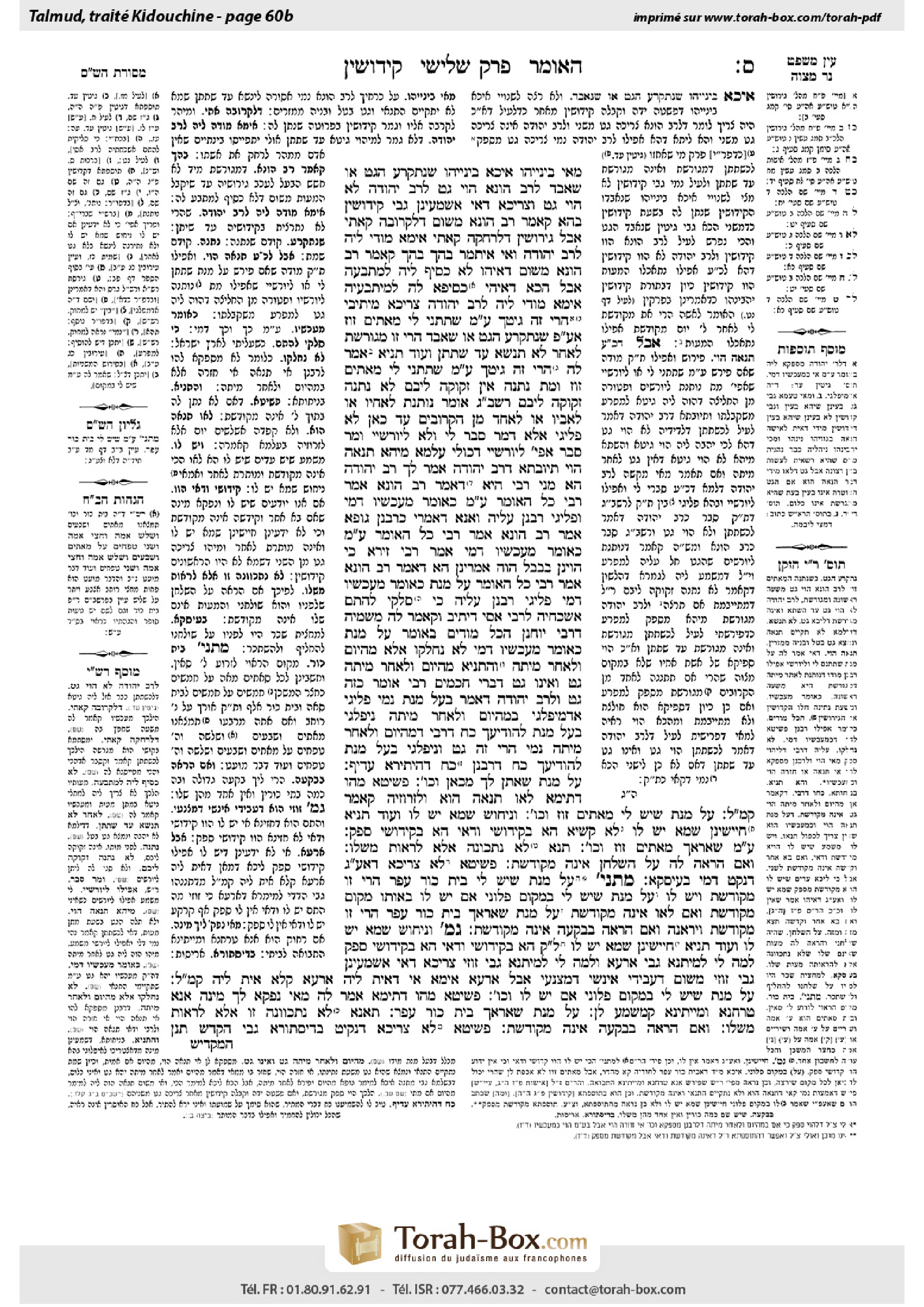
This page of Kiddushin includes the Aramaic text, an English translation and an AI-generated French translation, alongside the scan above.
קידושין ס׳ ב · Aramaic and Hebrew text
מַאי בֵּינַיְיהוּ? אִיכָּא בֵּינַיְיהוּ שֶׁנִּתְקָרַע הַגֵּט אוֹ שֶׁאָבַד, לְרַב הוּנָא הָוֵי גֵּט, לְרַב יְהוּדָה לָא הָוֵי גֵּט.
וּצְרִיכָא, דְּאִי אַשְׁמְעִינַן גַּבֵּי קִידּוּשִׁין, בְּהָא קָאָמַר רַב הוּנָא, מִשּׁוּם דִּלְקָרוֹבַהּ קָאָתֵי, אֲבָל גֵּירוּשִׁין, דִּלְרַחוֹקַהּ קָאָתֵי, אֵימָא מוֹדֵי לֵיהּ לְרַב יְהוּדָה.
וְאִי אִיתְּמַר בְּהָךְ: בְּהָךְ קָאָמַר רַב הוּנָא, מִשּׁוּם דְּאִיהוּ לָא כְּסִיף לֵיהּ לְמִתְבְּעַהּ, אֲבָל הָכָא, דְּאִיהִי כְּסִיפָא לַהּ לְמִיתְבְּעֵיהּ אֵימָא מוֹדֵי לֵיהּ לְרַב יְהוּדָה, צְרִיכָא.
מֵיתִיבִי: ״הֲרֵי זֶה גִּיטִּיךְ עַל מְנָת שֶׁתִּתְּנִי לִי מָאתַיִם זוּז״, אַף עַל פִּי שֶׁנִּתְקָרַע הַגֵּט אוֹ שֶׁאָבַד – הֲרֵי זוֹ מְגוֹרֶשֶׁת, לְאַחֵר לֹא תִּנָּשֵׂא עַד שֶׁתִּתֵּן.
וְעוֹד תַּנְיָא: אָמַר לָהּ ״הֲרֵי זֶה גִּיטִּיךְ עַל מְנָת שֶׁתִּתְּנִי לִי מָאתַיִם זוּז״ וָמֵת, נָתְנָה – אֵין זְקוּקָה לַיָּבָם, לֹא נָתְנָה – זְקוּקָה לְיָבָם. רַבָּן שִׁמְעוֹן בֶּן גַּמְלִיאֵל אוֹמֵר: נוֹתֶנֶת לְאָחִיו אוֹ לְאָבִיו אוֹ לְאֶחָד מִן הַקְּרוֹבִים.
עַד כָּאן לָא פְּלִיגִי אֶלָּא דְּמָר סָבַר: ״לִי וְלֹא לְיוֹרְשַׁיי״, וּמָר סָבַר: ״אֲפִילּוּ לְיוֹרְשַׁיי״, דְּכוּלֵּי עָלְמָא מִיהָא תְּנָאָה הָוֵי, תְּיוּבְתָּא דְרַב יְהוּדָה!
אָמַר לָךְ רַב יְהוּדָה: הָא מַנִּי – רַבִּי הִיא. דְּאָמַר רַב הוּנָא אָמַר רַבִּי: כׇּל הָאוֹמֵר ״עַל מְנָת״ כְּאוֹמֵר ״מֵעַכְשָׁיו״ דָּמֵי, וּפְלִיגִי רַבָּנַן עֲלֵיהּ. וַאֲנָא דַּאֲמַרִי כְּרַבָּנַן.
גּוּפָא, אָמַר רַב הוּנָא אָמַר רַבִּי: כׇּל הָאוֹמֵר ״עַל מְנָת״ כְּאוֹמֵר ״מֵעַכְשָׁיו״ דָּמֵי. אָמַר רַבִּי זֵירָא: כִּי הֲוֵינַן בְּבָבֶל הֲוָה אָמְרִינַן: הָא דְּאָמַר רַב הוּנָא אָמַר רַבִּי: כׇּל הָאוֹמֵר ״עַל מְנָת״ כְּאוֹמֵר ״מֵעַכְשָׁיו״ דָּמֵי, פְּלִיגִי רַבָּנַן עֲלֵיהּ.
כִּי סָלְקִי לְהָתָם אַשְׁכְּחֵיהּ לְרַבִּי אַסִּי דְּיָתֵיב וְקָאָמַר לַהּ מִשְּׁמֵיהּ דְּרַבִּי יוֹחָנָן: הַכֹּל מוֹדִים בְּאוֹמֵר ״עַל מְנָת״ כְּאוֹמֵר ״מֵעַכְשָׁיו״ דָּמֵי, לֹא נֶחְלְקוּ אֶלָּא: ״מֵהַיּוֹם וּלְאַחַר מִיתָה״.
וְהָתַנְיָא: ״מֵהַיּוֹם וּלְאַחַר מִיתָה״ – גֵּט וְאֵינוֹ גֵּט, דִּבְרֵי חֲכָמִים. רַבִּי אוֹמֵר: כָּזֶה גֵּט.
וּלְרַב יְהוּדָה, דְּאָמַר בְּ״עַל מְנָת״ נָמֵי פְּלִיגִי, אַדְּמִיפַּלְגִי בְּ״מֵהַיּוֹם וּלְאַחַר מִיתָה״ – נִיפְלְגֵי בְּ״עַל מְנָת״?
לְהוֹדִיעֲךָ כֹּחַ דְּרַבִּי, דְּ״מֵהַיּוֹם וּלְאַחַר מִיתָה״ נָמֵי הֲרֵי זֶה גֵּט. וְנִיפְלְגִי בְּ״עַל מְנָת״, לְהוֹדִיעֲךָ כֹּחַ דְּרַבָּנַן! כֹּחַ דְּהֶיתֵּירָא עֲדִיף.
״עַל מְנָת שֶׁאֶתֵּן לְךָ מִכָּאן וְכוּ׳״. פְּשִׁיטָא! מַהוּ דְּתֵימָא: לָאו תְּנָאָה הוּא, וּלְזָרוֹזֵיהּ קָאָמְרָ[ה], קָא מַשְׁמַע לַן.
״עַל מְנָת שֶׁיֵּשׁ לִי מָאתַיִם זוּז״ וְכוּ׳. וְנֵיחוּשׁ שֶׁמָּא יֵשׁ לוֹ! וְעוֹד, תַּנְיָא: חָיְישִׁינַן שֶׁמָּא יֵשׁ לוֹ!
לָא קַשְׁיָא: הָא בְּקִידּוּשֵׁי וַדַּאי, הָא בְּקִידּוּשֵׁי סָפֵק.
״עַל מְנָת שֶׁאַרְאֵךְ מָאתַיִם זוּז״ וְכוּ׳. תָּנָא: לֹא נִתְכַּוְּנָה אֶלָּא לִרְאוֹת מִשֶּׁלּוֹ. וְאִם הֶרְאָה לָהּ עַל הַשֻּׁלְחָן – אֵינָהּ מְקוּדֶּשֶׁת. פְּשִׁיטָא! לָא צְרִיכָא דְּאַף עַל גַּב דְּנָקֵט דְּמֵי בְּעִיסְקָא.
מַתְנִי׳ ״עַל מְנָת שֶׁיֵּשׁ לִי בֵּית כּוֹר עָפָר״ – הֲרֵי זוֹ מְקוּדֶּשֶׁת, וְיֵשׁ לוֹ. ״עַל מְנָת שֶׁיֵּשׁ לִי בְּמָקוֹם פְּלוֹנִי״, אִם יֵשׁ לוֹ בְּאוֹתוֹ מָקוֹם – מְקוּדֶּשֶׁת, וְאִם לָאו – אֵינָהּ מְקוּדֶּשֶׁת. ״עַל מְנָת שֶׁאַרְאֵךְ בֵּית כּוֹר עָפָר״ – הֲרֵי זוֹ מְקוּדֶּשֶׁת, וְיַרְאֶנָּה. וְאִם הֶרְאָהּ בַּבִּקְעָה – אֵינָהּ מְקוּדֶּשֶׁת.
גְּמָ׳ וְנֵיחוּשׁ שֶׁמָּא יֵשׁ לוֹ! וְעוֹד, תַּנְיָא: חָיְישִׁינַן שֶׁמָּא יֵשׁ לוֹ! לָא קַשְׁיָא. הָא בְּקִידּוּשֵׁי וַדַּאי, הָא בְּקִידּוּשֵׁי סָפֵק.
לְמָה לִי לְמִיתְנֵא גַּבֵּי אַרְעָא וּלְמָה לִי לְמִיתְנֵא גַּבֵּי זוּזֵי! צְרִיכָא, דְּאִי אַשְׁמְעִינַן גַּבֵּי זוּזֵי, מִשּׁוּם דַּעֲבִידִי אִינָשֵׁי דְּמַצְנְעִי. אֲבָל אַרְעָא, אֵימָא: אִי דְּאִית לֵיהּ אַרְעָא – קָלָא אִית לֵיהּ, קָא מַשְׁמַע לַן.
״עַל מְנָת שֶׁיֵּשׁ לִי בְּמָקוֹם פְּלוֹנִי״, אִם יֵשׁ לוֹ וְכוּ׳. פְּשִׁיטָא! מַהוּ דְּתֵימָא: אֲמַר לַהּ: מַאי נָפְקָא לָךְ מִינַּהּ, אֲנָא טָרַחְנָא וּמַיְיתֵינָא! קָמַשְׁמַע לַן.
״עַל מְנָת שֶׁאַרְאֵךְ בֵּית כּוֹר עָפָר״. תָּאנָא: לֹא נִתְכַּוְּונָה זוֹ אֶלָּא לִרְאוֹת מִשֶּׁלּוֹ. וְאִם הֶרְאָהּ בַּבִּקְעָה – אֵינָהּ מְקוּדֶּשֶׁת. פְּשִׁיטָא! לָא צְרִיכָא דְּנָקֵיט בְּדִיסְתּוּרָא.
גַּבֵּי הֶקְדֵּשׁ תְּנַן:
Kiddushin 60b · English translation
What is the difference between the explanations of Rav Huna and Rav Yehuda? Even Rav Huna agrees that she cannot marry someone else until she gives him the money. Until that point the bill of divorce does not come into effect and she remains married to the first man. The Gemara answers: The difference between them is in a case where the bill of divorce was torn or lost after she received it but before she gave him the money. According to the opinion of Rav Huna it is a valid bill of divorce, as the divorce takes effect from the moment he gives her the document. According to the opinion of Rav Yehuda it is not a valid bill of divorce, as he maintains that the bill of divorce goes into effect only later, which is impossible as it is either torn or lost.
The Gemara comments: And it is necessary to state both disputes, the one with regard to betrothal and the one with regard to divorce, as neither halakha could be derived from the other. As had it taught us only that the two Sages disagree with regard to betrothal, one might have said that it is there that Rav Huna says that the betrothal takes effect immediately, despite the fact that he must still give her the money, because betrothal comes to draw her near to him. Therefore, it is likely that he meant for the betrothal to take immediate effect. But with regard to divorce, when he comes to distance her, you might say that Rav Huna concedes to Rav Yehuda that the divorce comes into effect only from the moment she gives him the money.
And conversely, if the dispute had been stated only with regard to this case concerning a bill of divorce, one might have claimed that Rav Huna says that the bill of divorce comes into immediate effect only in this situation, because he is not ashamed to demand the money from her whenever he wants, and therefore he divorces her immediately. But here, concerning a betrothal, when she is ashamed to claim the money from him, you might say that Rav Huna concedes to Rav Yehuda that the woman does not accept the betrothal until she actually receives the money. It is therefore necessary for the dispute to be stated in both cases.
The Gemara raises an objection to the opinion of Rav Yehuda from a baraita (Tosefta, Gittin 5:5): If one says to his wife: This is your bill of divorce on the condition that you will give me two hundred dinars, even if the bill of divorce was torn or lost she is divorced. But she may not marry another man until she gives him the money. This ruling apparently accords with Rav Huna’s opinion that the bill of divorce goes into immediate effect from the moment it is given.
And it is further taught in a baraita: With regard to a man who said to his wife: This is your bill of divorce on the condition that you will give me two hundred dinars, and he died childless, if she gave him the money she is not bound by a levirate bond to the yavam, as she is already divorced. But if she did not give him the money she is bound by a levirate bond to the yavam. Rabban Shimon ben Gamliel says: If she did not give it to her husband during his lifetime she may give the money to her late husband’s brother, or to his father, or to one of the relatives who inherit from him, and by doing so she fulfills the condition and is retroactively divorced.
The Gemara analyzes this ruling: The tanna’im disagree only with regard to the following: One Sage, the first tanna, holds that by the phrase: On the condition that you will give me, he meant: To me specifically but not to my heirs. Consequently, if she does not give the money to him she is not divorced, as she cannot fulfill the condition by giving the money to his heirs. And one Sage, Rabban Shimon ben Gamliel, holds that the husband meant: Even to my heirs. In any event, everyone agrees that it is a condition and the divorce takes effect from the moment the bill of divorce is given. This is apparently a conclusive refutation of the opinion of Rav Yehuda.
The Gemara answers: Rav Yehuda could say to you: In accordance with whose opinion is this baraita? It is the opinion of Rabbi Yehuda HaNasi, as Rav Huna says that Rabbi Yehuda HaNasi says: Anyone who states a condition employing the language: On the condition, is like one who states that the agreement will take effect retroactively from now, even though the condition is fulfilled only later on. Rabbi Yehuda HaNasi maintains that the phrase: On the condition, indicates that an action should take effect now provided that a certain action is fulfilled later. And the Rabbis disagree with him, claiming that this expression does not mean that the action should take immediate effect, but only from when the condition is fulfilled. And Rav Yehuda would conclude by adding: And I spoke in accordance with the opinion of the Rabbis.
The Gemara analyzes the matter itself. Rav Huna says that Rabbi Yehuda HaNasi says that anyone who states a condition employing the language: On the condition, is like one who states that the agreement will take effect retroactively from now, even though the condition is fulfilled only later on. Rabbi Zeira said: When we were in Babylonia we would say: With regard to that which Rav Huna says that Rabbi Yehuda HaNasi says: Anyone who states a condition employing the language: On the condition, is like one who states that the agreement will take effect retroactively from now, that is Rabbi Yehuda HaNasi’s opinion, but the Rabbis disagree with him.
When I ascended to there, to Eretz Yisrael, I found Rabbi Asi sitting and saying the following ruling in the name of Rabbi Yoḥanan: All concede that with regard to one who says to his wife: On the condition, he is like one who states that the divorce will take effect retroactively from now. They disagreed only with regard to one who said to his wife: From today and after my death, whether he is considered to have added a condition or to have retracted from his initial statement.
And it is taught in a baraita that if one says to his wife: This is your bill of divorce from today and after my death, it is uncertain whether it is a valid bill of divorce or whether it is not a valid bill of divorce. This is the statement of the Rabbis. The Rabbis are uncertain whether he has changed his mind from his initial intention of giving the document that day, and now wishes to give a bill of divorce after his death, which is not effective, or whether he was merely adding a condition that the bill of divorce should take effect from today only when he dies. Conversely, Rabbi Yehuda HaNasi says: A document like this is a valid bill of divorce.
The Gemara asks: And according to the opinion of Rav Yehuda, who said that the tanna’im also disagree with regard to one who says to his wife: On the condition, instead of disagreeing with regard to the case where one says to his wife: From today and after my death, let them disagree with regard to a case where the husband used the expression: On the condition.
The Gemara answers: Rav Yehuda maintains that they disagree over both cases, and the baraita taught the dispute in this manner to convey to you the far-reaching nature of the opinion of Rabbi Yehuda HaNasi, who maintains that even if the husband says to his wife: From today and after my death, this is also a valid bill of divorce. The Gemara asks: And let them disagree with regard to a husband who says to his wife: On the condition, to convey to you the far-reaching nature of the opinion of the Rabbis, who hold that it is not a valid bill of divorce even in that case. The Gemara answers: It is preferable to emphasize the power of leniency. It is always better to formulate a dispute in a manner that emphasizes the extent of the lenient opinion.
§ The mishna teaches: With regard to one says to a woman: You are hereby betrothed to me on the condition that I will give you a particular sum of money from now and until thirty days have elapsed, if he gives her the money within the allotted time she is betrothed. The Gemara questions the need for this ruling: It is obvious that this is the case. The Gemara explains: This ruling is necessary, lest you say that the specified time period is not a proper condition, and he said so only to motivate himself to prove the sincerity of his intentions. The mishna therefore teaches us that the time period is an essential part of his condition, and if he fails to give her the money within this period the betrothal is void.
The mishna further teaches that if he says to her: You are hereby betrothed to me on the condition that I have two hundred dinars, if he in fact possesses the specified amount, she is betrothed, but if he does not, she is not betrothed. The Gemara asks: And let us be concerned that perhaps he has this sum, although he fails to show it to her. How can his betrothal be nullified if there is no conclusive evidence that he does not have the money? And furthermore, it is taught in a baraita that we are concerned that perhaps he has the money.
The Gemara answers: It is not difficult, as this case, in the mishna, is referring to a definite betrothal, which is not established in this case, as he has failed to demonstrate that he has the funds. By contrast, that case, in the baraita, is referring to an uncertain betrothal. The betrothal cannot be entirely disregarded, as he might have the money after all.
The mishna teaches that if a man says to her: You are hereby betrothed to me on the condition that I will show you two hundred dinars, she is betrothed and he must show her the money. A Sage taught (Tosefta 3:6): This woman intended to see only his own money, not simply to be shown any two hundred dinars. With regard to the subsequent ruling of the mishna: And if he showed her the money on the table she is not betrothed, the Gemara comments: This is obvious, as the woman wants to see his own money. The Gemara explains: No, it is necessary to teach that even if he holds somebody else’s money as part of a joint business venture, nevertheless, as the money does not actually belong to him he has failed to fulfill the condition.
MISHNA: With regard to one who says to a woman: You are hereby betrothed to me on the condition that I possess tillable land of a beit kor of earth, she is betrothed, provided that he possesses such land. If he said to her that the betrothal is: On the condition that I possess land in such and such a place, if he possesses land in that place she is betrothed, but if not she is not betrothed. If he said to her: You are hereby betrothed to me on the condition that I will show you a beit kor of earth, she is betrothed, and he shall show her. And if he showed her land in a valley, i.e., a field that does not belong to him among other fields, she is not betrothed.
GEMARA: With regard to the statement of the mishna that she is betrothed only if he actually possesses a beit kor of earth, the Gemara asks: And let us be concerned that perhaps he in fact possesses land of this size. And furthermore, it is explicitly taught in a baraita that we are concerned in this situation that perhaps he possesses land of this size. The Gemara answers: It is not difficult, as this case, the one in the mishna, is referring to a definite betrothal, which has not yet been established because he has not proven he owns a field of this kind; and that case, the one in the baraita, is referring to an uncertain betrothal.
The Gemara asks: Why do I need this mishna to teach this halakha with regard to land, and why do I also need the previous mishna to teach the same ruling with regard to money? There is no clear difference between the two cases. The Gemara answers: It is necessary to state the halakha in both cases, as had one mishna taught us this halakha only with regard to money one might have said that it is only in that case that it is uncertain whether she is betrothed, because people tend to hide their money, and therefore his financial status might not be well known. But in the case of land, you might say that if he had land this fact would generate publicity, as one cannot hide land. The mishna therefore teaches us that it is also possible for him to own land without people being aware of it.
§ The mishna teaches: If one says to a woman: You are hereby betrothed to me on the condition that I possess land in such and such a place, if he possesses land in that place she is betrothed, but if not, she is not betrothed. The Gemara questions the need for this ruling: It is obvious that if he does not possess land in that place she is not betrothed, as that was precisely his condition. The Gemara explains that this ruling is necessary lest you say that he can say to her: What difference does it make to you whether the field is in that location or elsewhere, as even if it is farther away I will go to the trouble of bringing the produce from the field to our house, so what loss have you incurred? The mishna therefore teaches us that despite this claim the betrothal is invalid, due to his failure to fulfill the condition.
§ The mishna further teaches: If a one says to a woman: You are hereby betrothed to me on the condition that I will show you a beit kor of earth, she is betrothed, provided that he possesses such land. A Sage taught (Tosefta 3:6): The woman intended to see only his own land. The mishna further teaches: And if he showed her a plot of land in a valley, she is not betrothed. The Gemara asks: This is obvious; after all, this land does not belong to him. The Gemara answers: No, it is necessary in a case where he maintains the field as a sharecropper [distora], i.e., he owns a share in it. Nevertheless, as the land does not belong to him she did not have this field in mind, and consequently she is not betrothed.
The Gemara comments: With regard to consecrated property, we learned in a mishna (Arakhin 25a):
Kiddushin 60b · Traduction française (IA)
Quelle est la différence entre les explications de Rav Houna et de Rav Yehouda ? Rav Houna lui-même convient qu’elle ne peut épouser un autre homme avant de lui avoir remis l’argent. Jusque-là, l’acte de divorce ne prend pas effet et elle reste mariée au premier homme. La Guemara répond : La différence entre eux concerne le cas où l’acte de divorce a été déchiré ou perdu après qu’elle l’a reçu, mais avant qu’elle lui ait remis l’argent. Selon Rav Houna, l’acte de divorce est valable, car le divorce prend effet dès qu’il lui remet le document. Selon Rav Yehouda, l’acte de divorce n’est pas valable, car il estime que le divorce ne prend effet que plus tard, ce qui est impossible puisque le document a été déchiré ou perdu.
La Guemara fait remarquer qu’il faut exposer les deux controverses, celle qui porte sur les fiançailles et celle qui porte sur le divorce, car aucune des deux halakhot ne peut être déduite de l’autre. En effet, si l’on nous avait enseigné seulement que les deux Sages sont en désaccord au sujet des fiançailles, on aurait pu dire que c’est dans ce cas que Rav Houna affirme que les fiançailles prennent effet immédiatement, bien qu’il doive encore lui remettre l’argent, parce que les fiançailles ont pour but de la rapprocher de lui. Il est donc vraisemblable qu’il voulait que les fiançailles prennent effet immédiatement. Mais, en matière de divorce, lorsqu’il cherche à l’éloigner, on aurait pu dire que Rav Houna concède à Rav Yehouda que le divorce ne prend effet qu’au moment où elle lui remet l’argent.
Inversement, si la controverse avait été rapportée uniquement à propos de ce cas d’acte de divorce, on aurait pu prétendre que Rav Houna affirme que l’acte de divorce prend effet immédiatement seulement dans cette situation, car il n’a pas honte de lui réclamer l’argent quand il le souhaite et, par conséquent, il la divorce immédiatement. Mais ici, à propos de fiançailles, alors qu’elle a honte de lui réclamer l’argent, on aurait pu dire que Rav Houna concède à Rav Yehouda que la femme n’accepte les fiançailles qu’après avoir effectivement reçu l’argent. Il faut donc rapporter la controverse dans les deux cas.
La Guemara soulève une objection contre l’opinion de Rav Yehouda à partir d’une baraïta (Tossefta, Guittin 5:5) : Si un homme dit à sa femme : « Voici ton acte de divorce, à condition que tu me donnes deux cents dinars », même si l’acte de divorce a été déchiré ou perdu, elle est divorcée. Mais elle ne peut pas épouser un autre homme avant de lui avoir remis l’argent. Cette décision semble conforme à l’opinion de Rav Houna, selon laquelle l’acte de divorce prend effet immédiatement, dès le moment où il est remis.
Une baraïta enseigne également : À propos d’un homme qui dit à sa femme : « Voici ton acte de divorce, à condition que tu me donnes deux cents dinars », puis meurt sans enfant, si elle lui a remis l’argent, elle n’est pas soumise au lien de lévirat avec le yavam, car elle est déjà divorcée. Mais si elle ne lui a pas remis l’argent, elle est soumise au lien de lévirat avec le yavam. Rabban Shimon ben Gamliel dit : Si elle ne l’a pas remis à son mari de son vivant, elle peut donner l’argent au frère de son défunt mari, à son père ou à l’un de ses parents qui héritent de lui ; ce faisant, elle satisfait à la condition et est divorcée rétroactivement.
La Guemara analyse cette décision : Les tannaïm ne sont en désaccord que sur le point suivant : selon un Sage, le premier tanna, par les mots « à condition que tu me donnes », il voulait dire « à moi exclusivement, et non à mes héritiers ». Par conséquent, si elle ne lui donne pas l’argent, elle n’est pas divorcée, car elle ne peut satisfaire à la condition en donnant l’argent à ses héritiers. Selon l’autre Sage, Rabban Shimon ben Gamliel, le mari voulait dire « même à mes héritiers ». Quoi qu’il en soit, tous conviennent qu’il s’agit d’une condition et que le divorce prend effet dès le moment où l’acte de divorce est remis. Cela constitue apparemment une réfutation décisive de l’opinion de Rav Yehouda.
La Guemara répond : Rav Yehouda pourrait te dire : De quelle opinion cette baraïta relève-t-elle ? De celle de Rabbi Yehouda HaNassi, car Rav Houna dit que Rabbi Yehouda HaNassi enseigne : Quiconque énonce une condition en employant la formule « à condition que » est comme s’il déclarait que l’accord prend effet rétroactivement à partir de maintenant, même si la condition n’est remplie que plus tard. Rabbi Yehouda HaNassi estime que l’expression « à condition que » indique que l’acte doit prendre effet dès maintenant, pourvu qu’une action donnée soit accomplie ultérieurement. Les Sages ne sont pas d’accord avec lui : selon eux, cette expression ne signifie pas que l’acte prend effet immédiatement, mais seulement au moment où la condition est remplie. Rav Yehouda conclurait en ajoutant : « Et moi, j’ai parlé conformément à l’opinion des Sages. »
La Guemara examine le sujet lui-même. Rav Houna dit que Rabbi Yehouda HaNassi enseigne : Quiconque énonce une condition en employant la formule « à condition que » est comme s’il déclarait que l’accord prend effet rétroactivement à partir de maintenant, même si la condition n’est remplie que plus tard. Rabbi Zeira dit : Lorsque nous étions en Babylonie, nous disions, au sujet de ce que Rav Houna rapporte au nom de Rabbi Yehouda HaNassi — à savoir que quiconque énonce une condition en employant la formule « à condition que » est comme s’il déclarait que l’accord prend effet rétroactivement à partir de maintenant —, qu’il s’agit de l’opinion de Rabbi Yehouda HaNassi, mais que les Sages ne sont pas d’accord avec lui.
Quand je suis monté là-bas, en Eretz Israël, j’ai trouvé Rabbi Assi assis et enseignant, au nom de Rabbi Yo’hanan, la halakha suivante : Tous conviennent que, lorsqu’un homme dit à sa femme « à condition que », cela équivaut à dire que le divorce prendra effet rétroactivement à partir de maintenant. Ils ne sont en désaccord qu’au sujet de celui qui dit à sa femme : « À partir d’aujourd’hui et après ma mort », à savoir s’il est considéré comme ayant ajouté une condition ou comme étant revenu sur sa déclaration initiale.
Et une baraïta enseigne que si un homme dit à sa femme : « Voici ton acte de divorce à partir d’aujourd’hui et après ma mort », on ne sait pas avec certitude si le document est un acte de divorce valable ou s’il ne l’est pas. Telle est la déclaration des Sages. Les Sages ne savent pas s’il a changé d’avis par rapport à son intention initiale de lui remettre le document ce jour-là et souhaite désormais lui donner un acte de divorce après sa mort, ce qui n’a aucun effet, ou s’il a simplement ajouté une condition selon laquelle l’acte de divorce ne prendra effet qu’à partir d’aujourd’hui, au moment de sa mort. À l’inverse, Rabbi Yehouda HaNassi dit : Un document de ce genre est un acte de divorce valable.
La Guemara demande : Et selon l’opinion de Rav Yehouda, qui dit que les tannaïm sont également en désaccord au sujet de celui qui dit à sa femme « à condition que », au lieu d’être en désaccord sur le cas où un homme dit à sa femme « à partir d’aujourd’hui et après ma mort », pourquoi ne seraient-ils pas en désaccord sur le cas où le mari emploie l’expression « à condition que » ?
La Guemara répond : Rav Yehouda estime qu’ils sont en désaccord sur les deux cas, et la baraïta rapporte la controverse sous cette forme pour te faire connaître la portée extrême de l’opinion de Rabbi Yehouda HaNassi, qui estime que même si le mari dit à sa femme « à partir d’aujourd’hui et après ma mort », il s’agit également d’un acte de divorce valable. La Guemara demande : Et pourquoi ne seraient-ils pas en désaccord au sujet d’un mari qui dit à sa femme « à condition que », afin de te faire connaître la portée extrême de l’opinion des Sages, selon laquelle l’acte de divorce n’est pas valable même dans ce cas ? La Guemara répond : Il est préférable de mettre en évidence la portée de l’opinion indulgente. Il vaut toujours mieux formuler une controverse de manière à souligner jusqu’où va l’opinion indulgente.
§ La Michna enseigne : À propos de celui qui dit à une femme : « Tu m’es consacrée à condition que je te donne une somme déterminée à partir de maintenant et avant l’expiration de trente jours », si l’homme lui donne l’argent dans le délai imparti, elle est fiancée. La Guemara demande pourquoi cette décision est nécessaire : c’est évident. La Guemara explique : Elle est nécessaire, de peur que tu dises que le délai indiqué n’est pas une véritable condition et qu’il ne l’a formulé ainsi que pour se pousser à montrer la sincérité de ses intentions. La Michna nous enseigne donc que le délai fait partie intégrante de sa condition et que, s’il ne lui donne pas l’argent dans ce délai, les fiançailles sont nulles.
La Michna enseigne également que s’il lui dit : « Tu m’es consacrée à condition que je possède deux cents dinars », si, en réalité, il possède la somme indiquée, elle est fiancée, mais s’il ne la possède pas, elle n’est pas fiancée. La Guemara demande : Ne faut-il pas craindre qu’il possède cette somme, même s’il ne la lui montre pas ? Comment les fiançailles peuvent-elles être annulées sans preuve concluante qu’il n’a pas l’argent ? De plus, une baraïta enseigne qu’il faut craindre qu’il possède l’argent.
La Guemara répond : Il n’y a pas de difficulté, car ce cas, dans la Michna, concerne des fiançailles certaines, qui ne sont pas établies ici puisqu’il n’a pas démontré qu’il possède les fonds. En revanche, l’autre cas, dans la baraïta, concerne des fiançailles incertaines. On ne peut pas écarter complètement les fiançailles, puisqu’il se peut qu’il possède effectivement l’argent.
La Michna enseigne que si un homme lui dit : « Tu m’es consacrée à condition que je te montre deux cents dinars », elle est fiancée et il doit lui montrer l’argent. Un Sage a enseigné (Tossefta 3:6) : Cette femme entendait voir son propre argent à lui, et non simplement qu’on lui montre une somme de deux cents dinars. Au sujet de la décision suivante de la Michna — s’il lui a montré l’argent posé sur la table, elle n’est pas fiancée —, la Guemara fait remarquer que c’est évident, puisque la femme veut voir son propre argent à lui. La Guemara explique : Non, il faut l’enseigner même dans le cas où il détient l’argent d’un autre dans le cadre d’une affaire commune ; néanmoins, puisque cet argent ne lui appartient pas réellement, il n’a pas satisfait à la condition.
MICHNA : À propos de celui qui dit à une femme : « Tu m’es consacrée à condition que je possède une terre cultivable d’un beit kor », elle est fiancée, à condition qu’il possède une telle terre. S’il lui dit que les fiançailles sont « à condition que je possède une terre à tel endroit », s’il possède une terre à cet endroit, elle est fiancée ; sinon, elle n’est pas fiancée. S’il lui dit : « Tu m’es consacrée à condition que je te montre une terre d’un beit kor », elle est fiancée, et il doit la lui montrer. S’il lui a montré une terre dans une vallée, c’est-à-dire un champ qui ne lui appartient pas, situé parmi d’autres champs, elle n’est pas fiancée.
GUEMARA : À propos de la déclaration de la Michna selon laquelle elle n’est fiancée que s’il possède réellement une terre d’un beit kor, la Guemara demande : Ne faut-il pas craindre qu’il possède effectivement une terre de cette superficie ? De plus, une baraïta enseigne explicitement qu’il faut, dans cette situation, craindre qu’il possède une terre de cette superficie. La Guemara répond : Il n’y a pas de difficulté, car ce cas, celui de la Michna, concerne des fiançailles certaines, qui ne sont pas encore établies puisqu’il n’a pas prouvé qu’il possède un champ de ce genre ; l’autre cas, celui de la baraïta, concerne des fiançailles incertaines.
La Guemara demande : Pourquoi la Michna doit-elle enseigner cette halakha au sujet d’une terre, et pourquoi la Michna précédente doit-elle enseigner la même décision au sujet de l’argent ? Il n’y a pas de différence évidente entre les deux cas. La Guemara répond : Il faut énoncer la halakha dans les deux cas, car si une Michna nous avait enseigné cette halakha uniquement au sujet de l’argent, on aurait pu dire que ce n’est que dans ce cas qu’il est incertain qu’elle soit fiancée, parce que les gens ont tendance à cacher leur argent et que, par conséquent, sa situation financière peut ne pas être connue. Mais, dans le cas d’une terre, on aurait pu dire que si une terre lui appartenait, cela se saurait, car on ne peut pas cacher une terre. La Michna nous enseigne donc qu’il est également possible qu’il possède une terre sans que les gens le sachent.
§ La Michna enseigne : Si un homme dit à une femme : « Tu m’es consacrée à condition que je possède une terre à tel endroit », s’il possède une terre à cet endroit, elle est fiancée ; sinon, elle n’est pas fiancée. La Guemara demande pourquoi cette décision est nécessaire : il est évident que s’il ne possède pas de terre à cet endroit, elle n’est pas fiancée, puisque telle était précisément sa condition. La Guemara explique que cette décision est nécessaire, de peur que tu dises qu’il peut lui répondre : « Qu’est-ce que cela peut te faire que le champ soit à cet endroit ou ailleurs ? Même s’il est plus éloigné, je prendrai la peine d’apporter les produits du champ jusqu’à notre maison. Quel préjudice as-tu donc subi ? » La Michna nous enseigne que, malgré cette affirmation, les fiançailles ne sont pas valables, car il n’a pas satisfait à la condition.
§ La Michna enseigne également : Si un homme dit à une femme : « Tu m’es consacrée à condition que je te montre une terre d’un beit kor », elle est fiancée, à condition qu’il possède une telle terre. Un Sage a enseigné (Tossefta 3:6) : La femme entendait voir uniquement la terre qui lui appartient à lui. La Michna enseigne également : S’il lui a montré un terrain dans une vallée, elle n’est pas fiancée. La Guemara demande : C’est évident ; après tout, cette terre ne lui appartient pas. La Guemara répond : Non, cette décision est nécessaire dans le cas où il exploite le champ comme métayer [distora], c’est-à-dire qu’il en possède une part. Néanmoins, puisque la terre ne lui appartient pas, elle n’avait pas ce champ à l’esprit et, par conséquent, elle n’est pas fiancée.
La Guemara fait remarquer : Au sujet des biens consacrés, nous avons appris dans une Michna (Arakhin 25a) :
Traduction française générée par IA à partir de l’édition anglaise de Sefaria. Vérifie toujours un passage avec le texte source.
Text from Sefaria: William Davidson Edition - Vocalized Aramaic (CC BY NC); William Davidson Edition - English (CC BY NC).