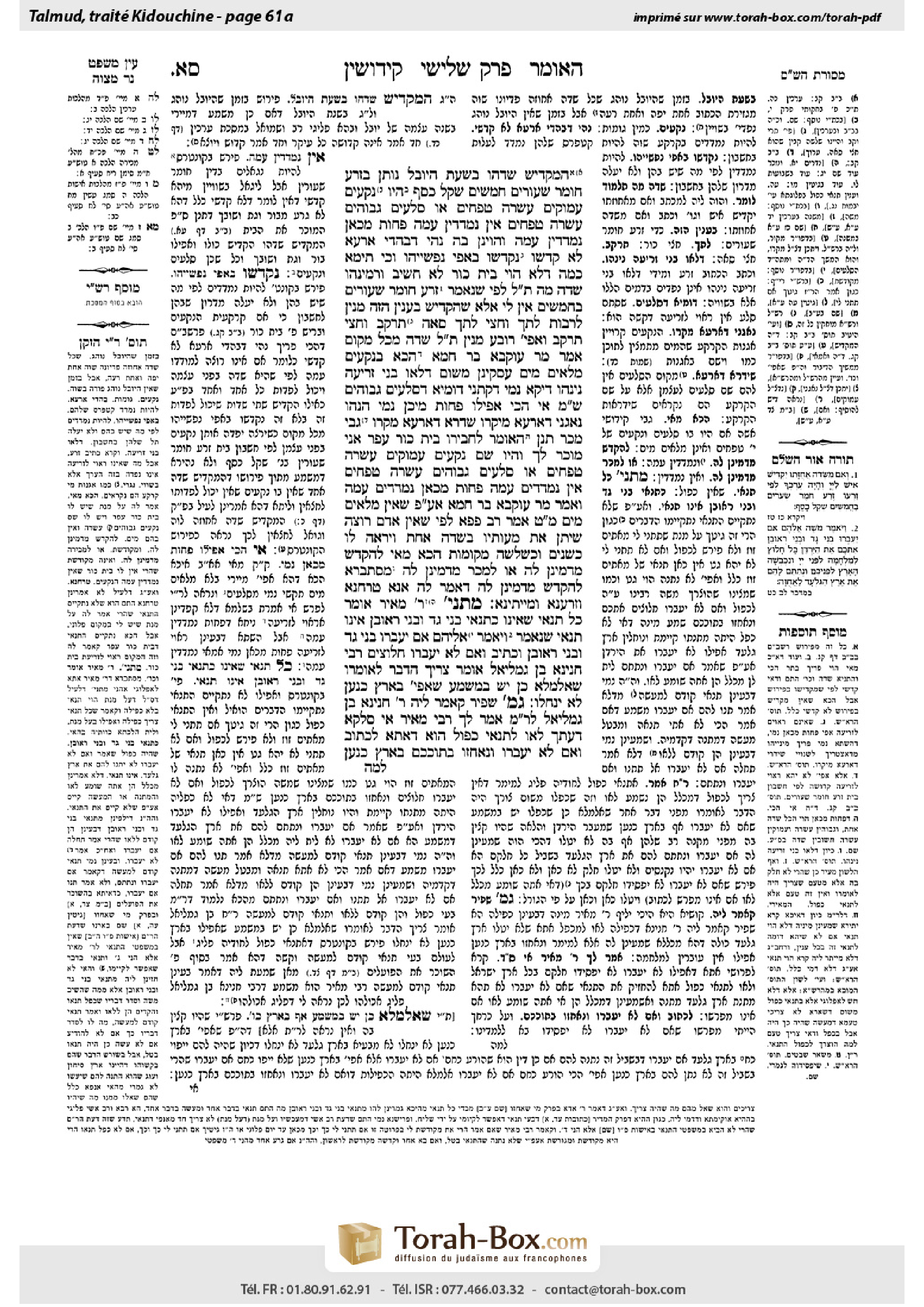
Kiddushin 61a: Talmud study for Daf Yomi
Daf Yomi is the daily study of one Talmud folio. Explore 37 tractates with scans, Hebrew text, Sefaria English and AI-generated French translations where annotated.
Passage selection and English or AI-generated French translation are available where the scan has annotations. Daf Study is independent of Torah-Box and Sefaria.
Browse Kiddushin · קידושין · All tractatesKiddushin 61a text and translations
This page of Kiddushin includes the Aramaic text, an English translation and an AI-generated French translation, alongside the scan above.
קידושין ס״א א · Aramaic and Hebrew text
הַמַּקְדִּישׁ שָׂדֵהוּ בִּשְׁעַת הַיּוֹבֵל, נוֹתֵן בְּזֶרַע חוֹמֶר שְׂעוֹרִים חֲמִשִּׁים שֶׁקֶל כָּסֶף. הָיוּ נְקָעִים עֲמוּקִּים עֲשָׂרָה טְפָחִים אוֹ סְלָעִים גְּבוֹהִים עֲשָׂרָה טְפָחִים – אֵין נִמְדָּדִין עִמָּהּ. פָּחוֹת מִכָּאן – נִמְדָּדִין עִמָּהּ.
וְהָוֵינַן בַּהּ: נְהִי דְּבַהֲדֵי אַרְעָא לֹא קָדְשׁוּ, נִקְדְּשׁוּ בְּאַפֵּי נַפְשַׁיְיהוּ! וְכִי תֵּימָא: כַּמָּה דְּלָא הָוֵי בֵּית כּוֹר לָא חֲשִׁיב, וּרְמִינְהוּ:
״שָׂדֶה״ מָה תַּלְמוּד לוֹמַר? – לְפִי שֶׁנֶּאֱמַר: ״זֶרַע חֹמֶר שְׂעֹרִים בַּחֲמִשִּׁים״, אֵין לִי אֶלָּא שֶׁהִקְדִּישׁ בָּעִנְיָן הַזֶּה, מִנַּיִן לְרַבּוֹת, לֶתֶךְ וַחֲצִי לֶתֶךְ, סְאָה, תַּרְקַב, וַחֲצִי תַּרְקַב, וַאֲפִילּוּ רוֹבַע מִנַּיִן? תַּלְמוּד לוֹמַר: ״שָׂדֶה״ – מִכׇּל מָקוֹם!
אָמַר מָר עוּקְבָא בַּר חָמָא: הָכָא בִּנְקָעִים מְלֵאִים מַיִם עָסְקִינַן, מִשּׁוּם דְּלָאו בְּנֵי זְרִיעָה נִינְהוּ. דַּיְקָא נָמֵי, דְּקָתָנֵי דּוּמְיָא דִסְלָעִים גְּבוֹהִים, שְׁמַע מִינַּהּ.
אִי הָכִי, אֲפִילּוּ פָּחוֹת מִיכֵּן נָמֵי! הָנְהוּ נְאגָנֵי דְאַרְעָא מִיקְּרוּ, שִׁדְרָא דְאַרְעָא מִקְּרוּ.
גַּבֵּי מֶכֶר תְּנַן: הָאוֹמֵר לַחֲבֵירוֹ ״בֵּית כּוֹר עָפָר אֲנִי מוֹכֵר לָךְ״, וְהָיוּ שָׁם נְקָעִים עֲמוּקִּים עֲשָׂרָה טְפָחִים אוֹ סְלָעִים גְּבוֹהִים עֲשָׂרָה טְפָחִים – אֵין נִמְדָּדִים עִמָּהּ. פָּחוֹת מִכָּאן – נִמְדָּדִים עִמָּהּ. וְאָמַר מָר עוּקְבָא בַּר חָמָא: אַף עַל פִּי שֶׁאֵין מְלֵאִים מַיִם.
מַאי טַעְמָא? אָמַר רַב פָּפָּא: לְפִי שֶׁאֵין אָדָם רוֹצֶה שֶׁיִּתֵּן אֶת מְעוֹתָיו בְּשָׂדֶה אַחַת וְיֵרָאֶה לוֹ כִּשְׁנַיִם וְכַשְּׁלֹשָׁה מְקוֹמוֹת.
הָכָא מַאי? לְהֶקְדֵּשׁ מְדַמֵּינַן לַהּ, אוֹ לְמֶכֶר מְדַמֵּינַן לַהּ? מִסְתַּבְּרָא לְהֶקְדֵּשׁ מְדַמֵּינַן לַהּ, דְּאָמַר לַהּ: אֲנָא טָרַחְנָא וְזָרַעְנָא וּמַיְיתֵינָא.
מַתְנִי׳ רַבִּי מֵאִיר אוֹמֵר: כׇּל תְּנַאי שֶׁאֵינוֹ כִּתְנַאי בְּנֵי גָּד וּבְנֵי רְאוּבֵן – אֵינוֹ תְּנַאי. שֶׁנֶּאֱמַר: ״וַיֹּאמֶר אֲלֵהֶם אִם יַעַבְרוּ בְנֵי גָד וּבְנֵי רְאוּבֵן״. וּכְתִיב: ״וְאִם לֹא יַעַבְרוּ חֲלוּצִים״.
רַבִּי חֲנִינָא בֶּן גַּמְלִיאֵל אוֹמֵר: צָרִיךְ הַדָּבָר לְאוֹמְרוֹ, שֶׁאִלְמָלֵא כֵּן, יֵשׁ בַּמַּשְׁמָע שֶׁאֲפִילּוּ בְּאֶרֶץ כְּנַעַן לֹא יִנְחָלוּ.
גְּמָ׳ שַׁפִּיר קָאָמַר לֵיהּ רַבִּי חֲנִינָא בֶּן גַּמְלִיאֵל לְרַבִּי מֵאִיר! אָמַר לָךְ רַבִּי מֵאִיר: אִי סָלְקָא דַעְתָּךְ לָאו לִתְנַאי כָּפוּל הוּא דַּאֲתָא, לִכְתּוֹב: ״וְאִם לֹא יַעַבְרוּ וְנֹאחֲזוּ בְתֹכְכֶם״, ״בְּאֶרֶץ כְּנָעַן״
Kiddushin 61a · English translation
With regard to one who consecrates his field during the time of the Jubilee Year, i.e., in an era when the halakhot of the Jubilee Year are observed, if he wishes to redeem it from the Temple treasury he gives fifty silver shekels for an area that yields a ḥomer, i.e., a kor, of barley seed. If the field had crevices, i.e., deep fissures in its surface, ten handbreadths deep, or boulders ten handbreadths high, they are not measured with it, i.e., in the calculation of land that requires redemption. If the crevices or boulders are less than that, they are measured with it.
And we discussed the following problem: Granted, that these areas are not consecrated together with the field, as they are ten handbreadths higher or lower than the rest of the land; but let the crevices and boulders be consecrated by themselves, so that they should require their own redemption of fifty silver shekels per beit kor. And if you would say that as long as an area does not amount to a beit kor it is not important, the Gemara raises a contradiction against this claim from a baraita.
The verse states with regard to one who consecrates his field: “Part of a field of his possession” (Leviticus 27:16). What is the meaning when the verse states this? Since it is stated in the same verse: “The sowing of a ḥomer of barley shall be valued at fifty shekels of silver,” I have derived only that this halakha applies to one who consecrated in this manner, i.e., consecrated an area fit to sow a ḥomer of barley. From where do I derive that this halakha includes a smaller area, e.g., one suitable for sowing a half-kor, and half of a half-kor, and the area for a se’a, and a tarkav, which is half a se’a, and half a tarkav, and even the area of a quarter-kav? The baraita restates its question: From where is it derived that these areas of land can also be consecrated and redeemed based on the fixed values of the Torah? The verse states “a field” in any case.
Therefore, the Gemara’s question remains: Why aren’t the crevices and boulders measured by themselves? Mar Ukva bar Ḥama said: Here we are dealing with crevices filled with water. Due to the fact that they are not fit for sowing, the crevices are not considered a field. The Gemara comments: The language of the mishna is also precise, as it teaches the case of crevices, similar to the case of high boulders, which are also unsuitable for sowing. The Gemara affirms: Learn from this comparison that this explanation is correct.
The Gemara asks: If so, i.e., if the crevices, like the boulders, are unfit for sowing, then even if there is a disparity of less than ten handbreadths as well, the crevices and boulders should likewise not be measured as part of the field. The Gemara answers: If they are separated from the field by less than ten handbreadths, these crevices are called the cracks in the ground. Similarly, boulders less than ten handbreadths high are called the spine of the ground. They are considered regular features of fields, which typically have a few pits and mounds.
With regard to a sale of a field, we learned in a mishna (Bava Batra 102b): In the case of one who says to another: I am selling you a beit kor of earth, if there were crevices ten handbreadths deep or boulders ten handbreadths high in the field, they are not measured with it; if the crevices or boulders were less than that, they are measured with it. And Mar Ukva bar Ḥama says: Even if they are not filled with water, nevertheless they are not included.
The Gemara asks: What is the reason for this difference between the two rulings of Mar Ukva bar Ḥama? Why in the case of a sale are crevices not considered part of the field even if they are not filled with water? Rav Pappa says: Because a person who buys a field does not want to give his money for one field and yet it appears to him like two or three places. When purchasing a parcel of land, it is important to the purchaser that the land be one contiguous unit so as to enable farming it without difficulty. Therefore, these areas of ten handbreadths are not measured as part of the field regardless of whether or not they are filled with water.
Having discussed the halakhot of a field with regard to consecration and sales, the Gemara asks: What is the halakha here, with regard to measuring a field to see if it fulfills the condition stipulated by one who betroths a woman, if it contains large crevices that are not filled with water? Do we compare it to the halakha of consecrated property and include these places, or do we compare it to the halakha of a sale, which means that they are not included? The Gemara answers: It stands to reason that we compare it to the case of consecrated property, as the husband can say to her: I will go to the trouble of sowing and bringing the produce from the lower or higher areas as well. Although the labor requires additional effort, he does possess a beit kor of land.
MISHNA: Rabbi Meir says: Any condition that is not doubled, i.e., which does not specify both the result of fulfilling the condition and the result of the condition remaining unfulfilled, like the condition Moses stipulated with the children of Gad and the children of Reuben who sought to settle on the eastern side of the Jordan, is not a valid condition and is not taken into account at all. As it is stated: “And Moses said to them, if the children of Gad and the children of Reuben pass over the Jordan with you, every man armed for battle before the Lord, and the land shall be subdued before you, then you shall give them the land of Gilead for a possession” (Numbers 32:29). And it is written afterward: “But if they will not pass over armed with you, they shall receive a possession among you in the land of Canaan” (Numbers 32:30).
Rabbi Ḥanina ben Gamliel says: One cannot derive the requirements of conditions in general from that particular case, as with regard to the nullification of the condition of the children of Gad and Reuben it was necessary to state the matter, as otherwise, if the verse had not specified both sides of the condition, it might have been thought it meant that they will not inherit even in the land of Canaan. One might have thought that if the tribes of Gad and Reuben would not fulfill the condition, they would forfeit their right to inherit anywhere. It was therefore necessary to specify that they would not lose their portion in Eretz Yisrael. Consequently, it is possible that with regard to a standard condition, where no such misunderstanding is likely to take place, it is not necessary to mention both sides.
GEMARA: Rabbi Ḥanina ben Gamliel is saying well, i.e., presenting a reasonable objection, to Rabbi Meir. He apparently refuted Rabbi Meir’s opinion entirely. How would Rabbi Meir respond? The Gemara answers: Rabbi Meir could have said to you: If it enters your mind that the verse does not come to teach the requirement of a compound condition to stipulate both positive and negative outcomes, let it merely write: But if they will not pass over they shall receive a possession among you, which would indicate that they have a portion in the land. The verse actually proceeds to state: “In the land of Canaan.”
Kiddushin 61a · Traduction française (IA)
À propos de celui qui consacre son champ pendant l’année du Jubilé, c’est-à-dire à une époque où les halakhot de l’année du Jubilé sont appliquées : s’il souhaite le racheter du Trésor du Temple, il donne cinquante sicles d’argent pour une superficie qui permet d’ensemencer un ḥomer, c’est-à-dire un kor, d’orge. Si le champ comporte des crevasses, c’est-à-dire des fissures profondes à sa surface, de dix palmes de profondeur, ou des rochers de dix palmes de hauteur, on ne les mesure pas avec le champ, c’est-à-dire qu’on ne les inclut pas dans le calcul de la superficie à racheter. Si les crevasses ou les rochers sont de dimensions inférieures, on les mesure avec le champ.
Nous avons posé le problème suivant : certes, ces zones ne sont pas consacrées avec le champ, puisqu’elles sont situées dix palmes plus haut ou plus bas que le reste du terrain ; mais que les crevasses et les rochers soient consacrés séparément, de sorte qu’ils exigent leur propre rachat, à raison de cinquante sicles d’argent par beit kor. Et si l’on disait qu’une zone qui n’atteint pas un beit kor n’a pas d’importance, la Guemara oppose à cette affirmation une baraïta.
Au sujet de celui qui consacre son champ, le verset dit : « Une partie d’un champ de sa propriété » (Lévitique 27,16). Pourquoi le verset précise-t-il cela ? Puisqu’il est dit dans ce même verset : « La quantité de semence d’un ḥomer d’orge sera estimée à cinquante sicles d’argent », j’ai seulement appris que cette halakha s’applique à celui qui a consacré de cette manière, c’est-à-dire une superficie permettant d’ensemencer un ḥomer d’orge. D’où apprend-on qu’elle inclut une superficie plus petite, par exemple celle qui permet d’ensemencer un demi-kor, la moitié d’un demi-kor, la superficie d’un séa, un tarkav, qui est la moitié d’un séa, la moitié d’un tarkav, et même la superficie d’un quart de kav ? La baraïta reformule sa question : d’où apprend-on que ces superficies peuvent elles aussi être consacrées et rachetées selon les valeurs fixées par la Torah ? Le verset dit « un champ », dans tous les cas.
La question de la Guemara demeure donc : pourquoi les crevasses et les rochers ne sont-ils pas mesurés séparément ? Mar Ukva bar Ḥama a dit : ici, nous parlons de crevasses remplies d’eau. Comme elles ne peuvent pas être ensemencées, elles ne sont pas considérées comme un champ. La Guemara fait remarquer que la formulation de la Michna est également précise, puisqu’elle mentionne le cas des crevasses, comme celui des rochers élevés, qui ne peuvent pas non plus être ensemencés. La Guemara confirme : déduis de cette comparaison que cette explication est juste.
La Guemara demande : dans ce cas, si les crevasses, comme les rochers, ne peuvent pas être ensemencées, alors même si la différence de niveau est inférieure à dix palmes, les crevasses et les rochers ne devraient pas non plus être mesurés comme faisant partie du champ. La Guemara répond : lorsqu’ils sont séparés du champ par moins de dix palmes, ces crevasses sont appelées les fissures du sol. De même, les rochers de moins de dix palmes de hauteur sont appelés l’épine dorsale du sol. Ils sont considérés comme des caractéristiques ordinaires des champs, qui comportent généralement quelques creux et quelques monticules.
À propos de la vente d’un champ, nous avons appris dans une Michna (Bava Batra 102b) : dans le cas de celui qui dit à un autre : « Je te vends un beit kor de terre », si le champ comporte des crevasses de dix palmes de profondeur ou des rochers de dix palmes de hauteur, on ne les mesure pas avec le champ ; si les crevasses ou les rochers sont de dimensions inférieures, on les mesure avec le champ. Et Mar Ukva bar Ḥama dit : même s’ils ne sont pas remplis d’eau, ils ne sont néanmoins pas inclus.
La Guemara demande : quelle est la raison de cette différence entre les deux décisions de Mar Ukva bar Ḥama ? Pourquoi, dans le cas d’une vente, les crevasses ne sont-elles pas considérées comme faisant partie du champ même lorsqu’elles ne sont pas remplies d’eau ? Rav Pappa dit : c’est parce qu’un acheteur ne veut pas payer pour un seul champ qui lui apparaît pourtant comme deux ou trois endroits. Lorsqu’il achète une parcelle, il importe à l’acheteur que le terrain forme un seul ensemble continu, afin de pouvoir le cultiver sans difficulté. Par conséquent, ces zones de dix palmes ne sont pas mesurées comme faisant partie du champ, qu’elles soient remplies d’eau ou non.
Après avoir examiné les halakhot relatives à un champ consacré ou vendu, la Guemara demande : qu’en est-il ici, lorsqu’on mesure un champ pour vérifier s’il satisfait à la condition stipulée par celui qui épouse une femme, si le champ comporte de grandes crevasses qui ne sont pas remplies d’eau ? Faut-il comparer ce cas à celui d’un bien consacré et inclure ces zones, ou au cas d’une vente, auquel cas elles ne sont pas incluses ? La Guemara répond : il semble raisonnable de comparer ce cas à celui d’un bien consacré, car le mari peut lui dire : « Je me donnerai la peine d’ensemencer et d’apporter les produits des zones basses ou élevées également. » Bien que le travail exige un effort supplémentaire, il possède bien un beit kor de terre.
MICHNA : Rabbi Meir dit : toute condition qui n’est pas énoncée sous forme de condition double, c’est-à-dire qui ne précise pas à la fois le résultat de l’accomplissement de la condition et celui de son non-accomplissement, comme la condition que Moïse a stipulée avec les fils de Gad et les fils de Ruben, qui souhaitaient s’installer sur la rive orientale du Jourdain, n’est pas une condition valide et n’est pas du tout prise en considération. Car il est dit : « Moïse leur dit : Si les fils de Gad et les fils de Ruben passent le Jourdain avec vous, chaque homme armé pour la guerre devant le Seigneur, et que le pays soit soumis devant vous, alors vous leur donnerez le pays de Galaad en possession » (Nombres 32,29). Et il est écrit ensuite : « Mais s’ils ne passent pas armés avec vous, ils recevront une possession parmi vous dans le pays de Canaan » (Nombres 32,30).
Rabbi Ḥanina ben Gamliel dit : on ne peut pas déduire les exigences générales relatives aux conditions de ce cas particulier, car, pour ce qui est de l’annulation de la condition posée aux fils de Gad et de Ruben, il était nécessaire de préciser la chose. En effet, si le verset n’avait pas indiqué les deux éventualités de la condition, on aurait pu penser qu’ils n’hériteraient pas non plus dans le pays de Canaan. On aurait pu croire que, si les tribus de Gad et de Ruben n’accomplissaient pas la condition, elles perdraient le droit d’hériter où que ce soit. Il fallait donc préciser qu’elles ne perdraient pas leur part en Eretz Yisrael. Il est donc possible que, pour une condition ordinaire, où un tel malentendu est peu probable, il ne soit pas nécessaire de mentionner les deux éventualités.
GUEMARA : Rabbi Ḥanina ben Gamliel a bien parlé, c’est-à-dire qu’il a formulé une objection raisonnable à Rabbi Meir. Apparemment, il a réfuté entièrement l’opinion de Rabbi Meir. Quelle réponse Rabbi Meir pourrait-il donner ? La Guemara répond : Rabbi Meir aurait pu te dire : si l’on envisage que le verset ne vient pas enseigner l’exigence d’une condition double, qui stipule à la fois les conséquences positives et négatives, qu’il écrive simplement : « Mais s’ils ne passent pas, ils recevront une possession parmi vous », ce qui indiquerait qu’ils ont une part dans le pays. Or, le verset ajoute en réalité : « dans le pays de Canaan ».
Traduction française générée par IA à partir de l’édition anglaise de Sefaria. Vérifie toujours un passage avec le texte source.
Text from Sefaria: William Davidson Edition - Vocalized Aramaic (CC BY NC); William Davidson Edition - English (CC BY NC).