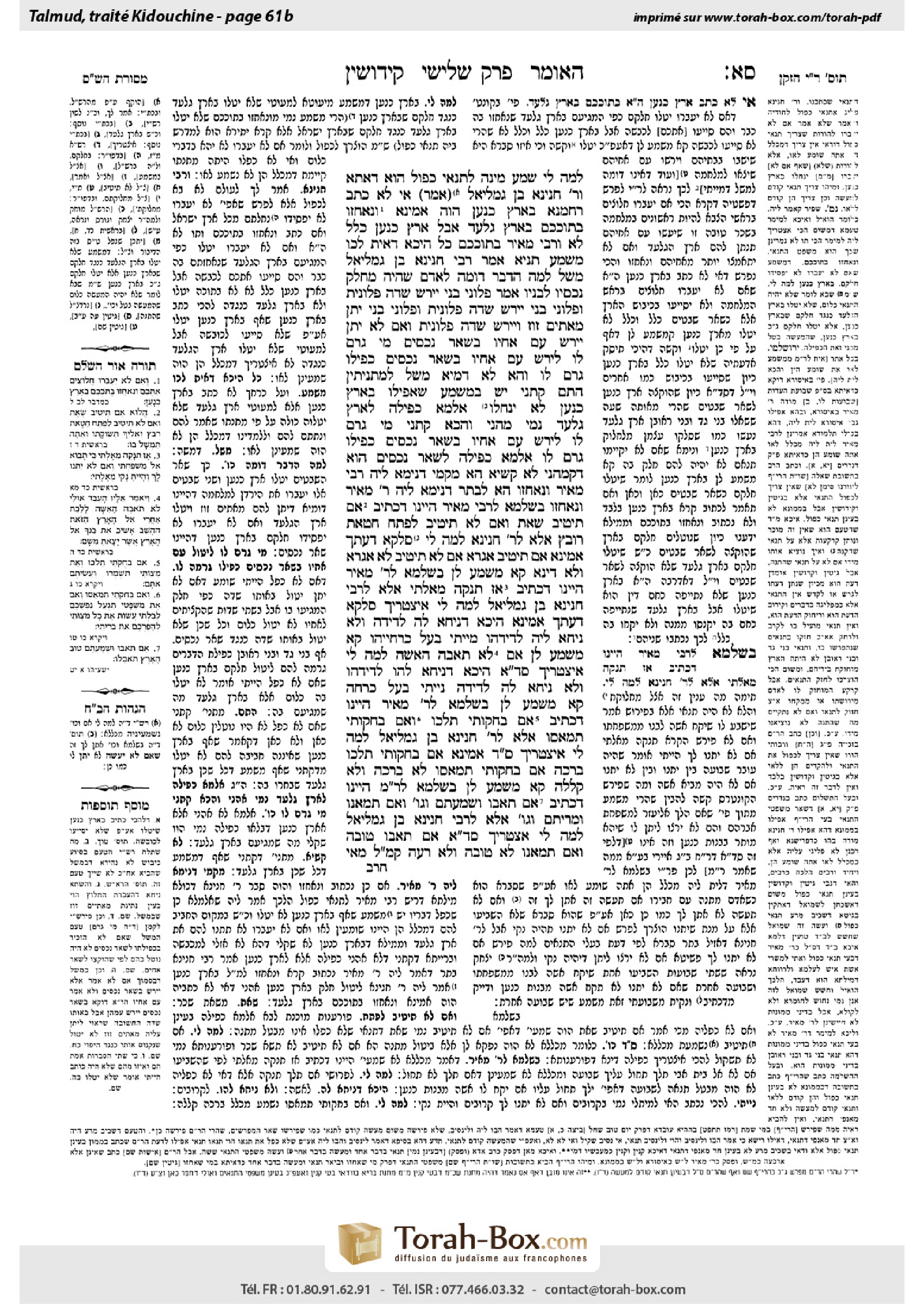
Kiddushin 61b: Talmud study for Daf Yomi
Daf Yomi is the daily study of one Talmud folio. Explore 37 tractates with scans, Hebrew text, Sefaria English and AI-generated French translations where annotated.
Passage selection and English or AI-generated French translation are available where the scan has annotations. Daf Study is independent of Torah-Box and Sefaria.
Browse Kiddushin · קידושין · All tractatesKiddushin 61b text and translations
This page of Kiddushin includes the Aramaic text, an English translation and an AI-generated French translation, alongside the scan above.
קידושין ס״א ב · Aramaic and Hebrew text
לְמָה לִי? שְׁמַע מִינַּהּ לִתְנַאי כָּפוּל הוּא דַּאֲתָא.
וְרַבִּי חֲנִינָא בֶּן גַּמְלִיאֵל אָמַר: אִי לָא כְּתַב רַחֲמָנָא ״בְּאֶרֶץ כְּנַעַן״, הֲוָה אָמֵינָא ״וְנֹאחֲזוּ בְתֹכְכֶם״ – בְּאֶרֶץ גִּלְעָד, אֲבָל אֶרֶץ כְּנַעַן – כְּלָל לָא. וְרַבִּי מֵאִיר? ״בְתֹכְכֶם״ – כֹּל הֵיכָא דְּאִית לְכוּ מַשְׁמַע.
תַּנְיָא: אָמַר רַבִּי חֲנִינָא בֶּן גַּמְלִיאֵל: מָשָׁל לְמָה הַדָּבָר דּוֹמֶה – לְאָדָם שֶׁהָיָה מְחַלֵּק נְכָסָיו לְבָנָיו, אָמַר: פְּלוֹנִי בְּנִי יִירַשׁ שָׂדֶה פְּלוֹנִית, וּפְלוֹנִי בְּנִי יִירַשׁ שָׂדֶה פְּלוֹנִית, וּפְלוֹנִי בְּנִי יִתֵּן מָאתַיִם זוּז וְיִירַשׁ שָׂדֶה פְּלוֹנִית, וְאִם לֹא יִתֵּן – יִירַשׁ עִם אֶחָיו בִּשְׁאָר נְכָסִים.
מִי גָּרַם לוֹ לִירַשׁ עִם אֶחָיו בִּשְׁאָר נְכָסִים – כְּפֵילוֹ גָּרַם לוֹ.
וְהָא לָא דָּמְיָא מָשָׁל לְמַתְנִיתִין! הָתָם קָתָנֵי: יֵשׁ בַּמַּשְׁמָע שֶׁאֲפִילּוּ בְּאֶרֶץ כְּנַעַן לֹא יִנְחָלוּ, אַלְמָא כְּפֵילָה לְאֶרֶץ גִּלְעָד נָמֵי מַהֲנֵי.
וְהָכָא קָתָנֵי: מִי גָּרַם לוֹ לִירַשׁ עִם אֶחָיו בִּשְׁאָר נְכָסִים – כְּפֵילוֹ גָּרַם לוֹ, אַלְמָא כְּפֵילָה לִשְׁאָר נְכָסִים הוּא דְּקָמַהֲנֵי!
לָא קַשְׁיָא. הָא – מִקַּמֵּי דְּנֵימָא לֵיהּ רַבִּי מֵאִיר ״וְנֹאחֲזוּ״,
הָא – לְבָתַר דְּנֵימָא לֵיהּ רַבִּי מֵאִיר ״וְנֹאחֲזוּ״.
בִּשְׁלָמָא לְרַבִּי מֵאִיר, הַיְינוּ דִּכְתִיב: ״אִם תֵּיטִיב שְׂאֵת, וְאִם לֹא תֵיטִיב לַפֶּתַח חַטָּאת רֹבֵץ״. אֶלָּא לְרַבִּי חֲנִינָא לְמָה לִי? סָלְקָא דַּעְתָּךְ אָמֵינָא: אִם תֵּיטִיב – אַגְרָא, אִם לֹא תֵיטִיב – לָא אַגְרָא וְלָא דִּינָא, קָא מַשְׁמַע לַן.
בִּשְׁלָמָא לְרַבִּי מֵאִיר, הַיְינוּ דִּכְתִיב: ״אָז תִּנָּקֶה מֵאָלָתִי״, אֶלָּא לְרַבִּי חֲנִינָא בֶּן גַּמְלִיאֵל לְמָה לִי?
אִצְטְרִיךְ, סָלְקָא דַּעְתָּךְ אָמֵינָא: הֵיכָא דְּנִיחָא לַהּ לְדִידַהּ וְלָא נִיחָא לֵיהּ לְדִידְהוּ מַיְיתֵי בְּעַל כֻּרְחַיְיהוּ, קָא מַשְׁמַע לַן.
״אִם לֹא תֹאבֶה הָאִשָּׁה״ לְמָה לִי? אִצְטְרִיךְ, סָלְקָא דַּעְתָּךְ אָמֵינָא: הֵיכָא דְּנִיחָא לְהוּ לְדִידְהוּ וְלָא נִיחָא לַהּ לְדִידַהּ – נַיְיתֵי בְּעַל כֻּרְחַהּ, קָא מַשְׁמַע לַן.
בִּשְׁלָמָא לְרַבִּי מֵאִיר, הַיְינוּ דִּכְתִיב: ״אִם בְּחֻקֹּתַי תֵּלֵכוּ״, ״וְאִם בְּחֻקֹּתַי תִּמְאָסוּ״, אֶלָּא לְרַבִּי חֲנִינָא בֶּן גַּמְלִיאֵל לְמָה לִי? אִצְטְרִיךְ, סָלְקָא דַּעְתָּךְ אָמֵינָא: ״אִם בְּחֻקֹּתַי תֵּלֵכוּ״ – בְּרָכָה, ״אִם בְּחֻקֹּתַי תִּמְאָסוּ״ – לֹא בְּרָכָה וְלֹא קְלָלָה, קָא מַשְׁמַע לַן.
בִּשְׁלָמָא לְרַבִּי מֵאִיר, הַיְינוּ דִּכְתִיב ״אִם תֹּאבוּ וּשְׁמַעְתֶּם וְגוֹ׳״, ״וְאִם תְּמָאֲנוּ וּמְרִיתֶם וְגוֹ׳״, אֶלָּא לְרַבִּי חֲנִינָא בֶּן גַּמְלִיאֵל לְמָה לִי? אִצְטְרִיךְ, סָלְקָא דַּעְתָּךְ אָמֵינָא: ״אִם תֹּאבוּ״ – טוֹבָה, ״וְאִם תְּמָאֲנוּ״ – לֹא טוֹבָה וְלֹא רָעָה, קָא מַשְׁמַע לַן.
מַאי
Kiddushin 61b · English translation
Why do I need this extra phrase? Conclude from it that it comes to teach the requirement of a compound condition.
And Rabbi Ḥanina ben Gamliel says: If the Merciful One had not written: “In the land of Canaan,” I would say that the requirement: “They shall receive a possession among you” (Numbers 32:30) is referring to the land of Gilead, i.e., this land must be shared with the other tribes. But they would not inherit in the land of Canaan at all. The Gemara asks: And how does Rabbi Meir respond to this claim? He maintains that the expression: “Among you,” means anywhere that you have taken possession, including the land of Canaan. Therefore, the subsequent phrase “the land of Canaan” is superfluous and serves to teach that the condition must be doubled.
It is taught in a baraita with regard to this issue that Rabbi Ḥanina ben Gamliel said: Hear a parable: To what is this matter, i.e., the condition of the children of Gad and Reuben, comparable? It is comparable to a person who was dividing up his property among his sons, and said: My son so-and-so shall inherit such and such a field; and my son so-and-so shall inherit such and such a field; and my son so-and-so shall give two hundred dinars and inherit such and such a field, and if he does not give the money he will inherit a part of the remainder of the property with his brothers.
What causes the last brother to inherit a part of the remainder of the property with his brothers? The father’s double formulation of the condition causes him to inherit in this manner. It was therefore necessary for the father to state both sides and explain what will happen if the third brother fails to give the money. Had the father not repeated the condition, upon failing to give the two hundred dinars the son would not have received any portion of the property.
The Gemara asks: But the parable is not similar to the mishna, as there the mishna teaches: It might have been thought it meant that if they do not fulfill the condition they will not inherit even in the land of Canaan, and certainly not in the land of Gilead. This apparently indicates that the double formulation is also effective for them to inherit the land of Gilead with the other tribes. Otherwise, the children of Gad and Reuben would not receive any part of the Gilead either.
And yet here the baraita teaches: What causes the last brother to inherit a part of the remainder of the property with his brothers? The father’s double formulation causes him. This apparently indicates that the double formulation is effective for the rest of the property, whereas he would have received that portion of the field linked to the condition in any case. According to this reasoning, the children of Gad and Reuben would have been granted a portion in the land of Gilead even without the double formulation.
The Gemara answers: This is not difficult, as this case, referring to Rabbi Ḥanina ben Gamliel’s ruling in the mishna, was stated before Rabbi Meir said to him that the verse could simply have stated: “They shall receive a possession among you.” At that stage, Rabbi Ḥanina ben Gamliel maintained that if the two tribes did not fulfill the condition they would not inherit even in the land of Gilead, as indicated by his use of the term: Even, in the mishna.
Whereas that case, referring to the parable in the baraita, was taught after Rabbi Meir said to Rabbi Ḥanina ben Gamliel that when the phrase: “They shall receive a possession,” appears by itself it is referring to the land of Canaan. As stated previously, Rabbi Ḥanina ben Gamliel responded by explaining that had the verse not stated: “In the land of Canaan,” one would have said that the requirement: “They shall receive a possession among you” (Numbers 32:30), is referring to the land of Gilead, and they would not inherit in the land of Canaan. In other words, even without the compound condition they would have received a portion in Gilead, which is similar to the parable.
§ The Gemara proceeds to analyze these two opinions: Granted, according to the opinion of Rabbi Meir, who requires a compound condition, this is the reason that it is written, with regard to God’s rebuke of Cain: “If you do well, shall it not be lifted up? And if you do not do well, sin crouches at the door” (Genesis 4:7). However, according to the opinion of Rabbi Ḥanina ben Gamliel, why do I need both sides of this stipulation to be specified? The Gemara answers: Were it not for the double formulation it might enter your mind to say that the verse means: If you do well shall you not receive a reward? And if you do not do well you will receive neither reward nor punishment. The double formulation of the verse teaches us that if Cain fails to do well he will be actively punished.
The Gemara asks another question: Granted, according to the opinion of Rabbi Meir, this is the reason that it is written, with regard to Abraham’s instruction to Eliezer to bring a wife for Isaac: “Then you shall be clear from my oath…if they will not give her to you” (Genesis 24:41). However, according to the opinion of Rabbi Ḥanina ben Gamliel, why do I need this addition? The positive formulation of the oath already indicates the negative.
The Gemara answers: It was necessary for this to be stated; if Abraham had stated only: “And take a wife for my son” (Genesis 24:38), it might enter your mind to say: In a case where the arrangement is satisfactory for her, but not satisfactory for her family, he should bring her against their wishes. The verse therefore teaches us that Eliezer is not obligated to bring her against her family’s wishes.
The Gemara inquires about another verse in that chapter: “If the woman is not willing to follow you” (Genesis 24:8). Why do I need this clause? The Gemara answers: It was necessary, since it might enter your mind to say: If it is satisfactory for them but not satisfactory for her, he should bring her against her wishes. The verse therefore teaches us that he should not bring her against her wishes.
The Gemara asks a related question: Granted, according to the opinion of Rabbi Meir, this is the reason that it is written: “If you walk in My statutes” (Leviticus 26:3), you will receive blessings; conversely: “And if you shall reject My statutes” (Leviticus 26:15), you will receive curses. However, according to the opinion of Rabbi Ḥanina ben Gamliel, why do I need both of these clauses? The Gemara answers: They are both necessary, as it might enter your mind to say: If you follow My statutes you will receive a blessing, whereas if you reject My statutes you will receive neither a blessing nor a curse. The verse therefore teaches us that the rejection of God’s statutes warrants a curse.
The Gemara again inquires: Granted, according to the opinion of Rabbi Meir, this is the reason that it is written: “If you are willing and obedient you shall eat the good of the land” (Isaiah 1:19), whereas: “But if you refuse and rebel you shall be devoured by the sword” (Isaiah 1:20). But according to the opinion of Rabbi Ḥanina ben Gamliel, why do I need the double formulation? The Gemara answers in a similar fashion: It is necessary, as it might enter your mind to say: “If you are willing” you will receive good, i.e., reward, “but if you refuse” you will receive neither good nor bad. The verse therefore teaches us that this is not the case, and one who rebels will receive punishment.
In connection with the verse from Isaiah, the Gemara asks: What is the meaning of the phrase:
Kiddushin 61b · Traduction française (IA)
Pourquoi ai-je besoin de cette expression supplémentaire ? Déduis-en qu’elle vient enseigner l’exigence d’une condition double.
Et Rabbi Ḥanina ben Gamliel dit : Si le Miséricordieux n’avait pas écrit « dans le pays de Canaan », j’aurais dit que l’exigence « ils recevront un héritage parmi vous » (Nombres 32:30) se rapporte au pays de Galaad, c’est-à-dire que ce pays doit être partagé avec les autres tribus, mais qu’ils n’hériteraient pas du tout dans le pays de Canaan. La Guemara demande : Et comment Rabbi Meïr répond-il à cette affirmation ? Il soutient que l’expression « parmi vous » signifie partout où vous avez pris possession, y compris dans le pays de Canaan. Par conséquent, l’expression qui suit, « le pays de Canaan », est superflue et vient enseigner que la condition doit être formulée sous ses deux aspects.
Une baraïta enseigne à propos de cette question que Rabbi Ḥanina ben Gamliel dit : Écoutez une parabole. À quoi cette affaire, c’est-à-dire la condition posée aux fils de Gad et de Reouven, est-elle comparable ? À un homme qui partageait ses biens entre ses fils et disait : « Mon fils Untel héritera de tel champ ; mon fils Untel héritera de tel champ ; et mon fils Untel donnera deux cents dinars et héritera de tel champ ; s’il ne donne pas l’argent, il héritera d’une part du reste des biens avec ses frères. »
Qu’est-ce qui fait que le dernier frère hérite d’une part du reste des biens avec ses frères ? C’est la formulation double de la condition par le père qui le fait hériter de cette manière. Il était donc nécessaire que le père énonce les deux possibilités et explique ce qui se produirait si le troisième frère ne donnait pas l’argent. Si le père n’avait pas répété la condition, le fils n’aurait reçu aucune part des biens s’il n’avait pas donné les deux cents dinars.
La Guemara demande : Mais la parabole ne correspond pas à la Michna. En effet, la Michna enseigne : On aurait pu croire que cela signifie que, s’ils ne remplissent pas la condition, ils n’hériteront même pas dans le pays de Canaan, et à plus forte raison pas dans le pays de Galaad. Cela semble indiquer que la formulation double leur permet également d’hériter du pays de Galaad avec les autres tribus. Sinon, les fils de Gad et de Reouven ne recevraient aucune part du pays de Galaad non plus.
Et pourtant, ici, la baraïta enseigne : Qu’est-ce qui fait que le dernier frère hérite d’une part du reste des biens avec ses frères ? C’est la formulation double du père. Cela semble indiquer que la formulation double produit son effet pour le reste des biens, tandis qu’il aurait de toute façon reçu cette part du champ liée à la condition. Selon ce raisonnement, les fils de Gad et de Reouven auraient reçu une part du pays de Galaad même sans la formulation double.
La Guemara répond : Il n’y a pas de difficulté, car ce cas — celui de l’enseignement de Rabbi Ḥanina ben Gamliel dans la Michna — a été évoqué avant que Rabbi Meïr ne lui dise que le verset aurait simplement pu dire : « Ils recevront un héritage parmi vous. » À ce stade, Rabbi Ḥanina ben Gamliel soutenait que, si les deux tribus ne remplissaient pas la condition, elles n’hériteraient même pas dans le pays de Galaad, comme l’indique l’emploi du terme « même » dans la Michna.
En revanche, cet autre cas — celui de la parabole dans la baraïta — a été enseigné après que Rabbi Meïr eut dit à Rabbi Ḥanina ben Gamliel que, lorsque l’expression « ils recevront un héritage » apparaît seule, elle se rapporte au pays de Canaan. Comme on l’a dit précédemment, Rabbi Ḥanina ben Gamliel répondit en expliquant que, si le verset n’avait pas dit « dans le pays de Canaan », on aurait dit que l’exigence « ils recevront un héritage parmi vous » (Nombres 32:30) se rapporte au pays de Galaad et qu’ils n’hériteraient pas dans le pays de Canaan. Autrement dit, même sans la condition double, ils auraient reçu une part en Galaad, ce qui correspond à la parabole.
§ La Guemara poursuit l’examen de ces deux opinions : Certes, selon Rabbi Meïr, qui exige une condition double, voilà pourquoi il est écrit, à propos du reproche adressé par Dieu à Caïn : « Si tu agis bien, ne seras-tu pas exalté ? Et si tu n’agis pas bien, le péché est tapi à la porte » (Genèse 4:7). Mais selon Rabbi Ḥanina ben Gamliel, pourquoi faut-il préciser les deux aspects de cette stipulation ? La Guemara répond : Sans la formulation double, tu aurais pu penser que le verset signifie : « Si tu agis bien, ne recevras-tu pas de récompense ? Et si tu n’agis pas bien, tu ne recevras ni récompense ni punition. » La formulation double du verset nous enseigne que, si Caïn n’agit pas bien, il sera effectivement puni.
La Guemara pose une autre question : Certes, selon Rabbi Meïr, voilà pourquoi il est écrit, à propos de l’instruction d’Abraham à Éliézer d’aller chercher une femme pour Isaac : « Alors tu seras quitte de mon serment… s’ils ne te la donnent pas » (Genèse 24:41). Mais selon Rabbi Ḥanina ben Gamliel, pourquoi cette précision est-elle nécessaire ? La formulation positive du serment indique déjà son contraire.
La Guemara répond : Il était nécessaire de le préciser. Si Abraham avait seulement dit : « Et prends une femme pour mon fils » (Genèse 24:38), tu aurais pu penser que, si cela convenait à la jeune femme mais pas à sa famille, Éliézer devrait l’emmener contre la volonté de celle-ci. Le verset nous enseigne donc qu’Éliézer n’est pas tenu de l’emmener contre la volonté de sa famille.
La Guemara s’interroge sur un autre verset de ce chapitre : « Si la femme ne veut pas te suivre » (Genèse 24:8). Pourquoi cette proposition est-elle nécessaire ? La Guemara répond : Elle était nécessaire, car tu aurais pu penser que, si cela convenait à sa famille mais pas à elle, il devrait l’emmener contre sa volonté. Le verset nous enseigne donc qu’il ne doit pas l’emmener contre sa volonté.
La Guemara pose une question connexe : Certes, selon Rabbi Meïr, voilà pourquoi il est écrit : « Si vous suivez Mes lois » (Lévitique 26:3), vous recevrez des bénédictions ; à l’inverse, « si vous rejetez Mes lois » (Lévitique 26:15), vous recevrez des malédictions. Mais selon Rabbi Ḥanina ben Gamliel, pourquoi ces deux propositions sont-elles nécessaires ? La Guemara répond qu’elles le sont toutes les deux, car tu aurais pu penser que, si vous suivez Mes lois, vous recevrez une bénédiction, tandis que, si vous rejetez Mes lois, vous ne recevrez ni bénédiction ni malédiction. Le verset nous enseigne donc que le rejet des lois de Dieu mérite une malédiction.
La Guemara s’interroge de nouveau : Certes, selon Rabbi Meïr, voilà pourquoi il est écrit : « Si vous consentez et obéissez, vous mangerez les bonnes choses du pays » (Isaïe 1:19), tandis que « si vous refusez et vous révoltez, vous serez dévorés par l’épée » (Isaïe 1:20). Mais selon Rabbi Ḥanina ben Gamliel, pourquoi la formulation double est-elle nécessaire ? La Guemara répond de manière analogue : Elle est nécessaire, car tu aurais pu penser que, « si vous consentez », vous recevrez le bien, c’est-à-dire une récompense, mais que, « si vous refusez », vous ne recevrez ni bien ni mal. Le verset nous enseigne que ce n’est pas le cas et que celui qui se révolte sera puni.
À propos du verset d’Isaïe, la Guemara demande : Quel est le sens de l’expression :
Traduction française générée par IA à partir de l’édition anglaise de Sefaria. Vérifie toujours un passage avec le texte source.
Text from Sefaria: William Davidson Edition - Vocalized Aramaic (CC BY NC); William Davidson Edition - English (CC BY NC).