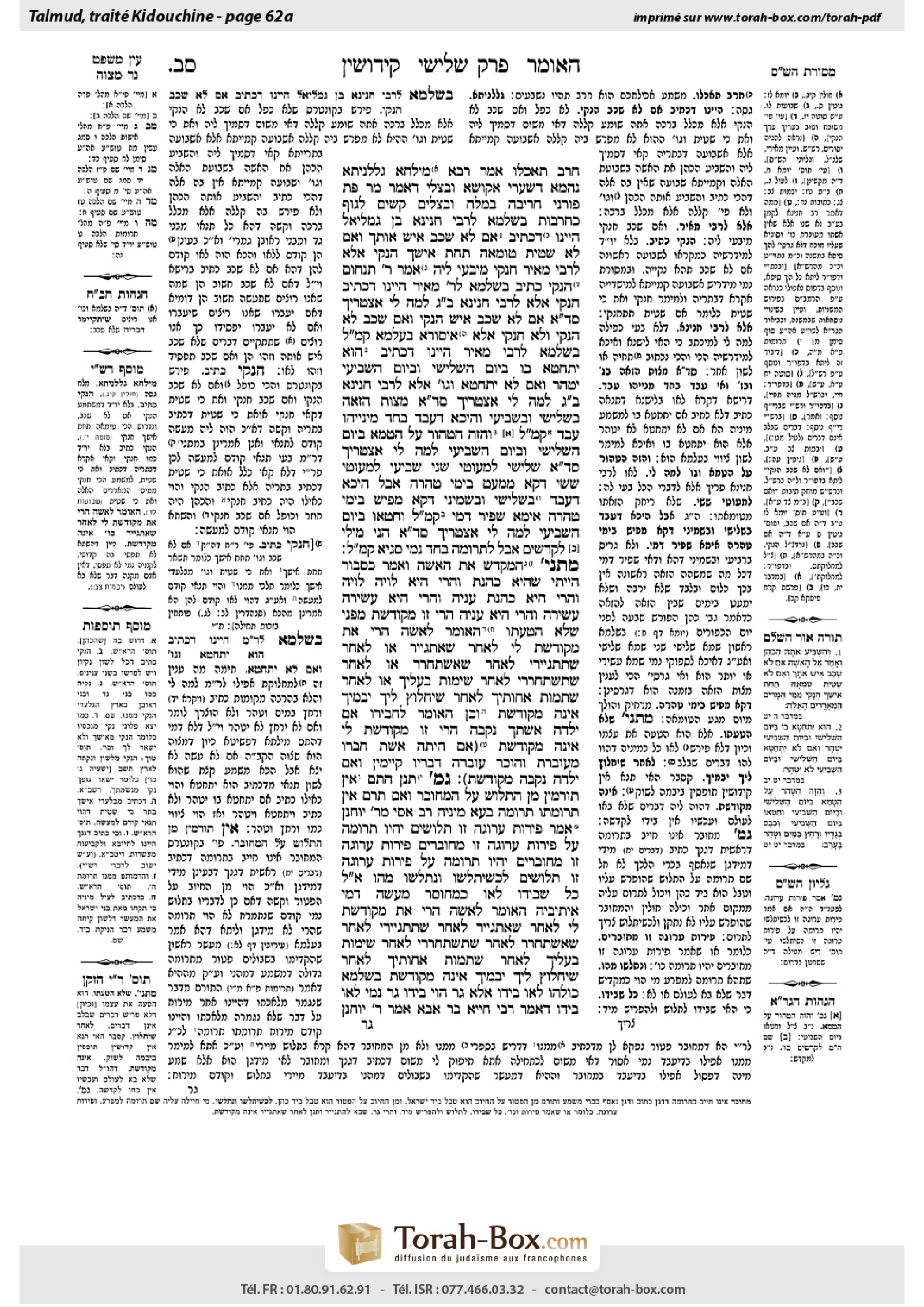
Kiddushin 62a: Talmud study for Daf Yomi
Daf Yomi is the daily study of one Talmud folio. Explore 37 tractates with scans, Hebrew text, Sefaria English and AI-generated French translations where annotated.
Passage selection and English or AI-generated French translation are available where the scan has annotations. Daf Study is independent of Torah-Box and Sefaria.
Browse Kiddushin · קידושין · All tractatesKiddushin 62a text and translations
This page of Kiddushin includes the Aramaic text, an English translation and an AI-generated French translation, alongside the scan above.
קידושין ס״ב א · Aramaic and Hebrew text
״חֶרֶב תְּאֻכְּלוּ״? אָמַר רָבָא: מִילְחָא גְּלָלְנִיתָא, נַהֲמָא דִשְׂעָרֵי אַקּוּשָׁא, וּבֻצְלֵי. דְּאָמַר מָר: פַּת פּוּרְנִי חֲרֵיבָה בְּמֶלַח, וּבְצָלִים – קָשִׁים לַגּוּף כַּחֲרָבוֹת.
בִּשְׁלָמָא לְרַבִּי חֲנִינָא בֶּן גַּמְלִיאֵל, הַיְינוּ דִּכְתִיב: ״אִם לֹא שָׁכַב אִישׁ אֹתָךְ וְאִם לֹא שָׂטִית טֻמְאָה תַּחַת אִישֵׁךְ הִנָּקִי״, אֶלָּא לְרַבִּי מֵאִיר, ״חִנְקִי״ מִיבְּעֵי לֵיהּ! אָמַר רַבִּי תַּנְחוּם: ״הנקי״ כְּתִיב.
בִּשְׁלָמָא לְרַבִּי מֵאִיר, הַיְינוּ דִּכְתִיב: ״הִנָּקִי״, אֶלָּא לְרַבִּי חֲנִינָא בֶּן גַּמְלִיאֵל לְמָה לִי? אִצְטְרִיךְ, סָלְקָא דַּעְתָּךְ אָמֵינָא: ״אִם לֹא שָׁכַב אִישׁ״ – הִנָּקִי, ״וְאִם שָׁכַב״ – לֹא הִנָּקִי וְלֹא חִנְקִי, אֶלָּא אִיסּוּרָא בְּעָלְמָא, קָא מַשְׁמַע לַן.
בִּשְׁלָמָא לְרַבִּי מֵאִיר, הַיְינוּ דִּכְתִיב: ״הוּא יִתְחַטָּא בוֹ בַּיּוֹם הַשְּׁלִישִׁי וּבַיּוֹם הַשְּׁבִיעִי יִטְהָר וְאִם לֹא יִתְחַטָּא וְגוֹ׳״, אֶלָּא לְרַבִּי חֲנִינָא בֶּן גַּמְלִיאֵל לְמָה לִי?
אִצְטְרִיךְ, סָלְקָא דַּעְתָּךְ אָמֵינָא: מִצְוַת הַזָּאָה בַּשְּׁלִישִׁי וּבַשְּׁבִיעִי, וְהֵיכָא דַּעֲבַד בְּחַד מִינַּיְיהוּ עֲבַד – קָא מַשְׁמַע לַן.
״וְהִזָּה הַטָּהֹר עַל הַטָּמֵא בַּיּוֹם הַשְּׁלִישִׁי וּבַיּוֹם הַשְּׁבִיעִי״ לְמָה לִי? אִצְטְרִיךְ, סָלְקָא דַּעְתָּךְ אָמֵינָא: שְׁלִישִׁי לְמַעוֹטֵי שֵׁנִי, שְׁבִיעִי לְמַעוֹטֵי שִׁשִּׁי, דְּקָא מְמַעֵט בִּימֵי טׇהֳרָה, אֲבָל הֵיכָא דַּעֲבַד בִּשְׁלִישִׁי וּבִשְׁמִינִי, דְּקָא מַפֵּישׁ בִּימֵי טׇהֳרָה – אֵימָא שַׁפִּיר דָּמֵי, קָא מַשְׁמַע לַן.
״וְחִטְּאוֹ בַּיּוֹם הַשְּׁבִיעִי״ לְמָה לִי? אִצְטְרִיךְ, סָלְקָא דַּעְתָּךְ אָמֵינָא: הָנֵי מִילֵּי לְקׇדָשִׁים, אֲבָל לִתְרוּמָה – בְּחַד נָמֵי סַגִּיא, קָא מַשְׁמַע לַן.
מַתְנִי׳ הַמְקַדֵּשׁ אֶת הָאִשָּׁה וְאָמַר: כְּסָבוּר הָיִיתִי שֶׁהִיא כֹּהֶנֶת וַהֲרֵי הִיא לְוִיָּה, לְוִיָּה וַהֲרֵי הִיא כֹּהֶנֶת, עֲנִיָּה וַהֲרֵי הִיא עֲשִׁירָה, עֲשִׁירָה וַהֲרֵי הִיא עֲנִיָּה – הֲרֵי זוֹ מְקוּדֶּשֶׁת, מִפְּנֵי שֶׁלֹּא הִטְעַתּוּ.
הָאוֹמֵר לָאִשָּׁה: ״הֲרֵי אַתְּ מְקוּדֶּשֶׁת לִי לְאַחַר שֶׁאֶתְגַּיֵּיר״, אוֹ ״לְאַחַר שֶׁתִּתְגַּיְּירִי״, ״לְאַחַר שֶׁאֶשְׁתַּחְרֵר״, אוֹ ״לְאַחַר שֶׁתִּשְׁתַּחְרְרִי״, ״לְאַחַר שֶׁיָּמוּת בַּעְלִיךְ״, אוֹ ״לְאַחַר שֶׁתָּמוּת אֲחוֹתִיךְ״, ״לְאַחַר שֶׁיַּחְלוֹץ לִיךְ יְבָמִיךְ״ – אֵינָהּ מְקוּדֶּשֶׁת.
וְכֵן הָאוֹמֵר לַחֲבֵירוֹ: ״אִם יָלְדָה אִשְׁתְּךָ נְקֵבָה הֲרֵי זוֹ מְקוּדֶּשֶׁת לִי״ – אֵינָהּ מְקוּדֶּשֶׁת. אִם הָיְתָה אֵשֶׁת חֲבֵרוֹ מְעוּבֶּרֶת וְהוּכַּר עוּבָּרָהּ – דְּבָרָיו קַיָּימִין, וְאִם יָלְדָה נְקֵבָה – מְקוּדֶּשֶׁת.
גְּמָ׳ תְּנַן הָתָם: אֵין תּוֹרְמִין מִן הַתָּלוּשׁ עַל הַמְחוּבָּר. וְאִם תָּרַם – אֵין תְּרוּמָתוֹ תְּרוּמָה.
בְּעָא מִינֵּיהּ רַב אַסִּי מֵרַבִּי יוֹחָנָן: אָמַר ״פֵּירוֹת עֲרוּגָה זוֹ תְּלוּשִׁים יִהְיוּ תְּרוּמָה עַל פֵּירוֹת עֲרוּגָה זוֹ מְחוּבָּרִים״, ״פֵּירוֹת עֲרוּגָה זוֹ מְחוּבָּרִים יִהְיוּ תְּרוּמָה עַל פֵּירוֹת עֲרוּגָה זוֹ תְּלוּשִׁים לִכְשֶׁיִּתָּלְשׁוּ״ וְנִתְלְשׁוּ, מַהוּ? אֲמַר לֵיהּ: כֹּל שֶׁבְּיָדוֹ לָאו כִּמְחוּסָּר מַעֲשֶׂה דָּמֵי.
אֵיתִיבֵיהּ: הָאוֹמֵר לָאִשָּׁה: ״הֲרֵי אַתְּ מְקוּדֶּשֶׁת לִי לְאַחַר שֶׁאֶתְגַּיֵּיר״, ״לְאַחַר שֶׁתִּתְגַּיְּירִי״, ״לְאַחַר שֶׁאֶשְׁתַּחְרֵר״, ״לְאַחַר שֶׁתִּשְׁתַּחְרְרִי״, ״לְאַחַר שֶׁיָּמוּת בַּעְלִיךְ״, ״לְאַחַר שֶׁתָּמוּת אֲחוֹתִיךְ״, ״לְאַחַר שֶׁיַּחְלוֹץ לִיךְ יְבָמִיךְ״ – אֵינָהּ מְקוּדֶּשֶׁת.
בִּשְׁלָמָא כּוּלְּהוּ לָאו בְּיָדוֹ, אֶלָּא גֵּר, הָוֵי בְּיָדוֹ! גֵּר נָמֵי לָאו בְּיָדוֹ, דְּאָמַר רַבִּי חִיָּיא בַּר אַבָּא אָמַר רַבִּי יוֹחָנָן:
Kiddushin 62a · English translation
“You shall be devoured by the sword” (Isaiah 1:20)? Rava says: This verse should be interpreted as if it states: You shall devour the sword, i.e., you shall eat food that harms the body like a sword, e.g., coarse grains [gelalenita] of salt, hard barley bread, and onions. As the Master said: Dried bakery [purnei] bread eaten with salt and onions harms the body like swords.
The Gemara asks: Granted, according to the opinion of Rabbi Ḥanina ben Gamliel, this is the reason that it is written with regard to a sota: “If no man has lain with you, and if you have not gone aside to uncleanness, being under your husband, you shall be free [hinnaki]” (Numbers 5:19), without specifying the negative side of this condition. But according to the opinion of Rabbi Meir, the verse should have stated: And if a man has lain with you, you should choke [ḥinnaki] and die. According to the opinion of Rabbi Meir, the verse should have clarified the other side of the condition and its ensuing punishment. Rabbi Tanḥum said: Indeed, a truncated form of hinnaki without the letter yod is written. This indicates that the word should be interpreted in two ways, as both hinnaki and ḥinnaki.
The Gemara continues: Granted, according to the opinion of Rabbi Meir, this is the reason that it is written hinnaki without the yod, to allude to the other side of the condition. But according to the opinion of Rabbi Ḥanina ben Gamliel, why do I need this word to be written in this way? The Gemara answers: It is necessary, as it might enter your mind to say: If no man has lain with you, you shall be free, and if he has lain with you, you should neither be free nor choke; rather, it is merely a prohibition that does not warrant a severe punishment. The unusual form of the term hinnaki teaches us that this is not the case.
Granted, according to the opinion of Rabbi Meir, this is the reason that it is written, with regard to one being purified with the water of purification from contact with a corpse: “He shall purify himself with it on the third day and on the seventh day, and he shall be pure; but if he does not purify himself on the third day and on the seventh day he shall not be pure” (Numbers 19:11–12). But according to the opinion of Rabbi Ḥanina ben Gamliel, why do I need this double formulation?
The Gemara answers: It is necessary, as it might enter your mind to say: The mitzva of sprinkling the water of purification must be performed on the third and seventh days ab initio, but if he performed it on one of them alone, the ritual is considered performed and he is purified after the fact. The verse therefore teaches us that this is not the case.
The Gemara asks about a later verse in the same chapter: “And the pure shall sprinkle on the impure on the third day and on the seventh day” (Numbers 19:19). Why do I need this repetition of the command? This was already stated earlier. The Gemara answers: It is necessary, as it might enter your mind to say that the third day excludes the second, i.e., he cannot receive the sprinkling of the water of purification before the third day, and similarly the seventh excludes the sixth day, because he thereby decreases the days of purity before the sprinkling. But if he performed the sprinkling on the third and on the eighth days, in which case he increases and adds to the days of purity, you might say that this is proper. The verse therefore teaches us that there must be a fixed interval of four days between each sprinkling ritual.
The Gemara further analyzes this verse: Why do I need the phrase: “And on the seventh day he shall purify him” (Numbers 19:19)? The Gemara answers: It is necessary, as it might enter your mind to say: This matter, i.e., the requirement to receive the sprinkling twice, applies only for eating and touching consecrated meat; but for partaking of teruma one sprinkling is also sufficient. The verse therefore teaches us that this is not the case.
MISHNA: With regard to one who betroths a woman and later says: When I betrothed her I thought that she was the daughter of a priest, and it turned out that she is the daughter of a Levite, or if he claims that he thought she was the daughter of a Levite and she is actually the daughter of a priest, or if he claims that he thought she was poor and she is wealthy; or wealthy and she is poor, in all of these cases she is betrothed, because she did not mislead him, and no explicit condition was stated with regard to these matters.
With regard to one who says to a woman: You are hereby betrothed to me after I convert, or: After you convert, or if he was a Canaanite slave and says: After I am emancipated, or if she was a Canaanite maidservant and he says: After you are emancipated, or if he says to a married woman: After your husband dies, or to his wife’s sister: After your sister dies, or if he says to a woman awaiting levirate marriage or ḥalitza from a brother-in-law [yavam], who in the opinion of this tanna cannot be betrothed by another man: After your yavam performs ḥalitza for you, in all these cases she is not betrothed. Since he cannot betroth her at the present time, his attempt at betrothal is ineffective.
And similarly, with regard to one who says to another: If your wife gives birth to a female the child is hereby betrothed to me, even if she becomes pregnant, or is pregnant but her pregnancy is not known, if she gives birth to a girl, that child is not betrothed to him. But if he said this when the wife of the other man was pregnant and her fetus was discernible at the time, i.e., her pregnancy was known, his statement is upheld, and therefore if she gives birth to a girl, the child is betrothed to him.
GEMARA: We learned in a mishna there (Terumot 1:5): One may not separate teruma from produce that has been detached from the ground for, i.e., to render permitted, produce that is attached to the ground. Produce still attached to the ground is not included in the obligation of teruma. And if he separated teruma in this manner, his teruma is not teruma, even after the produce has been detached from the ground.
Rav Asi raised a dilemma before Rabbi Yoḥanan: What is the halakha if one said: The detached produce of this garden bed should be teruma for the attached produce of this garden bed; or: The attached produce of this garden bed should be teruma for the detached produce of this garden bed, not now but when they will be detached; and the produce was subsequently detached? Rabbi Yoḥanan said to him: Anything that is in one’s power to perform is not considered lacking in its action. Since he could theoretically detach the produce at this very moment, teruma can be separated from it.
Rav Asi raised an objection to the opinion of Rabbi Yoḥanan from the mishna. With regard to one who says to a woman: You are hereby betrothed to me after I convert, or: After you convert, or: After I am emancipated, or: After you are emancipated, or: After your husband dies, or: After your sister dies, or: After your yavam performs ḥalitza for you, in all of these cases she is not betrothed.
Rav Asi explains his objection: Granted, in all of these cases but one it is not in his power to bring about the situation when he will be able to betroth her, but in the case of a convert, the matter is in his power, as he could convert now if he so chooses. According to the opinion of Rabbi Yoḥanan, any action that could potentially be performed is considered as though it has actually been performed. The Gemara responds: In the case of a convert, it is also not in his power to convert whenever he wants, as Rabbi Ḥiyya bar Abba says that Rabbi Yoḥanan says:
Kiddushin 62a · Traduction française (IA)
« Vous serez dévorés par l’épée » (Isaïe 1:20) ? Rava dit : Ce verset doit être interprété comme s’il disait : Vous dévorerez l’épée, c’est-à-dire que vous mangerez des aliments qui nuisent au corps comme une épée, par exemple des grains grossiers [gelalenita] de sel, du pain d’orge dur et des oignons. Car le Maître a dit : Le pain de boulangerie séché [purnei], mangé avec du sel et des oignons, nuit au corps comme des épées.
La Guemara demande : Certes, selon l’opinion de Rabbi Ḥanina ben Gamliel, c’est pour cette raison qu’il est écrit au sujet d’une sota : « Si aucun homme n’a couché avec toi et si tu ne t’es pas écartée pour te souiller, alors que tu étais sous l’autorité de ton mari, tu seras quitte [hinnaki] » (Nombres 5:19), sans préciser l’autre éventualité de cette condition. Mais selon l’opinion de Rabbi Meir, le verset aurait dû dire : « Et si un homme a couché avec toi, tu seras étranglée [ḥinnaki] et tu mourras. » Selon l’opinion de Rabbi Meir, le verset aurait dû préciser l’autre éventualité de la condition et la punition qui s’ensuit. Rabbi Tanḥum dit : En effet, une forme tronquée de hinnaki, sans la lettre yod, est écrite. Cela indique que le mot doit s’interpréter de deux façons, comme hinnaki et comme ḥinnaki.
La Guemara poursuit : Certes, selon l’opinion de Rabbi Meir, c’est pour cette raison que hinnaki est écrit sans le yod, afin de faire allusion à l’autre éventualité de la condition. Mais selon l’opinion de Rabbi Ḥanina ben Gamliel, pourquoi ce mot doit-il être écrit ainsi ? La Guemara répond : C’est nécessaire, car on pourrait penser que, si aucun homme n’a couché avec toi, tu seras quitte, et que, s’il a couché avec toi, tu ne seras ni quitte ni étranglée ; il s’agirait alors simplement d’une interdiction qui ne justifie pas une punition sévère. La forme inhabituelle du terme hinnaki nous enseigne que ce n’est pas le cas.
Certes, selon l’opinion de Rabbi Meir, c’est pour cette raison qu’il est écrit, au sujet de celui qui se purifie avec l’eau de purification après avoir été en contact avec un cadavre : « Il se purifiera avec elle le troisième jour et le septième jour, et il sera pur ; mais s’il ne se purifie pas le troisième jour et le septième jour, il ne sera pas pur » (Nombres 19:11–12). Mais selon l’opinion de Rabbi Ḥanina ben Gamliel, pourquoi cette double formulation est-elle nécessaire ?
La Guemara répond : C’est nécessaire, car on pourrait penser que la mitsva d’aspersion de l’eau de purification doit être accomplie le troisième et le septième jour a priori, mais que si elle n’était accomplie que l’un de ces deux jours, le rite serait considéré comme accompli et la personne serait purifiée a posteriori. Le verset nous enseigne donc que ce n’est pas le cas.
La Guemara pose une question sur un verset ultérieur du même chapitre : « Et l’homme pur fera l’aspersion sur l’homme impur le troisième jour et le septième jour » (Nombres 19:19). Pourquoi cette répétition du commandement est-elle nécessaire ? Cela a déjà été énoncé précédemment. La Guemara répond : C’est nécessaire, car on pourrait penser que le troisième jour exclut le deuxième, c’est-à-dire qu’il ne peut recevoir l’aspersion de l’eau de purification avant le troisième jour, et que, de même, le septième jour exclut le sixième, puisqu’il réduirait ainsi le nombre de jours de purification précédant l’aspersion. Mais si l’aspersion était faite le troisième et le huitième jour, auquel cas il augmenterait le nombre de jours de purification, on pourrait penser que cela convient. Le verset nous enseigne donc qu’il doit y avoir un intervalle fixe de quatre jours entre chaque rite d’aspersion.
La Guemara analyse encore ce verset : Pourquoi l’expression « et le septième jour, il le purifiera » (Nombres 19:19) est-elle nécessaire ? La Guemara répond : C’est nécessaire, car on pourrait penser que cette règle, c’est-à-dire l’obligation de recevoir deux aspersions, ne s’applique qu’à la consommation et au contact de viande consacrée, mais que, pour consommer de la terouma, une seule aspersion suffit également. Le verset nous enseigne donc que ce n’est pas le cas.
Michna : Celui qui fiance une femme, puis déclare : « Lorsque je l’ai fiancée, je pensais qu’elle était la fille d’un prêtre », alors qu’il s’avère qu’elle est la fille d’un lévite ; ou s’il prétend avoir pensé qu’elle était la fille d’un lévite, alors qu’elle est en réalité la fille d’un prêtre ; ou s’il prétend avoir pensé qu’elle était pauvre, alors qu’elle est riche, ou riche, alors qu’elle est pauvre : dans tous ces cas, elle est fiancée, car elle ne l’a pas induit en erreur et aucune condition explicite n’a été formulée à propos de ces éléments.
Celui qui dit à une femme : « Tu m’es fiancée après ma conversion », ou : « Après ta conversion » ; ou s’il est un esclave cananéen et dit : « Après mon affranchissement » ; ou si elle est une servante cananéenne et qu’il dit : « Après ton affranchissement » ; ou s’il dit à une femme mariée : « Après la mort de ton mari » ; ou à la sœur de sa femme : « Après la mort de ta sœur » ; ou s’il dit à une femme qui attend le lévirat ou la ḥalitsa de son beau-frère [yavam], qui, selon l’opinion de ce tanna, ne peut pas être fiancée par un autre homme : « Après que ton yavam aura accompli pour toi la ḥalitsa », dans tous ces cas, elle n’est pas fiancée. Puisqu’il ne peut pas la fiancer dans l’immédiat, sa tentative de fiançailles est sans effet.
De même, celui qui dit à un autre : « Si ta femme donne naissance à une fille, l’enfant m’est fiancée », n’obtient pas que l’enfant lui soit fiancée si la femme tombe ensuite enceinte, ou si elle est déjà enceinte mais que sa grossesse n’est pas connue, même si elle donne naissance à une fille. Mais s’il a dit cela alors que la femme de l’autre homme était enceinte et que son fœtus était discernable à ce moment-là, c’est-à-dire que sa grossesse était connue, sa déclaration est valide ; par conséquent, si elle donne naissance à une fille, l’enfant lui est fiancée.
Guemara : Nous avons appris dans une Michna là-bas (Teroumot 1:5) : On ne peut pas prélever la terouma sur des produits détachés du sol afin de rendre permis des produits encore attachés au sol. Les produits encore attachés au sol ne sont pas soumis à l’obligation de terouma. Et s’il a prélevé la terouma de cette manière, son prélèvement n’est pas valide, même après que les produits ont été détachés du sol.
Rav Asi posa une question à Rabbi Yoḥanan : Quelle est la halakha si quelqu’un a dit : « Que les produits détachés de cette parcelle soient la terouma pour les produits qui y sont encore attachés » ; ou : « Que les produits attachés de cette parcelle soient la terouma pour les produits détachés », non pas maintenant, mais lorsqu’ils seront détachés ; et que les produits ont ensuite été détachés ? Rabbi Yoḥanan lui dit : Tout ce qu’une personne a le pouvoir d’accomplir n’est pas considéré comme une action qui n’a pas encore été faite. Puisqu’il aurait théoriquement pu détacher les produits à cet instant même, la terouma peut en être prélevée.
Rav Asi objecta à l’opinion de Rabbi Yoḥanan en s’appuyant sur la Michna. Celui qui dit à une femme : « Tu m’es fiancée après ma conversion », ou : « Après ta conversion », ou : « Après mon affranchissement », ou : « Après ton affranchissement », ou : « Après la mort de ton mari », ou : « Après la mort de ta sœur », ou : « Après que ton yavam aura accompli pour toi la ḥalitsa », dans tous ces cas, elle n’est pas fiancée.
Rav Asi explique son objection : Certes, dans tous ces cas sauf un, il n’est pas en son pouvoir de faire advenir la situation qui lui permettra de la fiancer ; mais dans le cas d’un converti, cela est en son pouvoir, puisqu’il pourrait se convertir dès maintenant s’il le voulait. Selon l’opinion de Rabbi Yoḥanan, toute action susceptible d’être accomplie est considérée comme si elle avait déjà été accomplie. La Guemara répond : Dans le cas d’un converti aussi, il n’est pas en son pouvoir de se convertir quand il le veut, car Rabbi Ḥiyya bar Abba dit au nom de Rabbi Yoḥanan :
Traduction française générée par IA à partir de l’édition anglaise de Sefaria. Vérifie toujours un passage avec le texte source.
Text from Sefaria: William Davidson Edition - Vocalized Aramaic (CC BY NC); William Davidson Edition - English (CC BY NC).