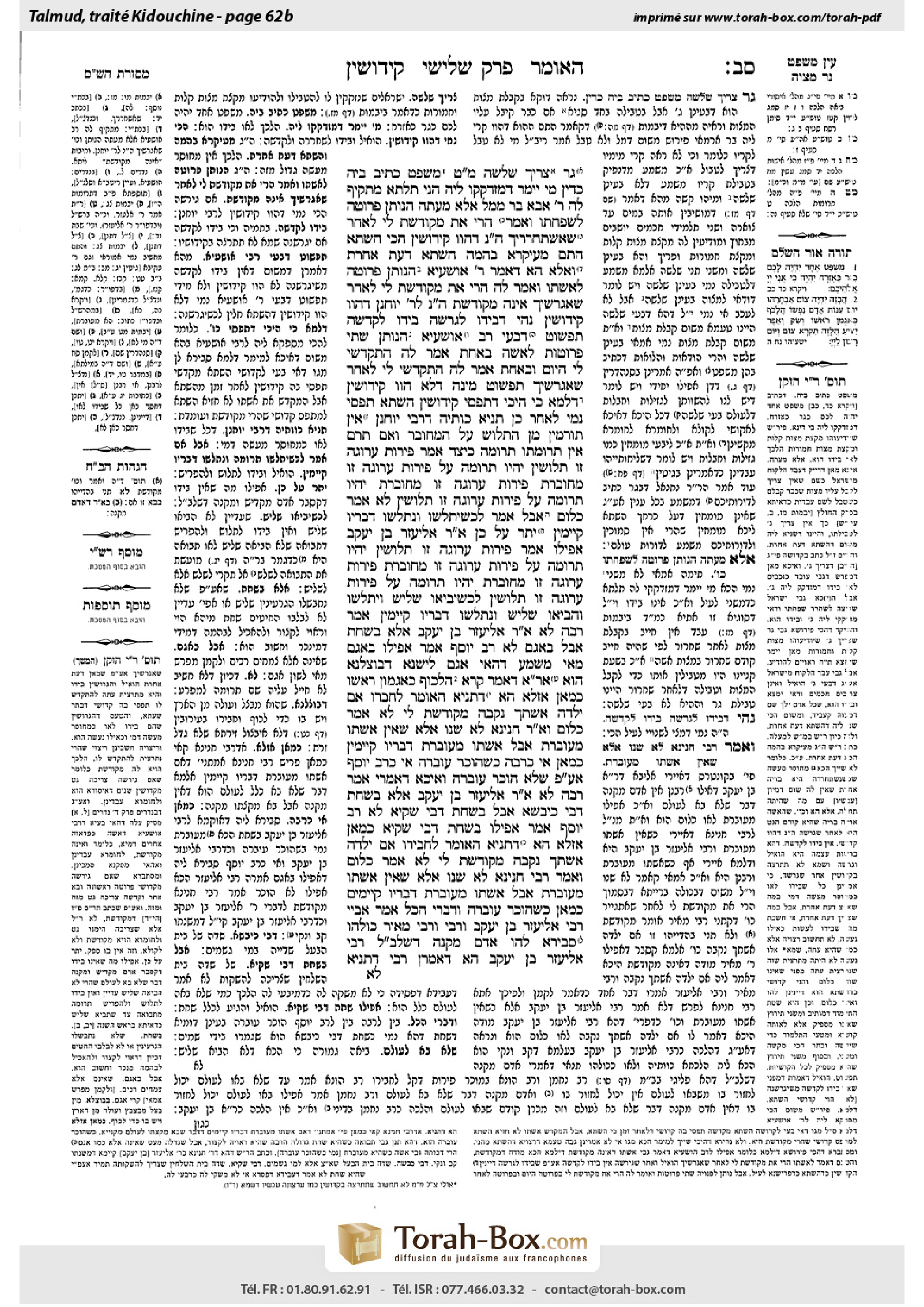
Kiddushin 62b: Talmud study for Daf Yomi
Daf Yomi is the daily study of one Talmud folio. Explore 37 tractates with scans, Hebrew text, Sefaria English and AI-generated French translations where annotated.
Passage selection and English or AI-generated French translation are available where the scan has annotations. Daf Study is independent of Torah-Box and Sefaria.
Browse Kiddushin · קידושין · All tractatesKiddushin 62b text and translations
This page of Kiddushin includes the Aramaic text, an English translation and an AI-generated French translation, alongside the scan above.
קידושין ס״ב ב · Aramaic and Hebrew text
גֵּר צָרִיךְ שְׁלֹשָׁה. מַאי טַעְמָא: ״מִשְׁפָּט״ כְּתִיב בֵּיהּ כַּדִּין, מִי יֵימַר דְּמִזְדַּקְּקוּ לֵיהּ הָנֵי תְּלָתָא.
מַתְקֵיף לַהּ רַבִּי אַבָּא בַּר מֶמֶל: אֶלָּא מֵעַתָּה, הַנּוֹתֵן פְּרוּטָה לְשִׁפְחָתוֹ, וְאָמַר: ״הֲרֵי אַתְּ מְקוּדֶּשֶׁת לִי לְאַחַר שֶׁאֲשַׁחְרְרִיךְ״ – הָכִי נָמֵי דְּהָווּ קִידּוּשִׁין? הָכִי הַשְׁתָּא?! הָתָם – מֵעִיקָּרָא בְּהֵמָה, הַשְׁתָּא – דַּעַת אַחֶרֶת.
וְאֶלָּא הָא דְּאָמַר רַבִּי אוֹשַׁעְיָא: הַנּוֹתֵן פְּרוּטָה לְאִשְׁתּוֹ וְאָמַר לָהּ: ״הֲרֵי אַתְּ מְקוּדֶּשֶׁת לִי לְאַחַר שֶׁאֲגָרְשִׁיךְ״ – אֵינָהּ מְקוּדֶּשֶׁת, הָכִי נָמֵי לְרַבִּי יוֹחָנָן דְּהָווּ קִידּוּשִׁין? נְהִי דִּבְיָדוֹ לְגָרְשָׁהּ, בְּיָדוֹ לְקַדְּשָׁהּ?
תִּפְשׁוֹט דְּבָעֵי רַב אוֹשַׁעְיָא: הַנּוֹתֵן שְׁתֵּי פְּרוּטוֹת לְאִשָּׁה, בְּאַחַת אָמַר לָהּ: ״הִתְקַדְּשִׁי לִי הַיּוֹם״, וּבְאַחַת אָמַר לָהּ: ״הִתְקַדְּשִׁי לִי לְאַחַר שֶׁאֲגָרְשִׁיךְ״, תִּפְשׁוֹט מִינַּהּ דְּלָא הָווּ קִידּוּשִׁין! דִּלְמָא כִּי הֵיכִי דְּתָפְסִי קִידּוּשִׁין הַשְׁתָּא – תָּפְסִי נָמֵי לְאַחַר כֵּן.
תַּנְיָא כְּוָתֵיהּ דְּרַבִּי יוֹחָנָן: אֵין תּוֹרְמִין מִן הַתָּלוּשׁ עַל הַמְחוּבָּר, וְאִם תָּרַם – אֵין תְּרוּמָתוֹ תְּרוּמָה. כֵּיצַד? אָמַר: ״פֵּירוֹת עֲרוּגָה זוֹ תְּלוּשִׁין יִהְיוּ תְּרוּמָה עַל פֵּירוֹת עֲרוּגָה זוֹ מְחוּבֶּרֶת״, ״פֵּירוֹת עֲרוּגָה זוֹ מְחוּבֶּרֶת יִהְיוּ תְּרוּמָה עַל פֵּירוֹת עֲרוּגָה זוֹ תְּלוּשִׁין״ – לֹא אָמַר כְּלוּם. אֲבָל אָמַר ״לִכְשֶׁיִּתָּלְשׁוּ״ וְנִתְלְשׁוּ – דְּבָרָיו קַיָּימִין.
יָתֵר עַל כֵּן אָמַר רַבִּי אֱלִיעֶזֶר בֶּן יַעֲקֹב: אֲפִילּוּ אָמַר ״פֵּירוֹת עֲרוּגָה זוֹ תְּלוּשִׁין יִהְיוּ תְּרוּמָה עַל פֵּירוֹת עֲרוּגָה זוֹ מְחוּבֶּרֶת״, ״פֵּירוֹת עֲרוּגָה זוֹ מְחוּבֶּרֶת יִהְיוּ תְּרוּמָה עַל פֵּירוֹת עֲרוּגָה זוֹ תְּלוּשִׁין לִכְשֶׁיָּבִיאוּ שְׁלִישׁ וְיִתָּלְשׁוּ״, וְהֵבִיאוּ שְׁלִישׁ וְנִתְלְשׁוּ – דְּבָרָיו קַיָּימִין.
אָמַר רַבָּה: לֹא אָמַר רַבִּי אֱלִיעֶזֶר בֶּן יַעֲקֹב אֶלָּא בְּשַׁחַת, אֲבָל בַּאֲגַם – לֹא. רַב יוֹסֵף אָמַר: אֲפִילּוּ בַּאֲגַם. מַאי מַשְׁמַע דְּהַאי אֲגַם לִישָּׁנָא דְּבוּצְלָנָא הוּא? אָמַר רַבִּי אֶלְעָזָר: דְּאָמַר קְרָא: ״הֲלָכֹף כְּאַגְמֹן רֹאשׁוֹ״.
כְּמַאן אָזְלָא הָא דְּתַנְיָא: הָאוֹמֵר לַחֲבֵרוֹ ״אִם יָלְדָה אִשְׁתְּךָ נְקֵבָה, מְקוּדֶּשֶׁת לִי״ – לֹא אָמַר כְּלוּם. וְאָמַר רַבִּי חֲנִינָא: לֹא שָׁנוּ אֶלָּא שֶׁאֵין אִשְׁתּוֹ מְעוּבֶּרֶת, אֲבָל אִשְׁתּוֹ מְעוּבֶּרֶת – דְּבָרָיו קַיָּימִין. כְּמַאן? אִי כְּרַבָּה כְּשֶׁהוּכַּר עוּבָּרָהּ, אִי כְּרַב יוֹסֵף – אַף עַל פִּי שֶׁלֹּא הוּכַּר עוּבָּרָהּ.
וְאִיכָּא דְּאָמְרִי: אָמַר רַבָּה: לָא אָמַר רַבִּי אֱלִיעֶזֶר בֶּן יַעֲקֹב אֶלָּא בְּשַׁחַת דְּבֵי כִיבְשָׁא, אֲבָל בְּשַׁחַת דְּבֵי שָׁקְיָא – לָא. רַב יוֹסֵף אָמַר: אֲפִילּוּ בְּשַׁחַת דְּבֵי שָׁקְיָא.
כְּמַאן אָזְלָא הָא דְּתַנְיָא: הָאוֹמֵר לַחֲבֵירוֹ: ״אִם יָלְדָה אִשְׁתְּךָ נְקֵבָה מְקוּדֶּשֶׁת לִי״ – לֹא אָמַר כְּלוּם. וְאָמַר רַבִּי חֲנִינָא: לֹא שָׁנוּ אֶלָּא שֶׁאֵין אִשְׁתּוֹ מְעוּבֶּרֶת, אֲבָל אִשְׁתּוֹ מְעוּבֶּרֶת – דְּבָרָיו קַיָּימִים. כְּמַאן – כְּשֶׁהוּכַּר עוּבָּרָהּ, וְדִבְרֵי הַכֹּל.
אָמַר אַבָּיֵי: רַבִּי אֱלִיעֶזֶר בֶּן יַעֲקֹב, וְרַבִּי, וְרַבִּי מֵאִיר כּוּלְּהוּ סְבִירָא לְהוּ – אָדָם מַקְנֶה דָּבָר שֶׁלֹּא בָּא לְעוֹלָם. רַבִּי אֱלִיעֶזֶר בֶּן יַעֲקֹב – הָא דַּאֲמַרַן. רַבִּי – דְּתַנְיָא:
Kiddushin 62b · English translation
A convert requires the presence of three Jews for his conversion. What is the reason for this requirement? It is written with regard to a convert: “You shall have one manner of law, for the convert as for the homeborn” (Leviticus 24:22), which indicates that a conversion is considered a judgment that requires three judges. And if he requires three judges, who says that those three will be available to him? Since he cannot convert at a time of his choosing, it is not considered within his power to convert.
Rabbi Abba bar Memel objects to this: If that is so, and anything that is in one’s power to perform is not considered lacking in its action, one who gives one peruta to his Canaanite maidservant and says: You are hereby betrothed to me after I emancipate you, so too will you say that it is a betrothal because he has the power to emancipate her? The Gemara rejects this suggestion: How can these cases be compared? There, the Canaanite maidservant initially had the legal status of an animal, i.e., she is not subject to betrothal at all, whereas now she has an independent mind. Once she has been emancipated she has the status of a Jew and is not considered the same person at all. Consequently, the attempted betrothal is certainly considered lacking an action.
The Gemara asks: But that which Rabbi Oshaya says: With regard to one who gives one peruta to his wife and says to her: You are hereby betrothed to me after I divorce you, she is not betrothed, so too according to the opinion of Rabbi Yoḥanan will you say that it is a betrothal because he has the power to divorce her? The Gemara answers: Although he has the power to divorce her, does he have the power to betroth her against her will? It is not in his power to effect the betrothal, as once she has divorced him the matter is no longer exclusively dependent upon him.
The Gemara comments: Being that it is not in his power to effect the betrothal, you can use this logic to resolve the dilemma raised by Rav Oshaya: What is the halakha with regard to one who gives two perutot to a woman, and with one he says to her: Be betrothed to me today, and with the other one he says to her: Be betrothed to me after I divorce you? What is her status after he divorces her? That dilemma was left unanswered, and the Gemara suggests that you can resolve from here that it is not a betrothal. The Gemara explains that this case is different, and Rav Oshaya’s dilemma was actually as follows: Perhaps in that situation, just as the betrothal is effective now, it is also effective afterward. Since she is currently under her own authority and agrees to betroth herself to him, it is possible that she can now consent to a betrothal that will take effect at a later time.
The Gemara comments: It is taught in a baraita in accordance with the opinion of Rabbi Yoḥanan: One may not separate teruma from the detached for the attached, and if he separated teruma, his teruma is not teruma. How so? If he said: The detached produce of this garden bed will be teruma for the attached produce of this garden bed, or: The attached produce of this garden bed will be teruma for the detached produce of this garden bed, he has not said anything of consequence, as the obligation to separate teruma applies only to detached produce. But if he said that the attached produce will be teruma when they will be detached, and they become detached, his statement is valid, as he has the power to detach them.
Moreover, Rabbi Eliezer ben Ya’akov said that even if one said: The detached produce of this garden bed will be teruma for the attached produce of this garden bed, or: The attached produce of this garden bed will be teruma for the detached produce of this garden bed when they, i.e., the attached produce, will reach one-third of their growth and are detached, although at the time they had yet to ripen which means that the obligations of terumot and tithes do not apply to them, when they will reach one-third of their growth and are detached, his statement is upheld.
Rabba says: Rabbi Eliezer ben Ya’akov says this ruling only with regard to fodder, produce that has grown stalks even if it is not yet ripe. But he did not refer to produce that is still completely soft [agam]. Rav Yosef says: He even referred to soft produce. In relation to this dispute, the Gemara asks: From where may it be inferred that this word agam is a term of growth [butzlana]? The Gemara answers that Rabbi Elazar said that this is as the verse states: “Is it to bow down his head as a bulrush [ke’agmon]” (Isaiah 58:5), i.e., like a soft, drooping plant.
§ The Gemara asks: In accordance with whose opinion is that which is taught in the following baraita: With regard to one who says to another: If your wife gives birth to a female she is betrothed to me, he has not said anything? And Rabbi Ḥanina says: They taught this halakha only in a case where the other’s wife is not pregnant. But if his wife is pregnant his statement is upheld. In accordance with whose opinion is this ruling? The Gemara answers: The baraita can be explained in accordance with everyone’s opinion. If it is in accordance with the opinion of Rabba, it is referring to a situation where her fetus was already noticeable, just as the stalks of fodder are recognizable. If it is in accordance with the opinion of Rav Yosef, the halakha of the baraita applies even if her fetus was not yet noticeable.
And there are those who say a different version of this dispute. Rabba says: Rabbi Eliezer ben Ya’akov says his ruling only with regard to fodder of a non-irrigated field, which is not watered. But he did not speak about fodder of an irrigated field. Since the produce of this field will not grow on its own if it is not watered, it is not considered as if this produce has entered the world. Rav Yosef said: Rabbi Eliezer ben Ya’akov referred even to fodder of an irrigated field, as this produce too is treated as having entered the world when it reaches the stage of fodder.
The Gemara asks: According to this version of the dispute, in accordance with whose opinion is that which is taught in the following baraita: If one says to another: If your wife gives birth to a female she is betrothed to me, he has not said anything? And Rabbi Ḥanina says: They taught this only when his wife is not pregnant, but if his wife is pregnant his statement is upheld. In accordance with whose opinion is this ruling? The baraita must be referring to a case where her fetus was noticeable, and therefore everyone agrees with this ruling. The baraita is in accordance with the opinions of both Rabba and Rav Yosef, as even Rav Yosef agrees that Rabbi Eliezer ben Ya’akov was referring only to fodder whose stalks were already noticeable.
Abaye says: Rabbi Eliezer ben Ya’akov, and Rabbi Yehuda HaNasi, and Rabbi Meir all hold the following principle: A person can transfer an entity that has not yet come into the world. That is, one can perform an act of acquisition for an item that is not yet in existence. The opinion of Rabbi Eliezer ben Ya’akov is referring to that which we just said, that one can separate teruma even for produce not yet included in this mitzva. Where does Rabbi Yehuda HaNasi state a similar opinion? As it is taught in a baraita:
Kiddushin 62b · Traduction française (IA)
Un converti a besoin de la présence de trois Juifs pour sa conversion. Quelle est la raison de cette exigence ? À propos du converti, il est écrit : « Vous aurez une seule règle, pour le converti comme pour l’indigène » (Lévitique 24:22), ce qui indique que la conversion est considérée comme un jugement nécessitant trois juges. Et s’il lui faut trois juges, qui garantit que ces trois-là seront disponibles ? Puisqu’il ne peut pas se convertir au moment de son choix, sa conversion n’est pas considérée comme étant en son pouvoir.
Rabbi Abba bar Memel objecte : s’il en est ainsi, et que tout ce qu’une personne a le pouvoir d’accomplir n’est pas considéré comme une action manquante, alors, à propos de celui qui donne une perouta à sa servante cananéenne et lui dit : « Tu m’es consacrée dès que je t’aurai affranchie », dira-t-on également qu’il s’agit d’un kiddouchin, parce qu’il a le pouvoir de l’affranchir ? La Guemara rejette cette suggestion : comment comparer ces cas ? Dans le cas de la servante cananéenne, elle avait initialement le statut juridique d’un animal, c’est-à-dire qu’elle n’est pas du tout susceptible de kiddouchin, alors qu’à présent elle a une volonté propre. Une fois affranchie, elle a le statut d’une Juive et n’est plus considérée comme la même personne. Par conséquent, la tentative de kiddouchin est certainement considérée comme nécessitant une action.
La Guemara demande : Mais, concernant ce que dit Rabbi Oshaya — celui qui donne une perouta à sa femme et lui dit : « Tu m’es consacrée après que je t’aurai répudiée » ne réalise pas de kiddouchin —, dira-t-on également, selon l’opinion de Rabbi Yoḥanan, qu’il s’agit d’un kiddouchin parce qu’il a le pouvoir de la répudier ? La Guemara répond : Bien qu’il ait le pouvoir de la répudier, a-t-il le pouvoir de la consacrer contre sa volonté ? Il n’est pas en son pouvoir de réaliser le kiddouchin, car une fois qu’elle l’aura quitté, la chose ne dépendra plus de lui seul.
La Guemara fait remarquer : puisqu’il n’est pas en son pouvoir de réaliser le kiddouchin, on peut se servir de ce raisonnement pour résoudre le dilemme soulevé par Rav Oshaya : quelle est la halakha concernant celui qui donne deux perutot à une femme et lui dit, au sujet de l’une : « Sois-moi consacrée aujourd’hui », et, au sujet de l’autre : « Sois-moi consacrée après que je t’aurai répudiée » ? Quel sera son statut après qu’il l’aura répudiée ? Ce dilemme est resté sans réponse, et la Guemara suggère que l’on peut en déduire ici qu’il ne s’agit pas d’un kiddouchin. La Guemara explique que ce cas est différent et que le dilemme de Rav Oshaya était en réalité le suivant : peut-être, dans cette situation, tout comme le kiddouchin prend effet maintenant, il prend également effet plus tard. Puisqu’elle est actuellement sous sa propre autorité et consent à se consacrer à lui, il est possible qu’elle puisse consentir dès à présent à un kiddouchin qui prendra effet ultérieurement.
La Guemara fait remarquer qu’une baraïta enseigne conformément à l’opinion de Rabbi Yoḥanan : on ne peut pas prélever la terouma sur des produits détachés pour des produits encore attachés, et si l’on a prélevé la terouma, celle-ci n’est pas valide. Comment cela ? S’il a dit : « Les produits détachés de cette parcelle serviront de terouma pour les produits encore attachés de cette parcelle », ou : « Les produits encore attachés de cette parcelle serviront de terouma pour les produits détachés de cette parcelle », il n’a rien dit qui ait une conséquence, car l’obligation de prélever la terouma ne s’applique qu’aux produits détachés. Mais s’il a dit que les produits encore attachés serviront de terouma lorsqu’ils seront détachés, et qu’ils le sont effectivement, sa déclaration est valide, car il a le pouvoir de les détacher.
De plus, Rabbi Eliezer ben Ya’akov a dit que même si quelqu’un a déclaré : « Les produits détachés de cette parcelle serviront de terouma pour les produits encore attachés de cette parcelle », ou : « Les produits encore attachés de cette parcelle serviront de terouma pour les produits détachés de cette parcelle lorsqu’ils, c’est-à-dire les produits encore attachés, auront atteint un tiers de leur croissance et seront détachés », sa déclaration est valide lorsqu’ils auront atteint un tiers de leur croissance et seront détachés, bien qu’à ce moment-là ils n’aient pas encore mûri, ce qui signifie que les obligations de terouma et de dîmes ne s’appliquent pas encore à eux.
Rabba dit : Rabbi Eliezer ben Ya’akov n’énonce cette règle que pour le fourrage, c’est-à-dire les produits qui ont poussé en tiges, même s’ils ne sont pas encore mûrs. Mais il ne parle pas des produits encore entièrement mous [agam]. Rav Yosef dit : il parle même des produits mous. À propos de cette controverse, la Guemara demande : comment déduire que le mot agam désigne un stade de croissance [butzlana] ? La Guemara répond que Rabbi Elazar a dit que cela correspond au verset : « Est-ce pour courber sa tête comme un roseau [ke’agmon] » (Isaïe 58:5), c’est-à-dire comme une plante molle et retombante.
§ La Guemara demande : Selon quelle opinion faut-il comprendre l’enseignement de la baraïta suivante : celui qui dit à un autre : « Si ta femme donne naissance à une fille, elle m’est consacrée », n’a rien dit ? Et Rabbi Ḥanina dit : ils n’ont enseigné cette halakha que lorsque la femme de l’autre n’est pas enceinte. Mais si elle est enceinte, sa déclaration est valide. Selon quelle opinion faut-il comprendre cette décision ? La Guemara répond : la baraïta peut s’expliquer selon l’opinion de tous. Si elle suit l’opinion de Rabba, elle concerne une situation où le fœtus était déjà visible, tout comme les tiges du fourrage sont reconnaissables. Si elle suit l’opinion de Rav Yosef, la halakha de la baraïta s’applique même si son fœtus n’était pas encore visible.
Certains rapportent une autre version de cette controverse. Rabba dit : Rabbi Eliezer ben Ya’akov n’énonce sa règle que pour le fourrage d’un champ non irrigué, qui n’est pas arrosé. Mais il ne parle pas du fourrage d’un champ irrigué. Puisque les produits de ce champ ne pousseront pas d’eux-mêmes s’ils ne sont pas arrosés, ils ne sont pas considérés comme étant déjà entrés dans le monde. Rav Yosef dit : Rabbi Eliezer ben Ya’akov parle même du fourrage d’un champ irrigué, car ces produits aussi sont considérés comme étant entrés dans le monde lorsqu’ils atteignent le stade du fourrage.
La Guemara demande : selon cette version de la controverse, selon quelle opinion faut-il comprendre l’enseignement de la baraïta suivante : si quelqu’un dit à un autre : « Si ta femme donne naissance à une fille, elle m’est consacrée », il n’a rien dit ? Et Rabbi Ḥanina dit : ils n’ont enseigné cela que lorsque sa femme n’est pas enceinte, mais si elle est enceinte, sa déclaration est valide. Selon quelle opinion faut-il comprendre cette décision ? La baraïta doit concerner un cas où le fœtus était visible ; tout le monde est donc d’accord avec cette décision. La baraïta concorde avec les opinions de Rabba et de Rav Yosef, car même Rav Yosef reconnaît que Rabbi Eliezer ben Ya’akov ne parlait que d’un fourrage dont les tiges étaient déjà visibles.
Abaye dit : Rabbi Eliezer ben Ya’akov, Rabbi Yehuda HaNasi et Rabbi Meir soutiennent tous le principe suivant : une personne peut transférer un bien qui n’est pas encore venu au monde. Autrement dit, on peut accomplir un acte d’acquisition portant sur un objet qui n’existe pas encore. L’opinion de Rabbi Eliezer ben Ya’akov concerne ce que nous venons de dire, à savoir qu’on peut prélever la terouma même pour des produits auxquels cette mitsva ne s’applique pas encore. Où Rabbi Yehuda HaNasi exprime-t-il une opinion similaire ? Comme l’enseigne une baraïta :
Traduction française générée par IA à partir de l’édition anglaise de Sefaria. Vérifie toujours un passage avec le texte source.
Text from Sefaria: William Davidson Edition - Vocalized Aramaic (CC BY NC); William Davidson Edition - English (CC BY NC).