Kiddushin 63a: Talmud study for Daf Yomi
Daf Yomi is the daily study of one Talmud folio. Explore 37 tractates with scans, Hebrew text, Sefaria English and AI-generated French translations where annotated.
Passage selection and English or AI-generated French translation are available where the scan has annotations. Daf Study is independent of Torah-Box and Sefaria.
Browse Kiddushin · קידושין · All tractatesKiddushin 63a text and translations
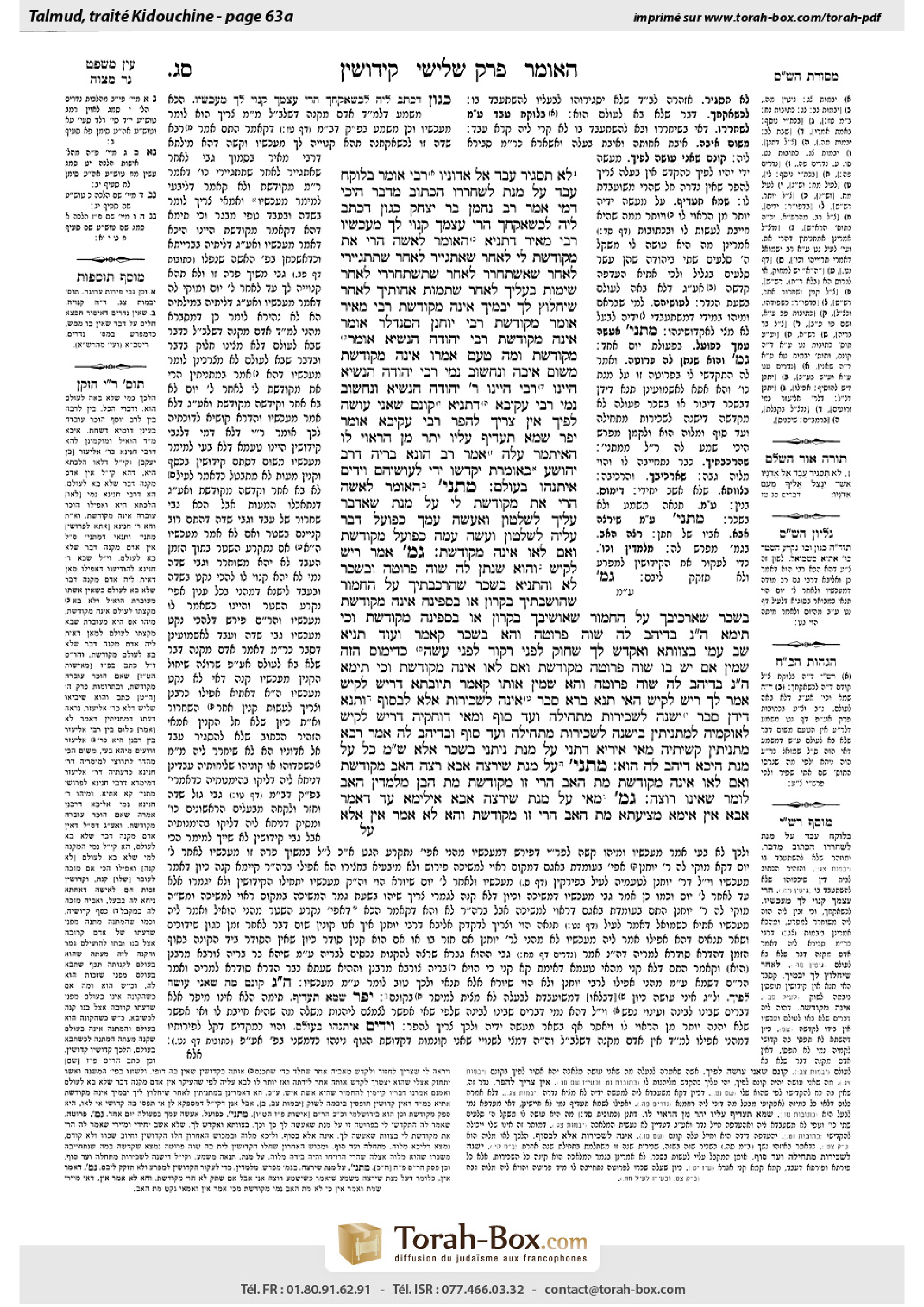
This page of Kiddushin includes the Aramaic text, an English translation and an AI-generated French translation, alongside the scan above.
קידושין ס״ג א · Aramaic and Hebrew text
״לֹא תַסְגִּיר עֶבֶד אֶל אֲדֹנָיו״, רַבִּי אוֹמֵר: בְּלוֹקֵחַ עֶבֶד עַל מְנָת לְשַׁחְרְרוֹ הַכָּתוּב מְדַבֵּר. הֵיכִי דָּמֵי? אָמַר רַב נַחְמָן בַּר יִצְחָק: כְּגוֹן דִּכְתַב לֵיהּ: ״לִכְשֶׁאֶקָּחֲךָ, הֲרֵי עַצְמְךָ קָנוּי לְךָ מֵעַכְשָׁיו״.
רַבִּי מֵאִיר, דְּתַנְיָא: הָאוֹמֵר לְאִשָּׁה: ״הֲרֵי אַתְּ מְקוּדֶּשֶׁת לִי לְאַחַר שֶׁאֶתְגַּיֵּיר״, ״לְאַחַר שֶׁתִּתְגַּיְּירִי״, ״לְאַחַר שֶׁאֶשְׁתַּחְרֵר״, ״לְאַחַר שֶׁתִּשְׁתַּחְרְרִי״, ״לְאַחַר שֶׁיָּמוּת בַּעְלִיךְ״, ״לְאַחַר שֶׁתָּמוּת אֲחוֹתִיךְ״, ״לְאַחַר שֶׁיַּחְלוֹץ לָךְ יְבָמִיךְ״ – אֵינָהּ מְקוּדֶּשֶׁת. רַבִּי מֵאִיר אוֹמֵר: מְקוּדֶּשֶׁת. רַבִּי יוֹחָנָן הַסַּנְדְּלָר אוֹמֵר: אֵינָהּ מְקוּדֶּשֶׁת.
רַבִּי יְהוּדָה הַנָּשִׂיא אוֹמֵר: מְקוּדֶּשֶׁת. וּמָה טַעַם אָמְרוּ ״אֵינָהּ מְקוּדֶּשֶׁת״ – מִשּׁוּם אֵיבָה.
וְנִחְשׁוֹב נָמֵי רַבִּי יְהוּדָה הַנָּשִׂיא! הַיְינוּ רַבִּי, הַיְינוּ רַבִּי יְהוּדָה הַנָּשִׂיא.
וְנִחְשׁוֹב נָמֵי רַבִּי עֲקִיבָא, דְּתַנְיָא: ״קֻוֽנָּם שֶׁאֲנִי עוֹשָׂה לְפִיךָ״ – אֵין צָרִיךְ לְהָפֵר.
רַבִּי עֲקִיבָא אוֹמֵר: יָפֵר, שֶׁמָּא תַּעֲדִיף עָלָיו יָתֵר מִן הָרָאוּי לוֹ. הָאִיתְּמַר עֲלַהּ, אָמַר רַב הוּנָא בְּרֵיהּ דְּרַב יְהוֹשֻׁעַ: בְּאוֹמֶרֶת: ״יִקְדְּשׁוּ יָדַי לְעוֹשֵׂיהֶם״, וְיָדַיִם אִיתַנְהוּ בָּעוֹלָם.
מַתְנִי׳ הָאוֹמֵר לָאִשָּׁה ״הֲרֵי אַתְּ מְקוּדֶּשֶׁת לִי עַל מְנָת שֶׁאֲדַבֵּר עָלַיִךְ לַשִּׁלְטוֹן״, ״וְאֶעֱשֶׂה עִמָּךְ כְּפוֹעֵל״, דִּבֵּר עָלֶיהָ לַשִּׁלְטוֹן וְעָשָׂה עִמָּהּ כְּפוֹעֵל – מְקוּדֶּשֶׁת, וְאִם לָאו – אֵינָהּ מְקוּדֶּשֶׁת.
גְּמָ׳ אָמַר רֵישׁ לָקִישׁ: וְהוּא שֶׁנָּתַן לָהּ שָׁוֶה פְּרוּטָה. וּבְשָׂכָר לָא? וְהָתַנְיָא: בִּשְׂכַר שֶׁהִרְכַּבְתִּיךְ עַל הַחֲמוֹר שֶׁהוֹשַׁבְתִּיךְ בְּקָרוֹן אוֹ בִּסְפִינָה – אֵינָהּ מְקוּדֶּשֶׁת.
בִּשְׂכַר שֶׁאַרְכִּיבִךְ עַל הַחֲמוֹר, שֶׁאוֹשִׁיבִךְ בְּקָרוֹן אוֹ בִּסְפִינָה – מְקוּדֶּשֶׁת. וְכִי תֵּימָא הָכָא נָמֵי בְּדִיהַב לַהּ שָׁוֶה פְּרוּטָה, וְהָא בִּשְׂכַר קָאָמַר.
וְעוֹד תַּנְיָא: שֵׁב עִמִּי בְּצַוְותָּא וְאֶקַּדֵּשׁ לָךְ, שְׂחוֹק לְפָנַי, רְקוֹד לְפָנַי, עֲשֵׂה כַּדִּימוֹס הַזֶּה – שָׁמִין, אִם יֵשׁ בּוֹ שָׁוֶה פְּרוּטָה – מְקוּדֶּשֶׁת, וְאִם לָאו – אֵינָהּ מְקוּדֶּשֶׁת. וְכִי תֵּימָא, הָכָא נָמֵי בְּדִיהַב לַהּ שָׁוֶה פְּרוּטָה, וְהָא שָׁמִין אוֹתוֹ קָאָמַר! תְּיוּבְתָּא דְּרֵישׁ לָקִישׁ.
אָמַר לָךְ רֵישׁ לָקִישׁ: הַאי תַּנָּא בָּרָא סָבַר: אֵינָהּ לִשְׂכִירוּת אֶלָּא לְבַסּוֹף. וְתַנָּא דִידַן סָבַר יֶשְׁנָהּ לִשְׂכִירוּת מִתְּחִילָּה וְעַד סוֹף.
וּמַאי דּוּחְקֵיהּ דְּרֵישׁ לָקִישׁ לְאוֹקוֹמַיהּ לְמַתְנִיתִין בְּיֶשְׁנָהּ לִשְׂכִירוּת מִתְּחִילָּה וְעַד סוֹף, וּבְדִיהַב לַהּ?
אָמַר רָבָא: מַתְנִיתִין קְשִׁיתֵיהּ, מַאי אִירְיָא דְּתָנֵי ״עַל מְנָת״? נִיתְנֵי ״בִּשְׂכַר״, אֶלָּא שְׁמַע מִינַּהּ: כֹּל ״עַל מְנָת״ הֵיכָא דִּיהַב לַהּ הוּא.
מַתְנִי׳ ״עַל מְנָת שֶׁיִּרְצֶה אַבָּא״, רָצָה הָאָב – מְקוּדֶּשֶׁת, וְאִם לָאו – אֵינָהּ מְקוּדֶּשֶׁת. מֵת הָאָב – הֲרֵי זוֹ מְקוּדֶּשֶׁת. מֵת הַבֵּן – מְלַמְּדִין הָאָב לוֹמַר שֶׁאֵינוֹ רוֹצֶה.
גְּמָ׳ מַאי ״עַל מְנָת שֶׁיִּרְצֶה אַבָּא״? אִילֵּימָא עַד דְּאָמַר אַבָּא ״אִין״, אֵימָא מְצִיעֲתָא: מֵת הָאָב – הֲרֵי זוֹ מְקוּדֶּשֶׁת, וְהָא לָא אֲמַר ״אִין״! אֶלָּא:
Kiddushin 63a · English translation
With regard to the verse: “You shall not deliver a slave to his master” (Deuteronomy 23:16), Rabbi Yehuda HaNasi says: The verse is speaking of one who acquires a slave, not to enslave him but in order to emancipate him. The court may not deliver the slave to this master, as this master has no right to enslave him. The Gemara asks: What are the circumstances of this case? Rav Naḥman bar Yitzḥak says: For example, if the new master wrote to the slave in his bill of manumission: When I will purchase you, you are hereby acquired to yourself from now. In that case the slave acquires himself from that moment, despite the fact that the buyer does not own him. This shows that Rabbi Yehuda HaNasi maintains that a person can transfer an item that has not yet entered the world, as one can emancipate his slave before acquiring him.
Rabbi Meir also holds that one can transfer an entity that has not yet come into the world, as it is taught in a baraita: With regard to one who says to a woman: You are hereby betrothed to me after I convert, or: After you convert, or: After I am emancipated, or: After you are emancipated, or: After your husband dies, or: After your sister dies, or: After your yavam performs ḥalitza for you, she is not betrothed. Rabbi Meir disagrees and says: She is betrothed. Rabbi Yoḥanan HaSandlar says: She is not betrothed.
Rabbi Yehuda HaNasi says that in some of these cases, by Torah law she is betrothed. And for what reason did the Sages say she is not betrothed? Due to enmity. Giving betrothal to a married woman that will take effect after her husband dies can engender enmity between the woman and her husband. Giving betrothal to one sister that depends on the death of the other can engender enmity between the sisters. Nevertheless, Rabbi Meir and Rabbi Yehuda HaNasi maintain that one can betroth a woman who is currently forbidden to him.
The Gemara asks: And let us also count Rabbi Yehuda HaNasi among those who maintain that a person can acquire an entity that has not yet come into the world. The reason it asks is that Rabbi Yehuda HaNasi is merely called Rabbi above. The Gemara answers: Rabbi Yehuda HaNasi is the same as Rabbi Yehuda HaNasi; they are one person.
The Gemara asks: And let us also count Rabbi Akiva, as it is taught in a mishna (see Nedarim 85a): If a woman stated a vow to her husband: I will not produce anything for you, including the work that she is obligated to do for him according to the terms of her marriage contract, as that is konam, i.e., forbidden like an offering, for me, her husband need not nullify the vow at all. It is automatically void, since she is obligated to perform those tasks.
Rabbi Akiva says: He should nevertheless nullify the vow, as perhaps she will exceed the required amount of work and do more for him than is fitting for him to receive. If she does more than the fixed amount of work that a woman is obligated to perform for her husband, the vow will be valid with respect to the excess to which he is not legally entitled, and he might inadvertently come to benefit from something that is forbidden to him. That excess is an entity that has not yet come into the world. The Gemara rejects this suggestion: Wasn’t it already stated with regard to this ruling that Rav Huna, son of Rav Yehoshua, says: This is referring to a woman who says: Let my hands be sanctified to their Maker? She sanctifies her actual hands, and these hands exist in the world; therefore the vow takes effect.
MISHNA: With regard to one who says to a woman: You are hereby betrothed to me on the condition that I will speak in your favor to the authorities, e.g., to help her address some legal matter, or: On the condition that I will act for you as a laborer, if he spoke in her favor to the authorities or acted for her as a laborer, she is betrothed. But if not, she is not betrothed.
GEMARA: Reish Lakish says: And this halakha applies only if he gave her an item worth one peruta at the time of the betrothal. She is not betrothed via his recommendation to the authorities or via the work itself, as these are merely conditions appended to the betrothal. The Gemara asks: And is she not betrothed by the monetary value of his recommendation or action? But isn’t it taught in a baraita that if one says to a woman: You are hereby betrothed to me by the monetary value you received when I had you ride on a donkey, or: By the monetary value you received when I had you sit on a wagon [karon], or: By the monetary value you received when I had you ride in a boat, she is not betrothed, as she has already done the action and therefore owes him this debt, and one cannot betroth a woman with a loan.
But if he says to her: By the monetary value you will receive when I will have you ride on a donkey, or: By the monetary value you will receive when I will have you sit on a wagon, or: By the monetary value you will receive when I will have you ride in a boat, she is betrothed. And if you would say that here too, it is referring to a case where he gave her an item worth one peruta, the baraita says: By the monetary value, which indicates that she is betrothed via this sum.
And furthermore, it is taught in a baraita that if a woman says to a man: Sit together with me and I will be betrothed to you, or: Perform entertainment before me, or: Dance before me, or: Perform work for me like this layer [dimus] of a building, the court appraises the monetary value of his action. If the action he performs for her is worth the value of one peruta, she is betrothed, but if not, she is not betrothed. And if you would say that here too, it is referring to a case where he gave her an item worth one peruta, and the betrothal is with that; but the baraita says: The court appraises it. If this were merely a condition, there would be no need for an appraisal. Isn’t this a conclusive refutation of the opinion of Reish Lakish?
The Gemara answers that Reish Lakish could have said to you: This tanna of the baraita maintains that the obligation to pay a person’s wage is incurred only at the end of the period for which he was hired. Consequently, she is betrothed via money rather than by a loan. And the tanna of our mishna maintains that the obligation to pay a wage is incurred continuously from the beginning of the period he was hired to its end. Since the debt accumulates throughout the duration that the service is performed, by the time he has finished the work she owes him the entire sum, and a debt cannot be used for a betrothal.
The Gemara asks: And what forces Reish Lakish to establish the mishna in accordance with the opinion that the obligation to pay a wage is incurred continuously from the beginning of the period he was hired to its end, and that it is referring to a case where he gave her the value of one peruta? Why does he reject the possibility that the mishna is referring to one who did not give an extra peruta, and instead he betrothed her with the value of the service he performed, in accordance with the opinion that the obligation to pay a person’s wage is incurred only at the end of the period for which he was hired?
The Gemara replies: Rava said that the mishna was difficult for Reish Lakish: Why does the tanna specifically teach: On the condition? Let him teach: By the monetary value, as stated in the baraita. Rather, conclude from it that any statement of: On the condition, is referring to a stipulation, and therefore the mishna must be dealing with a case where he has already given her the value of one peruta. Consequently, the value of his service cannot be the money for the betrothal itself, and instead serves as a later condition.
MISHNA: With regard to one who betroths a woman and says to her that the betrothal is: On the condition that my father will want this betrothal, if his father wants it, she is betrothed; but if not, she is not betrothed. If the father dies, she is betrothed, despite the fact that he did not reveal his wishes. If the son dies, one instructs the father to say that he does not want the betrothal, so that the betrothal will never have taken effect, thereby enabling her to avoid the requirement of levirate marriage.
GEMARA: What is the meaning of: On the condition that my father will want this betrothal? If we say it means they are not married until his father says yes, indicating his agreement, then say the middle clause of the mishna: If the father dies, she is betrothed. But how can she be betrothed? After all, he did not say yes, and the condition was not fulfilled. Rather,
Kiddushin 63a · Traduction française (IA)
À propos du verset : « Tu ne livreras pas un esclave à son maître » (Deutéronome 23, 16), Rabbi Yehouda HaNassi dit : Le verset parle de celui qui acquiert un esclave, non pour l’asservir, mais afin de l’affranchir. Le tribunal ne peut pas livrer l’esclave à ce maître, car celui-ci n’a pas le droit de l’asservir. La Guemara demande : Dans quelles circonstances cela se produit-il ? Rav Naḥman bar Yitzḥak répond : Par exemple, si le nouveau maître a écrit à l’esclave, dans son acte d’affranchissement : « Lorsque je t’aurai acheté, tu t’appartiendras désormais. » Dans ce cas, l’esclave s’acquiert lui-même dès cet instant, bien que l’acheteur ne soit pas encore son propriétaire. Cela montre que Rabbi Yehouda HaNassi estime qu’une personne peut transférer un bien qui n’est pas encore venu au monde, puisqu’on peut affranchir son esclave avant de l’avoir acquis.
Rabbi Meïr estime également qu’on peut transférer une entité qui n’est pas encore venue au monde, comme l’enseigne une baraïta : Celui qui dit à une femme : « Tu m’es désormais consacrée après que je me serai converti », ou : « Après que tu te seras convertie », ou : « Après que j’aurai été affranchi », ou : « Après que tu auras été affranchie », ou : « Après la mort de ton mari », ou : « Après la mort de ta sœur », ou : « Après que ton yavam aura accompli la ḥalitsa pour toi », ne la rend pas betrotée. Rabbi Meïr est d’un avis contraire et dit : Elle est betrotée. Rabbi Yoḥanan HaSandlar dit : Elle n’est pas betrotée.
Rabbi Yehouda HaNassi dit que, dans certains de ces cas, elle est betrotée selon la Torah. Pourquoi les Sages ont-ils alors dit qu’elle n’est pas betrotée ? À cause de l’hostilité. Betroter une femme mariée en vue d’un mariage qui prendrait effet après la mort de son mari peut susciter de l’hostilité entre elle et son mari. Betroter une sœur à la condition que l’autre meure peut susciter de l’hostilité entre les deux sœurs. Néanmoins, Rabbi Meïr et Rabbi Yehouda HaNassi estiment qu’on peut betroter une femme qui leur est actuellement interdite.
La Guemara demande : Comptons aussi Rabbi Yehouda HaNassi parmi ceux qui estiment qu’une personne peut acquérir une entité qui n’est pas encore venue au monde. La question se pose parce que Rabbi Yehouda HaNassi est simplement appelé Rabbi plus haut. La Guemara répond : Rabbi Yehouda HaNassi est bien le même que Rabbi Yehouda HaNassi ; il s’agit d’une seule et même personne.
La Guemara demande : Comptons aussi Rabbi Akiva, comme l’enseigne une Michna (voir Nedarim 85a) : Si une femme fait le vœu suivant à son mari : « Je ne produirai rien pour toi », y compris le travail qu’elle est tenue d’accomplir pour lui selon les termes de leur contrat de mariage, et qu’elle déclare que cela lui est konam, c’est-à-dire interdit comme une offrande, son mari n’a pas du tout besoin d’annuler le vœu. Celui-ci est automatiquement sans effet, puisqu’elle est tenue d’accomplir ces tâches.
Rabbi Akiva dit : Il doit néanmoins annuler le vœu, car elle pourrait dépasser la quantité de travail requise et en faire davantage qu’il ne convient qu’il reçoive. Si elle effectue plus que la quantité fixe de travail qu’une femme est tenue d’accomplir pour son mari, le vœu sera valide pour le surplus auquel il n’a pas droit selon la loi, et il pourrait par inadvertance tirer profit de quelque chose qui lui est interdit. Ce surplus est une entité qui n’est pas encore venue au monde. La Guemara rejette cette suggestion : N’a-t-il pas déjà été dit à propos de cette règle que Rav Houna, fils de Rav Yehoshoua, dit : Cela concerne une femme qui dit : « Que mes mains soient consacrées à leur Créateur » ? Elle consacre ses mains mêmes, qui existent dans le monde ; le vœu prend donc effet.
MICHNA : Celui qui dit à une femme : « Tu m’es betrotée à condition que je parle en ta faveur auprès des autorités », par exemple pour l’aider dans une affaire juridique, ou : « À condition que je travaille pour toi comme ouvrier », si effectivement il parle en sa faveur auprès des autorités ou travaille pour elle comme ouvrier, elle est betrotée. Sinon, elle ne l’est pas.
GUEMARA : Reish Lakish dit : Cette halakha ne s’applique que s’il lui a donné un objet d’une valeur d’une perouta au moment de la betrothèse. Elle n’est pas betrotée par sa recommandation auprès des autorités ni par le travail lui-même, car ceux-ci ne sont que des conditions ajoutées à la betrothèse. La Guemara demande : N’est-elle donc pas betrotée par la valeur monétaire de sa recommandation ou de son travail ? Pourtant, une baraïta enseigne que celui qui dit à une femme : « Tu m’es betrotée par la valeur monétaire que tu as reçue lorsque je t’ai fait monter sur un âne », ou : « Par la valeur monétaire que tu as reçue lorsque je t’ai fait asseoir dans une charrette [karon] », ou : « Par la valeur monétaire que tu as reçue lorsque je t’ai fait monter dans un bateau », ne la rend pas betrotée, puisqu’elle a déjà accompli l’action et lui doit donc cette somme ; or, on ne peut pas betroter une femme au moyen d’un prêt.
Mais s’il lui dit : « Tu m’es betrotée par la valeur monétaire que tu recevras lorsque je te ferai monter sur un âne », ou : « Par la valeur monétaire que tu recevras lorsque je te ferai asseoir dans une charrette », ou : « Par la valeur monétaire que tu recevras lorsque je te ferai monter dans un bateau », elle est betrotée. Et si tu dis qu’ici aussi il s’agit d’un cas où il lui a donné un objet d’une valeur d’une perouta, la baraïta dit : « Par la valeur monétaire », ce qui indique qu’elle est betrotée par cette somme.
En outre, une baraïta enseigne que si une femme dit à un homme : « Assieds-toi avec moi et je serai betrotée à toi », ou : « Divertis-moi », ou : « Danse devant moi », ou : « Travaille pour moi comme cette couche [dimus] d’un bâtiment », le tribunal évalue la valeur monétaire de son action. Si l’action qu’il accomplit pour elle vaut une perouta, elle est betrotée ; sinon, elle ne l’est pas. Et si tu dis qu’ici aussi il s’agit d’un cas où il lui a donné un objet d’une valeur d’une perouta, et que la betrothèse repose sur cet objet, la baraïta dit pourtant : « Le tribunal l’évalue. » S’il ne s’agissait que d’une condition, il n’y aurait aucune raison de procéder à une évaluation. N’est-ce pas là une réfutation décisive de l’avis de Reish Lakish ?
La Guemara répond que Reish Lakish aurait pu te dire : Le tanna de cette baraïta estime que l’obligation de payer le salaire d’une personne ne naît qu’à la fin de la période pour laquelle elle a été engagée. Par conséquent, elle est betrotée au moyen d’argent, et non d’un prêt. Quant au tanna de notre Michna, il estime que l’obligation de payer le salaire naît continuellement, du début à la fin de la période pour laquelle la personne a été engagée. Puisque la dette s’accumule pendant toute la durée du service, au moment où il a fini le travail, elle lui doit la somme entière ; or, une dette ne peut pas servir à une betrothèse.
La Guemara demande : Qu’est-ce qui oblige Reish Lakish à établir la Michna selon l’avis que l’obligation de payer un salaire naît continuellement, du début à la fin de la période pour laquelle la personne a été engagée, et à considérer qu’il s’agit d’un cas où il lui a donné la valeur d’une perouta ? Pourquoi écarte-t-il la possibilité que la Michna parle d’un homme qui ne lui a pas donné de perouta supplémentaire, mais l’a betrotée au moyen de la valeur du service qu’il a accompli, conformément à l’avis selon lequel l’obligation de payer le salaire d’une personne ne naît qu’à la fin de la période pour laquelle elle a été engagée ?
La Guemara répond : Rava dit que la Michna posait une difficulté à Reish Lakish : Pourquoi le tanna enseigne-t-il précisément : « À condition que » ? Qu’il enseigne plutôt : « Par la valeur monétaire », comme dans la baraïta. Il faut donc en conclure que toute formule disant « à condition que » désigne une stipulation ; la Michna doit par conséquent traiter d’un cas où il lui a déjà donné la valeur d’une perouta. La valeur de son service ne peut donc pas constituer l’argent de la betrothèse elle-même ; elle sert plutôt de condition ultérieure.
MICHNA : Celui qui betrote une femme et lui dit que la betrothèse est faite « à condition que mon père veuille cette betrothèse » : si son père la veut, elle est betrotée ; sinon, elle ne l’est pas. Si le père meurt, elle est betrotée, bien qu’il n’ait pas exprimé ses souhaits. Si le fils meurt, on demande au père de dire qu’il ne veut pas de la betrothèse, afin que celle-ci n’ait jamais pris effet, ce qui lui permet d’éviter l’obligation du mariage léviratique.
GUEMARA : Que signifie : « À condition que mon père veuille cette betrothèse » ? Si l’on dit que cela signifie qu’ils ne sont pas mariés jusqu’à ce que son père dise oui, manifestant ainsi son accord, alors explique la clause médiane de la Michna : « Si le père meurt, elle est betrotée. » Mais comment pourrait-elle être betrotée ? Après tout, il n’a pas dit oui et la condition n’a pas été remplie. Il faut plutôt dire…
Traduction française générée par IA à partir de l’édition anglaise de Sefaria. Vérifie toujours un passage avec le texte source.
Text from Sefaria: William Davidson Edition - Vocalized Aramaic (CC BY NC); William Davidson Edition - English (CC BY NC).