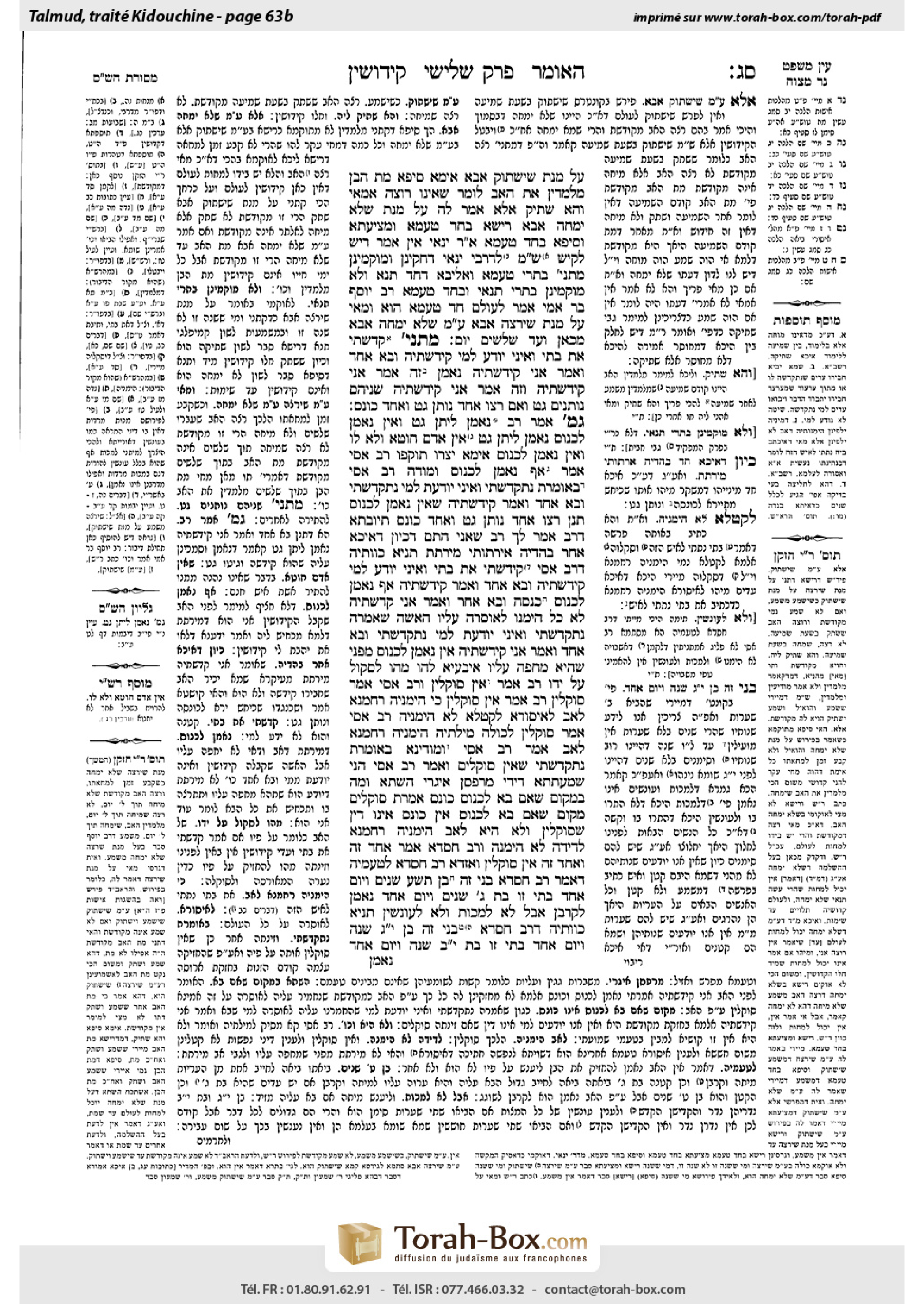
Kiddushin 63b: Talmud study for Daf Yomi
Daf Yomi is the daily study of one Talmud folio. Explore 37 tractates with scans, Hebrew text, Sefaria English and AI-generated French translations where annotated.
Passage selection and English or AI-generated French translation are available where the scan has annotations. Daf Study is independent of Torah-Box and Sefaria.
Browse Kiddushin · קידושין · All tractatesKiddushin 63b text and translations
This page of Kiddushin includes the Aramaic text, an English translation and an AI-generated French translation, alongside the scan above.
קידושין ס״ג ב · Aramaic and Hebrew text
עַל מְנָת שֶׁיִּשְׁתּוֹק אַבָּא. אֵימָא סֵיפָא: מֵת הַבֵּן – מְלַמְּדִין אֶת הָאָב לוֹמַר שֶׁאֵינוֹ רוֹצֶה. אַמַּאי? וְהָא שְׁתֵיק! אֶלָּא אֲמַר לַהּ ״עַל מְנָת שֶׁלֹּא יְמַחֶה אַבָּא״.
רֵישָׁא בְּחַד טַעְמָא וּמְצִיעֲתָא וְסֵיפָא בְּחַד טַעְמָא! אָמַר רַבִּי יַנַּאי: אִין. אָמַר רֵישׁ לָקִישׁ: שְׁמַע מִינַּהּ לִדְרַבִּי יַנַּאי דָּחֲקִינַן וּמוֹקְמִינַן מַתְנִיתִין בִּתְרֵי טַעֲמֵי וְאַלִּיבָּא דְּחַד תַּנָּא וְלָא מוֹקְמִינַן בִּתְרֵי תַּנָּאֵי וּבְחַד טַעְמָא.
רַב יוֹסֵף בַּר אַמֵּי אָמַר: לְעוֹלָם חַד טַעְמָא הוּא, וּמַאי ״עַל מְנָת שֶׁיִּרְצֶה אַבָּא״ – עַל מְנָת שֶׁלֹּא יְמַחֶה אַבָּא מִכָּאן וְעַד שְׁלֹשִׁים יוֹם.
מַתְנִי׳ ״קִדַּשְׁתִּי אֶת בִּתִּי וְאֵינִי יוֹדֵעַ לְמִי קִידַּשְׁתִּיהָ״, וּבָא אֶחָד וְאָמַר ״אֲנִי קִידַּשְׁתִּיהָ״ – נֶאֱמָן. זֶה אָמַר ״אֲנִי קִידַּשְׁתִּיהָ״ וְזֶה אָמַר ״אֲנִי קִידַּשְׁתִּיהָ״ – שְׁנֵיהֶם נוֹתְנִים גֵּט. וְאִם רָצוּ – אֶחָד נוֹתֵן גֵּט, וְאֶחָד כּוֹנֵס.
גְּמָ׳ אָמַר רַב: – נֶאֱמָן לִיתֵּן גֵּט, וְאֵין נֶאֱמָן לִכְנוֹס. נֶאֱמָן לִיתֵּן גֵּט, אֵין אָדָם חוֹטֵא וְלֹא לוֹ. וְאֵין נֶאֱמָן לִכְנוֹס? אֵימָא יִצְרוֹ תּוֹקְפוֹ.
רַב אַסִּי אָמַר: אַף נֶאֱמָן לִכְנוֹס. וּמוֹדֶה רַב אַסִּי בְּאוֹמֶרֶת ״נִתְקַדַּשְׁתִּי וְאֵינִי יוֹדַעַת לְמִי נִתְקַדַּשְׁתִּי״ וּבָא אֶחָד וְאָמַר ״קִידַּשְׁתִּיהָ״ שֶׁאֵין נֶאֱמָן לִכְנוֹס.
תְּנַן: רָצוּ – אֶחָד נוֹתֵן גֵּט וְאֶחָד כּוֹנֵס, תְּיוּבְתָּא דְרַב! אָמַר לְךָ רַב: שָׁאנֵי הָתָם, דְּכֵיוָן דְּאִיכָּא אַחֵר בַּהֲדֵיהּ – אִירְתוֹתֵי מִירְתַת.
תַּנְיָא כְּווֹתֵיהּ דְּרַב אַסִּי: קִידַּשְׁתִּי אֶת בִּתִּי וְאֵינִי יוֹדֵעַ לְמִי קִידַּשְׁתִּיהָ, וּבָא אֶחָד וְאָמַר קִידַּשְׁתִּיהָ – אַף נֶאֱמָן לִכְנוֹס. כְּנָסָהּ וּבָא אַחֵר וְאָמַר אֲנִי קִדַּשְׁתִּיהָ – לֹא כׇּל הֵימֶנּוּ לְאוֹסְרָהּ עָלָיו.
הָאִשָּׁה שֶׁאָמְרָה ״נִתְקַדַּשְׁתִּי וְאֵינִי יוֹדַעַת לְמִי נִתְקַדַּשְׁתִּי״ וּבָא אֶחָד וְאָמַר ״אֲנִי קִידַּשְׁתִּי״ – אֵין נֶאֱמָן לִכְנוֹס. מִפְּנֵי שֶׁהִיא מְחַפָּה עָלָיו.
אִיבַּעְיָא לְהוּ: מַהוּ לִסְקוֹל עַל יָדוֹ? רַב אָמַר: אֵין סוֹקְלִין. וְרַב אַסִּי אָמַר: סוֹקְלִין.
רַב אָמַר: אֵין סוֹקְלִין, כִּי הֵימְנֵיהּ רַחֲמָנָא לְאָב, לְאִיסּוּרָא, לִקְטָלָא לָא הֵימְנֵיהּ. רַב אַסִּי אָמַר: סוֹקְלִין, לְכוּלַּהּ מִילְּתֵיהּ הֵימְנֵיהּ רַחֲמָנָא לְאָב. אָמַר רַב אַסִּי: וּמוֹדֵינָא בְּאוֹמֶרֶת ״נִתְקַדַּשְׁתִּי״, שֶׁאֵין סוֹקְלִים.
וְאָמַר רַב אַסִּי: הָנֵי שְׁמַעְתָּתָא דִּידִי מְרַפְּסָן אִיגָּרֵי. הַשְׁתָּא, וּמָה בִּמְקוֹם שֶׁאִם בָּא לִכְנוֹס כּוֹנֵס – אָמַרְתָּ סוֹקְלִים, מְקוֹם שֶׁאִם בָּא לִכְנוֹס אֵין כּוֹנֵס – אֵינוֹ דִּין שֶׁסּוֹקְלִין?
וְלָא הִיא, לְאָב הֵימְנֵיהּ רַחֲמָנָא, לְדִידַהּ לָא הֵימְנַהּ.
וְרַב חִסְדָּא אָמַר: אֶחָד זֶה וְאֶחָד זֶה – אֵין סוֹקְלִין. וְאַזְדָּא רַב חִסְדָּא לְטַעְמֵיהּ, דְּאָמַר רַב חִסְדָּא: ״בְּנִי זֶה בֶּן תֵּשַׁע שָׁנִים וְיוֹם אֶחָד״, ״בִּתִּי זוֹ בַּת שָׁלֹשׁ שָׁנִים וְיוֹם אֶחָד״ – נֶאֱמָן לְקׇרְבָּן, אֲבָל לֹא לְמַכּוֹת וְלֹא לָעוֹנָשִׁין.
תַּנְיָא כְּווֹתֵיהּ דְּרַב חִסְדָּא: ״בְּנִי זֶה בֶּן שְׁלֹשׁ עֶשְׂרֵה שָׁנָה וְיוֹם אֶחָד״ ״בִּתִּי זוֹ בַּת שְׁתֵּים עֶשְׂרֵה שָׁנָה וְיוֹם אֶחָד״ –
Kiddushin 63b · English translation
the phrase: On the condition that my father wants this betrothal, means: On the condition that my father will remain silent and will not object when he hears of the betrothal. But if this is the case, say the last clause of the mishna: If the son died, one instructs the father to say that he does not want the betrothal. Why should this matter? After all, he remained silent when he first heard about it. Clearly his mere silence does not constitute agreement. Rather, one must say that the phrase: On the condition that my father wants this betrothal, means that he said to her: On the condition that my father will not object to this betrothal at any point in time.
The Gemara asks: Wouldn’t this mean that the first clause of the mishna describes one reason, i.e., one set of circumstances, and the middle clause and last clause describe one other reason? Rabbi Yannai said: Yes, this is so. Reish Lakish said: Conclude from his statement that according to the opinion of Rabbi Yannai one forces a mishna to be explained as following two reasons, and in accordance with the opinion of one tanna, rather than establishing a mishna as following the opinions of two tanna’im and one reason. In other words, an interpretation that maintains the unified attribution of one mishna is preferable, even if one is thereby forced to say that it addresses different situations.
Rav Yosef bar Ami said: Actually, the entire mishna is addressing one reason, i.e., one case, and what is the meaning of: On the condition that my father wants the betrothal? It means: On the condition that my father will not object from now and until thirty days have elapsed. His silence for thirty days indicates his acceptance of the betrothal.
MISHNA: With regard to a man who said: I betrothed my minor daughter to someone but I do not know to whom I betrothed her, and one man came forward and said: I betrothed her, his claim is deemed credible. If two men stepped forward and this one said: I betrothed her, and that one said: I betrothed her, they must both give her a bill of divorce to render it permitted for her to marry anyone else. And if they so desire, one of them gives her a bill of divorce and the other one may marry her.
GEMARA: Rav says: When the mishna states that the claim of one who says that he betrothed this girl is deemed credible, it means that he is deemed credible to the extent that he may give her a bill of divorce, but he is not deemed credible to marry her. He is deemed credible to give her a bill of divorce, as there is a presumption that a person sins only for his own benefit. No one is suspected of sinning when he does not stand to gain from it. Since he is not allowed to marry her himself, we do not say that he lied without purpose. But he is not deemed credible to marry her, as we say that his inclination might have overcome him, leading him to falsely claim that he is the one who betrothed her.
Rav Asi disagrees with Rav’s interpretation of the mishna and says: He is deemed credible even to marry her, as he would not dare to lie directly to the father of the girl he claims to have betrothed. And Rav Asi concedes in the case of a woman who says: I became betrothed but I do not know to whom I became betrothed, and one man came and said: I betrothed her, that he is not deemed credible to marry her. In this situation she might have agreed to collude with him, as the Gemara will explain.
The Gemara raises a difficulty: We learned in the mishna that if they so desire, one of them gives her a bill of divorce and the other one may marry her. This is apparently a conclusive refutation of the opinion of Rav, who says that he may not marry her. The Gemara answers: Rav could have said to you: There, in our mishna, it is different, as, since there is another person with him also claiming to have betrothed her, he is afraid to lie.
The Gemara comments: It is taught in a baraita in accordance with the opinion of Rav Asi: If a man said: I have betrothed my daughter to someone but I do not know to whom I betrothed her, and one person came forward and said: I betrothed her, he is deemed credible even to marry her. If that person married her, and another man came forward and said: It was I who betrothed her, it is not within the second man’s power to prohibit her to her husband.
The baraita cites another case: With regard to a woman who said: I became betrothed but I do not know to whom I became betrothed, and one man came and said: I betrothed her, he is not deemed credible to marry her. Why not? Because she is protecting him. Perhaps she decided only now that she wants to marry him and is therefore identifying him as the man who betrothed her, although she knows it was someone else. The same suspicions do not arise in the case of a father, who has no inclinations in this regard.
§ A dilemma was raised before the Sages: In the case of the mishna, where the father claims to have betrothed his daughter to someone, what is the halakha with regard to stoning based on the father’s account? Is a father who says: I betrothed my daughter, deemed credible to the extent that she is stoned as an adulteress if she engages in sexual intercourse with someone? Rav says the court does not stone her, and Rav Asi says the court stones her.
The Gemara elaborates: Rav said that the court does not stone her, because when the Merciful One deems the father credible when he says he betrothed his daughter, this is referring only to the prohibition against her marrying anyone else. By contrast, with regard to killing her, the Torah did not deem him credible. Rav Asi said: The court stones her, as the Merciful One deems the father credible with regard to all matters, including the death penalty. Rav Asi says: And I concede in the case of a woman who says: I became betrothed, that the court does not stone her on the basis of her own admission.
And Rav Asi says: These halakhot of mine are roof breakers, i.e., they are difficult and incomprehensible. Rav Asi explains: Now, in a case where a father said: I have betrothed my daughter to someone but I do not know to whom, where if someone came to marry her he is deemed credible and may marry her, which means you say that the court then stones her on the basis of the father’s testimony if she later commits adultery, is it not logical that the court should stone her in a case where a woman said: I became betrothed but I do not know to whom, thereby prohibiting herself to everyone to the extent that if someone came to marry her he may not marry her?
But that is not so, i.e., Rav Asi’s rulings are in fact reasonable: The Merciful One deems credible a father who says that his daughter is betrothed, and therefore she can even be stoned, but the Torah did not deem her, i.e., the woman herself, credible in this regard. She does not receive a special degree of credibility, and although she can declare herself a forbidden item, i.e., she can render herself forbidden to all men, as far as punishment is concerned her claim is treated by a court in accordance with the regular rules of evidence.
And Rav Ḥisda said: Both in this case, when the father says: I betrothed my daughter, and in that case, when she herself says: I became betrothed, the court does not stone her. The Gemara comments: And Rav Ḥisda follows his standard line of reasoning, as Rav Ḥisda says that if a father declared: This son of mine is nine years and one day old, or: This daughter of mine is three years and one day old, and the son engaged in intercourse with a woman forbidden to him, or the daughter engaged in intercourse with a man forbidden to her, he is deemed credible concerning his children’s ages with regard to the requirement for the adult to bring an offering if they performed the act unwittingly, but not with regard to their receiving the punishment of lashes and not with regard to other punishments.
The Gemara comments: It is taught in a baraita in accordance with the opinion of Rav Ḥisda that if one said: This son of mine is thirteen years and one day old, or: This daughter of mine is twelve years and one day old,
Kiddushin 63b · Traduction française (IA)
L'expression : « À la condition que mon père veuille cette fiançaille » signifie : « À la condition que mon père reste silencieux et ne s'oppose pas lorsqu'il apprendra la fiançaille ». Mais si tel est le cas, la dernière clause de la Michna dit : « Si le fils est mort, on instruit le père de dire qu'il ne veut pas la fiançaille ». Pourquoi cela devrait-il avoir de l'importance ? Après tout, il est resté silencieux lorsqu'il l'a apprise pour la première fois. Évidemment, son simple silence ne constitue pas un accord. Il faut plutôt dire que l'expression : « À la condition que mon père veuille cette fiançaille » signifie qu'il lui a dit : « À la condition que mon père ne s'oppose pas à cette fiançaille à aucun moment ».
La Guemara demande : Ne signifierait-ce pas que la première clause de la Michna décrit une raison, c'est-à-dire un ensemble de circonstances, et que la clause du milieu et la dernière clause décrivent une autre raison ? Rabbi Yannai a dit : Oui, c'est le cas. Reish Lakish a dit : Concluez de sa déclaration que, selon l'opinion de Rabbi Yannai, on force une Michna à être expliquée comme suivant deux raisons, et conformément à l'opinion d'un tanna, plutôt que d'établir une Michna comme suivant les opinions de deux tannaïm et d'une seule raison. En d'autres termes, une interprétation qui maintient l'attribution unifiée d'une Michna est préférable, même si l'on est alors forcé de dire qu'elle traite de situations différentes.
Rav Yosef bar Ami a dit : En réalité, toute la Michna traite d'une seule raison, c'est-à-dire d'un seul cas, et quelle est la signification de : « À la condition que mon père veuille la fiançaille » ? Cela signifie : « À la condition que mon père ne s'oppose pas à partir de maintenant et jusqu'à ce que trente jours se soient écoulés ». Son silence pendant trente jours indique son acceptation de la fiançaille.
MICHNA : Concernant un homme qui a dit : J'ai fiancé ma fille mineure à quelqu'un, mais je ne sais pas à qui je l'ai fiancée, et un homme s'est présenté en disant : C'est moi qui l'ai fiancée, sa déclaration est considérée comme crédible. Si deux hommes se sont présentés, l'un disant : C'est moi qui l'ai fiancée, et l'autre disant : C'est moi qui l'ai fiancée, ils doivent tous deux lui donner un acte de divorce pour qu'il lui soit permis de se marier avec quiconque. Et s'ils le désirent, l'un d'eux lui donne un acte de divorce et l'autre peut l'épouser.
GUEMARA : Rav dit : Lorsque la Michna énonce que la déclaration de celui qui dit qu'il a fiancé cette fille est considérée comme crédible, cela signifie qu'il est considéré comme crédible au point qu'il peut lui donner un acte de divorce, mais il n'est pas considéré comme crédible pour l'épouser. Il est considéré comme crédible pour lui donner un acte de divorce, car il y a une présomption qu'une personne ne pèche que pour son propre bénéfice. Personne n'est soupçonné de pécher lorsqu'il n'a rien à y gagner. Puisqu'il n'est pas autorisé à l'épouser lui-même, nous ne disons pas qu'il a menti sans but. Mais il n'est pas considéré comme crédible pour l'épouser, car nous disons que son inclination a pu le submerger, l'amenant à affirmer faussement qu'il est celui qui l'a fiancée.
Rav Asi est en désaccord avec l'interprétation de Rav de la Michna et dit : Il est considéré comme crédible même pour l'épouser, car il n'oserait pas mentir directement au père de la fille qu'il prétend avoir fiancée. Et Rav Asi concède que, dans le cas d'une femme qui dit : Je me suis fiancée, mais je ne sais pas à qui je me suis fiancée, et un homme est venu en disant : C'est moi qui l'ai fiancée, il n'est pas considéré comme crédible pour l'épouser. Dans cette situation, elle a pu accepter de comploter avec lui, comme la Guemara l'expliquera.
La Guemara soulève une difficulté : Nous avons appris dans la Michna que s'ils le désirent, l'un d'eux lui donne un acte de divorce et l'autre peut l'épouser. Cela semble être une réfutation définitive de l'opinion de Rav, qui dit qu'il ne peut pas l'épouser. La Guemara répond : Rav aurait pu vous dire : Là, dans notre Michna, c'est différent, car, puisqu'il y a une autre personne avec lui qui prétend aussi l'avoir fiancée, il a peur de mentir.
La Guemara commente : Il est enseigné dans une baraïta conformément à l'opinion de Rav Asi : Si un homme a dit : J'ai fiancé ma fille à quelqu'un, mais je ne sais pas à qui je l'ai fiancée, et une personne s'est présentée et a dit : C'est moi qui l'ai fiancée, il est considéré comme crédible même pour l'épouser. Si cette personne l'a épousée, et qu'un autre homme s'est présenté et a dit : C'est moi qui l'ai fiancée, il n'est pas dans le pouvoir du second homme de la rendre interdite à son mari.
La baraïta cite un autre cas : Concernant une femme qui a dit : Je me suis fiancée, mais je ne sais pas à qui je me suis fiancée, et un homme est venu et a dit : C'est moi qui l'ai fiancée, il n'est pas considéré comme crédible pour l'épouser. Pourquoi pas ? Parce qu'elle le protège. Peut-être a-t-elle décidé seulement maintenant qu'elle veut l'épouser et l'identifie donc comme l'homme qui l'a fiancée, bien qu'elle sache que c'était quelqu'un d'autre. Les mêmes soupçons ne se lèvent pas dans le cas d'un père, qui n'a aucune inclination à cet égard.
§ Un dilemme a été soumis aux Sages : Dans le cas de la Michna, où le père affirme avoir fiancé sa fille à quelqu'un, quelle est la halakha concernant la lapidation fondée sur la déclaration du père ? Un père qui dit : J'ai fiancé ma fille, est-il considéré comme crédible au point qu'elle soit lapidée comme adultère si elle a des rapports sexuels avec quelqu'un ? Rav dit que le tribunal ne la lapide pas, et Rav Asi dit que le tribunal la lapide.
La Guemara précise : Rav a dit que le tribunal ne la lapide pas, car lorsque le Tout-Puissant considère le père comme crédible lorsqu'il dit qu'il a fiancé sa fille, cela ne fait référence qu'à l'interdiction de se marier avec quiconque d'autre. En revanche, concernant sa mise à mort, la Torah ne l'a pas considéré comme crédible. Rav Asi a dit : Le tribunal la lapide, car le Tout-Puissant considère le père comme crédible pour toutes les affaires, y compris la peine de mort. Rav Asi dit : Et je concède que, dans le cas d'une femme qui dit : Je me suis fiancée, le tribunal ne la lapide pas sur la base de sa propre admission.
Et Rav Asi dit : Ces halakhot de ma part sont des briseurs de toits, c'est-à-dire qu'elles sont difficiles et incompréhensibles. Rav Asi explique : Or, dans un cas où un père a dit : J'ai fiancé ma fille à quelqu'un, mais je ne sais pas à qui, et où, si quelqu'un vient pour l'épouser, il est considéré comme crédible et peut l'épouser, ce qui signifie que vous dites que le tribunal la lapide ensuite sur la base du témoignage du père si elle commet ensuite l'adultère, n'est-il pas logique que le tribunal doive la lapider dans un cas où une femme a dit : Je me suis fiancée, mais je ne sais pas à qui, l'interdisant ainsi à tous, au point que si quelqu'un vient pour l'épouser, il ne peut pas l'épouser ?
Mais ce n'est pas le cas, c'est-à-dire que les décisions de Rav Asi sont en fait raisonnables : le Tout-Puissant accorde crédit à un père qui déclare que sa fille est fiancée, et par conséquent elle peut même être lapidée, mais la Torah n'accorde pas crédit à la femme elle-même en la circonstance. Elle ne bénéficie pas d'un degré de crédibilité particulier, et bien qu'elle puisse se déclarer objet interdit, c'est-à-dire se rendre interdite à tous les hommes, en ce qui concerne la punition, sa déclaration est traitée par le tribunal conformément aux règles ordinaires de la preuve.
Et Rav Ḥisda a dit : Tant dans ce cas, où le père dit : J'ai fiancé ma fille, que dans celui où elle-même dit : Je suis devenue fiancée, le tribunal ne la lapide pas. La Guemara commente : Et Rav Ḥisda suit sa ligne de raisonnement habituelle, car Rav Ḥisda dit que si un père a déclaré : Ce fils de moi a neuf ans et un jour, ou : Cette fille de moi a trois ans et un jour, et que le fils a eu des rapports avec une femme lui étant interdite, ou que la fille a eu des rapports avec un homme lui étant interdit, il est considéré comme crédible concernant l'âge de ses enfants en ce qui concerne l'obligation pour l'adulte d'apporter une offrande s'ils ont commis l'acte sans intention, mais pas en ce qui concerne leur réception de la punition des coups de fouet et pas en ce qui concerne d'autres punitions.
La Guemara commente : Il est enseigné dans une baraïta conformément à l'opinion de Rav Ḥisda que si quelqu'un a dit : Ce fils de moi a treize ans et un jour, ou : Cette fille de moi a douze ans et un jour,
Traduction française générée par IA à partir de l’édition anglaise de Sefaria. Vérifie toujours un passage avec le texte source.
Text from Sefaria: William Davidson Edition - Vocalized Aramaic (CC BY NC); William Davidson Edition - English (CC BY NC).