Kiddushin 64a: Talmud study for Daf Yomi
Daf Yomi is the daily study of one Talmud folio. Explore 37 tractates with scans, Hebrew text, Sefaria English and AI-generated French translations where annotated.
Passage selection and English or AI-generated French translation are available where the scan has annotations. Daf Study is independent of Torah-Box and Sefaria.
Browse Kiddushin · קידושין · All tractatesKiddushin 64a text and translations
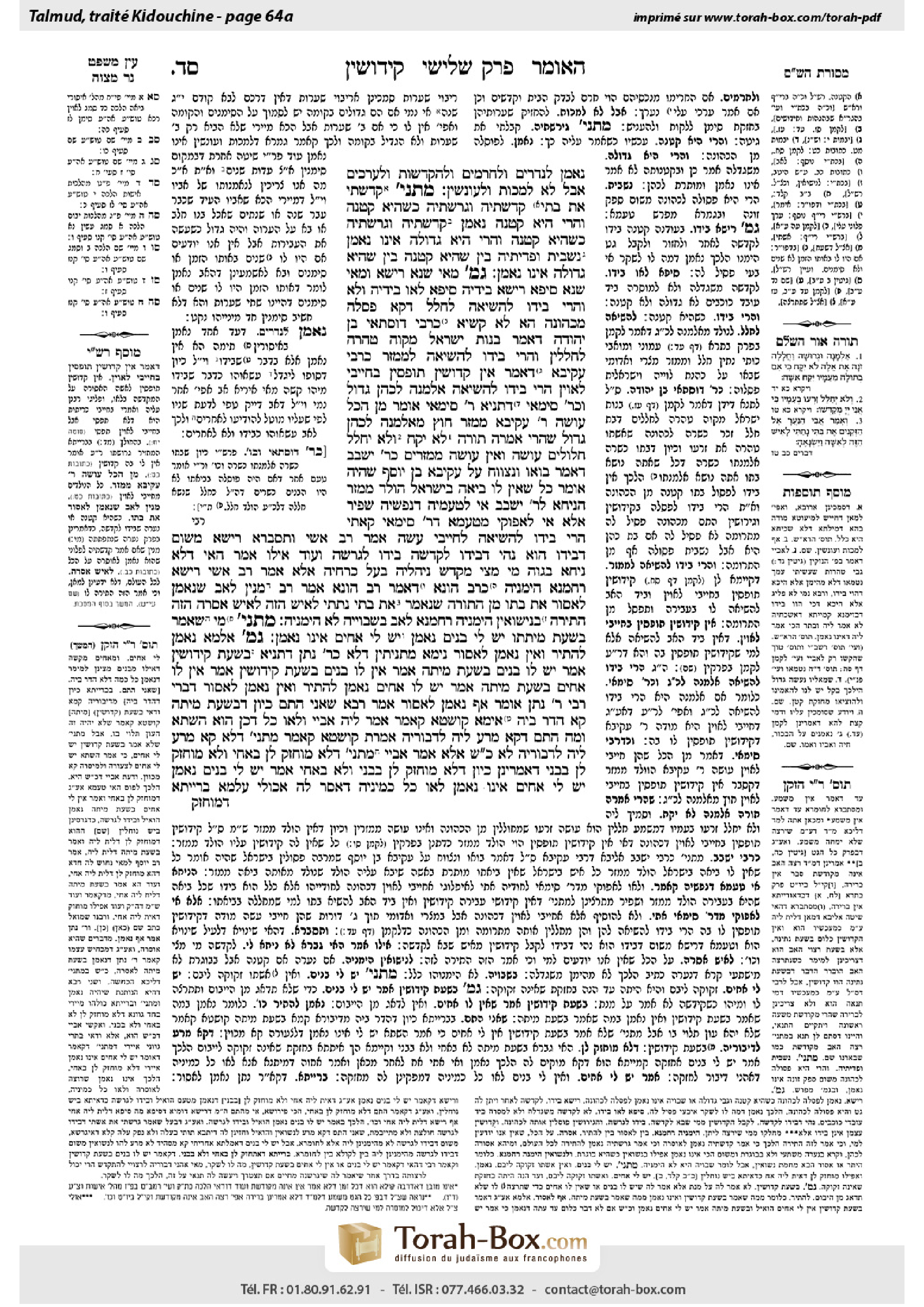
This page of Kiddushin includes the Aramaic text, an English translation and an AI-generated French translation, alongside the scan above.
קידושין ס״ד א · Aramaic and Hebrew text
נֶאֱמָן לִנְדָרִים, וְלַחֲרָמִים, וּלְהֶקְדֵּשׁוֹת וְלַעֲרָכִים, אֲבָל לֹא לְמַכּוֹת וְלָעוֹנָשִׁין.
מַתְנִי׳ ״קִדַּשְׁתִּי אֶת בִּתִּי״, ״קִדַּשְׁתִּיהָ וְגֵרַשְׁתִּיהָ כְּשֶׁהִיא קְטַנָּה״, וַהֲרֵי הִיא קְטַנָּה – נֶאֱמָן. ״קִדַּשְׁתִּיהָ וְגֵרַשְׁתִּיהָ כְּשֶׁהִיא קְטַנָּה״, וַהֲרֵי הִיא גְּדוֹלָה – אֵינוֹ נֶאֱמָן. נִשְׁבֵּית וּפְדִיתִיהָ, בֵּין שֶׁהִיא קְטַנָּה בֵּין שֶׁהִיא גְּדוֹלָה – אֵינוֹ נֶאֱמָן.
גְּמָ׳ מַאי שְׁנָא רֵישָׁא וּמַאי שְׁנָא סֵיפָא? רֵישָׁא בִּידֵיהּ, סֵיפָא לָאו בִּידֵיהּ.
וְלָא? וַהֲרֵי בְּיָדוֹ לְהַשִּׂיאָהּ לְחָלָל, דְּקָא פָסְלַהּ מִכְּהוּנָּה!
הָא לָא קַשְׁיָא, כְּרַבִּי דּוֹסְתַּאי בֶּן יְהוּדָה דְּאָמַר: בְּנוֹת יִשְׂרָאֵל מִקְוֵה טׇהֳרָה לַחֲלָלִין.
וַהֲרֵי בְּיָדוֹ לְהַשִּׂיאָהּ לְמַמְזֵר! כְּרַבִּי עֲקִיבָא דְּאָמַר: אֵין קִדּוּשִׁין תּוֹפְסִין בְּחַיָּיבֵי לָאוִין.
הֲרֵי בְּיָדוֹ לְהַשִּׂיאָהּ אַלְמָנָה לְכֹהֵן גָּדוֹל, וּכְרַבִּי סִימַאי, דְּתַנְיָא, רַבִּי סִימַאי אוֹמֵר: מִן הַכֹּל עוֹשֶׂה רַבִּי עֲקִיבָא מַמְזֵר, חוּץ מֵאַלְמָנָה לְכֹהֵן גָּדוֹל, שֶׁהֲרֵי אָמְרָה תּוֹרָה: ״לֹא יִקָּח... וְלֹא יְחַלֵּל״: – חִלּוּלִים עוֹשֶׂה, וְאֵין עוֹשֶׂה מַמְזֵרִים.
כְּרַבִּי יְשֵׁבָב, דְּאָמַר: בּוֹאוּ וְנִצְוַוח עַל עֲקִיבָא בֶּן יוֹסֵף שֶׁהָיָה אוֹמֵר: כֹּל שֶׁאֵין לוֹ בִּיאָה בְּיִשְׂרָאֵל הַוָּלָד מַמְזֵר.
הָנִיחָא לְרַבִּי יְשֵׁבָב אִי לְטַעְמֵיהּ דְּנַפְשֵׁיהּ – שַׁפִּיר. אֶלָּא אִי לְאַפּוֹקֵי מִטַּעְמָא דְּרַבִּי סִימַאי קָאָתֵי, הֲרֵי בְּיָדוֹ לְהַשִּׂיאָהּ לְחַיָּיבֵי עֲשֵׂה!
אָמַר רַב אָשֵׁי וְתִסְבְּרַאּ רֵישָׁא מִשּׁוּם דִּבְיָדוֹ הוּא? נְהִי דִּבְיָדוֹ לְקַדְּשָׁהּ, בְּיָדוֹ לְגָרְשָׁהּ? וְעוֹד, אִילּוּ אֲמַר הַאי דְּלָא נִיחָא [לֵיהּ] בְּגַוַּהּ מִי מָצֵי מְקַדֵּשׁ [לַהּ] נִיהֲלֵיהּ בְּעַל כֻּרְחֵיהּ?
אֶלָּא אָמַר רַב אָשֵׁי: רֵישָׁא רַחֲמָנָא הֵימְנֵיהּ, כְּרַב הוּנָא, דְּאָמַר רַב הוּנָא אָמַר רַב: מִנַּיִן לְאָב שֶׁנֶּאֱמָן לֶאֱסוֹר אֶת בִּתּוֹ מִן הַתּוֹרָה? שֶׁנֶּאֱמַר: ״אֶת בִּתִּי נָתַתִּי לָאִישׁ הַזֶּה״, ״לָאִישׁ״ – אֲסָרָהּ, ״הַזֶּה״ – הִתִּירָהּ.
בְּנִישּׂוּאִין הֵימְנֵיהּ רַחֲמָנָא לְאָב, בִּשְׁבוּיָיה לָא הֵימְנֵיהּ.
מַתְנִי׳ מִי שֶׁאָמַר בִּשְׁעַת מִיתָתוֹ ״יֵשׁ לִי בָּנִים״ – נֶאֱמָן. ״יֵשׁ לִי אַחִים״ – אֵינוֹ נֶאֱמָן.
גְּמָ׳ אַלְמָא נֶאֱמָן לְהַתִּיר וְאֵין נֶאֱמָן לֶאֱסוֹר. נֵימָא מַתְנִיתִין דְּלָא כְּרַבִּי נָתָן,
דְּתַנְיָא: בִּשְׁעַת קִידּוּשִׁין אָמַר יֵשׁ לוֹ בָּנִים, בִּשְׁעַת מִיתָה אָמַר אֵין לוֹ בָּנִים, בִּשְׁעַת קִידּוּשִׁין אָמַר אֵין לוֹ אַחִים, בִּשְׁעַת מִיתָה אָמַר יֵשׁ לוֹ אַחִים – נֶאֱמָן לְהַתִּיר וְאֵין נֶאֱמָן לֶאֱסוֹר, דִּבְרֵי רַבִּי. רַבִּי נָתָן אוֹמֵר: אַף נֶאֱמָן לֶאֱסוֹר.
אָמַר רָבָא: שָׁאנֵי הָתָם, כֵּיוָן דְּבִשְׁעַת מִיתָה קָא הָדַר בֵּיהּ, אֵימָא קוּשְׁטָא קָאָמַר. אֲמַר לֵיהּ אַבָּיֵי: וְלָאו כָּל דְּכֵן הוּא? הַשְׁתָּא, וּמָה הָתָם דְּקָא מַרַע לֵיהּ לְדִבּוּרֵיהּ, אָמְרַתְּ קוּשְׁטָא קָאָמַר, מַתְנִיתִין, דְּלָא קָא מַרַע לֵיהּ לְדִבּוּרֵיהּ, לֹא כׇּל שֶׁכֵּן?
אֶלָּא אָמַר אַבָּיֵי: מַתְנִיתִין דְּלָא מוּחְזָק לַן בְּאַחֵי וְלָא מוּחְזָק לַן בִּבְנֵי, דְּאָמְרִינַן: כֵּיוָן דְּלָא מוּחְזָק לַן בִּבְנֵי וְלָא בְּאַחֵי אָמַר: ״יֵשׁ לִי בָּנִים״ – נֶאֱמָן, ״יֵשׁ לִי אַחִים״ – אֵינוֹ נֶאֱמָן. לָאו כֹּל כְּמִינֵּיהּ דְּאָסַר לַהּ אַכּוּלֵּי עָלְמָא. בָּרַיְיתָא
Kiddushin 64a · English translation
the father is deemed credible concerning the ages of his children with regard to vows, i.e., any vow they make is valid; and with regard to dedications, i.e., if they consecrate an item by saying it should be dedicated to God; and with regard to consecrations and with regard to valuations, i.e., vows to donate to the Temple treasury the fixed valuation of oneself or others. In all these cases their vows are valid. But the father is not deemed credible with regard to lashes of the court, or with regard to other corporal punishments for transgressions they have committed, as the testimony of one witness, especially that of a family member, is insufficient for this purpose.
MISHNA: If a father says: I betrothed my minor daughter to someone, or: I betrothed her to someone and accepted her divorce when she was a minor girl, and she is still a minor girl at the time of this statement, he is deemed credible to render her forbidden to all other men as a married woman, or to a priest as a divorced woman. But if he says: I betrothed her to someone and accepted her divorce when she was a minor, and she is an adult woman at the time of his declaration, his statement is not deemed credible. Likewise, if he says: She was taken captive and I redeemed her, he is not deemed credible to disqualify her from marrying a priest whether she was a minor girl or an adult woman.
GEMARA: The Gemara asks: What is different in the first clause of the mishna and what is different in the latter clause? Why is the father deemed credible when she is a minor but not when she is an adult or to testify that she was taken captive? The Gemara answers: In the first clause it is still in his power to betroth her, and therefore he is deemed credible when he says that he did so earlier. By contrast, in the latter clause it is not in his power to betroth her, as one cannot betroth his adult daughter. Likewise, as it is not permitted for him to disqualify her by handing her over to a gentile, either when she is a minor or when she is an adult, he is not deemed credible when he says that she was taken captive.
The Gemara asks: But does a father not have the power to disqualify his daughter? But it is in his power to marry off his minor daughter to a ḥalal, i.e., the son of a priest who married a woman prohibited to him, which thereby disqualifies her from marrying into the priesthood. The father should therefore be deemed credible when he claims that she was taken captive.
The Gemara responds: This is not difficult, as one can say that the mishna is in accordance with the opinion of Rabbi Dostai ben Yehuda, who says: The daughters of Israelites are a ritual bath of purity for individuals of ḥalal status. In other words, an Israelite woman who marries a ḥalal purifies their children, i.e., renders their children fit, in that any daughter born to them is qualified to marry a priest. Similarly, the woman herself does not become disqualified by her intercourse with the ḥalal, and she may marry a priest if her husband dies. If so, a father does not have the power to disqualify his daughter from marrying into the priesthood.
The Gemara challenges: But it is in the father’s power to marry her off to a mamzer, thereby disqualifying her from the priesthood. The Gemara answers: This tanna holds in accordance with the opinion of Rabbi Akiva, who says: Betrothal does not take effect even with those women with whom one is only liable for violating a prohibition of engaging in intercourse and not a more severe prohibition that would render one liable for karet or capital punishment, so betrothal does not take effect with a mamzer.
The Gemara further challenges: But it is in the father’s power to marry her off as a widow to a High Priest, and this is in accordance with the opinion of Rabbi Simai, as it is taught in a baraita that Rabbi Simai says: In all cases Rabbi Akiva deems the child a mamzer, i.e., he considers the offspring of all forbidden acts of intercourse to be mamzerim, apart from a widow to a High Priest, as the Torah stated with regard to a High Priest: “A widow…shall he not take…and he shall not profane [yeḥallel] his seed” (Leviticus 21:14–15). From this verse it is derived: He renders his children ḥalalim by means of this relationship, but he does not render them mamzerim. Since this act of intercourse does not produce mamzerim, Rabbi Akiva agrees that betrothal is effective in this case.
The Gemara answers: The tanna of the mishna holds in accordance with the opinion of Rabbi Yeshevav, who says: Come, let us shout at Akiva ben Yosef, who would say: In every case where a Jew may not engage in intercourse with a particular woman, and he does so, the offspring that results from this union is a mamzer. This indicates that according to Rabbi Akiva all acts of forbidden intercourse produce mamzerim. Consequently, betrothal is of no effect in the case of any prohibition, including a widow to a High Priest, which means that a father cannot disqualify his daughter from the priesthood.
The Gemara asks: This mishna can work out well even according to the opinion of Rabbi Yeshevav if he states a reasoning of his own, i.e., he states an independent statement critical of Rabbi Akiva’s ruling that the child of any illicit union is a mamzer. Then, the ruling of the mishna is well, as it is a categorical statement that applies to all illicit unions. But if he comes to exclude the reason of Rabbi Simai, i.e., he means to take issue with the ruling of Rabbi Akiva in the specific case mentioned by Rabbi Simai, that of a widow to a High Priest, then Rabbi Yeshevav too concedes that according to the opinion of Rabbi Akiva, betrothal does take effect in a case where a positive mitzva is violated by the betrothal. Accordingly, it is in the father’s power to marry her to those with whom intercourse renders them liable for the violation of positive mitzvot, as Rabbi Akiva’s principle does not include cases of this kind.
Rav Ashi says: And how can you understand it that way? Can it be that the reason for the halakha in the first clause of the mishna is because it is in his power? Although it is in his power to betroth her, is it in his power to divorce her? And furthermore, if this one, the prospective husband, says that it is not satisfactory for him to betroth her, can her father betroth her to him against his will? A father cannot betroth his daughter to whomever he chooses without taking the man’s wishes into account.
Rather, Rav Ashi says: In the first clause of the mishna, the reason is that the Merciful One believes him, in accordance with the opinion of Rav Huna, as Rav Huna says that Rav says: From where is it derived that a father is deemed credible to render his daughter forbidden as a betrothed woman by Torah law? As it is stated: “I gave my daughter to this man [la’ish hazzeh]” (Deuteronomy 22:16). When the father said that he married her to “the man [la’ish],” he rendered her forbidden to all men. When he then said “this [hazzeh],” he rendered her permitted to this specific man, her husband.
Rav Ashi explains the ruling of the mishna: The Merciful One deems the father credible with regard to marriage, whereas He does not deem him credible with regard to a captive. The Torah did not grant a father any special credibility with regard to the claim that his daughter was taken captive.
MISHNA: With regard to one who said at the time of his death: I have children, in which case his wife does not require levirate marriage after his death, he is deemed credible. But if he said on his deathbed: I have brothers, indicating that it is prohibited for her to marry anyone else until one of his brothers performs ḥalitza with her after his death, he is not deemed credible.
GEMARA: Apparently, one can infer from the mishna that a husband is deemed credible to render his wife permitted but he is not deemed credible to render her forbidden. The Gemara suggests: Shall we say that the mishna is not in accordance with the opinion of Rabbi Natan?
As it is taught in a baraita: If someone said at the time of his betrothal that he has children, but at the time of his death he said that he does not have children; or if he said at the time of betrothal that he does not have brothers, and at the time of death he said he has brothers, in both cases he is deemed credible to render her permitted, i.e., to release her from the obligation of levirate marriage on the basis of his first statement, but he is not deemed credible to render her forbidden based on his last claim. This is the statement of Rabbi Yehuda HaNasi. Rabbi Natan says: He is deemed credible even to render her forbidden.
Rava says: There, in the baraita, it is different, since at the time of his death he retracted his initial statement. Therefore, one can say that it is likely that he spoke the truth. In general, however, he is not deemed credible to render her forbidden. Abaye said to him: And isn’t it all the more so that he should be deemed credible in this case? Abaye elaborates: Now consider, if there, where he weakens his previous statement, as he now says the opposite of his earlier claim, nevertheless you say that he spoke the truth, in the case of the mishna, where he does not weaken his earlier statement, as he had issued no prior claim about having or lacking children or brothers, is it not all the more so that he should be deemed credible?
Rather, Abaye said: The mishna is referring to a case where we do not have a presumptive status with regard to possible brothers of his, and likewise we do not have a presumptive status with regard to his children. The court has no prior knowledge as to whether the dying man has brothers or children. As we say: Since we do not have presumptive status with regard to either children or brothers, if he said: I have children, he is deemed credible, whereas if he said: I have brothers, he is not deemed credible. Why? It is not in his power to render her forbidden to everyone, counter to the presumption that he has no brothers. By contrast, the baraita is referring to
Kiddushin 64a · Traduction française (IA)
Le père est considéré comme crédible au sujet de l’âge de ses enfants en matière de vœux, c’est-à-dire que tout vœu qu’ils prononcent est valide ; en matière de dédicaces, c’est-à-dire lorsqu’ils consacrent un objet à Dieu en disant qu’il doit Lui être dédié ; ainsi qu’en matière de consécrations et d’évaluations, c’est-à-dire des vœux de verser au Trésor du Temple la valeur fixe de soi-même ou d’autrui. Dans tous ces cas, leurs vœux sont valides. Mais le père n’est pas considéré comme crédible en ce qui concerne les coups judiciaires ni les autres châtiments corporels pour des transgressions qu’ils auraient commises, car le témoignage d’un seul témoin, surtout celui d’un membre de la famille, ne suffit pas à cette fin.
MICHNA : Si un père dit : « J’ai fiancé ma fille mineure à quelqu’un », ou : « Je l’ai fiancée à quelqu’un et j’ai accepté son acte de divorce alors qu’elle était mineure », et qu’elle est encore mineure au moment de cette déclaration, il est considéré comme crédible lorsqu’il la déclare interdite à tous les autres hommes en tant que femme mariée, ou à un prêtre en tant que femme divorcée. Mais s’il dit : « Je l’ai fiancée à quelqu’un et j’ai accepté son acte de divorce alors qu’elle était mineure », et qu’elle est adulte au moment de sa déclaration, sa parole n’est pas considérée comme crédible. De même, s’il dit : « Elle a été faite prisonnière et je l’ai rachetée », il n’est pas considéré comme crédible pour la déclarer inapte à épouser un prêtre, qu’elle ait été mineure ou adulte.
GUEMARA : La Guemara demande : Qu’est-ce qui distingue la première partie de la Michna de la dernière ? Pourquoi le père est-il considéré comme crédible lorsqu’elle est mineure, mais pas lorsqu’elle est adulte, ni pour témoigner qu’elle a été faite prisonnière ? La Guemara répond : Dans la première partie, il a encore le pouvoir de la fiancer ; il est donc considéré comme crédible lorsqu’il affirme l’avoir fait auparavant. En revanche, dans la dernière partie, il n’a pas le pouvoir de la fiancer, puisqu’on ne peut pas fiancer sa fille adulte. De même, puisqu’il ne lui est pas permis de la rendre inapte en la livrant à un non-Juif, qu’elle soit mineure ou adulte, il n’est pas considéré comme crédible lorsqu’il dit qu’elle a été faite prisonnière.
La Guemara demande : Mais un père n’a-t-il pas le pouvoir de rendre sa fille inapte ? Il a pourtant le pouvoir de marier sa fille mineure à un ḥalal, c’est-à-dire au fils d’un prêtre qui a épousé une femme qui lui était interdite ; cela la rend alors inapte à se marier dans la prêtrise. Le père devrait donc être considéré comme crédible lorsqu’il affirme qu’elle a été faite prisonnière.
La Guemara répond : Il n’y a pas de difficulté, car on peut dire que la Michna suit l’opinion de Rabbi Dostai ben Yehuda, qui dit : « Les filles des Israélites sont un mikvé de pureté pour les personnes de statut ḥalal. » Autrement dit, une femme israélite qui épouse un ḥalal purifie leurs enfants, c’est-à-dire qu’elle les rend aptes : toute fille qui leur naît peut épouser un prêtre. De même, la femme elle-même ne devient pas inapte du fait de ses rapports avec le ḥalal et peut épouser un prêtre si son mari meurt. Ainsi, un père n’a pas le pouvoir de rendre sa fille inapte à se marier dans la prêtrise.
La Guemara objecte : Mais le père a le pouvoir de la marier à un mamzer, la rendant ainsi inapte à la prêtrise. La Guemara répond : Ce tanna suit l’opinion de Rabbi Akiva, qui dit que les fiançailles ne prennent pas effet même avec les femmes avec lesquelles on n’encourt que la transgression d’une interdiction relative aux relations sexuelles, et non une interdiction plus grave entraînant le karet ou la peine capitale ; les fiançailles ne prennent donc pas effet avec un mamzer.
La Guemara objecte encore : Mais le père a le pouvoir de la marier, en tant que veuve, à un grand prêtre ; c’est conforme à l’opinion de Rabbi Simai. En effet, il est enseigné dans une baraïta que Rabbi Simai dit : « Dans tous les cas, Rabbi Akiva considère l’enfant comme un mamzer », c’est-à-dire qu’il tient pour mamzerim les descendants de toutes les unions sexuelles interdites, à l’exception des enfants issus d’une veuve et d’un grand prêtre. À propos du grand prêtre, la Torah dit : « Une veuve… il ne prendra pas… et il ne profanera pas [yeḥallel] sa descendance » (Lévitique 21:14–15). On déduit de ce verset qu’il rend ses enfants ḥalalim par cette union, mais ne les rend pas mamzerim. Puisque ces rapports ne produisent pas de mamzerim, Rabbi Akiva convient que les fiançailles prennent effet dans ce cas.
La Guemara répond : Le tanna de la Michna suit l’opinion de Rabbi Yeshevav, qui dit : « Venez, crions contre Akiva ben Yosef, qui disait : “Dans tous les cas où un Juif ne peut pas avoir de rapports avec une femme donnée et qu’il le fait, l’enfant issu de cette union est un mamzer.” » Cela indique que, selon Rabbi Akiva, toute relation sexuelle interdite produit des mamzerim. Par conséquent, les fiançailles ne prennent pas effet en cas de transgression d’une quelconque interdiction, y compris lorsqu’il s’agit d’une veuve et d’un grand prêtre ; le père ne peut donc pas rendre sa fille inapte à la prêtrise.
La Guemara demande : Cette Michna peut aussi s’accorder avec l’opinion de Rabbi Yeshevav, s’il énonce un raisonnement qui lui est propre, c’est-à-dire une déclaration indépendante critiquant la décision de Rabbi Akiva selon laquelle l’enfant de toute union illicite est un mamzer. La décision de la Michna convient alors, puisqu’il s’agit d’une règle générale applicable à toutes les unions illicites. Mais s’il entend écarter le raisonnement de Rabbi Simai, c’est-à-dire contester la décision de Rabbi Akiva dans le cas particulier mentionné par Rabbi Simai, celui d’une veuve et d’un grand prêtre, alors Rabbi Yeshevav lui aussi admet que, selon Rabbi Akiva, les fiançailles prennent effet lorsqu’elles entraînent la transgression d’une mitsva positive. En conséquence, le père a le pouvoir de la marier à des hommes avec lesquels les rapports sexuels entraînent la transgression de mitsvot positives, car le principe de Rabbi Akiva n’inclut pas les cas de ce type.
Rav Ashi dit : Comment pouvez-vous comprendre les choses de cette manière ? Se peut-il que la raison de la halakha dans la première partie de la Michna soit qu’il en a le pouvoir ? Même s’il a le pouvoir de la fiancer, a-t-il celui de la divorcer ? De plus, si cet homme, le prétendant, dit qu’il ne souhaite pas la fiancer, son père peut-il la fiancer à lui contre sa volonté ? Un père ne peut pas fiancer sa fille à qui il veut sans tenir compte du souhait de l’homme.
Rav Ashi dit plutôt : Dans la première partie de la Michna, la raison est que le Miséricordieux le tient pour crédible, conformément à l’opinion de Rav Huna. En effet, Rav Huna dit au nom de Rav : D’où apprend-on, selon la Torah, qu’un père est considéré comme crédible pour déclarer sa fille interdite en tant que fiancée ? Car il est écrit : « J’ai donné ma fille à cet homme [la’ish hazzeh] » (Deutéronome 22:16). Lorsque le père dit qu’il l’a mariée à « l’homme [la’ish] », il la rend interdite à tous les hommes. Puis, lorsqu’il dit « cet [hazzeh] », il la rend permise à cet homme précis, son mari.
Rav Ashi explique la décision de la Michna : Le Miséricordieux considère le père comme crédible en matière de mariage, mais ne le considère pas comme crédible au sujet d’une captive. La Torah n’a accordé au père aucune crédibilité particulière quant à l’affirmation que sa fille a été faite prisonnière.
MICHNA : Celui qui dit au moment de sa mort : « J’ai des enfants », auquel cas sa femme n’a pas besoin d’un mariage léviratique après sa mort, est considéré comme crédible. Mais s’il dit sur son lit de mort : « J’ai des frères », indiquant qu’il lui est interdit d’épouser quelqu’un d’autre jusqu’à ce que l’un de ses frères accomplisse la ḥalitsa avec elle après sa mort, il n’est pas considéré comme crédible.
GUEMARA : Il semble qu’on puisse déduire de la Michna qu’un mari est considéré comme crédible pour rendre sa femme permise, mais qu’il ne l’est pas pour la rendre interdite. Faut-il donc conclure que la Michna ne suit pas l’opinion de Rabbi Natan ?
En effet, il est enseigné dans une baraïta : Si quelqu’un a dit au moment de ses fiançailles qu’il a des enfants, mais qu’au moment de sa mort il a dit qu’il n’en a pas ; ou s’il a dit au moment de ses fiançailles qu’il n’a pas de frères, puis, au moment de sa mort, qu’il a des frères, dans les deux cas il est considéré comme crédible pour la rendre permise, c’est-à-dire la libérer de l’obligation du mariage léviratique sur la base de sa première déclaration, mais il n’est pas considéré comme crédible pour la rendre interdite sur la base de sa dernière affirmation. Telle est la déclaration de Rabbi Yehuda HaNasi. Rabbi Natan dit : « Il est considéré comme crédible même pour la rendre interdite. »
Rava dit : Dans ce cas de la baraïta, la situation est différente, car, au moment de sa mort, il est revenu sur sa déclaration initiale. On peut donc dire qu’il est probable qu’il ait dit la vérité. En général, toutefois, il n’est pas considéré comme crédible pour la rendre interdite. Abaye lui dit : Ne devrait-il pas, à plus forte raison, être considéré comme crédible dans ce cas ? Abaye développe : Considérons ceci : dans le cas de la baraïta, où il affaiblit sa déclaration précédente puisqu’il affirme maintenant le contraire de ce qu’il avait dit auparavant, tu dis néanmoins qu’il a dit la vérité. Dans le cas de la Michna, où il n’affaiblit pas sa déclaration précédente puisqu’il n’avait auparavant rien affirmé au sujet de la présence ou de l’absence d’enfants ou de frères, ne devrait-il pas, à plus forte raison, être considéré comme crédible ?
Abaye dit plutôt : La Michna traite d’un cas où il n’existe pas de présomption quant à l’existence d’éventuels frères de cet homme, ni quant à celle de ses enfants. Le tribunal ne sait pas d’avance si le mourant a des frères ou des enfants. Nous disons donc : puisqu’il n’existe de présomption ni concernant ses enfants ni concernant ses frères, s’il dit : « J’ai des enfants », il est considéré comme crédible, tandis que s’il dit : « J’ai des frères », il ne l’est pas. Pourquoi ? Il n’a pas le pouvoir de la rendre interdite à tous, à l’encontre de la présomption selon laquelle il n’a pas de frères. En revanche, la baraïta traite de
Traduction française générée par IA à partir de l’édition anglaise de Sefaria. Vérifie toujours un passage avec le texte source.
Text from Sefaria: William Davidson Edition - Vocalized Aramaic (CC BY NC); William Davidson Edition - English (CC BY NC).