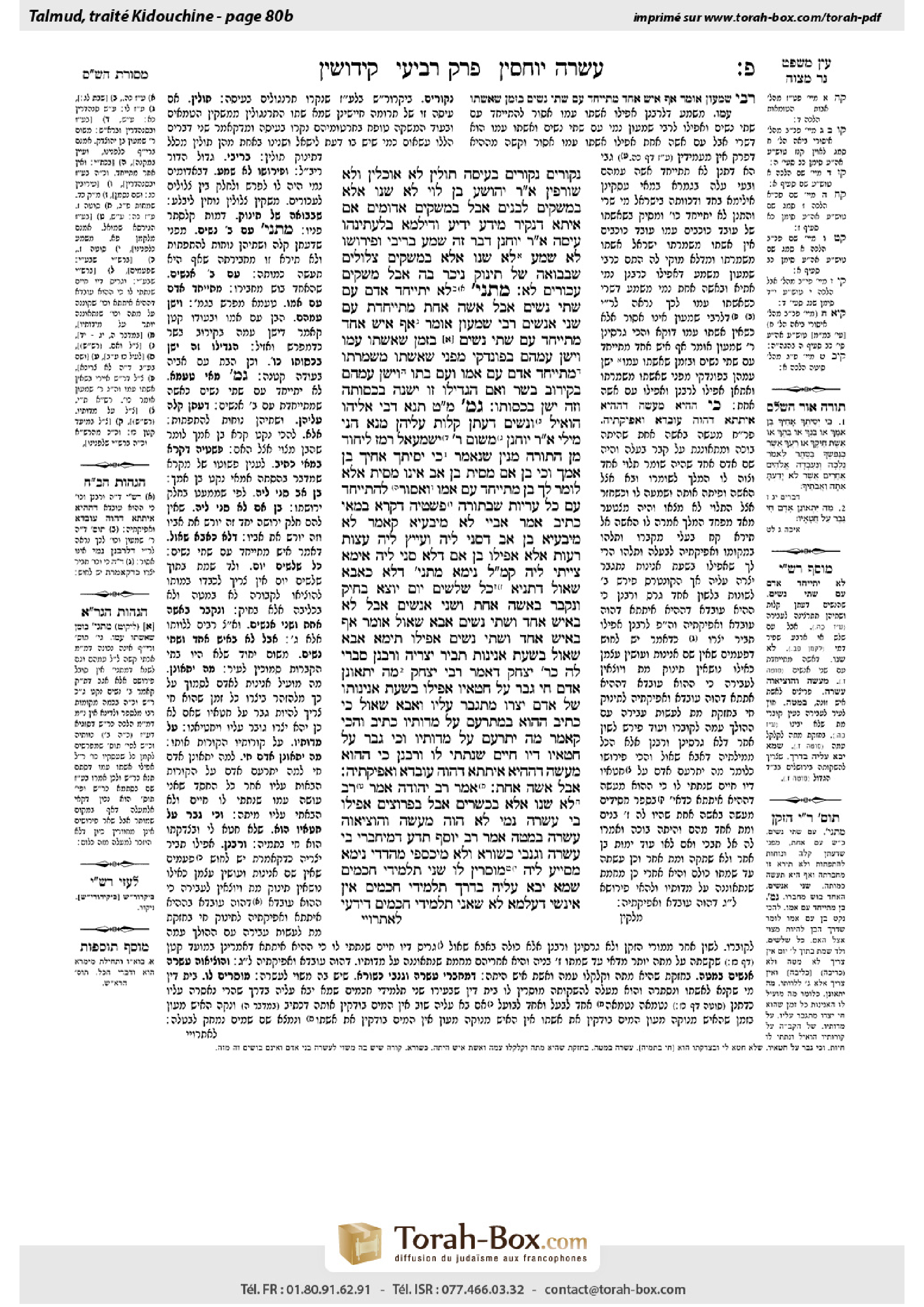
Kiddushin 80b: Talmud study for Daf Yomi
Daf Yomi is the daily study of one Talmud folio. Explore 37 tractates with scans, Hebrew text, Sefaria English and AI-generated French translations where annotated.
Passage selection and English or AI-generated French translation are available where the scan has annotations. Daf Study is independent of Torah-Box and Sefaria.
Browse Kiddushin · קידושין · All tractatesKiddushin 80b text and translations
This page of Kiddushin includes the Aramaic text, an English translation and an AI-generated French translation, alongside the scan above.
קידושין פ׳ ב · Aramaic and Hebrew text
נִקּוּרִים נִקּוּרִים בָּעִיסָּה – תּוֹלִין, לֹא אוֹכְלִין וְלֹא שׂוֹרְפִין.
אָמַר רַבִּי יְהוֹשֻׁעַ בֶּן לֵוִי: לֹא שָׁנוּ אֶלָּא בְּמַשְׁקִים לְבָנִים, אֲבָל בְּמַשְׁקִים אֲדוּמִּים – אִם אִיתָא דִּנְקִיר מִידָּע יְדִיעַ. וְדִילְמָא בְּלַעְתִּינְהוּ עִיסָּה?
אָמַר רַבִּי יוֹחָנָן: דָּבָר זֶה שָׁמַע בְּרִיבִּי, וּפֵירוּשׁוֹ לֹא שָׁמַע: לֹא שָׁנוּ אֶלָּא בְּמַשְׁקִים צְלוּלִים, שֶׁבָּבוּאָה שֶׁל תִּינוֹק נִיכָּר בָּהֶ[ן], אֲבָל מַשְׁקִים עֲכוּרִים – לֹא.
מַתְנִי׳ לֹא יִתְיַיחֵד אָדָם עִם שְׁתֵּי נָשִׁים, אֲבָל אִשָּׁה אַחַת מִתְיַיחֶדֶת עִם שְׁנֵי אֲנָשִׁים. רַבִּי שִׁמְעוֹן אוֹמֵר: אַף אִישׁ אֶחָד מִתְיַיחֵד עִם שְׁתֵּי נָשִׁים בִּזְמַן שֶׁאִשְׁתּוֹ עִמּוֹ, וְיָשֵׁן עִמָּהֶם בְּפוּנְדְּקִי, מִפְּנֵי שֶׁאִשְׁתּוֹ מְשַׁמַּרְתּוֹ. מִתְיַיחֵד אָדָם עִם אִמּוֹ וְעִם בִּתּוֹ וְיָשֵׁן עִמָּהֶם בְּקֵירוּב בָּשָׂר. וְאִם הִגְדִּילוּ – זוֹ יְשֵׁנָה בִּכְסוּתָהּ וְזֶה יָשֵׁן בִּכְסוּתוֹ.
גְּמָ׳ מַאי טַעְמָא? תְּנָא דְּבֵי אֵלִיָּהוּ: הוֹאִיל וְנָשִׁים דַּעְתָּן קַלּוֹת עֲלֵיהֶן.
מְנָא הָנֵי מִילֵּי? אָמַר רַבִּי יוֹחָנָן מִשּׁוּם רַבִּי יִשְׁמָעֵאל: רֶמֶז לְיִחוּד מִן הַתּוֹרָה מִנַּיִן – שֶׁנֶּאֱמַר: ״כִּי יְסִיתְךָ אָחִיךָ בֶן אִמֶּךָ״.
וְכִי בֶּן אֵם מֵסִית, בֶּן אָב אֵינוֹ מֵסִית? אֶלָּא לוֹמַר לָךְ: בֵּן מִתְיַיחֵד עִם אִמּוֹ, וְאָסוּר לְהִתְיַיחֵד עִם כׇּל עֲרָיוֹת שֶׁבַּתּוֹרָה.
פְּשָׁטֵיהּ דִּקְרָא בְּמַאי כְּתִיב? אָמַר אַבָּיֵי: לָא מִיבַּעְיָא קָאָמַר. לָא מִיבַּעְיָא בֶּן אָב, דְּסָנֵי לֵיהּ וְעָיֵיץ לֵיהּ עֵצוֹת רָעוֹת, אֶלָּא אֲפִילּוּ בֶּן אֵם, דְּלָא סָנֵי לֵיהּ – אֵימָא צָיְיתִי לֵיהּ, קָא מַשְׁמַע לַן.
נֵימָא מַתְנִיתִין דְּלָא כְּאַבָּא שָׁאוּל, דְּתַנְיָא: כׇּל שְׁלֹשִׁים יוֹם – יוֹצֵא בְּחֵיק, וְנִקְבָּר בְּאִשָּׁה אַחַת וּשְׁנֵי אֲנָשִׁים, אֲבָל לֹא בְּאִישׁ אֶחָד וּשְׁתֵּי נָשִׁים. אַבָּא שָׁאוּל אוֹמֵר: אַף בְּאִישׁ אֶחָד וּשְׁתֵּי נָשִׁים.
אֲפִילּוּ תֵּימָא אַבָּא שָׁאוּל, בִּשְׁעַת אֲנִינוּת תְּבִיר יִצְרֵיהּ.
וְרַבָּנַן סָבְרִי לַהּ כְּרַבִּי יִצְחָק. דְּאָמַר רַבִּי יִצְחָק: ״מַה יִּתְאוֹנֵן אָדָם חָי גֶּבֶר עַל חֲטָאָיו״ – אֲפִילּוּ בִּשְׁעַת אֲנִינוּתוֹ שֶׁל אָדָם יִצְרוֹ מִתְגַּבֵּר עָלָיו. וְאַבָּא שָׁאוּל? כִּי כְּתִיב הָהוּא – בְּמִתְרַעֵם עַל מִדּוֹתָיו כְּתִיב, וְהָכִי קָאָמַר: מָה יִתְרַעֵם עַל מִדּוֹתָיו, וְכִי גָּבַר עַל חֲטָאָיו? דַּיּוֹ חַיִּים שֶׁנָּתַתִּי לוֹ!
וְרַבָּנַן? כִּי הָהוּא מַעֲשֶׂה דְּהַהִיא אִיתְּתָא דַּהֲוָה עוֹבָדָא וְאַפֵּיקְתֵּיהּ.
אֲבָל אִשָּׁה אַחַת. אָמַר רַב יְהוּדָה אָמַר רַב: לֹא שָׁנוּ אֶלָּא בִּכְשֵׁרִים, אֲבָל בִּפְרוּצִים – אֲפִילּוּ בֵּי עַשְׂרָה נָמֵי לָא. הֲוָה מַעֲשֶׂה, וְהוֹצִיאוּהָ עֲשָׂרָה בַּמִּטָּה. אָמַר רַב יוֹסֵף: תִּדַּע, דְּמִיחַבְּרִי בֵּי עַשְׂרָה וְגָנְבִי כְּשׁוּרָא וְלָא מִיכַּסְפִי מֵהֲדָדֵי.
נֵימָא מְסַיַּיע לֵיהּ: מוֹסְרִין לוֹ שְׁנֵי תַּלְמִידֵי חֲכָמִים, שֶׁמָּא יָבֹא עָלֶיהָ בַּדֶּרֶךְ. תַּלְמִידֵי חֲכָמִים – אֵין, אִינָשֵׁי דְּעָלְמָא – לָא? שָׁאנֵי תַּלְמִידֵי חֲכָמִים דְּיָדְעִי
Kiddushin 80b · English translation
small holes in the dough where the chickens had pecked it, in that case the dough is held in suspension; it is neither eaten nor burned, since the chickens may have drunk from the impure liquids before they pecked at the dough but there is no proof of this. Despite this being a case where they cannot be asked, which generally would result in the dough being deemed pure, here it is deemed impure due to the uncertainty. The fact that in the second case of the baraita it is not deemed to be definitely impure supports the opinion of Rabbi Yoḥanan, who holds that in the case of the child the status of the dough also remains a matter of uncertainty.
Rabbi Yehoshua ben Levi says: They taught this halakha only in a case of white liquid, when the appearance of the peck marks provides no proof of whether the chickens had previously drunk from the liquid, but in a case of red, impure liquid, if it is so that they had pecked, it would be known that they had drunk from the liquid, since the peck marks would be colored red. The Gemara asks: Even if the liquid were red and there were no red marks on the dough, how can one say definitively that they did not peck? Perhaps the dough absorbed the liquid, leaving no identifiable mark?
Rabbi Yoḥanan says: The Distinguished, i.e., Rabbi Yehoshua ben Levi, heard this matter, but he did not hear its interpretation, and he should have supplied an additional detail: They taught this halakha only in a case of clear liquid, which can be absorbed in the dough without leaving a stain. What is meant by clear? It means that in which the reflection [bavua] of a child is recognizable when he peers into it. But in a case of murky liquid, this halakha was not stated, since the liquid would have left a mark.
MISHNA: A man may not be secluded with two women lest he sin with them, but one woman may be secluded with two men. Rabbi Shimon says: Even one man may be secluded with two women when his wife is with him, and in that situation he may even sleep in the same inn with two women, because his wife guards him from sinning with them. They further said that a man may be secluded with his mother, and with his daughter, and sleep alongside them with bodily contact without clothes, since there is no concern that they will engage in sexual intercourse. And when they, the son or daughter, have grown up, this one sleeps in her garment and that one sleeps in his garment, but they may share a bed.
GEMARA: What is the reason that a man may not be secluded with two women, but a woman may be secluded with two men? The school of Eliyahu taught: Since women are of light mind they are more easily seduced.
The Gemara asks: From where are these matters, that it is prohibited for a man to be secluded with women, derived? Rabbi Yoḥanan says in the name of Rabbi Yishmael: From where is there an allusion from the Written Torah to the prohibition against seclusion? As it is stated concerning one who incites others to idolatrous worship: “If your brother, the son of your mother, entices you” (Deuteronomy 13:7).
Rabbi Yishmael considers why the Torah uses the example of “the son of your mother.” But is it only the son of a mother who entices? Doesn’t the son of a father entice? Rather, the verse means to say to you: A son may be secluded with his mother. Consequently, if a woman has two sons from two different husbands, they will both stay close to her. The Torah therefore uses the example of “the son of your mother” because half-brothers who share a mother become close to each other. By contrast, half-brothers who share a father will not become close, since one’s father’s wife who is not one’s mother is a forbidden relative. And it is prohibited to be secluded with those with whom relations are forbidden by the Torah.
Since this verse merely alludes to the prohibition against seclusion, the Gemara asks: With regard to what is the plain meaning of the verse written, i.e., in the context of enticement to idolatrous worship, why does it emphasize “the son of your mother”? Abaye said: The verse is speaking utilizing the style of: It is not necessary. It is not necessary to state that one should not be enticed by the son of a father, who hates him due to their rivalry for their father’s inheritance and therefore gives him bad advice. Rather, the same is true even of the son of a mother, who does not hate him, since they are not rivals for the same inheritance, as each inherits from his own father. One might therefore say that he should listen to him and accept his advice. The verse consequently teaches us that he should pay no heed to his enticements.
The Gemara comments: Shall we say the mishna is not in accordance with the opinion of Abba Shaul, as it is taught in a baraita: If a child dies any time during the first thirty days after his birth, he is not given a proper funeral but is carried out held in their bosom, not on a bier, and buried by one woman and two men. But he may not be buried by one man and two women, due to the prohibition against seclusion. Abba Shaul says: He may even be buried by one man and two women. This indicates that Abba Shaul deems it permitted for a man to be secluded with two women.
The Gemara rejects this: You can even say that the mishna is in accordance with the opinion of Abba Shaul, as he permits it only in the case of the baraita, because at the time of acute mourning, i.e., immediately after a close relative has died, one’s inclination to sin is broken, and there is no concern that he might come to sin.
And the Rabbis, who render seclusion forbidden even then, hold in accordance with the statement of Rabbi Yitzḥak, as Rabbi Yitzḥak says as follows with regard to the verse: “Why does a living man complain, a powerful man due to his sins?” (Lamentations 3:39): Even at the time of a person’s acute mourning, his inclination to sin overpowers him. The Gemara asks: And how does Abba Shaul explain this verse? The Gemara answers: When that was written, it was written with regard to one who complains about God’s ways. And this is what the verse is saying: Why does one complain about God’s ways and claim that he has been treated unjustly? Has he overpowered his sins? God responds: The life I have given him is sufficient for him, and he deserves no more.
And the Rabbis are concerned about the possibility of sin even in times of acute mourning, like that incident involving a certain woman, as there was an incident where she removed her husband from his grave. When visiting her husband’s grave, she engaged in intercourse with a man who was tasked with guarding the body of one executed by the king. Meanwhile, that body was taken, and she suggested that they disinter her husband so that the guard could claim that he fulfilled his task properly. This demonstrates that even at a time of mourning one may succumb to temptation.
§ The mishna teaches: But one woman may be secluded with two men. Rav Yehuda says that Rav says: They taught this halakha only with regard to men of fit morals, but with regard to those steeped in sexual immorality, she may not be secluded even with ten men. There was an incident where ten men carried out a woman on a bier, as though she were dead, and engaged in intercourse with her. Rav Yosef says: Know that this is so, since ten people will join together and steal a heavy beam without being ashamed before one another. Similarly, several men can join together for a licentious act without shame.
The Gemara suggests: Shall we say the following mishna (Sota 7a) supports him: It was taught with regard to one who is bringing his wife, whom he suspects of having committed adultery [sota], to the Temple to perform the ritual of the bitter water, that they provide him with two Torah scholars to accompany them lest he engage in sexual intercourse with her along the way, as until the ritual has been performed she remains forbidden to her husband? It can be inferred from here: Two Torah scholars, yes; their presence will assure that no one will engage in forbidden intercourse. Regular men, no; there is still a concern that they may engage in intercourse. This indicates that ordinary people are not relied upon with regard to seclusion with a woman. The Gemara rejects this proof: The reason there is a need for them to be Torah scholars is that Torah scholars are different, in that they know
Kiddushin 80b · Traduction française (IA)
de petits trous dans la pâte, là où les poules l’avaient picorée. Dans ce cas, la pâte reste en suspens : elle n’est ni consommée ni brûlée, car les poules ont peut-être bu des liquides impurs avant de picorer la pâte, mais rien ne le prouve. Bien qu’il s’agisse d’un cas où l’on ne peut pas les interroger, ce qui conduirait généralement à considérer la pâte comme pure, ici elle est considérée comme impure en raison du doute. Le fait que, dans le second cas de la baraïta, elle ne soit pas considérée comme certainement impure étaye l’opinion de Rabbi Yoḥanan, selon laquelle, dans le cas de l’enfant, le statut de la pâte reste lui aussi incertain.
Rabbi Yehoshua ben Levi dit : Ils n’ont enseigné cette halakha que dans le cas d’un liquide blanc, lorsque l’aspect des marques de bec ne permet pas de savoir si les poules avaient auparavant bu du liquide ; mais, dans le cas d’un liquide impur rouge, si elles avaient picoré, on saurait qu’elles avaient bu du liquide, puisque les marques de bec seraient rouges. La Guemara demande : Même si le liquide était rouge et qu’il n’y avait pas de marques rouges sur la pâte, comment peut-on affirmer avec certitude qu’elles n’ont pas picoré ? Peut-être la pâte a-t-elle absorbé le liquide, sans laisser de trace identifiable ?
Rabbi Yoḥanan dit : Le Distingué, c’est-à-dire Rabbi Yehoshua ben Levi, a entendu cette question, mais il n’en a pas entendu l’explication, et il aurait dû ajouter une précision : Ils n’ont enseigné cette halakha que dans le cas d’un liquide clair, qui peut être absorbé par la pâte sans y laisser de tache. Qu’entend-on par « clair » ? Un liquide dans lequel le reflet [bavua] d’un enfant est reconnaissable lorsqu’il se penche pour regarder. Mais cette halakha n’a pas été enseignée dans le cas d’un liquide trouble, car celui-ci aurait laissé une trace.
MICHNA : Un homme ne peut pas s’isoler avec deux femmes, de peur qu’il ne commette une faute avec elles ; mais une femme peut s’isoler avec deux hommes. Rabbi Shimon dit : Même un homme peut s’isoler avec deux femmes lorsque son épouse est avec lui ; dans ce cas, il peut même dormir dans la même auberge que deux femmes, car son épouse le préserve de la faute. Ils ont également dit qu’un homme peut s’isoler avec sa mère et avec sa fille, et dormir auprès d’elles avec un contact physique, sans vêtements, puisqu’on ne craint pas qu’ils aient des relations sexuelles. Lorsque le fils ou la fille a grandi, l’un dort vêtu et l’autre vêtue, mais ils peuvent partager un lit.
GUEMARA : Pour quelle raison un homme ne peut-il pas s’isoler avec deux femmes, alors qu’une femme peut s’isoler avec deux hommes ? L’école d’Élie enseigna : Les femmes ayant l’esprit léger, elles se laissent plus facilement séduire.
La Guemara demande : D’où déduit-on que l’isolement d’un homme avec des femmes est interdit ? Rabbi Yoḥanan dit au nom de Rabbi Yishmael : Où trouve-t-on dans la Torah écrite une allusion à l’interdiction de s’isoler ? Car il est dit, au sujet de celui qui incite autrui à pratiquer l’idolâtrie : « Si ton frère, le fils de ta mère, t’incite » (Deutéronome 13:7).
Rabbi Yishmael s’interroge sur l’emploi par la Torah de l’expression « le fils de ta mère ». Mais est-ce seulement le fils d’une mère qui incite ? Le fils d’un père n’incite-t-il pas aussi ? Le verset veut plutôt te dire ceci : un fils peut s’isoler avec sa mère. Par conséquent, si une femme a deux fils de deux maris différents, ils resteront tous deux auprès d’elle. La Torah prend donc l’exemple du « fils de ta mère », car des demi-frères qui ont la même mère deviennent proches l’un de l’autre. En revanche, des demi-frères qui ont le même père ne deviennent pas proches, car l’épouse de leur père qui n’est pas leur mère est une parente interdite. Or, il est interdit de s’isoler avec ceux avec qui les relations sont interdites par la Torah.
Puisque ce verset ne fait qu’évoquer l’interdiction de s’isoler, la Guemara demande : Quel est le sens littéral du verset, c’est-à-dire, dans le contexte de l’incitation à l’idolâtrie, pourquoi insiste-t-il sur l’expression « le fils de ta mère » ? Abaye dit : Le verset emploie la tournure « cela va sans dire ». Il va sans dire qu’il ne faut pas se laisser inciter par le fils d’un père, qui le hait en raison de leur rivalité pour l’héritage de leur père et lui donne donc de mauvais conseils. Mais il en va de même pour le fils d’une mère, qui ne le hait pas, puisqu’ils ne se disputent pas le même héritage, chacun héritant de son propre père. On pourrait donc penser qu’il faut l’écouter et accepter ses conseils. Le verset nous enseigne par conséquent qu’il ne faut pas prêter attention à ses incitations.
La Guemara fait remarquer : Faut-il en conclure que la Michna n’est pas conforme à l’opinion d’Abba Shaul, comme on l’enseigne dans une baraïta : Si un enfant meurt à n’importe quel moment au cours des trente premiers jours suivant sa naissance, on ne lui fait pas de funérailles en bonne et due forme ; on l’emporte dans les bras, et non sur un brancard, puis une femme et deux hommes l’enterrent. Mais il ne peut pas être enterré par un homme et deux femmes, en raison de l’interdiction de s’isoler. Abba Shaul dit : Il peut même être enterré par un homme et deux femmes. Cela indique qu’Abba Shaul considère qu’un homme peut s’isoler avec deux femmes.
La Guemara rejette cette conclusion : On peut même dire que la Michna est conforme à l’opinion d’Abba Shaul, car il ne le permet que dans le cas de la baraïta, au moment du deuil aigu, c’est-à-dire immédiatement après la mort d’un proche : le penchant à la faute est alors brisé, et l’on ne craint pas que l’homme commette une faute.
Quant aux rabbins, qui interdisent l’isolement même dans ce cas, ils se conforment à l’enseignement de Rabbi Yitzḥak. En effet, Rabbi Yitzḥak dit, à propos du verset : « Pourquoi un homme vivant se plaindrait-il, un homme fort à cause de ses péchés ? » (Lamentations 3:39) : même au moment du deuil aigu, le penchant à la faute prend le dessus sur l’homme. La Guemara demande : Et comment Abba Shaul explique-t-il ce verset ? La Guemara répond : Lorsqu’il fut écrit, il l’a été au sujet de celui qui se plaint des voies de Dieu. Voici ce que dit le verset : Pourquoi se plaindre des voies de Dieu et prétendre avoir été traité injustement ? A-t-il triomphé de ses péchés ? Dieu répond : La vie que Je lui ai accordée lui suffit, et il ne mérite rien de plus.
Les rabbins craignent la possibilité d’une faute même en période de deuil aigu, comme le montre cette histoire au sujet d’une certaine femme : il arriva qu’elle fit sortir son mari de sa tombe. Alors qu’elle se rendait sur la tombe de son mari, elle eut des relations sexuelles avec un homme chargé de garder le corps d’un condamné exécuté par le roi. Entre-temps, le corps fut emporté, et elle suggéra qu’ils exhument son mari afin que le gardien puisse prétendre avoir correctement accompli sa tâche. Cela montre que même en période de deuil, on peut succomber à la tentation.
§ La Michna enseigne : Mais une femme peut s’isoler avec deux hommes. Rav Yehuda dit au nom de Rav : Ils n’ont enseigné cette halakha qu’au sujet d’hommes de mœurs irréprochables ; mais avec des hommes plongés dans la débauche sexuelle, elle ne peut pas s’isoler, même s’ils sont dix. Il arriva que dix hommes transportèrent une femme sur un brancard, comme si elle était morte, et eurent des relations sexuelles avec elle. Rav Yosef dit : Sache que c’est bien ainsi, car dix personnes s’unissent pour voler une lourde poutre sans avoir honte les unes devant les autres. De même, plusieurs hommes peuvent s’unir pour un acte débauché sans éprouver de honte.
La Guemara propose : Faut-il dire que la Michna suivante (Sota 7a) vient étayer son opinion ? On a enseigné au sujet de celui qui conduit au Temple son épouse, qu’il soupçonne d’adultère [sota], afin qu’elle accomplisse le rituel des eaux amères, qu’on lui adjoint deux érudits en Torah pour les accompagner, de peur qu’il n’ait des relations sexuelles avec elle en chemin, car jusqu’à ce que le rituel ait été accompli, elle lui reste interdite. On peut en déduire : Deux érudits en Torah, oui ; leur présence garantit que personne n’aura de relations interdites. Des hommes ordinaires, non ; on craint toujours qu’ils aient des relations sexuelles. Cela indique qu’on ne peut pas se fier aux gens ordinaires lorsqu’il s’agit d’isolement avec une femme. La Guemara rejette cette preuve : s’il faut des érudits en Torah, c’est parce que les érudits en Torah sont différents, en ce qu’ils savent
Traduction française générée par IA à partir de l’édition anglaise de Sefaria. Vérifie toujours un passage avec le texte source.
Text from Sefaria: William Davidson Edition - Vocalized Aramaic (CC BY NC); William Davidson Edition - English (CC BY NC).