Kiddushin 81a: Talmud study for Daf Yomi
Daf Yomi is the daily study of one Talmud folio. Explore 37 tractates with scans, Hebrew text, Sefaria English and AI-generated French translations where annotated.
Passage selection and English or AI-generated French translation are available where the scan has annotations. Daf Study is independent of Torah-Box and Sefaria.
Browse Kiddushin · קידושין · All tractatesKiddushin 81a text and translations
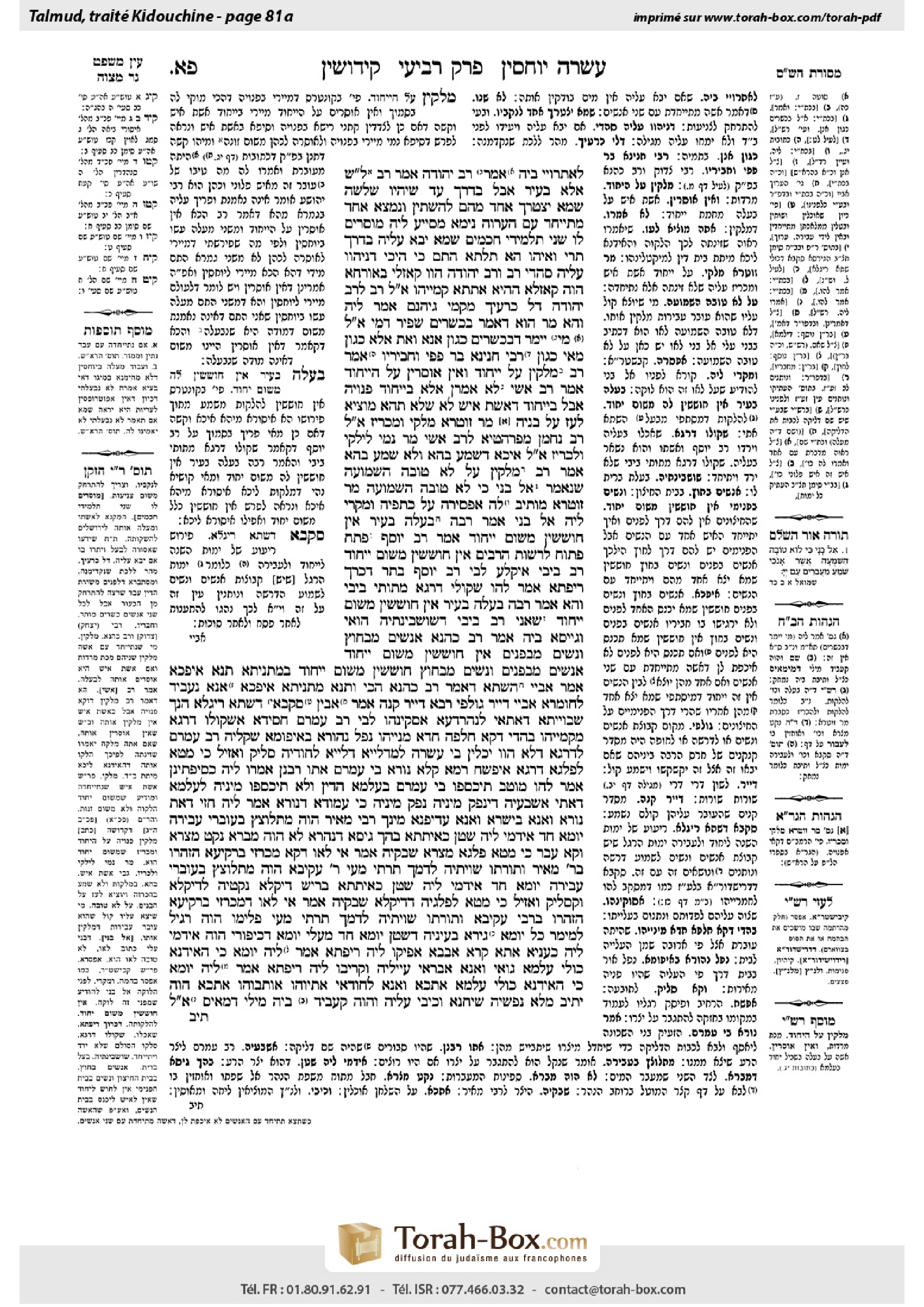
This page of Kiddushin includes the Aramaic text, an English translation and an AI-generated French translation, alongside the scan above.
קידושין פ״א א · Aramaic and Hebrew text
לְאַתְרוֹיֵי בֵּיהּ.
אָמַר רַב יְהוּדָה אָמַר רַב: לֹא שָׁנוּ אֶלָּא בָּעִיר, אֲבָל בַּדֶּרֶךְ – עַד שֶׁיִּהְיוּ שְׁלֹשָׁה, שֶׁמָּא יִצְטָרֵךְ אֶחָד מֵהֶם לְהַשְׁתִּין, וְנִמְצָא אֶחָד מִתְיַיחֵד עִם הָעֶרְוָה. נֵימָא מְסַיַּיע לֵיהּ: מוֹסְרִים לוֹ שְׁנֵי תַּלְמִידֵי חֲכָמִים שֶׁמָּא יָבֹא עָלֶיהָ בַּדֶּרֶךְ. תְּרֵי וְאִיהוּ, הָא תְּלָתָא! הָתָם כִּי הֵיכִי דְּנִיהְווֹ עֲלֵיהּ סָהֲדִי.
רַב וְרַב יְהוּדָה הֲווֹ קָאָזְלִי בְּאוֹרְחָא, הֲוָה קָאָזְלָא הַהִיא אִתְּתָא קַמַּיְיהוּ. אֲמַר לֵיהּ רַב לְרַב יְהוּדָה: דַּל כַּרְעָיךְ מִקַּמֵּי גֵיהִנָּם. אֲמַר לֵיהּ: וְהָא מָר הוּא דְּאָמַר בִּכְשֵׁרִים שַׁפִּיר דָּמֵי! אֲמַר לֵיהּ: מִי יֵימַר דְּבִכְשֵׁרִים כְּגוֹן אֲנָא וְאַתְּ? אֶלָּא כְּגוֹן מַאי? כְּגוֹן רַבִּי חֲנִינָא בַּר פַּפֵּי וַחֲבֵירָיו.
אָמַר רַב: מַלְקִין עַל יִיחוּד, וְאֵין אוֹסְרִין עַל הַיִּיחוּד. אָמַר רַב אָשֵׁי: לָא אֲמַרַן אֶלָּא בְּיִיחוּד פְּנוּיָה, אֲבָל בְּיִיחוּד דְּאֵשֶׁת אִישׁ – לָא, שֶׁלֹּא תְּהֵא מוֹצִיא לַעַז עַל בָּנֶיהָ.
מָר זוּטְרָא מַלְקֵי וּמַכְרֵיז. אֲמַר לֵיהּ רַב נַחְמָן מִפַּרְהַטְיָא לְרַב אָשֵׁי: מָר נָמֵי לַילְקֵי וְלַכְרֵיז! אֲמַר לֵיהּ: אִיכָּא דְּשָׁמַע בְּהָא וְלָא שָׁמַע בְּהָא.
אָמַר רַב: מַלְקִין עַל לֹא טוֹבָה הַשְּׁמוּעָה, שֶׁנֶּאֱמַר: ״אַל בָּנָי כִּי לוֹא טוֹבָה הַשְּׁמֻעָה״. מָר זוּטְרָא מוֹתֵיב לֵהּ אַפְסֵירָה עַל כַּתְפֵּיהּ וּמַקְרֵי לֵיהּ: ״אַל בָּנָי״
אָמַר רַבָּה: בַּעְלָהּ בָּעִיר – אֵין חוֹשְׁשִׁין מִשּׁוּם יִיחוּד. אָמַר רַב יוֹסֵף: פֶּתַח פָּתוּחַ לִרְשׁוּת הָרַבִּים – אֵין חוֹשְׁשִׁין מִשּׁוּם יִיחוּד. רַב בִּיבִי אִיקְּלַע לְבֵי רַב יוֹסֵף. בָּתַר דִּכְרַךְ רִיפְתָּא אֲמַר לְהוּ: שְׁקוּלוּ דַּרְגָּא מִתּוּתֵי בִּיבִי. וְהָא אָמַר רַבָּה: בַּעְלָהּ בָּעִיר – אֵין חוֹשְׁשִׁין מִשּׁוּם יִיחוּד! שָׁאנֵי רַב בִּיבִי דְּשׁוֹשְׁבִינְתֵּיהּ הֲוַאי וְגָיְיסָא בֵּיהּ.
אָמַר רַב כָּהֲנָא: אֲנָשִׁים מִבַּחוּץ וְנָשִׁים מִבִּפְנִים – אֵין חוֹשְׁשִׁין מִשּׁוּם יִיחוּד. אֲנָשִׁים מִבִּפְנִים וְנָשִׁים מִבַּחוּץ – חוֹשְׁשִׁין מִשּׁוּם יִיחוּד.
בְּמַתְנִיתָא תָּנָא אִיפְּכָא. אָמַר אַבָּיֵי: הַשְׁתָּא דְּאָמַר רַב כָּהֲנָא הָכִי וְתָנָא מַתְנִיתָא אִיפְּכָא, אֲנָא נַעֲבֵיד לְחוּמְרָא.
אַבָּיֵי דָּיַיר גּוּלְפֵי. רָבָא דָּיַיר קְנֵה. אָמַר אָבִין: סְקָבָא דְשַׁתָּא רִיגְלָא.
הָנָךְ שְׁבוּיָיתָא דַּאֲתַאי לִנְהַרְדְּעָא. אַסְּקִינְהוּ לְבֵי רַב עַמְרָם חֲסִידָא, אַשְׁקוּלוּ דַּרְגָּא מִקַּמַּיְיהוּ. בַּהֲדֵי דְּקָא חָלְפָה חֲדָא מִנַּיְיהוּ נְפַל נְהוֹרָא בְּאִיפּוּמָּא. שַׁקְלֵיהּ רַב עַמְרָם לְדַרְגָּא דְּלָא הֲווֹ יָכְלִין בֵּי עַשְׂרָה לְמִדְלְיֵיהּ, דַּלְיֵיהּ לְחוֹדֵיהּ, סָלֵיק וְאָזֵיל.
כִּי מְטָא לְפַלְגָא [דְּ]דַרְגָּא אִיפְּשַׁח, רְמָא קָלָא: נוּרָא בֵּי עַמְרָם! אֲתוֹ רַבָּנַן, אֲמַרוּ לֵיהּ: כַּסֵּיפְתִּינַן. אֲמַר לְהוּ: מוּטָב תִּיכַּסְפוּ בֵּי עַמְרָם בְּעָלְמָא הָדֵין וְלָא תִּיכַּסְפוּ מִינֵּיהּ לְעָלְמָא דְּאָתֵי. אַשְׁבְּעֵיהּ דְּיִנְפַּק מִינֵּיהּ, נְפַק מִינֵּיהּ כִּי עַמּוּדָא דְנוּרָא. אֲמַר לֵיהּ: חֲזִי, דְּאַתְּ נוּרָא וַאֲנָא בִּישְׂרָא, וַאֲנָא עֲדִיפְנָא מִינָּךְ.
רַבִּי מֵאִיר הֲוָה מִתְלוֹצֵץ בְּעוֹבְרֵי עֲבֵירָה. יוֹמָא חַד אִידְּמִי לֵיהּ שָׂטָן כְּאִיתְּתָא בְּהָךְ גִּיסָא דְנַהֲרָא, לָא הֲוָה מַבָּרָא – נְקַט מִצְרָא וְקָא עָבַר. כִּי מְטָא פַּלְגָא מִצְרָא שַׁבְקֵיהּ, אָמַר: אִי לָאו דְּקָא מַכְרְזִי בִּרְקִיעָא ״הִזָּהֲרוּ בְּרַבִּי מֵאִיר וְתוֹרָתוֹ״ שַׁוֵּיתֵיהּ לִדְמָךְ תַּרְתֵּי מָעֵי.
רַבִּי עֲקִיבָא הֲוָה מִתְלוֹצֵץ בְּעוֹבְרֵי עֲבֵירָה. יוֹמָא חַד אִידְּמִי לֵיהּ שָׂטָן כְּאִיתְּתָא בְּרֵישׁ דִּיקְלָא. נַקְטֵיהּ לְדִיקְלָא וְקָסָלֵיק וְאָזֵיל. כִּי מְטָא לְפַלְגֵיהּ דְּדִיקְלָא שַׁבְקֵיהּ, אָמַר: אִי לָאו דְּמַכְרְזִי בִּרְקִיעָא ״הִזָּהֲרוּ בְּרַבִּי עֲקִיבָא וְתוֹרָתוֹ״ שַׁוֵּיתֵיהּ לִדְמָךְ תַּרְתֵּי מָעֵי.
פְּלֵימוֹ הֲוָה רְגִיל לְמֵימַר כׇּל יוֹמָא ״גִּירָא בְּעֵינֵיהּ דְּשָׂטָן״. יוֹמָא חַד מַעֲלֵי יוֹמָא דְכִיפּוּרֵי הֲוָה. אִידְּמִי לֵיהּ כְּעַנְיָא. אֲתָא קְרָא אַבָּבָא, אַפִּיקוּ לֵיהּ רִיפְתָּא. אֲמַר לֵיהּ: יוֹמָא כִּי הָאִידָּנָא כּוּלֵּי עָלְמָא גַּוַּאי וַאֲנָא אַבָּרַאי? עַיְּילֵיהּ וְקָרִיבוּ לֵיהּ רִיפְתָּא. אֲמַר לֵיהּ: יוֹמָא כִּי הָאִידָּנָא כּוּלֵּי עָלְמָא אַתַּכָּא וַאֲנָא לְחוֹדַאי? אַתְיוּהּ אוֹתְבוּהּ אַתַּכָּא. הֲוָה יָתֵיב מְלָא נַפְשֵׁיהּ שִׁיחְנָא וְכִיבֵי (עֲלֵיהּ) וַהֲוָה קָעָבֵיד בֵּיהּ מִילֵּי דִּמְאִיס. אֲמַר לֵיהּ:
Kiddushin 81a · English translation
how to warn him not to engage in intercourse with her, since that would neutralize the effectiveness of the examination of the waters.
Rav Yehuda says that Rav says: The Sages taught that two men may seclude themselves with one woman only in a city, where others are present, but on the road it is not permitted unless there are three. Why are two men insufficient on the road? Perhaps one of them will need to urinate and will walk away, and it will turn out that one person will be secluded with a woman forbidden to him. The Gemara suggests: Shall we say the mishna quoted above supports him: They provide him with two Torah scholars to accompany them lest he engage in sexual intercourse with her along the way? He and two Torah scholars are three, which indicates that there is a requirement for three men when they are traveling. The Gemara answers: That is no proof, as there, in the case of the sota, there is a requirement for an additional two men in order that they should serve as witnesses about him, to testify whether or not he engaged in intercourse with her along the way.
The Gemara relates: Rav and Rav Yehuda were walking along the way, and a certain woman was walking ahead of them. Rav said to Rav Yehuda: Raise your feet and walk quickly away from Gehenna so that we do not remain secluded with her. Rav Yehuda said to him: But wasn’t it you, Master, who said that it is permitted in the case of men of fit morals? Rav said to him: Who says that I referred to men of fit morals such as you and me? Rav Yehuda responded: Rather, such as whom? Rav answered: Such as Rabbi Ḥanina bar Pappi and his colleagues, who have proven that they can withstand temptation (see 39b). All other people are not trusted in this matter.
Rav says: The court flogs a man due to his being secluded with a woman. But a wife is not forbidden to her husband, and an unmarried woman is not prohibited from marrying a priest due to being secluded, as it cannot be stated definitively that the secluded pair engaged in sexual intercourse. Rav Ashi says: We stated the halakha that one is flogged due to being secluded only with an unmarried woman, but for being secluded with a married woman, one is not flogged. Why not? It is so that there should not be rumors spread concerning her children. If the secluded pair is flogged, everyone will assume that they engaged in intercourse, and people will consider her children to be mamzerim, whereas in fact they were flogged only for being secluded.
The Gemara relates: Mar Zutra would even flog one who was secluded with a married woman, and he would proclaim the reason for the punishment. Rav Naḥman from Parhatya said to Rav Ashi: Let the Master also flog and proclaim the reason. Rav Ashi said to him: I am hesitant to do so, in case there are those who hear about this, i.e., the flogging, and do not hear about that, i.e., the reason for the flogging.
Rav says: The court flogs one due to his being the subject of a bad rumor, meaning that not only is a person flogged when the facts have been ascertained, but even when he has only reportedly committed transgressions he may be flogged. As it is stated: “No, my sons, for it is no good report” (I Samuel 2:24). When Mar Zutra would flog a person for being the subject of a bad rumor, he would place the bridle of a donkey on the person’s shoulders and recite before him when administering lashes: “No, my sons, for it is no good report,” so that people would know why he was being flogged.
Rabba says: If a woman’s husband is in town, there is no concern due to her being secluded with a man. People are afraid to sin with her, since they cannot be sure when her husband will return. Rav Yosef says: If there is an open entrance to the public domain there is no concern due to being secluded. The Gemara relates: Rav Beivai arrived at Rav Yosef’s house. After he wrapped his bread, i.e., ate his meal, he said to the members of the household: Remove the ladder from beneath Beivai, who was going to sleep in the upper story, so that he not be able to climb down, due to the prohibition of being secluded with Rav Yosef’s wife. The Gemara asks: But doesn’t Rabba say: If her husband is in town, there is no concern due to her being secluded with a man? The Gemara answers: Rav Beivai is different, since Rav Yosef’s wife was his friend and she was familiar with him, and therefore there was more cause for concern.
Rav Kahana says: If the men are located on the outside, i.e., in the outer room, and the women in the inside, i.e., in the inner room, there is no concern due to being secluded. Even if one of the men were to enter the inner room, he would be seen by the other men. By contrast, if there were men in the inside and women on the outside, there is a concern due to being secluded, since one of the men can claim that he is leaving and in fact join the women.
The Gemara comments: The opposite was taught in a baraita, that if the men are on the outside and the women are inside there is concern due to being secluded, as one of the men might venture inside without being noticed, but if the men are inside and the women are outside, he knows that one of the other men might go out through the women’s quarters at any time, and therefore there is no concern due to being secluded. Abaye said: Now that Rav Kahana has said the halakha in this manner and a baraita teaches the opposite, we shall act stringently in both cases.
Abaye would arrange rows of pitchers between the men and women, so that they would not be able to cross from one area to the other without making noise. Rava would arrange rows of reeds to prevent passage. Avin said: The wound [sakva], i.e., the vulnerable point, of the year is the Festival, since men and women would come together on these joyous occasions, and this would lead to sin.
§ The Gemara relates: Those captive women who were brought to Neharde’a, where they were redeemed, were brought up to the house of Rav Amram the Pious. They removed the ladder from before them to prevent men from climbing up after them to the attic where they were to sleep. When one of them passed by the entrance to the upper chamber, it was as though a light shone in the aperture due to her great beauty. Out of his desire for her, Rav Amram grabbed a ladder that ten men together could not lift, lifted it on his own and began climbing.
When he was halfway up the ladder, he strengthened his legs against the sides of the ladder to stop himself from climbing further, raised his voice, and cried out: There is a fire in the house of Amram. Upon hearing this, the Sages came and found him in that position. They said to him: You have embarrassed us, since everyone sees what you had intended to do. Rav Amram said to them: It is better that you be shamed in Amram’s house in this world, and not be ashamed of him in the World-to-Come. He took an oath that his evil inclination should emerge from him, and an apparition similar to a pillar of fire emerged from him. He said to his evil inclination: See, as you are fire and I am mere flesh, and yet, I am still superior to you, as I was able to overcome you.
The Gemara relates: Rabbi Meir would ridicule transgressors by saying it is easy to avoid temptation. One day, Satan appeared to him as a woman standing on the other side of the river. Since there was no ferry to cross the river, he took hold of a rope bridge and crossed the river. When he reached halfway across the rope bridge, the evil inclination left him and said to him: Were it not for the fact that they proclaim about you in heaven: Be careful with regard to Rabbi Meir and his Torah, I would have made your blood like two ma’a, i.e., completely worthless, since you would have fallen completely from your spiritual level.
Rabbi Akiva would likewise ridicule transgressors. One day, Satan appeared to him as a woman at the top of a palm tree. Rabbi Akiva grabbed hold of the palm tree and began climbing. When he was halfway up the palm tree, the evil inclination left him and said to him: Were it not for the fact that they proclaim about you in heaven: Be careful with regard to Rabbi Akiva and his Torah, I would have made your blood like two ma’a.
The Sage Peleimu had the habit to say every day: An arrow in the eye of Satan, mocking the temptations of the evil inclination. One day, it was the eve of Yom Kippur, and Satan appeared to him as a pauper who came and called him to the door, requesting alms. Peleimu brought out bread to him. Satan said to him: On a day like today, everyone is inside eating, and shall I stand outside and eat? Peleimu brought him inside and gave him bread. He said to him: On a day like today, everyone is sitting at the table, and shall I sit by myself? They brought him and sat him at the table. He was sitting and had covered himself with boils and pus, and he was doing repulsive things at the table. Peleimu said to the pauper:
Kiddushin 81a · Traduction française (IA)
comment l’avertir de ne pas avoir de rapports avec elle, car cela neutraliserait l’efficacité de l’épreuve des eaux.
Rav Yehouda dit au nom de Rav : Les Sages ont enseigné que deux hommes peuvent s’isoler avec une femme uniquement en ville, où d’autres personnes sont présentes, mais que, sur la route, cela n’est permis que s’ils sont trois. Pourquoi deux hommes ne suffisent-ils pas sur la route ? Peut-être l’un d’eux aura-t-il besoin d’uriner et s’éloignera-t-il, de sorte qu’un seul homme se retrouvera isolé avec une femme qui lui est interdite. La Guemara suggère : Faut-il en conclure que la Michna citée plus haut le confirme : on lui fournit deux érudits de la Torah pour l’accompagner, de peur qu’il n’ait des rapports avec elle en chemin ? Lui-même et les deux érudits de la Torah font trois hommes, ce qui indique qu’il en faut trois lorsqu’ils voyagent. La Guemara répond : Cela ne prouve rien, car, dans le cas de la sota, deux hommes supplémentaires sont requis afin qu’ils servent de témoins à son sujet et attestent s’il a ou non eu des rapports avec elle en chemin.
La Guemara rapporte : Rav et Rav Yehouda marchaient sur la route, et une femme marchait devant eux. Rav dit à Rav Yehouda : Accélère le pas et éloignons-nous rapidement de la Géhenne, afin que nous ne restions pas isolés avec elle. Rav Yehouda lui dit : Mais n’est-ce pas toi, maître, qui as dit que cela est permis dans le cas d’hommes aux mœurs irréprochables ? Rav lui répondit : Qui dit que je parlais d’hommes aux mœurs irréprochables tels que toi et moi ? Rav Yehouda demanda : De qui alors ? Rav répondit : D’hommes tels que Rabbi Ḥanina bar Pappi et ses compagnons, qui ont prouvé qu’ils pouvaient résister à la tentation (voir 39b). On ne peut pas faire confiance aux autres dans ce domaine.
Rav dit : Le tribunal fouette un homme parce qu’il s’est isolé avec une femme. Cependant, une épouse n’est pas interdite à son mari, et une femme célibataire n’est pas empêchée d’épouser un prêtre au motif qu’elle s’est isolée, car on ne peut pas affirmer avec certitude que les deux personnes isolées ont eu des rapports. Rav Ashi dit : Nous avons énoncé la halakha selon laquelle on est fouetté pour s’être isolé uniquement avec une femme célibataire ; mais on n’est pas fouetté pour s’être isolé avec une femme mariée. Pourquoi ? Afin que des rumeurs ne circulent pas au sujet de ses enfants. Si les deux personnes isolées sont fouettées, tout le monde supposera qu’elles ont eu des rapports, et les gens considéreront ses enfants comme des mamzerim, alors qu’en réalité elles n’auront été fouettées que pour s’être isolées.
La Guemara rapporte : Mar Zutra faisait même fouetter celui qui s’était isolé avec une femme mariée, et il proclamait la raison de la punition. Rav Naḥman de Parhatya dit à Rav Ashi : Que le maître fasse lui aussi fouetter les coupables et proclame la raison. Rav Ashi lui dit : J’hésite à le faire, de peur que certains entendent parler de cela, c’est-à-dire du fouet, sans entendre parler de cela, c’est-à-dire de la raison du fouet.
Rav dit : Le tribunal fouette quelqu’un parce qu’il fait l’objet d’une mauvaise rumeur. Cela signifie qu’on ne fouette pas seulement une personne lorsque les faits ont été établis, mais qu’on peut aussi la fouetter lorsqu’on rapporte simplement qu’elle a commis des transgressions. Comme il est dit : « Non, mes fils, car ce n’est pas une bonne réputation » (I Samuel 2:24). Lorsque Mar Zutra faisait fouetter quelqu’un parce qu’il faisait l’objet d’une mauvaise rumeur, il plaçait sur ses épaules le bât d’un âne et récitait devant lui, pendant qu’on lui administrait les coups : « Non, mes fils, car ce n’est pas une bonne réputation », afin que les gens sachent pourquoi il était fouetté.
Rabba dit : Si le mari d’une femme se trouve en ville, il n’y a pas lieu de craindre qu’elle s’isole avec un homme. Les hommes ont peur de pécher avec elle, car ils ne peuvent pas savoir à quel moment son mari reviendra. Rav Yosef dit : S’il y a une entrée ouverte sur le domaine public, il n’y a pas lieu de craindre un isolement. La Guemara rapporte : Rav Beivai arriva chez Rav Yosef. Après avoir mangé, il dit aux membres de la maisonnée : Retirez l’échelle qui se trouve sous Beivai, qui allait dormir à l’étage supérieur, afin qu’il ne puisse pas redescendre, par crainte qu’il ne s’isole avec la femme de Rav Yosef. La Guemara demande : Mais Rabba ne dit-il pas que, si le mari se trouve en ville, il n’y a pas lieu de craindre que sa femme s’isole avec un homme ? La Guemara répond : Le cas de Rav Beivai est différent, puisque la femme de Rav Yosef était son amie et le connaissait bien ; il y avait donc davantage lieu de s’inquiéter.
Rav Kahana dit : Si les hommes se trouvent à l’extérieur, c’est-à-dire dans la pièce extérieure, et les femmes à l’intérieur, c’est-à-dire dans la pièce intérieure, il n’y a pas lieu de craindre un isolement. Même si l’un des hommes entrait dans la pièce intérieure, les autres hommes le verraient. En revanche, si les hommes se trouvent à l’intérieur et les femmes à l’extérieur, il y a lieu de craindre un isolement, car l’un des hommes peut prétendre qu’il s’en va et, en réalité, rejoindre les femmes.
La Guemara fait remarquer : Une baraïta enseigne le contraire : si les hommes se trouvent à l’extérieur et les femmes à l’intérieur, il y a lieu de craindre un isolement, car l’un des hommes pourrait entrer sans être remarqué ; mais si les hommes se trouvent à l’intérieur et les femmes à l’extérieur, il sait que l’un des autres hommes peut à tout moment sortir en passant par les quartiers des femmes, et il n’y a donc pas lieu de craindre un isolement. Abaye dit : Puisque Rav Kahana a énoncé la halakha de cette manière et qu’une baraïta enseigne le contraire, nous agirons avec rigueur dans les deux cas.
Abaye disposait des rangées de cruches entre les hommes et les femmes, afin qu’ils ne puissent pas passer d’un espace à l’autre sans faire de bruit. Rava disposait des rangées de roseaux pour empêcher le passage. Avin dit : Le point vulnérable [sakva] de l’année, c’est la fête, car les hommes et les femmes se réunissent à ces occasions joyeuses, ce qui peut mener au péché.
§ La Guemara rapporte : Les femmes captives qui avaient été amenées à Neharde’a, où elles furent rachetées, furent conduites dans la maison de Rav Amram le Pieux. On retira l’échelle qui se trouvait devant elles afin d’empêcher les hommes de monter les rejoindre dans le grenier où elles devaient dormir. Lorsque l’une d’elles passa devant l’entrée de la pièce située à l’étage, ce fut comme si une lumière brillait dans l’ouverture, tant elle était belle. Pris de désir pour elle, Rav Amram saisit une échelle que dix hommes n’auraient pas pu soulever ensemble, la souleva seul et commença à monter.
À mi-hauteur de l’échelle, il appuya fermement ses jambes contre ses montants pour s’empêcher de monter plus haut, éleva la voix et cria : « Il y a le feu dans la maison d’Amram ! » En entendant cela, les Sages accoururent et le trouvèrent dans cette position. Ils lui dirent : « Tu nous as couverts de honte, puisque tout le monde voit ce que tu avais l’intention de faire. » Rav Amram leur répondit : « Mieux vaut que vous soyez couverts de honte dans la maison d’Amram en ce monde plutôt que d’avoir honte de lui dans le Monde à venir. » Il jura que son mauvais penchant sortirait de lui, et une apparition semblable à une colonne de feu sortit de lui. Il dit à son mauvais penchant : « Vois : tu es feu, tandis que moi, je ne suis que chair, et pourtant je te suis supérieur, car j’ai pu te vaincre. »
La Guemara rapporte : Rabbi Meïr se moquait des transgresseurs en disant qu’il était facile de résister à la tentation. Un jour, Satan lui apparut sous l’aspect d’une femme qui se tenait de l’autre côté du fleuve. Comme il n’y avait pas de bac pour traverser le fleuve, Rabbi Meïr s’agrippa à un pont de cordes et traversa. Lorsqu’il arriva à mi-chemin, le mauvais penchant le quitta et lui dit : « Si, au ciel, on ne proclamait pas : “Prenez garde à Rabbi Meïr et à sa Torah”, je t’aurais réduit à l’équivalent de deux ma’a de sang, c’est-à-dire que je t’aurais fait entièrement déchoir de ton niveau spirituel. »
Rabbi Akiva se moquait lui aussi des transgresseurs. Un jour, Satan lui apparut sous l’aspect d’une femme au sommet d’un palmier. Rabbi Akiva s’agrippa au palmier et commença à grimper. Lorsqu’il arriva à mi-hauteur, le mauvais penchant le quitta et lui dit : « Si, au ciel, on ne proclamait pas : “Prenez garde à Rabbi Akiva et à sa Torah”, je t’aurais réduit à l’équivalent de deux ma’a de sang. »
Le Sage Peleimu avait l’habitude de dire chaque jour : « Une flèche dans l’œil de Satan », se moquant ainsi des tentations du mauvais penchant. Un jour, la veille de Yom Kippour, Satan lui apparut sous l’aspect d’un pauvre qui vint l’appeler à la porte pour demander l’aumône. Peleimu lui apporta du pain. Satan lui dit : « Un jour comme aujourd’hui, tout le monde mange à l’intérieur, et moi, je devrais rester dehors pour manger ? » Peleimu le fit entrer et lui donna du pain. Satan lui dit : « Un jour comme aujourd’hui, tout le monde est assis à table, et moi, je devrais m’asseoir seul ? » On le fit asseoir à table. Il était assis, couvert de furoncles et de pus, et faisait des choses répugnantes à table. Peleimu dit au pauvre :
Traduction française générée par IA à partir de l’édition anglaise de Sefaria. Vérifie toujours un passage avec le texte source.
Text from Sefaria: William Davidson Edition - Vocalized Aramaic (CC BY NC); William Davidson Edition - English (CC BY NC).