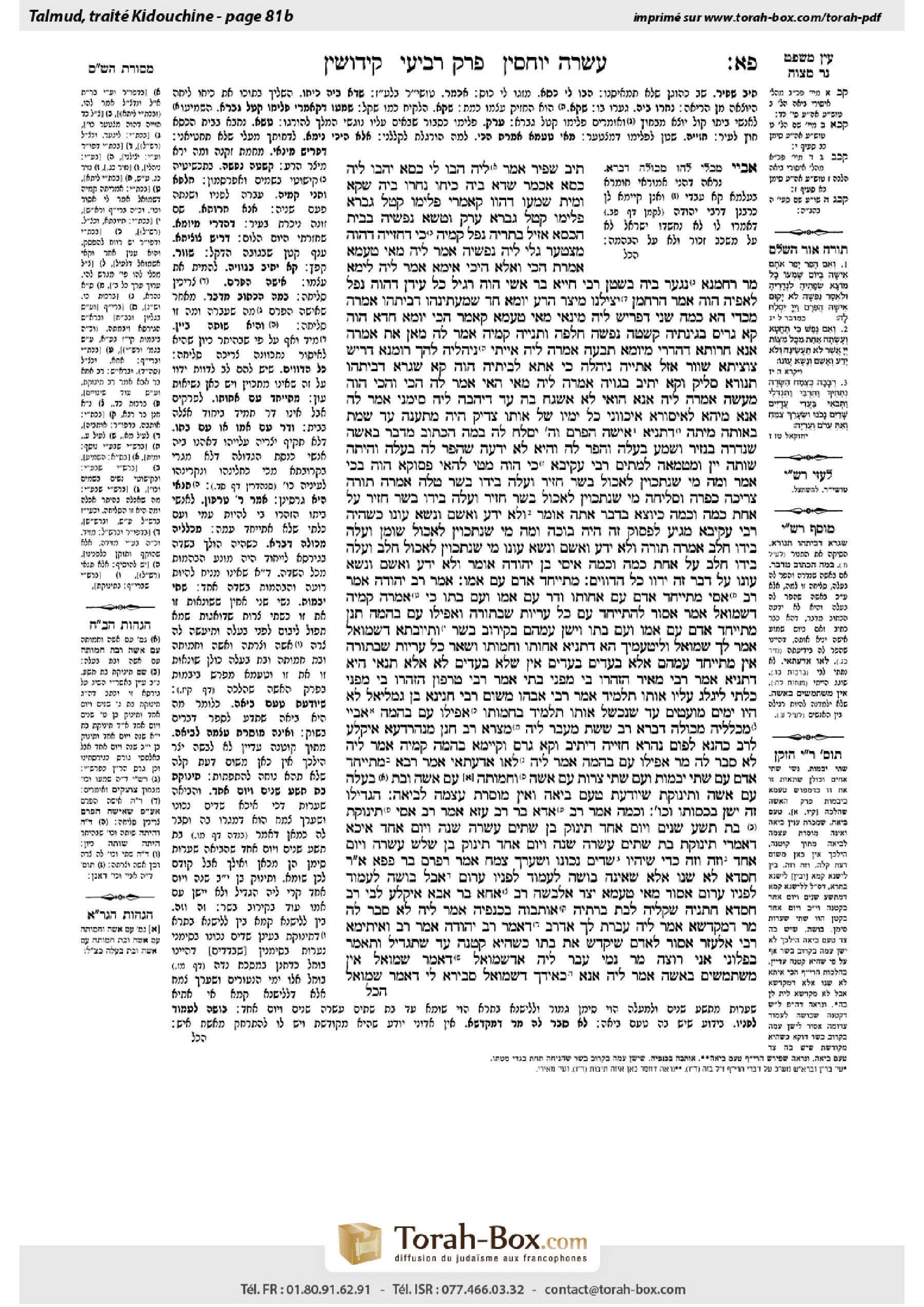
Kiddushin 81b: Talmud study for Daf Yomi
Daf Yomi is the daily study of one Talmud folio. Explore 37 tractates with scans, Hebrew text, Sefaria English and AI-generated French translations where annotated.
Passage selection and English or AI-generated French translation are available where the scan has annotations. Daf Study is independent of Torah-Box and Sefaria.
Browse Kiddushin · קידושין · All tractatesKiddushin 81b text and translations
This page of Kiddushin includes the Aramaic text, an English translation and an AI-generated French translation, alongside the scan above.
קידושין פ״א ב · Aramaic and Hebrew text
תִּיב שַׁפִּיר. אֲמַר לֵיהּ: הַבוּ לִי כָּסָא, יְהַבוּ לֵיהּ כָּסָא. אַכְמַר שְׁדָא בֵּיהּ כִּיחוֹ. נְחַרוּ בֵּיהּ. שְׁקָא וּמִית. שְׁמַעוּ דַּהֲווֹ קָאָמְרִי: פְּלֵימוֹ קְטַל גַּבְרָא! פְּלֵימוֹ קְטַל גַּבְרָא! עֲרַק וּטְשָׁא נַפְשֵׁיהּ בְּבֵית הַכִּסֵּא. אָזֵיל בָּתְרֵיהּ, נְפַל קַמֵּיהּ. כִּי דְּחַזְיֵיהּ דַּהֲוָה מִצְטַעַר גַּלִּי לֵיהּ נַפְשֵׁיהּ. אֲמַר לֵיהּ: מַאי טַעְמָא אָמְרַתְּ הָכִי? וְאֶלָּא הֵיכִי אֵימָא? אֲמַר לֵיהּ: לֵימָא מָר ״רַחֲמָנָא נִגְעַר בֵּיהּ בְּשָׂטָן״.
רַבִּי חִיָּיא בַּר אָשֵׁי הֲוָה רְגִיל כׇּל עִידָּן דַּהֲוָה נָפֵל לְאַפֵּיהּ הֲוָה אָמַר: ״הָרַחֲמָן יַצִּילֵנוּ מִיֵּצֶר הָרָע״. יוֹמָא חַד (שְׁמַעְתִּינְהוּ) [שְׁמַעְתֵּיהּ] דְּבֵיתְהוּ, אֲמַרָה: מִכְּדֵי הָא כַּמָּה שְׁנֵי דְּפָרֵישׁ לֵיהּ מִינַּאי, מַאי טַעְמָא קָאָמַר הָכִי?
יוֹמָא חֲדָא הֲוָה קָא גָרֵיס בְּגִינְּתֵיהּ. קַשִּׁטָה נַפְשַׁהּ, חָלְפָה וְתָנְיָיה קַמֵּיהּ. אֲמַר לַהּ: מַאן אַתְּ? אֲמַרָה: אֲנָא חָרוּתָא דַּהֲדַרִי מִיּוֹמָא. תַּבְעַהּ. אֲמַרָה לֵיהּ: אַיְיתִי נִיהֲלַי לְהָךְ רוּמָּנָא דְּרֵישׁ צוּצִיתָא. שְׁוַור, אֲזַל אַתְיֵיהּ נִיהֲלַהּ.
כִּי אֲתָא לְבֵיתֵיהּ הֲוָה קָא שָׁגְרָא דְּבֵיתְהוּ תַּנּוּרָא, סָלֵיק וְקָא יָתֵיב בְּגַוֵּיהּ. אֲמַרָה לֵיהּ: מַאי הַאי? אֲמַר לַהּ: הָכִי וְהָכִי הֲוָה מַעֲשֶׂה. אָמְרָה לֵיהּ: אֲנָא הֲוַאי. לָא אַשְׁגַּח בַּהּ, עַד דִּיהַבָה לֵיהּ סִימָנֵי. אָמַר לַהּ: אֲנָא מִיהָא לְאִיסּוּרָא אִיכַּוַּונִי. כׇּל יָמָיו שֶׁל אוֹתוֹ צַדִּיק הָיָה מִתְעַנֶּה עַד שֶׁמֵּת בְּאוֹתָהּ מִיתָה.
דְּתַנְיָא: ״אִישָׁהּ הֲפֵרָם וַה׳ יִסְלַח לָהּ״, בַּמָּה הַכָּתוּב מְדַבֵּר? בְּאִשָּׁה שֶׁנָּדְרָה בְּנָזִיר, וְשָׁמַע בַּעְלָהּ וְהֵפֵר לָהּ, וְהִיא לֹא יָדְעָה שֶׁהֵפֵר לָהּ בַּעְלָהּ, וְהָיְתָה שׁוֹתָה יַיִן וּמִטַּמְּאָה לְמֵתִים.
רַבִּי עֲקִיבָא כִּי הֲוָה מָטֵי לְהַאי פְּסוּקָא הֲוָה בָּכֵי, אָמַר: וּמָה מִי שֶׁנִּתְכַּוֵּין לֶאֱכוֹל בְּשַׂר חֲזִיר וְעָלָה בְּיָדוֹ בְּשַׂר טָלֶה, אָמְרָה תּוֹרָה: צְרִיכָה כַּפָּרָה וּסְלִיחָה, מִי שֶׁנִּתְכַּוֵּין לֶאֱכוֹל בְּשַׂר חֲזִיר וְעָלָה בְּיָדוֹ בְּשַׂר חֲזִיר – עַל אַחַת כַּמָּה וְכַמָּה.
כַּיּוֹצֵא בַּדָּבָר אַתָּה אוֹמֵר ״וְלֹא יָדַע וְאָשֵׁם וְנָשָׂא עֲוֹנוֹ״. כְּשֶׁהָיָה רַבִּי עֲקִיבָא מַגִּיעַ לְפָסוּק זֶה הָיָה בּוֹכֶה: וּמָה מִי שֶׁנִּתְכַּוֵּין לֶאֱכוֹל שׁוּמָּן וְעָלָה בְּיָדוֹ חֵלֶב – אָמְרָה תּוֹרָה: ״וְלֹא יָדַע וְאָשֵׁם וְנָשָׂא עֲוֹנוֹ״, מִי שֶׁנִּתְכַּוֵּין לֶאֱכוֹל חֵלֶב וְעָלָה בְּיָדוֹ חֵלֶב – עַל אַחַת כַּמָּה וְכַמָּה. אִיסִי בֶּן יְהוּדָה אוֹמֵר: ״וְלֹא יָדַע וְאָשֵׁם וְנָשָׂא עֲוֹנוֹ״ – עַל דָּבָר זֶה יִדְווּ כׇּל הַדּוֹוִים.
מִתְיַיחֵד אָדָם עִם אִמּוֹ. אָמַר רַב יְהוּדָה אָמַר רַב אַסִּי: מִתְיַיחֵד אָדָם עִם אֲחוֹתוֹ, וְדָר עִם אִמּוֹ וְעִם בִּתּוֹ. כִּי אַמְרִ[יתַ]הּ קַמֵּיהּ דִּשְׁמוּאֵל, אָמַר: אָסוּר לְהִתְיַיחֵד עִם כׇּל עֲרָיוֹת שֶׁבַּתּוֹרָה, וַאֲפִילּוּ עִם בְּהֵמָה.
תְּנַן: מִתְיַיחֵד אָדָם עִם אִמּוֹ וְעִם בִּתּוֹ וְיָשֵׁן עִמָּהֶם בְּקֵירוּב בָּשָׂר, וּתְיוּבְתָּא דִשְׁמוּאֵל! אָמַר לָךְ שְׁמוּאֵל: וְלִיטַעְמָיךְ, הָא דְּתַנְיָא: אֲחוֹתוֹ וַחֲמוֹתוֹ וּשְׁאָר כׇּל עֲרָיוֹת שֶׁבַּתּוֹרָה אֵין מִתְיַיחֵד עִמָּהֶם אֶלָּא בְּעֵדִים. בְּעֵדִים – אִין, שֶׁלֹּא בְּעֵדִים – לָא!
אֶלָּא תַּנָּאֵי הִיא. דְּתַנְיָא, אָמַר רַבִּי מֵאִיר: הִזָּהֲרוּ בִּי מִפְּנֵי בִּתִּי. אָמַר רַבִּי טַרְפוֹן: הִזָּהֲרוּ בִּי מִפְּנֵי כַּלָּתִי. לִיגְלֵג עָלָיו אוֹתוֹ תַּלְמִיד. אָמַר רַבִּי אֲבָהוּ מִשּׁוּם רַבִּי חֲנִינָא בֶּן גַּמְלִיאֵל: לֹא הָיוּ יָמִים מוּעָטִים עַד שֶׁנִּכְשַׁל אוֹתוֹ תַּלְמִיד בַּחֲמוֹתוֹ.
אֲפִילּוּ עִם בְּהֵמָה אַבָּיֵי מְכַלֵּ[י] לֵיהּ מִכּוּלֵּהּ דַּבְרָא. רַב שֵׁשֶׁת מְעַבַּר לֵיהּ מִצְרָא. רַב חָנָן מִנְּהַרְדְּעָא אִיקְּלַע לְרַב כָּהֲנָא לְפוּם נַהֲרָא. חַזְיֵיהּ דְּיָתֵיב וְקָא גָרֵס וְקָיְימָא בְּהֵמָה קַמֵּיהּ. אֲמַר לֵיהּ: לָא סָבַר לַהּ מָר אֲפִילּוּ עִם בְּהֵמָה? אֲמַר לֵיהּ: לָאו אַדַּעְתַּאי.
אָמַר רָבָא: מִתְיַיחֵד אָדָם עִם שְׁתֵּי יְבָמוֹת וְעִם שְׁתֵּי צָרוֹת, עִם אִשָּׁה וַחֲמוֹתָהּ, עִם אִשָּׁה וּבַת בַּעְלָהּ, עִם אִשָּׁה וְתִינוֹקֶת שֶׁיּוֹדַעַת טַעַם בִּיאָה, וְאֵין מוֹסֶרֶת עַצְמָהּ לְבִיאָה.
הִגְדִּילוּ זֶה יָשֵׁן בִּכְסוּתוֹ וְכוּ׳. וְכַמָּה? אָמַר רַב אַדָּא בַּר רַב (עֻזָּא) [עַוָּא] אָמַר רַב אַסִּי: תִּינוֹקֶת בַּת תֵּשַׁע שָׁנִים וְיוֹם אֶחָד, תִּינוֹק בֶּן שְׁתֵּים עֶשְׂרֵה שָׁנָה וְיוֹם אֶחָד. אִיכָּא דְאָמְרִי: תִּינוֹקֶת בַּת שְׁתֵּים עֶשְׂרֵה שָׁנָה וְיוֹם אֶחָד, תִּינוֹק בֶּן שְׁלֹשׁ עֶשְׂרֵה וְיוֹם אֶחָד, וְזֶה וְזֶה כְּדֵי שֶׁיִּהְיוּ ״שָׁדַיִם נָכֹנוּ וּשְׂעָרֵךְ צִמֵּחַ״.
אָמַר רַפְרָם בַּר פָּפָּא אָמַר רַב חִסְדָּא: לֹא שָׁנוּ אֶלָּא שֶׁאֵינָהּ בּוֹשָׁה לַעֲמוֹד לְפָנָיו עֲרוּמָּה, אֲבָל בּוֹשָׁה לַעֲמוֹד לְפָנָיו עֲרוּמָּה – אָסוּר. מַאי טַעְמָא – יֵצֶר אַלְבְּשַׁהּ.
רַב אַחָא בַּר אַבָּא אִיקְּלַע לְבֵי רַב חִסְדָּא חַתְנֵיהּ. שַׁקְלֵיהּ לְבַת בְּרַתֵּיה אוֹתְבַהּ בְּכַנְפֵיהּ. אֲמַר לֵיהּ: לָא סָבַר לַהּ מָר דְּמִקַּדְּשָׁא? אֲמַר לֵיהּ: עֲבַרְתְּ לָךְ אַדְּרַב. דְּאָמַר רַב יְהוּדָה אָמַר רַב, וְאִיתֵּימָא רַבִּי אֶלְעָזָר: אָסוּר לְאָדָם שֶׁיְּקַדֵּשׁ אֶת בִּתּוֹ כְּשֶׁהִיא קְטַנָּה, עַד שֶׁתַּגְדִּיל וְתֹאמַר: ״בִּפְלוֹנִי אֲנִי רוֹצָה״. מָר נָמֵי עֲבַר לֵיהּ אַדִּשְׁמוּאֵל, דְּאָמַר שְׁמוּאֵל: אֵין מִשְׁתַּמְּשִׁים בְּאִשָּׁה! אֲמַר לֵיהּ: אֲנָא כְּאִידַּךְ דִּשְׁמוּאֵל סְבִירָא לִי, דְּאָמַר שְׁמוּאֵל:
Kiddushin 81b · English translation
Sit properly and do not act in a revolting manner. Satan then said to him: Give me a cup. They gave him a cup. He coughed up his phlegm and spat it into the cup. They berated him for acting this way, at which point Satan pretended to sink down and die. They heard people around them saying: Peleimu killed a man! Peleimu killed a man! Peleimu fled and hid himself in the bathroom. Satan followed him and fell before him. Upon seeing that Peleimu was suffering, he revealed himself to him. Satan said to him: What is the reason that you spoke this way, provoking me by saying: An arrow in the eye of Satan? He replied: But what then should I say? Satan said to him: Let the Master, i.e., Peleimu, say: Let the Merciful One rebuke the Satan.
The Gemara relates: Rabbi Ḥiyya bar Ashi was accustomed to say, whenever he would fall on his face in prayer: May the Merciful One save us from the evil inclination. One day his wife heard him saying this prayer. She said: After all, it has been several years since he has withdrawn from engaging in intercourse with me due to his advanced years. What is the reason that he says this prayer, as there is no concern that he will engage in sinful sexual behavior?
One day, while he was studying in his garden, she adorned herself and repeatedly walked past him. He said: Who are you? She said: I am Ḥaruta, a well-known prostitute, returning from my day at work. He propositioned her. She said to him: Give me that pomegranate from the top of the tree as payment. He leapt up, went, and brought it to her, and they engaged in intercourse.
When he came home, his wife was lighting a fire in the oven. He went and sat inside it. She said to him: What is this? He said to her: Such and such an incident occurred; he told her that he engaged in intercourse with a prostitute. She said to him: It was I. He paid no attention to her, thinking she was merely trying to comfort him, until she gave him signs that it was indeed she. He said to her: I, in any event, intended to transgress. The Gemara relates: All the days of that righteous man he would fast for the transgression he intended to commit, until he died by that death in his misery.
The Gemara explains the source that one who intended to transgress is punished even though he did not actually sin. As it is taught in a baraita concerning a husband who nullified the vow of his wife: “Her husband has made them null; and the Lord will forgive her” (Numbers 30:13). With regard to what case is the verse speaking? Why would the woman require forgiveness if her husband has nullified her vow? It is referring to a woman who vowed to be a nazirite, and her husband heard and nullified her vow. And she did not know that her husband had nullified her vow, and she drank wine and contracted impurity from a corpse, violating her presumed vow.
The Gemara relates: When Rabbi Akiva came to this verse he would cry. He said: And if with regard to one who intended to eat pork, and kosher lamb came up in his hand, like this woman who intended to violate her vow but in fact did not, the Torah nevertheless says: She requires atonement and forgiveness, all the more so does one who intended to eat pork and pork came up in his hand require atonement and forgiveness.
In a similar manner, you can say that the same lesson can be derived from the verse: “Though he know it not, yet is he guilty, and shall bear his iniquity” (Leviticus 5:17). When Rabbi Akiva came to this verse he would cry. He said: And if with regard to one who intended to eat permitted fat, and forbidden fat mistakenly came up in his hand, the Torah states: “Though he know it not, yet is he guilty, and shall bear his iniquity,” all the more so is this true for one who intended to eat forbidden fat and forbidden fat came up in his hand. Isi ben Yehuda says with regard to the verse “Though he know it not, yet is he guilty, and shall bear his iniquity”: With regard to this matter all sufferers shall grieve, since the verse teaches that one is punished even for sinning unawares.
§ The mishna teaches that a man may be secluded with his mother. Rav Yehuda says that Rav Asi says: A man may be secluded with his sister, and live with his mother or with his daughter in a permanent arrangement, without concern. When he said this before Shmuel, the latter said: It is prohibited to be secluded with all those with whom relations are forbidden by the Torah, and even with an animal, as it is prohibited to engage in intercourse with an animal as well.
We learned in the mishna: A man may be secluded with his mother, and with his daughter, and sleep alongside them with bodily contact, and this appears to be a conclusive refutation of the statement of Shmuel. The Gemara answers: Shmuel could have said to you: And according to your reasoning, how should one explain that which is taught in a baraita: With regard to his sister, and his mother-in-law, and all those with whom relations are forbidden, including his mother and daughter, one may be secluded with them only in the presence of witnesses, from which it can be inferred: In the presence of witnesses, yes; without the presence of witnesses, no. This baraita supports the opinion of Shmuel that one may not be secluded with his mother or sister.
Rather, it is a dispute between tanna’im as to whether one may be secluded with his mother or sister. As it is taught in a baraita: Rabbi Meir said: Be careful with me because of my daughter, i.e., make sure I am not left secluded with her. Similarly, Rabbi Tarfon said: Be careful with me because of my daughter-in-law. A certain student mocked him for being wary of the possibility of sinning with his daughter-in-law. Rabbi Abbahu said in the name of Rabbi Ḥanina ben Gamliel: Not many days passed until that student stumbled into sin with his mother-in-law.
The Gemara stated that according to Shmuel it is prohibited for one to be alone even with an animal. The Gemara relates: Abaye removed the animals from the entire field he was in. Rav Sheshet transferred the animals to the other side of the fence. Rav Ḥanan from Neharde’a happened to come to Rav Kahana in Pum Nahara. He saw that he was sitting and studying, and an animal was standing before him. Rav Ḥanan said to him: Doesn’t the Master hold that one may not be secluded even with an animal? Rav Kahana said to him: It did not enter my mind that an animal was before me.
Rava says: A man may be secluded with two sisters-in-law and with two rival wives, i.e., two women who share a husband; with a woman and her mother-in-law; and with a woman and her husband’s daughter. Since these women typically dislike each other, each fears that the other will publicize her sins, and they will be careful not to transgress. Similarly, a man may be secluded with a woman and a girl who knows the meaning of sexual intercourse, i.e., one who is old enough to understand the nature of intercourse, but is still young enough that she does not submit herself to intercourse, since she does not yet desire it. In such a situation, the woman is concerned that the child will reveal her behavior.
§ The mishna teaches that when one’s children have grown up, this one sleeps in his garment and that one sleeps in her garment, but they may share a bed. The Gemara asks: And how old must a child be to be considered grown up for the purposes of this halakha? Rav Adda bar Rav Azza says that Rav Asi says: A girl must reach the age of nine years and one day; a boy must reach the age of twelve years and one day. There are those who say: A girl must reach the age of twelve years and one day; a boy must reach the age of thirteen years and one day. And according to this and that, according to both opinions, the girl is considered a child until she has reached the stage of: “Your breasts were fashioned, and your hair was grown” (Ezekiel 16:7), meaning the onset of puberty.
Rafram bar Pappa says that Rav Ḥisda says: They taught that a man may sleep in close proximity to his minor daughter only if she is not ashamed to stand naked before him, but if she is ashamed to stand naked before him, it is prohibited for him to sleep close to her, regardless of her age. What is the reason? It is that the inclination has a hold upon her, as otherwise she would not be ashamed.
The Gemara relates: Rav Aḥa bar Abba arrived at the house of Rav Ḥisda, his son-in-law. He took his daughter’s daughter and placed her on his lap. Rav Ḥisda said to him: Doesn’t the Master think that she might already be betrothed? Rav Aḥa said to him: If that is true, you have transgressed the ruling of Rav, as Rav Yehuda says that Rav says, and some say it was said by Rabbi Elazar: It is prohibited for a man to betroth his daughter when she is a minor, until she grows up and says: I want to marry so-and-so, as otherwise she might reject the designated husband and ultimately sin by committing adultery. Rav Ḥisda replied: The Master has likewise transgressed the words of Shmuel. As Shmuel says: One may not make use of a woman, so how can you hold her on your lap? He said to him: I hold in accordance with another statement of Shmuel, as Shmuel says:
Kiddushin 81b · Traduction française (IA)
Assieds-toi correctement et ne te comporte pas d'une manière répugnante. Satan lui dit alors : Donne-moi une coupe. On lui donna une coupe. Il cracha son mucus et le jeta dans la coupe. On le blâma pour s'être comporté ainsi, auquel point Satan feignit de s'effondrer et de mourir. Ils entendirent les gens autour d'eux dire : Peleimu a tué un homme ! Peleimu a tué un homme ! Peleimu s'enfuit et se cacha dans les toilettes. Satan le suivit et s'effondra devant lui. Voyant que Peleimu souffrait, il se révéla à lui. Satan lui dit : Quelle est la raison pour laquelle tu as parlé ainsi, me provoquant en disant : Une flèche dans l'œil de Satan ? Il répondit : Mais que devrais-je dire alors ? Satan lui dit : Que le Maître, c'est-à-dire Peleimu, dise : Que le Tout-Puissant réprime le Satan.
La Guemara rapporte : Rabbi Ḥiyya bar Ashi avait l'habitude de dire, chaque fois qu'il se prosternait face contre terre en priant : Que le Tout-Puissant nous sauve de l'impulsion du mal. Un jour, sa femme l'entendit dire cette prière. Elle dit : Après tout, cela fait plusieurs années qu'il s'est abstenu de relations sexuelles avec moi en raison de son âge avancé. Quelle est la raison pour laquelle il dit cette prière, alors qu'il n'y a aucune crainte qu'il commette un acte sexuel pécheresse ?
Un jour, alors qu'il étudiait dans son jardin, elle se parura et passa plusieurs fois devant lui. Il dit : Qui es-tu ? Elle dit : Je suis Ḥaruta, une prostituée bien connue, qui rentre de sa journée de travail. Il lui fit une proposition. Elle lui dit : Donne-moi cette grenade du haut de l'arbre en paiement. Il sauta, alla la cueillir et la lui apporta, et ils eurent des relations sexuelles.
Quand il rentra chez lui, sa femme allumait un feu dans le four. Il alla s'asseoir dedans. Elle lui dit : Qu'est-ce que c'est que cela ? Il lui répondit : Tel et tel incident s'est produit ; il lui raconta qu'il avait eu des relations sexuelles avec une prostituée. Elle lui dit : C'était moi. Il ne fit pas attention à elle, pensant qu'elle essayait simplement de le consoler, jusqu'à ce qu'elle lui donne des signes que c'était bien elle. Il lui dit : Moi, de toute façon, j'avais l'intention de transgresser. La Guemara rapporte : Tous les jours de la vie de ce juste, il jeûnait pour la transgression qu'il avait l'intention de commettre, jusqu'à ce qu'il meure de cette mort dans sa misère.
La Guemara explique la source selon laquelle celui qui a l'intention de transgresser est puni, même s'il n'a pas réellement péché. Comme il est enseigné dans une baraïta concernant un mari qui a annulé le vœu de sa femme : « Son mari les a rendus nuls ; et l'Éternel lui pardonnera » (Nombres 30:13). À quel cas le verset fait-il référence ? Pourquoi la femme aurait-elle besoin de pardon si son mari a annulé son vœu ? Il s'agit d'une femme qui a fait vœu d'être nazirite, et son mari l'a entendu et a annulé son vœu. Et elle ne savait pas que son mari avait annulé son vœu, et elle a bu du vin et contracté une impureté d'un cadavre, violant ainsi son vœu présumé.
La Guemara rapporte : Quand Rabbi Akiva arrivait à ce verset, il pleurait. Il disait : Et si, concernant celui qui avait l'intention de manger de la viande de porc, et que de l'agneau casher s'est présenté dans sa main, comme cette femme qui avait l'intention de violer son vœu mais qui ne l'a pas fait en réalité, la Torah dit néanmoins : Elle a besoin d'expiation et de pardon, d'autant plus celui qui avait l'intention de manger de la viande de porc et que de la viande de porc s'est présentée dans sa main a-t-il besoin d'expiation et de pardon.
De même, on peut dire que la même leçon peut être déduite du verset : « Même s'il ne le savait pas, il est néanmoins coupable, et il portera son iniquité » (Lévitique 5:17). Lorsque Rabbi Akiva arrivait à ce verset, il pleurait. Il disait : Et si, pour celui qui avait l'intention de manger de la graisse permise, mais que de la graisse interdite s'est présentée par erreur dans sa main, la Torah déclare : « Même s'il ne le savait pas, il est néanmoins coupable, et il portera son iniquité », d'autant plus est-ce vrai pour celui qui avait l'intention de manger de la graisse interdite et que de la graisse interdite s'est présentée dans sa main. Isi ben Yehuda dit à propos du verset « Même s'il ne le savait pas, il est néanmoins coupable, et il portera son iniquité » : Concernant cette affaire, tous les souffrants doivent se lamenter, car le verset enseigne qu'on est puni même pour pécher sans le savoir.
§ La Michna enseigne qu'un homme peut être en tête-à-tête avec sa mère. Rav Yehuda dit que Rav Asi dit : Un homme peut être en tête-à-tête avec sa sœur, et vivre avec sa mère ou avec sa fille dans un arrangement permanent, sans crainte. Lorsque cela fut dit devant Shmuel, ce dernier dit : Il est interdit d'être en tête-à-tête avec toutes celles avec qui les relations sont interdites par la Torah, et même avec un animal, car il est interdit d'avoir des relations avec un animal également.
Nous avons appris dans la Michna : Un homme peut être en tête-à-tête avec sa mère, et avec sa fille, et dormir à côté d'elles avec contact corporel, et cela semble être une réfutation conclusive de la déclaration de Shmuel. La Guemara répond : Shmuel aurait pu te dire : Et selon ton raisonnement, comment expliquer ce qui est enseigné dans une baraïta : Concernant sa sœur, et sa belle-mère, et toutes celles avec qui les relations sont interdites, y compris sa mère et sa fille, on peut être en tête-à-tête avec elles seulement en présence de témoins, d'où on peut déduire : En présence de témoins, oui ; sans la présence de témoins, non. Cette baraïta soutient l'opinion de Shmuel qu'on ne peut pas être en tête-à-tête avec sa mère ou sa sœur.
Plutôt, il s'agit d'un désaccord entre les tannaïm quant à savoir si on peut être en tête-à-tête avec sa mère ou sa sœur. Comme il est enseigné dans une baraïta : Rabbi Meir a dit : Faites attention à moi à cause de ma fille, c'est-à-dire, assurez-vous que je ne sois pas laissé en tête-à-tête avec elle. De même, Rabbi Tarfon a dit : Faites attention à moi à cause de ma belle-fille. Un certain étudiant se moqua de lui pour sa prudence quant à la possibilité de pécher avec sa belle-fille. Rabbi Abbahu a dit au nom de Rabbi Ḥanina ben Gamliel : Peu de jours se sont écoulés avant que cet étudiant ne tombe dans le péché avec sa belle-mère.
La Guemara a déclaré que, selon Chmouel, il est interdit à un homme d'être seul, même avec un animal. La Guemara rapporte : Abaye a retiré les animaux de tout le champ dans lequel il se trouvait. Rav Chéchet a transféré les animaux de l'autre côté de la clôture. Rav Hana de Neharde'a est venu par hasard chez Rav Kahana à Pum Nahara. Il le vit assis en train d'étudier, et un animal se tenait devant lui. Rav Hana lui dit : Le Maître ne soutient-il pas qu'on ne doit pas se mettre en situation de séduction, même avec un animal ? Rav Kahana lui répondit : Il ne m'est pas venu à l'esprit qu'un animal se trouvait devant moi.
Rava dit : Un homme peut se trouver en situation d'isolement avec deux belles-sœurs, et avec deux épouses rivales, c'est-à-dire deux femmes qui partagent un même mari ; avec une femme et sa belle-mère ; et avec une femme et la fille de son mari. Étant donné que ces femmes se détestent généralement les unes les autres, chacune craint que l'autre ne divulgue ses fautes, et elles prendront soin de ne pas transgresser. De même, un homme peut se trouver en situation d'isolement avec une femme et une jeune fille qui connaît le sens de la relation sexuelle, c'est-à-dire une fille assez âgée pour comprendre la nature de la relation, mais encore assez jeune pour ne pas se soumettre à la relation, car elle n'en éprouve pas encore le désir. Dans une telle situation, la femme craint que l'enfant ne révèle son comportement.
§ La Michna enseigne que lorsque ses enfants sont devenus adultes, celui-ci dort dans son vêtement et celle-ci dans son vêtement, mais ils peuvent partager un lit. La Guemara demande : Et quel âge un enfant doit-il avoir pour être considéré comme adulte aux fins de cette halakha ? Rav Adda bar Rav Azza dit que Rav Asi dit : Une fille doit avoir atteint l'âge de neuf ans et un jour ; un garçon doit avoir atteint l'âge de douze ans et un jour. Certains disent : Une fille doit avoir atteint l'âge de douze ans et un jour ; un garçon doit avoir atteint l'âge de treize ans et un jour. Et selon l'une et l'autre opinion, selon les deux avis, la fille est considérée comme enfant jusqu'à ce qu'elle ait atteint le stade de : « Vos seins se sont formés, et vos cheveux ont poussé » (Ézéchiel 16:7), signifiant le début de la puberté.
Rafram bar Pappa dit que Rav Ḥisda dit : Ils ont enseigné qu'un homme peut dormir à proximité de sa fille mineure seulement si elle n'est pas honteuse de se tenir nue devant lui, mais si elle est honteuse de se tenir nue devant lui, il lui est interdit de dormir à proximité d'elle, quel que soit son âge. Quelle est la raison ? C'est que l'inclination a prise sur elle, car sinon elle ne serait pas honteuse.
La Guemara rapporte : Rav Aḥa bar Abba est arrivé à la maison de Rav Ḥisda, son gendre. Il a pris sa fille de fille et l'a placée sur ses genoux. Rav Ḥisda lui dit : Le Maître ne pense-t-il pas qu'elle pourrait déjà être fiancée ? Rav Aḥa lui dit : Si c'est le cas, vous avez transgressé la décision de Rav, car Rav Yehouda dit que Rav dit, et certains disent que c'est Rabbi Elazar qui l'a dit : Il est interdit à un homme de fiancer sa fille lorsqu'elle est mineure, jusqu'à ce qu'elle grandisse et dise : Je veux épouser untel, car sinon elle pourrait rejeter le mari désigné et finir par pécher en commettant l'adultère. Rav Ḥisda répondit : Le Maître a également transgressé les paroles de Chmouel. Car Chmouel dit : On ne doit pas faire usage d'une femme, comment donc pouvez-vous la tenir sur vos genoux ? Il lui dit : Je suis d'accord avec une autre déclaration de Chmouel, car Chmouel dit :
Traduction française générée par IA à partir de l’édition anglaise de Sefaria. Vérifie toujours un passage avec le texte source.
Text from Sefaria: William Davidson Edition - Vocalized Aramaic (CC BY NC); William Davidson Edition - English (CC BY NC).