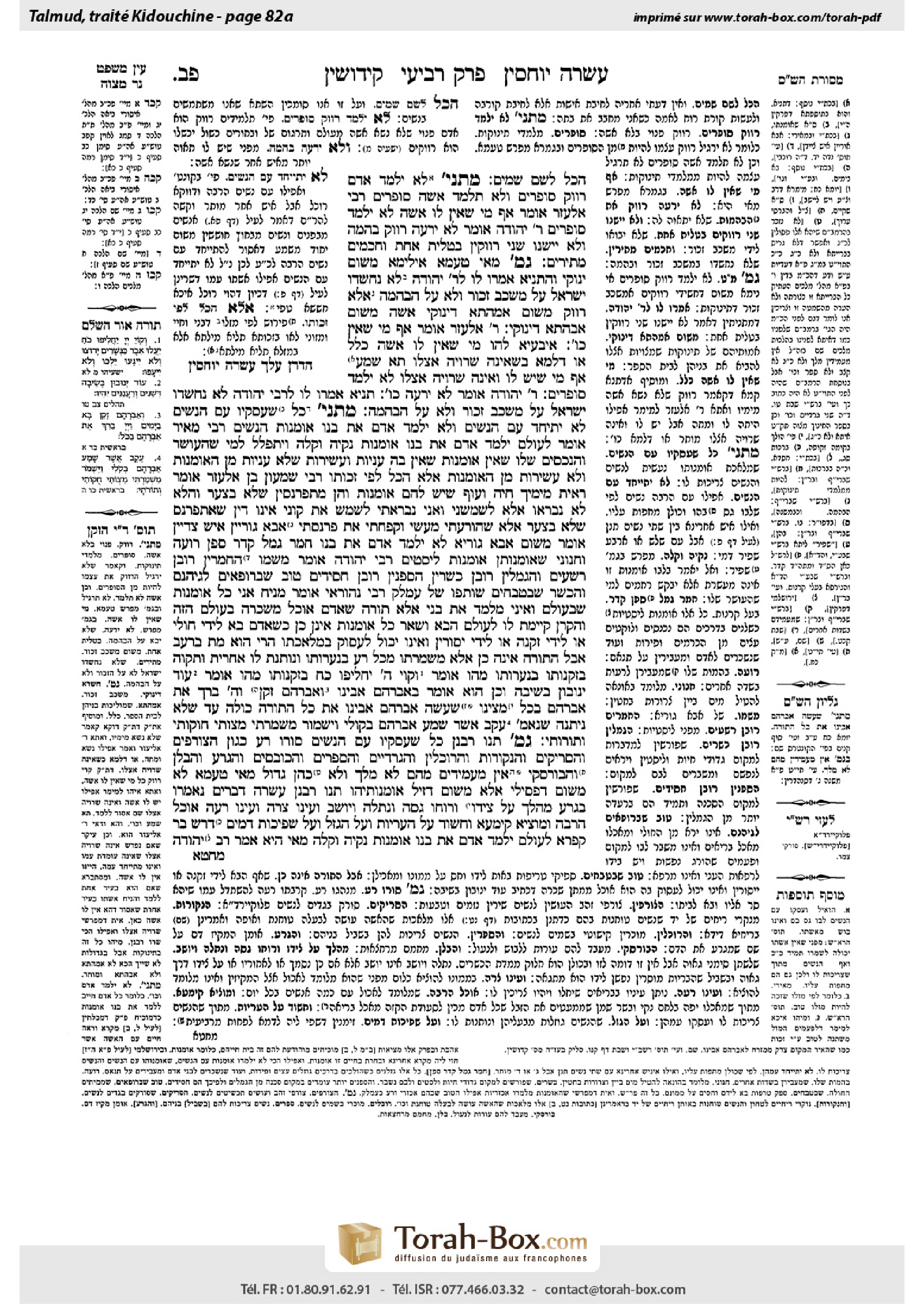
Kiddushin 82a: Talmud study for Daf Yomi
Daf Yomi is the daily study of one Talmud folio. Explore 37 tractates with scans, Hebrew text, Sefaria English and AI-generated French translations where annotated.
Passage selection and English or AI-generated French translation are available where the scan has annotations. Daf Study is independent of Torah-Box and Sefaria.
Browse Kiddushin · קידושין · All tractatesKiddushin 82a text and translations
This page of Kiddushin includes the Aramaic text, an English translation and an AI-generated French translation, alongside the scan above.
קידושין פ״ב א · Aramaic and Hebrew text
הַכֹּל לְשֵׁם שָׁמַיִם.
מַתְנִי׳ לֹא יְלַמֵּד אָדָם רַוּוֹק סוֹפְרִים. וְלֹא תְּלַמֵּד אִשָּׁה סוֹפְרִים. רַבִּי אֶלְעָזָר אוֹמֵר: אַף מִי שֶׁאֵין לוֹ אִשָּׁה לֹא יְלַמֵּד סוֹפְרִים. רַבִּי יְהוּדָה אוֹמֵר: לֹא יִרְעֶה רַוּוֹק בְּהֵמָה, וְלֹא יִישְׁנוּ שְׁנֵי רַוּוֹקִין בְּטַלִּית אַחַת, וַחֲכָמִים מַתִּירִים.
גְּמָ׳ מַאי טַעְמָא? אִילֵּימָא מִשּׁוּם יָנוֹקֵי, וְהָתַנְיָא: אָמְרוּ לוֹ לְרַבִּי יְהוּדָה: לֹא נֶחְשְׁדוּ יִשְׂרָאֵל עַל מִשְׁכַּב זְכוּר וְלֹא עַל הַבְּהֵמָה! אֶלָּא: רַוּוֹק – מִשּׁוּם אִמָּהָתָא דְיָנוֹקֵי. אִשָּׁה – מִשּׁוּם אֲבָהָתָא דְיָנוֹקֵי.
רַבִּי אֶלְעָזָר אוֹמֵר אַף מִי שֶׁאֵין כּוּ׳. אִיבַּעְיָא לְהוּ: מִי שֶׁאֵין לוֹ אִשָּׁה כְּלָל, אוֹ דִלְמָא בְּשֶׁאֵינָהּ שְׁרוּיָה אֶצְלוֹ? תָּא שְׁמַע: אַף מִי שֶׁיֵּשׁ לוֹ וְאֵינָהּ שְׁרוּיָה אֶצְלוֹ לֹא יְלַמֵּד סוֹפְרִים.
רַבִּי יְהוּדָה אוֹמֵר לֹא יִרְעֶה כּוּ׳. תַּנְיָא: אָמְרוּ לוֹ לְרַבִּי יְהוּדָה: לֹא נֶחְשְׁדוּ יִשְׂרָאֵל עַל מִשְׁכַּב זְכוּר וְלֹא עַל הַבְּהֵמָה.
מַתְנִי׳ כֹּל שֶׁעֲסָקָיו עִם הַנָּשִׁים לֹא יִתְיַחֵד עִם הַנָּשִׁים, וְלֹא יְלַמֵּד אָדָם אֶת בְּנוֹ אוּמָּנוּת הַנָּשִׁים. רַבִּי מֵאִיר אוֹמֵר: לְעוֹלָם יְלַמֵּד אָדָם אֶת בְּנוֹ אוּמָּנוּת נְקִיָּה וְקַלָּה, וְיִתְפַּלֵּל לְמִי שֶׁהָעוֹשֶׁר וְהַנְּכָסִים שֶׁלּוֹ. שֶׁאֵין אוּמָּנוּת שֶׁאֵין בָּהּ עֲנִיּוּת וַעֲשִׁירוּת, שֶׁלֹּא עֲנִיּוּת מִן הָאוּמָּנוּת, וְלֹא עֲשִׁירוּת מִן הָאוּמָּנוּת, אֶלָּא הַכֹּל לְפִי זְכוּתוֹ.
רַבִּי שִׁמְעוֹן בֶּן אֶלְעָזָר אוֹמֵר: רָאִיתָ מִיָּמֶיךָ חַיָּה וָעוֹף שֶׁיֵּשׁ לָהֶם אוּמָּנוּת? וְהֵן מִתְפַּרְנְסִין שֶׁלֹּא בְּצַעַר! וַהֲלֹא לֹא נִבְרְאוּ אֶלָּא לְשַׁמְּשֵׁנִי, וַאֲנִי נִבְרֵאתִי לְשַׁמֵּשׁ אֶת קוֹנִי, אֵינוֹ דִּין שֶׁאֶתְפַּרְנֵס שֶׁלֹּא בְּצַעַר? אֶלָּא שֶׁהוֹרַעְתִּי מַעֲשַׂי, וְקִפַּחְתִּי אֶת פַּרְנָסָתִי.
אַבָּא גּוּרְיָין אִישׁ צַיְידָן אוֹמֵר מִשּׁוּם אַבָּא גּוּרְיָא: לֹא יְלַמֵּד אָדָם אֶת בְּנוֹ חַמָּר, גַּמָּל, קַדָּר, סַפָּן, רוֹעֶה, וְחֶנְוָנִי – שֶׁאוּמָּנוּתָן אוּמָּנוּת לִיסְטִים. רַבִּי יְהוּדָה אוֹמֵר מִשְּׁמוֹ: הַחַמָּרִין רוּבָּן רְשָׁעִים, וְהַגַּמָּלִין רוּבָּן כְּשֵׁרִין, הַסַּפָּנִין רוּבָּן חֲסִידִים. טוֹב שֶׁבָּרוֹפְאִים – לְגֵיהִנָּם, וְהַכָּשֵׁר שֶׁבַּטַּבָּחִים – שׁוּתָּפוֹ שֶׁל עֲמָלֵק.
רַבִּי נְהוֹרַאי אוֹמֵר: מַנִּיחַ אֲנִי כׇּל אוּמָּנוּת שֶׁבָּעוֹלָם וְאֵינִי מְלַמֵּד אֶת בְּנִי אֶלָּא תּוֹרָה, שֶׁאָדָם אוֹכֵל מִשְּׂכָרָהּ בָּעוֹלָם הַזֶּה, וְהַקֶּרֶן קַיֶּימֶת לוֹ לָעוֹלָם הַבָּא, וּשְׁאָר כׇּל אוּמָּנִיּוֹת אֵינָן כֵּן. כְּשֶׁאָדָם בָּא לִידֵי חוֹלִי אוֹ לִידֵי זִקְנָה אוֹ לִידֵי יִסּוּרִין, וְאֵינוֹ יָכוֹל לַעֲסוֹק בִּמְלַאכְתּוֹ – הֲרֵי הוּא מֵת בָּרָעָב. אֲבָל הַתּוֹרָה אֵינָהּ כֵּן, אֶלָּא מְשַׁמַּרְתּוֹ מִכׇּל רַע בְּנַעֲרוּתוֹ, וְנוֹתֶנֶת לוֹ אַחֲרִית וְתִקְוָה בְּזִקְנוּתוֹ.
בְּנַעֲרוּתוֹ מַהוּ אוֹמֵר? ״וְקוֹיֵ ה׳ יַחֲלִיפוּ כֹחַ״. בְּזִקְנוּתוֹ מַהוּ אוֹמֵר? ״עוֹד יְנוּבוּן בְּשֵׂיבָה״, וְכֵן הוּא אוֹמֵר בְּאַבְרָהָם אָבִינוּ: ״וְאַבְרָהָם זָקֵן... וַה׳ בֵּרַךְ אֶת אַבְרָהָם בַּכֹּל״ – מָצִינוּ שֶׁעָשָׂה אַבְרָהָם אָבִינוּ אֶת כָּל הַתּוֹרָה כּוּלָּהּ עַד שֶׁלֹּא נִיתְּנָה, שֶׁנֶּאֱמַר: ״עֵקֶב אֲשֶׁר שָׁמַע אַבְרָהָם בְּקֹלִי וַיִּשְׁמֹר מִשְׁמַרְתִּי מִצְוֹתַי חֻקּוֹתַי וְתוֹרֹתָי״
גְּמָ׳ תָּנוּ רַבָּנַן: כׇּל שֶׁעֲסָקָיו עִם הַנָּשִׁים – סוֹרוֹ רַע, כְּגוֹן הַצּוֹרְפִים, וְהַסָּרֵיקִים, וְהַנָּקוֹרוֹת, וְהָרוֹכְלִין, וְהַגַּרְדִּיִּים, וְהַסַּפָּרִים וְהַכּוֹבְסִים, וְהַגָּרָע, וְהַבַּלָּן, וְהַבּוּרְסְקִי – אֵין מַעֲמִידִים מֵהֶם לֹא מֶלֶךְ וְלֹא כֹּהֵן גָּדוֹל. מַאי טַעְמָא? לָא מִשּׁוּם דִּפְסִילִי, אֶלָּא מִשּׁוּם דְּזִיל אוּמָּנוּתַיְהוּ.
תָּנוּ רַבָּנַן: עֲשָׂרָה דְּבָרִים נֶאֶמְרוּ בְּגָרָע: מְהַלֵּךְ עַל צִידּוֹ, וְרוּחוֹ גַּסָּה, וְנִתְלֶה וְיוֹשֵׁב, וְעֵינוֹ צָרָה, וְעֵינוֹ רָעָה, אוֹכֵל הַרְבֵּה וּמוֹצִיא קִימְעָא, וְחָשׁוּד עַל הָעֲרָיוֹת וְעַל הַגָּזֵל וְעַל שְׁפִיכוּת דָּמִים.
דָּרַשׁ בַּר קַפָּרָא: לְעוֹלָם יְלַמֵּד אָדָם אֶת בְּנוֹ אוּמָּנוּת נְקִיָּה וְקַלָּה. מַאי הִיא? אָמַר רַב יְהוּדָה:
Kiddushin 82a · English translation
All such actions are permitted for the sake of Heaven. In other words, if one is acting out of familial affection, without any element of licentiousness, they are permitted.
MISHNA: A bachelor may not act as a teacher of children, nor may a woman act as a teacher of children. Rabbi Elazar says: Even one who does not have a wife may not act as a teacher of children. Rabbi Yehuda says: A bachelor may not herd cattle, nor may two bachelors sleep with one covering, lest they transgress the prohibition against homosexual intercourse, but the Rabbis permit it.
GEMARA: What is the reason that a bachelor may not teach children? If we say it is due to the children themselves, that it is suspected that he may engage in homosexual intercourse with them, but isn’t it taught in a baraita (Tosefta 5:10): They said to Rabbi Yehuda: Jews are not suspected of engaging in homosexual intercourse nor of engaging in intercourse with an animal. Rather, the reason is as follows: A bachelor may not be a teacher of children due to the mothers of the children, who come to the school from time to time, with whom he might sin. Similarly, a woman may not serve as a teacher to children because she may come to be secluded with the fathers of the children.
The mishna teaches that Rabbi Elazar says: Even one who does not have a wife may not act as a teacher of children. A dilemma was raised before the students in the study hall: Does Rabbi Elazar mean one who does not have a wife at all, or perhaps he is referring even to one who has a wife, in a circumstance where she is not residing with him? Come and hear: Even one who has a wife but she is not residing with him may not act as a teacher of children. This statement is in accordance with the opinion of Rabbi Elazar and indicates that his restriction applies even if the man is married.
The mishna teaches that Rabbi Yehuda says: A bachelor may not herd cattle, nor may two bachelors sleep with one covering. It is taught in the Tosefta (5:10): They said to Rabbi Yehuda: Jews are not suspected of engaging in homosexual intercourse nor of engaging in intercourse with an animal.
MISHNA: Anyone who has professional dealings primarily with women may not be secluded with women. There is more of a concern that such a man might sin due to his familiarity with the women. And a person may not teach his son a trade that necessitates frequent interaction with women, for the same reason. With regard to teaching one’s son a trade, Rabbi Meir says: A person should always teach his son a clean and easy trade and pray for success to the One to Whom wealth and property belong, as ultimately there is no trade that does not include both poverty and wealth, since a person can become rich from any profession. Poverty does not come from a particular trade, nor does wealth come from a particular trade, but rather, all is in accordance with a person’s merit. Therefore, one should choose a clean and easy trade, and pray to God for success.
Rabbi Shimon ben Elazar says: Have you ever seen a beast or a bird that has a trade? And yet they earn their livelihood without anguish. But all these were created only to serve me, and I, a human being, was created to serve the One Who formed me. Is it not right that I should earn my livelihood without anguish? But I, i.e., humanity, have committed evil actions and have lost my livelihood. This is why people must work to earn a living.
Abba Guryan of Tzadyan says in the name of Abba Gurya: A person may not teach his son the trades of a donkey driver, a camel driver, a pot maker, a sailor, a shepherd, or a storekeeper. The reason for all these is the same, as their trades are the trades of robbers; all of these professions involve a measure of dishonesty and are likely to lead to robbery. Rabbi Yehuda says in Abba Gurya’s name: Most donkey drivers are wicked, since they engage in deceit, and most camel drivers, who traverse dangerous places such as deserts, are of fit character, as they pray to God to protect them on their journeys. Most sailors are pious, since the great danger of the seas instills in them the fear of Heaven. The best of doctors is to Gehenna, and even the fittest of butchers is a partner of Amalek.
Rabbi Nehorai says: I set aside all the trades in the world, and I teach my son only Torah, as a person partakes of its reward in this world and the principal reward remains for him in the World-to-Come, which is not true of other professions, whose rewards are only in this world. Furthermore, if a person comes to be ill, or old, or undergoes suffering, and is unable to be involved in his trade, behold, he dies in hunger. But with regard to the Torah it is not so, since one can study it under all circumstances. Rather, it preserves him from all evil and sin in his youth, and provides him with a future and hope in his old age.
The mishna explains: With regard to his youth, what does it say about a Torah scholar? “But they that wait for the Lord shall renew their strength” (Isaiah 40:31). With regard to his old age, what does it say? “They shall still bring forth fruit in old age” (Psalms 92:15), and it likewise states with regard to Abraham our forefather: “And Abraham was old, well stricken in age; and the Lord had blessed Abraham in all things” (Genesis 24:1). We found that Abraham our forefather fulfilled the entire Torah before it was given, as it is stated: “Because that Abraham listened to My voice, and kept My charge, My commandments, My statutes, and My laws” (Genesis 26:5), which indicates that Abraham observed all the mitzvot of his own accord and was rewarded in his old age as a result.
GEMARA: The Sages taught: With regard to anyone who has professional dealings primarily with women, his practice and company are bad, and it is best to keep away from him. This category includes, for example, the smiths, and the carders, and the fixers of hand mills of women, and the peddlers of jewelry and perfume to women, and the weavers [gardiyyim], and the barbers, and the launderers, and the bloodletter, and the bathhouse attendant [ballan], and the tanner [burseki]. One may not appoint from among those who have these professions neither a king nor a High Priest. What is the reason for this? It is not because they are disqualified, since there is nothing wrong with these jobs, but because their trades are demeaning, and they would not be respected when appointed to a position of authority.
The Sages taught: Ten things were stated with regard to a bloodletter: He walks on his side, i.e., in a haughty manner; and his spirit is arrogant; and he leans and sits, i.e., he does not sit down like others do but leans on an object in a conceited fashion; and he is stingy; and he is envious; and he eats much and discharges only a little; and he is suspected of engaging in intercourse with those with whom relations are forbidden, and of stealing, and of bloodshed in the course of his work.
Bar Kappara taught: A person should always teach his son a clean and easy trade. The Gemara asks: What is such a profession? Rav Yehuda said:
Kiddushin 82a · Traduction française (IA)
Toutes ces actions sont permises lorsqu’elles sont accomplies pour l’amour du Ciel. Autrement dit, si l’on agit par affection familiale, sans aucune dimension licencieuse, elles sont permises.
MICHNA : Un célibataire ne peut pas enseigner aux enfants, pas plus qu’une femme. Rabbi Elazar dit : Même un homme qui n’a pas d’épouse ne peut pas enseigner aux enfants. Rabbi Yehuda dit : Un célibataire ne peut pas garder du bétail, et deux célibataires ne peuvent pas dormir sous la même couverture, de peur qu’ils ne transgressent l’interdit des relations homosexuelles ; mais les Sages le permettent.
GUEMARA : Pourquoi un célibataire ne peut-il pas enseigner aux enfants ? Si l’on dit que c’est à cause des enfants eux-mêmes, car on pourrait soupçonner qu’il ait des relations homosexuelles avec eux, n’est-il pas pourtant enseigné dans une baraïta (Tosefta 5:10) : « On dit à Rabbi Yehuda : Les Juifs ne sont soupçonnés ni d’avoir des relations homosexuelles ni d’avoir des relations avec un animal » ? La raison est plutôt la suivante : un célibataire ne peut pas enseigner aux enfants à cause de leurs mères, qui viennent de temps à autre à l’école et avec lesquelles il pourrait fauter. De même, une femme ne peut pas enseigner aux enfants, car elle pourrait se retrouver seule avec leurs pères.
La Michna enseigne que Rabbi Elazar dit : Même un homme qui n’a pas d’épouse ne peut pas enseigner aux enfants. Une question fut soulevée devant les élèves de la maison d’étude : Rabbi Elazar parle-t-il de celui qui n’a pas d’épouse du tout, ou vise-t-il peut-être aussi celui qui a une épouse, mais qui ne réside pas avec lui ? Écoutez : même un homme qui a une épouse, mais qui ne réside pas avec lui, ne peut pas enseigner aux enfants. Cette déclaration concorde avec l’opinion de Rabbi Elazar et indique que son interdiction s’applique même si l’homme est marié.
La Michna enseigne que Rabbi Yehuda dit : Un célibataire ne peut pas garder du bétail, et deux célibataires ne peuvent pas dormir sous la même couverture. La Tosefta (5:10) enseigne : « On dit à Rabbi Yehuda : Les Juifs ne sont soupçonnés ni d’avoir des relations homosexuelles ni d’avoir des relations avec un animal. »
MICHNA : Quiconque exerce principalement un métier qui le met en contact avec des femmes ne peut pas se retrouver seul avec elles. On craint davantage qu’un tel homme ne faute en raison de sa familiarité avec ces femmes. Pour la même raison, on ne peut pas apprendre à son fils un métier qui nécessite des contacts fréquents avec des femmes. À propos de l’apprentissage d’un métier à son fils, Rabbi Meir dit : Il faut toujours apprendre à son fils un métier propre et facile, et prier pour la réussite Celui à qui appartiennent la richesse et les biens, car, en définitive, il n’existe aucun métier qui ne comporte à la fois pauvreté et richesse, puisqu’on peut s’enrichir dans n’importe quelle profession. La pauvreté ne vient pas d’un métier particulier, pas plus que la richesse ne vient d’un métier particulier ; tout dépend plutôt du mérite de la personne. Il faut donc choisir un métier propre et facile, et prier Dieu pour réussir.
Rabbi Shimon ben Elazar dit : As-tu jamais vu une bête ou un oiseau exercer un métier ? Pourtant, ils gagnent leur subsistance sans peine. Or, tous ceux-là ont été créés uniquement pour me servir, tandis que moi, un être humain, j’ai été créé pour servir Celui qui m’a formé. N’est-il pas juste que je gagne ma subsistance sans peine ? Mais moi, c’est-à-dire l’humanité, j’ai commis de mauvaises actions et j’ai perdu ma subsistance. Voilà pourquoi les gens doivent travailler pour gagner leur vie.
Abba Guryan de Tzadyan dit au nom d’Abba Gurya : On ne peut pas apprendre à son fils les métiers de conducteur d’âne, de chamelier, de potier, de marin, de berger ou de boutiquier. La raison est la même dans tous ces cas : ce sont des métiers de voleurs ; toutes ces professions comportent une part de malhonnêteté et risquent de mener au vol. Rabbi Yehuda dit au nom d’Abba Gurya : La plupart des conducteurs d’âne sont méchants, car ils pratiquent la tromperie ; la plupart des chameliers, qui traversent des lieux dangereux comme les déserts, sont de bonne moralité, car ils prient Dieu de les protéger pendant leurs voyages. La plupart des marins sont pieux, car le grand danger de la mer leur inspire la crainte du Ciel. Le meilleur des médecins est destiné à la Géhenne, et même le plus honnête des bouchers est un associé d’Amalek.
Rabbi Nehoraï dit : Je laisse de côté tous les métiers du monde et n’enseigne à mon fils que la Torah, car on en reçoit une récompense en ce monde, tandis que l’essentiel de la récompense lui reste réservé dans le Monde à venir ; il n’en va pas ainsi des autres professions, dont les récompenses ne se trouvent qu’en ce monde. De plus, si une personne tombe malade, vieillit ou endure des souffrances et ne peut plus exercer son métier, la voilà qui meurt de faim. Mais il n’en va pas ainsi de la Torah, car on peut l’étudier en toutes circonstances. Au contraire, elle préserve l’homme de tout mal et de toute faute dans sa jeunesse, et lui offre un avenir et un espoir dans sa vieillesse.
La Michna explique : Que dit-on du jeune âge d’un érudit en Torah ? « Mais ceux qui espèrent en l’Éternel renouvellent leur force » (Isaïe 40:31). Et que dit-on de sa vieillesse ? « Ils portent encore des fruits dans la vieillesse » (Psaumes 92:15). Il est également écrit au sujet d’Abraham notre père : « Abraham était vieux, avancé en âge, et l’Éternel avait béni Abraham en toutes choses » (Genèse 24:1). Nous avons appris qu’Abraham notre père avait observé toute la Torah avant qu’elle ne soit donnée, comme il est écrit : « Parce qu’Abraham a écouté Ma voix et a observé Mon observance, Mes commandements, Mes lois et Mes enseignements » (Genèse 26:5). Cela indique qu’Abraham observa de son propre chef toutes les mitsvot et qu’il en fut récompensé dans sa vieillesse.
GUEMARA : Les Sages ont enseigné : Quiconque exerce principalement un métier qui le met en contact avec des femmes a une conduite et une fréquentation mauvaises ; il vaut mieux se tenir à l’écart de lui. Cette catégorie comprend, par exemple, les forgerons, les cardeurs, les réparateurs de moulins à bras appartenant à des femmes, les colporteurs de bijoux et de parfums auprès des femmes, les tisserands [gardiyyim], les barbiers, les blanchisseurs, les saigneurs, le préposé aux bains [ballan] et le tanneur [burseki]. On ne peut nommer ni roi ni grand prêtre parmi ceux qui exercent ces professions. Pourquoi ? Non parce qu’ils seraient inaptes, car ces métiers n’ont rien de répréhensible, mais parce qu’ils sont dégradants et que ceux qui les exercent ne seraient pas respectés s’ils étaient nommés à une fonction d’autorité.
Les Sages ont enseigné : Dix choses ont été dites au sujet d’un saigneur : il marche de côté, c’est-à-dire d’un air hautain ; son esprit est arrogant ; il s’appuie et s’assied, c’est-à-dire qu’il ne s’assied pas comme les autres, mais prend appui sur un objet avec suffisance ; il est avare ; il est envieux ; il mange beaucoup et n’évacue que peu ; on le soupçonne d’avoir des relations avec des personnes avec lesquelles les relations sont interdites, de voler et de verser le sang dans le cadre de son travail.
Bar Kappara enseignait : Il faut toujours apprendre à son fils un métier propre et facile. La Guemara demande : De quelle profession s’agit-il ? Rav Yehuda dit :
Traduction française générée par IA à partir de l’édition anglaise de Sefaria. Vérifie toujours un passage avec le texte source.
Text from Sefaria: William Davidson Edition - Vocalized Aramaic (CC BY NC); William Davidson Edition - English (CC BY NC).