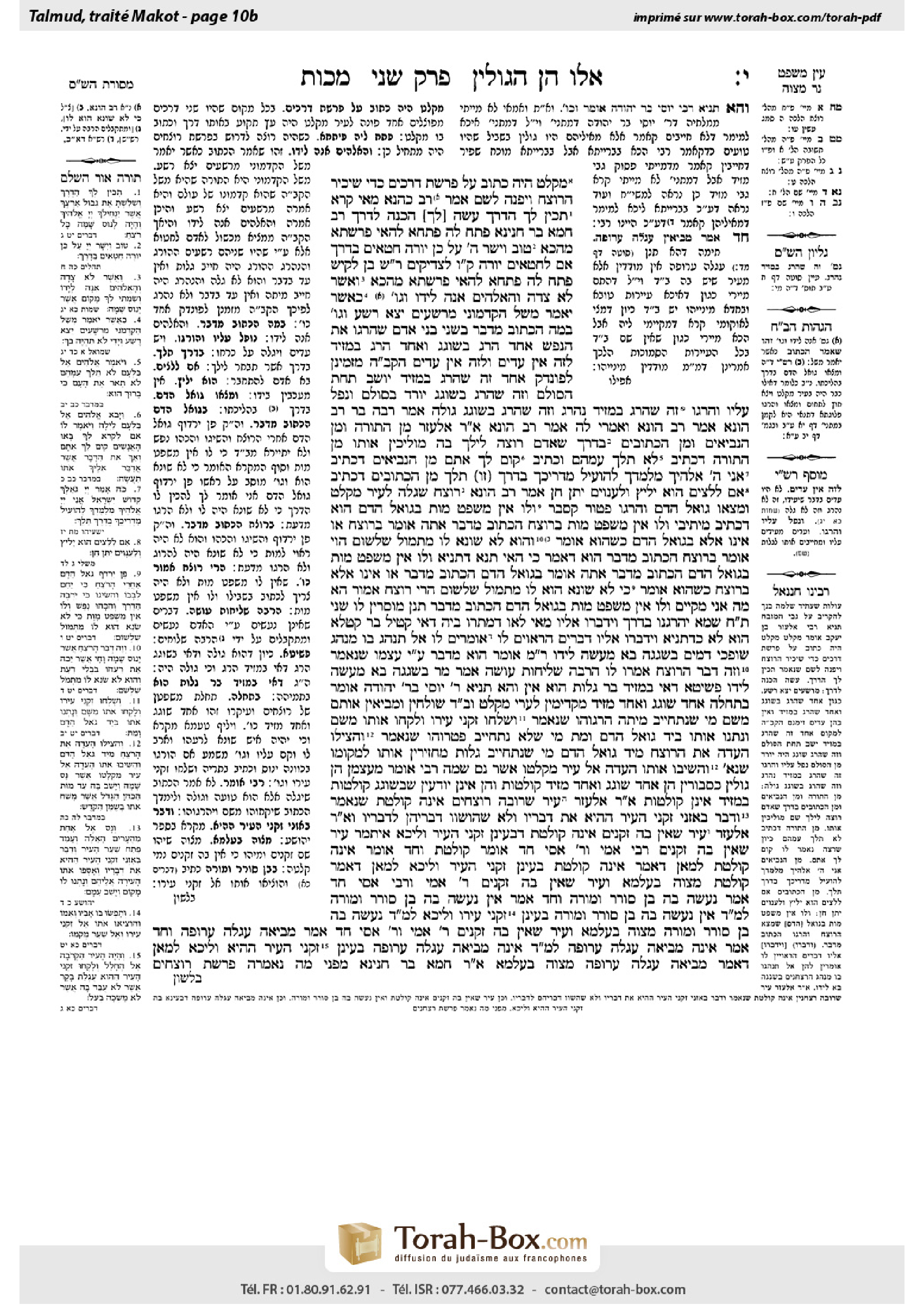
Makkot 10b: Talmud study for Daf Yomi
Daf Yomi is the daily study of one Talmud folio. Explore 37 tractates with scans, Hebrew text, Sefaria English and AI-generated French translations where annotated.
Passage selection and English or AI-generated French translation are available where the scan has annotations. Daf Study is independent of Torah-Box and Sefaria.
Browse Makkot · מכות · All tractatesMakkot 10b text and translations
This page of Makkot includes the Aramaic text, an English translation and an AI-generated French translation, alongside the scan above.
מכות י׳ ב · Aramaic and Hebrew text
״מִקְלָט״ הָיָה כָּתוּב עַל פָּרָשַׁת דְּרָכִים, כְּדֵי שֶׁיַּכִּיר הָרוֹצֵחַ וְיִפְנֶה לְשָׁם. אָמַר רַב כָּהֲנָא: מַאי קְרָא? ״תָּכִין לְךָ הַדֶּרֶךְ״ – עֲשֵׂה [לְךָ] הֲכָנָה לַדֶּרֶךְ.
רַב חָמָא בַּר חֲנִינָא פָּתַח לַהּ פִּתְחָא לְהַאי פָּרַשְׁתָּא מֵהָכָא: ״טוֹב וְיָשָׁר ה׳ עַל כֵּן יוֹרֶה חַטָּאִים בַּדָּרֶךְ״ – אִם לַחַטָּאִים יוֹרֶה, קַל וָחוֹמֶר לַצַּדִּיקִים.
רַבִּי שִׁמְעוֹן בֶּן לָקִישׁ פָּתַח לַהּ פִּתְחָא לְהַאי פָּרַשְׁתָּא מֵהָכָא: ״וַאֲשֶׁר לֹא צָדָה וְהָאֱלֹהִים אִנָּה לְיָדוֹ וְגוֹ׳״, ״כַּאֲשֶׁר יֹאמַר מְשַׁל הַקַּדְמֹנִי מֵרְשָׁעִים יֵצֵא רֶשַׁע וְגוֹ׳״,
בַּמָּה הַכָּתוּב מְדַבֵּר – בִּשְׁנֵי בְּנֵי אָדָם שֶׁהָרְגוּ אֶת הַנֶּפֶשׁ, אֶחָד הָרַג בְּשׁוֹגֵג וְאֶחָד הָרַג בְּמֵזִיד, לָזֶה אֵין עֵדִים וְלָזֶה אֵין עֵדִים. הַקָּדוֹשׁ בָּרוּךְ הוּא מַזְמִינָן לְפוּנְדָּק אֶחָד, זֶה שֶׁהָרַג בְּמֵזִיד יוֹשֵׁב תַּחַת הַסּוּלָּם, וְזֶה שֶׁהָרַג בְּשׁוֹגֵג יוֹרֵד בַּסּוּלָּם, וְנֹפֵל עָלָיו וְהֹרְגוֹ, זֶה שֶׁהָרַג בְּמֵזִיד – נֶהֱרָג, וְזֶה שֶׁהָרַג בְּשׁוֹגֵג – גּוֹלֶה.
אָמַר רַבָּה בַּר רַב הוּנָא אָמַר רַב הוּנָא, וְאָמְרִי לַהּ אָמַר רַב הוּנָא אָמַר רַבִּי אֶלְעָזָר: מִן הַתּוֹרָה וּמִן הַנְּבִיאִים וּמִן הַכְּתוּבִים – בַּדֶּרֶךְ שֶׁאָדָם רוֹצֶה לֵילֵךְ בָּהּ – מוֹלִיכִין אוֹתוֹ.
מִן הַתּוֹרָה, דִּכְתִיב: ״לֹא תֵלֵךְ עִמָּהֶם״, וּכְתִיב: ״קוּם לֵךְ אִתָּם״. מִן הַנְּבִיאִים – דִּכְתִיב: ״אֲנִי ה׳ אֱלֹהֶיךָ מְלַמֶּדְךָ לְהוֹעִיל מַדְרִיכְךָ בְּדֶרֶךְ (זוּ) תֵּלֵךְ״. מִן הַכְּתוּבִים – דִּכְתִיב: ״אִם לַלֵּצִים הוּא יָלִיץ וְלַעֲנָוִים יִתֶּן חֵן״.
אָמַר רַב הוּנָא: רוֹצֵחַ שֶׁגָּלָה לְעִיר מִקְלָט וּמְצָאוֹ גּוֹאֵל הַדָּם וַהֲרָגוֹ – פָּטוּר. קָסָבַר: ״וְלוֹ אֵין מִשְׁפַּט מָוֶת״ – בְּגוֹאֵל הַדָּם הוּא דִּכְתִיב.
מֵיתִיבִי: ״וְלוֹ אֵין מִשְׁפַּט מָוֶת״ – בָּרוֹצֵחַ הַכָּתוּב מְדַבֵּר. אַתָּה אוֹמֵר בָּרוֹצֵחַ, אוֹ אֵינוֹ אֶלָּא בְּגוֹאֵל הַדָּם? כְּשֶׁהוּא אוֹמֵר: ״וְהוּא לֹא שֹׂנֵא לוֹ מִתְּמוֹל שִׁלְשׁוֹם״ – הֱוֵי אוֹמֵר בָּרוֹצֵחַ הַכָּתוּב מְדַבֵּר.
הוּא דְּאָמַר כִּי הַאי תַּנָּא, דְּתַנְיָא: ״וְלוֹ אֵין מִשְׁפַּט מָוֶת״ – בְּגוֹאֵל הַדָּם הַכָּתוּב מְדַבֵּר. אַתָּה אוֹמֵר בְּגוֹאֵל הַדָּם הַכָּתוּב מְדַבֵּר, אוֹ אֵינוֹ אֶלָּא בָּרוֹצֵחַ? כְּשֶׁהוּא אוֹמֵר: ״כִּי לֹא שׂוֹנֵא הוּא לוֹ מִתְּמוֹל שִׁלְשׁוֹם״ – הֲרֵי רוֹצֵחַ אָמוּר, הָא מָה אֲנִי מְקַיֵּים: ״וְלוֹ אֵין מִשְׁפַּט מָוֶת״? בְּגוֹאֵל הַדָּם הַכָּתוּב מְדַבֵּר.
תְּנַן: מוֹסְרִין לוֹ שְׁנֵי תַּלְמִידֵי חֲכָמִים, שֶׁמָּא יַהַרְגֶנּוּ בַּדֶּרֶךְ, וִידַבְּרוּ אֵלָיו. מַאי לָאו דְּמַתְרוּ בֵּיהּ, דְּאִי קָטֵיל בַּר קְטָלָא הוּא?
לָא, כִּדְתַנְיָא: וִידַבְּרוּ אֵלָיו – דְּבָרִים הָרְאוּיִים לוֹ. אוֹמְרִים לוֹ: אַל תִּנְהַג בּוֹ מִנְהַג שׁוֹפְכֵי דָמִים, בִּשְׁגָגָה בָּא מַעֲשֶׂה לְיָדוֹ. רַבִּי מֵאִיר אוֹמֵר: הוּא מְדַבֵּר עַל יְדֵי עַצְמוֹ, שֶׁנֶּאֱמַר: ״וְזֶה דְּבַר הָרֹצֵחַ״. אָמְרוּ לוֹ: הַרְבֵּה שְׁלִיחוּת עוֹשָׂה.
אָמַר מָר: בִּשְׁגָגָה בָּא מַעֲשֶׂה לְיָדוֹ. פְּשִׁיטָא! דְּאִי בְּמֵזִיד, בַּר גָּלוּת הוּא? אִין.
וְהָא תַּנְיָא, רַבִּי יוֹסֵי בְּרַבִּי יְהוּדָה אוֹמֵר: בַּתְּחִלָּה, אֶחָד שׁוֹגֵג וְאֶחָד מֵזִיד מַקְדִּימִין לְעָרֵי מִקְלָט, וּבֵית דִּין שׁוֹלְחִין וּמְבִיאִין אוֹתָם מִשָּׁם.
מִי שֶׁנִּתְחַיֵּיב מִיתָה – הֲרָגוּהוּ, שֶׁנֶּאֱמַר: ״וְשָׁלְחוּ זִקְנֵי עִירוֹ וְלָקְחוּ אֹתוֹ מִשָּׁם וְנָתְנוּ אֹתוֹ בְּיַד גֹּאֵל הַדָּם וָמֵת״. מִי שֶׁלֹּא נִתְחַיֵּיב – פְּטָרוּהוּ, שֶׁנֶּאֱמַר: ״וְהִצִּילוּ הָעֵדָה אֶת הָרֹצֵחַ מִיַּד גֹּאֵל הַדָּם״. מִי שֶׁנִּתְחַיֵּיב גָּלוּת – מַחְזִירִין אוֹתוֹ לִמְקוֹמוֹ, שֶׁנֶּאֱמַר: ״וְהֵשִׁיבוּ אֹתוֹ הָעֵדָה אֶל עִיר מִקְלָטוֹ אֲשֶׁר נָס שָׁמָּה״.
רַבִּי אוֹמֵר: מֵעַצְמָן הֵן גּוֹלִין. כִּסְבוּרִין הֵן אֶחָד שׁוֹגֵג וְאֶחָד מֵזִיד – קוֹלְטוֹת, וְהֵן אֵינָן יוֹדְעִין שֶׁבַּשּׁוֹגֵג קוֹלְטוֹת, בְּמֵזִיד אֵינָן קוֹלְטוֹת.
אָמַר רַבִּי אֶלְעָזָר: עִיר שֶׁרוּבָּהּ רוֹצְחִים – אֵינָהּ קוֹלֶטֶת, שֶׁנֶּאֱמַר: ״וְדִבֶּר בְּאׇזְנֵי זִקְנֵי הָעִיר הַהִיא אֶת דְּבָרָיו״ – וְלֹא שֶׁהוּשְׁווּ דִּבְרֵיהֶן לִדְבָרָיו.
וְאָמַר רַבִּי אֶלְעָזָר: עִיר שֶׁאֵין בָּהּ זְקֵנִים אֵינָהּ קוֹלֶטֶת, דְּבָעֵינַן ״זִקְנֵי הָעִיר״ וְלֵיכָּא. אִיתְּמַר: עִיר שֶׁאֵין בָּהּ זְקֵנִים, רַבִּי אַמֵּי וְרַבִּי אַסִּי – חַד אוֹמֵר: קוֹלֶטֶת, וְחַד אוֹמֵר: אֵינָהּ קוֹלֶטֶת. לְמַאן דְּאָמַר אֵינָהּ קוֹלֶטֶת – בָּעֵינַן ״זִקְנֵי הָעִיר״, וְלֵיכָּא. לְמַאן דְּאָמַר קוֹלֶטֶת – מִצְוָה בְּעָלְמָא.
וְעִיר שֶׁאֵין בָּהּ זְקֵנִים – רַבִּי אַמֵּי וְרַבִּי אַסִּי, חַד אָמַר: נַעֲשֶׂה בָּהּ בֵּן סוֹרֵר וּמוֹרֶה, וְחַד אָמַר: אֵין נַעֲשֶׂה בָּהּ בֵּן סוֹרֵר וּמוֹרֶה. לְמַאן דְּאָמַר אֵין נַעֲשֶׂה בָּהּ בֵּן סוֹרֵר וּמוֹרֶה – בָּעֵינַן ״זִקְנֵי עִירוֹ״, וְלֵיכָּא. לְמַאן דְּאָמַר נַעֲשֶׂה בָּהּ בֵּן סוֹרֵר וּמוֹרֶה – מִצְוָה בְּעָלְמָא.
וְעִיר שֶׁאֵין בָּהּ זְקֵנִים, רַבִּי אַמֵּי וְרַבִּי אַסִּי – חַד אָמַר: מְבִיאָה עֶגְלָה עֲרוּפָה, וְחַד אָמַר: אֵינָהּ מְבִיאָה עֶגְלָה עֲרוּפָה. לְמַאן דְּאָמַר אֵינָהּ מְבִיאָה עֶגְלָה עֲרוּפָה – בָּעֵינַן ״זִקְנֵי הָעִיר הַהִיא״, וְלֵיכָּא. לְמַאן דְּאָמַר מְבִיאָה עֶגְלָה עֲרוּפָה – מִצְוָה בְּעָלְמָא.
אָמַר רַבִּי חָמָא בַּר חֲנִינָא: מִפְּנֵי מָה נֶאֶמְרָה פָּרָשַׁת רוֹצְחִים
Makkot 10b · English translation
Refuge was written on signs at every crossroads marking the path to a city of refuge, so that the unintentional murderer would identify the route to the city of refuge and turn to go there. Rav Kahana said: What is the verse from which this is derived? “Prepare for you the road” (Deuteronomy 19:3), meaning: Perform for you preparation of the road.
§ Apropos that halakha, the Gemara cites that Rav Ḥama bar Ḥanina introduced this portion with regard to the halakhot of exile with an introduction from here: “Good and upright is God; therefore He directs sinners along the way” (Psalms 25:8). He said: If He directs sinners by commanding the placing of signs directing them to the city of refuge, it may be inferred a fortiori that He will assist and direct the righteous along the path of righteousness.
Rabbi Shimon ben Lakish introduced this portion with an introduction from here: It is stated with regard to an unintentional murderer: “And one who did not lie in wait, but God caused it to come to his hand, and I will appoint you a place where he may flee” (Exodus 21:13). Now this is puzzling. Why would God cause one to sin in this manner? The verse states: “As the ancient parable says: From the wicked comes forth wickedness” (I Samuel 24:13). Evil incidents befall those who have already sinned.
Reish Lakish explains: In this light, the verse “But God caused it to come to his hand” may be understood. With regard to what scenario is the verse speaking? It is with regard to two people who killed a person, where one killed unintentionally while the other killed intentionally. For this person there are no witnesses to his action, and for that person there are no witnesses to his action; therefore, neither received the appropriate punishment of exile and execution, respectively. The Holy One, Blessed be He, summons them to one inn. This person who killed intentionally sits beneath a ladder, and that person who killed unintentionally descends the ladder, and he falls upon him and kills him. There were witnesses to that incident and therefore, that person who killed intentionally is killed, and that person who killed unintentionally is exiled, each receiving what he deserved.
Apropos the path upon which God leads people, the Gemara cites a statement that Rabba bar Rav Huna says that Rav Huna says, and some say it was a statement that Rav Huna says that Rabbi Elazar says: From the Torah, from the Prophets, and from the Writings one learns that along the path a person wishes to proceed, one leads and assists him.
One learns this from the Torah, as it is written that initially God said to Balaam with regard to the contingent dispatched by Balak: “You shall not go with them” (Numbers 22:12). After Balaam implored Him and indicated his desire to go with them, it is written: “Arise, go with them” (Numbers 22:20). One learns this from the Prophets, as it is written: “I am the Lord your God, Who teaches you for your profit, Who leads you on the path that you go” (Isaiah 48:17), indicating that along the path that one seeks to go, God will direct him. One learns this from the Writings, as it is written: “If one seeks the cynics, He will cause him to join the cynics, but to the humble He will give grace” (Proverbs 3:34), indicating that if one chooses cynicism God will direct him there and if he opts for humility God will grant him grace.
§ The Gemara resumes its discussion of the halakhot of exile. Rav Huna says: In the case of an unintentional murderer who was exiled to a city of refuge, and the blood redeemer found him on the way and killed him, he is exempt. The Gemara notes: Rav Huna holds that the verse: “Lest the blood redeemer pursue the murderer…and strike him fatally…and for him there is no sentence of death, as he did not hate him from before” (Deuteronomy 19:6), is written with regard to the blood redeemer, teaching that the blood redeemer is not liable to be executed for killing the murderer.
The Gemara raises an objection to the opinion of Rav Huna from a baraita: “And for him there is no sentence of death”; the verse is speaking with regard to the unintentional murderer, teaching that the unintentional murderer is not liable to be executed. That is why the Jewish people were commanded to establish cities of refuge to protect him. The baraita proceeds to prove that the verse is written with regard to the murderer. Do you say that it is speaking with regard to the unintentional murderer, or is it speaking only with regard to the blood redeemer? When it states in an earlier verse: “And he did not hate him from before” (Deuteronomy 19:4), it is clear that the reference is to the unintentional murderer, and therefore, you must say that in the phrase: “And for him there is no sentence of death,” the verse is speaking with regard to the unintentional murderer.
The Gemara answers: Rav Huna states his opinion in accordance with the opinion of that following tanna, as it is taught in another baraita: “And for him there is no sentence of death”; the verse is speaking with regard to the blood redeemer. The baraita clarifies: Do you say that it is speaking with regard to the blood redeemer, or is it speaking only with regard to the unintentional murderer? When it states: “As he did not hate him from before,” the unintentional murderer is already stated, as that phrase certainly is referring to him. How do I realize the meaning of the verse: “And for him there is no sentence of death”? It is with regard to the blood redeemer that the verse is speaking.
The Gemara cites proof concerning Rav Huna’s ruling from the mishna. We learned in the mishna: And they would provide the unintentional murderer fleeing to a city of refuge with two Torah scholars, due to the concern that perhaps the blood redeemer will seek to kill him in transit, and in that case they will talk to the blood redeemer. The Gemara asks: What, is it not that the Torah scholars forewarn him that if he kills the unintentional murderer he would be liable to be executed? That contradicts Rav Huna’s opinion that a blood redeemer who kills the unintentional murderer is exempt.
The Gemara rejects this proof: No, the statement of the Torah scholars to the blood redeemer can be explained as it is taught in a baraita: And they will speak to him about matters appropriate to him. They say to the blood redeemer: Do not accord him treatment appropriate for murderers, as it was unintentionally that he came to be involved in the incident. Rabbi Meir says: The unintentional murderer too speaks [medabber] on his own behalf to dissuade the blood redeemer, as it is stated: “And this is the matter [devar] of the murderer, who shall flee there and live” (Deuteronomy 19:4), indicating that the murderer himself apologizes and speaks to the blood redeemer. The Sages said to Rabbi Meir: Many matters are performed more effectively through agency.
The Gemara analyzes the baraita. The Master says in the baraita: It was unintentionally that he came to be involved in the incident. The Gemara asks: Isn’t this obvious? As, if it were intentionally that he killed a person, is he liable to be exiled? The Gemara answers: Yes, even intentional murderers flee to a city of refuge on occasion.
The Gemara continues: And so it is taught in a baraita: Rabbi Yosei, son of Rabbi Yehuda, says: Initially, either one who killed another unintentionally or one who killed another intentionally would hurry and flee to the cities of refuge, and the court in his city would send for him and would bring him from there to stand trial.
The baraita continues: With regard to one who was found liable to receive the death penalty for intentional murder, after the trial the court would execute him, as it is stated: “And the elders of his city shall send and take him from there and deliver him into the hands of the blood redeemer and he shall die” (Deuteronomy 19:12). And with regard to one who was not found liable to receive the death penalty, e.g., if they deemed that it was due to circumstances beyond his control, they freed him, as it is stated: “And the congregation shall rescue the murderer from the hands of the blood redeemer” (Numbers 35:25). With regard to one who was found liable to be exiled, the court would restore him to his place in the city of refuge, as it is stated: “And the congregation shall judge between the murderer and the blood redeemer…and the congregation shall restore him to his city of refuge, that he fled there” (Numbers 35:24–25).
The baraita continues: Rabbi Yehuda HaNasi says: The Torah does not command intentional murderers to flee to a city of refuge; rather, the Torah is cognizant of the fact that in practice, intentional murderers would exile themselves on their own, as they thought that they would be admitted to these cities, which would provide refuge for both unintentional and intentional murderers, and they do not know that only those who murder unintentionally are admitted to these cities, but those who murder intentionally are not admitted.
§ Rabbi Elazar says: An unintentional murderer is not admitted to a city of refuge whose majority consists of unintentional murderers, as it is stated with regard to an unintentional murderer who fled to a city of refuge: “And he shall speak his matters in the ears of the elders of that city” (Joshua 20:4), indicating that there is some novel element in the matters that he seeks to convey to the elders of the town, but not when their matters are equal to his matters, as those elders made the same statements when they arrived at the city of refuge as unintentional murderers.
And Rabbi Elazar says: An unintentional murderer is not admitted to a city in which there are no elders, as we require the fulfillment of the verse: “And he shall speak in the ears of the elders of the city” (Joshua 20:4), and there are none. It was stated: A city in which there are no elders is the subject of a dispute between Rabbi Ami and Rabbi Asi. One says: An unintentional murderer is admitted there, and one says: An unintentional murderer is not admitted there. The Gemara explains: According to the one who says that an unintentional murderer is not admitted to a city in which there are no elders, his reasoning is due to the fact that we require the presence of the elders of the city and there are none. According to the one who says that an unintentional murderer is admitted there, his reasoning is that he holds that speaking to the elders is merely a mitzva ab initio, but it does not affect the city’s status as a city of refuge.
And a city in which there are no elders is the subject of another dispute between Rabbi Ami and Rabbi Asi. One says: One can become a wayward and rebellious son in it. And one says: One cannot become a wayward and rebellious son in it. The Gemara explains: According to the one who says that one cannot become wayward and rebellious son in it, it is due to the fact that we require the presence of the elders of the city, as it is written: “And his father and mother shall take hold of him and bring him out to the elders of his city and the gate of his place” (Deuteronomy 21:19), and there are none. According to the one who says that one can become a wayward and rebellious son in it, the presence of the elders is merely a mitzva ab initio.
And a city in which there are no elders is the subject of another dispute between Rabbi Ami and Rabbi Asi. One says: If a corpse was discovered proximate to that city, the inhabitants of the city bring a heifer whose neck is broken. And one says: The inhabitants of the city do not bring a heifer whose neck is broken. The Gemara explains: According to the one who says that the inhabitants of the city do not bring a heifer whose neck is broken, it is due to the fact that we require the presence of the elders of the city, as it is written: “And the elders of that city shall bring the calf down to a rough valley” (Deuteronomy 21:4), and there are no elders. According to the one who says that the inhabitants of the city bring a heifer whose neck is broken, the presence of the elders is merely a mitzva ab initio.
§ Rabbi Ḥama bar Ḥanina says: For what reason was the portion discussing murderers stated
Makkot 10b · Traduction française (IA)
Des panneaux portant l’indication « refuge » étaient placés à chaque carrefour, balisant le chemin vers une ville de refuge, afin que le meurtrier involontaire puisse trouver la route menant à la ville de refuge et s’y diriger. Rav Kahana dit : De quel verset cela est-il déduit ? « Prépare pour toi le chemin » (Deutéronome 19:3), c’est-à-dire : prépare pour toi la route.
§ À propos de cette halakha, la Guemara rapporte que Rav Ḥama bar Ḥanina introduisit ce passage sur les halakhot de l’exil par cette citation : « Dieu est bon et droit ; c’est pourquoi Il indique aux pécheurs le chemin » (Psaumes 25:8). Il dit : S’Il indique le chemin aux pécheurs en ordonnant de placer des panneaux les dirigeant vers la ville de refuge, on peut en déduire a fortiori qu’Il aidera et guidera les justes sur le chemin de la justice.
Rabbi Shimon ben Lakish introduisit ce passage par cette citation : À propos du meurtrier involontaire, il est dit : « Celui qui n’était pas à l’affût, mais que Dieu a fait tomber sous sa main, Je te désignerai un lieu où il pourra s’enfuir » (Exode 21:13). Or, cela est étonnant : pourquoi Dieu ferait-Il en sorte qu’un homme commette ainsi une faute ? Le verset dit : « Comme le dit le proverbe ancien : De la méchanceté vient la méchanceté » (I Samuel 24:13). Les malheurs frappent ceux qui ont déjà péché.
Reish Lakish explique : Dans cette perspective, on peut comprendre le verset « Mais Dieu l’a fait tomber sous sa main ». À quelle situation ce verset fait-il référence ? À deux hommes qui ont tué quelqu’un, l’un involontairement et l’autre intentionnellement. Il n’y a pas de témoins de l’acte de l’un, ni de témoins de l’acte de l’autre ; aucun n’a donc reçu la peine qui convenait, l’exil pour l’un et l’exécution pour l’autre. Le Saint, béni soit-Il, les fait se retrouver dans une même auberge. Celui qui a tué intentionnellement s’assied au pied d’une échelle, tandis que celui qui a tué involontairement descend l’échelle ; il tombe sur lui et le tue. Des témoins ont assisté à cet événement. Celui qui avait tué intentionnellement est donc mis à mort, et celui qui avait tué involontairement est exilé : chacun reçoit ce qu’il mérite.
À propos du chemin sur lequel Dieu conduit les hommes, la Guemara rapporte une déclaration de Rabba bar Rav Huna au nom de Rav Huna ; certains disent qu’elle fut énoncée par Rav Huna au nom de Rabbi Elazar : la Torah, les Prophètes et les Écrits enseignent tous que l’on conduit et aide une personne sur le chemin qu’elle souhaite emprunter.
La Torah l’enseigne, car il est écrit qu’au début Dieu dit à Balaam, au sujet de la délégation envoyée par Balak : « Tu n’iras pas avec eux » (Nombres 22:12). Après que Balaam L’eut supplié et eut manifesté son désir de les accompagner, il est écrit : « Lève-toi, va avec eux » (Nombres 22:20). Les Prophètes l’enseignent, car il est écrit : « Je suis le Seigneur, ton Dieu, qui t’enseigne pour ton bien, qui te conduit sur le chemin où tu vas » (Isaïe 48:17), indiquant que Dieu guidera chacun sur le chemin qu’il cherche à emprunter. Les Écrits l’enseignent, car il est écrit : « S’il recherche les moqueurs, Il le fera fréquenter les moqueurs, mais aux humbles Il accordera la grâce » (Proverbes 3:34), indiquant que si quelqu’un choisit la moquerie, Dieu le guidera dans cette voie, tandis que s’il opte pour l’humilité, Dieu lui accordera la grâce.
§ La Guemara reprend son examen des halakhot de l’exil. Rav Huna dit : Dans le cas d’un meurtrier involontaire exilé dans une ville de refuge, si le go’el hadam le trouve en chemin et le tue, il est exempt. La Guemara précise que Rav Huna considère que le verset « de peur que le go’el hadam ne poursuive le meurtrier… et ne le frappe mortellement… alors qu’il n’est pas passible de mort, puisqu’il ne le haïssait pas auparavant » (Deutéronome 19:6) concerne le go’el hadam et enseigne que celui-ci n’est pas passible d’exécution pour avoir tué le meurtrier.
La Guemara soulève une objection à l’opinion de Rav Huna à partir d’une baraïta : « Alors qu’il n’est pas passible de mort » ; le verset parle du meurtrier involontaire et enseigne que celui-ci n’est pas passible d’exécution. C’est pourquoi le peuple juif reçut l’ordre d’établir des villes de refuge pour le protéger. La baraïta poursuit en démontrant que le verset parle du meurtrier. Peut-on dire qu’il parle du meurtrier involontaire, ou bien parle-t-il uniquement du go’el hadam ? Puisqu’un verset antérieur dit : « Et il ne le haïssait pas auparavant » (Deutéronome 19:4), il est clair que la référence est au meurtrier involontaire. Il faut donc dire que, dans les mots « alors qu’il n’est pas passible de mort », le verset parle du meurtrier involontaire.
La Guemara répond : Rav Huna exprime son opinion conformément à celle du tanna qui suit, comme il est enseigné dans une autre baraïta : « Alors qu’il n’est pas passible de mort » ; le verset parle du go’el hadam. La baraïta précise : Peut-on dire qu’il parle du go’el hadam, ou bien parle-t-il uniquement du meurtrier involontaire ? Puisqu’il est écrit : « puisqu’il ne le haïssait pas auparavant », le meurtrier involontaire a déjà été mentionné, car cette expression le désigne assurément. Comment faut-il donc comprendre les mots « alors qu’il n’est pas passible de mort » ? Le verset parle du go’el hadam.
La Guemara apporte un argument à l’appui de la décision de Rav Huna à partir de la Michna. Nous avons appris dans la Michna : On fournissait au meurtrier involontaire qui s’enfuyait vers une ville de refuge deux érudits en Torah, par crainte que le go’el hadam ne cherche à le tuer en chemin ; dans ce cas, ils parleraient au go’el hadam. La Guemara demande : N’est-ce pas pour le prévenir que, s’il tue le meurtrier involontaire, il sera passible d’exécution ? Cela contredirait l’opinion de Rav Huna, selon laquelle le go’el hadam qui tue le meurtrier involontaire est exempt.
La Guemara rejette cet argument : Non, les propos des érudits en Torah au go’el hadam peuvent s’expliquer comme il est enseigné dans une baraïta : ils lui parleront de ce qui convient à sa situation. Ils disent au go’el hadam : Ne le traitez pas comme un meurtrier, car il s’est trouvé mêlé à cet incident involontairement. Rabbi Meïr dit : Le meurtrier involontaire parle lui aussi [medabber] en sa propre faveur afin de dissuader le go’el hadam, comme il est dit : « Et voici l’affaire [devar] du meurtrier qui s’enfuira là et vivra » (Deutéronome 19:4), ce qui indique que le meurtrier lui-même présente ses excuses et parle au go’el hadam. Les Sages dirent à Rabbi Meïr : Bien des choses sont accomplies plus efficacement par l’intermédiaire d’un mandataire.
La Guemara analyse la baraïta. Le Maître dit dans la baraïta : Il s’est trouvé mêlé à cet incident involontairement. La Guemara demande : N’est-ce pas évident ? Car s’il avait tué quelqu’un intentionnellement, aurait-il été passible d’exil ? La Guemara répond : Si, même les meurtriers intentionnels s’enfuient parfois dans une ville de refuge.
La Guemara poursuit : Ainsi, il est enseigné dans une baraïta : Rabbi Yosei, fils de Rabbi Yehuda, dit : Au début, tous ceux qui avaient tué quelqu’un, involontairement ou intentionnellement, se hâtaient de s’enfuir dans les villes de refuge, et le tribunal de leur ville envoyait les chercher et les faisait venir de là pour qu’ils comparaissent en jugement.
La baraïta poursuit : Celui qui était reconnu passible de la peine de mort pour meurtre intentionnel était exécuté par le tribunal après son procès, comme il est dit : « Les anciens de sa ville enverront le chercher, le feront sortir de là et le livreront aux mains du go’el hadam, et il mourra » (Deutéronome 19:12). Celui qui n’était pas reconnu passible de la peine de mort, par exemple si le tribunal estimait que l’acte était dû à des circonstances indépendantes de sa volonté, était libéré, comme il est dit : « L’assemblée sauvera le meurtrier des mains du go’el hadam » (Nombres 35:25). Quant à celui qui était reconnu passible d’exil, le tribunal le ramenait à sa place dans la ville de refuge, comme il est dit : « L’assemblée jugera entre le meurtrier et le go’el hadam… et l’assemblée le ramènera dans sa ville de refuge, où il s’était enfui » (Nombres 35:24–25).
La baraïta poursuit : Rabbi Yehuda HaNasi dit : La Torah n’ordonne pas aux meurtriers intentionnels de s’enfuir dans une ville de refuge ; elle tient plutôt compte du fait qu’en pratique, les meurtriers intentionnels s’exilaient d’eux-mêmes, pensant qu’ils seraient admis dans ces villes, qui serviraient de refuge aussi bien aux meurtriers involontaires qu’aux meurtriers intentionnels. Ils ignoraient que seuls ceux qui tuent involontairement sont admis dans ces villes, tandis que ceux qui tuent intentionnellement ne le sont pas.
§ Rabbi Elazar dit : Un meurtrier involontaire n’est pas admis dans une ville de refuge dont la majorité des habitants sont des meurtriers involontaires, comme il est dit au sujet du meurtrier involontaire qui s’est enfui dans une ville de refuge : « Il exposera son affaire aux oreilles des anciens de cette ville » (Josué 20:4). Cela indique qu’il y a quelque élément nouveau dans ce qu’il cherche à exposer aux anciens de la ville, mais pas lorsque leur situation est identique à la sienne, puisque ces anciens ont tenu les mêmes propos lorsqu’ils sont arrivés dans la ville de refuge en tant que meurtriers involontaires.
Et Rabbi Elazar dit : Un meurtrier involontaire n’est pas admis dans une ville où il n’y a pas d’anciens, car il faut que le verset « Il parlera aux oreilles des anciens de la ville » (Josué 20:4) soit accompli, or il n’y a pas d’anciens. La question de savoir si un meurtrier involontaire est admis dans une ville dépourvue d’anciens fait l’objet d’une controverse entre Rabbi Ami et Rabbi Asi. L’un dit : Un meurtrier involontaire y est admis ; l’autre dit : Un meurtrier involontaire n’y est pas admis. La Guemara explique : Selon celui qui dit qu’un meurtrier involontaire n’est pas admis dans une ville dépourvue d’anciens, c’est parce qu’il faut la présence des anciens de la ville, or il n’y en a pas. Selon celui qui dit qu’un meurtrier involontaire y est admis, c’est parce qu’il considère que parler aux anciens est seulement une mitsva à accomplir a priori, sans que cela influe sur le statut de la ville en tant que ville de refuge.
Et la question de savoir si un fils dévoyé et rebelle peut se trouver dans une ville dépourvue d’anciens fait l’objet d’une autre controverse entre Rabbi Ami et Rabbi Asi. L’un dit : On peut y trouver un fils dévoyé et rebelle. L’autre dit : On ne peut pas y trouver un fils dévoyé et rebelle. La Guemara explique : Selon celui qui dit qu’on ne peut pas y trouver de fils dévoyé et rebelle, c’est parce qu’il faut la présence des anciens de la ville, comme il est écrit : « Son père et sa mère le saisiront, le conduiront auprès des anciens de sa ville et à la porte de son lieu » (Deutéronome 21:19), or il n’y en a pas. Selon celui qui dit qu’on peut y trouver un fils dévoyé et rebelle, la présence des anciens n’est qu’une mitsva à accomplir a priori.
Et la question de savoir si les habitants d’une ville dépourvue d’anciens doivent accomplir le rite de la génisse à la nuque brisée fait l’objet d’une autre controverse entre Rabbi Ami et Rabbi Asi. L’un dit : Si un cadavre est découvert près de cette ville, ses habitants apportent une génisse dont la nuque est brisée. L’autre dit : Les habitants de la ville n’apportent pas de génisse dont la nuque est brisée. La Guemara explique : Selon celui qui dit que les habitants de la ville n’apportent pas de génisse dont la nuque est brisée, c’est parce qu’il faut la présence des anciens de la ville, comme il est écrit : « Les anciens de cette ville feront descendre la génisse dans une vallée accidentée » (Deutéronome 21:4), or il n’y a pas d’anciens. Selon celui qui dit que les habitants de la ville apportent une génisse dont la nuque est brisée, la présence des anciens n’est qu’une mitsva à accomplir a priori.
§ Rabbi Ḥama bar Ḥanina dit : Pour quelle raison le passage concernant les meurtriers a-t-il été énoncé
Traduction française générée par IA à partir de l’édition anglaise de Sefaria. Vérifie toujours un passage avec le texte source.
Text from Sefaria: William Davidson Edition - Vocalized Aramaic (CC BY NC); William Davidson Edition - English (CC BY NC).