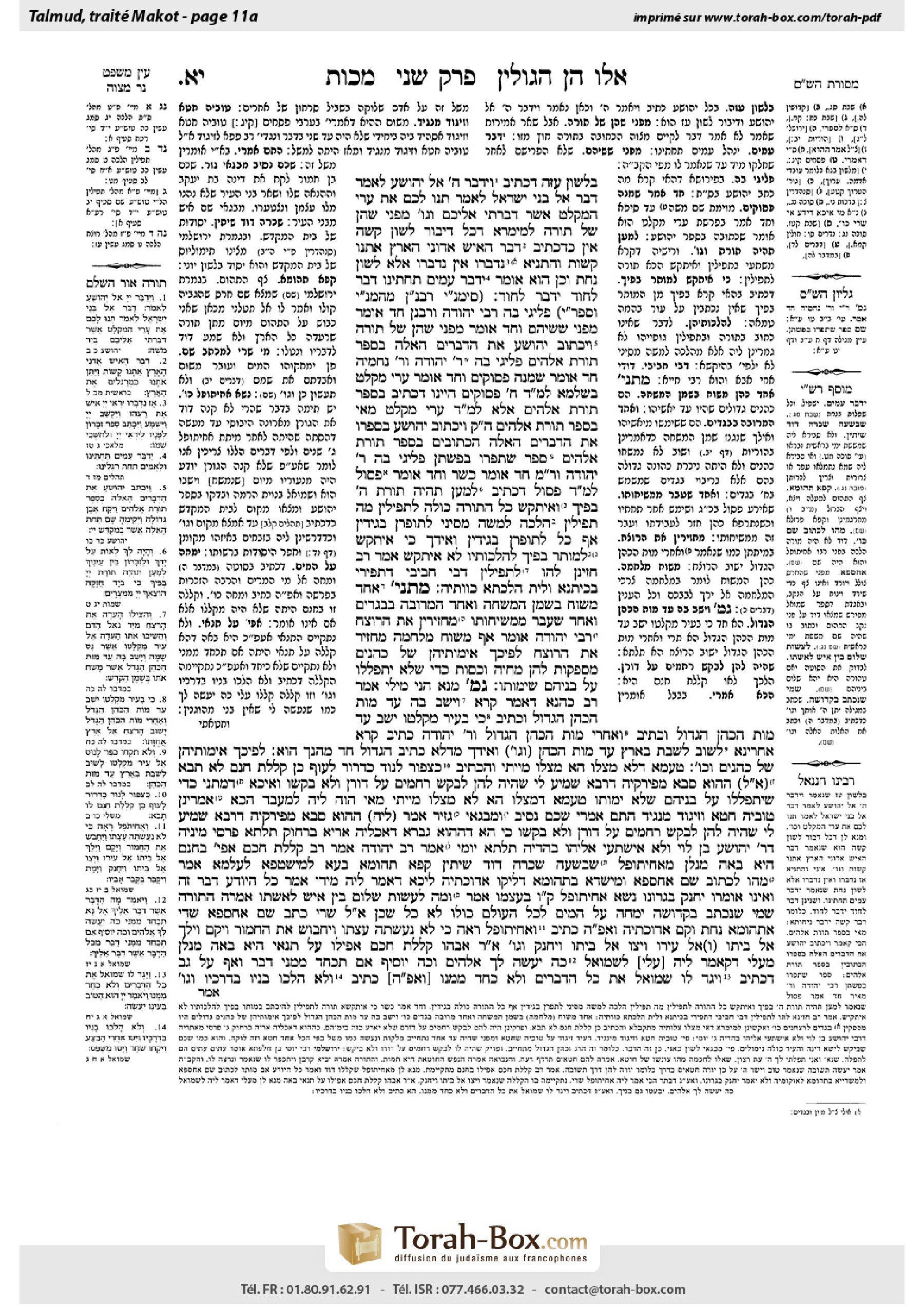
Makkot 11a: Talmud study for Daf Yomi
Daf Yomi is the daily study of one Talmud folio. Explore 37 tractates with scans, Hebrew text, Sefaria English and AI-generated French translations where annotated.
Passage selection and English or AI-generated French translation are available where the scan has annotations. Daf Study is independent of Torah-Box and Sefaria.
Browse Makkot · מכות · All tractatesMakkot 11a text and translations
This page of Makkot includes the Aramaic text, an English translation and an AI-generated French translation, alongside the scan above.
מכות י״א א · Aramaic and Hebrew text
בְּלָשׁוֹן עַזָּה, דִּכְתִיב: ״וַיְדַבֵּר ה׳ אֶל יְהוֹשֻׁעַ לֵאמֹר דַּבֵּר אֶל בְּנֵי יִשְׂרָאֵל לֵאמֹר תְּנוּ לָכֶם אֶת עָרֵי הַמִּקְלָט אֲשֶׁר דִּבַּרְתִּי אֲלֵיכֶם וְגוֹ׳״? מִפְּנֵי שֶׁהֵן שֶׁל הַתּוֹרָה.
לְמֵימְרָא דְּכׇל דִּיבּוּר לָשׁוֹן קָשָׁה? אִין, כְּדִכְתִיב: ״דִּבֶּר הָאִישׁ אֲדֹנֵי הָאָרֶץ אִתָּנוּ קָשׁוֹת״. וְהָתַנְיָא: ״נִדְבְּרוּ״, אֵין ״נִדְבְּרוּ״ אֶלָּא לְשׁוֹן נַחַת, וְכֵן הוּא אוֹמֵר ״יַדְבֵּר עַמִּים תַּחְתֵּינוּ״! ״דִּבֶּר״ לְחוּד, ״יַדְבֵּר״ לְחוּד.
(סִימָנֵי רַבָּנַן מְהֵמְנֵי וְסָפְרֵי).
פְּלִיגִי בַּהּ רַבִּי יְהוּדָה וְרַבָּנַן, חַד אוֹמֵר: מִפְּנֵי שֶׁשִּׁיהָם. וְחַד אוֹמֵר: מִפְּנֵי שֶׁהֵן שֶׁל תּוֹרָה.
״וַיִּכְתֹּב יְהוֹשֻׁעַ אֶת הַדְּבָרִים הָאֵלֶּה בְּסֵפֶר תּוֹרַת אֱלֹהִים״, פְּלִיגִי בַּהּ רַבִּי יְהוּדָה וְרַבִּי נְחֶמְיָה – חַד אוֹמֵר: שְׁמֹנָה פְּסוּקִים, וְחַד אוֹמֵר: עָרֵי מִקְלָט.
בִּשְׁלָמָא לְמַאן דְּאָמַר שְׁמֹנָה פְּסוּקִים, הַיְינוּ דִּכְתִיב: ״בְּסֵפֶר תּוֹרַת אֱלֹהִים״. אֶלָּא לְמַאן דְּאָמַר עָרֵי מִקְלָט, מַאי ״בְּסֵפֶר תּוֹרַת אֱלֹהִים״? הָכִי קָאָמַר: ״וַיִּכְתּוֹב יְהוֹשֻׁעַ בְּסִפְרוֹ אֶת הַדְּבָרִים הָאֵלֶּה הַכְּתוּבִים בְּסֵפֶר תּוֹרַת אֱלֹהִים״.
סֵפֶר שֶׁתְּפָרוֹ בְּפִשְׁתָּן, פְּלִיגִי בַּהּ רַבִּי יְהוּדָה וְרַבִּי מֵאִיר – חַד אוֹמֵר: כָּשֵׁר, וְחַד אוֹמֵר: פָּסוּל.
לְמַאן דְּאָמַר פָּסוּל, דִּכְתִיב: ״לְמַעַן תִּהְיֶה תּוֹרַת ה׳ בְּפִיךָ״, וְאִיתַּקַּשׁ כׇּל הַתּוֹרָה כּוּלָּהּ לִתְפִילִּין: מָה תְּפִילִּין הֲלָכָה לְמֹשֶׁה מִסִּינַי לְתוֹפְרָן בְּגִידִין – אַף כֹּל לְתׇפְרָן בְּגִידִין. וְאִידַּךְ: כִּי אִיתַּקַּשׁ – לַמּוּתָּר בְּפִיךְ, לְהִלְכוֹתָיו לָא אִיתַּקַּשׁ.
אָמַר רַב: חֲזֵינַן לְהוּ לִתְפִילִּין דְּבֵי חֲבִיבִי דִּתְפִירִי בְּכִיתָּנָא, וְלֵית הִלְכְתָא כְּווֹתֵיהּ.
מַתְנִי׳ אֶחָד מָשׁוּחַ בְּשֶׁמֶן הַמִּשְׁחָה, וְאֶחָד הַמְרוּבֶּה בִּבְגָדִים, וְאֶחָד שֶׁעָבַר מִמְּשִׁיחוּתוֹ – מַחֲזִירִין אֶת הָרוֹצֵחַ. רַבִּי יְהוּדָה אוֹמֵר: אַף מְשׁוּחַ מִלְחָמָה מַחֲזִיר אֶת הָרוֹצֵחַ.
לְפִיכָךְ אִימּוֹתֵיהֶן שֶׁל כֹּהֲנִים מְסַפְּקוֹת לָהֶן מִחְיָה וּכְסוּת, כְּדֵי שֶׁלֹּא יִתְפַּלְּלוּ עַל בְּנֵיהֶם שֶׁיָּמוּתוּ.
גְּמָ׳ מְנָא הָנֵי מִילֵּי? אָמַר רַב כָּהֲנָא: דְּאָמַר קְרָא: ״וְיָשַׁב בָּהּ עַד מוֹת הַכֹּהֵן הַגָּדֹל״, וּכְתִיב: ״כִּי בְעִיר מִקְלָטוֹ יֵשֵׁב עַד מוֹת הַכֹּהֵן הַגָּדֹל״, וּכְתִיב: ״וְאַחֲרֵי מוֹת הַכֹּהֵן הַגָּדֹל״.
וְרַבִּי יְהוּדָה? כְּתִיב קְרָא אַחֲרִינָא: ״לָשׁוּב לָשֶׁבֶת בָּאָרֶץ עַד מוֹת הַכֹּהֵן״. (וְגוֹ׳) וְאִידַּךְ: מִדְּלָא כְּתִיב: ״הַגָּדוֹל״ – חַד מֵהָנָךְ הוּא.
לְפִיכָךְ אִימּוֹתֵיהֶן שֶׁל כֹּהֲנִים כּוּ׳. טַעְמָא דְּלָא מְצַלּוּ, הָא מְצַלּוּ – מָיְיתִי? וְהָכְתִיב: ״כַּצִּפּוֹר לָנוּד כַּדְּרוֹר לָעוּף כֵּן קִלְלַת חִנָּם לֹא תָבֹא״! אֲמַר לֵיהּ הָהוּא סָבָא: מִפִּירְקֵיהּ דְּרָבָא שְׁמִיעַ לִי, שֶׁהָיָה לָהֶן לְבַקֵּשׁ רַחֲמִים עַל דּוֹרָן וְלֹא בִּקְּשׁוּ.
וְאִיכָּא דְּמַתְנֵי: כְּדֵי שֶׁיִּתְפַּלְּלוּ עַל בְּנֵיהֶם שֶׁלֹּא יָמוּתוּ. טַעְמָא דִּמְצַלּוּ, הָא לָא מְצַלּוּ – מָיְיתִי? מַאי הֲוָה לֵיהּ לְמֶעְבַּד? הָכָא אָמְרִינַן: טוֹבִיָּה חֲטָא וְזִיגּוּד מִנַּגַּיד.
הָתָם אָמְרִי: שְׁכֶם נָסֵיב וּמִבְגַּאי גָּזַיר.
אֲמַר לֵיהּ הָהוּא סָבָא: מִפִּירְקֵיהּ דְּרָבָא שְׁמִיעַ לִי, שֶׁהָיָה לָהֶן לְבַקֵּשׁ רַחֲמִים עַל דּוֹרָן וְלֹא בִּקְּשׁוּ. כִּי הָא דְּהָהוּא גַּבְרָא דְּאַכְלֵיהּ אַרְיָא בְּרָחוֹק תְּלָתָא פַּרְסֵי מִינֵּיהּ דְּרַבִּי יְהוֹשֻׁעַ בֶּן לֵוִי, וְלָא אִישְׁתַּעִי אֵלִיָּהוּ בַּהֲדֵיהּ תְּלָתָא יוֹמֵי.
אָמַר רַב יְהוּדָה אָמַר רַב: קִלְלַת חָכָם – אֲפִילּוּ בְּחִנָּם הִיא בָּאָה. מְנָלַן? מֵאֲחִיתוֹפֶל, שֶׁבְּשָׁעָה שֶׁכָּרָה דָּוִד שִׁיתִין, קְפָא תְּהוֹמָא, בְּעָא לְמִישְׁטְפָא לְעָלְמָא. אֲמַר: מַהוּ לִכְתּוֹב שֵׁם אַחַסְפָּא וּמִישְׁדֵּא בִּתְהוֹמָא דְּלֵיקוּ אַדּוּכְתֵּיהּ? לֵיכָּא דְּאָמַר לֵיהּ מִידֵּי. אֲמַר: כׇּל הַיּוֹדֵעַ דָּבָר זֶה וְאֵינוֹ אוֹמְרוֹ – יֵחָנֵק בִּגְרוֹנוֹ.
נָשָׂא אֲחִיתוֹפֶל קַל וָחוֹמֶר בְּעַצְמוֹ, אָמַר: וּמָה לַעֲשׂוֹת שָׁלוֹם בֵּין אִישׁ לְאִשְׁתּוֹ, אָמְרָה הַתּוֹרָה: שְׁמִי שֶׁנִּכְתַּב בִּקְדוּשָּׁה יִמָּחֶה עַל הַמַּיִם, לְכׇל הָעוֹלָם כּוּלּוֹ לֹא כׇּל שֶׁכֵּן? אֲמַר לֵיהּ: שְׁרֵי. כְּתַב שֵׁם אַחַסְפָּא, שְׁדָא אַתְּהוֹמָא, נְחַת וְקָם אַדּוּכְתֵּיהּ.
וַאֲפִילּוּ הָכִי כְּתִיב: ״וַאֲחִיתֹפֶל רָאָה כִּי לֹא נֶעֶשְׂתָה עֲצָתוֹ וַיַּחֲבֹשׁ אֶת הַחֲמוֹר וַיָּקׇם וַיֵּלֶךְ אֶל בֵּיתוֹ (וְ)אֶל עִירוֹ וַיְצַו אֶל בֵּיתוֹ וַיֵּחָנַק וְגוֹ׳״.
אָמַר רַבִּי אֲבָהוּ: קִלְלַת חָכָם – אֲפִילּוּ עַל תְּנַאי הִיא בָּאָה. מְנָלַן? מֵעֵלִי, דְּקָאָמַר לֵיהּ [עֵלִי] לִשְׁמוּאֵל: ״כֹּה יַעֲשֶׂה לְּךָ אֱלֹהִים וְכֹה יוֹסִיף אִם תְּכַחֵד מִמֶּנִּי דָּבָר״. וְאַף עַל גַּב דִּכְתִיב: ״וַיַּגֶּד לוֹ שְׁמוּאֵל אֶת כׇּל הַדְּבָרִים וְלֹא כִחֵד מִמֶּנּוּ״, [וַאֲפִילּוּ הָכִי] כְּתִיב: ״וְלֹא הָלְכוּ בָנָיו בִּדְרָכָיו וְגוֹ׳״.
Makkot 11a · English translation
with harsh language, as it is written: “And the Lord spoke [vayedabber] to Joshua saying: Speak [dabber] to the children of Israel, saying: Assign you the cities of refuge of which I spoke [dibbarti] to you by means of Moses” (Joshua 20:1–2). Why does the Torah repeatedly employ a term of dibbur, connoting harsh speech, as opposed to the term of amira, connoting neutral speech? It is due to the fact that the cities of refuge are a mitzva of the Torah, and therefore they warrant emphasis.
The Gemara asks: Is that to say that all instances of speaking [dibbur] indicate harsh language? The Gemara answers: Yes, as it is written with regard to Joseph’s brothers: “The man, the lord of the land, spoke [dibber] harshly to us” (Genesis 42:30). The Gemara asks: But isn’t it taught in a baraita with regard to the verse: “Then they who feared the Lord spoke [nidberu] with one another” (Malachi 3:16), that the term “they spoke” is nothing other than a term of gentleness, and likewise, the same is true of the verse which states: “He subdues [yadber] peoples under us” (Psalms 47:4), meaning that God will calmly and gently conduct the nations under the influence of the Jewish people? The Gemara answers: The meaning of dibber is discrete and the meaning of yadber is discrete. There is a difference between the two conjugations of the same root.
The Gemara provides a mnemonic for the disputes involving Rabbi Yehuda that follow: Rabbis; mehemni, i.e., the dispute with Rabbi Neḥemya; and the dispute with regard to Torah scrolls sewn with threads of flax.
The Gemara resumes the discussion of the harsh language employed in the portion discussing murderers in the book of Joshua. Rabbi Yehuda and the Rabbis disagree with regard to this matter. One says harsh language was employed because Joshua delayed fulfilling the mitzva of designating cities of refuge, and one says it is because the cities of refuge are a mitzva of the Torah, and therefore they warrant emphasis.
The Gemara cites an additional dispute with regard to the portion of the cities of refuge in the book of Joshua. It is written: “And Joshua wrote these matters in the scroll of the Torah of God” (Joshua 24:26). Rabbi Yehuda and Rabbi Neḥemya disagree with regard to this matter. One says: The reference is to the final eight verses in the Torah that record the death of Moses and were recorded by Joshua in the scroll of the Torah, in addition to the rest of the Torah that was written by Moses (see Bava Batra 15a). And one says: The reference is to the portion of the cities of refuge that appears in the book of Joshua.
The Gemara discusses these two opinions: Granted, according to the one who says that the reference is to the final eight verses in the Torah, that is the reason that it is written: “And Joshua wrote these matters in the scroll of the Torah of God,” as he wrote those verses and they were included in the Torah. But according to the one who says that the reference is to the portion of the cities of refuge in the book of Joshua, what is the meaning of the phrase “in the scroll of the Torah of God”? They appear in the book of Joshua, not in the Torah. The Gemara answers: This is what the verse is saying: And Joshua wrote in his book these matters that are also written in the scroll of the Torah of God.
The Gemara proceeds to cite another dispute between Rabbi Yehuda and one of the Sages in which it is not clear which opinion is attributable to which Sage. In the case of a Torah scroll where one sewed its sheets with linen threads, Rabbi Yehuda and Rabbi Meir disagree with regard to this matter. One says: The Torah scroll is fit for use, and one says: The Torah scroll is unfit for use.
The Gemara elaborates: According to the one who says that the Torah scroll is unfit for use, the reason is as it is written with regard to phylacteries: “And it shall be for you a sign on your hand and a memorial between your eyes, in order that the Torah of God shall be in your mouth” (Exodus 13:9). And in this verse the entire Torah is juxtaposed and likened to phylacteries: Just as with regard to phylacteries, there is a halakha transmitted to Moses from Sinai to sew them with sinews, so too, with regard to all sheets of the Torah scroll, there is a requirement to sew them with sinews. And the other Sage holds: When the Torah scroll is juxtaposed and likened to phylacteries, it is only with regard to the principle that the sheets of the Torah scroll may be prepared only from a species of animal that is permitted to your mouth, i.e., that it is permitted for a Jew to eat; but with regard to its other halakhot, it is not juxtaposed and likened to phylacteries.
Rav said: I saw that the phylacteries of the house of my uncle, Rabbi Ḥiyya, were sewn with linen. But the halakha is not in accordance with his opinion; phylacteries may be sewn only with sinews.
MISHNA: The Torah states that an unintentional murderer is required to remain in the city of refuge to which he fled until the death of the High Priest. The mishna elaborates: With regard to High Priests, who were appointed in several different manners, one anointed with the anointing oil, which was the method through which High Priests were consecrated until the oil was sequestered toward the end of the First Temple period; and one consecrated by donning multiple garments, the eight vestments unique to the High Priest, which was the practice during the Second Temple period; and one who received a temporary appointment due to the unfitness of the serving High Priest, who departed from his anointment with the restoration of the serving High Priest to active service, their deaths facilitate the return of the murderer from the city of refuge to his home. Rabbi Yehuda says: Even the death of a priest anointed for war to address the soldiers (see Deuteronomy 20:1–7) facilitates the return of the murderer.
The mishna continues: Therefore, the mothers of High Priests would provide those exiled to cities of refuge with sustenance and garments so that they would not pray that their sons would die. The more comfortable their lives in the city of refuge, the less urgency they would feel to leave, and the less likely it would be that they would pray for the death of the High Priests.
GEMARA: The Gemara asks: From where are these matters, that the death of these High Priests facilitates the return of the murderer, derived? Rav Kahana said they are derived from a verse, as the verse states: “And he shall dwell there until the death of the High Priest who was anointed with the sacred oil” (Numbers 35:25), and it is written: “For in his city of refuge he shall dwell until the death of the High Priest” (Numbers 35:28), and it is written: “And after the death of the High Priest the murderer shall return to his ancestral land” (Numbers 35:28). The three mentions of the death of the High Priest correspond to the three types of High Priest enumerated by the first tanna of the mishna: One anointed with oil, one consecrated by donning the eight vestments, and one who was relieved of his position.
And Rabbi Yehuda holds that another verse is written: “And you shall take no ransom for him that fled to his city of refuge, to return and dwell in the land until the death of the priest” (Numbers 35:32), from which it is derived that the death of the priest anointed for war also facilitates the return of the murderer. And the other tanna says: From the fact that High Priest is not written in that verse, it is clear that the reference is not to an additional type of High Priest; rather, the reference is to one of those High Priests mentioned in the preceding verses.
§ The mishna teaches: Therefore, the mothers of High Priests would provide those exiled to cities of refuge with sustenance and garments so that they would not pray that their sons will die. The Gemara asks: The reason that the High Priest will not die is that they do not pray; but if they prayed for the death of the High Priest, would he die? But isn’t it written: “As the wandering sparrow, as the flying swallow, so a curse that is baseless shall come home” (Proverbs 26:2)? Why does the mishna express concern over a baseless curse? A certain elder said to him: I heard in the lecture delivered by Rava that it is not a baseless curse, as the High Priests share the blame for the unintentional murders performed by these people, as they should have pleaded for mercy for their generation, that no murder should transpire, even unintentionally, and they did not plead. Due to their share in the blame, prayers for their death could be effective.
And some teach a variant reading of the mishna: Therefore, the mothers of High Priests would provide those exiled to cities of refuge with sustenance and garments, so that those exiled would pray that their sons will not die. The Gemara infers: The reason that the High Priests will not die is that they pray, but if they did not pray for the High Priest not to die, would the High Priest die? What could the High Priest have done to prevent the unintentional murder? Here, in Babylonia, we say an adage to describe a situation of that sort: Toviyya sinned and Zigud is flogged. Toviyya violated a prohibition and Zigud came as a single witness to testify against him. Since the testimony of a single witness is not valid in court, he is flogged for defaming Toviyya. The sinner is unpunished and the person who sought to testify against him is flogged. This became a colloquialism for a situation where one is punished for the sin of another.
There, in Eretz Yisrael, they say a different adage with the same application: Shechem married a woman and Mavgai circumcised himself. This is based on the episode of the abduction of Dinah in the city of Shechem (see Genesis, chapter 34), where Shechem compelled all the male residents of the city to undergo circumcision so that he could marry Dinah. Shechem married Dinah, while the rest of the males suffered the pain of circumcision and received no benefit.
A certain elder said to him: I heard in the lecture delivered by Rava that the High Priests share the blame, as they should have pleaded for mercy for their generation and they did not plead. Consequently, they required the exiles to pray on their own behalf. The Gemara illustrates the concept of the responsibility held by the spiritual leadership: This is like in this incident where a certain man was eaten by a lion at a distance of three parasangs from the place of residence of Rabbi Yehoshua ben Levi, and Elijah the prophet did not speak with him for three days because of his failure to pray that an incident of this kind would not transpire in his place of residence.
Apropos curses that are realized, Rav Yehuda says that Rav says: With regard to the curse of a Sage, even if it is baseless, i.e., based on a mistaken premise, it nevertheless comes to fruition and affects the object of the curse. From where do we derive this? It is derived from this incident involving Ahithophel. When David dug the drainpipes in preparation for building the Temple, the waters of the depths rose and sought to inundate the world. David said: What is the halakha? Is it permitted to write the sacred name on an earthenware shard and throw it into the depths, so that the water will subside and stand in its place? There was no one who said anything to him. David said: Anyone who knows the answer to this matter and does not say it shall be strangled.
Then Ahithophel raised an a fortiori inference on his own and said: And if in order to make peace between a man and his wife in the case of a sota, when the husband suspects his wife of having committed adultery, the Torah says: My name that was written in sanctity shall be erased on the water, then, in order to establish peace for the whole world in its entirety, is it not all the more so permitted? Ahithophel said to David: It is permitted. David wrote the sacred name on an earthenware shard and cast it into the depths, and the water in the depths subsided and stood in its place.
And even so it is written that during the rebellion of Absalom: “And Ahithophel saw that his counsel was not taken, and he saddled his donkey and he arose and went to his house, to his town, and he commanded his household and strangled himself” (II Samuel 17:23). Although David stipulated that his curse would take effect only if one who knows the answer fails to share it with him, and Ahithophel did not fail to share it with him, the curse was realized.
The Gemara cites a similar statement: Rabbi Abbahu says: With regard to the curse of a Sage, even if it is stated conditionally, it comes to realization. From where do we derive this? It is derived from an incident involving Eli the High Priest, as Eli said to Samuel, after the latter had received a prophetic vision with regard to Eli, that his sons do not follow his path: “Therefore may God do to you, and more also, if you hide any matter from me of all the matters that He spoke unto you” (I Samuel 3:17). And even though it is written immediately thereafter: “And Samuel told him all the matters, and did not hide from him” (I Samuel 3:18), it is written at the time of Samuel’s death: “And his sons did not follow in his ways” (I Samuel 8:3), indicating that God did to Samuel as he prophesied with regard to Eli, and his own sons did not follow his path. Despite the fact that Eli stated the curse conditionally, Samuel was affected by the curse.
Makkot 11a · Traduction française (IA)
par des paroles dures, comme il est écrit : « Et le Seigneur parla [vayedabber] à Josué, disant : Parle [dabber] aux enfants d’Israël, disant : Assignez les villes de refuge dont je vous ai parlé [dibbarti] par l’intermédiaire de Moïse » (Josué 20:1–2). Pourquoi la Torah emploie-t-elle à plusieurs reprises un terme de dibbur, qui évoque une parole dure, plutôt que le terme d’amira, qui évoque une parole neutre ? C’est parce que les villes de refuge sont une mitsva de la Torah et qu’elles méritent donc d’être soulignées.
La Guemara demande : Cela signifie-t-il que toutes les occurrences du terme « parler » [dibbur] indiquent une parole dure ? La Guemara répond : Oui, comme il est écrit au sujet des frères de Joseph : « L’homme, le seigneur du pays, nous a parlé [dibber] durement » (Genèse 42:30). La Guemara demande : Mais n’est-il pas enseigné dans une baraïta, au sujet du verset « Alors ceux qui craignaient le Seigneur se parlèrent [nidberu] les uns aux autres » (Malachie 3:16), que le terme « se parlèrent » n’exprime rien d’autre qu’une parole douce ? Il en va de même pour le verset : « Il soumet [yadber] les peuples sous nos pieds » (Psaumes 47:4), qui signifie que Dieu conduira calmement et avec douceur les nations sous l’influence du peuple juif. La Guemara répond : Le sens de dibber est une chose, et celui de yadber en est une autre. Il existe une différence entre les deux formes conjuguées d’une même racine.
La Guemara fournit un moyen mnémotechnique pour les controverses impliquant Rabbi Yehuda qui suivent : les rabbins ; mehemni, c’est-à-dire la controverse avec Rabbi Neḥemya ; et la controverse concernant les rouleaux de la Torah cousus avec des fils de lin.
La Guemara reprend la discussion sur les paroles dures employées dans le passage concernant les meurtriers, dans le livre de Josué. Rabbi Yehuda et les Sages sont en désaccord à ce sujet. Selon l’un, des paroles dures furent employées parce que Josué tarda à accomplir la mitsva de désigner des villes de refuge ; selon l’autre, c’est parce que les villes de refuge sont une mitsva de la Torah et qu’elles méritent donc d’être soulignées.
La Guemara cite une autre controverse concernant le passage relatif aux villes de refuge dans le livre de Josué. Il est écrit : « Et Josué écrivit ces paroles dans le rouleau de la Torah de Dieu » (Josué 24:26). Rabbi Yehuda et Rabbi Neḥemya sont en désaccord à ce sujet. Selon l’un, il s’agit des huit derniers versets de la Torah, qui relatent la mort de Moïse et furent consignés par Josué dans le rouleau de la Torah, en plus du reste de la Torah écrit par Moïse (voir Baba Batra 15a). Selon l’autre, il s’agit du passage relatif aux villes de refuge qui figure dans le livre de Josué.
La Guemara examine ces deux opinions : il est compréhensible que, selon celui qui affirme qu’il s’agit des huit derniers versets de la Torah, il soit écrit : « Et Josué écrivit ces paroles dans le rouleau de la Torah de Dieu », puisqu’il écrivit ces versets et qu’ils furent inclus dans la Torah. Mais selon celui qui affirme qu’il s’agit du passage relatif aux villes de refuge dans le livre de Josué, que signifie l’expression « dans le rouleau de la Torah de Dieu » ? Ces paroles figurent dans le livre de Josué, et non dans la Torah. La Guemara répond : Voici ce que dit le verset : Josué écrivit dans son livre ces paroles qui sont également écrites dans le rouleau de la Torah de Dieu.
La Guemara cite ensuite une autre controverse entre Rabbi Yehuda et l’un des Sages, sans qu’il soit précisé clairement à quel Sage attribuer chaque opinion. Dans le cas d’un rouleau de la Torah dont les feuilles ont été cousues avec des fils de lin, Rabbi Yehuda et Rabbi Meïr sont en désaccord. Selon l’un, le rouleau de la Torah est apte à l’usage ; selon l’autre, il ne l’est pas.
La Guemara développe : selon celui qui affirme que le rouleau de la Torah est impropre à l’usage, la raison en est qu’il est écrit au sujet des téfilines : « Ce sera pour toi un signe sur ta main et un mémorial entre tes yeux, afin que la Torah de Dieu soit dans ta bouche » (Exode 13:9). Dans ce verset, la Torah tout entière est mise en parallèle avec les téfilines et leur est assimilée : de même qu’en ce qui concerne les téfilines, une halakha transmise à Moïse au Sinaï impose de les coudre avec des tendons, de même, les feuilles du rouleau de la Torah doivent être cousues avec des tendons. L’autre Sage considère que, lorsque le rouleau de la Torah est mis en parallèle avec les téfilines et leur est assimilé, cela ne concerne que le principe selon lequel les feuilles du rouleau de la Torah ne peuvent être préparées qu’à partir d’une espèce animale dont la consommation est permise, c’est-à-dire qu’un Juif a le droit de manger ; mais, pour ce qui est des autres halakhot, le rouleau de la Torah n’est pas mis en parallèle avec les téfilines et ne leur est pas assimilé.
Rav dit : J’ai vu que les téfilines de la maison de mon oncle, Rabbi Ḥiyya, étaient cousues avec du lin. Mais la halakha ne suit pas son opinion : les téfilines ne peuvent être cousues qu’avec des tendons.
MICHNA : La Torah stipule qu’un meurtrier involontaire doit rester dans la ville de refuge où il s’est enfui jusqu’à la mort du Grand Prêtre. La Michna précise que plusieurs types de Grands Prêtres furent investis de leurs fonctions de différentes manières : l’un fut oint avec l’huile d’onction, méthode par laquelle les Grands Prêtres étaient consacrés jusqu’à ce que l’huile soit mise à l’abri, vers la fin de la période du Premier Temple ; un autre fut consacré en revêtant les huit vêtements propres au Grand Prêtre, comme cela se pratiquait durant la période du Second Temple ; un autre encore reçut une nomination provisoire en raison de l’inaptitude du Grand Prêtre en fonction, et cessa d’exercer cette fonction lorsque celui-ci reprit son service actif. La mort de chacun d’eux permet au meurtrier de retourner de la ville de refuge chez lui. Rabbi Yehuda dit : La mort même d’un prêtre oint pour la guerre, chargé de s’adresser aux soldats (voir Deutéronome 20:1–7), permet au meurtrier de retourner chez lui.
La Michna poursuit : c’est pourquoi les mères des Grands Prêtres fournissaient des vivres et des vêtements aux exilés dans les villes de refuge, afin qu’ils ne prient pas pour que leurs fils meurent. Plus leur vie dans la ville de refuge était confortable, moins ils ressentaient le besoin de partir et moins ils risquaient de prier pour la mort des Grands Prêtres.
GUEMARA : La Guemara demande : De quels versets déduit-on que la mort de ces Grands Prêtres permet au meurtrier de retourner chez lui ? Rav Kahana répond que cela se déduit des versets suivants : « Il y demeurera jusqu’à la mort du Grand Prêtre qui a été oint de l’huile sacrée » (Nombres 35:25) ; « Car il demeurera dans sa ville de refuge jusqu’à la mort du Grand Prêtre » (Nombres 35:28) ; et « Après la mort du Grand Prêtre, le meurtrier retournera dans le pays de son héritage » (Nombres 35:28). Les trois mentions de la mort du Grand Prêtre correspondent aux trois types de Grands Prêtres énumérés par le premier tanna de la Michna : celui qui a été oint d’huile, celui qui a été consacré en revêtant les huit vêtements et celui qui a été relevé de ses fonctions.
Et Rabbi Yehuda considère qu’un autre verset est écrit : « Vous ne prendrez aucune rançon pour celui qui s’est enfui dans sa ville de refuge, afin qu’il retourne habiter dans le pays avant la mort du prêtre » (Nombres 35:32), d’où l’on déduit que la mort du prêtre oint pour la guerre permet également au meurtrier de retourner chez lui. L’autre tanna dit : Puisque le terme « Grand Prêtre » ne figure pas dans ce verset, il est clair qu’il ne s’agit pas d’un type supplémentaire de Grand Prêtre ; il s’agit plutôt de l’un des Grands Prêtres mentionnés dans les versets précédents.
§ La Michna enseigne : c’est pourquoi les mères des Grands Prêtres fournissaient des vivres et des vêtements aux exilés dans les villes de refuge, afin qu’ils ne prient pas pour que leurs fils meurent. La Guemara demande : La raison pour laquelle le Grand Prêtre ne mourra pas serait donc qu’ils ne prient pas ; mais s’ils priaient pour sa mort, mourrait-il ? N’est-il pas écrit : « Comme le moineau qui s’envole, comme l’hirondelle qui vole, ainsi une malédiction sans fondement ne se réalise pas » (Proverbes 26:2) ? Pourquoi la Michna redoute-t-elle une malédiction sans fondement ? Un certain ancien lui dit : J’ai entendu dans l’enseignement de Rava que cette malédiction n’est pas sans fondement, car les Grands Prêtres partagent la responsabilité des meurtres involontaires commis par ces personnes : ils auraient dû implorer la miséricorde pour leur génération, afin qu’aucun meurtre ne survienne, même involontairement, mais ils ne l’ont pas fait. Puisqu’ils partagent la responsabilité, les prières pour leur mort pourraient être efficaces.
Certains enseignent une autre version de la Michna : c’est pourquoi les mères des Grands Prêtres fournissaient des vivres et des vêtements aux exilés dans les villes de refuge, afin que ceux-ci prient pour que leurs fils ne meurent pas. La Guemara en déduit que la raison pour laquelle les Grands Prêtres ne mourront pas est qu’ils prient ; mais s’ils ne priaient pas pour que le Grand Prêtre ne meure pas, celui-ci mourrait-il ? Qu’aurait pu faire le Grand Prêtre pour empêcher le meurtre involontaire ? Ici, en Babylonie, on dit un proverbe pour décrire une situation de ce genre : Toviyya a péché et Zigud est fouetté. Toviyya a transgressé une interdiction, et Zigud est venu témoigner contre lui comme témoin unique. Comme le témoignage d’un témoin unique n’est pas recevable au tribunal, c’est Zigud qui est fouetté pour avoir diffamé Toviyya. Le pécheur n’est pas puni et celui qui a voulu témoigner contre lui est fouetté. Cette expression est devenue un proverbe décrivant une situation où l’on est puni pour la faute d’un autre.
Là-bas, en Terre d’Israël, on dit un autre proverbe qui s’applique de la même manière : Shechem a épousé une femme et Mavgai s’est fait circoncire. Cela se fonde sur l’épisode de l’enlèvement de Dina dans la ville de Shechem (voir Genèse, chapitre 34), où Shechem contraignit tous les habitants masculins de la ville à se faire circoncire pour pouvoir épouser Dina. Shechem épousa Dina, tandis que les autres hommes subirent la douleur de la circoncision sans en tirer aucun bénéfice.
Un certain ancien lui dit : J’ai entendu dans l’enseignement de Rava que les Grands Prêtres partagent la responsabilité, car ils auraient dû implorer la miséricorde pour leur génération, mais ils ne l’ont pas fait. Par conséquent, ils avaient besoin que les exilés prient pour leur propre compte. La Guemara illustre la responsabilité des dirigeants spirituels par un incident : un homme fut dévoré par un lion à trois parasanges du lieu de résidence de Rabbi Yehoshua ben Levi, et le prophète Élie ne lui adressa pas la parole pendant trois jours parce qu’il avait omis de prier pour qu’un tel événement ne se produise pas dans son lieu de résidence.
À propos des malédictions qui se réalisent, Rav Yehuda dit au nom de Rav : la malédiction d’un Sage, même si elle est sans fondement, c’est-à-dire fondée sur une prémisse erronée, se réalise néanmoins et atteint la personne visée. D’où le déduit-on ? De l’épisode concernant Ahithophel. Lorsque David creusa les conduites d’évacuation en vue de construire le Temple, les eaux des profondeurs montèrent et menacèrent d’inonder le monde. David demanda : Quelle est la halakha ? Est-il permis d’inscrire le Nom sacré sur un tesson de terre cuite et de le jeter dans les profondeurs, afin que les eaux s’apaisent et restent à leur place ? Personne ne lui répondit. David dit : Que celui qui connaît la réponse à cette question et ne la donne pas soit étranglé.
Alors Ahithophel établit de lui-même un raisonnement a fortiori et dit : Si, pour rétablir la paix entre un homme et sa femme dans le cas d’une sota, lorsque le mari soupçonne sa femme d’avoir commis l’adultère, la Torah dit : « Mon nom, écrit dans la sainteté, sera effacé dans l’eau », alors, pour rétablir la paix dans le monde entier, n’est-il pas à plus forte raison permis de le faire ? Ahithophel dit à David : C’est permis. David inscrivit le Nom sacré sur un tesson de terre cuite et le jeta dans les profondeurs ; les eaux s’apaisèrent et restèrent à leur place.
Et pourtant, il est écrit qu’au cours de la rébellion d’Absalom : « Ahithophel vit que son conseil n’avait pas été suivi ; il sella son âne, se leva, partit chez lui, dans sa ville, donna des ordres à sa maison et s’étrangla » (II Samuel 17:23). Bien que David ait précisé que sa malédiction ne se réaliserait que si quelqu’un qui connaissait la réponse ne la lui communiquait pas, et qu’Ahithophel la lui communiqua, la malédiction se réalisa.
La Guemara cite une déclaration similaire : Rabbi Abbahu dit que la malédiction d’un Sage, même formulée sous condition, se réalise. D’où le déduit-on ? D’un incident concernant le Grand Prêtre Éli. Après que Samuel eut reçu une vision prophétique au sujet d’Éli, révélant que ses fils ne suivaient pas sa voie, Éli lui dit : « Que Dieu te traite ainsi, et qu’il y ajoute encore, si tu me caches quoi que ce soit de toutes les paroles qu’il t’a dites » (I Samuel 3:17). Et bien qu’il soit écrit juste après : « Samuel lui rapporta toutes les paroles et ne lui en cacha aucune » (I Samuel 3:18), il est écrit, au moment de la mort de Samuel : « Ses fils ne suivirent pas ses voies » (I Samuel 8:3). Cela indique que Dieu fit à Samuel ce qu’Éli avait annoncé au sujet de lui-même, et que les fils de Samuel ne suivirent pas sa voie. Bien qu’Éli ait formulé sa malédiction sous condition, Samuel en subit les effets.
Traduction française générée par IA à partir de l’édition anglaise de Sefaria. Vérifie toujours un passage avec le texte source.
Text from Sefaria: William Davidson Edition - Vocalized Aramaic (CC BY NC); William Davidson Edition - English (CC BY NC).