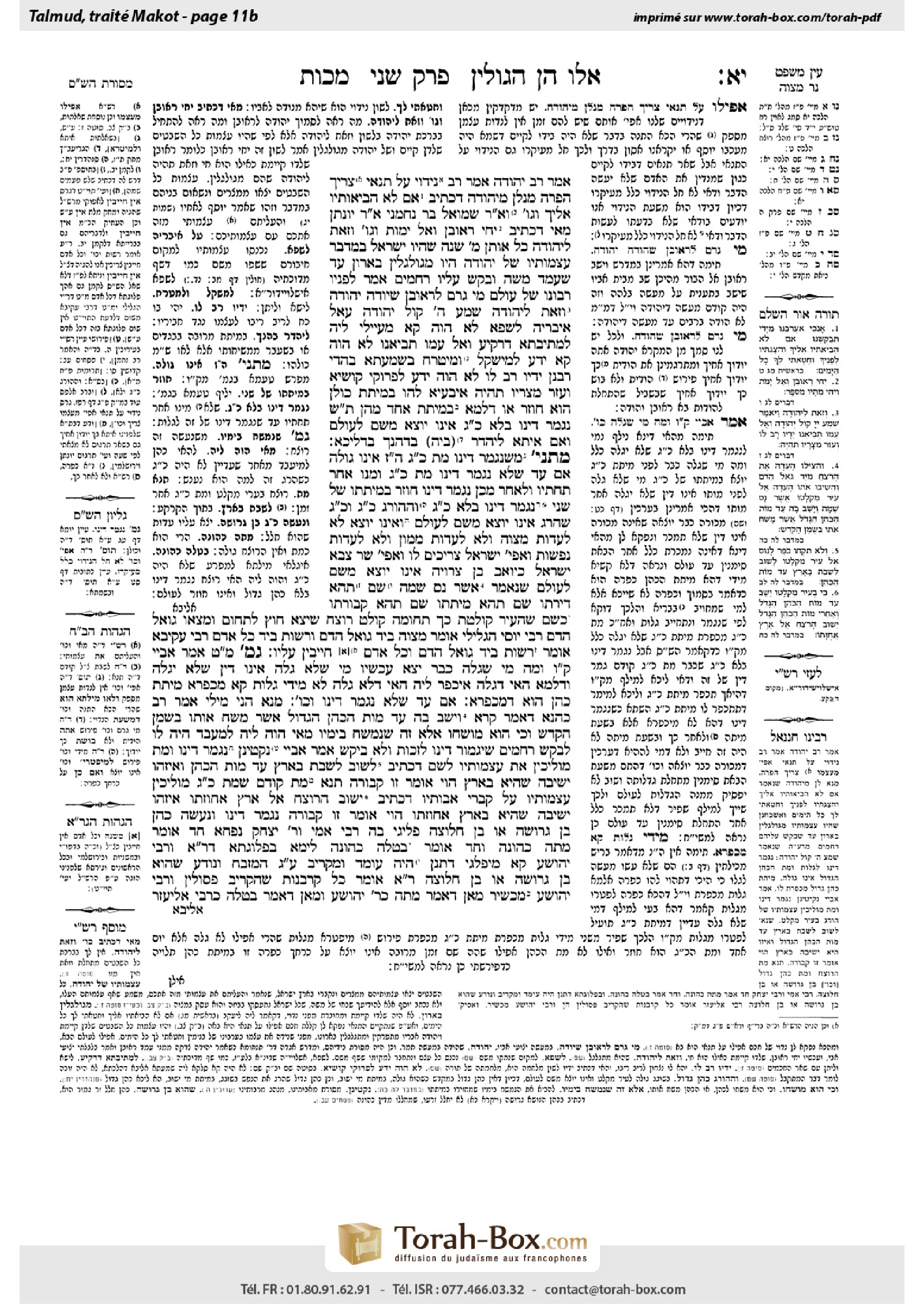
Makkot 11b: Talmud study for Daf Yomi
Daf Yomi is the daily study of one Talmud folio. Explore 37 tractates with scans, Hebrew text, Sefaria English and AI-generated French translations where annotated.
Passage selection and English or AI-generated French translation are available where the scan has annotations. Daf Study is independent of Torah-Box and Sefaria.
Browse Makkot · מכות · All tractatesMakkot 11b text and translations
This page of Makkot includes the Aramaic text, an English translation and an AI-generated French translation, alongside the scan above.
מכות י״א ב · Aramaic and Hebrew text
אָמַר רַב יְהוּדָה אָמַר רַב: נִידּוּי עַל תְּנַאי – צָרִיךְ הֲפָרָה. מְנָלַן? מִיְּהוּדָה, דִּכְתִיב: ״אִם לֹא הֲבִיאֹתִיו אֵלֶיךָ וְגוֹ׳״, וְאָמַר רַבִּי שְׁמוּאֵל בַּר נַחְמָנִי אָמַר רַבִּי יוֹנָתָן: מַאי דִּכְתִיב: ״יְחִי רְאוּבֵן וְאַל יָמֹת, וְגוֹ׳ וְזֹאת לִיהוּדָה״?
כׇּל אוֹתָן אַרְבָּעִים שָׁנָה שֶׁהָיוּ יִשְׂרָאֵל בַּמִּדְבָּר, עַצְמוֹתָיו שֶׁל יְהוּדָה הָיוּ מְגוּלְגָּלִין בָּאָרוֹן, עַד שֶׁעָמַד מֹשֶׁה וּבִקֵּשׁ עָלָיו רַחֲמִים. אָמַר לְפָנָיו: רִבּוֹנוֹ שֶׁל עוֹלָם, מִי גָּרַם לִרְאוּבֵן שֶׁיּוֹדֶה – יְהוּדָה, ״וְזֹאת לִיהוּדָה... שְׁמַע ה׳ קוֹל יְהוּדָה״.
עָאל אִיבְרֵיהּ לְשָׁפָא, לָא הֲוָה קָא מְעַיְּילִי לֵיהּ לִמְתִיבְתָּא דְּרָקִיעַ, ״וְאֶל עַמּוֹ תְּבִיאֶנּוּ״. לָא הֲוָה קָא יָדַע לְמִישְׁקַל וּמִיטְרַח בִּשְׁמַעְתָּא בַּהֲדֵי רַבָּנַן, ״יָדָיו רַב לוֹ״. לָא הֲוָה יָדַע לְפָרוֹקֵי קוּשְׁיָא, ״וְעֵזֶר מִצָּרָיו תִּהְיֶה״.
אִיבַּעְיָא לְהוּ: בְּמִיתַת כּוּלָּן הוּא חוֹזֵר, אוֹ דִלְמָא בְּמִיתַת אֶחָד מֵהֶן?
תָּא שְׁמַע: נִגְמַר דִּינוֹ בְּלֹא כֹּהֵן גָּדוֹל – אֵינוֹ יוֹצֵא מִשָּׁם לְעוֹלָם. וְאִם אִיתָא, לִיהְדַּר בֵּיהּ בִּדְהָנָךְ! בִּדְלֵיכָּא.
מַתְנִי׳ מִשֶּׁנִּגְמַר דִּינוֹ מֵת כֹּהֵן גָּדוֹל – הֲרֵי זֶה אֵינוֹ גּוֹלֶה. אִם עַד שֶׁלֹּא נִגְמַר דִּינוֹ מֵת כֹּהֵן גָּדוֹל וּמִינּוּ אַחֵר תַּחְתָּיו וּלְאַחַר מִכֵּן נִגְמַר דִּינוֹ – חוֹזֵר בְּמִיתָתוֹ שֶׁל שֵׁנִי. נִגְמַר דִּינוֹ בְּלֹא כֹּהֵן גָּדוֹל, וְהַהוֹרֵג כֹּהֵן גָּדוֹל, וְכֹהֵן גָּדוֹל שֶׁהָרַג – אֵינוֹ יוֹצֵא מִשָּׁם לְעוֹלָם.
וְאֵינוֹ יוֹצֵא לֹא לְעֵדוּת מִצְוָה, וְלֹא לְעֵדוּת מָמוֹן, וְלֹא לְעֵדוּת נְפָשׁוֹת. וַאֲפִילּוּ יִשְׂרָאֵל צְרִיכִים לוֹ, וַאֲפִילּוּ שַׂר צָבָא יִשְׂרָאֵל כְּיוֹאָב בֶּן צְרוּיָה אֵינוֹ יוֹצֵא מִשָּׁם לְעוֹלָם, שֶׁנֶּאֱמַר: ״אֲשֶׁר נָס שָׁמָּה״ – שָׁם תְּהֵא דִּירָתוֹ, שָׁם תְּהֵא מִיתָתוֹ, שָׁם תְּהֵא קְבוּרָתוֹ.
כְּשֵׁם שֶׁהָעִיר קוֹלֶטֶת – כָּךְ תְּחוּמָהּ קוֹלֵט. רוֹצֵחַ שֶׁיֵּצֵא חוּץ לַתְּחוּם וּמְצָאוֹ גּוֹאֵל הַדָּם, רַבִּי יוֹסֵי הַגְּלִילִי אוֹמֵר: מִצְוָה בְּיַד גּוֹאֵל הַדָּם, וּרְשׁוּת בְּיַד כׇּל אָדָם. רַבִּי עֲקִיבָא אוֹמֵר: רְשׁוּת בְּיַד גּוֹאֵל הַדָּם, וְכׇל אָדָם חַיָּיבִין עָלָיו.
גְּמָ׳ מַאי טַעְמָא? אָמַר אַבָּיֵי: קַל וָחוֹמֶר, וּמָה מִי שֶׁגָּלָה כְּבָר – יָצָא עַכְשָׁיו, מִי שֶׁלֹּא גָּלָה – אֵינוֹ דִּין שֶׁלֹּא יִגְלֶה? וְדִלְמָא: הַאי דִּגְלָה אִיכַּפַּר לֵיהּ, הַאי דְּלָא גְּלָה לָא! מִידֵּי גָּלוּת קָא מְכַפְּרָא? מִיתַת כֹּהֵן הוּא דִּמְכַפְּרָא!
אִם עַד שֶׁלֹּא נִגְמַר דִּינוֹ וְכוּ׳. מְנָא הָנֵי מִילֵּי? אָמַר רַב כָּהֲנָא: דְּאָמַר קְרָא: ״וְיָשַׁב בָּהּ עַד מוֹת הַכֹּהֵן הַגָּדֹל אֲשֶׁר מָשַׁח אֹתוֹ בְּשֶׁמֶן הַקֹּדֶשׁ״, וְכִי הוּא מוֹשְׁחוֹ? אֶלָּא: זֶה שֶׁנִּמְשַׁח בְּיָמָיו.
מַאי הֲוָה לֵיהּ לְמֶעְבַּד? הָיָה לוֹ לְבַקֵּשׁ רַחֲמִים שֶׁיִּגְמוֹר דִּינוֹ לִזְכוּת, וְלֹא בִּיקֵּשׁ.
אָמַר אַבָּיֵי: נָקְטִינַן: נִגְמַר דִּינוֹ וָמֵת – מוֹלִיכִין אֶת עַצְמוֹתָיו לְשָׁם, דִּכְתִיב: ״לָשׁוּב לָשֶׁבֶת בָּאָרֶץ עַד מוֹת הַכֹּהֵן״, וְאֵיזֶהוּ יְשִׁיבָה שֶׁהִיא בָּאָרֶץ – הֱוֵי אוֹמֵר זוֹ קְבוּרָה. תָּנָא: מֵת קוֹדֶם שֶׁמֵּת כֹּהֵן גָּדוֹל, מוֹלִיכִין עַצְמוֹתָיו עַל קִבְרֵי אֲבוֹתָיו, דִּכְתִיב: ״יָשׁוּב הָרֹצֵחַ אֶל אֶרֶץ אֲחֻזָּתוֹ״, אֵיזֶהוּ יְשִׁיבָה שֶׁהִיא בְּאֶרֶץ אֲחוּזָּתוֹ הֱוֵי אוֹמֵר זוֹ קְבוּרָה.
נִגְמַר דִּינוֹ, וְנַעֲשָׂה כֹּהֵן בֶּן גְּרוּשָׁה אוֹ בֶּן חֲלוּצָה, פְּלִיגִי בַּהּ רַבִּי אַמֵּי וְרַבִּי יִצְחָק נַפָּחָא. חַד אוֹמֵר: מֵתָה כְּהוּנָּה. וְחַד אוֹמֵר: בָּטְלָה כְּהוּנָּה.
לֵימָא בִּפְלוּגְתָּא דְּרַבִּי אֱלִיעֶזֶר וְרַבִּי יְהוֹשֻׁעַ קָא מִיפַּלְגִי. דִּתְנַן: הָיָה עוֹמֵד וּמַקְרִיב עַל גַּבֵּי הַמִּזְבֵּחַ, וְנוֹדַע שֶׁהוּא בֶּן גְּרוּשָׁה אוֹ בֶּן חֲלוּצָה, רַבִּי אֱלִיעֶזֶר אוֹמֵר: כׇּל קׇרְבָּנוֹת שֶׁהִקְרִיב פְּסוּלִין, וְרַבִּי יְהוֹשֻׁעַ מַכְשִׁיר.
מַאן דְּאָמַר מֵתָה כְּרַבִּי יְהוֹשֻׁעַ, וּמַאן דְּאָמַר בָּטְלָה כְּרַבִּי אֱלִיעֶזֶר?
Makkot 11b · English translation
Apropos declarations that take effect even if they were stated conditionally and the condition was not fulfilled, Rav Yehuda says that Rav says: Ostracism that was declared conditionally requires nullification, even though the condition was not fulfilled. From where do we derive this? It is derived from Judah, as it is written with regard to his request that his father allow the brothers to take Benjamin to Egypt: “If I do not bring him to you…I would have sinned to you for all days” (Genesis 43:9), i.e., I will remain ostracized as a sinner. And Rabbi Shmuel bar Naḥmani says that Rabbi Yonatan says: What is the meaning of that which is written: “Let Reuben live and not die” (Deuteronomy 33:6), followed immediately by the verse: “And this for Judah” (Deuteronomy 33:7)? Why was the blessing of Judah linked to that of Reuben?
Throughout those forty years that the children of Israel were in the wilderness, Judah’s bones were rattling in the coffin, detached from one another, because the ostracism that he declared upon himself remained in effect, until Moses stood and entreated God to have mercy upon him. Moses said before Him: Master of the Universe, who caused Reuben to confess his sin with Bilhah? It was Judah. Judah’s confession to his sin with Tamar led Reuben to confess to his own sin. Moses continued: “And this is for Judah…hear God, the voice of Judah” (Deuteronomy 33:7).
At that point his limbs entered their designated place [leshafa] and no longer rattled, but the Heavenly court still would not allow him to enter the heavenly academy. Moses continued: “And bring him to his people” (Deuteronomy 33:7), so that he may join the other righteous people in Heaven. That request was also granted, but Judah did not know how to engage in the give-and-take of halakha with the Sages in the heavenly academy. Moses continued: “His hands shall contend for him” (Deuteronomy 33:7). That request was also granted, but Judah did not know how to resolve any difficulty raised to reject his opinion until Moses prayed: “And You shall be a help against his adversaries” (Deuteronomy 33:7).
The mishna enumerates those High Priests whose death facilitates the return of unintentional murderers to their homes from the city of refuge to which they fled. A dilemma was raised before the Sages: Is it only with the death of all of the High Priests enumerated in the mishna that the unintentional murderer returns, or perhaps it is even with the death of one of them that he returns?
The Gemara suggests: Come and hear a resolution to the dilemma from the succeeding mishna: If the verdict of a murderer was decided at a time when there was no one filling the position of High Priest, he never leaves the city of refuge. And if it is so that the death of any of those listed in the mishna facilitates his return, let him return with the death of one of these other High Priests, the one who was sanctified by donning the eight vestments or a priest who was relieved of his position. The Gemara rejects the proof: The mishna is referring to a case where there were no High Priests when the verdict was decided.
MISHNA: If, after the unintentional murderer’s verdict was decided and he was sentenced to exile, the High Priest died, he is not exiled, as the death of the High Priest exempts him from exile. If it was before his verdict was decided that the High Priest died and they appointed another in his place, and thereafter his verdict was decided, he returns from exile with the death of the second High Priest. If the verdict of a murderer was decided at a time when there was no High Priest, and likewise in the cases of one who unintentionally killed a High Priest and in the case of a High Priest who killed unintentionally, the unintentional murderer never leaves the city of refuge.
And one who is exiled may not leave the city at all, either for testimony relating to a mitzva, or for testimony relating to monetary matters, or for testimony relating to capital matters. And even if the Jewish people require his services, and even if he is the general of the army of Israel like Joab ben Zeruiah, he never leaves the city of refuge, as it is stated: “And the congregation shall restore him to his city of refuge, that he fled there” (Numbers 35:25), from which it is derived: There shall be his dwelling, there shall be his death, there shall be his burial.
The mishna continues: Just as an unintentional murderer is admitted to the city of refuge, so is he admitted to its outskirts, located within the Shabbat boundary. Once he entered the outskirts of the city, the blood redeemer may not kill him. In a case where a murderer emerged beyond the Shabbat boundary of the city of refuge and the blood redeemer found him there, Rabbi Yosei HaGelili says: It is a mitzva for the blood redeemer to kill him, and it is optional for every other person to do so. Rabbi Akiva says: It is optional for the blood redeemer, and every other person is liable for killing him.
GEMARA: The mishna teaches: If after the unintentional murderer’s verdict was decided and he was sentenced to exile, the High Priest died, the unintentional murderer is not exiled. The Gemara asks: What is the reason for this? Abaye says: It is derived through an a fortiori inference: If one who was already exiled now emerges with the death of this High Priest, with regard to one who was not yet exiled, is it not right that he should not be exiled? The Gemara rejects this reasoning: And perhaps with regard to this one, who was already exiled, his sin was atoned for by his exile, and therefore the death of the High Priest facilitates his return, but that one, who was not yet exiled, no, his sin was not atoned for and the death of the High Priest should not prevent his exile. The Gemara rebuts: Is it his exile that atones for his sin? It is the death of the High Priest that atones for his sin, and the High Priest died.
The mishna teaches: If it was before his verdict was decided that the High Priest died and they appointed another in his place, and thereafter his verdict was decided, he returns with the death of the second High Priest. The Gemara asks: From where are these matters derived? Rav Kahana said that they are derived from a verse, as the verse states: “And he shall dwell there until the death of the High Priest, whom he anointed with the sacred oil” (Numbers 35:25). Now is it the unintentional murderer who anoints the High Priest? Rather, the reference is to that High Priest who was anointed during his days, after he committed the unintentional murder.
The Gemara asks: Why is his return home dependent on the death of the second High Priest? Earlier (11a), the Gemara explained that the High Priest bears a share of the responsibility for unintentional murderers, as he should have pleaded for mercy for his generation and he did not do so. In this case, as the High Priest in question was appointed only after the murder transpired, what could he have done to prevent the unintentional murder? The Gemara answers: He should have pleaded for mercy that the verdict of the unintentional murderer would be decided by the court favorably, so that he would not be sentenced to exile, and he did not plead.
§ Abaye said: We have a tradition that with regard to an unintentional murderer whose verdict was decided and who was sentenced to exile, and he died before he was exiled to the city of refuge, one transports his bones to the city of refuge, and buries him there, as it is written: “To return and dwell in the land until the death of the priest” (Numbers 35:32). And what is the dwelling that is in the land? You must say it is referring to his burial. A Sage taught: If an unintentional murderer died in a city of refuge before the High Priest died, one transports his bones to the graves of his ancestors after the High Priest dies, as it is written: “The murderer shall return to his ancestral land” (Numbers 35:28). What is the dwelling that is taking place in his ancestral land? You must say it is his burial.
§ The Gemara cites a dispute with regard to a case where the murderer’s verdict was decided, i.e., he was sentenced to exile, and the High Priest filling the position at the time was deemed the son of a divorced woman or the son of a ḥalutza, and the High Priest was thereby disqualified from the priesthood. Rabbi Ami and Rabbi Yitzḥak Nappaḥa disagree with regard to this matter. One says: The priesthood died, i.e., it is as though the High Priest died, and all exiles return home from the city of refuge. And the other one says: The priesthood is voided, i.e., it is as though there was no High Priest filling the position during that period, and therefore, the exiles may never leave the city of refuge.
The Gemara suggests: Let us say that these amora’im, Rabbi Ami and Rabbi Yitzḥak Nappaḥa, disagree with regard to the issue that is the subject of the dispute between Rabbi Eliezer and Rabbi Yehoshua, as we learned in a mishna (Terumot 8:1): If a priest was standing and sacrificing offerings upon the altar, and it became known that he was the son of a divorced woman or the son of a ḥalutza, and he was disqualified from the Temple service, Rabbi Eliezer says: All offerings that he sacrificed up to that point are not valid, as it is apparent that he is not and never was fit for Temple service, and Rabbi Yehoshua deems all offerings that he already sacrificed as valid.
The Gemara explains: Let us say that the one who says here that the priesthood died holds in accordance with the opinion of Rabbi Yehoshua. He holds that the High Priest is disqualified only from the time of the discovery that he is disqualified from the priesthood and forward, while any service performed previous to that discovery is valid. The discovery that he is disqualified from the priesthood is like the High Priest’s death, but his priesthood is not invalidated retroactively. And the one who says that the priesthood is voided holds in accordance with the opinion of Rabbi Eliezer, and since his priesthood is voided retroactively, there was no High Priest filling the position when he was sentenced.
Makkot 11b · Traduction française (IA)
À propos des déclarations qui prennent effet même lorsqu’elles sont formulées sous condition et que celle-ci ne se réalise pas, Rav Yehouda dit au nom de Rav : une mise au ban prononcée sous condition doit être annulée, même si la condition ne s’est pas réalisée. D’où le déduisons-nous ? De Juda, comme il est écrit au sujet de sa demande à son père de laisser les frères emmener Benjamin en Égypte : « Si je ne le ramène pas auprès de toi… j’aurai péché envers toi pour toujours » (Genèse 43, 9), c’est-à-dire que je resterai mis au ban comme un pécheur. Rabbi Shmuel bar Naḥmani dit au nom de Rabbi Yonatan : Quel est le sens de ce qui est écrit : « Que Ruben vive et ne meure pas » (Deutéronome 33, 6), puis, immédiatement après : « Et ceci pour Juda » (Deutéronome 33, 7) ? Pourquoi la bénédiction de Juda est-elle liée à celle de Ruben ?
Pendant les quarante années où les enfants d’Israël séjournèrent dans le désert, les os de Juda s’entrechoquaient dans son cercueil, disjoints, car la mise au ban qu’il avait prononcée contre lui-même restait en vigueur, jusqu’à ce que Moïse se lève et implore Dieu d’avoir pitié de lui. Moïse dit devant Lui : « Maître de l’Univers, qui a amené Ruben à reconnaître son péché avec Bilha ? C’est Juda. » L’aveu par Juda de son péché avec Tamar amena Ruben à reconnaître son propre péché. Moïse poursuivit : « Et ceci pour Juda… Écoute, Dieu, la voix de Juda » (Deutéronome 33, 7).
À ce moment-là, ses membres reprirent leur place [leshafa] et cessèrent de s’entrechoquer, mais le tribunal céleste ne lui permit toujours pas d’entrer dans l’académie céleste. Moïse poursuivit : « Et ramène-le auprès de son peuple » (Deutéronome 33, 7), afin qu’il rejoigne les autres justes au Ciel. Cette demande fut également exaucée, mais Juda ne savait pas comment participer aux discussions de halakha avec les Sages de l’académie céleste. Moïse poursuivit : « Que ses mains combattent pour lui » (Deutéronome 33, 7). Cette demande fut également exaucée, mais Juda ne savait pas comment répondre aux difficultés soulevées pour réfuter son opinion, jusqu’à ce que Moïse prie : « Et sois-lui un secours contre ses adversaires » (Deutéronome 33, 7).
La Michna énumère les grands prêtres dont la mort permet aux meurtriers involontaires de rentrer chez eux depuis la ville de refuge où ils se sont réfugiés. Les Sages soulèvent un dilemme : le meurtrier involontaire ne rentre-t-il qu’à la mort de tous les grands prêtres énumérés dans la Michna, ou rentre-t-il dès la mort de l’un d’entre eux ?
La Guemara propose : « Viens et entends » une réponse au dilemme tirée de la Michna suivante : si le verdict d’un meurtrier a été prononcé à une époque où personne n’occupait la fonction de grand prêtre, il ne quitte jamais la ville de refuge. Or, s’il en est ainsi, et que la mort de n’importe lequel des grands prêtres énumérés dans la Michna lui permette de rentrer, qu’il rentre à la mort de l’un de ces autres grands prêtres : celui qui a été consacré en revêtant les huit vêtements, ou un prêtre relevé de ses fonctions. La Guemara rejette cette preuve : la Michna parle d’un cas où il n’y avait aucun grand prêtre au moment où le verdict a été prononcé.
MICHNA : Si, après que le verdict du meurtrier involontaire a été prononcé et qu’il a été condamné à l’exil, le grand prêtre meurt, le meurtrier n’est pas exilé, car la mort du grand prêtre le dispense de l’exil. Si le grand prêtre meurt avant que le verdict du meurtrier soit prononcé, qu’un autre est nommé à sa place, puis que le verdict est prononcé, le meurtrier rentre de l’exil à la mort du second grand prêtre. Si le verdict d’un meurtrier est prononcé à une époque où il n’y a pas de grand prêtre, de même que dans le cas de celui qui a tué involontairement un grand prêtre et dans celui du grand prêtre qui a tué involontairement, le meurtrier involontaire ne quitte jamais la ville de refuge.
Celui qui est exilé ne peut quitter la ville en aucune circonstance, que ce soit pour témoigner au sujet d’une mitsva, dans une affaire d’argent ou dans une affaire criminelle. Même si le peuple juif a besoin de ses services, et même s’il est le général de l’armée d’Israël, comme Yoav fils de Tserouya, il ne quitte jamais la ville de refuge, comme il est dit : « Et l’assemblée le ramènera dans sa ville de refuge, où il s’était réfugié » (Nombres 35, 25). Il en ressort que c’est là qu’il demeurera, là qu’il mourra et là qu’il sera enseveli.
La Michna poursuit : de même qu’un meurtrier involontaire est admis dans la ville de refuge, il est également admis dans ses abords, situés à l’intérieur du périmètre du Chabbat. Une fois qu’il est entré dans les abords de la ville, le vengeur du sang ne peut plus le tuer. Si un meurtrier sort au-delà du périmètre du Chabbat de la ville de refuge et que le vengeur du sang l’y trouve, Rabbi Yossei HaGelili dit : c’est une mitsva pour le vengeur du sang de le tuer, et toute autre personne peut le faire à sa discrétion. Rabbi Akiva dit : le vengeur du sang peut le faire à sa discrétion, mais toute autre personne qui le tue en est responsable.
GUEMARA : La Michna enseigne que si le grand prêtre meurt après que le verdict du meurtrier involontaire a été prononcé et qu’il a été condamné à l’exil, celui-ci n’est pas exilé. La Guemara demande : Quelle en est la raison ? Abayé dit : On le déduit par raisonnement a fortiori : si celui qui a déjà été exilé peut maintenant sortir à la mort de ce grand prêtre, à plus forte raison celui qui n’a pas encore été exilé ne doit-il pas l’être. La Guemara rejette ce raisonnement : peut-être que, dans le cas de celui qui a déjà été exilé, son péché a été expié par son exil, si bien que la mort du grand prêtre lui permet de rentrer ; mais, pour l’autre, qui n’a pas encore été exilé, son péché n’a pas été expié et la mort du grand prêtre ne devrait donc pas empêcher son exil. La Guemara réfute cette objection : est-ce son exil qui expie son péché ? C’est la mort du grand prêtre qui expie son péché, et le grand prêtre est mort.
La Michna enseigne que si le grand prêtre meurt avant que le verdict du meurtrier involontaire soit prononcé, qu’un autre est nommé à sa place, puis que le verdict est prononcé, le meurtrier rentre à la mort du second grand prêtre. La Guemara demande : D’où ces règles sont-elles déduites ? Rav Kahana dit qu’elles sont déduites d’un verset : « Et il demeurera là jusqu’à la mort du grand prêtre, qui a été oint de l’huile sainte » (Nombres 35, 25). Est-ce le meurtrier involontaire qui oint le grand prêtre ? Il s’agit plutôt du grand prêtre qui a été oint de son vivant, après qu’il eut commis l’homicide involontaire.
La Guemara demande : Pourquoi son retour chez lui dépend-il de la mort du second grand prêtre ? Plus haut (11a), la Guemara a expliqué que le grand prêtre porte une part de responsabilité dans les homicides involontaires, car il aurait dû implorer la miséricorde divine pour sa génération, mais ne l’a pas fait. Dans ce cas, puisque le grand prêtre en question n’a été nommé qu’après l’homicide, qu’aurait-il pu faire pour empêcher celui-ci ? La Guemara répond : il aurait dû implorer la miséricorde divine afin que le tribunal rende un verdict favorable au meurtrier involontaire, de sorte qu’il ne soit pas condamné à l’exil, mais il ne l’a pas fait.
§ Abayé dit : Nous avons une tradition selon laquelle, si le verdict d’un meurtrier involontaire a été prononcé, qu’il a été condamné à l’exil et qu’il meurt avant d’être exilé dans la ville de refuge, on transporte ses os jusqu’à la ville de refuge et on l’y enterre, comme il est écrit : « Pour revenir et demeurer dans le pays jusqu’à la mort du prêtre » (Nombres 35, 32). Et quelle demeure dans le pays cela peut-il désigner ? Il faut dire qu’il s’agit de son lieu de sépulture. Un Sage a enseigné : si un meurtrier involontaire meurt dans une ville de refuge avant la mort du grand prêtre, on transporte ses os dans les sépultures de ses ancêtres après la mort du grand prêtre, comme il est écrit : « Le meurtrier retournera dans le pays de son patrimoine » (Nombres 35, 28). Quelle demeure dans son patrimoine ancestral cela peut-il désigner ? Il faut dire qu’il s’agit de son lieu de sépulture.
§ La Guemara rapporte une controverse concernant le cas où le verdict du meurtrier a été prononcé, c’est-à-dire où il a été condamné à l’exil, et où il est apparu que le grand prêtre alors en fonction était le fils d’une femme divorcée ou le fils d’une ḥaloutsa, ce qui le disqualifiait de la prêtrise. Rabbi Ami et Rabbi Yitzḥak Nappaḥa sont en désaccord sur ce point. L’un dit : la prêtrise a pris fin, c’est-à-dire que c’est comme si le grand prêtre était mort, et tous les exilés rentrent chez eux depuis la ville de refuge. L’autre dit : la prêtrise est annulée, c’est-à-dire que c’est comme si aucun grand prêtre n’avait occupé cette fonction durant cette période ; les exilés ne peuvent donc jamais quitter la ville de refuge.
La Guemara propose : peut-on dire que ces amoraïm, Rabbi Ami et Rabbi Yitzḥak Nappaḥa, sont en désaccord sur la même question que Rabbi Eliezer et Rabbi Yehoshua, comme nous l’avons appris dans une Michna (Teroumot 8, 1) : si un prêtre se tient à l’autel et y offre des sacrifices, puis qu’on découvre qu’il est le fils d’une femme divorcée ou le fils d’une ḥaloutsa et qu’il est ainsi disqualifié du service au Temple, Rabbi Eliezer dit : tous les sacrifices qu’il a offerts jusque-là ne sont pas valides, car il apparaît qu’il n’est pas et n’a jamais été apte au service du Temple ; Rabbi Yehoshua, lui, considère comme valides tous les sacrifices qu’il avait déjà offerts.
La Guemara explique : peut-on dire que celui qui affirme ici que la prêtrise a pris fin suit l’opinion de Rabbi Yehoshua ? Selon lui, le grand prêtre n’est disqualifié qu’à partir du moment où l’on découvre qu’il est inapte à la prêtrise, et pour la suite ; tout service accompli avant cette découverte est valide. La découverte de son inaptitude à la prêtrise équivaut à la mort du grand prêtre, mais sa prêtrise n’est pas invalidée rétroactivement. Celui qui affirme que la prêtrise est annulée suit, lui, l’opinion de Rabbi Eliezer : puisque sa prêtrise est annulée rétroactivement, aucun grand prêtre n’occupait la fonction au moment où le meurtrier a été condamné.
Traduction française générée par IA à partir de l’édition anglaise de Sefaria. Vérifie toujours un passage avec le texte source.
Text from Sefaria: William Davidson Edition - Vocalized Aramaic (CC BY NC); William Davidson Edition - English (CC BY NC).