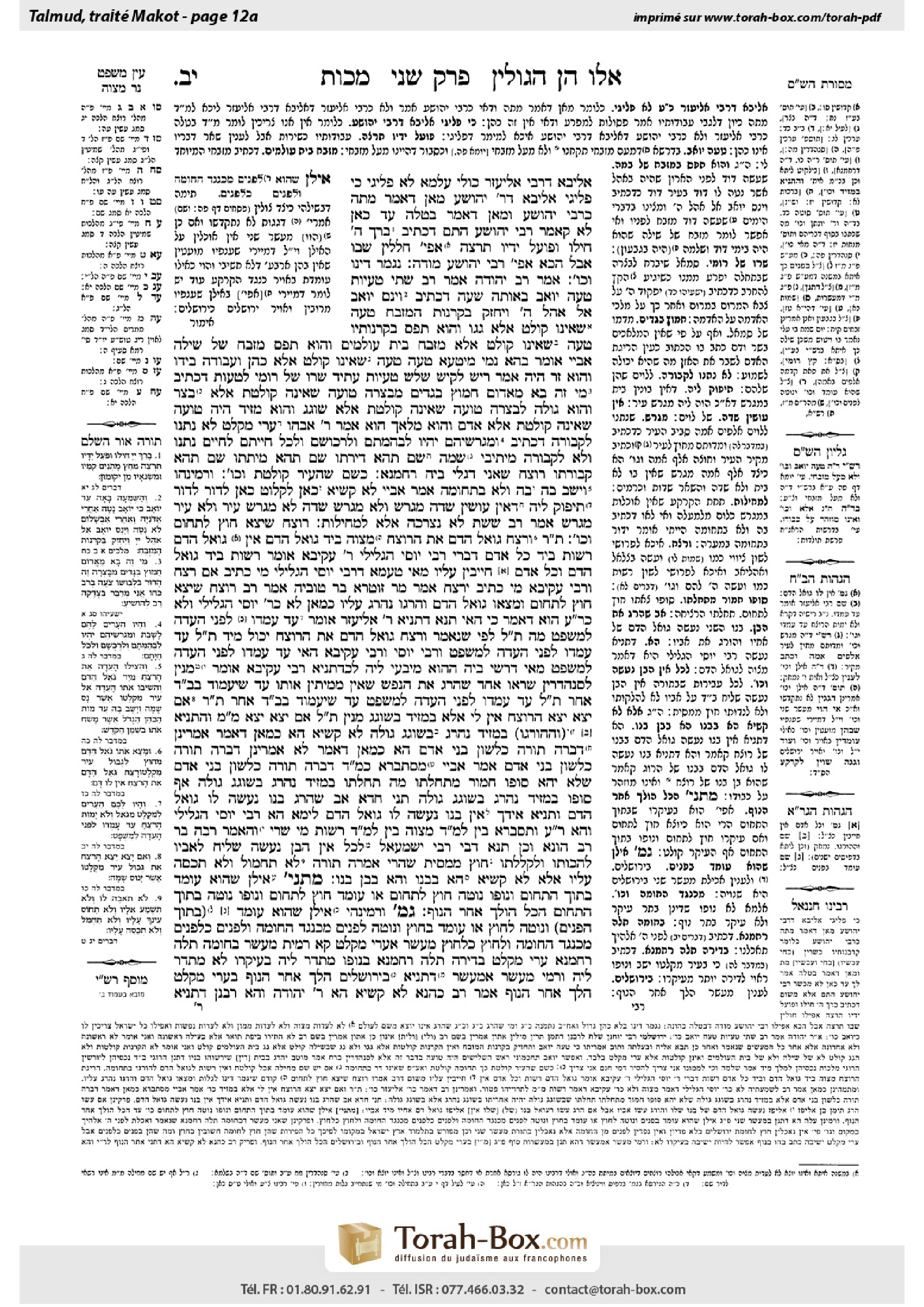
Makkot 12a: Talmud study for Daf Yomi
Daf Yomi is the daily study of one Talmud folio. Explore 37 tractates with scans, Hebrew text, Sefaria English and AI-generated French translations where annotated.
Passage selection and English or AI-generated French translation are available where the scan has annotations. Daf Study is independent of Torah-Box and Sefaria.
Browse Makkot · מכות · All tractatesMakkot 12a text and translations
This page of Makkot includes the Aramaic text, an English translation and an AI-generated French translation, alongside the scan above.
מכות י״ב א · Aramaic and Hebrew text
אַלִּיבָּא דְּרַבִּי אֱלִיעֶזֶר כּוּלֵּי עָלְמָא לָא פְלִיגִי, כִּי פְּלִיגִי אַלִּיבָּא דְּרַבִּי יְהוֹשֻׁעַ: מַאן דְּאָמַר מֵתָה – כְּרַבִּי יְהוֹשֻׁעַ, וּמַאן דְּאָמַר בָּטְלָה – עַד כָּאן לָא קָאָמַר רַבִּי יְהוֹשֻׁעַ הָתָם דִּכְתִיב: ״בָּרֵךְ ה׳ חֵילוֹ וּפֹעַל יָדָיו תִּרְצֶה״ – אֲפִילּוּ חֲלָלִין שֶׁבּוֹ, אֲבָל הָכָא, אֲפִילּוּ רַבִּי יְהוֹשֻׁעַ מוֹדֶה.
נִגְמַר דִּינוֹ וְכוּ׳. אָמַר רַב יְהוּדָה אָמַר רַב: שְׁתֵּי טָעִיּוֹת טָעָה יוֹאָב בְּאוֹתָהּ שָׁעָה, דִּכְתִיב: ״וַיָּנׇס יוֹאָב אֶל אֹהֶל ה׳ וַיַּחֲזֵק בְּקַרְנוֹת הַמִּזְבֵּחַ״,
טָעָה – שֶׁאֵינוֹ קוֹלֵט אֶלָּא גַּגּוֹ, וְהוּא תָּפַס בְּקַרְנוֹתָיו. טָעָה – שֶׁאֵינוֹ קוֹלֵט אֶלָּא מִזְבַּח בֵּית עוֹלָמִים, וְהוּא תָּפַס מִזְבֵּחַ שֶׁל שִׁילֹה. אַבָּיֵי אוֹמֵר: בְּהָא נָמֵי מִיטְעָא טְעָה: טָעָה – שֶׁאֵינוֹ קוֹלֵט אֶלָּא כֹּהֵן וַעֲבוֹדָה בְּיָדוֹ, וְהוּא זָר הָיָה.
אָמַר רֵישׁ לָקִישׁ: שָׁלֹשׁ טָעִיּוֹת עָתִיד שָׂרוֹ שֶׁל רוֹמִי לִטְעוֹת, דִּכְתִיב: ״מִי זֶה בָּא מֵאֱדוֹם חֲמוּץ בְּגָדִים מִבׇּצְרָה״, טוֹעֶה – שֶׁאֵינָהּ קוֹלֶטֶת אֶלָּא בֶּצֶר, וְהוּא גּוֹלֶה לְבׇצְרָה. טוֹעֶה – שֶׁאֵינָהּ קוֹלֶטֶת אֶלָּא שׁוֹגֵג, וְהוּא מֵזִיד הָיָה. טוֹעֶה – שֶׁאֵינָהּ קוֹלֶטֶת אֶלָּא אָדָם, וְהוּא מַלְאָךְ הוּא.
אָמַר רַבִּי אֲבָהוּ: עָרֵי מִקְלָט לֹא נִתְּנוּ לִקְבוּרָה, דִּכְתִיב: ״וּמִגְרְשֵׁיהֶם יִהְיוּ לִבְהֶמְתָּם וְלִרְכֻשָׁם וּלְכֹל חַיָּתָם״ – לְחַיִּים נִתְּנוּ וְלֹא לִקְבוּרָה. מֵיתִיבִי, ״שָׁמָּה״ – שָׁם תְּהֵא דִּירָתוֹ, שָׁם תְּהֵא מִיתָתוֹ, שָׁם תְּהֵא קְבוּרָתוֹ! רוֹצֵחַ שָׁאנֵי, דְּגַלִּי בֵּיהּ רַחֲמָנָא.
כְּשֵׁם שֶׁהָעִיר קוֹלֶטֶת וְכוּ׳. וּרְמִינְהוּ: ״וְיָשַׁב בָּהּ״ – בָּהּ וְלֹא בִּתְחוּמָהּ! אָמַר אַבָּיֵי: לָא קַשְׁיָא, כָּאן – לִקְלוֹט, כָּאן – לָדוּר.
״לָדוּר״? תִּיפּוֹק לֵיהּ דְּאֵין עוֹשִׂין שָׂדֶה מִגְרָשׁ וְלֹא מִגְרָשׁ שָׂדֶה, לֹא מִגְרָשׁ עִיר וְלֹא עִיר מִגְרָשׁ. אָמַר רַב שֵׁשֶׁת: לֹא נִצְרְכָה אֶלָּא לִמְחִילּוֹת.
רוֹצֵחַ שֶׁיָּצָא חוּץ לַתְּחוּם וְכוּ׳. תָּנוּ רַבָּנַן: ״וְרָצַח גֹּאֵל הַדָּם אֶת הָרֹצֵחַ״ – מִצְוָה בְּיַד גּוֹאֵל הַדָּם, אֵין גּוֹאֵל הַדָּם – רְשׁוּת בְּיַד כׇּל אָדָם, דִּבְרֵי רַבִּי יוֹסֵי הַגְּלִילִי. רַבִּי עֲקִיבָא אוֹמֵר: רְשׁוּת בְּיַד גּוֹאֵל הַדָּם, וְכׇל אָדָם חַיָּיבִין עָלָיו.
מַאי טַעְמָא דְּרַבִּי יוֹסֵי הַגְּלִילִי? מִי כְּתִיב: ״אִם רֹצֵחַ״? וְרַבִּי עֲקִיבָא: מִי כְּתִיב: ״יִרְצַח״?
אָמַר מָר זוּטְרָא בַּר טוֹבִיָּה אָמַר רַב: רוֹצֵחַ שֶׁיֵּצֵא חוּץ לַתְּחוּם, וּמְצָאוֹ גּוֹאֵל הַדָּם וַהֲרָגוֹ – נֶהֱרָג עָלָיו. כְּמַאן? לָא כְּרַבִּי יוֹסֵי הַגְּלִילִי, וְלָא כְּרַבִּי עֲקִיבָא!
הוּא דְּאָמַר כִּי הַאי תַּנָּא, דְּתַנְיָא: רַבִּי אֱלִיעֶזֶר אוֹמֵר: ״עַד עׇמְדוֹ לִפְנֵי הָעֵדָה לַמִּשְׁפָּט״, מָה תַּלְמוּד לוֹמַר? לְפִי שֶׁנֶּאֱמַר: ״וְרָצַח גֹּאֵל הַדָּם אֶת הָרֹצֵחַ״, יָכוֹל מִיָּד? תַּלְמוּד לוֹמַר: ״עַד עׇמְדוֹ לִפְנֵי הָעֵדָה לַמִּשְׁפָּט״.
וְרַבִּי יוֹסֵי וְרַבִּי עֲקִיבָא, הַאי ״עַד עׇמְדוֹ לִפְנֵי הָעֵדָה לַמִּשְׁפָּט״ מַאי דָּרְשִׁי בֵּיהּ? הָהוּא מִיבְּעֵי לֵיהּ לְכִדְתַנְיָא, רַבִּי עֲקִיבָא אוֹמֵר: מִנַּיִן לְסַנְהֶדְרִין שֶׁרָאוּ אֶחָד שֶׁהָרַג אֶת הַנֶּפֶשׁ שֶׁאֵין מְמִיתִין אוֹתוֹ עַד שֶׁיַּעֲמוֹד בְּבֵית דִּין אַחֵר? תַּלְמוּד לוֹמַר: ״עַד עׇמְדוֹ לִפְנֵי הָעֵדָה לַמִּשְׁפָּט״ – עַד שֶׁיַּעֲמוֹד בְּבֵית דִּין אַחֵר.
תָּנוּ רַבָּנַן: ״אִם יָצֹא יֵצֵא הָרֹצֵחַ״ – אֵין לִי אֶלָּא בְּמֵזִיד, בְּשׁוֹגֵג מִנַּיִן? תַּלְמוּד לוֹמַר: ״אִם יָצֹא יֵצֵא״ – מִכׇּל מָקוֹם.
וְהָתַנְיָא: וְהַהוֹרְגוֹ, בְּמֵזִיד – נֶהֱרָג, בְּשׁוֹגֵג – גּוֹלֶה! לָא קַשְׁיָא, הָא כְּמַאן דְּאָמַר: אָמְרִינַן דִּבְּרָה תּוֹרָה כִלְשׁוֹן בְּנֵי אָדָם, הָא כְּמַאן דְּאָמַר: לָא אָמְרִינַן דִּבְּרָה תּוֹרָה כִלְשׁוֹן בְּנֵי אָדָם.
אָמַר אַבָּיֵי: מִסְתַּבְּרָא כְּמַאן דְּאָמַר דִּבְּרָה תּוֹרָה כִּלְשׁוֹן בְּנֵי אָדָם, שֶׁלֹּא יְהֵא סוֹפוֹ חָמוּר מִתְּחִלָּתוֹ: מָה תְּחִלָּתוֹ, בְּמֵזִיד – נֶהֱרָג, בְּשׁוֹגֵג – גּוֹלֶה, אַף סוֹפוֹ, בְּמֵזִיד – נֶהֱרָג, בְּשׁוֹגֵג – גּוֹלֶה.
תָּנֵי חֲדָא: אָב שֶׁהָרַג – בְּנוֹ נַעֲשָׂה לוֹ גּוֹאֵל הַדָּם. וְתַנְיָא אִידַּךְ: אֵין בְּנוֹ נַעֲשָׂה לוֹ גּוֹאֵל הַדָּם. לֵימָא הָא רַבִּי יוֹסֵי הַגְּלִילִי וְהָא רַבִּי עֲקִיבָא?
וְתִסְבְּרַאּ? בֵּין לְמַאן דְּאָמַר מִצְוָה בֵּין לְמַאן דְּאָמַר רְשׁוּת, מִי שְׁרֵי? וְהָאָמַר רַבָּה בַּר רַב הוּנָא, וְכֵן תָּנָא דְּבֵי רַבִּי יִשְׁמָעֵאל: לַכֹּל אֵין הַבֵּן נַעֲשֶׂה שָׁלִיחַ לְאָבִיו לְהַכּוֹתוֹ וּלְקִלְלָתוֹ, חוּץ מִמֵּסִית, שֶׁהֲרֵי אָמְרָה תּוֹרָה ״לֹא תַחְמֹל וְלֹא תְכַסֶּה עָלָיו״!
אֶלָּא לָא קַשְׁיָא: הָא בִּבְנוֹ, וְהָא בְּבֶן בְּנוֹ.
מַתְנִי׳ אִילָן שֶׁהוּא עוֹמֵד בְּתוֹךְ הַתְּחוּם, וְנוֹפוֹ נוֹטֶה חוּץ לַתְּחוּם, אוֹ עוֹמֵד חוּץ לַתְּחוּם וְנוֹפוֹ נוֹטֶה בְּתוֹךְ הַתְּחוּם – הַכֹּל הוֹלֵךְ אַחַר הַנּוֹף.
גְּמָ׳ וּרְמִינְהִי: אִילָן שֶׁהוּא עוֹמֵד בְּתוֹךְ הַפָּנִים וְנוֹטֶה לַחוּץ, אוֹ עוֹמֵד בַּחוּץ וְנוֹטֶה לִפְנִים, מִכְּנֶגֶד הַחוֹמָה וְלִפְנִים – כְּלִפְנִים, מִכְּנֶגֶד הַחוֹמָה וְלַחוּץ – כְּלַחוּץ!
מַעֲשֵׂר אַעָרֵי מִקְלָט קָא רָמֵית? מַעֲשֵׂר בְּחוֹמָה תְּלָה רַחֲמָנָא, עָרֵי מִקְלָט בְּדִירָה תְּלָה רַחֲמָנָא – בְּנוֹפוֹ מִתְּדַר לֵיהּ, בְּעִיקָּרוֹ לָא מִתְּדַר לֵיהּ.
וּרְמִי מַעֲשֵׂר אַמַּעֲשֵׂר, דְּתַנְיָא: בִּירוּשָׁלַיִם – הַלֵּךְ אַחַר הַנּוֹף, בְּעָרֵי מִקְלָט – הַלֵּךְ אַחַר הַנּוֹף. אָמַר רַב כָּהֲנָא: לָא קַשְׁיָא, הָא רַבִּי יְהוּדָה וְהָא רַבָּנַן, דְּתַנְיָא,
Makkot 12a · English translation
The Gemara rejects this parallel: According to the opinion of Rabbi Eliezer, everyone agrees that he holds that the priesthood is voided. When they disagree, it is according to the opinion of Rabbi Yehoshua: The one who says the priesthood is dead holds in accordance with the straightforward understanding of the opinion of Rabbi Yehoshua. And the one who says the priesthood is voided can also hold in accordance with his opinion and explain that Rabbi Yehoshua states his opinion only there, with regard to Temple service, as it is written: “Bless, God, his property [ḥeilo], and accept the work of his hands” (Deuteronomy 33:11). The term ḥeilo is interpreted homiletically to mean that even the offerings of those disqualified from Temple service due to flawed lineage [ḥalalin] are accepted after the fact. But here, with regard to the status of the priest, even Rabbi Yehoshua concedes that the priesthood is voided retroactively.
§ The mishna teaches: If the verdict of a murderer was decided at a time when there was no High Priest, and likewise in the cases of one who unintentionally killed a High Priest and in the case of a High Priest who killed unintentionally, the unintentional murderer never leaves the city of refuge. And one who is exiled may not leave the city at all; even if the Jewish people require his services, and even if he is the general of the army of the Jewish people like Joab ben Zeruiah, he does not leave the city of refuge ever. Rav Yehuda says that Rav says: Joab made two errors at that moment, when he fled from Solomon, as it is written: “And Joab fled to the Tent of God and grasped the horns of the altar” (I Kings 2:28).
He erred in that only the top of the altar provides refuge, and he grasped its corners. Moreover, he erred in that only the altar of the eternal House, i.e., the Temple. provides refuge, and he grasped the altar at Shiloh. Abaye said: It is with regard to this that Joab also erred, as the altar provides refuge only for a priest who grasps the roof of the altar and his service is in his hand, and Joab was a non-priest.
Apropos errors, the Gemara cites that Reish Lakish says: The angel of Rome is destined to make three errors, as it is written: “Who is this who comes from Edom, with crimsoned garments from Bozrah?” (Isaiah 63:1), which is a parable for God’s arrival after killing the angel of Rome in Bozrah. The angel of Rome will err in that it is only the city of Bezer that provides refuge and he exiled himself to Bozrah; he will err in that it provides refuge only to an unintentional murderer and he was an intentional murderer; and he will err in that it provides refuge only to a person and he is an angel.
§ The Gemara resumes its analysis of the mishna. Rabbi Abbahu says: Cities of refuge were not given for the purpose of burial of unintentional murderers within them, as it is written with regard to the Levite cities: “And their open land shall be for their cattle, and for their property, and for all their beasts [ḥayyatam]” (Numbers 35:3), from which it is derived: For life [leḥayyim] they are given, but not for burial. Even Levites who reside in these cities are buried beyond the open land surrounding the city. The Gemara raises an objection to this from the mishna’s interpretation of the term: “That he fled there” (Numbers 35:25), from which it is derived: There shall be his dwelling, there shall be his death, there shall be his burial. The Gemara answers: A murderer is different, as the Merciful One revealed concerning him that he is to be buried there. That does not apply to the other residents of the city.
The mishna teaches: Just as an unintentional murderer is admitted to the city of refuge, so is he admitted to its outskirts, located within the Shabbat boundary. And the Gemara raises a contradiction from a baraita with regard to that which is written concerning the unintentional murderer: “And he shall dwell in it” (Numbers 35:25), from which it is inferred: “In it,” but not within its boundary. Abaye said: This is not difficult. Here, the mishna is referring to the unintentional murderer being admitted to the city, which will provide refuge from the blood redeemer, who may not kill him there. There, the baraita is referring to the place where it is permitted for the murderer to dwell, i.e., within the city itself and not on its outskirts.
The Gemara asks: Why is it necessary to state that the murderer may not dwell on the outskirts of the city? Let him derive that halakha from the fact that one may not render the field of a Levite city an open space, nor an open space a field, nor an open space part of the city, nor the city an open space. Apparently, the outskirts of the city, whose status is that of an open space, may not be utilized for residential purposes. Rav Sheshet said: It is necessary to state this halakha only for tunnels. If a murderer excavated a tunnel on the outskirts of the city, although he did not violate the prohibition against ruining the fields of the city, he may not reside there based on the halakha by Torah law that he must reside inside the city.
§ The mishna teaches a dispute between Rabbi Yosei HaGelili and Rabbi Akiva with regard to a case where the unintentional murderer emerged beyond the Shabbat boundary of the city of refuge, and the blood redeemer found him there. The Sages taught that it is written: “And the blood redeemer finds him outside the border of his city of refuge and the blood redeemer murders the murderer, he has no blood” (Numbers 35:27): It is a mitzva for the blood redeemer to kill him, and if there is no blood redeemer available to fulfill this mitzva, it is optional for any person to do so; this is the statement of Rabbi Yosei HaGelili. Rabbi Akiva says: It is optional for the blood redeemer to kill him, and any other person is liable for killing him.
The Gemara analyzes the mishna: What is the reason for the opinion of Rabbi Yosei HaGelili? He says: Is it written: If the blood redeemer murders the unintentional murderer, he has no blood? It states: “And the blood redeemer murders the murderer,” indicating that it is a mitzva. And Rabbi Akiva says: Is it written: The blood redeemer shall murder, in the imperative? It merely states: “And the blood redeemer murders,” which is merely relating the scenario under discussion.
On a related note, the Gemara cites that Mar Zutra bar Toviyya says that Rav says: In the case of a murderer who emerged beyond the Shabbat boundary of the city of refuge, and the blood redeemer found him there and killed him, the blood redeemer is executed for killing him. The Gemara asks: In accordance with whose opinion did Rav issue this ruling? He issued it neither in accordance with the opinion of Rabbi Yosei HaGelili, who maintains that there is a mitzva for the blood redeemer to kill him, nor in accordance with the opinion of Rabbi Akiva, who says the blood redeemer has the option of killing him.
The Gemara answers: Rav states this ruling in accordance with the opinion of that tanna, as it is taught in a baraita that Rabbi Eliezer says with regard to the verse: “And the murderer shall not die, until he stands before the congregation for judgment” (Numbers 35:12): Why must the verse state this? It is necessary since it is stated: “And the blood redeemer finds him…and the blood redeemer murders the murderer” (Numbers 35:27). One might have thought that the blood redeemer may murder him immediately; therefore, the verse states: “Until he stands before the congregation for judgment,” from which it is derived that the blood redeemer may kill the murderer only after he is convicted in court. Mar Zutra bar Toviyya says that Rav says that the blood redeemer is liable if he kills the murderer before he is convicted.
The Gemara asks: And as for Rabbi Yosei HaGelili and Rabbi Akiva, with regard to this verse: “Until he stands before the congregation for judgment,” what do they derive from it? The Gemara answers: That verse is necessary for that which is taught in a baraita that Rabbi Akiva says: From where is it derived in the case of a Sanhedrin that saw one kill a person that they may not execute him until he stands trial in a different court? It is derived from a verse, as the verse states: “Until he stands before the congregation for judgment,” meaning: Until he stands before a different court. Since they themselves witnessed the murder, they are no longer capable of considering the possibility that he may be innocent.
The Sages taught in a baraita with regard to the verse: “And if the murderer emerges [yatzo yetze] …and the blood redeemer murders the murderer, he has no blood” (Numbers 35:26–27): I have derived only that the blood redeemer may kill the unintentional murderer if the unintentional murderer emerges from the city intentionally. From where is it derived that the same applies if he emerges unwittingly? It is derived from this verse, as the verse states: “If yatzo yetze”; the doubled form of the verb serves to teach that this halakha applies in any case where the unintentional murderer emerges from the city of refuge.
The Gemara asks: But isn’t it taught in a baraita with regard to an unintentional murderer who emerged from the city of refuge unwittingly: And one who kills him intentionally is executed, and one who kills him unintentionally is exiled? The Gemara answers: This is not difficult, as this second baraita is in accordance with the opinion of the one who says that we say: The Torah spoke in the language of people, and no halakha is derived from the doubled form of the verb: Yatzo yetze, as it is merely a rhetorical flourish, and that first baraita is in accordance with the opinion of the one who says that we do not say: The Torah spoke in the language of people, and the compound verb was employed in order to derive that the blood redeemer may kill the unintentional murderer even if he emerged from the city of refuge unwittingly.
Abaye said: It stands to reason that the halakha is in accordance with the opinion of the one who says: The Torah spoke in the language of people, and the blood redeemer is liable for killing an unintentional murderer who emerged from the city of refuge unwittingly, in order to ensure that the ultimate punishment of the unintentional murderer, when he emerges from the city of refuge, will not be more severe than his initial punishment, when he is sentenced in court. Just as with regard to his initial punishment for murder, if he killed intentionally he is executed, and if he killed unintentionally he is exiled, so too, with regard to his ultimate punishment, if he emerges from the city of refuge intentionally he is killed by the blood redeemer, and if he emerges unwittingly he is returned to exile in the city of refuge.
§ It is taught in one baraita: In the case of a father who killed his son, his surviving son becomes his blood redeemer and may kill him. And it is taught in another baraita: His son does not become his blood redeemer. The Gemara suggests: Let us say that this baraita, which states that his son does become his blood redeemer, is in accordance with the opinion of Rabbi Yosei HaGelili. Since there is a mitzva for the blood redeemer to kill the murderer, this mitzva applies equally to a son. And that baraita, which states that a son does not become a blood redeemer to kill his father, is in accordance with the opinion of Rabbi Akiva, who holds that the blood redeemer has only the option, not a mitzva, to kill the murderer.
The Gemara rejects that understanding. And how can you understand it in that manner? Both according to the one who says that there is a mitzva for the blood redeemer to kill the unintentional murderer and according to the one who says that it is optional, is it permitted for a son to do so? But doesn’t Rabba bar Rav Huna say, and likewise the school of Rabbi Yishmael taught: With regard to all transgressions of the Torah, even if the father is liable to receive lashes or be ostracized, a son does not become an agent of the court to flog his father or to curse him, apart from the case of a father who acted as one who incites others to engage in idol worship, as the Torah states in his regard: “You shall neither spare nor conceal him” (Deuteronomy 13:9)?
Rather, the Gemara suggests that the apparent contradiction between the two baraitot is not difficult, as this baraita, which says that the son does not become a blood redeemer to kill his father, is referring to his son, and that baraita, which says that the son does become a blood redeemer, is referring to the son of his son, who can become a blood redeemer to kill his grandfather, as the grandson is not required to honor his grandfather as he is required to honor his father.
MISHNA: The previous mishna teaches that the halakhic status of the outskirts of the city is like that of the city itself in terms of the unintentional murderer being provided refuge there. The mishna adds: With regard to a tree that stands within the Shabbat boundary of a city of refuge, whose boughs extend outside the boundary, or a tree that stands outside the boundary and its boughs extend inside the boundary, the status of the tree, whether it is considered inside or outside the boundary, in all cases follows the boughs.
GEMARA: And the Gemara raises a contradiction from a mishna (Ma’aser Sheni 3:7) taught with regard to second tithe. Second-tithe produce must be consumed within Jerusalem or redeemed outside of Jerusalem: With regard to a tree that stands within Jerusalem, and whose boughs extend outside the city wall, or a tree that stands outside the city wall and whose boughs extend inside the wall, the principle is: The halakhic status of any part of the tree that is above the wall and inward is that of an area within the wall and the halakhic status of any part of the tree that is above the wall and outward is that of an area outside the wall. Apparently, the trunk does not follow the boughs and the boughs do not follow the trunk. The status of each part of the tree is determined by its position relative to the wall.
The Gemara rejects the parallel between the cases. Are you raising a contradiction between the halakha of second tithe and the halakha of cities of refuge? With regard to the halakha of second tithe, the Merciful One made the status of the tree dependent on the wall, and with regard to cities of refuge, the Merciful One made the status of the tree dependent on dwelling. One can dwell in its boughs, but one cannot dwell in its trunk. Therefore, with regard to cities of refuge, the halakhic status of the tree is determined by the boughs.
And the Gemara raises a contradiction between the previous baraita with regard to the halakha of second tithe and another baraita with regard to the halakha of second tithe, as it is taught in a baraita (see Ma’asrot 3:10): In Jerusalem, follow the boughs in determining the status of the tree with regard to consuming second-tithe produce, and likewise, with regard to cities of refuge, follow the boughs in determining the status of the tree with regard to providing refuge for an unintentional murderer. Rav Kahana said: This apparent contradiction is not difficult, as this baraita is in accordance with the opinion of Rabbi Yehuda, and that baraita is in accordance with the opinion of the Rabbis. As it is taught in a baraita with regard to partaking of second tithe in Jerusalem:
Makkot 12a · Traduction française (IA)
La Guemara rejette ce parallèle : selon l’opinion de Rabbi Eliezer, tous conviennent qu’il considère que la prêtrise est annulée. Le désaccord porte sur l’opinion de Rabbi Yehoshua : celui qui dit que la prêtrise est éteinte suit l’interprétation littérale de l’opinion de Rabbi Yehoshua. Quant à celui qui dit que la prêtrise est annulée, il peut également s’appuyer sur son opinion et expliquer que Rabbi Yehoshua ne l’énonce que dans ce cas, à propos du service du Temple, comme il est écrit : « Bénis, Seigneur, ses biens [ḥeilo], et agrée l’œuvre de ses mains » (Deutéronome 33, 11). Le terme ḥeilo est interprété par homilétique comme signifiant que même les offrandes de ceux qui sont disqualifiés du service du Temple en raison d’une ascendance entachée [ḥalalin] sont acceptées après coup. Mais ici, à propos du statut du prêtre, même Rabbi Yehoshua admet que la prêtrise est annulée rétroactivement.
§ La Michna enseigne : si le verdict d’un meurtrier a été prononcé à une époque où il n’y avait pas de grand prêtre, et de même dans le cas de celui qui a tué involontairement un grand prêtre et dans celui d’un grand prêtre qui a tué involontairement, le meurtrier involontaire ne quitte jamais la ville de refuge. Celui qui est exilé ne peut quitter la ville sous aucun prétexte ; même si le peuple juif a besoin de ses services, et même s’il est le général de l’armée du peuple juif, comme Yoav fils de Tserouya, il ne quitte jamais la ville de refuge. Rav Yehouda dit au nom de Rav : Yoav a commis deux erreurs à ce moment-là, lorsqu’il s’enfuit devant Salomon, comme il est écrit : « Yoav s’enfuit vers la Tente de Dieu et saisit les cornes de l’autel » (I Rois 2, 28).
Il se trompa en pensant que seul le sommet de l’autel procurait un refuge, alors qu’il en saisit les angles. De plus, il se trompa en pensant que seul l’autel de la Maison éternelle, c’est-à-dire du Temple, procurait un refuge, alors qu’il saisit l’autel de Silo. Abayé dit : Yoav se trompa aussi sur ce point, car l’autel ne procure un refuge qu’à un prêtre qui saisit son sommet et a son service en main ; or Yoav n’était pas prêtre.
À propos d’erreurs, la Guemara rapporte que Reish Lakish dit : l’ange de Rome est destiné à commettre trois erreurs, comme il est écrit : « Qui est celui qui vient d’Édom, aux vêtements écarlates de Botsra ? » (Isaïe 63, 1), image de l’arrivée de Dieu après qu’il aura tué l’ange de Rome à Botsra. L’ange de Rome se trompera en pensant que seule la ville de Betsèr procure un refuge, alors qu’il se sera exilé à Botsra ; il se trompera en pensant que le refuge n’est accordé qu’à un meurtrier involontaire, alors qu’il aura commis un meurtre intentionnel ; et il se trompera en pensant que le refuge n’est accordé qu’à un être humain, alors qu’il est un ange.
§ La Guemara reprend son analyse de la Michna. Rabbi Abahou dit : les villes de refuge n’ont pas été données pour que les meurtriers involontaires y soient enterrés, comme il est écrit à propos des villes des Lévites : « Leurs terrains ouverts seront pour leur bétail, pour leurs biens et pour toutes leurs bêtes [ḥayyatam] » (Nombres 35, 3). On en déduit qu’elles sont données pour la vie [leḥayyim], mais non pour l’enterrement. Même les Lévites qui résident dans ces villes sont enterrés au-delà du terrain ouvert qui entoure la ville. La Guemara soulève une objection à partir de l’interprétation que la Michna donne de l’expression « où il s’est enfui » (Nombres 35, 25), dont on déduit : qu’il y réside, qu’il y meure et qu’il y soit enterré. La Guemara répond : le meurtrier est différent, car le Miséricordieux a révélé à son sujet qu’il doit y être enterré. Cela ne s’applique pas aux autres habitants de la ville.
La Michna enseigne : de même qu’un meurtrier involontaire est admis dans la ville de refuge, il est également admis dans ses abords, situés à l’intérieur du périmètre du Chabbat. La Guemara soulève une contradiction à partir d’une baraïta concernant le meurtrier involontaire, à propos duquel il est écrit : « Il y résidera » (Nombres 35, 25), d’où l’on déduit : « en elle », mais non dans ses limites. Abayé dit : il n’y a pas de difficulté. Ici, la Michna parle de l’admission du meurtrier involontaire dans la ville, où le vengeur du sang ne peut pas le tuer. Là, la baraïta parle du lieu où le meurtrier est autorisé à résider, c’est-à-dire à l’intérieur même de la ville, et non dans ses abords.
La Guemara demande : pourquoi est-il nécessaire de préciser que le meurtrier ne peut pas résider dans les abords de la ville ? On pourrait déduire cette halakha du fait qu’il est interdit de transformer le champ d’une ville lévitique en terrain ouvert, un terrain ouvert en champ, un terrain ouvert en partie de la ville, ou la ville en terrain ouvert. Il semble donc que les abords de la ville, dont le statut est celui d’un terrain ouvert, ne puissent pas servir à l’habitation. Rav Sheshet dit : cette halakha n’est nécessaire que pour les tunnels. Si un meurtrier creuse un tunnel dans les abords de la ville, bien qu’il n’ait pas enfreint l’interdiction d’abîmer les champs de la ville, il ne peut pas y résider, conformément à la halakha de la Torah selon laquelle il doit résider à l’intérieur de la ville.
§ La Michna rapporte un désaccord entre Rabbi Yosei HaGelili et Rabbi Akiva au sujet du cas où le meurtrier involontaire a dépassé le périmètre du Chabbat de la ville de refuge et où le vengeur du sang l’a trouvé là. Les Sages ont enseigné qu’il est écrit : « Le vengeur du sang le trouve hors des limites de sa ville de refuge et le vengeur du sang tue le meurtrier, il n’est pas coupable de sang » (Nombres 35, 27). C’est une mitsva pour le vengeur du sang de le tuer ; s’il n’y a pas de vengeur du sang disponible pour accomplir cette mitsva, n’importe qui peut le faire, à titre facultatif. Telle est l’opinion de Rabbi Yosei HaGelili. Rabbi Akiva dit : le vengeur du sang peut choisir de le tuer, mais toute autre personne qui le tue est passible de peine.
La Guemara examine la Michna : quelle est la raison de l’opinion de Rabbi Yosei HaGelili ? Il dit : est-il écrit : « Si le vengeur du sang tue le meurtrier involontaire, il n’est pas coupable de sang » ? Il est écrit : « Et le vengeur du sang tue le meurtrier », ce qui indique qu’il s’agit d’une mitsva. Rabbi Akiva dit : est-il écrit : « Que le vengeur du sang tue », à l’impératif ? Il est simplement écrit : « Et le vengeur du sang tue », ce qui ne fait que décrire la situation en question.
À ce propos, la Guemara rapporte que Mar Zutra bar Toviyya dit au nom de Rav : dans le cas d’un meurtrier qui a dépassé le périmètre du Chabbat de la ville de refuge, que le vengeur du sang a trouvé là et tué, le vengeur du sang est exécuté pour l’avoir tué. La Guemara demande : selon l’opinion de qui Rav a-t-il rendu cette décision ? Elle ne suit ni l’opinion de Rabbi Yosei HaGelili, qui estime que le vengeur du sang a la mitsva de le tuer, ni celle de Rabbi Akiva, qui dit que le vengeur du sang a le choix de le tuer.
La Guemara répond : Rav rend cette décision conformément à l’opinion de ce tanna, comme on l’enseigne dans une baraïta : Rabbi Eliezer dit au sujet du verset « Le meurtrier ne mourra pas avant d’avoir comparu devant la communauté pour être jugé » (Nombres 35, 12) : pourquoi le verset doit-il le préciser ? C’est nécessaire puisque le verset dit : « Le vengeur du sang le trouve… et le vengeur du sang tue le meurtrier » (Nombres 35, 27). On aurait pu penser que le vengeur du sang peut le tuer immédiatement. C’est pourquoi le verset dit : « avant d’avoir comparu devant la communauté pour être jugé », d’où l’on déduit que le vengeur du sang ne peut tuer le meurtrier qu’après sa condamnation par un tribunal. Mar Zutra bar Toviyya dit au nom de Rav que le vengeur du sang est passible de peine s’il tue le meurtrier avant sa condamnation.
La Guemara demande : que déduisent Rabbi Yosei HaGelili et Rabbi Akiva de ce verset : « avant d’avoir comparu devant la communauté pour être jugé » ? La Guemara répond : ce verset est nécessaire pour l’enseignement d’une baraïta où Rabbi Akiva dit : d’où déduit-on que, si un Sanhédrin a vu quelqu’un tuer une personne, il ne peut pas l’exécuter avant qu’il ait été jugé par un autre tribunal ? On le déduit d’un verset, car il est écrit : « avant d’avoir comparu devant la communauté pour être jugé », c’est-à-dire jusqu’à ce qu’il comparaisse devant un autre tribunal. Puisqu’ils ont eux-mêmes été témoins du meurtre, ils ne sont plus en mesure d’envisager qu’il puisse être innocent.
Les Sages ont enseigné dans une baraïta à propos du verset : « Si le meurtrier sort [yatzo yetze]… et que le vengeur du sang tue le meurtrier, il n’est pas coupable de sang » (Nombres 35, 26-27) : je n’ai déduit que ceci, que le vengeur du sang peut tuer le meurtrier involontaire si celui-ci sort intentionnellement de la ville. D’où déduit-on qu’il en va de même s’il en sort à son insu ? On le déduit de ce verset, qui dit : « Si yatzo yetze » ; la forme redoublée du verbe enseigne que cette halakha s’applique dans tous les cas où le meurtrier involontaire sort de la ville de refuge.
La Guemara demande : mais n’enseigne-t-on pas dans une baraïta, à propos d’un meurtrier involontaire qui est sorti de la ville de refuge à son insu, que celui qui le tue intentionnellement est exécuté, tandis que celui qui le tue involontairement est exilé ? La Guemara répond : il n’y a pas de difficulté, car cette seconde baraïta suit l’opinion de celui qui dit que la Torah s’exprime dans le langage des hommes et qu’aucune halakha ne se déduit de la forme redoublée du verbe yatzo yetze, qui n’est qu’un effet de style. La première baraïta suit, quant à elle, l’opinion de celui qui dit que la Torah ne s’exprime pas dans le langage des hommes et que la forme verbale redoublée a été employée afin de déduire que le vengeur du sang peut tuer le meurtrier involontaire même si celui-ci est sorti de la ville de refuge à son insu.
Abayé dit : il est logique que la halakha suive l’opinion de celui qui dit que la Torah s’exprime dans le langage des hommes et que le vengeur du sang est passible de peine s’il tue un meurtrier involontaire sorti de la ville de refuge à son insu, afin que la peine ultime du meurtrier involontaire, lorsqu’il sort de la ville de refuge, ne soit pas plus sévère que sa peine initiale, lorsqu’il est condamné par le tribunal. De même que, pour sa peine initiale liée au meurtre, il est exécuté s’il a tué intentionnellement et exilé s’il a tué involontairement, de même, pour sa peine ultime, il est tué par le vengeur du sang s’il sort intentionnellement de la ville de refuge, et renvoyé en exil dans la ville de refuge s’il en sort à son insu.
§ Une baraïta enseigne : dans le cas d’un père qui a tué son fils, son fils survivant devient son vengeur du sang et peut le tuer. Une autre baraïta enseigne : son fils ne devient pas son vengeur du sang. La Guemara suggère : disons que cette baraïta, qui affirme que son fils devient son vengeur du sang, suit l’opinion de Rabbi Yosei HaGelili. Puisqu’il y a une mitsva pour le vengeur du sang de tuer le meurtrier, cette mitsva s’applique également à un fils. L’autre baraïta, qui affirme qu’un fils ne devient pas le vengeur du sang chargé de tuer son père, suit l’opinion de Rabbi Akiva, qui estime que le vengeur du sang a seulement le choix, et non la mitsva, de tuer le meurtrier.
La Guemara rejette cette interprétation. Comment pouvez-vous comprendre les choses ainsi ? Que l’on dise qu’il y a une mitsva pour le vengeur du sang de tuer le meurtrier involontaire ou que cela soit facultatif, est-il permis à un fils de le faire ? Or Rabba bar Rav Houna dit — et l’école de Rabbi Yishmael a également enseigné : pour toutes les transgressions de la Torah, même si le père est passible de flagellation ou d’ostracisme, le fils ne devient pas l’agent du tribunal chargé de flageller son père ou de le maudire, sauf dans le cas d’un père qui a incité autrui à pratiquer l’idolâtrie, car la Torah dit à son sujet : « Tu ne l’épargneras pas et tu ne le couvriras pas » (Deutéronome 13, 9).
La Guemara propose plutôt que la contradiction apparente entre les deux baraïtot ne pose pas de difficulté : cette baraïta, qui dit que le fils ne devient pas le vengeur du sang chargé de tuer son père, parle de son fils ; tandis que l’autre baraïta, qui dit que le fils devient le vengeur du sang, parle du fils de son fils, qui peut devenir le vengeur du sang chargé de tuer son grand-père, car le petit-fils n’est pas tenu d’honorer son grand-père comme il est tenu d’honorer son père.
MICHNA : La Michna précédente enseigne que les abords de la ville ont, du point de vue de la halakha, le même statut que la ville elle-même en ce qui concerne le refuge accordé au meurtrier involontaire. La Michna ajoute : au sujet d’un arbre situé à l’intérieur du périmètre du Chabbat d’une ville de refuge, dont les branches s’étendent au-delà du périmètre, ou d’un arbre situé à l’extérieur du périmètre, dont les branches s’étendent à l’intérieur, le statut de l’arbre — qu’il soit considéré comme étant à l’intérieur ou à l’extérieur du périmètre — est toujours déterminé par ses branches.
GUEMARA : La Guemara soulève une contradiction à partir d’une Michna (Ma’aser Sheni 3, 7) concernant la seconde dîme. Les produits de la seconde dîme doivent être consommés à l’intérieur de Jérusalem ou rachetés à l’extérieur de Jérusalem. Au sujet d’un arbre situé à l’intérieur de Jérusalem, dont les branches s’étendent au-delà de l’enceinte de la ville, ou d’un arbre situé à l’extérieur de l’enceinte, dont les branches s’étendent à l’intérieur, le principe est le suivant : toute partie de l’arbre située au-dessus de l’enceinte et vers l’intérieur a, du point de vue de la halakha, le statut d’un espace à l’intérieur de l’enceinte ; toute partie située au-dessus de l’enceinte et vers l’extérieur a le statut d’un espace extérieur à l’enceinte. Il semble donc que le tronc ne suive pas les branches et que les branches ne suivent pas le tronc. Le statut de chaque partie de l’arbre est déterminé par sa position par rapport à l’enceinte.
La Guemara rejette le parallèle entre les cas. Comparez-vous la halakha de la seconde dîme à celle des villes de refuge ? Pour la halakha de la seconde dîme, le Miséricordieux a fait dépendre le statut de l’arbre de l’enceinte ; pour les villes de refuge, le Miséricordieux a fait dépendre le statut de l’arbre de la possibilité d’y résider. On peut résider dans ses branches, mais pas dans son tronc. Par conséquent, pour les villes de refuge, le statut de l’arbre est déterminé par ses branches.
La Guemara soulève une contradiction entre la baraïta précédente concernant la halakha de la seconde dîme et une autre baraïta sur ce même sujet, car on enseigne dans une baraïta (voir Ma’asrot 3, 10) : à Jérusalem, pour déterminer le statut de l’arbre en ce qui concerne la consommation des produits de la seconde dîme, on suit les branches ; de même, pour les villes de refuge, on suit les branches afin de déterminer si l’arbre procure un refuge au meurtrier involontaire. Rav Kahana dit : cette contradiction apparente ne pose pas de difficulté, car cette baraïta suit l’opinion de Rabbi Yehouda, tandis que l’autre baraïta suit l’opinion des Rabbins. En effet, on enseigne dans une baraïta à propos de la consommation de la seconde dîme à Jérusalem :
Traduction française générée par IA à partir de l’édition anglaise de Sefaria. Vérifie toujours un passage avec le texte source.
Text from Sefaria: William Davidson Edition - Vocalized Aramaic (CC BY NC); William Davidson Edition - English (CC BY NC).