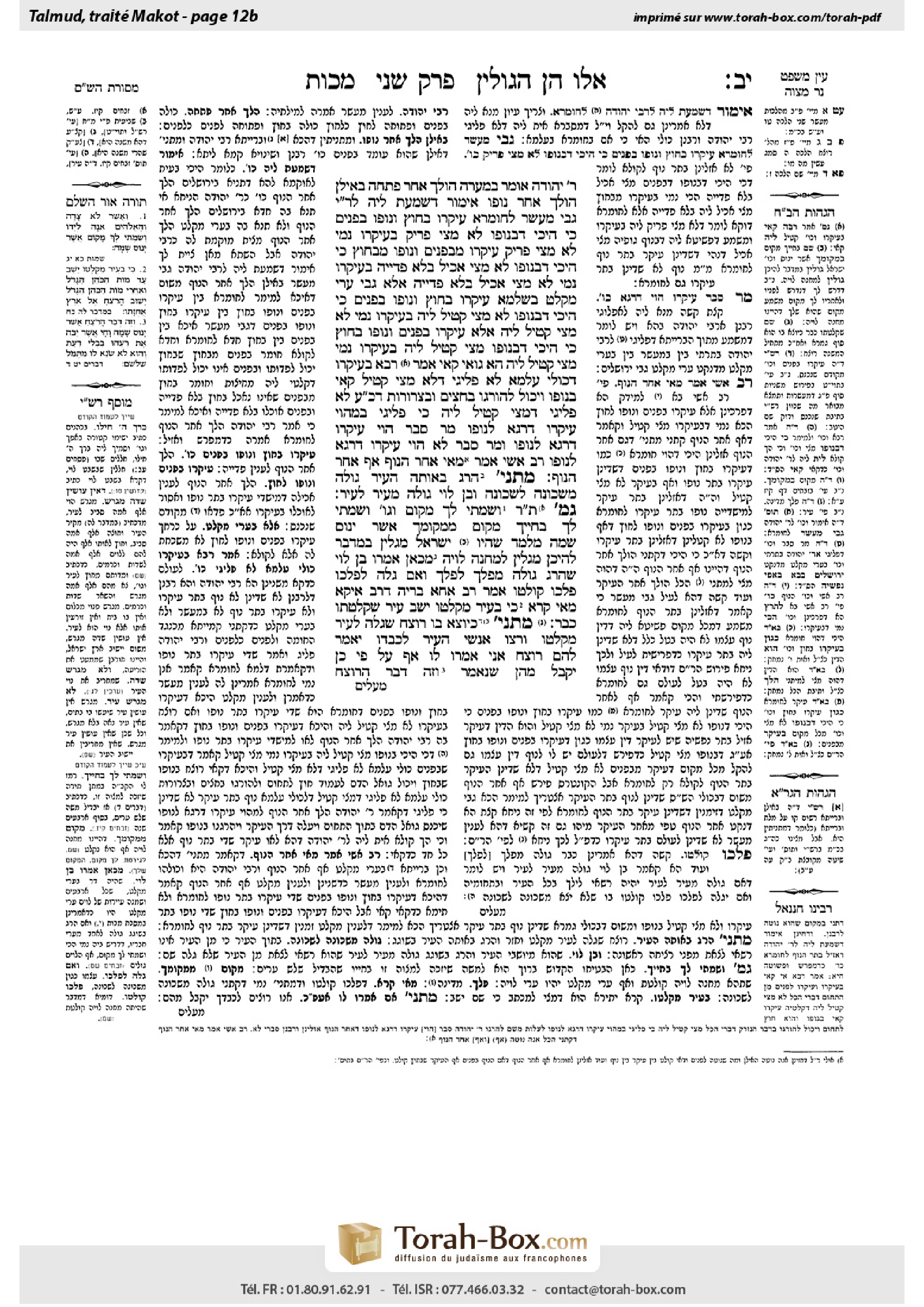
Makkot 12b: Talmud study for Daf Yomi
Daf Yomi is the daily study of one Talmud folio. Explore 37 tractates with scans, Hebrew text, Sefaria English and AI-generated French translations where annotated.
Passage selection and English or AI-generated French translation are available where the scan has annotations. Daf Study is independent of Torah-Box and Sefaria.
Browse Makkot · מכות · All tractatesMakkot 12b text and translations
This page of Makkot includes the Aramaic text, an English translation and an AI-generated French translation, alongside the scan above.
מכות י״ב ב · Aramaic and Hebrew text
רַבִּי יְהוּדָה אוֹמֵר: בִּמְעָרָה – הַלֵּךְ אַחַר פִּתְחָהּ, בְּאִילָן – הַלֵּךְ אַחַר נוֹפוֹ.
אֵימוֹר דְּשָׁמְעַתְּ לֵיהּ לְרַבִּי יְהוּדָה גַּבֵּי מַעֲשֵׂר לְחוּמְרָא, עִיקָּרוֹ בַּחוּץ וְנוֹפוֹ בִּפְנִים, כִּי הֵיכִי דִּבְנוֹפוֹ לָא מָצֵי פָּרֵיק – בְּעִיקָּרוֹ נָמֵי לָא מָצֵי פָּרֵיק. עִיקָּרוֹ מִבִּפְנִים וְנוֹפוֹ מִבַּחוּץ, כִּי הֵיכִי דִּבְנוֹפוֹ לָא מָצֵי אָכֵיל בְּלֹא פְּדִיָּיה – בְּעִיקָּרוֹ נָמֵי לָא מָצֵי אָכֵיל בְּלֹא פְּדִיָּיה.
אֶלָּא גַּבֵּי עָרֵי מִקְלָט, בִּשְׁלָמָא עִיקָּרוֹ בַּחוּץ וְנוֹפוֹ בִּפְנִים, כִּי הֵיכִי דִּבְנוֹפוֹ לָא מָצֵי קָטֵיל לֵיהּ, בְּעִיקָּרוֹ נָמֵי לָא מָצֵי קָטֵיל לֵיהּ. אֶלָּא עִיקָּרוֹ בִּפְנִים וְנוֹפוֹ בַּחוּץ, כִּי הֵיכִי דִּבְנוֹפוֹ מָצֵי קָטֵיל לֵיהּ, בְּעִיקָּרוֹ נָמֵי מָצֵי קָטֵיל לֵיהּ?! הָא גַּוַּאי קָאֵי!
אָמַר רָבָא: בְּעִיקָּרוֹ – דְּכוּלֵּי עָלְמָא לָא פְּלִיגִי דְּלָא מָצֵי קָטֵיל. קָאֵי בְּנוֹפוֹ, וְיָכוֹל לְהוֹרְגוֹ בְּחִצִּים וּבִצְרוֹרוֹת – דְּכוּלֵּי עָלְמָא לָא פְּלִיגִי דְּמָצֵי קָטֵיל לֵיהּ.
כִּי פְּלִיגִי – בְּמֶהֱוֵי עִיקָּרוֹ דַּרְגָּא לְנוֹפוֹ. מָר סָבַר: הָוֵי עִיקָּרוֹ דַּרְגָּא לְנוֹפוֹ. וּמָר סָבַר: לָא הָוֵי עִיקָּרוֹ דַּרְגָּא לְנוֹפוֹ.
רַב אָשֵׁי אָמַר: מַאי ״אַחַר הַנּוֹף״ – אַף אַחַר הַנּוֹף.
מַתְנִי׳ הָרַג בְּאוֹתָהּ הָעִיר – גּוֹלֶה מִשְּׁכוּנָה לִשְׁכוּנָה, וּבֶן לֵוִי – גּוֹלֶה מֵעִיר לְעִיר.
גְּמָ׳ תָּנוּ רַבָּנַן: ״וְשַׂמְתִּי לְךָ מָקוֹם וְגוֹ׳״, ״וְשַׂמְתִּי לְךָ״ – בְּחַיֶּיךָ. ״מָקוֹם מִמְּקוֹמְךָ אֲשֶׁר יָנוּס שָׁמָּה״ – מְלַמֵּד שֶׁהָיוּ יִשְׂרָאֵל מַגְלִין בַּמִּדְבָּר. לְהֵיכָן מַגְלִין – לְמַחֲנֵה לְוִיָּה.
מִכָּאן אָמְרוּ: בֶּן לֵוִי שֶׁהָרַג – גּוֹלֶה מִפֶּלֶךְ לְפֶלֶךְ, וְאִם גָּלָה לְפִלְכּוֹ – פִּלְכּוֹ קוֹלְטוֹ. אָמַר רַב אַחָא בְּרֵיהּ דְּרַב אִיקָא: מַאי קְרָא? ״כִּי בְעִיר מִקְלָטוֹ יֵשֵׁב״ – עִיר שֶׁקְּלָטַתּוּ כְּבָר.
מַתְנִי׳ כַּיּוֹצֵא בּוֹ, רוֹצֵחַ שֶׁגָּלָה לָעִיר מִקְלָטוֹ וְרָצוּ אַנְשֵׁי הָעִיר לְכַבְּדוֹ, יֹאמַר לָהֶם ״רוֹצֵחַ אֲנִי״, אָמְרוּ לוֹ: ״אַף עַל פִּי כֵן״ – יְקַבֵּל מֵהֶן, שֶׁנֶּאֱמַר: ״וְזֶה דְּבַר הָרוֹצֵחַ״.
Makkot 12b · English translation
Rabbi Yehuda says: With regard to a cave, follow its entrance; if the entrance is inside the city, the status of the entire cave is that of part of the city, and one may partake of tithes in it. With regard to a tree, follow its boughs. The baraita that states that with regard to second tithe in Jerusalem and cities of refuge one follows the boughs is in accordance with the opinion of Rabbi Yehuda.
The Gemara rejects that explanation. Say that you heard Rabbi Yehuda express this opinion with regard to second-tithe produce in a situation where his ruling is a stringency, as in the case where the trunk of a tree is outside Jerusalem and its boughs are inside Jerusalem, just as among its boughs, one may not redeem second-tithe produce, and he must partake of it in Jerusalem, so too at its trunk he may not redeem second-tithe produce, even though it stands outside of Jerusalem. So too in a case where the trunk of a tree is inside and its boughs outside, there is a stringency: Just as among its boughs, one may not partake of second-tithe produce without redemption, so too at its trunk he may not partake of second-tithe produce without redemption, even though it stands inside Jerusalem.
But with regard to cities of refuge, it may be otherwise: Granted, if its trunk is outside the boundary and its boughs are inside, just as among its boughs, the blood redeemer may not kill the unintentional murderer, so too at its trunk, he may not kill him. But if its trunk was inside and its boughs outside, would one say that just as among its boughs, the blood redeemer may kill him, at its trunk, he may also kill him? Isn’t the unintentional murderer standing inside the city of refuge? How could one say that it is permitted for the blood redeemer to kill him inside the city?
Rava said that it can be explained as follows: In the case where its trunk is inside the boundary and its boughs outside, and the unintentional murderer was standing at its trunk, everyone agrees that the blood redeemer may not kill him, and when Rabbi Yehuda said that the trunk follows the boughs, he did not intend to include that case. If the murderer is standing among the boughs of the tree, and the blood redeemer is able to kill him with arrows and pebbles, everyone, including the Rabbis, agrees that the blood redeemer may kill him, as the boughs are outside the city.
When they disagree is with regard to whether its trunk can become a step for its boughs, enabling the blood redeemer to gain access to the unintentional murderer there. One Sage, Rabbi Yehuda, holds: Its trunk can become a step for its boughs; the blood redeemer may gain access to the boughs extending outside the boundary and kill the unintentional murderer by climbing the trunk inside the city. It was in that context that Rabbi Yehuda says that the trunk follows the boughs. And one Sage, the Rabbis, holds: Its trunk cannot become a step for its boughs.
Rav Ashi said: What is the meaning of Rabbi Yehuda’s statement: Follow its boughs? It does not mean that the location of the boughs is the only determining factor; rather, it means that in addition to the trunk, follow the boughs as well in a case where it is a stringency. Therefore, with regard to a city of refuge a tree whose trunk is inside the boundary and its boughs extend beyond the boundary, the halakhic status of the boughs is the same as what it would be were they inside the boundary.
MISHNA: If an unintentional murderer, exiled to a city of refuge, unintentionally killed a person in the same city, he is exiled from that neighborhood where he resided to another neighborhood within that city. And a Levite who is a permanent resident of a city of refuge and unintentionally killed a person is exiled from that city to another city.
GEMARA: Apropos the halakha in the mishna that a Levite is exiled from one city to another city, the Gemara cites that which the Sages taught with regard to the verse: “And one who did not lie in wait…and I will appoint for you a place where he may flee” (Exodus 21:13). “And I will appoint for you”; God said to Moses: There will be a place that provides refuge for unintentional murderers already during your lifetime. “A place”; it will be from your place, meaning the Levite camp served as the place that provided refuge in the wilderness. “Where he may flee”; this teaches that Israel would exile unintentional murderers in the wilderness as well, before they entered the land. To where did they exile unintentional murderers when they were in the wilderness? They exiled them to the Levite camp, which provided refuge.
From here the Sages said: A Levite who killed unintentionally is exiled from one district to another district, to a different Levite city in the other district. And if he was exiled to a city in his own district, he is admitted to the city in his district, which provides him with refuge. Rav Aḥa, son of Rav Ika, said: What is the verse from which it is derived that a murderer who unintentionally killed in the city of refuge where he was exiled is exiled to another neighborhood in that same city? It is derived from a verse, as it is stated: “For in his city of refuge he shall dwell” (Numbers 35:28), indicating that it is a city in which he was already admitted, as the verse is referring to it as his city, and he shall continue to reside there as well.
MISHNA: Similarly, in the case of a murderer who was exiled to a city of refuge and the people of the city sought to honor him due to his prominence, he shall say to them: I am a murderer. If the residents of the city say to him: We are aware of your status and nevertheless, we wish to honor you, he may accept the honor from them, as it is stated: “And this is the matter [devar] of the murderer” (Deuteronomy 19:4), from which it is derived that the murderer is required to say [ledabber] to them that he is a murderer. He is not required to tell them any more than that.
Makkot 12b · Traduction française (IA)
Rabbi Yehouda dit : Pour une grotte, on suit son entrée ; si celle-ci se trouve à l’intérieur de la ville, toute la grotte est considérée comme faisant partie de la ville, et l’on peut y consommer des produits de la dîme. Pour un arbre, on suit ses branches. La baraïta qui enseigne que, pour la seconde dîme à Jérusalem et dans les villes de refuge, on suit les branches, est conforme à l’opinion de Rabbi Yehouda.
La Guemara rejette cette explication. Dis plutôt que tu as entendu Rabbi Yehouda exprimer cette opinion au sujet des produits de la seconde dîme dans une situation où sa décision constitue une rigueur, comme dans le cas où le tronc d’un arbre se trouve à l’extérieur de Jérusalem et ses branches à l’intérieur : de même que, parmi ses branches, on ne peut pas racheter les produits de la seconde dîme et qu’on doit les consommer à Jérusalem, de même, au niveau de son tronc, on ne peut pas racheter les produits de la seconde dîme, bien que celui-ci se trouve à l’extérieur de Jérusalem. De même, dans le cas où le tronc de l’arbre se trouve à l’intérieur et ses branches à l’extérieur, il y a une rigueur : de même que, parmi ses branches, on ne peut pas consommer les produits de la seconde dîme sans les avoir rachetés, de même, au niveau de son tronc, on ne peut pas les consommer sans les avoir rachetés, bien que celui-ci se trouve à l’intérieur de Jérusalem.
Mais il peut en aller autrement pour les villes de refuge. Certes, si le tronc se trouve à l’extérieur de la limite et ses branches à l’intérieur, de même que, parmi ses branches, le vengeur du sang ne peut pas tuer le meurtrier involontaire, de même, au niveau de son tronc, il ne peut pas le tuer. Mais si le tronc se trouve à l’intérieur et ses branches à l’extérieur, dirait-on que, de même que, parmi ses branches, le vengeur du sang peut le tuer, il peut également le tuer au niveau du tronc ? Le meurtrier involontaire ne se trouve-t-il pas à l’intérieur de la ville de refuge ? Comment pourrait-on dire qu’il est permis au vengeur du sang de le tuer à l’intérieur de la ville ?
Rava dit que l’on peut l’expliquer ainsi : dans le cas où le tronc se trouve à l’intérieur de la limite et ses branches à l’extérieur, si le meurtrier involontaire se tenait au niveau du tronc, tous reconnaissent que le vengeur du sang ne peut pas le tuer. Lorsque Rabbi Yehouda dit que le tronc suit les branches, il n’entendait pas inclure ce cas. Si le meurtrier se tient parmi les branches de l’arbre et que le vengeur du sang peut le tuer avec des flèches et des pierres, tous, y compris les Sages, reconnaissent que le vengeur du sang peut le tuer, puisque les branches se trouvent à l’extérieur de la ville.
Leur désaccord porte sur la question de savoir si le tronc peut servir de marchepied pour accéder aux branches, permettant ainsi au vengeur du sang d’atteindre le meurtrier involontaire qui s’y trouve. Un Sage, Rabbi Yehouda, estime que le tronc peut servir de marchepied pour accéder aux branches : le vengeur du sang peut atteindre les branches qui s’étendent au-delà de la limite et tuer le meurtrier involontaire en grimpant sur le tronc situé à l’intérieur de la ville. C’est dans ce contexte que Rabbi Yehouda dit que le tronc suit les branches. Un autre Sage, les Sages, estime que le tronc ne peut pas servir de marchepied pour accéder aux branches.
Rav Achi dit : Que signifie la déclaration de Rabbi Yehouda : « On suit ses branches » ? Cela ne signifie pas que l’emplacement des branches est le seul facteur déterminant ; cela signifie plutôt qu’en plus du tronc, on tient également compte des branches dans un cas où cela constitue une rigueur. Par conséquent, pour une ville de refuge, si le tronc d’un arbre se trouve à l’intérieur de la limite et que ses branches s’étendent au-delà, les branches ont le même statut halakhique que si elles se trouvaient à l’intérieur de la limite.
Michna : Si un meurtrier involontaire, exilé dans une ville de refuge, tue involontairement une personne dans cette même ville, il est exilé du quartier où il résidait vers un autre quartier de cette ville. Un Lévite qui réside de façon permanente dans une ville de refuge et qui tue involontairement une personne est exilé de cette ville vers une autre ville.
Guemara : À propos de la halakha de la Michna selon laquelle un Lévite est exilé d’une ville vers une autre, la Guemara cite ce que les Sages ont enseigné au sujet du verset : « Et celui qui ne l’avait pas guetté… et je te désignerai un lieu où il pourra fuir » (Exode 21:13). « Et je te désignerai » : Dieu dit à Moïse qu’il y aurait, de son vivant déjà, un lieu offrant refuge aux meurtriers involontaires. « Un lieu » : il viendra de ton lieu, c’est-à-dire que le camp des Lévites servait de lieu de refuge dans le désert. « Où il pourra fuir » : cela enseigne qu’Israël exilait aussi les meurtriers involontaires dans le désert, avant leur entrée dans le pays. Où les exilait-on lorsqu’ils se trouvaient dans le désert ? On les exilait dans le camp des Lévites, qui leur servait de refuge.
De là, les Sages ont dit : Un Lévite qui a tué involontairement est exilé d’un district vers un autre district, dans une autre ville lévitique du second district. Et s’il est exilé dans une ville de son propre district, il est admis dans cette ville de son district, qui lui offre refuge. Rav Aḥa, fils de Rav Ika, dit : Quel est le verset dont on déduit qu’un meurtrier qui a tué involontairement dans la ville de refuge où il a été exilé est exilé vers un autre quartier de cette même ville ? On le déduit d’un verset, comme il est dit : « Car il demeurera dans sa ville de refuge » (Nombres 35:28), ce qui indique qu’il s’agit d’une ville où il a déjà été admis, puisque le verset la désigne comme sa ville, et qu’il doit continuer à y résider.
Michna : De même, si un meurtrier exilé dans une ville de refuge reçoit des habitants de la ville une proposition d’honneurs en raison de sa notoriété, il leur dira : « Je suis un meurtrier. » Si les habitants de la ville lui disent : « Nous connaissons ta situation et souhaitons néanmoins t’honorer », il peut accepter ces honneurs, comme il est dit : « Et voici le propos [devar] du meurtrier » (Deutéronome 19:4). On en déduit que le meurtrier doit leur dire [ledabber] qu’il est un meurtrier. Il n’est pas tenu de leur en dire davantage.
Traduction française générée par IA à partir de l’édition anglaise de Sefaria. Vérifie toujours un passage avec le texte source.
Text from Sefaria: William Davidson Edition - Vocalized Aramaic (CC BY NC); William Davidson Edition - English (CC BY NC).