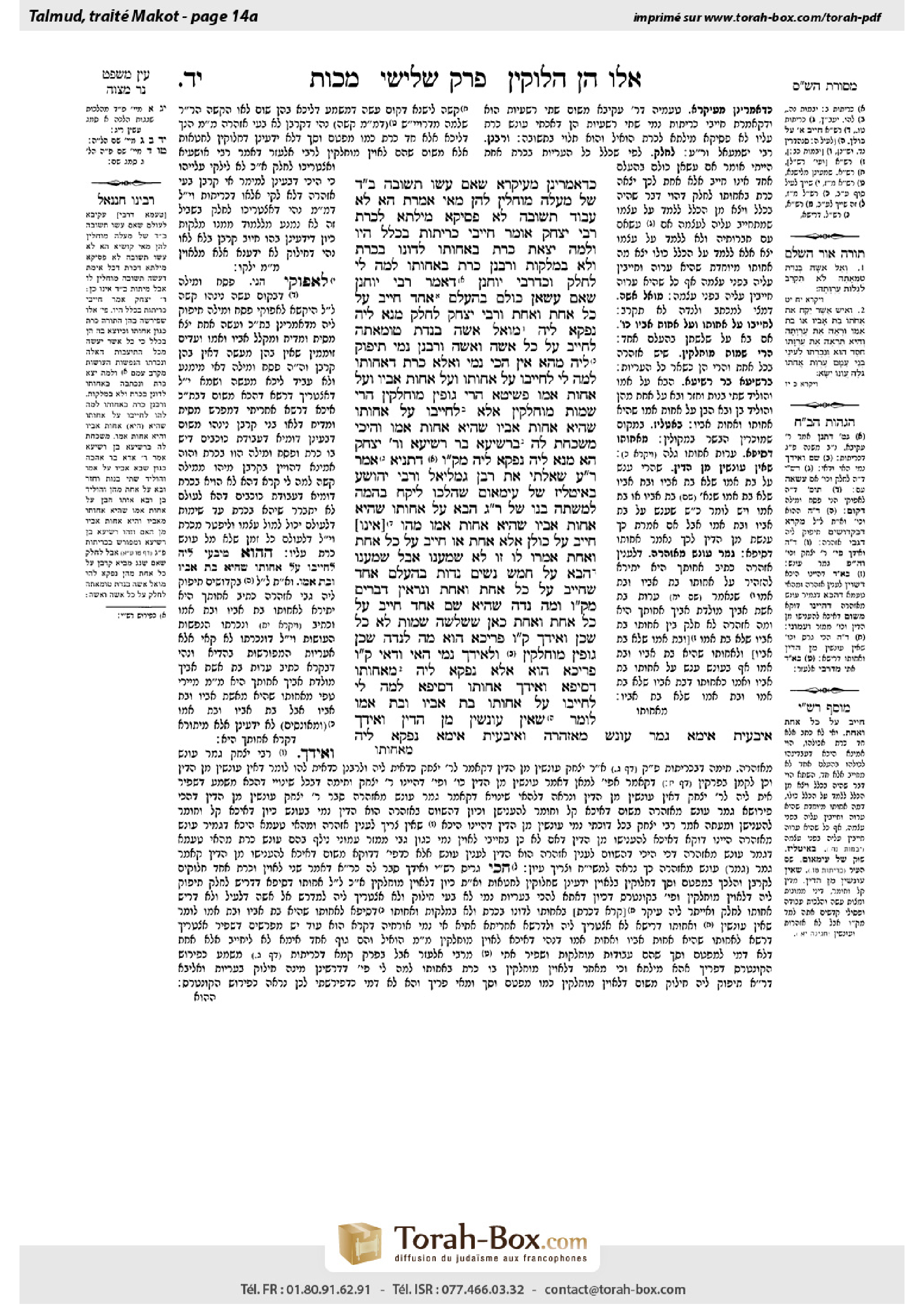
Makkot 14a: Talmud study for Daf Yomi
Daf Yomi is the daily study of one Talmud folio. Explore 37 tractates with scans, Hebrew text, Sefaria English and AI-generated French translations where annotated.
Passage selection and English or AI-generated French translation are available where the scan has annotations. Daf Study is independent of Torah-Box and Sefaria.
Browse Makkot · מכות · All tractatesMakkot 14a text and translations
This page of Makkot includes the Aramaic text, an English translation and an AI-generated French translation, alongside the scan above.
מכות י״ד א · Aramaic and Hebrew text
כִּדְאָמְרִינַן מֵעִיקָּרָא, שֶׁאִם עָשׂוּ תְּשׁוּבָה – בֵּית דִּין שֶׁל מַעְלָה מוֹחֲלִין לָהֶן. מַאי אָמְרַתְּ? הָא לָא עֲבוּד תְּשׁוּבָה? לָא פְּסִיקָא מִילְּתָא לְכָרֵת.
רַבִּי יִצְחָק אוֹמֵר: חַיָּיבֵי כָרֵיתוֹת בַּכְּלָל הָיוּ, וְלָמָּה יָצָאת כָּרֵת בַּאֲחוֹתוֹ – לְדוּנוֹ בְּכָרֵת וְלֹא בְּמַלְקוֹת.
וְרַבָּנַן, כָּרֵת בַּאֲחוֹתוֹ לְמָה לִי? לְחַלֵּק, וְכִדְרַבִּי יוֹחָנָן, דְּאָמַר רַבִּי יוֹחָנָן: שֶׁאִם עֲשָׂאָן כּוּלָּם בְּהֶעְלֵם אֶחָד – חַיָּיב עַל כׇּל אַחַת וְאַחַת.
וְרַבִּי יִצְחָק, לְחַלֵּק מְנָא לֵיהּ? נָפְקָא לֵיהּ מִוְּאֶל אִשָּׁה בְּנִדַּת טֻמְאָתָהּ, לְחַיֵּיב עַל כׇּל אִשָּׁה וְאִשָּׁה.
וְרַבָּנַן נָמֵי, תִּיפּוֹק לֵיהּ מֵהָא! אִין הָכִי נָמֵי. וְאֶלָּא, כָּרֵת דַּאֲחוֹתוֹ לְמָה לִי? לְחַיְּיבוֹ עַל אֲחוֹתוֹ וְעַל אֲחוֹת אָבִיו וְעַל אֲחוֹת אִמּוֹ.
פְּשִׁיטָא, הֲרֵי גּוּפִין מוּחְלָקִין, הֲרֵי שֵׁמוֹת מוּחְלָקִין! אֶלָּא, לְחַיְּיבוֹ עַל אֲחוֹתוֹ שֶׁהִיא אֲחוֹת אָבִיו שֶׁהִיא אֲחוֹת אִמּוֹ. וְהֵיכִי מַשְׁכַּחַתְּ לַהּ – בְּרַשִּׁיעָא בַּר רַשִּׁיעָא.
וְרַבִּי יִצְחָק, הָא מְנָא לֵיהּ? נָפְקָא לֵיהּ מִקַּל וָחוֹמֶר, דְּתַנְיָא: אָמַר רַבִּי עֲקִיבָא: שָׁאַלְתִּי אֶת רַבָּן גַּמְלִיאֵל וְרַבִּי יְהוֹשֻׁעַ בָּאִיטְלִיז שֶׁל עֵימָאוּם, שֶׁהָלְכוּ לִיקַּח בְּהֵמָה לְמִשְׁתֵּה בְנוֹ שֶׁל רַבָּן גַּמְלִיאֵל: הַבָּא עַל אֲחוֹתוֹ שֶׁהִיא אֲחוֹת אָבִיו שֶׁהִיא אֲחוֹת אִמּוֹ, מַהוּ? [אֵינוֹ] חַיָּיב עַל כּוּלָּן אֶלָּא אַחַת, אוֹ חַיָּיב עַל כׇּל אַחַת וְאַחַת?
אָמְרוּ לוֹ: זוֹ לֹא שָׁמַעְנוּ, אֲבָל שָׁמַעְנוּ: הַבָּא עַל חָמֵשׁ נָשִׁים נִדּוֹת בְּהֶעְלֵם אֶחָד, שֶׁחַיָּיב עַל כׇּל אַחַת וְאַחַת, וְנִרְאִין דְּבָרִים מִקַּל וָחוֹמֶר: וּמָה נִדָּה שֶׁהִיא שֵׁם אֶחָד – חַיָּיב עַל כׇּל אַחַת וְאַחַת, כָּאן שֶׁשְּׁלֹשָׁה שֵׁמוֹת – לֹא כׇּל שֶׁכֵּן?
וְאִידָּךְ, קַל וָחוֹמֶר פְּרִיכָא הוּא: מָה לְנִדָּה, שֶׁכֵּן גּוּפִין מוּחְלָקִין.
וּלְאִידַּךְ נָמֵי, הַאי וַדַּאי קַל וָחוֹמֶר פְּרִיכָא הוּא! אֶלָּא, נָפְקָא לֵיהּ מֵ״אֲחֹתוֹ״ דְּסֵיפָא.
וְאִידָּךְ, ״אֲחוֹתוֹ״ דְּסֵיפָא לְמָה לִי? לְחַיְּיבוֹ עַל אֲחוֹתוֹ בַּת אָבִיו וּבַת אִמּוֹ, לוֹמַר שֶׁאֵין עוֹנְשִׁין מִן הַדִּין.
וְאִידַּךְ? אִיבָּעֵית אֵימָא גָּמַר עוֹנֶשׁ מֵאַזְהָרָה. וְאִיבָּעֵית אֵימָא, נָפְקָא לֵיהּ
Makkot 14a · English translation
as we stated initially, that if they repented the heavenly court absolves them of the punishment of karet, and therefore this is not a case of two punishments for one transgression, and there is no exemption from lashes. What do you say in response, that they did not yet repent? Nevertheless, since the matter is not clear-cut with regard to karet, as perhaps they repented, they are therefore not exempt from lashes.
§ It is taught in the baraita that Rabbi Yitzḥak says: Those liable to receive karet in cases of incest were included in the principle: “For anyone who performs any of these abominations, the souls who do so shall be excised from among their people” (Leviticus 18:29). And why was the punishment of karet, when administered to one who engages in intercourse with his sister, excluded from this verse and mentioned independently (Leviticus 20:17)? It is to sentence him to be punished with karet and not to be punished with lashes.
The Gemara asks: And according to the Rabbis, i.e., Rabbi Yishmael and Rabbi Akiva, who maintain that those liable to receive karet are flogged, why do I need karet to be written in the case of one who engages in intercourse with his sister; what does it teach? The Gemara answers: It teaches to divide the various prohibitions of sexual intercourse with forbidden relatives, and is in accordance with the statement of Rabbi Yoḥanan, as Rabbi Yoḥanan says that if one performed all the transgressions described in the passage in the Torah enumerating forbidden relatives during one lapse of awareness, he is liable to bring a separate sin-offering for each and every one, as one is liable to receive karet for each and every one.
The Gemara asks: And concerning Rabbi Yitzḥak, who derives the halakha that one who is liable to receive karet is not flogged from the fact that karet for one who engages in intercourse with his sister emerged from the generalization, from where does he derive the concept to divide the various prohibitions? The Gemara answers: He derives it from the verse written with regard to a menstruating woman: “And to a woman in the separation of her impurity you shall not approach” (Leviticus 18:19). From the superfluous expression “and to a woman,” Rabbi Yitzḥak derives that one is liable for intercourse with each and every forbidden woman.
The Gemara asks: And with regard to the Rabbis as well, let them derive the division of the prohibitions from this verse, rather than from the fact that karet for one who engages in intercourse with his sister emerged from the generalization. The Gemara answers: Yes, it is indeed so, they derive division from the verse with regard to a menstruating woman; but rather, the question again arises: Why do I need karet to be written in the case of one who engages in intercourse with his sister; what does it teach? The Gemara answers: It teaches to render him liable to bring three separate sin-offerings for engaging in intercourse with his sister, and with his father’s sister, and with his mother’s sister, during a single lapse of awareness.
The Gemara asks: Isn’t the fact that he is liable to bring three sin-offerings obvious? The actions were performed with separate bodies, i.e., three different women, and those actions violated the names of three separate prohibitions; no derivation is required. Rather, it is to render him liable to bring three separate sin-offerings for engaging in intercourse with his sister who is also his father’s sister and who is also his mother’s sister. The Gemara inquires: And how can you find these circumstances? The Gemara answers: It is found in the case of a wicked person, son of a wicked person. How so? If a man engages in intercourse with his mother, and she bears him two daughters, and he then engages in intercourse with one of the daughters and fathers a son, that son could engage in intercourse with the other daughter, who is his half sister through his father, as well as being his father’s half sister and his mother’s half sister.
The Gemara asks: And with regard to Rabbi Yitzḥak, from where does he derive this? He derives it by means of an a fortiori inference, as it is taught in a baraita that Rabbi Akiva says: I asked Rabban Gamliel and Rabbi Yehoshua a question in the meat market [itliz] of the town of Emmaus, where they went to purchase an animal for the wedding feast of Rabban Gamliel’s son. Rabbi Akiva asked: In the case of one who engages in intercourse with his sister who is also his father’s sister and who is also his mother’s sister, what is the halakha with regard to bringing a sin-offering? Is he liable to bring only one sin-offering for engaging in intercourse that violated all of the prohibitions, or is he liable to bring a sin-offering for each and every prohibition that he violated when he engaged in intercourse with that woman?
Rabban Gamliel and Rabbi Yehoshua said to him: We did not hear the halakha in that case. But we heard the halakha in a similar case: One who engages in intercourse with five menstruating women during one lapse of awareness is liable to bring a sin-offering for each and every one of the women with whom he engaged in intercourse, and it appears with regard to the matter of your inquiry that he is liable to bring a sin-offering for each and every prohibition, by means of an a fortiori inference. How so? If in the case of a menstruating woman, which involves violation of the name of one prohibition, he is liable for intercourse with each and every one, here, where the woman is forbidden due to the names of three prohibitions, is it not all the more so logical that he is liable to bring three sin-offerings?
The Gemara explains: And according to the other opinion of the Rabbis, who maintain that liability for intercourse with each and every one is derived from an explicit verse, it is a refuted a fortiori inference: What is notable about the case of a menstruating woman? It is notable in that the actions were performed with separate bodies, i.e., different women, while in the case in question, the person engaged in intercourse with one woman.
The Gemara asks: And according to the other opinion of Rabbi Yitzḥak too, this is certainly a refuted a fortiori inference, from which no halakha can be derived. Rather, as for the halakha that a person is liable to bring three sin-offerings for engaging in intercourse with his sister who is also his father’s sister and who is also his mother’s sister, Rabbi Yitzḥak derives it from the phrase “his sister” written in the latter clause of that verse. The verse begins: “And a man who takes his sister, the daughter of his father or the daughter of his mother…and they shall be excised…the nakedness of his sister he has revealed, he shall bear his transgression” (Leviticus 20:17). From the repetition of the term sister, it is derived that he is liable to bring a sin-offering for each and every prohibition that he violated.
The Gemara asks: And according to the other opinion of the Rabbis, who derive this halakha from the term “sister” at the beginning of the verse, why do I need the phrase “his sister” to be written in the latter clause of that verse; what does it teach? The Gemara answers: It teaches to render him liable for engaging in intercourse with his sister who is also the daughter of his father and the daughter of his mother, which comes to say that one does not administer punishment based on an a fortiori inference. Although the Torah specified liability for one who engaged in intercourse with his paternal sister and for one who engaged in intercourse with his maternal sister, an independent derivation is necessary for liability for one who engaged in intercourse with a woman who is both his paternal and his maternal sister.
The Gemara asks: And according to the other opinion of Rabbi Yitzḥak, who derives another matter from the term “sister” in the latter verse, from where does he derive liability for one who engaged in intercourse with a woman who is both his paternal and his maternal sister? The Gemara answers: If you wish, say he derives the punishment from the prohibition; just as the prohibition includes intercourse with a woman who is both his paternal and his maternal sister, the same applies to the punishment. And if you wish, say instead that he derives it
Makkot 14a · Traduction française (IA)
comme nous l’avons dit au début : si ces personnes se repentent, le tribunal céleste les absout de la peine de karet. Il ne s’agit donc pas d’un cas où deux peines sanctionnent une seule transgression, et elles ne sont pas exemptées de la flagellation. Que réponds-tu à cela, en disant qu’elles ne se sont pas encore repenties ? Malgré tout, puisque la question du karet n’est pas tranchée — car elles se sont peut-être repenties —, elles ne sont donc pas exemptées de la flagellation.
§ Il est enseigné dans une baraïta que Rabbi Yitzḥak dit : Ceux qui encourent le karet pour des rapports incestueux étaient inclus dans le principe : « Quiconque commet l’une de ces abominations, les personnes qui les commettent seront retranchées du milieu de leur peuple » (Lévitique 18:29). Pourquoi la peine de karet, dans le cas de celui qui a des rapports avec sa sœur, est-elle exclue de ce verset et mentionnée séparément (Lévitique 20:17) ? C’est pour le condamner au karet et non à la flagellation.
La Guemara demande : Et selon les Rabbins, c’est-à-dire Rabbi Yishmael et Rabbi Akiva, qui soutiennent que ceux qui encourent le karet sont flagellés, pourquoi le karet devait-il être mentionné dans le cas de celui qui a des rapports avec sa sœur ? Que vient-il enseigner ? La Guemara répond : Cela sert à distinguer les différentes interdictions relatives aux rapports avec des proches interdits, conformément à l’enseignement de Rabbi Yoḥanan. En effet, Rabbi Yoḥanan dit que si quelqu’un commet toutes les transgressions énumérées dans le passage de la Torah consacré aux proches interdits au cours d’un seul accès d’inconscience, il doit apporter un sacrifice expiatoire distinct pour chacune d’elles, puisqu’il encourt le karet pour chacune.
La Guemara demande : Et pour Rabbi Yitzḥak, qui déduit la halakha selon laquelle celui qui encourt le karet n’est pas flagellé du fait que le karet applicable à celui qui a des rapports avec sa sœur a été exclu de la règle générale, de quoi déduit-il le principe de distinction entre les différentes interdictions ? La Guemara répond : Il le déduit du verset concernant une femme menstruée : « Tu ne t’approcheras pas d’une femme pendant la séparation due à son impureté » (Lévitique 18:19). Rabbi Yitzḥak déduit de l’expression superflue « et à une femme » que l’on est passible pour avoir eu des rapports avec chacune des femmes interdites.
La Guemara demande : Les Rabbins aussi, qu’ils déduisent la distinction entre les interdictions de ce verset, plutôt que du fait que le karet applicable à celui qui a des rapports avec sa sœur a été exclu de la règle générale ! La Guemara répond : Oui, c’est bien ainsi ; ils déduisent cette distinction du verset concernant une femme menstruée. Mais la question se pose alors de nouveau : pourquoi le karet devait-il être mentionné dans le cas de celui qui a des rapports avec sa sœur ? Que vient-il enseigner ? La Guemara répond : Cela enseigne qu’il doit apporter trois sacrifices expiatoires distincts s’il a des rapports avec sa sœur, avec la sœur de son père et avec la sœur de sa mère, au cours d’un seul accès d’inconscience.
La Guemara demande : N’est-il pas évident qu’il doit apporter trois sacrifices expiatoires ? Les actes ont été commis avec des corps distincts, c’est-à-dire trois femmes différentes, et ils ont enfreint trois interdictions distinctes ; aucune déduction n’est nécessaire. Il s’agit plutôt d’établir qu’il doit apporter trois sacrifices expiatoires distincts s’il a des rapports avec sa sœur, qui est également la sœur de son père et la sœur de sa mère. La Guemara demande : Et comment une telle situation est-elle possible ? La Guemara répond : Elle se rencontre dans le cas d’un homme pervers, fils d’un homme pervers. Comment cela ? Un homme a des rapports avec sa mère, qui lui donne deux filles. Il a ensuite des rapports avec l’une d’elles et engendre un fils. Ce fils pourrait avoir des rapports avec l’autre fille, qui est sa demi-sœur par son père, ainsi que la demi-sœur de son père et la demi-sœur de sa mère.
La Guemara demande : Et pour Rabbi Yitzḥak, de quoi déduit-il cela ? Il le déduit au moyen d’un raisonnement a fortiori, comme l’enseigne une baraïta où Rabbi Akiva dit : J’ai posé une question à Rabban Gamliel et à Rabbi Yehoshua au marché de la viande [itliz] de la ville d’Emmaüs, où ils s’étaient rendus pour acheter un animal en vue du festin de mariage du fils de Rabban Gamliel. Rabbi Akiva demanda : Pour celui qui a des rapports avec sa sœur, qui est également la sœur de son père et la sœur de sa mère, quelle est la halakha concernant l’obligation d’apporter un sacrifice expiatoire ? Doit-il apporter un seul sacrifice expiatoire pour ces rapports, qui enfreignent toutes les interdictions, ou doit-il apporter un sacrifice expiatoire pour chacune des interdictions qu’il a enfreintes en ayant des rapports avec cette femme ?
Rabban Gamliel et Rabbi Yehoshua lui répondirent : Nous n’avons pas entendu la halakha dans ce cas. Mais nous avons entendu la halakha dans un cas analogue : celui qui a des rapports avec cinq femmes menstruées au cours d’un seul accès d’inconscience doit apporter un sacrifice expiatoire pour chacune des femmes avec lesquelles il a eu des rapports. Il semble que, dans le cas de ta question, il doive apporter un sacrifice expiatoire pour chacune des interdictions, au moyen d’un raisonnement a fortiori. Comment cela ? Si, dans le cas d’une femme menstruée, qui implique la transgression d’une seule interdiction, il est passible pour ses rapports avec chacune d’elles, ici, où la femme est interdite en vertu de trois interdictions, n’est-il pas d’autant plus logique qu’il doive apporter trois sacrifices expiatoires ?
La Guemara explique : Selon l’autre opinion des Rabbins, qui soutiennent que l’obligation pour les rapports avec chacune des femmes est déduite d’un verset explicite, ce raisonnement a fortiori est réfuté. Qu’y a-t-il de particulier dans le cas d’une femme menstruée ? Les actes ont été commis avec des corps distincts, c’est-à-dire avec des femmes différentes, tandis que, dans le cas en question, l’homme a eu des rapports avec une seule femme.
La Guemara demande : Et selon l’autre opinion, celle de Rabbi Yitzḥak, il s’agit également, à l’évidence, d’un raisonnement a fortiori réfuté, dont on ne peut déduire aucune halakha. Rabbi Yitzḥak déduit plutôt de l’expression « sa sœur », écrite dans la seconde partie de ce verset, la halakha selon laquelle une personne doit apporter trois sacrifices expiatoires si elle a des rapports avec sa sœur, qui est également la sœur de son père et la sœur de sa mère. Le verset commence ainsi : « Si un homme prend sa sœur, fille de son père ou fille de sa mère […] ils seront retranchés […] il a dévoilé la nudité de sa sœur, il portera sa faute » (Lévitique 20:17). La répétition du terme « sœur » enseigne qu’il doit apporter un sacrifice expiatoire pour chacune des interdictions qu’il a enfreintes.
La Guemara demande : Et selon l’autre opinion des Rabbins, qui déduisent cette halakha du terme « sœur » au début du verset, pourquoi l’expression « sa sœur » devait-elle être écrite dans la seconde partie de ce verset ? Que vient-elle enseigner ? La Guemara répond : Elle enseigne qu’il est passible pour avoir des rapports avec sa sœur qui est à la fois la fille de son père et la fille de sa mère. Cela vient enseigner que l’on ne prononce pas une peine sur la base d’un raisonnement a fortiori. Bien que la Torah ait précisé la responsabilité de celui qui a des rapports avec sa sœur paternelle et celle de celui qui a des rapports avec sa sœur maternelle, une déduction distincte est nécessaire pour établir la responsabilité de celui qui a des rapports avec une femme qui est à la fois sa sœur paternelle et sa sœur maternelle.
La Guemara demande : Et selon l’autre opinion, celle de Rabbi Yitzḥak, qui déduit une autre chose du terme « sœur » dans le dernier verset, de quoi déduit-il la responsabilité de celui qui a des rapports avec une femme qui est à la fois sa sœur paternelle et sa sœur maternelle ? La Guemara répond : Si tu veux, dis qu’il déduit la peine de l’interdiction : de même que l’interdiction inclut les rapports avec une femme qui est à la fois sa sœur paternelle et sa sœur maternelle, il en va de même pour la peine. Et si tu veux, dis plutôt qu’il la déduit
Traduction française générée par IA à partir de l’édition anglaise de Sefaria. Vérifie toujours un passage avec le texte source.
Text from Sefaria: William Davidson Edition - Vocalized Aramaic (CC BY NC); William Davidson Edition - English (CC BY NC).