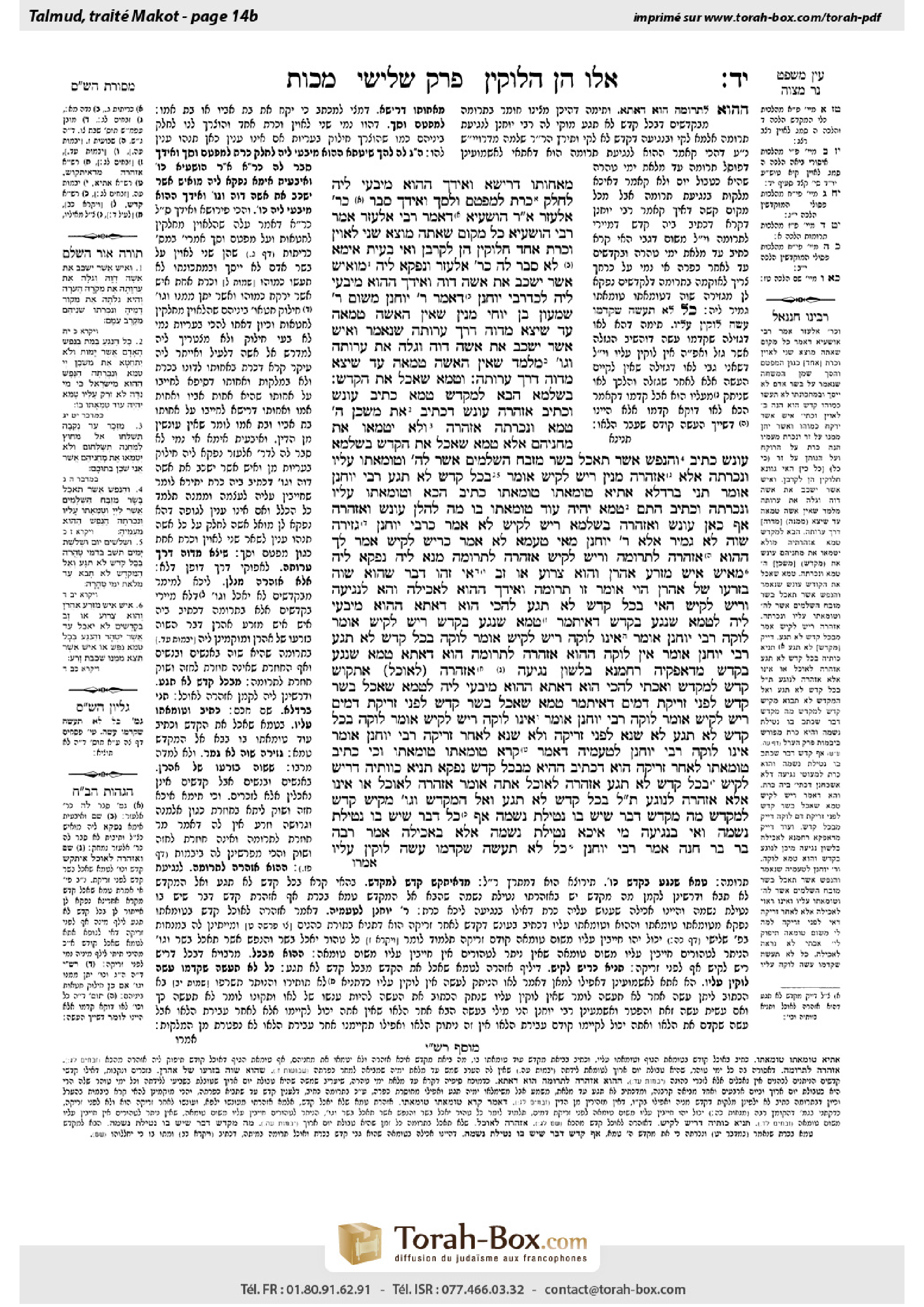
Makkot 14b: Talmud study for Daf Yomi
Daf Yomi is the daily study of one Talmud folio. Explore 37 tractates with scans, Hebrew text, Sefaria English and AI-generated French translations where annotated.
Passage selection and English or AI-generated French translation are available where the scan has annotations. Daf Study is independent of Torah-Box and Sefaria.
Browse Makkot · מכות · All tractatesMakkot 14b text and translations
This page of Makkot includes the Aramaic text, an English translation and an AI-generated French translation, alongside the scan above.
מכות י״ד ב · Aramaic and Hebrew text
מֵ״אֲחוֹתוֹ״ דְּרֵישָׁא.
וְאִידַּךְ: הַהוּא מִיבְּעֵי לֵיהּ, לְחַלֵּק כָּרֵת לַמְפַטֵּם וְלַסָּךְ.
וְאִידַּךְ? סָבַר כְּרַבִּי אֶלְעָזָר אָמַר רַבִּי הוֹשַׁעְיָא, דְּאָמַר רַבִּי אֶלְעָזָר אָמַר רַבִּי הוֹשַׁעְיָא: כׇּל מָקוֹם שֶׁאַתָּה מוֹצֵא שְׁנֵי לָאוִין וְכָרֵת אֶחָד – חֲלוּקִין הֵן לְקׇרְבָּן.
וְאִי בָּעֵית אֵימָא: לָא סָבַר לַהּ כְּרַבִּי אֶלְעָזָר, וְנָפְקָא לֵיהּ מִ״וְאִישׁ אֲשֶׁר יִשְׁכַּב אֶת אִשָּׁה דָּוָה״.
וְאִידַּךְ? הַהוּא מִיבְּעֵי לֵיהּ לְכִדְרַבִּי יוֹחָנָן, דְּאָמַר רַבִּי יוֹחָנָן מִשּׁוּם רַבִּי שִׁמְעוֹן בֶּן יוֹחַי: מִנַּיִן שֶׁאֵין הָאִשָּׁה טְמֵאָה עַד שֶׁיֵּצֵא מַדְוֶהָ דֶּרֶךְ עֶרְוָתָהּ? שֶׁנֶּאֱמַר: ״וְאִישׁ אֲשֶׁר יִשְׁכַּב אֶת אִשָּׁה דָּוָה וְגִלָּה אֶת עֶרְוָתָהּ וְגוֹ׳״ – מְלַמֵּד שֶׁאֵין הָאִשָּׁה טְמֵאָה עַד שֶׁיֵּצֵא מַדְוֶהָ דֶּרֶךְ עֶרְוָתָהּ.
״וְטָמֵא שֶׁאָכַל אֶת הַקֹּדֶשׁ״. בִּשְׁלָמָא הַבָּא לַמִּקְדָּשׁ טָמֵא – כְּתִיב עוֹנֶשׁ וּכְתִיב אַזְהָרָה: עוֹנֶשׁ – דִּכְתִיב: ״אֶת מִשְׁכַּן ה׳ טִמֵּא וְנִכְרְתָה״. אַזְהָרָה – ״וְלֹא יְטַמְּאוּ אֶת מַחֲנֵיהֶם״. אֶלָּא טָמֵא שֶׁאָכַל אֶת הַקֹּדֶשׁ, בִּשְׁלָמָא ״עוֹנֶשׁ״ כְּתִיב – ״וְהַנֶּפֶשׁ אֲשֶׁר תֹּאכַל בָּשָׂר מִזֶּבַח הַשְּׁלָמִים אֲשֶׁר לַה׳ וְטֻמְאָתוֹ עָלָיו וְנִכְרְתָה״, אֶלָּא אַזְהָרָה מִנַּיִן?
רֵישׁ לָקִישׁ אוֹמֵר: ״בְּכׇל קֹדֶשׁ לֹא תִגָּע״.
רַבִּי יוֹחָנָן אוֹמֵר, תָּנֵי בַּרְדְּלָא: אָתְיָא ״טוּמְאָתוֹ״ ״טוּמְאָתוֹ״, כְּתִיב הָכָא ״וְטֻמְאָתוֹ עָלָיו וְנִכְרְתָה״, וּכְתִיב הָתָם ״טָמֵא יִהְיֶה עוֹד טֻמְאָתוֹ בּוֹ״, מָה לְהַלָּן עוֹנֶשׁ וְאַזְהָרָה – אַף כָּאן עוֹנֶשׁ וְאַזְהָרָה.
בִּשְׁלָמָא, רֵישׁ לָקִישׁ לָא אָמַר כְּרַבִּי יוֹחָנָן – גְּזֵירָה שָׁוָה לָא גְּמִיר. אֶלָּא רַבִּי יוֹחָנָן, מַאי טַעְמָא לָא אָמַר כְּרֵישׁ לָקִישׁ? אָמַר לָךְ: הַהוּא אַזְהָרָה לִתְרוּמָה.
וְרֵישׁ לָקִישׁ, אַזְהָרָה לִתְרוּמָה מְנָא לֵיהּ? נָפְקָא לֵיהּ מֵ״אִישׁ אִישׁ מִזֶּרַע אַהֲרֹן וְהוּא צָרוּעַ אוֹ זָב״, אֵי זֶהוּ דָּבָר שֶׁהוּא שָׁוֶה בְּזַרְעוֹ שֶׁל אַהֲרֹן – הֱוֵי אוֹמֵר זוֹ תְּרוּמָה. וְאִידַּךְ? הַהוּא לַאֲכִילָה, וְהָא לִנְגִיעָה.
וְרֵישׁ לָקִישׁ, הַאי ״בְּכׇל קֹדֶשׁ לֹא תִגָּע״ לְהָכִי הוּא דַּאֲתָא? הַהוּא מִיבְּעֵי לֵיהּ לְטָמֵא שֶׁנָּגַע בַּקֹּדֶשׁ! דְּאִיתְּמַר: טָמֵא שֶׁנָּגַע בַּקֹּדֶשׁ, רֵישׁ לָקִישׁ אוֹמֵר: לוֹקֶה, רַבִּי יוֹחָנָן אוֹמֵר: אֵינוֹ לוֹקֶה. רֵישׁ לָקִישׁ אוֹמֵר: לוֹקֶה, ״בְּכׇל קֹדֶשׁ לֹא תִגָּע״. רַבִּי יוֹחָנָן אוֹמֵר: אֵין לוֹקֶה, הָהוּא אַזְהָרָה לִתְרוּמָה הוּא דַּאֲתָא!
טָמֵא שֶׁנָּגַע בַּקֹּדֶשׁ – מִדְּאַפְּקֵיהּ רַחֲמָנָא בִּלְשׁוֹן נְגִיעָה, אַזְהָרָה לָאוֹכֵל – אִתַּקַּושׁ קֹדֶשׁ לְמִקְדָּשׁ.
וְאַכַּתִּי, לְהָכִי הוּא דַּאֲתָא? הַהוּא מִיבְּעֵי לֵיהּ לְטָמֵא שֶׁאָכַל בְּשַׂר קֹדֶשׁ לִפְנֵי זְרִיקַת דָּמִים! דְּאִיתְּמַר: טָמֵא שֶׁאָכַל בְּשַׂר קֹדֶשׁ לִפְנֵי זְרִיקַת דָּמִים, רֵישׁ לָקִישׁ אוֹמֵר: לוֹקֶה, רַבִּי יוֹחָנָן אוֹמֵר: אֵינוֹ לוֹקֶה.
רֵישׁ לָקִישׁ אוֹמֵר: לוֹקֶה, ״בְּכׇל קֹדֶשׁ לֹא תִגָּע״, לָא שְׁנָא לִפְנֵי זְרִיקָה וְלָא שְׁנָא לְאַחַר זְרִיקָה. רַבִּי יוֹחָנָן אוֹמֵר: אֵינוֹ לוֹקֶה. רַבִּי יוֹחָנָן לְטַעְמֵיהּ, דְּאָמַר קְרָא ״טוּמְאָתוֹ״ ״טוּמְאָתוֹ״, וְכִי כְּתִיב ״טוּמְאָתוֹ״ – לְאַחַר זְרִיקָה הוּא דִּכְתִיב! הָהִיא מִ״בְּכׇל קֹדֶשׁ״ נָפְקָא.
תַּנְיָא כְּווֹתֵיהּ דְּרֵישׁ לָקִישׁ: ״בְּכׇל קֹדֶשׁ לֹא תִגָּע״ – אַזְהָרָה לָאוֹכֵל. אַתָּה אוֹמֵר אַזְהָרָה לָאוֹכֵל, אוֹ אֵינוֹ אֶלָּא אַזְהָרָה לַנּוֹגֵעַ? תַּלְמוּד לוֹמַר: בְּכׇל קֹדֶשׁ לֹא תִגָּע וְאֶל הַמִּקְדָּשׁ וְגוֹ׳״ – מַקִּישׁ קֹדֶשׁ לַמִּקְדָּשׁ, מָה מִקְדָּשׁ דָּבָר שֶׁיֵּשׁ בּוֹ נְטִילַת נְשָׁמָה – אַף כׇּל דָּבָר שֶׁיֵּשׁ בּוֹ נְטִילַת נְשָׁמָה. וְאִי בִּנְגִיעָה – מִי אִיכָּא נְטִילַת נְשָׁמָה? אֶלָּא בַּאֲכִילָה.
אָמַר רַבָּה בַּר בַּר חָנָה אָמַר רַבִּי יוֹחָנָן: כׇּל לֹא תַעֲשֶׂה שֶׁקְּדָמוֹ עֲשֵׂה – לוֹקִין עָלָיו.
Makkot 14b · English translation
from the term “his sister” at the beginning of the verse (Leviticus 20:17), as the verse could have been formulated: And a man who takes the daughter of his father or the daughter of his mother, and there is no need to mention a sister at all. Liability for intercourse with a woman who is the daughter of both his father and his mother is derived from the term “his sister.”
And according to the other opinion of the Rabbis, since nothing relevant to the topic of intercourse with one’s sister is derived from the term “sister,” that term is necessary in order to derive an unrelated matter, i.e., to divide the various prohibitions and establish liability for either one who blends anointing oil or for one who applies anointing oil to receive karet, if he performed either intentionally, and to bring a sin-offering if he performed either unwittingly, even though only a single punishment of karet is written in the verse: “A man who blends a mixture like it and who places any of it upon a non-priest, and he shall be excised from his people” (Exodus 30:33).
And the other, Rabbi Yitzḥak, holds in this regard in accordance with that which Rabbi Elazar says that Rabbi Hoshaya says, as Rabbi Elazar says that Rabbi Hoshaya says that there is a principle: Any place where you find two different prohibitions and one punishment of karet stated concerning them, they are distinct with regard to liability to bring an offering; if he performed both unwittingly, he is liable to bring two sin-offerings. According to Rabbi Yitzḥak, there is no need for an additional derivation to render one who unwittingly blends and applies anointing oil liable to bring two sin-offerings.
And if you wish, say instead that he does not hold in accordance with that which Rabbi Elazar says that Rabbi Hoshaya says in this regard, and he derives liability to bring two sin-offerings for one who unwittingly blends and applies anointing oil from a superfluous term elsewhere: “And a man who lies with a woman who is afflicted, and…both of them shall be excised” (Leviticus 20:18). Intercourse with a menstruating woman is already included in the verse: “For anyone who performs any of these abominations, the souls who do so shall be excised from among their people” (Leviticus 18:29). Since this verse does not introduce any nuance concerning the punishment of karet for one who engages in intercourse with a menstruating woman, an unrelated matter is derived, which establishes liability for one who blends anointing oil and for one who applies anointing oil to receive karet if he performed either act intentionally, and to bring a sin-offering if he performed either act unwittingly.
And according to the other opinion of the Rabbis, what is derived from the verse? That verse is necessary for him to derive the halakha in accordance with the statement of Rabbi Yoḥanan, as Rabbi Yoḥanan says in the name of Rabbi Shimon ben Yoḥai: From where is it derived that a woman is impure as a menstruating woman only if the blood of menstruation is discharged through her vagina? Blood discharged from any other orifice does not render her impure. It is derived as it is stated: “And a man who lies with a woman who is afflicted, and uncovers her nakedness” (Leviticus 20:18), which teaches that a woman is impure only if the blood of menstruation is discharged through her vagina.
§ The mishna teaches: And a ritually impure person who ate sacrificial food, and one who entered the Temple while ritually impure, are flogged. The Gemara asks: Granted, one who entered the Temple while ritually impure is flogged, as a punishment is written and a prohibition is written. The Gemara elaborates: There is a punishment, as it is written: “He has rendered impure the Tabernacle of the Lord, and that soul shall be excised” (Numbers 19:13). And there is a prohibition, as it is written: “And they shall not render their camp impure” (Numbers 5:3). But with regard to a ritually impure person who ate sacrificial food, granted, a punishment is written: “And the soul that eats from the flesh of a peace-offering that pertains to the Lord and his impurity is upon him, and that soul shall be excised” (Leviticus 7:20). But from where is a prohibition derived?
Reish Lakish says: The prohibition is derived from that which is written with regard to a woman after childbirth who has not yet completed the purification process: “No consecrated item shall she touch” (Leviticus 12:4), and the reference is not merely to touching, but to eating.
Rabbi Yoḥanan says that a Sage named Bardela teaches: The matter is derived by means of a verbal analogy between the term “his impurity” written here, and the term “his impurity” written there. Here, with regard to a ritually impure person who eats sacrificial food, it is written: “And his impurity is upon him, and that soul shall be excised,” and there, with regard to a ritually impure person entering the Temple, it is written: “He shall be impure, his impurity is yet upon him” (Numbers 19:13). Just as there, with regard to a ritually impure person who entered the Sanctuary, there is a punishment and there is a prohibition, as noted earlier, so too here, with regard to a ritually impure person who ate sacrificial food, it is derived that there is a punishment and there is a prohibition.
The Gemara analyzes the dispute: Granted, Reish Lakish did not say that the source for the prohibition is a verbal analogy in accordance with the opinion of Rabbi Yoḥanan, as he did not receive this verbal analogy as a tradition from his teachers and one may not derive a verbal analogy on his own. But what is the reason that Rabbi Yoḥanan did not say that the source of the prohibition is the verse “No consecrated item shall she touch,” in accordance with the opinion of Reish Lakish, as that appears to be a more straightforward source? The Gemara answers: Rabbi Yoḥanan could say to you: That is not a prohibition for partaking of sacrificial food in a state of impurity; rather, it is a prohibition for partaking of teruma in a state of impurity.
The Gemara asks: And Reish Lakish, from where does he derive a prohibition against partaking of teruma in a state of impurity? The Gemara answers: He derives it from that which is written: “Any man from the descendants of Aaron who is leprous or a zav may not partake of the sacred food until he will be pure” (Leviticus 22:4). The phrase “descendants of Aaron” indicates that the prohibition applies to all descendants, including women. What, then, is an item whose status is equal with regard to all descendants of Aaron, as opposed to certain sacrificial foods that may be eaten only by males? You must say it is teruma. The Gemara asks: And according to the other opinion of Rabbi Yoḥanan, what is derived from this verse? The Gemara answers: This verse serves to prohibit partaking of teruma while impure; and that verse: “No consecrated item shall she touch,” serves to prohibit touching teruma while impure.
The Gemara asks: And according to Reish Lakish, does this verse: “No consecrated item shall she touch” (Leviticus 12:4), come to teach this prohibition concerning partaking of sacrificial food? He requires that verse in order to derive the prohibition of a ritually impure person who touched sacrificial food. As it was stated that there is an amoraic dispute with regard to a ritually impure person who touched sacrificial food. Reish Lakish says: He is flogged. Rabbi Yoḥanan says: He is not flogged. The Gemara elaborates: Reish Lakish says: He is flogged, as it is written: “No consecrated item shall she touch.” Rabbi Yoḥanan says: He is not flogged, because it is to teach a prohibition for touching teruma that this verse comes.
The Gemara answers: Reish Lakish derives both prohibitions from this verse. The prohibition concerning a ritually impure person who touched sacrificial food is derived from the fact that the Merciful One formulates the prohibition with the term touching. The prohibition for a ritually impure person who partakes of sacrificial food is derived because the matter of a ritually impure person eating sacrificial food is juxtaposed to the matter of entering the Temple while ritually impure, as the Gemara explains below.
The Gemara asks: And still, does the verse come for that derivation? Reish Lakish requires that verse in order to derive the prohibition for a ritually impure person who ate sacrificial meat before the sprinkling of the blood of the offering on the altar, when it is not permitted to partake of the meat. As it was stated, there is an amoraic dispute with regard to a ritually impure person who ate sacrificial meat before the sprinkling of the blood. Reish Lakish says: He is flogged for doing so; Rabbi Yoḥanan says: He is not flogged.
Reish Lakish says: He is flogged, as it is written: “No consecrated item shall she touch,” which is stated in general terms, indicating that it is no different whether one touches the consecrated item prior to sprinkling the blood, and it is no different if one touches the consecrated item after sprinkling the blood. Rabbi Yoḥanan says: He is not flogged. Rabbi Yoḥanan conforms to his standard line of reasoning, that the prohibition is derived by means of the verbal analogy cited above, as the verse states “his impurity,” written with regard to a ritually impure person who eats sacrificial food, and the meaning of that term is derived from “his impurity,” written with regard to a ritually impure person entering the Temple. And when “his impurity” is written, it is with regard to partaking of sacrificial meat after the sprinkling of the blood that it is written. The Gemara explains that according to Reish Lakish, that prohibition is derived from the term: “No [bekhol] consecrated item,” as the term bekhol is inclusive and prohibits one from partaking of sacrificial meat even before the sprinkling of the blood.
The Gemara comments: It is taught in a baraita in accordance with the opinion of Reish Lakish. It is written: “No consecrated item shall she touch”; this is a prohibition for a ritually impure person who eats sacrificial food. Do you say that it is a prohibition for a ritually impure person who eats sacrificial food, or perhaps it is only a prohibition for a ritually impure person who touches sacrificial food? The verse states: “No consecrated item shall she touch, and to the Temple she may not come” (Leviticus 12:4). The verse juxtaposes the matter of a ritually impure person eating sacrificial food to the matter of entering the Temple while ritually impure. Just as entering the Temple is a matter that entails a punishment that involves the taking of a life, i.e., karet, so too, every matter in that verse entails a punishment that involves the taking of a life. The Gemara explains: And if the prohibition is with regard to touching sacrificial food, is there a punishment that entails the taking of a life? Rather, the prohibition is with regard to eating.
§ Rabba bar bar Ḥana says that Rabbi Yoḥanan says: With regard to any prohibition that has a positive mitzva that preceded it, everyone agrees that one is flogged for its violation, as it is not classified as a prohibition that entails fulfillment of a positive mitzva.
Makkot 14b · Traduction française (IA)
à partir du terme « sa sœur », au début du verset (Lévitique 20,17), car le verset aurait pu être formulé ainsi : « Un homme qui prend la fille de son père ou la fille de sa mère », sans qu’il soit nécessaire de mentionner une sœur. La responsabilité pour des relations avec une femme qui est la fille à la fois de son père et de sa mère est déduite du terme « sa sœur ».
Et selon l’autre opinion, celle des Rabbins, puisque rien qui concerne les relations avec sa sœur ne se déduit du terme « sœur », ce terme est nécessaire pour déduire un sujet sans rapport, à savoir distinguer les différentes interdictions et établir que celui qui mélange l’huile d’onction ou celui qui en applique est passible de retranchement s’il accomplit l’un ou l’autre de ces actes intentionnellement, et doit apporter un sacrifice expiatoire s’il accomplit l’un ou l’autre par inadvertance, bien qu’un seul retranchement soit mentionné dans le verset : « Un homme qui préparera un mélange semblable et qui en appliquera sur un non-prêtre sera retranché de son peuple » (Exode 30,33).
Et l’autre, Rabbi Yitzḥak, soutient à cet égard ce que Rabbi Elazar dit au nom de Rabbi Hoshaya : il existe un principe selon lequel, partout où l’on trouve deux interdictions distinctes assorties d’une seule peine de retranchement, elles sont distinctes quant à l’obligation d’apporter un sacrifice ; s’il a transgressé les deux par inadvertance, il doit apporter deux sacrifices expiatoires. Selon Rabbi Yitzḥak, aucune déduction supplémentaire n’est nécessaire pour rendre celui qui a mélangé et appliqué l’huile d’onction par inadvertance passible de deux sacrifices expiatoires.
Et si tu préfères, dis plutôt qu’à cet égard, il ne soutient pas ce que Rabbi Elazar dit au nom de Rabbi Hoshaya ; il déduit l’obligation d’apporter deux sacrifices expiatoires pour celui qui a mélangé et appliqué l’huile d’onction par inadvertance d’un terme superflu ailleurs : « Un homme qui couche avec une femme atteinte, et… tous deux seront retranchés » (Lévitique 20,18). Les relations avec une femme menstruée sont déjà incluses dans le verset : « Quiconque commet l’une de ces abominations, les personnes qui les commettent seront retranchées du milieu de leur peuple » (Lévitique 18,29). Puisque ce verset n’apporte aucune précision concernant la peine de retranchement encourue par celui qui a des relations avec une femme menstruée, on en déduit un sujet sans rapport : celui qui mélange l’huile d’onction et celui qui en applique sont passibles de retranchement s’ils accomplissent l’un ou l’autre de ces actes intentionnellement, et doivent apporter un sacrifice expiatoire s’ils les accomplissent par inadvertance.
Et selon l’autre opinion, celle des Rabbins, que déduit-on du verset ? Ce verset est nécessaire pour en déduire la halakha conformément à l’enseignement de Rabbi Yoḥanan. En effet, Rabbi Yoḥanan dit au nom de Rabbi Shimon ben Yoḥai : d’où déduit-on qu’une femme n’est impure comme femme menstruée que si le sang menstruel s’écoule par son vagin ? Le sang qui s’écoule par tout autre orifice ne la rend pas impure. On le déduit de ce qui est dit : « Un homme qui couche avec une femme atteinte et découvre sa nudité » (Lévitique 20,18), ce qui enseigne qu’une femme n’est impure que si le sang menstruel s’écoule par son vagin.
§ La Michna enseigne : Une personne rituellement impure qui a consommé de la nourriture consacrée, ainsi que celle qui est entrée dans le Temple en état d’impureté rituelle, sont flagellées. La Guemara demande : Certes, celui qui est entré dans le Temple en état d’impureté rituelle est flagellé, puisqu’une peine et une interdiction sont énoncées. La Guemara précise : La peine est énoncée ainsi : « Il a rendu impur le Tabernacle de l’Éternel, et cette personne sera retranchée » (Nombres 19,13). L’interdiction est énoncée ainsi : « Ils ne rendront pas leur camp impur » (Nombres 5,3). Mais concernant la personne rituellement impure qui a consommé de la nourriture consacrée, certes, une peine est énoncée : « La personne qui mange de la chair d’un sacrifice de paix appartenant à l’Éternel alors que son impureté est sur elle, cette personne sera retranchée » (Lévitique 7,20). Mais d’où déduit-on l’interdiction ?
Reish Lakish dit : L’interdiction se déduit de ce qui est écrit au sujet d’une femme après l’accouchement qui n’a pas encore achevé son processus de purification : « Elle ne touchera aucun objet consacré » (Lévitique 12,4). Il ne s’agit pas seulement de toucher, mais aussi de consommer.
Rabbi Yoḥanan dit qu’un Sage nommé Bardela enseigne : la question se déduit au moyen d’une analogie verbale entre le terme « son impureté », écrit ici, et le terme « son impureté », écrit là-bas. Ici, au sujet d’une personne rituellement impure qui consomme de la nourriture consacrée, il est écrit : « Son impureté est sur elle, et cette personne sera retranchée » ; et là-bas, au sujet d’une personne rituellement impure qui entre dans le Temple, il est écrit : « Elle sera impure, son impureté est encore sur elle » (Nombres 19,13). De même que là-bas, au sujet d’une personne rituellement impure qui est entrée dans le sanctuaire, il y a une peine et une interdiction, comme indiqué précédemment, de même ici, au sujet d’une personne rituellement impure qui a consommé de la nourriture consacrée, on déduit qu’il y a une peine et une interdiction.
La Guemara analyse le désaccord : certes, Reish Lakish n’a pas dit que la source de l’interdiction est une analogie verbale, conformément à l’opinion de Rabbi Yoḥanan, car il n’avait pas reçu cette analogie verbale de ses maîtres et on ne peut pas établir de sa propre initiative une analogie verbale. Mais pourquoi Rabbi Yoḥanan n’a-t-il pas dit que la source de l’interdiction est le verset « Elle ne touchera aucun objet consacré », conformément à l’opinion de Reish Lakish, puisque cela semble être une source plus directe ? La Guemara répond : Rabbi Yoḥanan pourrait te dire que ce n’est pas une interdiction de consommer de la nourriture consacrée en état d’impureté ; c’est plutôt une interdiction de consommer de la terouma en état d’impureté.
La Guemara demande : Et Reish Lakish, d’où déduit-il l’interdiction de consommer de la terouma en état d’impureté ? La Guemara répond : Il la déduit de ce qui est écrit : « Tout homme parmi les descendants d’Aaron qui est lépreux ou zav ne pourra pas consommer de la nourriture consacrée avant d’être pur » (Lévitique 22,4). L’expression « descendants d’Aaron » indique que l’interdiction s’applique à tous les descendants, y compris aux femmes. Quel est donc l’aliment dont le statut est identique pour tous les descendants d’Aaron, contrairement à certains aliments sacrificiels que seuls les hommes peuvent consommer ? Il faut dire qu’il s’agit de la terouma. La Guemara demande : Et selon l’autre opinion, celle de Rabbi Yoḥanan, que déduit-on de ce verset ? La Guemara répond : Ce verset sert à interdire de consommer de la terouma en état d’impureté ; et l’autre verset, « Elle ne touchera aucun objet consacré », sert à interdire de toucher la terouma en état d’impureté.
La Guemara demande : Et selon Reish Lakish, ce verset, « Elle ne touchera aucun objet consacré » (Lévitique 12,4), vient-il enseigner cette interdiction concernant la consommation de nourriture consacrée ? Il a besoin de ce verset pour déduire l’interdiction visant une personne rituellement impure qui a touché de la nourriture consacrée. En effet, un désaccord entre amoraïm a été rapporté au sujet d’une personne rituellement impure qui a touché de la nourriture consacrée. Reish Lakish dit : elle est flagellée. Rabbi Yoḥanan dit : elle n’est pas flagellée. La Guemara précise : Reish Lakish dit qu’elle est flagellée, car il est écrit : « Elle ne touchera aucun objet consacré ». Rabbi Yoḥanan dit qu’elle n’est pas flagellée, car ce verset vient enseigner l’interdiction de toucher la terouma.
La Guemara répond : Reish Lakish déduit les deux interdictions de ce verset. L’interdiction visant une personne rituellement impure qui a touché de la nourriture consacrée se déduit du fait que le Miséricordieux formule l’interdiction au moyen du terme « toucher ». L’interdiction visant une personne rituellement impure qui consomme de la nourriture consacrée se déduit du fait que le cas d’une personne rituellement impure qui mange de la nourriture consacrée est juxtaposé à celui de l’entrée dans le Temple en état d’impureté rituelle, comme la Guemara l’explique plus loin.
La Guemara demande : Et pourtant, le verset vient-il pour cette déduction ? Reish Lakish a besoin de ce verset pour déduire l’interdiction visant une personne rituellement impure qui a consommé de la viande consacrée avant l’aspersion du sang du sacrifice sur l’autel, alors qu’il n’est pas permis de consommer cette viande. En effet, un désaccord entre amoraïm a été rapporté au sujet d’une personne rituellement impure qui a consommé de la viande consacrée avant l’aspersion du sang. Reish Lakish dit qu’elle est flagellée pour cela ; Rabbi Yoḥanan dit qu’elle n’est pas flagellée.
Reish Lakish dit qu’elle est flagellée, car il est écrit : « Elle ne touchera aucun objet consacré », une formulation générale qui indique que cela ne fait aucune différence que l’on touche l’objet consacré avant l’aspersion du sang ou après. Rabbi Yoḥanan dit qu’elle n’est pas flagellée. Rabbi Yoḥanan reste fidèle à son raisonnement habituel : l’interdiction se déduit au moyen de l’analogie verbale citée plus haut, car le verset énonce « son impureté » au sujet d’une personne rituellement impure qui consomme de la nourriture consacrée, et le sens de ce terme se déduit de « son impureté », écrit au sujet d’une personne rituellement impure qui entre dans le Temple. Or, lorsqu’il est question de « son impureté », il s’agit de la consommation de viande consacrée après l’aspersion du sang. La Guemara explique que, selon Reish Lakish, cette interdiction se déduit du terme : « Aucun [bekhol] objet consacré », car le terme bekhol inclut et interdit de consommer de la viande consacrée même avant l’aspersion du sang.
La Guemara fait remarquer qu’une baraïta est enseignée conformément à l’opinion de Reish Lakish. Il est écrit : « Elle ne touchera aucun objet consacré » ; il s’agit d’une interdiction visant une personne rituellement impure qui consomme de la nourriture consacrée. Dirais-tu qu’il s’agit d’une interdiction visant une personne rituellement impure qui consomme de la nourriture consacrée, ou peut-être s’agit-il seulement d’une interdiction visant une personne rituellement impure qui touche de la nourriture consacrée ? Le verset dit : « Elle ne touchera aucun objet consacré et elle ne pourra pas venir au Temple » (Lévitique 12,4). Le verset juxtapose le cas d’une personne rituellement impure qui consomme de la nourriture consacrée à celui de l’entrée dans le Temple en état d’impureté rituelle. De même que l’entrée dans le Temple est passible d’une peine qui entraîne la mort, c’est-à-dire le retranchement, de même chaque cas dans ce verset entraîne une peine qui entraîne la mort. La Guemara explique : or, si l’interdiction concerne le fait de toucher de la nourriture consacrée, cela entraîne-t-il une peine qui entraîne la mort ? C’est donc que l’interdiction concerne la consommation.
§ Rabba bar bar Ḥana dit au nom de Rabbi Yoḥanan : concernant toute interdiction précédée d’une mitsva positive, tous conviennent que celui qui la transgresse est flagellé, puisqu’elle n’est pas classée parmi les interdictions qui comportent l’accomplissement d’une mitsva positive.
Traduction française générée par IA à partir de l’édition anglaise de Sefaria. Vérifie toujours un passage avec le texte source.
Text from Sefaria: William Davidson Edition - Vocalized Aramaic (CC BY NC); William Davidson Edition - English (CC BY NC).