Makkot 15a: Talmud study for Daf Yomi
Daf Yomi is the daily study of one Talmud folio. Explore 37 tractates with scans, Hebrew text, Sefaria English and AI-generated French translations where annotated.
Passage selection and English or AI-generated French translation are available where the scan has annotations. Daf Study is independent of Torah-Box and Sefaria.
Browse Makkot · מכות · All tractatesMakkot 15a text and translations
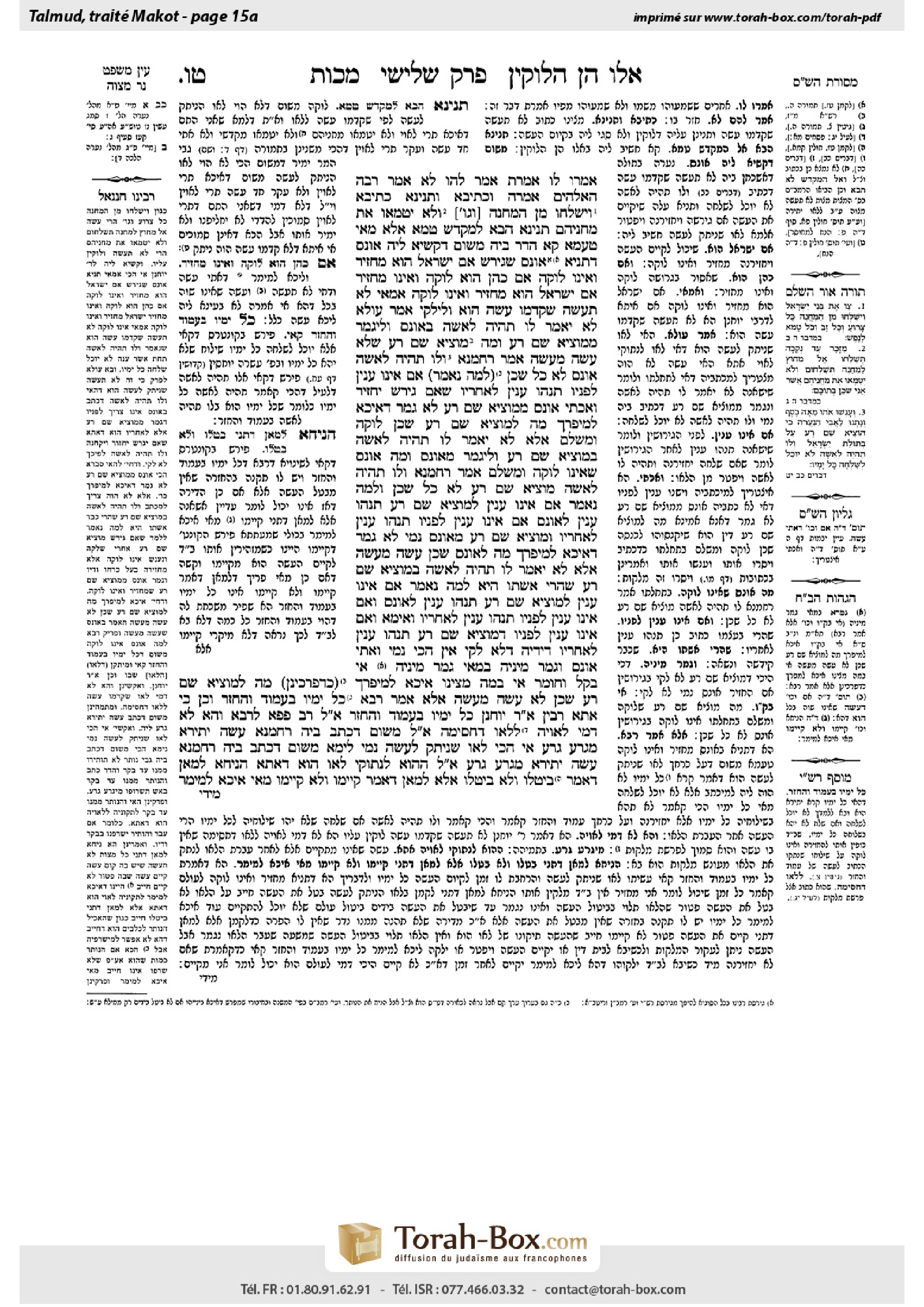
This page of Makkot includes the Aramaic text, an English translation and an AI-generated French translation, alongside the scan above.
מכות י״ה א · Aramaic and Hebrew text
אָמְרוּ לוֹ: אָמַרְתָּ? אֲמַר לְהוּ: לָא. אָמַר רַבָּה: הָאֱלֹהִים! אַמְרַהּ, וּכְתִיבָא וּתְנֵינָא: כְּתִיבָא – ״וִישַׁלְּחוּ מִן הַמַּחֲנֶה [וְגוֹ׳]״ ״וְלֹא יְטַמְּאוּ אֶת מַחֲנֵיהֶם״. תְּנֵינָא – הַבָּא לַמִּקְדָּשׁ טָמֵא.
אֶלָּא מַאי טַעְמָא קָא הָדַר בֵּיהּ? מִשּׁוּם דְּקַשְׁיָא לֵיהּ אוֹנֶס. דְּתַנְיָא: אוֹנֵס שֶׁגֵּירַשׁ, אִם יִשְׂרָאֵל הוּא – מַחְזִיר וְאֵינוֹ לוֹקֶה. אִם כֹּהֵן הוּא – לוֹקֶה וְאֵינוֹ מַחְזִיר.
אִם יִשְׂרָאֵל הוּא – מַחְזִיר וְאֵינוֹ לוֹקֶה, אַמַּאי? לֹא תַעֲשֶׂה שֶׁקְּדָמוֹ עֲשֵׂה הוּא, וְלִילְקֵי!
אָמַר עוּלָּא: לֹא יֵאָמֵר ״לוֹ תִּהְיֶה לְאִשָּׁה״, בְּאוֹנֵס, וְלִיגְמַר מִמּוֹצִיא שֵׁם רַע: וּמָה מוֹצִיא שֵׁם רַע שֶׁלֹּא עָשָׂה מַעֲשֶׂה – אָמַר רַחֲמָנָא ״וְלוֹ תִהְיֶה לְאִשָּׁה״, אוֹנֵס לֹא כׇּל שֶׁכֵּן?
לָמָּה נֶאֱמַר? אִם אֵינוֹ עִנְיָן לְפָנָיו תְּנֵהוּ עִנְיָן לְאַחֲרָיו, שֶׁאִם גֵּירַשׁ יַחֲזִיר.
וְאַכַּתִּי, אוֹנֵס מִמּוֹצִיא שֵׁם רָע לָא גָּמַר, דְּאִיכָּא לְמִיפְרַךְ: מָה לְמוֹצִיא שֵׁם רַע, שֶׁכֵּן לוֹקֶה וּמְשַׁלֵּם!
אֶלָּא: לֹא יֵאָמֵר ״לוֹ תִהְיֶה לְאִשָּׁה״ בְּמוֹצִיא שֵׁם רַע, וְלִיגְמַר מֵאוֹנֵס: וּמָה אוֹנֵס שֶׁאֵינוֹ לוֹקֶה וּמְשַׁלֵּם, אָמַר רַחֲמָנָא ״וְלוֹ תִהְיֶה לְאִשָּׁה״, מוֹצִיא שֵׁם רַע לֹא כׇּל שֶׁכֵּן? וְלָמָּה נֶאֱמַר? אִם אֵינוֹ עִנְיָן לַמּוֹצִיא שֵׁם רַע – תְּנֵהוּ עִנְיָן לָאוֹנֵס, אִם אֵינוֹ עִנְיָן לְפָנָיו – תְּנֵהוּ עִנְיָן לְאַחֲרָיו.
וּמוֹצִיא שֵׁם רַע מֵאוֹנֵס נָמֵי לָא גָּמַר, דְּאִיכָּא לְמִיפְרַךְ: מָה לְאוֹנֵס – שֶׁכֵּן עָשָׂה מַעֲשֶׂה!
אֶלָּא: לֹא יֵאָמֵר ״לוֹ תִהְיֶה לְאִשָּׁה״ בְּמוֹצִיא שֵׁם רַע, שֶׁהֲרֵי אִשְׁתּוֹ הִיא. לָמָּה נֶאֱמַר? אִם אֵינוֹ עִנְיָן לַמּוֹצִיא שֵׁם רַע – תְּנֵהוּ עִנְיָן לָאוֹנֵס, וְאִם אֵינוֹ עִנְיָן לְפָנָיו – תְּנֵהוּ עִנְיָן לְאַחֲרָיו.
וְאֵימָא, וְאִם אֵינוֹ עִנְיָן לְפָנָיו דְּמוֹצִיא שֵׁם רַע – תְּנֵהוּ עִנְיָן לְאַחֲרָיו דִּידֵיהּ, דְּלָא לָקֵי!
אִין הָכִי נָמֵי, וְאָתֵי אוֹנֵס וְגָמַר מִינֵּיהּ. בְּמַאי גָּמַר מִינֵּיהּ? אִי בְּקַל וָחוֹמֶר אִי בְּ״מָה מָצִינוּ״ – אִיכָּא לְמִיפְרַךְ כִּדְפָרְכִינַן: מָה לְמוֹצִיא שֵׁם רַע, שֶׁכֵּן לֹא עָשָׂה מַעֲשֶׂה!
אֶלָּא אָמַר רָבָא: כׇּל יָמָיו בַּעֲמוֹד וְהַחְזֵר. וְכֵן כִּי אֲתָא רָבִין אָמַר רַבִּי יוֹחָנָן: כׇּל יָמָיו בַּעֲמוֹד וְהַחְזֵר.
אֲמַר לֵיהּ רַב פָּפָּא לְרָבָא: וְהָא לָא דָּמֵי לָאוֵיהּ לְלָאו דַּחֲסִימָה! אֲמַר לֵיהּ: מִשּׁוּם דִּכְתַב בֵּיהּ רַחֲמָנָא עֲשֵׂה יַתִּירָא מִגְרָע גָּרַע?
אִי הָכִי, לָאו שֶׁנִּיתָּק לַעֲשֵׂה נָמֵי, לֵימָא: מִשּׁוּם דִּכְתַב בֵּיהּ רַחֲמָנָא עֲשֵׂה יַתִּירָא מִגְרָע גָּרַע? אֲמַר לֵיהּ: הָהוּא לְנַתּוֹקֵי לָאו הוּא דַּאֲתָא.
הָנִיחָא לְמַאן דְּאָמַר בִּיטְּלוֹ וְלֹא בִּיטְּלוֹ,
אֶלָּא לְמַאן דְּאָמַר קִיְּימוֹ וְלֹא קִיְּימוֹ, מַאי אִיכָּא לְמֵימַר?
Makkot 15a · English translation
They said to Rabbi Yoḥanan: Did you say this halakha? Rabbi Yoḥanan said to them: No. Rabba bar bar Ḥana said in the form of an oath: By God, he said it, and this halakha is written in the Torah and we learn it in the mishna. It is written: “And they shall send from the camp any man who is leprous, and any zav…and they shall not render their camp impure” (Numbers 5:2–4). There is a prohibition against rendering the camp impure, and there is a positive mitzva to send them out of the camp. Since the positive mitzva precedes and is independent of the prohibition, one is flogged for the violation of that prohibition, as we learn in the mishna among those liable to receive lashes: One who entered the Temple while ritually impure.
The Gemara asks: Rather, what is the reason he retracted his statement and claimed he did not say it? The Gemara answers: It is due to the fact that the halakha concerning one who rapes a virgin young woman, who is required by Torah law to marry her and for whom it is prohibited to divorce her as long as he lives, is difficult for him, as it is taught in a baraita: In the case of a rapist who divorced the woman he raped, if he is a non-priest, he remarries her, and he is not flogged for violating the prohibition: “He may not send her away all his days” (Deuteronomy 22:29). If he is a priest, he is flogged for violating the prohibition, and he does not remarry her because it is prohibited for him to marry a divorcée.
The Gemara elaborates: If he is a non-priest, he remarries her, and he is not flogged. Why? It is a prohibition that has a positive mitzva which preceded it, as the positive mitzva: “And she shall be his wife” (Deuteronomy 22:29), precedes the prohibition “He may not send her away.” But let him be flogged, since he violated the prohibition by divorcing her. Apparently, one is not flogged even if the positive mitzva precedes the prohibition.
Ulla says in response: The positive mitzva in the case of a rapist is not a mitzva that precedes the prohibition. Rather, it follows the prohibition and rectifies it, as it is referring to a case of one who married his victim and then divorced her. Let the verse not state: “And she shall be his wife,” in the case of a rapist, and let us derive it by means of an a fortiori inference from the case of one who defames his bride, claiming that she was not a virgin when he consummated the marriage: If in the case of a defamer, who did not perform an action but sinned through speech, the Merciful One states: “And she shall be his wife” (Deuteronomy 22:19), then in the case of a rapist, who performed an action, is it not all the more so that he is obligated to take her as a wife?
Ulla continues: Why, then, is the mitzva stated in the case of the rapist? If it is not relevant to the matter of before the rapist marries the victim, apply it to the matter of after the rapist marries the victim, teaching that if he divorced her he must remarry her. Although in the verse it appears prior to the prohibition “He may not send her away,” it actually serves to rectify that prohibition.
The Gemara asks: But still, this affords no proof, as one cannot derive the case of a rapist from the case of a defamer, as the a fortiori inference can be refuted: What is notable about the case of a defamer, which is more stringent than the case of a rapist? It is notable in that he is flogged and is liable to pay retribution, which is contrary to the principle that in general, two punishments are not administered for one transgression.
The Gemara suggests: Rather, let the verse not state: “And she shall be his wife,” in the case of the defamer, and let us derive it by means of an a fortiori inference from the case of a rapist: And if in the case of a rapist, who is not both flogged and liable to pay restitution, but is liable to receive only one punishment, the Merciful One states: “And she shall be his wife,” in the case of a defamer, who is flogged and liable to pay retribution, is it not all the more so that he is obligated to take her as a wife? And why, then, is it stated in the case of the defamer? Rather, if the mitzva is not relevant to the matter of the defamer, apply it to the matter of the rapist, and if the mitzva is not relevant to the matter of before the rapist marries the victim, apply it to the matter of after the rapist marries the victim, teaching that if he divorced her he must remarry her. Although in the verse it appears prior to the prohibition “He may not send her away,” it actually serves to rectify that prohibition.
The Gemara asks: But this affords no proof, as one cannot derive the case of a defamer from the case of a rapist either, as the a fortiori inference can be refuted: What is notable about the case of a rapist? It is notable in that he performed an action, while the defamer performed no action.
The Gemara suggests: Rather, let the verse not state: “And she shall be his wife,” in the case of the defamer because the expression is redundant, as she is already his wife. It would have been sufficient for the verse to state that it is prohibited for him to send her away. Why, then, is it stated in the case of the defamer? Rather, if the mitzva is not relevant to the matter of the defamer, apply it to the matter of the rapist, and if the mitzva is not relevant to the matter of before the rapist marries the victim, apply it to the matter of after the rapist marries the victim, teaching that if he divorced her he must remarry her. Although the positive mitzva appears in the verse prior to the prohibition “He may not send her away,” it actually serves to rectify that prohibition.
The Gemara questions that derivation: And say instead: And if the mitzva is not relevant to the matter of the defamer before he marries his bride, as they are married, apply it to the matter of the defamer himself after they are married, teaching that if he divorced her and violated the prohibition against divorcing her, he is obligated to remarry her, and it teaches that he is not flogged, as the positive mitzva rectifies the prohibition. But in the case of a rapist, the mitzva is to marry her after the rape but there is no mitzva to marry her after he divorces her, and nevertheless, he is not flogged.
The Gemara answers: Yes, it is indeed so; the halakha is derived with regard to the defamer himself, teaching that if he divorces his bride he is obligated to remarry her. And the case of the rapist comes and is derived from the case of the defamer, and the same halakha applies there as well. The Gemara asks: With what derivation is the case of a rapist derived from the case of a defamer? If it is by means of an a fortiori inference or if it is by means of the inductive hermeneutical principle: What do we find, those derivations can be refuted, as we refuted the derivations earlier in the Gemara: What is notable about the case of a defamer? It is notable in that he did not perform an action.
Rather, Rava says: From where is it derived that a rapist must remarry his victim if he divorced her because the positive mitzva rectifies the prohibition “He may not send her away”? It is derived from the superfluous phrase: “All his days” (Deuteronomy 22:29), indicating that all his days, even after he marries and divorces her, he is obligated to arise and remarry her and is consequently not liable to receive lashes. The Gemara adds: And likewise, when Ravin came from Eretz Yisrael to Babylonia, he said that Rabbi Yoḥanan says: All his days he is obligated to arise and remarry her.
Rav Pappa said to Rava that a question arises with regard to Rabbi Yoḥanan’s statement that one is flogged for violating a prohibition preceded by a positive mitzva: But isn’t its prohibition dissimilar to the prohibition of muzzling an ox while it is threshing grain (see Deuteronomy 25:4), which is the paradigm for all prohibitions for whose violation one is flogged, as no positive mitzva is stated in conjunction with the prohibition of muzzling? Rava said to him: Is it reasonable to say that due to the fact that the Merciful One wrote in its regard an additional positive mitzva, the stringency of the prohibition lessens, so that no lashes are administered?
Rav Pappa objected to this claim: If so, with regard to a prohibition that entails fulfillment of a positive mitzva as well, let us say: Is it reasonable to say that due to the fact that the Merciful One wrote in its regard an additional positive mitzva, the stringency of the prohibition lessens, so that no lashes are administered? Rava said to him: In that case, the transgressor is not flogged because the mitzva comes to sever the prohibition from the punishment of lashes.
The Gemara returns to the statement of Rava, who said with regard to the rapist: All his days he is obligated to arise and remarry her, and that is why he is not flogged for violating the prohibition “He may not send her away,” and asks: This works out well according to the one who says that the criterion for determining whether one is flogged for violating a prohibition that entails fulfillment of a positive mitzva is whether he nullified the mitzva or did not nullify the mitzva. According to this opinion, one is flogged only if fulfillment of the mitzva is no longer possible, e.g., a priest who divorced the woman whom he raped. By contrast, a non-priest would not be flogged, because the option of remarriage remains viable.
But according to the one who says that the criterion for determining whether one is flogged in that case is whether he fulfilled the mitzva or did not fulfill the mitzva, and if he did not immediately fulfill the mitzva he is flogged, what can be said? Even in the case of a non-priest who divorced the rape victim, once he fails to remarry her immediately, he is liable to receive lashes.
Makkot 15a · Traduction française (IA)
On demanda à Rabbi Yoḥanan : « As-tu enseigné cette halakha ? » Rabbi Yoḥanan leur répondit : « Non. » Rabba bar bar Ḥana jura en disant : « Par Dieu, il l’a enseignée, et cette halakha est écrite dans la Torah et nous l’apprenons dans la Michna. » Il est écrit : « Vous renverrez du camp tout homme atteint de lèpre et tout zav […] afin qu’ils ne rendent pas impur leur camp » (Nombres 5, 2-4). Il y a une interdiction de rendre le camp impur, ainsi qu’une mitsva positive de les renvoyer du camp. Puisque la mitsva positive précède l’interdiction et en est indépendante, on reçoit la flagellation pour la transgression de cette interdiction, comme nous l’apprenons dans la Michna parmi ceux qui sont passibles de flagellation : celui qui entre dans le Temple en état d’impureté rituelle.
La Guemara demande : Quelle est donc la raison pour laquelle il s’est rétracté et a affirmé ne pas avoir dit cela ? La Guemara répond : C’est parce que la halakha concernant celui qui viole une jeune fille vierge, qu’il est tenu d’épouser selon la Torah et qu’il lui est interdit de répudier tant qu’il est en vie, lui pose une difficulté. En effet, il est enseigné dans une baraïta : Dans le cas d’un violeur qui a répudié la femme qu’il avait violée, s’il n’est pas prêtre, il la reprend pour épouse et ne reçoit pas la flagellation pour avoir transgressé l’interdiction : « Il ne pourra pas la répudier de tous ses jours » (Deutéronome 22, 29). S’il est prêtre, il reçoit la flagellation pour avoir transgressé l’interdiction et ne la reprend pas pour épouse, car il lui est interdit d’épouser une divorcée.
La Guemara développe : S’il n’est pas prêtre, il la reprend pour épouse et ne reçoit pas la flagellation. Pourquoi ? Il s’agit d’une interdiction assortie d’une mitsva positive qui la précède, car la mitsva positive « Elle sera sa femme » (Deutéronome 22, 29) précède l’interdiction « Il ne pourra pas la répudier ». Mais qu’il reçoive la flagellation, puisqu’il a transgressé l’interdiction en la répudiant ! Il semble donc qu’on ne reçoit pas la flagellation même lorsque la mitsva positive précède l’interdiction.
Oulla répond : Dans le cas du violeur, la mitsva positive ne précède pas l’interdiction. Au contraire, elle vient après l’interdiction et la rectifie, car elle se rapporte au cas de celui qui a épousé sa victime puis l’a répudiée. Que le verset ne dise pas « Elle sera sa femme » à propos du violeur, et déduisons-le par un raisonnement a fortiori du cas de celui qui diffame sa fiancée, prétendant qu’elle n’était pas vierge lorsqu’il a consommé le mariage : si, dans le cas du diffamateur, qui n’a commis aucun acte et a péché par la parole, le Miséricordieux dit : « Elle sera sa femme » (Deutéronome 22, 19), dans le cas du violeur, qui a commis un acte, n’est-il pas à plus forte raison tenu de la prendre pour épouse ?
Oulla poursuit : Pourquoi donc la mitsva est-elle énoncée dans le cas du violeur ? Si elle ne se rapporte pas à la période précédant le mariage du violeur avec sa victime, appliquons-la à la période qui suit ce mariage, pour enseigner que s’il l’a répudiée, il doit la reprendre pour épouse. Bien que, dans le verset, elle apparaisse avant l’interdiction « Il ne pourra pas la répudier », elle sert en réalité à rectifier cette interdiction.
La Guemara demande : Mais cela ne constitue toujours pas une preuve, car on ne peut pas déduire le cas du violeur de celui du diffamateur : le raisonnement a fortiori peut être réfuté ainsi : Qu’y a-t-il de particulier dans le cas du diffamateur, qui est plus rigoureux que celui du violeur ? C’est qu’il reçoit la flagellation et est tenu de payer des dommages-intérêts, contrairement au principe selon lequel, en général, deux peines ne sont pas infligées pour une seule transgression.
La Guemara suggère : Que le verset ne dise donc pas « Elle sera sa femme » dans le cas du diffamateur, et déduisons-le par un raisonnement a fortiori du cas du violeur : si, dans le cas du violeur, qui ne reçoit pas à la fois la flagellation et l’obligation de payer des dommages-intérêts, mais n’est passible que d’une seule peine, le Miséricordieux dit : « Elle sera sa femme », dans le cas du diffamateur, qui reçoit la flagellation et est tenu de payer des dommages-intérêts, n’est-il pas à plus forte raison tenu de la prendre pour épouse ? Pourquoi donc cela est-il énoncé dans le cas du diffamateur ? Appliquons plutôt la mitsva au cas du violeur, si elle ne se rapporte pas au diffamateur ; et, si elle ne se rapporte pas à la période précédant le mariage du violeur avec sa victime, appliquons-la à la période qui suit ce mariage, pour enseigner que s’il l’a répudiée, il doit la reprendre pour épouse. Bien que, dans le verset, elle apparaisse avant l’interdiction « Il ne pourra pas la répudier », elle sert en réalité à rectifier cette interdiction.
La Guemara demande : Mais cela ne constitue pas une preuve, car on ne peut pas non plus déduire le cas du diffamateur de celui du violeur : le raisonnement a fortiori peut être réfuté ainsi : Qu’y a-t-il de particulier dans le cas du violeur ? C’est qu’il a commis un acte, tandis que le diffamateur n’en a commis aucun.
La Guemara suggère : Que le verset ne dise donc pas « Elle sera sa femme » dans le cas du diffamateur, puisque cette expression est superflue : elle est déjà sa femme. Il aurait suffi que le verset dise qu’il lui est interdit de la répudier. Pourquoi cela est-il donc énoncé dans le cas du diffamateur ? Appliquons plutôt la mitsva au cas du violeur, si elle ne se rapporte pas au diffamateur ; et, si elle ne se rapporte pas à la période précédant le mariage du violeur avec sa victime, appliquons-la à la période qui suit ce mariage, pour enseigner que s’il l’a répudiée, il doit la reprendre pour épouse. Bien que la mitsva positive apparaisse dans le verset avant l’interdiction « Il ne pourra pas la répudier », elle sert en réalité à rectifier cette interdiction.
La Guemara remet en question cette déduction : Disons plutôt que, si la mitsva ne se rapporte pas au diffamateur avant qu’il épouse sa fiancée, puisqu’ils sont déjà mariés, appliquons-la au diffamateur lui-même après leur mariage, pour enseigner que s’il l’a répudiée et a transgressé l’interdiction de la répudier, il est tenu de la reprendre pour épouse ; cela enseigne aussi qu’il ne reçoit pas la flagellation, puisque la mitsva positive rectifie l’interdiction. Mais, dans le cas du violeur, la mitsva consiste à épouser sa victime après le viol ; il n’y a pas de mitsva de l’épouser après l’avoir répudiée, et pourtant il ne reçoit pas la flagellation.
La Guemara répond : Oui, c’est bien cela : la halakha est déduite concernant le diffamateur lui-même, pour enseigner que s’il répudie sa fiancée, il est tenu de la reprendre pour épouse. Quant au cas du violeur, il est déduit de celui du diffamateur, et la même halakha s’y applique. La Guemara demande : Par quelle déduction déduit-on le cas du violeur de celui du diffamateur ? Si c’est par un raisonnement a fortiori ou par le principe herméneutique inductif « Que constatons-nous ? », ces déductions peuvent être réfutées, comme nous l’avons fait précédemment dans la Guemara : Qu’y a-t-il de particulier dans le cas du diffamateur ? C’est qu’il n’a commis aucun acte.
Rava dit plutôt : D’où déduit-on que le violeur doit reprendre pour épouse sa victime s’il l’a répudiée, parce que la mitsva positive rectifie l’interdiction « Il ne pourra pas la répudier » ? On le déduit de l’expression superflue « de tous ses jours » (Deutéronome 22, 29), qui indique que, tous ses jours, même après l’avoir épousée puis répudiée, il est tenu de se lever et de la reprendre pour épouse ; il n’est donc pas passible de flagellation. La Guemara ajoute : De même, lorsque Ravin vint d’Erets Israël en Babylonie, il dit au nom de Rabbi Yoḥanan : Tous ses jours, il est tenu de se lever et de la reprendre pour épouse.
Rav Pappa dit à Rava qu’une question se pose au sujet de l’affirmation de Rabbi Yoḥanan selon laquelle on reçoit la flagellation pour avoir transgressé une interdiction précédée d’une mitsva positive : Mais cette interdiction ne ressemble-t-elle pas à celle qui interdit de museler un bœuf pendant qu’il foule le grain (voir Deutéronome 25, 4), laquelle sert de modèle à toutes les interdictions dont la transgression entraîne la flagellation, alors qu’aucune mitsva positive n’est énoncée avec l’interdiction de museler ? Rava lui répondit : Est-il raisonnable de dire que, parce que le Miséricordieux a écrit à son sujet une mitsva positive supplémentaire, la rigueur de l’interdiction s’en trouve diminuée, de sorte qu’on n’inflige pas la flagellation ?
Rav Pappa objecta à cette affirmation : Dans ce cas, à propos d’une interdiction dont la transgression entraîne également l’accomplissement d’une mitsva positive, dirons-nous que, parce que le Miséricordieux a écrit à son sujet une mitsva positive supplémentaire, la rigueur de l’interdiction s’en trouve diminuée, de sorte qu’on n’inflige pas la flagellation ? Rava lui répondit : Dans ce cas, le transgresseur ne reçoit pas la flagellation, car la mitsva vient dissocier l’interdiction de la peine de flagellation.
La Guemara revient à la déclaration de Rava concernant le violeur : il est tenu de se lever et de reprendre sa victime pour épouse tous ses jours, et c’est pourquoi il ne reçoit pas la flagellation pour avoir transgressé l’interdiction « Il ne pourra pas la répudier ». Elle demande : Cela fonctionne bien selon celui qui dit que le critère permettant de déterminer si l’on reçoit la flagellation pour avoir transgressé une interdiction assortie de l’accomplissement d’une mitsva positive consiste à savoir si l’on a annulé ou non la mitsva. Selon cette opinion, on ne reçoit la flagellation que si l’accomplissement de la mitsva n’est plus possible, par exemple dans le cas d’un prêtre qui a répudié la femme qu’il avait violée. En revanche, un homme qui n’est pas prêtre ne reçoit pas la flagellation, car il peut encore la reprendre pour épouse.
Mais, selon celui qui dit que le critère permettant de déterminer si l’on reçoit la flagellation dans ce cas consiste à savoir si l’on a accompli ou non la mitsva, et que si l’on ne l’accomplit pas immédiatement, on reçoit la flagellation, que peut-on répondre ? Même dans le cas d’un homme qui n’est pas prêtre et qui a répudié la victime du viol, dès lors qu’il ne la reprend pas immédiatement pour épouse, il est passible de flagellation.
Traduction française générée par IA à partir de l’édition anglaise de Sefaria. Vérifie toujours un passage avec le texte source.
Text from Sefaria: William Davidson Edition - Vocalized Aramaic (CC BY NC); William Davidson Edition - English (CC BY NC).