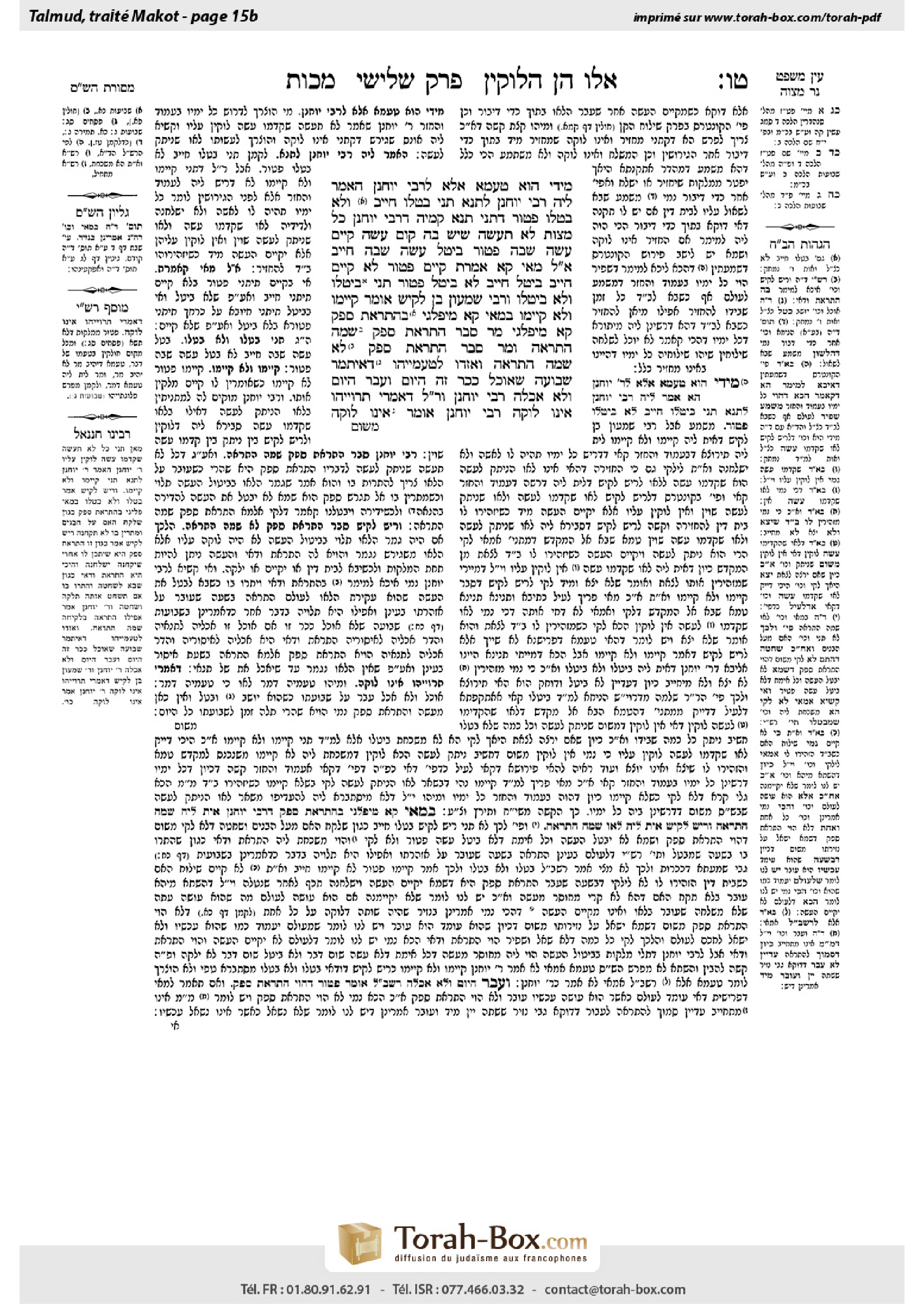
Makkot 15b: Talmud study for Daf Yomi
Daf Yomi is the daily study of one Talmud folio. Explore 37 tractates with scans, Hebrew text, Sefaria English and AI-generated French translations where annotated.
Passage selection and English or AI-generated French translation are available where the scan has annotations. Daf Study is independent of Torah-Box and Sefaria.
Browse Makkot · מכות · All tractatesMakkot 15b text and translations
This page of Makkot includes the Aramaic text, an English translation and an AI-generated French translation, alongside the scan above.
מכות י״ה ב · Aramaic and Hebrew text
מִידֵּי הוּא טַעְמָא אֶלָּא לְרַבִּי יוֹחָנָן? הָאָמַר לֵיהּ רַבִּי יוֹחָנָן לְתַנָּא, תְּנִי: בִּטְּלוֹ – חַיָּיב, וְלֹא בִּטְּלוֹ – פָּטוּר.
דְּתָנֵי תַּנָּא קַמֵּיהּ דְּרַבִּי יוֹחָנָן: כׇּל מִצְוַת לֹא תַעֲשֶׂה שֶׁיֵּשׁ בָּהּ קוּם עֲשֵׂה, קִיֵּים עֲשֵׂה שֶׁבָּהּ – פָּטוּר, בִּיטֵּל עֲשֵׂה שֶׁבָּהּ – חַיָּיב.
אֲמַר לֵיהּ: מַאי קָא אָמְרַתְּ? קִיֵּים – פָּטוּר, לֹא קִיֵּים – חַיָּיב, בִּיטֵּל – חַיָּיב, לֹא בִּיטֵּל – פָּטוּר! תְּנִי: בִּיטְּלוֹ וְלֹא בִּיטְּלוֹ. וְרַבִּי שִׁמְעוֹן בֶּן לָקִישׁ אוֹמֵר: קִיְּימוֹ וְלֹא קִיְּימוֹ.
בְּמַאי קָא מִיפַּלְגִי? בְּהַתְרָאַת סָפֵק קָא מִיפַּלְגִי, מָר סָבַר: הַתְרָאַת סָפֵק שְׁמָהּ הַתְרָאָה,
וּמָר סָבַר: הַתְרָאַת סָפֵק לֹא שְׁמָהּ הַתְרָאָה.
וְאָזְדוּ לְטַעְמַיְיהוּ, דְּאִיתְּמַר: ״שְׁבוּעָה שֶׁאוֹכַל כִּכָּר זֶה הַיּוֹם״, וְעָבַר הַיּוֹם וְלֹא אֲכָלָהּ, רַבִּי יוֹחָנָן וְרֵישׁ לָקִישׁ דְּאָמְרִי תַּרְוַיְיהוּ: אֵינוֹ לוֹקֶה. רַבִּי יוֹחָנָן אוֹמֵר: אֵינוֹ לוֹקֶה,
Makkot 15b · English translation
The Gemara answers: The only reason Rava stated his explanation, that all his days he is obligated to arise and remarry her and that is why the rapist is not flogged even though it is a prohibition preceded by a positive mitzva, is to explain the opinion of Rabbi Yoḥanan, who said that for any prohibition that has a positive mitzva which preceded it, everyone agrees that one is flogged for its violation. Didn’t Rabbi Yoḥanan say to the tanna who would recite the mishnayot and baraitot in the study hall: Teach that if he nullified the mitzva, he is liable to receive lashes, and if he did not nullify the mitzva, he is exempt from lashes? According to Rabbi Yoḥanan, it works out well.
What is the dispute to which the Gemara is alluding? The tanna taught a baraita before Rabbi Yoḥanan: With regard to any prohibition that entails a command to arise and perform a mitzva, if he fulfilled the positive mitzva that is entailed therein, he is exempt from lashes, and if he nullified the positive mitzva that is entailed therein, he is liable to receive lashes.
Rabbi Yoḥanan said to the tanna: What is it that you are saying? The baraita that you recited is self-contradictory, as based on the first clause: If he fulfilled the mitzva he is exempt, apparently, if he did not fulfill the mitzva he is liable. Yet based on the latter clause: If he nullified the mitzva, he is liable, apparently, if he did not nullify the mitzva he is exempt, even though he failed to fulfill the mitzva. Rather, teach: If he nullified the mitzva, he is liable to receive lashes, and if he did not nullify the mitzva, he is exempt from lashes. And Rabbi Shimon ben Lakish says: The formulation of the baraita must be consistent; therefore, teach: If he fulfilled the mitzva, he is exempt, and if he did not fulfill the mitzva he is liable.
The Gemara inquires: With regard to what matter do they disagree? They disagree with regard to uncertain forewarning, i.e., forewarning concerning a transgression with regard to which it will not be clarified whether or not his action will render him liable to receive lashes. One Sage, Rabbi Yoḥanan, holds: Uncertain forewarning is characterized as forewarning; therefore, even if it is unclear whether the action that the transgressor is about to perform will render him liable to receive lashes, he can be forewarned, and if he violates the prohibition in a manner that will render him liable, he is flogged.
And one Sage, Reish Lakish, holds: Uncertain forewarning is not characterized as forewarning. According to Rabbi Yoḥanan, the rapist is forewarned when he is about to divorce his wife, even though there is uncertainty whether he will nullify the mitzva. If he nullifies the mitzva, e.g., if he vows that deriving benefit from his ex-wife is forbidden to him, thereby ensuring that he cannot remarry her, he is flogged. Reish Lakish holds that if one’s liability to receive lashes was dependent upon the nullification of the mitzva, the rapist would never be flogged, as in that case the forewarning would of necessity be uncertain. Therefore, he explains that the criterion for determining whether one is flogged is whether he fulfilled the mitzva immediately. Violating the prohibition renders him liable to receive lashes; he may then choose to be flogged or to fulfill the mitzva. Therefore, when he is forewarned that he will be flogged if he divorces her, it is not uncertain forewarning.
And they follow their standard lines of reasoning, as it was stated that Rabbi Yoḥanan and Reish Lakish disagreed in a case where one said: On my oath I will eat this loaf today, and the day passed and he did not eat it. Rabbi Yoḥanan and Reish Lakish both say: He is not flogged for taking a false oath. They disagree with regard to the reason that he is not flogged. Rabbi Yoḥanan says: He is not flogged,
Makkot 15b · Traduction française (IA)
La Guemara répond : Rava n’a donné son explication — selon laquelle il est tenu, toute sa vie, de se relever et de la reprendre pour épouse, et c’est pourquoi le violeur n’est pas passible de coups, bien qu’il s’agisse d’une interdiction précédée d’une mitsva positive — que pour expliquer l’opinion de Rabbi Yoḥanan, qui a dit que, pour toute interdiction précédée d’une mitsva positive, tous conviennent que celui qui la transgresse est passible de coups. Rabbi Yoḥanan n’a-t-il pas dit au tanna qui récitait les michnayot et les baraïtot dans la maison d’étude : « Enseigne que s’il a annulé la mitsva, il est passible de coups, et que s’il ne l’a pas annulée, il est exempt de coups » ? Selon Rabbi Yoḥanan, cela s’explique bien.
À quel différend la Guemara fait-elle allusion ? Le tanna enseigna une baraïta devant Rabbi Yoḥanan : Pour toute interdiction qui implique l’obligation de se relever et d’accomplir une mitsva, s’il a accompli la mitsva positive qu’elle implique, il est exempt de coups ; mais s’il a annulé la mitsva positive qu’elle implique, il est passible de coups.
Rabbi Yoḥanan dit au tanna : « Qu’est-ce que tu racontes ? La baraïta que tu as récitée se contredit elle-même : d’après la première partie, s’il a accompli la mitsva, il est exempt ; il semble donc que s’il ne l’a pas accomplie, il soit passible de coups. Pourtant, d’après la dernière partie, s’il a annulé la mitsva, il est passible de coups ; il semble donc que s’il ne l’a pas annulée, il soit exempt, même s’il n’a pas accompli la mitsva. Enseigne plutôt : s’il a annulé la mitsva, il est passible de coups, et s’il ne l’a pas annulée, il en est exempt. » Rabbi Shimon ben Lakish dit, quant à lui : La formulation de la baraïta doit être cohérente ; enseigne donc : s’il a accompli la mitsva, il est exempt, et s’il ne l’a pas accomplie, il est passible de coups.
La Guemara demande : Sur quel point sont-ils en désaccord ? Ils sont en désaccord au sujet de l’avertissement incertain, c’est-à-dire d’un avertissement relatif à une transgression pour laquelle on ne saura pas si l’acte commis rendra son auteur passible de coups. L’un des Sages, Rabbi Yoḥanan, considère qu’un avertissement incertain est considéré comme un avertissement. Par conséquent, même s’il n’est pas certain que l’acte que le transgresseur s’apprête à commettre le rendra passible de coups, on peut l’avertir ; et s’il transgresse l’interdiction d’une manière qui le rend passible de coups, il est puni de coups.
L’autre Sage, Reish Lakish, considère qu’un avertissement incertain n’est pas considéré comme un avertissement. Selon Rabbi Yoḥanan, le violeur est averti lorsqu’il s’apprête à divorcer de son épouse, bien qu’on ne sache pas s’il annulera la mitsva. S’il annule la mitsva — par exemple, s’il fait le vœu qu’il lui est interdit de tirer profit de son ex-épouse, s’assurant ainsi qu’il ne pourra pas la reprendre pour épouse — il est puni de coups. Reish Lakish considère que si la peine de coups dépendait de l’annulation de la mitsva, le violeur ne serait jamais puni de coups, car l’avertissement serait alors nécessairement incertain. Il explique donc que le critère pour déterminer si une personne est punie de coups est de savoir si elle a accompli la mitsva immédiatement. La transgression de l’interdiction la rend passible de coups ; elle peut alors choisir de recevoir les coups ou d’accomplir la mitsva. Par conséquent, lorsqu’on l’avertit qu’il sera puni de coups s’il divorce d’elle, l’avertissement n’est pas incertain.
Ils suivent leurs raisonnements habituels, car il a été enseigné que Rabbi Yoḥanan et Reish Lakish étaient en désaccord dans le cas où quelqu’un disait : « Je jure que je mangerai cette miche aujourd’hui », puis la journée s’écoulait sans qu’il l’ait mangée. Rabbi Yoḥanan et Reish Lakish disent tous deux qu’il n’est pas puni de coups pour avoir prêté un faux serment. Ils sont en désaccord sur la raison pour laquelle il n’est pas puni de coups. Rabbi Yoḥanan dit : Il n’est pas puni de coups,
Traduction française générée par IA à partir de l’édition anglaise de Sefaria. Vérifie toujours un passage avec le texte source.
Text from Sefaria: William Davidson Edition - Vocalized Aramaic (CC BY NC); William Davidson Edition - English (CC BY NC).