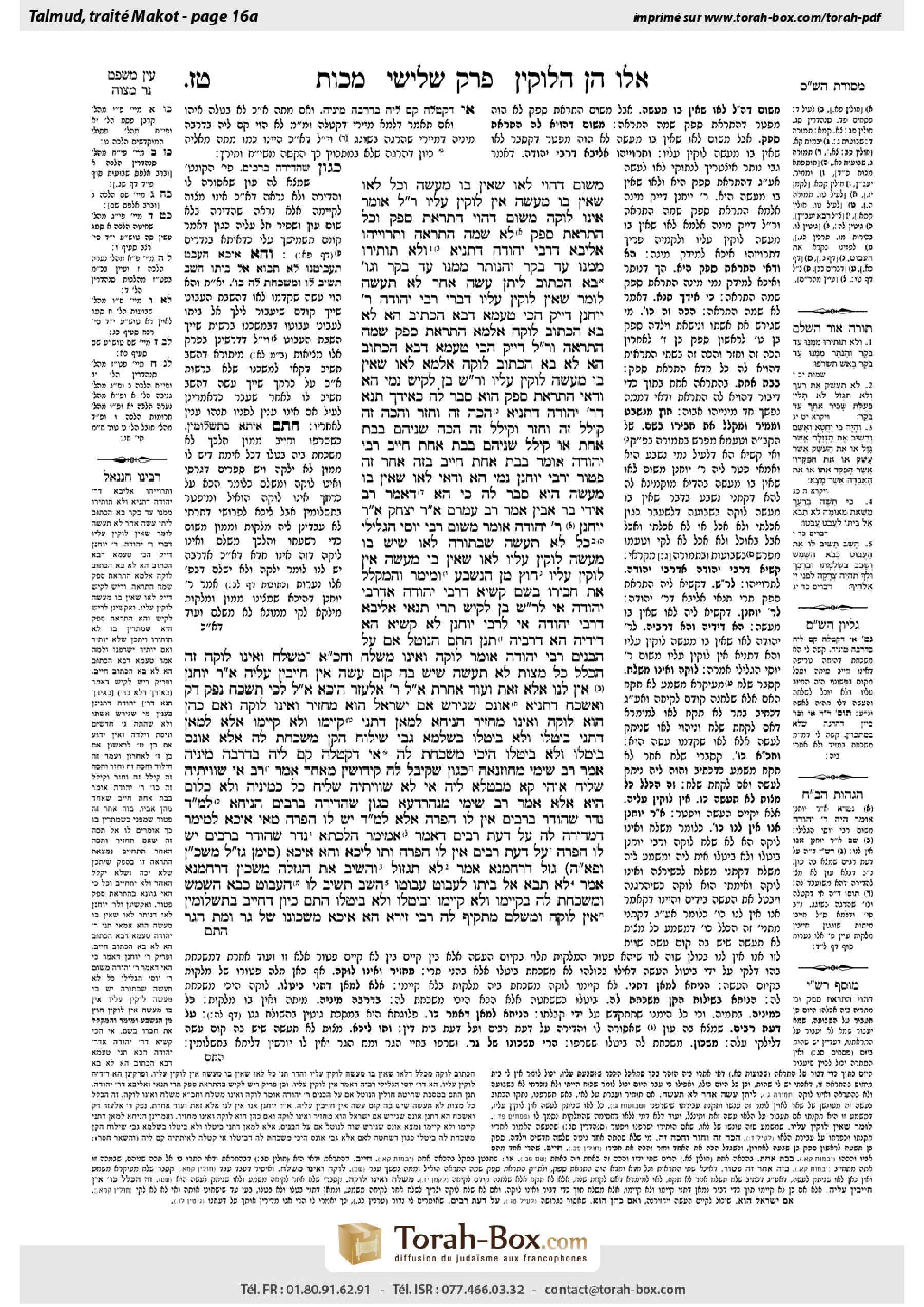
Makkot 16a: Talmud study for Daf Yomi
Daf Yomi is the daily study of one Talmud folio. Explore 37 tractates with scans, Hebrew text, Sefaria English and AI-generated French translations where annotated.
Passage selection and English or AI-generated French translation are available where the scan has annotations. Daf Study is independent of Torah-Box and Sefaria.
Browse Makkot · מכות · All tractatesMakkot 16a text and translations
This page of Makkot includes the Aramaic text, an English translation and an AI-generated French translation, alongside the scan above.
מכות י״ו א · Aramaic and Hebrew text
מִשּׁוּם דְּהָוֵי לָאו שֶׁאֵין בּוֹ מַעֲשֶׂה, וְכׇל לָאו שֶׁאֵין בּוֹ מַעֲשֶׂה – אֵין לוֹקִין עָלָיו. רֵישׁ לָקִישׁ אוֹמֵר: אֵינוֹ לוֹקֶה, מִשּׁוּם דְּהָוֵי הַתְרָאַת סָפֵק, וְכׇל הַתְרָאַת סָפֵק – לֹא שְׁמָהּ הַתְרָאָה.
וְתַרְוַיְיהוּ אַלִּיבָּא דְּרַבִּי יְהוּדָה. דְּתַנְיָא: ״וְלֹא תוֹתִירוּ מִמֶּנּוּ עַד בֹּקֶר, וְהַנֹּתָר מִמֶּנּוּ עַד בֹּקֶר וְגוֹ׳״, בָּא הַכָּתוּב לִיתֵּן עֲשֵׂה אַחַר לֹא תַעֲשֶׂה, לוֹמַר שֶׁאֵין לוֹקִין עָלָיו, דִּבְרֵי רַבִּי יְהוּדָה. רַבִּי יוֹחָנָן דָּיֵיק הָכִי: טַעְמָא דְּבָא הַכָּתוּב, הָא לֹא בָּא הַכָּתוּב – לוֹקֶה, אַלְמָא: הַתְרָאַת סָפֵק שְׁמָהּ הַתְרָאָה.
וְרֵישׁ לָקִישׁ דָּיֵיק הָכִי: טַעְמָא דְּבָא הַכָּתוּב, הָא לֹא בָּא הַכָּתוּב – לוֹקֶה, אַלְמָא: לָאו שֶׁאֵין בּוֹ מַעֲשֶׂה לוֹקִין עָלָיו.
וְרַבִּי שִׁמְעוֹן בֶּן לָקִישׁ נָמֵי, הָא וַדַּאי הַתְרָאַת סָפֵק הוּא!
סָבַר לַהּ כְּאִידַּךְ תַּנָּא דְּרַבִּי יְהוּדָה. דְּתַנְיָא: הִכָּה זֶה וְחָזַר וְהִכָּה זֶה, קִילֵּל זֶה וְחָזַר וְקִילֵּל זֶה, הִכָּה שְׁנֵיהֶם בְּבַת אַחַת אוֹ קִילֵּל שְׁנֵיהֶם בְּבַת אַחַת – חַיָּיב. רַבִּי יְהוּדָה אוֹמֵר: בְּבַת אַחַת – חַיָּיב, בְּזֶה אַחַר זֶה – פָּטוּר.
וְרַבִּי יוֹחָנָן נָמֵי, הָא וַדַּאי לָאו שֶׁאֵין בּוֹ מַעֲשֶׂה הוּא!
סָבַר לַהּ כִּי הָא דְּאָמַר רַב אִידִי בַּר אָבִין אָמַר רַב עַמְרָם אָמַר רַבִּי יִצְחָק אָמַר רַבִּי יוֹחָנָן: רַבִּי יְהוּדָה אוֹמֵר מִשּׁוּם רַבִּי יוֹסֵי הַגְּלִילִי: כׇּל לֹא תַעֲשֶׂה שֶׁבַּתּוֹרָה, לָאו שֶׁיֵּשׁ בּוֹ מַעֲשֶׂה – לוֹקִין עָלָיו, לָאו שֶׁאֵין בּוֹ מַעֲשֶׂה – אֵין לוֹקִין עָלָיו, חוּץ מִן הַנִּשְׁבָּע, וּמֵימִר, וְהַמְקַלֵּל אֶת חֲבֵירוֹ בַּשֵּׁם.
קַשְׁיָא דְּרַבִּי יְהוּדָה אַדְּרַבִּי יְהוּדָה!
אִי לְרַבִּי שִׁמְעוֹן בֶּן לָקִישׁ – תְּרֵי תַּנָּאֵי אַלִּיבָּא דְּרַבִּי יְהוּדָה, אִי לְרַבִּי יוֹחָנָן – לָא קַשְׁיָא: הָא דִידֵיהּ, הָא דְרַבֵּיהּ.
תְּנַן הָתָם: הַנּוֹטֵל אֵם עַל הַבָּנִים, רַבִּי יְהוּדָה אוֹמֵר: לוֹקֶה, וְאֵינוֹ מְשַׁלֵּחַ. וַחֲכָמִים אוֹמְרִים: מְשַׁלֵּחַ וְאֵינוֹ לוֹקֶה. זֶה הַכְּלָל: כׇּל מִצְוַת לֹא תַעֲשֶׂה שֶׁיֵּשׁ בָּהּ קוּם עֲשֵׂה – אֵין חַיָּיבִין עָלֶיהָ. אָמַר רַבִּי יוֹחָנָן: אֵין לָנוּ אֶלָּא זֹאת וְעוֹד אַחֶרֶת.
אֲמַר לֵיהּ רַבִּי אֶלְעָזָר: הֵיכָא? אֲמַר לֵיהּ: לְכִי תַּשְׁכַּח. נְפַק דָּק וְאַשְׁכַּח, דְּתַנְיָא: אוֹנֵס שֶׁגֵּירַשׁ, אִם יִשְׂרָאֵל הוּא – מַחְזִיר וְאֵינוֹ לוֹקֶה, וְאִם כֹּהֵן הוּא – לוֹקֶה וְאֵינוֹ מַחְזִיר.
הָנִיחָא לְמַאן דְּתָנֵי קִיְּימוֹ וְלֹא קִיְּימוֹ.
אֶלָּא לְמַאן דְּתָנֵי בִּיטְּלוֹ וְלֹא בִּיטְּלוֹ, בִּשְׁלָמָא גַּבֵּי שִׁילּוּחַ הַקֵּן מַשְׁכַּחַתְּ לַהּ, אֶלָּא אוֹנֵס בִּיטְּלוֹ וְלֹא בִּיטְּלוֹ הֵיכִי מַשְׁכַּחַתְּ לַהּ?
אִי דְּקַטְלַהּ – קָם לֵיהּ בִּדְרַבָּה מִינֵּיהּ! אָמַר רַב שִׁימִי מָחוֹזְנָאָה: כְּגוֹן שֶׁקִּיבֵּל לָהּ קִידּוּשִׁין מֵאַחֵר. אָמַר רַב: אִי שַׁוֵּויתֵיהּ שָׁלִיחַ – אִיהִי קָא מְבַטְּלָא לֵיהּ, אִי לָא שַׁוֵּויתֵיהּ שָׁלִיחַ – כֹּל כְּמִינֵּיהּ? וְלָא כְּלוּם הִיא!
אֶלָּא אָמַר רַב שִׁימִי מִנְּהַרְדְּעָא כְּגוֹן שֶׁהִדִּירָהּ בָּרַבִּים. הָנִיחָא לְמַאן דְּאָמַר נֶדֶר שֶׁהוּדַּר בָּרַבִּים אֵין לוֹ הֲפָרָה, אֶלָּא לְמַאן דְּאָמַר יֵשׁ לוֹ הֲפָרָה, מַאי אִיכָּא לְמֵימַר? (דְּמַדִּירַהּ לַהּ) [כְּגוֹן שֶׁהִדִּירָהּ] עַל דַּעַת רַבִּים. דְּאָמַר אַמֵּימָר: הִלְכְתָא, נֶדֶר שֶׁהוּדַּר בָּרַבִּים – יֵשׁ לוֹ הֲפָרָה, עַל דַּעַת רַבִּים – אֵין לוֹ הֲפָרָה.
וְתוּ לֵיכָּא? וְהָא אִיכָּא (סִימָן גָּזֵל מַשְׁכֹּן וּפֵאָה), גָּזֵל, דְּרַחֲמָנָא אָמַר ״לֹא תִגְזֹל״, ״וְהֵשִׁיב אֶת הַגְּזֵלָה״. מַשְׁכּוֹן, דְּרַחֲמָנָא אָמַר ״לֹא תָבֹא אֶל בֵּיתוֹ לַעֲבֹט עֲבֹטוֹ״, ״הָשֵׁב תָּשִׁיב לוֹ הָעֲבוֹט כְּבֹא הַשֶּׁמֶשׁ״.
וּמַשְׁכַּחַתְּ לַהּ בְּקִיְּימוֹ וְלֹא קִיְּימוֹ, וּבִיטְּלוֹ וְלֹא בִּיטְּלוֹ! הָתָם כֵּיוָן דְּחַיָּיב בְּתַשְׁלוּמִין – אֵין לוֹקֶה וּמְשַׁלֵּם.
מַתְקֵיף לַהּ רַבִּי זֵירָא: הָא אִיכָּא מַשְׁכּוֹנוֹ שֶׁל גֵּר, וּמֵת הַגֵּר!
Makkot 16a · English translation
because it is a prohibition that does not involve an action. He violates the oath by failing to perform an action, rather than by performing an action, and the principle is: With regard to any prohibition that does not involve an action, one is not flogged for its violation. Reish Lakish says: He is not flogged, because the forewarning in this case is an uncertain forewarning. One cannot properly forewarn him before he takes the oath, because as long as time remains in the day he can still eat the loaf at a later time and fulfill the oath; and any uncertain forewarning is not characterized as forewarning.
The Gemara adds: And both Rabbi Yoḥanan and Reish Lakish hold in accordance with the opinion of Rabbi Yehuda, as it is taught in a baraita: It is stated with regard to the Paschal offering: “And you shall let nothing of it remain until the morning, and that which remains of it until the morning you shall burn in fire” (Exodus 12:10). The verse comes to position the positive mitzva of burning the leftover flesh after the prohibition against leaving over the flesh, to say that one is not flogged for its violation; this is the statement of Rabbi Yehuda. Rabbi Yoḥanan inferred this from the statement of Rabbi Yehuda: The reason he is not flogged is that the verse comes and positions the mitzva after the prohibition; but if the verse had not come and positioned the mitzva after the prohibition, he would have been flogged. Apparently, uncertain forewarning is characterized as forewarning, as he can be forewarned not to leave over the flesh of the offering, even though he would not be flogged were he to burn it.
And Reish Lakish inferred this: The reason he is not flogged is that the verse comes and positions the mitzva after the prohibition; but if the verse had not come and positioned the mitzva after the prohibition, he would have been flogged. Apparently, one is flogged even for violating a prohibition that does not involve an action, as he violates the prohibition without performing an action.
The Gemara asks: And according to Rabbi Shimon ben Lakish too, this is certainly a case of uncertain forewarning; why, then, does he not conclude based on Rabbi Yehuda’s statement that uncertain forewarning is characterized as forewarning?
The Gemara answers: He holds in accordance with the opinion of the other tanna in the name of Rabbi Yehuda, as it is taught in a baraita: If a woman was divorced and remarried soon after, and a son was born seven months after her remarriage and nine months after her divorce, it is unclear whether he is the son of the first husband or of the second husband. In that case, if this son struck this husband of his mother, and then struck that husband, or if he cursed this husband and then cursed that one, and likewise if he struck both of them simultaneously or cursed both of them simultaneously, he is liable for striking or cursing his father. Rabbi Yehuda says: If he cursed or struck both of them simultaneously he is liable, but if he cursed or struck them one after the other, even if he was forewarned prior to cursing or striking each one, he is exempt. Apparently, Rabbi Yehuda is of the opinion that one is not flogged after uncertain forewarning; since in this case it is impossible to determine which of them is the father, inevitably the forewarning is uncertain.
The Gemara asks: And according to Rabbi Yoḥanan too, this is certainly a case of a prohibition that does not involve an action. Why, then, does he not conclude based on Rabbi Yehuda’s statement that one is flogged for violating a prohibition of that kind?
The Gemara answers: Rabbi Yoḥanan holds in accordance with that which was cited in his name, as Rav Idi bar Avin says that Rav Amram says that Rabbi Yitzḥak says that Rabbi Yoḥanan says that Rabbi Yehuda says in the name of Rabbi Yosei HaGelili: With regard to any prohibition in the Torah, if it is a prohibition that involves an action, one is flogged for its violation; if it is a prohibition that does not involve an action, one is not flogged for its violation, except for one who takes a false oath, one who substitutes a non-sacred animal for a sacrificial animal, saying: This animal is substituted for that one, and one who curses another invoking the name of God. In those three instances, the perpetrator is flogged even though he performed no action.
The Gemara asks: Although the difficulties that were raised with regard to the opinions of Rabbi Yoḥanan and Reish Lakish were answered, the apparent contradiction from one statement of Rabbi Yehuda to another statement of Rabbi Yehuda is difficult. The Gemara cited contradictory statements of Rabbi Yehuda with regard to lashes both in the case of a prohibition that does not involve an action and in the case of uncertain forewarning.
The Gemara answers: If it is according to Rabbi Shimon ben Lakish, the contradiction may be resolved with the explanation that the two sources reflect the opinions of two tanna’im, who disagree in accordance with the opinion of Rabbi Yehuda. If it is according to Rabbi Yoḥanan, the contradiction is not difficult, as this baraita reflects his opinion, that one is flogged for violating a prohibition that involves an action, and that baraita reflects the opinion of his teacher, Rabbi Yosei HaGelili, who holds that one is not flogged for violating a prohibition that involves an action.
§ We learned in a mishna there (17a): With regard to one who takes the mother bird with her fledglings, thereby violating the Torah prohibition: “You shall not take the mother with her fledglings; you shall send the mother, and the fledglings you may take for yourself” (Deuteronomy 22:6–7), Rabbi Yehuda says: He is flogged for taking the mother bird, and he does not send the mother, and the Rabbis say: He sends the mother and is not flogged, as this is the principle: With regard to any prohibition that entails a command to arise and perform a mitzva, one is not liable to receive lashes for its violation. Rabbi Yoḥanan says: We have only this mitzva and another where one would be flogged if not for the relevant mitzva.
Rabbi Elazar said to Rabbi Yoḥanan: Which is that other mitzva? Rabbi Yoḥanan said to him: You will know when you discover it yourself. Rabbi Elazar went out, examined the matter, and discovered the answer, as it is taught in a baraita: With regard to a rapist who divorced the woman he raped, if he is a non-priest, he remarries her, and he is not flogged for violating the prohibition: “He may not send her away all his days” (Deuteronomy 22:29). And if he is a priest, he is flogged for violating the prohibition, and he does not remarry her.
The Gemara states: This works out well according to the one who teaches that the criterion for determining whether one is flogged for violating a prohibition that entails fulfillment of a positive mitzva is whether he fulfilled the mitzva or did not fulfill the mitzva, and if he does not fulfill the mitzva immediately when he is instructed to do so, he is flogged when he fails to do so.
But according to the one who teaches that the criterion for determining whether one is flogged in that case is whether he nullified the mitzva or did not nullify the mitzva, and one is flogged only if he performed an action that renders it impossible to fulfill the mitzva, granted, with regard to the sending away of the mother bird from the nest, you can find a situation where he nullifies the mitzva, e.g., if he killed the mother bird. But in the case of a rapist, if the criterion is whether he nullified the mitzva or he did not nullify it, how can you find a situation where the man is flogged because he nullified any possibility of remarrying her?
If he cannot remarry her because he killed her, he will be executed, not flogged, based on the principle: He receives the greater punishment. Rav Shimi of Meḥoza said: He nullifies the possibility of remarriage in a case where he received, on her behalf, the money for betrothal from another, thereby ensuring that his own remarriage to her is no longer an option. Rav said: That is not a viable solution; if his ex-wife designated him as an agent to receive the money of betrothal on her behalf, it is she who nullifies the possibility of fulfilling the mitzva for him, as a woman is betrothed only with her consent, and he is not liable at all. If she did not designate him as an agent, is it in his power to accept betrothal on behalf of a woman who did not designate him to do so? His action is nothing, and the betrothal does not take effect.
Rather, Rav Shimi of Neharde’a said: He nullifies the possibility of remarriage in a case where he vowed in public that it is prohibited for him to derive benefit from her, and it is consequently prohibited for him to marry her. The Gemara asks: This works out well according to the one who says that a vow that was taken in public has no nullification; he is flogged, since by taking that vow he has rendered remarriage impossible. But according to the one who says that even a vow taken in public has the possibility of nullification, what can be said? He can nullify the vow and remarry her. The Gemara answers: The reference is to a case where he vows on the basis of the consent of the public that it is prohibited for him to derive benefit from her, as Ameimar says that the halakha is: A vow that was taken in public has the possibility of nullification; a vow that was taken on the basis of the consent of the public has no nullification.
The Gemara questions Rabbi Yoḥanan’s statement: And are there no more prohibitions that entail fulfillment of a positive mitzva for which one is flogged? But aren’t there others? Before stating its challenges, the Gemara provides a mnemonic for the cases that it will cite: Robbery, collateral, and pe’a. The Gemara elaborates: Isn’t there the case of robbery, where the Merciful One states: “You shall not rob” (Leviticus 19:13), and also states: “And he shall return the stolen item” (Leviticus 5:23)? Isn’t there the case of collateral, where the Merciful One states: “You shall not come into his house to fetch his pledge” (Deuteronomy 24:10), and He then states: “You shall return to him the pledge when the sun sets” (Deuteronomy 24:13)?
The Gemara continues: And you find that one is liable to receive lashes in those cases both if the criterion is whether he fulfilled the mitzva or did not fulfill the mitzva, and if the criterion is whether he nullified the mitzva or he did not nullify it. According to the first criterion, he is flogged if he fails to return the stolen item or the collateral; according to the second criterion, he is flogged if he destroys the stolen item or the collateral. The Gemara answers: There, in both those cases, he is not flogged, since he is liable to remit monetary payment for the stolen item or the collateral, as the principle is: One is not both flogged and liable to pay restitution for one transgression.
Rabbi Zeira objects to this: But isn’t there a case where he is not liable to pay, e.g., if he appropriated the collateral of a convert and the convert died with no heirs. In that case, there is no payment, and nevertheless, he is not flogged.
Makkot 16a · Traduction française (IA)
car il s’agit d’une interdiction qui n’implique pas d’acte. Il transgresse le serment en omettant d’agir, et non en accomplissant un acte ; or, le principe est que l’on ne reçoit pas de coups de fouet pour la transgression d’une interdiction qui n’implique pas d’acte. Reish Lakish dit : il ne reçoit pas de coups de fouet, car, dans ce cas, l’avertissement est incertain. On ne peut pas dûment l’avertir avant qu’il ne prête serment, car, tant qu’il reste du temps dans la journée, il peut encore manger le pain plus tard et ainsi respecter son serment ; or, un avertissement incertain n’est pas considéré comme un avertissement.
La Guemara ajoute : Rabbi Yoḥanan et Reish Lakish suivent tous deux l’opinion de Rabbi Yehuda, comme on l’enseigne dans une baraïta : à propos du sacrifice pascal, il est dit : « Vous n’en laisserez rien jusqu’au matin, et ce qui en restera jusqu’au matin, vous le brûlerez au feu » (Exode 12,10). Le verset vient placer la mitsva positive de brûler la chair restante après l’interdiction de laisser de la chair en reste, pour enseigner que l’on ne reçoit pas de coups de fouet pour cette transgression ; telle est l’opinion de Rabbi Yehuda. Rabbi Yoḥanan déduit cela de la déclaration de Rabbi Yehuda : s’il ne reçoit pas de coups de fouet, c’est parce que le verset vient placer la mitsva après l’interdiction ; mais si le verset n’était pas venu placer la mitsva après l’interdiction, il aurait reçu des coups de fouet. Il apparaît donc qu’un avertissement incertain est considéré comme un avertissement, car on peut l’avertir de ne pas laisser de chair du sacrifice en reste, même s’il ne recevrait pas de coups de fouet s’il la brûlait.
Reish Lakish, quant à lui, déduit ceci : s’il ne reçoit pas de coups de fouet, c’est parce que le verset vient placer la mitsva après l’interdiction ; mais si le verset n’était pas venu placer la mitsva après l’interdiction, il aurait reçu des coups de fouet. Il apparaît donc que l’on reçoit des coups de fouet même pour avoir transgressé une interdiction qui n’implique pas d’acte, puisqu’il transgresse l’interdiction sans accomplir d’acte.
La Guemara demande : Pour Rabbi Shimon ben Lakish aussi, il s’agit certainement d’un cas d’avertissement incertain. Pourquoi, alors, ne conclut-il pas, sur la base de la déclaration de Rabbi Yehuda, qu’un avertissement incertain est considéré comme un avertissement ?
La Guemara répond : Il suit l’opinion de l’autre tanna qui rapporte les propos de Rabbi Yehuda, comme on l’enseigne dans une baraïta : si une femme a divorcé puis s’est remariée peu après, et qu’un fils est né sept mois après son remariage et neuf mois après son divorce, on ne sait pas s’il est le fils de son premier mari ou de son second mari. Dans ce cas, si ce fils frappe l’un des maris de sa mère, puis frappe l’autre, ou s’il maudit l’un puis l’autre, et de même s’il les frappe tous deux en même temps ou les maudit tous deux en même temps, il est passible pour avoir frappé ou maudit son père. Rabbi Yehuda dit : s’il les a maudits ou frappés tous deux en même temps, il est passible ; mais s’il les a maudits ou frappés l’un après l’autre, même s’il a été averti avant de maudire ou de frapper chacun d’eux, il est exempt. Il apparaît donc que, selon Rabbi Yehuda, on ne reçoit pas de coups de fouet après un avertissement incertain ; puisque, dans ce cas, il est impossible de déterminer lequel des deux est le père, l’avertissement est nécessairement incertain.
La Guemara demande : Pour Rabbi Yoḥanan aussi, il s’agit certainement d’un cas d’interdiction qui n’implique pas d’acte. Pourquoi, alors, ne conclut-il pas, sur la base de la déclaration de Rabbi Yehuda, que l’on reçoit des coups de fouet pour avoir transgressé une interdiction de ce type ?
La Guemara répond : Rabbi Yoḥanan suit l’enseignement rapporté en son nom, car Rav Idi bar Avin dit que Rav Amram dit que Rabbi Yitzḥak dit que Rabbi Yoḥanan dit que Rabbi Yehuda dit au nom de Rabbi Yosei HaGelili : pour toute interdiction de la Torah, si elle implique un acte, on reçoit des coups de fouet pour sa transgression ; si elle n’implique pas d’acte, on ne reçoit pas de coups de fouet pour sa transgression, à l’exception de celui qui prononce un faux serment, de celui qui substitue un animal profane à un animal consacré en disant : « Cet animal est substitué à celui-là », et de celui qui maudit autrui en invoquant le nom de Dieu. Dans ces trois cas, le coupable reçoit des coups de fouet bien qu’il n’ait accompli aucun acte.
La Guemara demande : Bien que les difficultés soulevées au sujet des opinions de Rabbi Yoḥanan et de Reish Lakish aient été résolues, la contradiction entre une déclaration de Rabbi Yehuda et une autre demeure difficile. La Guemara a cité des déclarations contradictoires de Rabbi Yehuda concernant les coups de fouet, tant dans le cas d’une interdiction qui n’implique pas d’acte que dans celui d’un avertissement incertain.
La Guemara répond : Selon Rabbi Shimon ben Lakish, on peut résoudre la contradiction en expliquant que les deux sources reflètent les opinions de deux tannaïm qui divergent sur l’opinion de Rabbi Yehuda. Selon Rabbi Yoḥanan, il n’y a pas de difficulté : cette baraïta reflète son opinion, selon laquelle on reçoit des coups de fouet pour avoir transgressé une interdiction qui implique un acte, tandis que l’autre baraïta reflète l’opinion de son maître, Rabbi Yosei HaGelili, selon laquelle on ne reçoit pas de coups de fouet pour avoir transgressé une interdiction qui implique un acte.
§ Nous avons appris dans une Michna (17a) : au sujet de celui qui prend la mère avec ses oisillons, transgressant ainsi l’interdiction de la Torah : « Tu ne prendras pas la mère avec ses oisillons ; tu renverras la mère, et tu pourras prendre les oisillons pour toi » (Deutéronome 22,6-7), Rabbi Yehuda dit : il reçoit des coups de fouet pour avoir pris la mère, et ne la renvoie pas. Les Sages disent : il renvoie la mère et ne reçoit pas de coups de fouet, car tel est le principe : pour toute interdiction assortie du commandement de se lever et d’accomplir une mitsva, on n’est pas passible de coups de fouet pour l’avoir transgressée. Rabbi Yoḥanan dit : nous ne connaissons que cette mitsva et une autre pour lesquelles on recevrait des coups de fouet si la mitsva correspondante n’existait pas.
Rabbi Elazar dit à Rabbi Yoḥanan : Quelle est cette autre mitsva ? Rabbi Yoḥanan lui dit : Tu le sauras quand tu la découvriras toi-même. Rabbi Elazar sortit, examina la question et trouva la réponse, comme on l’enseigne dans une baraïta : si un violeur a répudié la femme qu’il a violée, s’il n’est pas prêtre, il la reprend pour épouse et ne reçoit pas de coups de fouet pour avoir transgressé l’interdiction : « Il ne pourra pas la renvoyer tous ses jours » (Deutéronome 22,29). Mais s’il est prêtre, il reçoit des coups de fouet pour avoir transgressé l’interdiction et ne la reprend pas pour épouse.
La Guemara précise : cela fonctionne bien selon celui qui enseigne que le critère permettant de déterminer si l’on reçoit des coups de fouet pour avoir transgressé une interdiction assortie à l’accomplissement d’une mitsva positive est de savoir si l’on a accompli ou non la mitsva ; s’il ne l’accomplit pas dès qu’on lui ordonne de le faire, il reçoit des coups de fouet pour ne pas l’avoir fait.
Mais selon celui qui enseigne que le critère permettant de déterminer si l’on reçoit des coups de fouet dans ce cas est de savoir si l’on a rendu ou non la mitsva impossible à accomplir, et que l’on ne reçoit des coups de fouet que si l’on a accompli un acte qui rend impossible l’accomplissement de la mitsva, on peut certes trouver, dans le cas du renvoi de la mère oiseau du nid, une situation où il rend la mitsva impossible, par exemple s’il tue la mère oiseau. Mais dans le cas d’un violeur, si le critère est de savoir s’il a rendu ou non la mitsva impossible à accomplir, comment trouver une situation où l’homme reçoit des coups de fouet parce qu’il aurait rendu impossible toute possibilité de la reprendre pour épouse ?
S’il ne peut pas la reprendre pour épouse parce qu’il l’a tuée, il sera exécuté, et non frappé de coups de fouet, selon le principe : il reçoit la peine la plus lourde. Rav Shimi de Meḥoza dit : il rend impossible la reprise du mariage dans le cas où il a reçu, pour elle, l’argent des fiançailles d’un autre homme, garantissant ainsi que la reprendre lui-même pour épouse n’est plus une possibilité. Rav dit : ce n’est pas une solution valable. Si son ex-femme l’a désigné comme mandataire pour recevoir l’argent des fiançailles en son nom, c’est elle qui rend impossible, pour lui, l’accomplissement de la mitsva, car une femme ne se fiance qu’avec son consentement ; il n’est donc pas du tout passible. Si elle ne l’a pas désigné comme mandataire, est-il en son pouvoir d’accepter des fiançailles au nom d’une femme qui ne l’a pas désigné à cette fin ? Son acte est sans effet, et les fiançailles ne prennent pas effet.
Au contraire, Rav Shimi de Neharde’a dit : il rend impossible la reprise du mariage dans le cas où il a fait en public le vœu qu’il lui est interdit de tirer profit d’elle, si bien qu’il lui est par conséquent interdit de l’épouser. La Guemara demande : cela fonctionne bien selon celui qui dit qu’un vœu prononcé en public ne peut être annulé : il reçoit des coups de fouet, puisqu’en prononçant ce vœu, il a rendu impossible la reprise du mariage. Mais selon celui qui dit que même un vœu prononcé en public peut être annulé, que peut-on répondre ? Il peut annuler le vœu et la reprendre pour épouse. La Guemara répond : il s’agit d’un cas où il a fait le vœu avec le consentement du public qu’il lui est interdit de tirer profit d’elle, car Ameimar dit que la halakha est la suivante : un vœu prononcé en public peut être annulé ; un vœu prononcé avec le consentement du public ne peut pas être annulé.
La Guemara met en doute la déclaration de Rabbi Yoḥanan : n’existe-t-il pas d’autres interdictions assorties à l’accomplissement d’une mitsva positive pour lesquelles on reçoit des coups de fouet ? N’y en a-t-il pas d’autres ? Avant d’énoncer ses objections, la Guemara donne un moyen mnémotechnique pour les cas qu’elle va citer : vol, gage et péa. La Guemara développe : n’y a-t-il pas le cas du vol, au sujet duquel le Miséricordieux dit : « Tu ne voleras pas » (Lévitique 19,13), et dit aussi : « Il restituera l’objet volé » (Lévitique 5,23) ? N’y a-t-il pas le cas du gage, au sujet duquel le Miséricordieux dit : « Tu n’entreras pas dans sa maison pour prendre son gage » (Deutéronome 24,10), puis dit : « Tu lui rendras le gage au coucher du soleil » (Deutéronome 24,13) ?
La Guemara poursuit : dans ces cas, on peut trouver qu’une personne est passible de coups de fouet, aussi bien selon le critère consistant à savoir si elle a accompli ou non la mitsva que selon celui consistant à savoir si elle a rendu ou non la mitsva impossible à accomplir. Selon le premier critère, elle reçoit des coups de fouet si elle ne restitue pas l’objet volé ou le gage ; selon le second, elle reçoit des coups de fouet si elle détruit l’objet volé ou le gage. La Guemara répond : dans ces deux cas, elle ne reçoit pas de coups de fouet, car elle est tenue de verser une somme d’argent en réparation de l’objet volé ou du gage ; or, le principe est qu’on ne reçoit pas à la fois des coups de fouet et l’obligation de verser une indemnité pour une même transgression.
Rabbi Zeira objecte : mais n’existe-t-il pas un cas où il n’est pas tenu de payer, par exemple s’il s’est emparé du gage appartenant à un converti, lequel est mort sans héritier ? Dans ce cas, il n’y a pas de paiement ; pourtant, il ne reçoit pas de coups de fouet.
Traduction française générée par IA à partir de l’édition anglaise de Sefaria. Vérifie toujours un passage avec le texte source.
Text from Sefaria: William Davidson Edition - Vocalized Aramaic (CC BY NC); William Davidson Edition - English (CC BY NC).