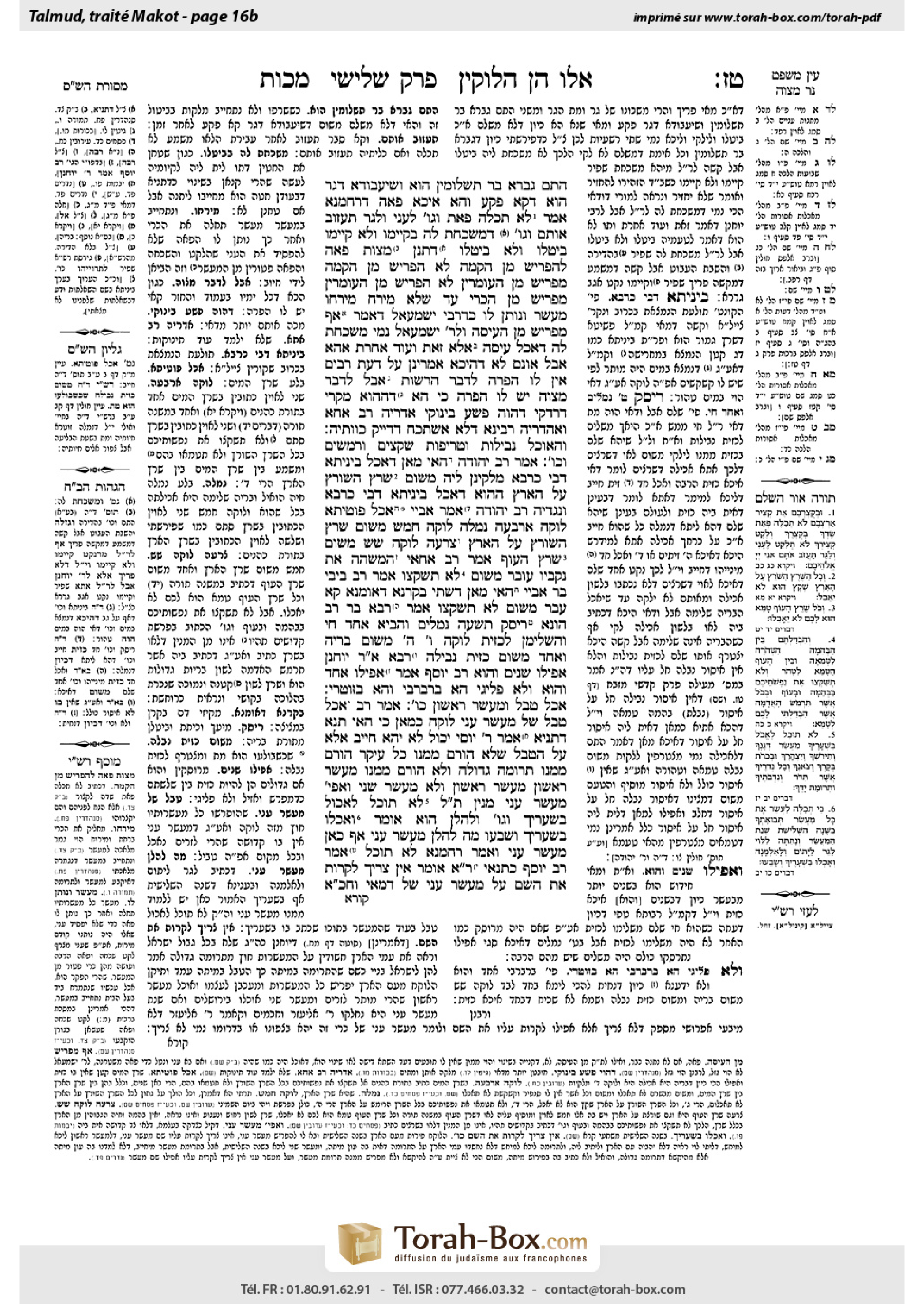
Makkot 16b: Talmud study for Daf Yomi
Daf Yomi is the daily study of one Talmud folio. Explore 37 tractates with scans, Hebrew text, Sefaria English and AI-generated French translations where annotated.
Passage selection and English or AI-generated French translation are available where the scan has annotations. Daf Study is independent of Torah-Box and Sefaria.
Browse Makkot · מכות · All tractatesMakkot 16b text and translations
This page of Makkot includes the Aramaic text, an English translation and an AI-generated French translation, alongside the scan above.
מכות י״ו ב · Aramaic and Hebrew text
הָתָם, גַּבְרָא בַּר תַּשְׁלוּמִין הוּא, וְשִׁיעְבּוּדָא דְּגֵר הוּא דְּקָא פָקַע.
וְהָא אִיכָּא פֵּאָה, דְּרַחֲמָנָא אָמַר ״לֹא תְכַלֶּה פְּאַת וְגוֹ׳״ ״לֶעָנִי וְלַגֵּר תַּעֲזֹב אֹתָם וְגוֹ׳״,
דְּמַשְׁכַּחַתְּ לַהּ בְּקִיְּימוֹ וְלֹא קִיְּימוֹ, בִּיטְּלוֹ וְלֹא בִּיטְּלוֹ! דִּתְנַן: מִצְוַת פֵּאָה לְהַפְרִישׁ מִן הַקָּמָה. לֹא הִפְרִישׁ מִן הַקָּמָה – מַפְרִישׁ מִן הָעוֹמָרִין. לֹא הִפְרִישׁ מִן הָעוֹמָרִין – מַפְרִישׁ מִן הַכְּרִי, עַד שֶׁלֹּא מֵירַח. מֵירְחוֹ – מְעַשֵּׂר וְנוֹתֵן לוֹ!
כִּדְרַבִּי יִשְׁמָעֵאל, דְּאָמַר: אַף מַפְרִישׁ מִן הָעִיסָּה. וּלְרַבִּי יִשְׁמָעֵאל נָמֵי מַשְׁכַּחַתְּ לַהּ, דַּאֲכַל עִיסָּה!
אֶלָּא, ״זֹאת וְעוֹד אַחֶרֶת״ – אַהָא, אֲבָל אוֹנֵס – לָא. דְּהֵיכָא אָמְרִינַן עַל דַּעַת רַבִּים אֵין לוֹ הֲפָרָה – לִדְבַר הָרְשׁוּת, אֲבָל לִדְבַר מִצְוָה – יֵשׁ לוֹ הֲפָרָה.
כִּי הָא דְּהָהוּא מַקְרֵי דַרְדְּקֵי דַּהֲוָה פָּשַׁע בְּיָנוֹקֵי, אַדְּרֵיהּ רַב אַחָא, וְאַהְדְּרֵיהּ רָבִינָא, דְּלָא אִשְׁתְּכַח דְּדָיֵיק כְּווֹתֵיהּ.
וְהָאוֹכֵל נְבֵילוֹת וּטְרֵיפוֹת שְׁקָצִים וּרְמָשִׂים וְכוּ׳. אָמַר רַב יְהוּדָה: הַאי מַאן דַּאֲכַל בִּינִיתָא דְּבֵי כְרָבָא – מַלְקִינַן לֵיהּ מִשּׁוּם ״שֶׁרֶץ הַשֹּׁרֵץ עַל הָאָרֶץ״. הָהוּא דַּאֲכַל בִּינִיתָא דְּבֵי כְרָבָא וְנַגְּדֵיהּ רַב יְהוּדָה.
אָמַר אַבָּיֵי: אָכַל פּוּטִיתָא – לוֹקֶה אַרְבָּעָה.
נְמָלָה – לוֹקֶה חָמֵשׁ, מִשּׁוּם ״שֶׁרֶץ הַשֹּׁרֵץ עַל הָאָרֶץ״.
צִרְעָה – לוֹקֶה שֵׁשׁ, מִשּׁוּם שֶׁרֶץ הָעוֹף.
אָמַר רַב אַחַאי: הַמְשַׁהֶה אֶת נְקָבָיו עוֹבֵר מִשּׁוּם ״לֹא תְשַׁקְּצוּ״. אָמַר רַב בִּיבִי בַּר אַבָּיֵי: הַאי מַאן דְּשָׁתֵי בְּקַרְנָא דְּאוּמָּנָא קָא עָבַר מִשּׁוּם ״לֹא תְשַׁקְּצוּ״.
אָמַר רָבָא בַּר רַב הוּנָא: רִיסֵּק תִּשְׁעָה נְמָלִים וְהֵבִיא אֶחָד חַי וְהִשְׁלִימָן לִכְזַיִת – לוֹקֶה שֵׁשׁ, חָמֵשׁ – מִשּׁוּם בְּרִיָּה, וְאֶחָד – מִשּׁוּם כְּזַיִת נְבֵילָה. רָבָא אָמַר רַבִּי יוֹחָנָן: אֲפִילּוּ שְׁנַיִם וְהוּא. רַב יוֹסֵף אָמַר: אֲפִילּוּ אַחַד וְהוּא. וְלָא פְּלִיגִי, הָא – בְּרַבְרְבֵי, וְהָא – בְּזוּטְרֵי.
״אָכַל טֶבֶל וּמַעֲשֵׂר רִאשׁוֹן״ כּוּ׳. אָמַר רַב: אָכַל טֶבֶל שֶׁל מַעְשַׂר עָנִי – לוֹקֶה.
כְּמַאן – כִּי הַאי תַּנָּא, דְּתַנְיָא, אָמַר רַבִּי יוֹסֵי: יָכוֹל לֹא יְהֵא חַיָּיב אֶלָּא עַל הַטֶּבֶל שֶׁלֹּא הוּרַם מִמֶּנּוּ כׇּל עִיקָּר; הוּרַם מִמֶּנּוּ תְּרוּמָה גְּדוֹלָה וְלֹא הוּרַם מִמֶּנּוּ מַעֲשֵׂר רִאשׁוֹן, מַעֲשֵׂר רִאשׁוֹן וְלֹא מַעֲשֵׂר שֵׁנִי, וַאֲפִילּוּ מַעְשַׂר עָנִי, מִנַּיִן?
תַּלְמוּד לוֹמַר: ״לֹא תוּכַל לֶאֱכֹל בִּשְׁעָרֶיךָ וְגוֹ׳״ וּלְהַלָּן הוּא אוֹמֵר: ״וְאָכְלוּ בִשְׁעָרֶיךָ וְשָׂבֵעוּ״, מָה לְהַלָּן מַעְשַׂר עָנִי, אַף כָּאן מַעְשַׂר עָנִי, וְאָמַר רַחֲמָנָא: ״לֹא תוּכַל״.
אָמַר רַב יוֹסֵף: כְּתַנָּאֵי, רַבִּי אֱלִיעֶזֶר אוֹמֵר: אֵין צָרִיךְ לִקְרוֹת אֶת הַשֵּׁם עַל מַעְשַׂר עָנִי שֶׁל דְּמַאי, וַחֲכָמִים אוֹמְרִים:
Makkot 16b · English translation
The Gemara answers: There, the man who appropriated the collateral is liable to remit monetary payment, and it is only that the lien of the convert on the property has lapsed, as there is no one to receive payment. Therefore, he is not flogged, based on the principle: One is not both flogged and liable to pay restitution.
The Gemara asks: But isn’t there the case of pe’a, where there is a prohibition, as the Merciful One states: “You shall not wholly reap the corner of your field” (Leviticus 23:22), followed by the mitzva: “To the poor and the convert you shall leave them” (Leviticus 23:22)?
And you find one liable to receive lashes in those cases both if the criterion is whether he fulfilled the mitzva or did not fulfill the mitzva, and if the criterion is whether he nullified the mitzva or he did not nullify it, as we learned in a baraita: The mitzva of pe’a is to separate it from the standing grain still growing from the ground. If he did not separate it from the standing grain, but reaped the entire field, he separates a portion from the sheaves as pe’a. If he did not separate it from the sheaves, he separates it from the pile where one places the kernels after threshing, before he smooths the pile. Once he smooths the pile, the produce is considered grain from which one is obligated to separate terumot and tithes. If he already smoothed the pile before designating the pe’a, he tithes the grain in the pile and then gives the pe’a to the poor person. Once he grinds the kernels into flour, he no longer separates pe’a.
Apparently, it is possible to nullify the possibility of fulfilling the mitzva of leaving pe’a by grinding the grain; why, then, did Rabbi Yoḥanan omit this case from his list of prohibitions rectified by a positive mitzva for which one is flogged? The Gemara answers: Rabbi Yoḥanan holds in accordance with the opinion of Rabbi Yishmael, who says: One separates pe’a even from the dough. He maintains that the possibility of fulfilling the mitzva of pe’a is never nullified, as one may separate pe’a even after grinding and kneading. The Gemara challenges: And according to Rabbi Yishmael, you also find a way to nullify the possibility of fulfilling the mitzva, in a case where one ate the dough.
Rather, the Gemara retracts its previous understanding of the statement of Rabbi Yoḥanan: We have only this mitzva and another where one would be flogged if not for the relevant mitzva. The term: This, is in reference to the sending away of the mother bird, and the term: Another, is in reference to this halakha of pe’a. But in the case of a rapist, no, the possibility of remarrying the rape victim whom he divorced is not nullified, even if he vows on the basis of the consent of the public. Where do we say that a vow on the basis of the consent of the public has no nullification? It is only in a case where one seeks nullification of the vow for the purpose of a matter that is optional, i.e., not a mitzva; but if one seeks nullification of the vow for the purpose of a matter that is a mitzva, even a vow taken on the basis of the consent of the public has the possibility of nullification. In the case of the rapist, he could seek nullification of his vow to enable him to fulfill the mitzva of remarrying his divorcée, and therefore the vow can be nullified.
The Gemara relates an incident that proves this point. As this happened in that incident where there was a certain teacher of children who was negligent in his supervision of the children, and Rav Aḥa vowed on the basis of the consent of the public that he would no longer be allowed to teach children. And nevertheless Ravina restored him to his position, because no other teacher was found who was as accurate as he. Apparently, even a vow taken on the basis of the consent of the public has the possibility of nullification, if that nullification is sought in order to fulfill a mitzva.
§ The mishna teaches: And one who eats unslaughtered animal or bird carcasses, or tereifot, or repugnant creatures, or creeping animals, is liable to receive lashes. Rav Yehuda says: One who eats a fish-like creature found in the furrows of a field formed by a plow [binnita devei kerava], we flog him due to violation of the prohibition: “Creeping animals that creep on the ground…shall not be eaten” (Leviticus 11:41). The Gemara relates: There was a certain person who ate a fish-like creature found in the furrows of a field formed by a plow, and Rav Yehuda flogged him.
Abaye says: One who ate a putita, a creeping animal found in the sea, is flogged with four sets of lashes. There are two prohibitions stated with regard to creeping animals in the sea: “And any that do not have fins and scales in the seas and in the rivers…you shall not eat of their flesh” (Leviticus 11:10–11), and: “And any that do not have fins and scales you shall not eat” (Deuteronomy 14:10). In addition, there are two other prohibitions stated with regard to creeping animals in general: “You shall not render yourselves detestable with any creeping animal that creeps, neither shall you render yourselves impure with them” (Leviticus 11:43), for a total of four.
If one ate an ant, he is flogged with five sets of lashes. In addition to the two prohibitions stated with regard to repugnant creatures in general, he is also flogged for violating the prohibitions: “Creeping animals that creep on the ground…shall not be eaten” (Leviticus 11:41), and: “And all creeping animals that creep on the ground, you shall not eat them” (Leviticus 11:42), and: “Neither shall you render yourselves impure with any manner of creeping things that crawls upon the ground” (Leviticus 11:44).
If one ate a wasp, he is flogged with six sets of lashes. In addition to the five prohibitions violated by one who eats an ant, he is flogged with an additional set of lashes due to violation of the prohibition with regard to winged creeping creatures: “And all winged creeping creatures are impure for you, they may not be eaten” (Deuteronomy 14:19).
Rav Aḥai says: One who delays relieving himself through his orifices when the need arises violates the prohibition of: “You shall not make your souls detestable” (Leviticus 20:25). Rav Beivai bar Abaye says: One who drinks from the horn of a bloodletter through which blood has passed violates the prohibition of: “You shall not make your souls detestable.”
Rava bar Rav Huna says: If one crushed nine ants and brought another one that was alive and thereby completed their measure to an olive-bulk and ate them, he is flogged with six sets of lashes: Five for eating an entity for which one is flogged five times as stated above with regard to one who eats an ant, and one for eating an olive-bulk of an unslaughtered carcass all together. Rava says that Rabbi Yoḥanan says: Even if he ate two crushed ants and the ant that was alive, he is flogged with six sets of lashes. Rav Yosef says: Even if he ate one crushed ant and the ant that was alive. The Gemara comments: And they do not disagree; this case, where Rava and Rav Yosef say that he is flogged for eating one or two crushed ants and one that is alive, is referring to large ants, which together amount to an olive-bulk. And that case, where Rava bar Rav Huna mentions nine ants, is referring to small ants, as a greater number of ants is required to constitute an olive-bulk and render him liable. Consequently, there is no halakhic dispute in this case.
§ The mishna teaches that among those flogged is one who ate untithed produce or first-tithe produce whose teruma of the tithe was not taken. Rav says: If one ate untithed produce from which teruma and first tithe were separated and poor man’s tithe was not separated, he is flogged.
The Gemara explains: In accordance with whose opinion did Rav issue this ruling? It is in accordance with the opinion of this tanna, as it is taught in a baraita that Rabbi Yosei says: One might have thought that one is liable for eating only untithed produce from which no gifts were taken at all; but if teruma gedola was taken from the produce, but first tithe was not taken from it, or if the first tithe was separated but not second tithe, or even if only poor man’s tithe was not separated, from where is it derived that the halakhic status of the produce is that of untithed produce and one is liable for eating it?
The baraita continues: It is derived as the verse states: “You may not eat within your gates the tithe of your grain or of your wine or of your oil” (Deuteronomy 12:17), and there it states: “And you shall give to the Levite, to the convert, to the orphan, and to the widow, and they shall eat within your gates and be satisfied” (Deuteronomy 26:12). Just as there, with regard to the phrase “and they shall eat within your gates,” it is referring to poor man’s tithe, here too, “you may not eat within your gates” is referring to produce in which there is poor man’s tithe, as it has not yet been separated, and the Merciful One states a prohibition: You may not eat it.
Rav Yosef said: This matter is subject to a dispute between tanna’im. Rabbi Eliezer says: One need not separate by means of calling the name upon poor man’s tithe of doubtfully tithed produce [demai]. With regard to produce purchased from an am ha’aretz, i.e., one who is unreliable with regard to tithes, there is a rabbinic ordinance requiring one to separate first and second tithe and teruma of the tithe from it. Nevertheless, one is not required to separate poor man’s tithe from that produce, because poor man’s tithe is a monetary debt owed to the poor, and in a case of uncertainty, the principle is: The burden of proof rests upon the claimant. Rabbi Eliezer holds that failure to separate poor man’s tithe does not accord the produce the status of untithed produce. And the Rabbis say:
Makkot 16b · Traduction française (IA)
La Guemara répond : dans ce cas, l’homme qui s’est approprié le gage reste redevable d’un paiement ; seul le droit de gage du converti sur le bien est devenu caduc, puisqu’il n’y a personne pour recevoir le paiement. Il n’est donc pas passible de flagellation, selon le principe qu’on ne peut pas être à la fois flagellé et tenu de verser une indemnité.
La Guemara demande : Mais n’y a-t-il pas le cas de la péa, où il y a une interdiction, puisque le Miséricordieux dit : « Tu ne moissonneras pas entièrement le coin de ton champ » (Lévitique 23,22), puis énonce la mitsva : « Tu les laisseras au pauvre et au converti » (Lévitique 23,22) ?
Or, dans ces cas, on peut être passible de flagellation aussi bien lorsque le critère est d’avoir accompli ou non la mitsva que lorsqu’il s’agit de savoir si on l’a rendue impossible ou non, comme nous l’avons appris dans une baraïta : la mitsva de la péa consiste à la prélever sur les céréales encore sur pied, toujours enracinées dans le sol. S’il ne l’a pas prélevée sur les céréales encore sur pied, mais qu’il a moissonné tout le champ, il prélève une part des gerbes au titre de la péa. S’il ne l’a pas prélevée sur les gerbes, il la prélève dans le tas où l’on rassemble les grains après le battage, avant d’aplanir le tas. Une fois le tas aplani, la récolte est considérée comme des céréales sur lesquelles il faut prélever les teroumot et les dîmes. S’il a déjà aplani le tas avant de désigner la péa, il prélève les dîmes sur les céréales du tas, puis donne la péa au pauvre. Une fois les grains moulus en farine, il ne prélève plus la péa.
Il apparaît donc qu’il est possible de rendre impossible l’accomplissement de la mitsva de laisser la péa en moulant les grains. Pourquoi Rabbi Yoḥanan a-t-il alors omis ce cas de sa liste des interdictions réparées par une mitsva positive, pour lesquelles on est passible de flagellation ? La Guemara répond : Rabbi Yoḥanan suit l’opinion de Rabbi Yishmael, qui dit : on prélève la péa même sur la pâte. Il estime que la possibilité d’accomplir la mitsva de la péa ne disparaît jamais, puisqu’on peut prélever la péa même après avoir moulu et pétri les grains. La Guemara objecte : Mais, selon Rabbi Yishmael, on peut aussi rendre impossible l’accomplissement de la mitsva si l’on mange la pâte.
La Guemara revient plutôt sur sa compréhension précédente de la déclaration de Rabbi Yoḥanan : il n’y a que cette mitsva et une autre pour lesquelles on serait passible de flagellation en l’absence de la mitsva correspondante. Le terme « cette » renvoie au renvoi de la mère oiseau, et le terme « une autre » à cette halakha de la péa. Mais dans le cas du violeur, la possibilité d’épouser de nouveau la femme qu’il a violée après l’avoir répudiée n’est pas rendue impossible, même s’il fait un vœu avec le consentement de la collectivité. Dans quel cas dit-on qu’un vœu fait avec le consentement de la collectivité ne peut pas être annulé ? Seulement lorsqu’on cherche à l’annuler pour une affaire facultative, c’est-à-dire qui ne relève pas d’une mitsva. Mais si l’on cherche à l’annuler pour une affaire qui relève d’une mitsva, même un vœu fait avec le consentement de la collectivité peut être annulé. Dans le cas du violeur, il pourrait demander l’annulation de son vœu afin d’accomplir la mitsva d’épouser de nouveau la femme qu’il a répudiée ; le vœu peut donc être annulé.
La Guemara rapporte un épisode qui confirme ce point. Il s’agissait d’un maître d’enfants qui négligeait la surveillance des enfants ; Rav Aḥa fit alors un vœu avec le consentement de la collectivité, interdisant à cet homme d’enseigner aux enfants. Pourtant, Ravina le rétablit dans ses fonctions, car on ne trouva aucun autre maître aussi précis que lui. Il apparaît donc que même un vœu fait avec le consentement de la collectivité peut être annulé si l’on demande cette annulation afin d’accomplir une mitsva.
§ La Michna enseigne : celui qui mange des carcasses d’animaux ou d’oiseaux qui n’ont pas été abattus rituellement, des animaux tréfa, des créatures répugnantes ou des animaux rampants est passible de flagellation. Rav Yehouda dit : celui qui mange une créature ressemblant à un poisson, trouvée dans les sillons d’un champ tracés par une charrue [binnita devei kerava], est flagellé pour avoir enfreint l’interdiction : « Les animaux rampants qui rampent sur le sol… ne seront pas mangés » (Lévitique 11,41). La Guemara rapporte qu’un homme mangea une créature ressemblant à un poisson, trouvée dans les sillons d’un champ tracés par une charrue, et que Rav Yehouda le flagella.
Abayé dit : celui qui mange une putita, une créature rampante vivant dans la mer, est passible de quatre séries de flagellations. Deux interdictions concernant les créatures rampantes de la mer sont énoncées : « Et tout ce qui n’a ni nageoires ni écailles dans les mers et dans les fleuves… vous ne mangerez pas de leur chair » (Lévitique 11,10-11), et : « Et tout ce qui n’a ni nageoires ni écailles, vous ne le mangerez pas » (Deutéronome 14,10). S’y ajoutent deux autres interdictions concernant les créatures rampantes en général : « Ne vous rendez pas détestables par quelque animal rampant que ce soit, et ne vous rendez pas impurs par eux » (Lévitique 11,43), soit quatre interdictions au total.
Celui qui mange une fourmi est passible de cinq séries de flagellations. Outre les deux interdictions énoncées au sujet des créatures répugnantes en général, il est également flagellé pour avoir enfreint les interdictions suivantes : « Les animaux rampants qui rampent sur le sol… ne seront pas mangés » (Lévitique 11,41) ; « Et tous les animaux rampants qui rampent sur le sol, vous ne les mangerez pas » (Lévitique 11,42) ; et « Ne vous rendez pas impurs par quelque créature rampante que ce soit, qui rampe sur le sol » (Lévitique 11,44).
Celui qui mange une guêpe est passible de six séries de flagellations. Outre les cinq interdictions enfreintes par celui qui mange une fourmi, il est passible d’une série supplémentaire de flagellations pour avoir enfreint l’interdiction relative aux créatures rampantes ailées : « Et toutes les créatures rampantes ailées sont impures pour vous ; elles ne seront pas mangées » (Deutéronome 14,19).
Rav Aḥai dit : celui qui retarde le moment de se soulager par ses orifices alors qu’il en ressent le besoin enfreint l’interdiction : « Vous ne rendrez pas vos personnes détestables » (Lévitique 20,25). Rav Beivai bar Abayé dit : celui qui boit dans la corne d’un saigneur par laquelle le sang a coulé enfreint l’interdiction : « Vous ne rendrez pas vos personnes détestables ».
Rava bar Rav Huna dit : si quelqu’un écrase neuf fourmis, en apporte une autre vivante et complète ainsi le volume d’une olive, puis les mange, il est passible de six séries de flagellations : cinq pour avoir mangé une créature dont la consommation entraîne cinq séries de flagellations, comme indiqué plus haut au sujet de celui qui mange une fourmi, et une pour avoir mangé au total le volume d’une olive de carcasse non abattue rituellement. Rava dit au nom de Rabbi Yoḥanan : même s’il a mangé deux fourmis écrasées et une fourmi vivante, il est passible de six séries de flagellations. Rav Yosef dit : même s’il a mangé une fourmi écrasée et une fourmi vivante. La Guemara commente : ils ne sont pas en désaccord. Le cas où Rava et Rav Yosef disent qu’il est passible de flagellation pour avoir mangé une ou deux fourmis écrasées et une fourmi vivante concerne de grandes fourmis, qui forment ensemble le volume d’une olive. L’autre cas, où Rava bar Rav Huna mentionne neuf fourmis, concerne de petites fourmis, car il en faut davantage pour atteindre le volume d’une olive et le rendre passible. Il n’y a donc pas de désaccord halakhique sur ce point.
§ La Michna enseigne que celui qui mange des produits non dîmés ou des produits de la première dîme dont la terouma de la dîme n’a pas été prélevée est passible de flagellation. Rav dit : si quelqu’un mange des produits non dîmés dont la terouma et la première dîme ont été prélevées, mais dont la dîme du pauvre n’a pas été prélevée, il est passible de flagellation.
La Guemara explique : selon l’opinion de quel tanna Rav a-t-il rendu cette décision ? Selon celle de ce tanna, car il est enseigné dans une baraïta que Rabbi Yosei dit : on aurait pu penser que l’on est passible uniquement pour avoir mangé des produits non dîmés dont aucun prélèvement n’a été effectué. Mais si la grande terouma a été prélevée sur les produits tandis que la première dîme ne l’a pas été, ou si la première dîme a été prélevée mais pas la seconde dîme, ou même si seule la dîme du pauvre n’a pas été prélevée, d’où déduit-on que ces produits ont le statut de produits non dîmés et que l’on est passible pour les avoir mangés ?
La baraïta poursuit : on le déduit du verset qui dit : « Tu ne pourras pas manger dans tes portes la dîme de ton blé, de ton vin ou de ton huile » (Deutéronome 12,17), et de ce qui est dit ailleurs : « Tu donneras au Lévite, au converti, à l’orphelin et à la veuve, et ils mangeront dans tes portes et seront rassasiés » (Deutéronome 26,12). De même que là, l’expression « ils mangeront dans tes portes » fait référence à la dîme du pauvre, ici aussi, « tu ne pourras pas manger dans tes portes » fait référence aux produits qui comportent une dîme du pauvre parce qu’elle n’a pas encore été prélevée ; le Miséricordieux énonce donc l’interdiction de les manger.
Rav Yosef dit : cette question fait l’objet d’un désaccord entre les tannaïm. Rabbi Eliezer dit : il n’est pas nécessaire de désigner la dîme du pauvre en la prélevant sur des produits dont le statut au regard des dîmes est douteux [demai]. Pour les produits achetés à un am ha’aretz, c’est-à-dire à quelqu’un qui n’est pas fiable en matière de dîmes, une ordonnance rabbinique impose d’en prélever la première et la seconde dîme, ainsi que la terouma de la dîme. Néanmoins, il n’est pas nécessaire d’en prélever la dîme du pauvre, car celle-ci constitue une dette d’argent envers les pauvres et, en cas de doute, le principe veut que la charge de la preuve incombe au demandeur. Rabbi Eliezer estime que le fait de ne pas prélever la dîme du pauvre ne confère pas aux produits le statut de produits non dîmés. Et les Sages disent :
Traduction française générée par IA à partir de l’édition anglaise de Sefaria. Vérifie toujours un passage avec le texte source.
Text from Sefaria: William Davidson Edition - Vocalized Aramaic (CC BY NC); William Davidson Edition - English (CC BY NC).