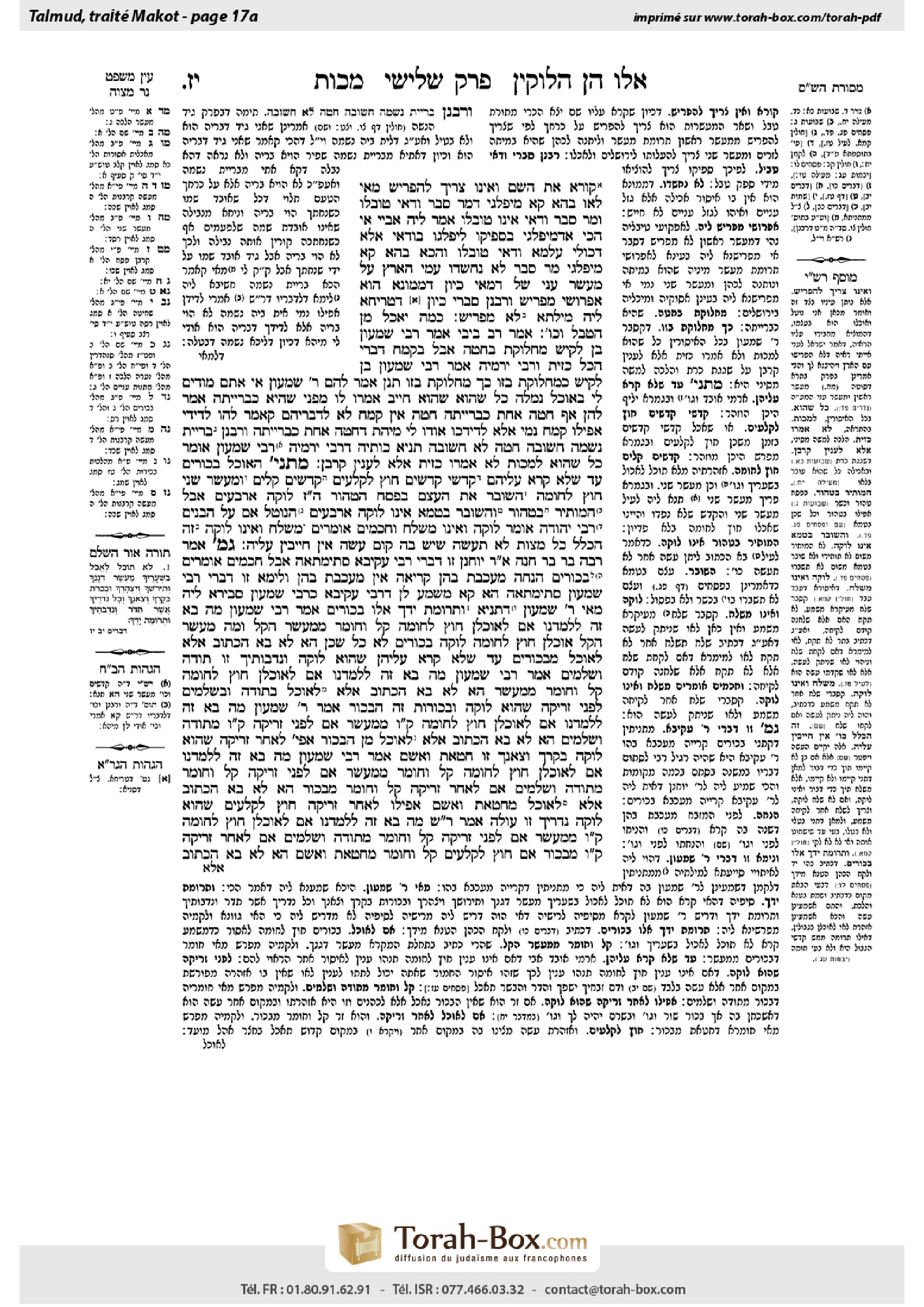
Makkot 17a: Talmud study for Daf Yomi
Daf Yomi is the daily study of one Talmud folio. Explore 37 tractates with scans, Hebrew text, Sefaria English and AI-generated French translations where annotated.
Passage selection and English or AI-generated French translation are available where the scan has annotations. Daf Study is independent of Torah-Box and Sefaria.
Browse Makkot · מכות · All tractatesMakkot 17a text and translations
This page of Makkot includes the Aramaic text, an English translation and an AI-generated French translation, alongside the scan above.
מכות י״ז א · Aramaic and Hebrew text
קוֹרֵא אֶת הַשֵּׁם, וְאֵינוֹ צָרִיךְ לְהַפְרִישׁ.
מַאי לָאו בְּהָא קָא מִיפַּלְגִי, דְּמָר סָבַר: וַדַּאי – טוֹבְלוֹ. וּמָר סָבַר: וַדַּאי – אֵינוֹ טוֹבְלוֹ? אֲמַר לֵיהּ אַבָּיֵי: אִי הָכִי, אַדְּמִיפַּלְגִי בִּסְפֵיקוֹ, לִיפַּלְגוּ בְּוַדַּאי!
אֶלָּא, דְּכוּלֵּי עָלְמָא וַדַּאי – טוֹבְלוֹ. וְהָכָא בְּהָא קָא מִיפַּלְגִי, מָר סָבַר: לֹא נֶחְשְׁדוּ עַמֵּי הָאָרֶץ עַל מַעְשַׂר עָנִי שֶׁל דְּמַאי. כֵּיוָן דְּמָמוֹנָא הוּא – אַפְרוֹשֵׁי מַפְרֵישׁ. וְרַבָּנַן סָבְרִי: כֵּיוָן דִּטְרִיחָא לֵיהּ מִילְּתָא – לָא מַפְרֵישׁ.
כַּמָּה יֹאכַל מִן הַטֶּבֶל וְכוּ׳: אָמַר רַב בִּיבִי אָמַר רַבִּי שִׁמְעוֹן בֶּן לָקִישׁ: מַחְלוֹקֶת בְּחִטָּה, אֲבָל בְּקֶמַח – דִּבְרֵי הַכֹּל כְּזַיִת. וְרַבִּי יִרְמְיָה אָמַר רַבִּי שִׁמְעוֹן בֶּן לָקִישׁ: כְּמַחְלוֹקֶת בָּזוֹ כָּךְ מַחְלוֹקֶת בָּזוֹ.
תְּנַן, אָמַר לָהֶם רַבִּי שִׁמְעוֹן: אִי אַתֶּם מוֹדִים לִי בְּאוֹכֵל נְמָלָה כׇּל שֶׁהוּא שֶׁהוּא חַיָּיב? אָמְרוּ לוֹ: מִפְּנֵי שֶׁהִיא כִּבְרִיָּיתָהּ. אָמַר לָהֶן: אַף חִטָּה אַחַת כִּבְרִיָּיתָהּ. חִטָּה – אִין, קֶמַח – לָא!
לְדִבְרֵיהֶם קָאָמַר לְהוּ: לְדִידִי – אֲפִילּוּ קֶמַח נָמֵי, אֶלָּא לְדִידְכוּ – אוֹדוֹ לִי מִיהַת דְּחִטָּה אַחַת כִּבְרִיָּיתָהּ. וְרַבָּנַן: בְּרִיַּית נְשָׁמָה – חֲשִׁובָה, חִטָּה – לָא חֲשִׁובָה. תַּנְיָא כְּוָתֵיהּ דְּרַבִּי יִרְמְיָה, רַבִּי שִׁמְעוֹן אוֹמֵר: כׇּל שֶׁהוּא לְמַכּוֹת, לֹא אָמְרוּ כְּזַיִת אֶלָּא לְעִנְיַן קׇרְבָּן.
מַתְנִי׳ הָאוֹכֵל בִּכּוּרִים עַד שֶׁלֹּא קָרָא עֲלֵיהֶם, קׇדְשֵׁי קָדָשִׁים חוּץ לַקְּלָעִים, קָדָשִׁים קַלִּים וּמַעֲשֵׂר שֵׁנִי חוּץ לַחוֹמָה. הַשּׁוֹבֵר אֶת הָעֶצֶם בַּפֶּסַח הַטָּהוֹר – הֲרֵי זֶה לוֹקֶה אַרְבָּעִים. אֲבָל הַמּוֹתִיר בַּטָּהוֹר וְהַשּׁוֹבֵר בַּטָּמֵא – אֵינוֹ לוֹקֶה אַרְבָּעִים.
הַנּוֹטֵל אֵם עַל הַבָּנִים, רַבִּי יְהוּדָה אוֹמֵר: לוֹקֶה וְאֵינוֹ מְשַׁלֵּחַ. וַחֲכָמִים אוֹמְרִים: מְשַׁלֵּחַ וְאֵינוֹ לוֹקֶה. זֶה הַכְּלָל: כׇּל מִצְוַת לֹא תַעֲשֶׂה שֶׁיֵּשׁ בָּהּ קוּם עֲשֵׂה – אֵין חַיָּיבִין עָלֶיהָ.
גְּמָ׳ אָמַר רַבָּה בַּר בַּר חָנָה אָמַר רַבִּי יוֹחָנָן: זוֹ דִּבְרֵי רַבִּי עֲקִיבָא סְתִימְתָּאָה, אֲבָל חֲכָמִים אוֹמְרִים: בִּכּוּרִים – הַנָּחָה מְעַכֶּבֶת בָּהֶן, קְרִיאָה אֵין מְעַכֶּבֶת בָּהֶן.
וְלֵימָא זוֹ דִּבְרֵי רַבִּי שִׁמְעוֹן סְתִימְתָּאָה! הָא קָא מַשְׁמַע לַן דְּרַבִּי עֲקִיבָא כְּרַבִּי שִׁמְעוֹן סְבִירָא לֵיהּ.
מַאי רַבִּי שִׁמְעוֹן? דְּתַנְיָא: ״וּתְרוּמַת יָדֶךָ״ – אֵלּוּ בִּכּוּרִים.
אָמַר רַבִּי שִׁמְעוֹן: מָה בָּא זֶה לְלַמְּדֵנוּ? אִם לְאוֹכְלָן חוּץ לַחוֹמָה – קַל וָחוֹמֶר מִמַּעֲשֵׂר הַקַּל: וּמָה מַעֲשֵׂר הַקַּל, אוֹכְלָן חוּץ לַחוֹמָה לוֹקֶה – בִּכּוּרִים לֹא כׇּל שֶׁכֵּן? הָא לֹא בָּא הַכָּתוּב אֶלָּא לָאוֹכֵל מִבִּכּוּרִים עַד שֶׁלֹּא קָרָא עֲלֵיהֶם, שֶׁהוּא לוֹקֶה.
״וְנִדְבֹתֶיךָ״ – זוֹ תּוֹדָה וּשְׁלָמִים. אָמַר רַבִּי שִׁמְעוֹן: מָה בָּא זֶה לְלַמְּדֵנוּ? אִם לְאוֹכְלָן חוּץ לַחוֹמָה – קַל וָחוֹמֶר מִמַּעֲשֵׂר, הָא לֹא בָּא הַכָּתוּב אֶלָּא לָאוֹכֵל בְּתוֹדָה וּבִשְׁלָמִים לִפְנֵי זְרִיקָה, שֶׁהוּא לוֹקֶה.
״וּבְכֹרֹת״ – זֶה הַבְּכוֹר. אָמַר רַבִּי שִׁמְעוֹן: מָה בָּא זֶה לְלַמְּדֵנוּ? אִם לְאוֹכְלָן חוּץ לַחוֹמָה – קַל וָחוֹמֶר מִמַּעֲשֵׂר, אִם לִפְנֵי זְרִיקָה – קַל וָחוֹמֶר מִתּוֹדָה וּשְׁלָמִים! הָא לֹא בָּא הַכָּתוּב אֶלָּא לָאוֹכֵל מִן הַבְּכוֹר אֲפִילּוּ לְאַחַר זְרִיקָה, שֶׁהוּא לוֹקֶה.
״בְּקָרְךָ וְצֹאנֶךָ״ – זוֹ חַטָּאת וְאָשָׁם. אָמַר רַבִּי שִׁמְעוֹן: מָה בָּא זֶה לְלַמְּדֵנוּ?
אִם לְאוֹכְלָן חוּץ לַחוֹמָה – קַל וָחוֹמֶר מִמַּעֲשֵׂר, אִם לִפְנֵי זְרִיקָה – קַל וָחוֹמֶר מִתּוֹדָה וּשְׁלָמִים, אִם לְאַחַר זְרִיקָה – קַל וָחוֹמֶר מִבְּכוֹר! הָא לֹא בָּא הַכָּתוּב אֶלָּא לָאוֹכֵל מֵחַטָּאת וְאָשָׁם אֲפִילּוּ לְאַחַר זְרִיקָה חוּץ לַקְּלָעִים, שֶׁהוּא לוֹקֶה.
״נְדָרֶיךָ״ – זוֹ עוֹלָה. אָמַר רַבִּי שִׁמְעוֹן: מָה בָּא זֶה לְלַמְּדֵנוּ?
אִם לְאוֹכְלָן חוּץ לַחוֹמָה – קַל וָחוֹמֶר מִמַּעֲשֵׂר, אִם לִפְנֵי זְרִיקָה – קַל וָחוֹמֶר מִתּוֹדָה וּשְׁלָמִים, אִם לְאַחַר זְרִיקָה – קַל וָחוֹמֶר מִבְּכוֹר, אִם חוּץ לַקְּלָעִים – קַל וָחוֹמֶר מֵחַטָּאת וְאָשָׁם! הָא לֹא בָּא הַכָּתוּב
Makkot 17a · English translation
He designates a portion of the produce by means of calling the name upon poor man’s tithe, but he is not required to physically separate that portion and give it to the poor.
Rav Yosef suggests: What, is it not that they disagree with regard to this: That one Sage, the Rabbis, holds that produce from which poor man’s tithe was certainly not separated is rendered untithed produce, and therefore, in a case where there is uncertainty whether poor man’s tithe was separated, one is required to separate it; and one Sage, Rabbi Eliezer, holds that produce from which poor man’s tithe was certainly not separated is not rendered untithed produce, and therefore, one need not even designate poor man’s tithe by calling its name upon a portion of the produce? Abaye said to Rav Yosef: If it is so, that this is the point in dispute, rather than disagreeing with regard to a case of uncertainty whether poor man’s tithe was separated, let them disagree with regard to a case of certainty that poor man’s tithe was not separated.
Rather, contrary to the previous suggestion, say that everyone agrees that produce from which poor man’s tithe was certainly not separated is rendered untithed produce. And here, it is with regard to this that they disagree: One Sage, Rabbi Eliezer, holds: Amei ha’aretz are not suspected of refraining from separating poor man’s tithe of demai. Since it is merely a matter of money, and no sanctity is involved, he separates poor man’s tithe, although he does not actually give it to the poor. And the Rabbis hold: Since the matter involves exertion for him, he does not even separate poor man’s tithe.
§ The mishna teaches: How much does one need to eat from untithed produce and be liable to receive lashes? Rabbi Shimon says: Even if one ate any amount of untithed produce he is liable to receive lashes. And the Rabbis say: He is liable only if he eats an olive-bulk. Rav Beivai says that Rabbi Shimon ben Lakish says: Their dispute is with regard to one who eats one kernel of wheat of untithed produce. But with regard to flour, everyone agrees that one is liable only if he eats an olive-bulk. And Rabbi Yirmeya says that Rabbi Shimon ben Lakish says: Just as there is a dispute with regard to this case of a kernel of wheat, so too, there is a dispute with regard to that case of flour.
The Gemara cites proof from that which we learned in the mishna: Rabbi Shimon said to them: Do you not concede to me with regard to one who eats an ant of any size that he is liable to receive lashes? The Rabbis said to Rabbi Shimon: He is flogged for eating an ant of any size due to the fact that it is an intact entity in the form of its creation. Rabbi Shimon said to them: One kernel of wheat is also in the form of its creation. The Gemara infers from Rabbi Shimon’s response: For a kernel of wheat, yes, one is liable; for any amount of flour, no, one is not liable. Apparently, even Rabbi Shimon concedes that one is liable for eating only an olive-bulk of wheat flour, in accordance with the statement that Rav Beivai says that Rabbi Shimon ben Lakish says.
The Gemara answers: It is in accordance with the statement of the Rabbis that Rabbi Shimon spoke to them, and he meant as follows: According to my opinion, even if one ate any amount of flour he is also liable. But according to your opinion, concede to me at least that one is liable if he eats one kernel of wheat, as it is in the form of its creation. And the Rabbis say in response: There is a difference; an entity with a soul, i.e., a living creature, is significant, and one is liable for eating an entity of any volume. A kernel of wheat is not significant. The Gemara notes: It is taught in a baraita in accordance with the opinion of Rabbi Yirmeya, that Rabbi Shimon says: One who eats any amount of food that is forbidden is liable to receive lashes; the Sages said the measure of an olive-bulk only with regard to liability to bring a sin-offering for one who unwittingly ate forbidden food.
MISHNA: In the case of a priest who eats first fruits before the one who brought the fruits to the Temple recited over those fruits the Torah verses that he is obligated to recite (see Deuteronomy 26:3–10); and one who ate offerings of the most sacred order outside the curtains surrounding the Tabernacle courtyard, or outside the Temple courtyard; and one who ate offerings of lesser sanctity or second-tithe produce outside the wall of Jerusalem; and also one who breaks the bone of a ritually pure Paschal offering; in all these cases he is flogged with forty lashes. But one who leaves the flesh of the ritually pure Paschal offering until the morning of the fifteenth of Nisan, and one who breaks a bone of a ritually impure Paschal offering, is not flogged with forty lashes.
With regard to one who takes the mother bird with her fledglings, thereby violating the Torah prohibition: “You shall not take the mother with her fledglings; you shall send the mother, and the fledglings you may take for yourself” (Deuteronomy 22:6–7), Rabbi Yehuda says: He is flogged for taking the mother bird, and does not send the mother, and the Rabbis say: He sends the mother and is not flogged, as this is the principle: With regard to any prohibition that entails a command to arise and perform a mitzva, he is not liable to receive lashes for its violation.
GEMARA: The mishna teaches that a priest who eats first fruits before the one who brought the fruits to the Temple recited the accompanying Torah verses is liable to receive lashes. With regard to this statement, Rabba bar bar Ḥana says that Rabbi Yoḥanan says: This is the statement of Rabbi Akiva, whose statements are often cited in the mishna unattributed. But the Rabbis say: With regard to first fruits, the lack of placement alongside the altar invalidates them, and they may not be eaten; but the lack of recitation of the accompanying Torah verses does not invalidate them, and if one placed them and did not recite the accompanying Torah verses, the priest who eats them is not flogged.
The Gemara suggests: And let Rabbi Yoḥanan say: This statement in the mishna is the unattributed statement of Rabbi Shimon, who stated this halakha explicitly, rather than attributing the statement to Rabbi Akiva, whose statement was not explicit. The Gemara answers: This teaches us that although he did not say so explicitly, Rabbi Akiva holds in accordance with the opinion of Rabbi Shimon.
What is the statement of Rabbi Shimon? It is as it is taught in a baraita with regard to food items that may not be eaten outside the walls of Jerusalem. It is written: “You may not eat within your gates the tithe of your grain, or of your wine, or of your oil, or the firstborn of your herd or of your flock, nor any of your vows that you vow, nor your gift offerings, nor the donation of your hand” (Deuteronomy 12:17). The Sages explain that with regard to the phrase “nor the donation of [terumat] your hand,” these are first fruits.
Rabbi Shimon said: What does this phrase come to teach us? If it is to teach the prohibition to eat the first fruits outside the wall of Jerusalem, there is no need for a verse, as it may be derived by means of an a fortiori inference from the lenient case of second-tithe produce. If with regard to the lenient case of second-tithe produce, one who eats them outside the wall is flogged, then with regard to first fruits, all the more so is it not clear that he is flogged? Rather, the verse comes to teach only with regard to a priest who partakes of first fruits before the person who brought the fruits to the Temple recited the accompanying Torah verses over them, teaching that he is flogged.
The baraita continues: “Nor your gift offerings”; this is a thanks-offering and a peace-offering that one donates voluntarily. Rabbi Shimon says: What does this phrase come to teach us? If it is to teach that it is prohibited to eat a thanks-offering and a peace-offering outside the wall of Jerusalem, there is no need for a verse, as it may be derived by means of an a fortiori inference from the case of second-tithe produce, for whose consumption outside the wall one is flogged, despite the fact that it is not an offering. Rather, the verse comes to teach only with regard to one who partakes of a thanks-offering or of a peace-offering before the sprinkling of its blood on the altar, before the consumption of its flesh is permitted, that he is flogged.
The baraita continues: “Or the firstborn”; this is the firstborn. Rabbi Shimon says: What does this verse come to teach us? If it is to teach that it is prohibited to eat a firstborn animal outside the wall of Jerusalem, there is no need for a verse, as it may be derived by means of an a fortiori inference from the case of second-tithe produce. If it is to teach that it is prohibited to eat a firstborn animal before the sprinkling of the blood, it may be derived by means of an a fortiori inference from the case of a thanks-offering and a peace-offering, which are offerings of lesser sanctity, as even non-priests may partake of their flesh. Rather, the verse comes to teach only with regard to a non-priest who partakes of the flesh of a firstborn even after the sprinkling of its blood, that he is flogged.
The baraita continues: “Of your herd or of your flock”; this is a sin-offering and a guilt-offering, which are offerings of the most sacred order, which may be eaten only within the Temple courtyard. Rabbi Shimon says: What does this verse come to teach us?
If it is to teach that it is prohibited to eat a sin-offering and a guilt-offering outside the wall, there is no need for a verse, as it may be derived by means of an a fortiori inference from the case of second-tithe produce. If it is to teach that it is prohibited to eat a sin-offering and a guilt-offering before the sprinkling of the blood, it may be derived by means of an a fortiori inference from the case of a thanks-offering and a peace-offering, which are offerings of lesser sanctity. If it is to teach that it is prohibited for a non-priest to eat a sin-offering and a guilt-offering after the sprinkling of its blood, it may be derived by means of an a fortiori inference from the case of a firstborn animal. Rather, the verse comes to teach only with regard to one who partakes of the flesh of a sin-offering or a guilt-offering even after the sprinkling of its blood, which is the correct time to partake of it, but he partakes of it outside the curtains surrounding the Tabernacle courtyard or outside the Temple courtyard, that he is flogged.
The baraita continues: “Your vows”; this is the burnt-offering, which is an offering of the most sacred order and is entirely consumed upon the altar, and is brought as a gift offering, not as an obligation. Rabbi Shimon says: What does this verse come to teach us?
If it is to teach that it is prohibited to eat a burnt-offering outside the wall of Jerusalem, there is no need for a verse, as it may be derived by means of an a fortiori inference from the case of second-tithe produce. If it is to teach that it is prohibited to eat a burnt-offering before the sprinkling of the blood, it may be derived by means of an a fortiori inference from the case of a thanks-offering and a peace-offering, which are offerings of lesser sanctity. If it is to teach that it is prohibited for a non-priest to eat a sin-offering and a guilt-offering after the sprinkling of its blood, it may be derived by means of an a fortiori inference from the case of a firstborn animal. If it is to teach that it is prohibited to eat a burnt-offering outside the curtains surrounding the Tabernacle courtyard or outside the Temple courtyard there is an a fortiori inference from a sin-offering and a guilt-offering. Rather, the verse comes
Makkot 17a · Traduction française (IA)
Il désigne une part de la récolte en la déclarant comme dîme des pauvres, mais il n’est pas tenu de la séparer matériellement et de la donner aux pauvres.
Rav Yosef suggère : N’est-ce pas sur ce point qu’ils sont en désaccord ? Un Sage, les Rabbins, estime que les produits dont la dîme des pauvres n’a certainement pas été prélevée sont considérés comme des produits non soumis à la dîme ; par conséquent, en cas de doute quant au prélèvement de la dîme des pauvres, il faut la prélever. L’autre Sage, Rabbi Eliezer, estime que les produits dont la dîme des pauvres n’a certainement pas été prélevée ne sont pas considérés comme des produits non soumis à la dîme ; par conséquent, il n’est même pas nécessaire de désigner la dîme des pauvres en la déclarant sur une partie de la récolte. Abaye dit à Rav Yosef : Si tel est le point de désaccord, au lieu de diverger au sujet d’un cas où l’on doute que la dîme des pauvres ait été prélevée, qu’ils divergent au sujet d’un cas où l’on sait avec certitude qu’elle ne l’a pas été.
Au contraire, à l’inverse de la suggestion précédente, disons que tous conviennent que les produits dont la dîme des pauvres n’a certainement pas été prélevée sont considérés comme des produits non soumis à la dîme. Et voici sur quoi ils sont en désaccord : un Sage, Rabbi Eliezer, estime que les amei ha’aretz ne sont pas soupçonnés de s’abstenir de prélever la dîme des pauvres sur le demaï. Puisqu’il s’agit simplement d’une question d’argent, sans enjeu de sainteté, il désigne la dîme des pauvres, même s’il ne la donne pas effectivement aux pauvres. Les Rabbins, eux, estiment que, puisque cela lui demande un effort, il ne désigne même pas la dîme des pauvres.
§ La Michna enseigne : Quelle quantité de produits non soumis à la dîme faut-il manger pour être passible de flagellation ? Rabbi Shimon dit : Même si l’on en mange la moindre quantité, on est passible de flagellation. Les Rabbins disent : On n’est passible que si l’on en mange le volume d’une olive. Rav Beivai rapporte au nom de Rabbi Shimon ben Lakish : Leur désaccord porte sur celui qui mange un seul grain de blé non soumis à la dîme. Mais, en ce qui concerne la farine, tous conviennent que l’on n’est passible que si l’on en mange le volume d’une olive. Rabbi Yirmeya rapporte au nom de Rabbi Shimon ben Lakish : De même qu’il y a un désaccord dans le cas d’un grain de blé, de même y en a-t-il dans celui de la farine.
La Guemara apporte une preuve tirée de ce que nous avons appris dans la Michna. Rabbi Shimon leur dit : Ne reconnaissez-vous pas que celui qui mange une fourmi, quelle que soit sa taille, est passible de flagellation ? Les Rabbins répondirent à Rabbi Shimon : On le flagelle pour avoir mangé une fourmi, quelle que soit sa taille, parce qu’elle constitue une entité entière, dans la forme qui lui a été donnée lors de sa création. Rabbi Shimon leur dit : Un grain de blé aussi a la forme qui lui a été donnée lors de sa création. La Guemara déduit de la réponse de Rabbi Shimon que, pour un grain de blé, oui, on est passible, mais que, pour n’importe quelle quantité de farine, non, on ne l’est pas. Apparemment, même Rabbi Shimon reconnaît que l’on n’est passible que si l’on mange le volume d’une olive de farine de blé, conformément à ce que Rav Beivai rapporte au nom de Rabbi Shimon ben Lakish.
La Guemara répond : Rabbi Shimon s’adressait aux Rabbins selon leur opinion et voulait dire ceci : Selon mon opinion, on est passible même si l’on mange la moindre quantité de farine. Mais, selon votre opinion, reconnaissez-moi au moins que l’on est passible si l’on mange un seul grain de blé, puisqu’il est dans la forme qui lui a été donnée lors de sa création. Les Rabbins répondent : Il y a une différence ; une entité dotée d’une âme, c’est-à-dire un être vivant, a de l’importance, et l’on est passible pour en avoir mangé quelle qu’en soit la quantité. Un grain de blé, lui, n’a pas d’importance. La Guemara relève qu’une baraïta enseigne conformément à l’opinion de Rabbi Yirmeya : Rabbi Shimon dit que celui qui mange la moindre quantité d’un aliment interdit est passible de flagellation ; les Sages n’ont fixé la mesure du volume d’une olive que pour l’obligation d’apporter un sacrifice expiatoire lorsqu’on a mangé par inadvertance un aliment interdit.
MICHNA : Dans le cas d’un prêtre qui mange des prémices avant que celui qui les a apportées au Temple ait récité à leur sujet les versets de la Torah qu’il est tenu de réciter (voir Deutéronome 26, 3-10), de celui qui mange des sacrifices de sainteté supérieure hors des tentures entourant le parvis du Tabernacle ou hors du parvis du Temple, de celui qui mange des sacrifices de sainteté moindre ou des produits de la seconde dîme hors des murailles de Jérusalem, ainsi que de celui qui brise un os d’un sacrifice pascal rituellement pur : dans tous ces cas, il est flagellé de quarante coups. Mais celui qui laisse la chair du sacrifice pascal rituellement pur jusqu’au matin du quinze Nissan, et celui qui brise un os d’un sacrifice pascal rituellement impur, ne sont pas flagellés de quarante coups.
Au sujet de celui qui prend la mère oiseau avec ses oisillons, transgressant ainsi l’interdiction de la Torah : « Tu ne prendras pas la mère avec ses petits ; tu laisseras partir la mère, et tu pourras prendre les petits pour toi » (Deutéronome 22, 6-7), Rabbi Yehouda dit : Il est flagellé pour avoir pris la mère oiseau et ne pas l’avoir laissée partir. Les Rabbins disent : Il laisse partir la mère et n’est pas flagellé, car tel est le principe : pour toute interdiction qui implique un commandement de se lever et d’accomplir une mitsva, on n’est pas passible de flagellation pour l’avoir transgressée.
GUEMARA : La Michna enseigne qu’un prêtre qui mange des prémices avant que celui qui les a apportées au Temple ait récité les versets de la Torah qui les accompagnent est passible de flagellation. À propos de cet enseignement, Rabba bar bar Ḥana rapporte au nom de Rabbi Yoḥanan : Il s’agit de la déclaration de Rabbi Akiva, dont les propos sont souvent cités sans attribution dans la Michna. Mais les Rabbins disent : Pour les prémices, le fait de ne pas les avoir déposées à côté de l’autel les invalide et elles ne peuvent pas être mangées ; en revanche, l’absence de récitation des versets de la Torah qui les accompagnent ne les invalide pas. Ainsi, si on les a déposées sans réciter ces versets, le prêtre qui les mange n’est pas flagellé.
La Guemara suggère : Rabbi Yoḥanan n’aurait-il pas dû dire que cet enseignement anonyme de la Michna est celui de Rabbi Shimon, qui a énoncé explicitement cette halakha, plutôt que de l’attribuer à Rabbi Akiva, qui ne l’a pas énoncée explicitement ? La Guemara répond : Cela nous enseigne que, même s’il ne l’a pas dit explicitement, Rabbi Akiva est du même avis que Rabbi Shimon.
Quel est l’enseignement de Rabbi Shimon ? C’est ce qu’enseigne une baraïta à propos des aliments qu’il est interdit de manger hors des murailles de Jérusalem. Il est écrit : « Tu ne pourras pas manger dans tes portes la dîme de ton blé, de ton vin ou de ton huile, ni les premiers-nés de ton gros ou de ton petit bétail, ni aucun de tes vœux que tu formules, ni tes offrandes volontaires, ni le don de ta main » (Deutéronome 12, 17). Les Sages expliquent que l’expression « ni le don de [terumat] ta main » désigne les prémices.
Rabbi Shimon dit : Que vient nous enseigner cette expression ? S’il s’agit d’enseigner l’interdiction de manger les prémices hors des murailles de Jérusalem, le verset est superflu, car on peut le déduire par un raisonnement a fortiori du cas moins rigoureux des produits de la seconde dîme. Si, dans le cas moins rigoureux des produits de la seconde dîme, celui qui les mange hors des murailles est flagellé, à plus forte raison est-il évident qu’il est flagellé dans le cas des prémices. Le verset vient plutôt enseigner uniquement le cas d’un prêtre qui prend part aux prémices avant que celui qui les a apportées au Temple ait récité à leur sujet les versets de la Torah qui les accompagnent : il est flagellé.
La baraïta poursuit : « Ni tes offrandes volontaires » désigne un sacrifice d’action de grâce et un sacrifice de paix que l’on apporte volontairement. Rabbi Shimon dit : Que vient nous enseigner cette expression ? S’il s’agit d’enseigner qu’il est interdit de manger un sacrifice d’action de grâce ou un sacrifice de paix hors des murailles de Jérusalem, le verset est superflu, car on peut le déduire par un raisonnement a fortiori du cas des produits de la seconde dîme, pour lesquels celui qui les consomme hors des murailles est flagellé, bien qu’il ne s’agisse pas d’un sacrifice. Le verset vient plutôt enseigner uniquement le cas de celui qui prend part à un sacrifice d’action de grâce ou à un sacrifice de paix avant l’aspersion de son sang sur l’autel, avant que la consommation de sa chair ne soit permise : il est flagellé.
La baraïta poursuit : « Ni les premiers-nés » désigne le premier-né. Rabbi Shimon dit : Que vient nous enseigner ce verset ? S’il s’agit d’enseigner qu’il est interdit de manger un animal premier-né hors des murailles de Jérusalem, le verset est superflu, car on peut le déduire par un raisonnement a fortiori du cas des produits de la seconde dîme. S’il s’agit d’enseigner qu’il est interdit de manger un animal premier-né avant l’aspersion du sang, on peut le déduire par un raisonnement a fortiori du cas du sacrifice d’action de grâce et du sacrifice de paix, qui sont des sacrifices de sainteté moindre puisque même les non-prêtres peuvent manger leur chair. Le verset vient plutôt enseigner uniquement le cas d’un non-prêtre qui prend part à la chair d’un premier-né même après l’aspersion de son sang : il est flagellé.
La baraïta poursuit : « De ton gros ou de ton petit bétail » désigne un sacrifice expiatoire et un sacrifice de culpabilité, qui sont des sacrifices de sainteté supérieure et ne peuvent être mangés que dans le parvis du Temple. Rabbi Shimon dit : Que vient nous enseigner ce verset ?
S’il s’agit d’enseigner qu’il est interdit de manger un sacrifice expiatoire ou un sacrifice de culpabilité hors des murailles, le verset est superflu, car on peut le déduire par un raisonnement a fortiori du cas des produits de la seconde dîme. S’il s’agit d’enseigner qu’il est interdit de manger un sacrifice expiatoire ou un sacrifice de culpabilité avant l’aspersion du sang, on peut le déduire par un raisonnement a fortiori du cas du sacrifice d’action de grâce et du sacrifice de paix, qui sont des sacrifices de sainteté moindre. S’il s’agit d’enseigner qu’il est interdit à un non-prêtre de manger un sacrifice expiatoire ou un sacrifice de culpabilité après l’aspersion de son sang, on peut le déduire par un raisonnement a fortiori du cas d’un animal premier-né. Le verset vient plutôt enseigner uniquement le cas de celui qui prend part à la chair d’un sacrifice expiatoire ou d’un sacrifice de culpabilité après l’aspersion de son sang, au moment où il est permis d’en manger, mais la consomme hors des tentures entourant le parvis du Tabernacle ou hors du parvis du Temple : il est flagellé.
La baraïta poursuit : « Tes vœux » désigne l’holocauste, qui est un sacrifice de sainteté supérieure, entièrement consumé sur l’autel et apporté comme offrande volontaire, non comme obligation. Rabbi Shimon dit : Que vient nous enseigner ce verset ?
S’il s’agit d’enseigner qu’il est interdit de manger un holocauste hors des murailles de Jérusalem, le verset est superflu, car on peut le déduire par un raisonnement a fortiori du cas des produits de la seconde dîme. S’il s’agit d’enseigner qu’il est interdit de manger un holocauste avant l’aspersion du sang, on peut le déduire par un raisonnement a fortiori du cas du sacrifice d’action de grâce et du sacrifice de paix, qui sont des sacrifices de sainteté moindre. S’il s’agit d’enseigner qu’il est interdit à un non-prêtre de manger un sacrifice expiatoire ou un sacrifice de culpabilité après l’aspersion de son sang, on peut le déduire par un raisonnement a fortiori du cas d’un animal premier-né. S’il s’agit d’enseigner qu’il est interdit de manger un holocauste hors des tentures entourant le parvis du Tabernacle ou hors du parvis du Temple, on peut le déduire par un raisonnement a fortiori du cas d’un sacrifice expiatoire et d’un sacrifice de culpabilité. Le verset vient
Traduction française générée par IA à partir de l’édition anglaise de Sefaria. Vérifie toujours un passage avec le texte source.
Text from Sefaria: William Davidson Edition - Vocalized Aramaic (CC BY NC); William Davidson Edition - English (CC BY NC).