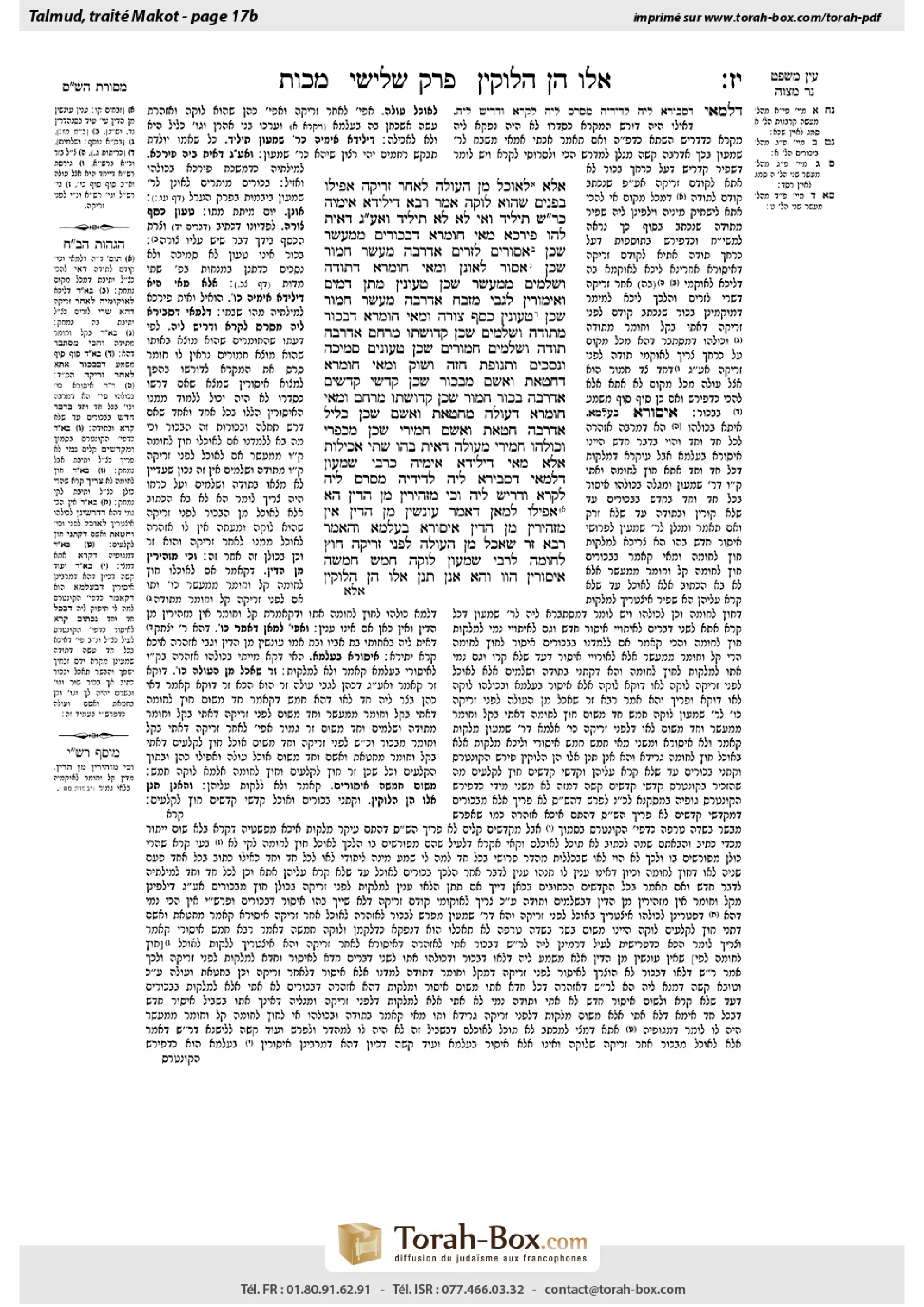
Makkot 17b: Talmud study for Daf Yomi
Daf Yomi is the daily study of one Talmud folio. Explore 37 tractates with scans, Hebrew text, Sefaria English and AI-generated French translations where annotated.
Passage selection and English or AI-generated French translation are available where the scan has annotations. Daf Study is independent of Torah-Box and Sefaria.
Browse Makkot · מכות · All tractatesMakkot 17b text and translations
This page of Makkot includes the Aramaic text, an English translation and an AI-generated French translation, alongside the scan above.
מכות י״ז ב · Aramaic and Hebrew text
אֶלָּא לָאוֹכֵל מִן הָעוֹלָה לְאַחַר זְרִיקָה, אֲפִילּוּ בִּפְנִים, שֶׁהוּא לוֹקֶה.
אָמַר רָבָא: דְּיָלְידָא אִימֵּיהּ כְּרַבִּי שִׁמְעוֹן – תֵּילִיד, וְאִי לָא – לָא תֵּילִיד. וְאַף עַל גַּב דְּאִית לְהוּ פִּירְכָא.
מַאי חוּמְרָא דְּבִכּוּרִים מִמַּעֲשֵׂר – שֶׁכֵּן אֲסוּרִים לְזָרִים. אַדְּרַבָּה, מַעֲשֵׂר חָמוּר, שֶׁכֵּן אָסוּר לְאוֹנֵן.
וּמַאי חוּמְרָא דְּתוֹדָה וּשְׁלָמִים מִמַּעֲשֵׂר – שֶׁכֵּן טְעוּנִין מַתַּן דָּמִים וְאֵימוּרִין לְגַבֵּי מִזְבֵּחַ. אַדְּרַבָּה, מַעֲשֵׂר חָמוּר, שֶׁכֵּן טְעוּנִין כֶּסֶף צוּרָה.
וּמַאי חוּמְרָא דִּבְכוֹר מִתּוֹדָה וּשְׁלָמִים – שֶׁכֵּן קְדוּשָּׁתוֹ מֵרֶחֶם. אַדְּרַבָּה: תּוֹדָה וּשְׁלָמִים חֲמוּרִים, שֶׁכֵּן טְעוּנִים סְמִיכָה, וּנְסָכִים, וּתְנוּפַת חָזֶה וָשׁוֹק.
וּמַאי חוּמְרָא דְּחַטָּאת וְאָשָׁם מִבְּכוֹר – שֶׁכֵּן קׇדְשֵׁי קָדָשִׁים. אַדְּרַבָּה, בְּכוֹר חָמוּר, שֶׁכֵּן קְדוּשָּׁתוֹ מֵרֶחֶם.
וּמַאי חוּמְרָא דְּעוֹלָה מֵחַטָּאת וְאָשָׁם – שֶׁכֵּן כָּלִיל. אַדְּרַבָּה, חַטָּאת וְאָשָׁם חֲמִירִי, שֶׁכֵּן מְכַפְּרִי.
וְכוּלְּהוּ חֲמִירִי מֵעוֹלָה, דְּאִית בְּהוּ שְׁתֵּי אֲכִילוֹת!
אֶלָּא מַאי דְּיָלְידָא אִימֵּיהּ כְּרַבִּי שִׁמְעוֹן? דִּלְמַאי דִּסְבִירָא לֵיהּ לְדִידֵיהּ, מְסָרֵס לֵיהּ לִקְרָא וְדָרֵישׁ לֵיהּ.
וְכִי מַזְהִירִין מִן הַדִּין? הָא אֲפִילּוּ לְמַאן דְּאָמַר עוֹנְשִׁין מִן הַדִּין, אֵין מַזְהִירִין מִן הַדִּין! אִיסּוּרָא בְּעָלְמָא.
וְהָאָמַר רָבָא: זָר שֶׁאָכַל מִן הָעוֹלָה לִפְנֵי זְרִיקָה חוּץ לַחוֹמָה, לְרַבִּי שִׁמְעוֹן לוֹקֶה חָמֵשׁ! חֲמִשָּׁה אִיסּוּרִין הָווּ.
וְהָא אֲנַן תְּנַן: אֵלּוּ הֵן הַלּוֹקִין!
Makkot 17b · English translation
to teach only with regard to one who partakes of the flesh of a burnt-offering after the sprinkling, even inside the courtyard, that he is flogged.
Rava says with regard to Rabbi Shimon’s statement in the baraita: With regard to anyone whose mother is bearing a child who is like Rabbi Shimon, she should bear that child, and if not, it is preferable that she does not bear him at all. Rava was so impressed by Rabbi Shimon’s statement that he praised him and characterized him as the model of a wise man. Rava added: And I say this even though there is a refutation for each of his conclusions. What are the refutations?
What is the stringency of first fruits vis-à-vis second-tithe produce? It is that first fruits are forbidden to non-priests, who are permitted to eat second-tithe produce. That can be refuted; on the contrary, second-tithe produce is more stringent than first fruits, in that it is forbidden to an acute mourner, i.e., one whose close relative died that day, which is not the case with regard to first fruits according to the opinion of Rabbi Shimon (see Yevamot 73b).
And what is the stringency of a thanks-offering and a peace-offering vis-à-vis second-tithe produce? It is that the thanks-offering and the peace-offering require the placement of blood and sacrificial portions upon the altar. That can be refuted; on the contrary, second-tithe produce is more stringent than the thanks-offering and the peace-offering, in that the redemption of second-tithe produce requires money minted into a coin. A disqualified thanks-offering and peace-offering, like other disqualified offerings, may be redeemed with any object of equal value.
And what is the stringency of a firstborn offering vis-à-vis a thanks-offering and a peace-offering? It is that the sanctity of the firstborn takes effect from the womb, while the other offerings are consecrated by their owners. That can be refuted; on the contrary, a thanks-offering and a peace-offering are more stringent, in that they require placing hands on the head of the offering before its sacrifice, and libations, and the waving of the breast and the thigh, which is not the case with regard to a firstborn offering.
And what is the stringency of a sin-offering and a guilt-offering vis-à-vis a firstborn offering? It is that a sin-offering and a guilt-offering are offerings of the most sacred order. That can be refuted; on the contrary, a firstborn offering is more stringent, in that its sanctity takes effect from the womb, not from consecration by its owner.
And what is the stringency of the burnt-offering vis-à-vis a sin-offering and a guilt-offering? It is that it is burnt in its entirety upon the altar, and no part of it is given to the priests. That can be refuted; on the contrary, the sin-offering and the guilt-offering are more stringent, in that they atone for one’s sins, and a burnt-offering is brought as a gift offering.
And all of those matters listed in the baraita are more stringent than the burnt-offering because there are two consumptions with regard to each of these matters, as they are consumed upon the altar and consumed by their owner and the priests, whereas the burnt-offering is consumed in its entirety upon the altar.
The Gemara asks: Rather, what is the meaning of this statement of praise: With regard to anyone whose mother is bearing a child who is like Rabbi Shimon, she should bear that child, and if not, it is preferable if she does not bear him at all? Ultimately, all of his derivations can be refuted. The Gemara answers: The praise is based on the fact that in order to arrive at what he himself holds, he transposes the verse and interprets it. Rabbi Shimon does not interpret the verse from beginning to end; rather, he begins with the final case of first fruits, in order to arrive at the desired conclusion. Rava was impressed with Rabbi Shimon’s interpretation.
The Gemara asks with regard to Rabbi Shimon, who derived prohibitions not written in the Torah by means of a fortiori inferences: And does one derive a prohibition from an a fortiori inference? But even according to the one who says that if there is a prohibition written explicitly in the Torah, one administers punishment based on an a fortiori inference, one does not derive a prohibition from an a fortiori inference. The Gemara answers: Rabbi Shimon does not derive prohibitions for which one is flogged from those inferences; rather, he derives a mere prohibition.
The Gemara asks: But doesn’t Rava say: With regard to a non-priest who ate the flesh of a burnt-offering before sprinkling its blood, outside the walls, according to Rabbi Shimon he is flogged with five sets of lashes: One because he is a non-priest; one for eating a burnt-offering; one for eating the flesh of an offering before its blood was sprinkled; one for eating offerings of the most sacred order outside the Temple courtyard; and one for eating sacrificial food outside of Jerusalem. Apparently, Rabbi Shimon holds that all these are actual prohibitions for which one is flogged. The Gemara answers: It does not mean that one is actually flogged; rather, it means that they are five prohibitions.
The Gemara asks: But didn’t we learn in the mishna: And these are the people who are flogged by Torah law? Among them is a priest who eats first fruits before the recitation of the accompanying Torah verses, and the Gemara established that the mishna is in accordance with the opinion of Rabbi Shimon.
Makkot 17b · Traduction française (IA)
Cela enseigne que seul celui qui mange la chair d’un holocauste après l’aspersion, même à l’intérieur de la cour, est passible de flagellation.
Rava dit au sujet de la déclaration de Rabbi Shimon dans la baraïta : « Si une femme porte un enfant qui sera comme Rabbi Shimon, qu’elle le mette au monde ; sinon, mieux vaut qu’elle ne le mette pas au monde. » La déclaration de Rabbi Shimon impressionna tant Rava qu’il fit son éloge et le qualifia de modèle du sage. Rava ajouta : « Je dis cela même si chacune de ses conclusions peut être réfutée. » Quelles sont ces réfutations ?
En quoi les prémices sont-elles plus strictes que la seconde dîme ? En ceci que les prémices sont interdites aux non-prêtres, qui sont autorisés à manger les produits de la seconde dîme. On peut réfuter cela : au contraire, les produits de la seconde dîme sont soumis à une règle plus stricte que les prémices, en ce qu’ils sont interdits à un endeuillé en première phase, c’est-à-dire à celui dont un proche est mort ce jour-là, contrairement aux prémices, selon l’opinion de Rabbi Shimon (voir Yevamot 73b).
En quoi l’offrande de reconnaissance et le sacrifice de paix sont-ils plus stricts que les produits de la seconde dîme ? En ceci que l’offrande de reconnaissance et le sacrifice de paix exigent que le sang et les portions sacrificielles soient déposés sur l’autel. On peut réfuter cela : au contraire, les produits de la seconde dîme sont soumis à une règle plus stricte que l’offrande de reconnaissance et le sacrifice de paix, en ce que leur rachat exige de l’argent frappé en pièces. Une offrande de reconnaissance ou un sacrifice de paix invalidé, comme les autres sacrifices invalidés, peut être racheté au moyen de tout objet de valeur équivalente.
En quoi le sacrifice du premier-né est-il plus strict que l’offrande de reconnaissance et le sacrifice de paix ? En ceci que la sainteté du premier-né prend effet dès le sein maternel, tandis que les autres sacrifices sont consacrés par leurs propriétaires. On peut réfuter cela : au contraire, l’offrande de reconnaissance et le sacrifice de paix sont soumis à une règle plus stricte, en ce qu’ils exigent l’imposition des mains sur la tête du sacrifice avant son offrande, des libations ainsi que l’agitation de la poitrine et de la cuisse, ce qui n’est pas le cas du sacrifice du premier-né.
En quoi le sacrifice expiatoire et le sacrifice de culpabilité sont-ils plus stricts que le sacrifice du premier-né ? En ceci que le sacrifice expiatoire et le sacrifice de culpabilité sont des sacrifices du degré de sainteté le plus élevé. On peut réfuter cela : au contraire, le sacrifice du premier-né est soumis à une règle plus stricte, en ce que sa sainteté prend effet dès le sein maternel, et non par la consécration de son propriétaire.
En quoi l’holocauste est-il plus strict que le sacrifice expiatoire et le sacrifice de culpabilité ? En ceci qu’il est entièrement consumé sur l’autel, sans qu’aucune partie n’en soit donnée aux prêtres. On peut réfuter cela : au contraire, le sacrifice expiatoire et le sacrifice de culpabilité sont plus stricts, en ce qu’ils expient les fautes d’une personne, tandis que l’holocauste est apporté comme offrande volontaire.
Toutes les choses énumérées dans la baraïta sont plus strictes que l’holocauste, car chacune donne lieu à deux consommations : elles sont consumées sur l’autel, puis consommées par leur propriétaire et par les prêtres, tandis que l’holocauste est entièrement consumé sur l’autel.
La Guemara demande : Que signifie donc cet éloge : « Si une femme porte un enfant qui sera comme Rabbi Shimon, qu’elle le mette au monde ; sinon, mieux vaut qu’elle ne le mette pas au monde » ? En fin de compte, toutes ses déductions peuvent être réfutées. La Guemara répond : cet éloge repose sur le fait que, pour parvenir à la position qu’il défend lui-même, Rabbi Shimon inverse l’ordre du verset et l’interprète. Il n’interprète pas le verset du début à la fin ; il commence plutôt par le dernier cas, celui des prémices, afin d’aboutir à la conclusion souhaitée. L’interprétation de Rabbi Shimon impressionna Rava.
La Guemara demande au sujet de Rabbi Shimon, qui a déduit des interdictions non énoncées dans la Torah au moyen de raisonnements a fortiori : peut-on déduire une interdiction d’un raisonnement a fortiori ? Même selon celui qui affirme que, lorsqu’une interdiction est explicitement énoncée dans la Torah, on peut infliger une peine sur la base d’un raisonnement a fortiori, on ne déduit pas une interdiction d’un raisonnement a fortiori. La Guemara répond : Rabbi Shimon ne déduit pas de ces raisonnements des interdictions passibles de flagellation ; il en déduit seulement une simple interdiction.
La Guemara demande : Rava ne dit-il pas qu’un non-prêtre qui a mangé la chair d’un holocauste avant l’aspersion de son sang, à l’extérieur des murs, est passible, selon Rabbi Shimon, de cinq séries de flagellations : une parce qu’il est non-prêtre ; une pour avoir mangé un holocauste ; une pour avoir mangé la chair d’un sacrifice avant l’aspersion de son sang ; une pour avoir mangé des sacrifices du degré de sainteté le plus élevé à l’extérieur de la cour du Temple ; et une pour avoir mangé de la nourriture sacrificielle à l’extérieur de Jérusalem ? Il semble donc que, selon Rabbi Shimon, toutes ces interdictions soient effectivement passibles de flagellation. La Guemara répond : cela ne signifie pas qu’il soit effectivement passible de flagellation, mais qu’il y a cinq interdictions.
La Guemara demande : N’avons-nous pas appris dans la Michna : « Et voici ceux qui sont passibles de flagellation selon la Torah » ? Parmi eux figure un prêtre qui mange des prémices avant la récitation des versets de la Torah qui les accompagnent, et la Guemara a établi que la Michna suit l’opinion de Rabbi Shimon.
Traduction française générée par IA à partir de l’édition anglaise de Sefaria. Vérifie toujours un passage avec le texte source.
Text from Sefaria: William Davidson Edition - Vocalized Aramaic (CC BY NC); William Davidson Edition - English (CC BY NC).