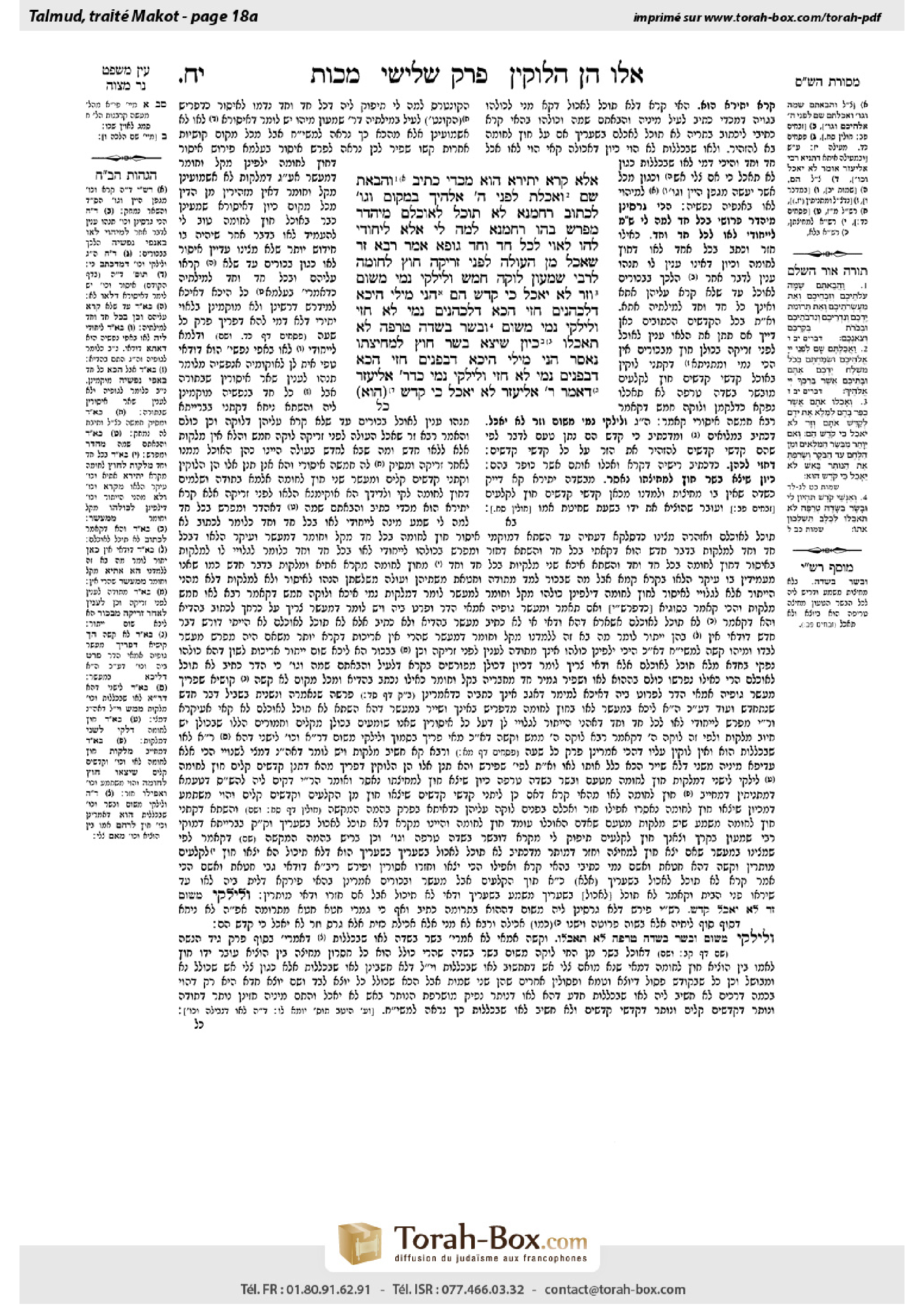
Makkot 18a: Talmud study for Daf Yomi
Daf Yomi is the daily study of one Talmud folio. Explore 37 tractates with scans, Hebrew text, Sefaria English and AI-generated French translations where annotated.
Passage selection and English or AI-generated French translation are available where the scan has annotations. Daf Study is independent of Torah-Box and Sefaria.
Browse Makkot · מכות · All tractatesMakkot 18a text and translations
This page of Makkot includes the Aramaic text, an English translation and an AI-generated French translation, alongside the scan above.
מכות י״ח א · Aramaic and Hebrew text
אֶלָּא קְרָא יַתִּירָא הוּא, מִכְּדֵי כְּתִיב ״וְהֵבֵאתָ שָׁם וְאָכַלְתָּ לִפְנֵי ה׳ אֱלֹהֶיךָ בַּמָּקוֹם וְגוֹ׳״, לִכְתּוֹב רַחֲמָנָא ״לֹא תוּכַל לְאוֹכְלָם״, מִיהְדָּר מְפָרֵשׁ בְּהוּ רַחֲמָנָא לְמָה לִי?
אֶלָּא לְיַחוֹדֵי לְהוּ לָאוֵי לְכׇל חַד וְחַד.
גּוּפָא, אָמַר רָבָא: זָר שֶׁאָכַל מִן הָעוֹלָה לִפְנֵי זְרִיקָה חוּץ לַחוֹמָה – לְרַבִּי שִׁמְעוֹן לוֹקֶה חָמֵשׁ. וְלִילְקֵי נָמֵי מִשּׁוּם: ״וְזָר לֹא יֹאכַל כִּי קֹדֶשׁ הֵם״! הָנֵי מִילֵּי הֵיכָא דִּלְכֹהֲנִים חֲזֵי, הָכָא דִּלְכֹהֲנִים נָמֵי לָא חֲזֵי.
וְלִילְקֵי נָמֵי מִשּׁוּם ״וּבָשָׂר בַּשָּׂדֶה טְרֵפָה לֹא תֹאכֵלוּ״, כֵּיוָן שֶׁיָּצָא בָּשָׂר חוּץ לִמְחִיצָתוֹ – נֶאֱסָר! הָנֵי מִילֵּי הֵיכָא דְּבִפְנִים חֲזֵי, הָכָא דִּבְפָנִים נָמֵי לָא חֲזֵי.
וְלִילְקֵי נָמֵי כִּדְרַבִּי אֱלִיעֶזֶר, דְּאָמַר רַבִּי אֱלִיעֶזֶר: ״לֹא יֵאָכֵל כִּי קֹדֶשׁ הוּא״,
Makkot 18a · English translation
Rather, the derivation is that the entire verse beginning: “You may not eat within your gates the tithe of your grain” (Deuteronomy 12:17) is a superfluous verse. After all, it is already written: “And there you shall bring your burnt-offerings, and your sacrifices, and your tithes, and the donation of your hand, and your vows, and your gift offerings, and the firstborn of your herd and of your flock, and there you shall eat before the Lord your God” (Deuteronomy 12:6–7); all the items that must be eaten within the walls of Jerusalem are enumerated. Let the Merciful One write simply: You may not eat them, in general terms, which would constitute a prohibition for which one would be liable to receive lashes for each of the cases enumerated. Why do I need the Merciful One to again specifically enumerate and detail each of them?
Rather, this repetition serves to designate additional prohibitions for each and every one of the cases enumerated in the later verse (Deuteronomy 12:17). The prohibition is derived not by means of an a fortiori inference; rather, it is derived from the superfluous verse. Rabbi Shimon derives by means of the a fortiori inferences the additional prohibition that is in effect in each of these cases.
§ With regard to the matter itself, Rava says: With regard to a non-priest who ate the flesh of a burnt-offering before sprinkling its blood, outside the walls, according to Rabbi Shimon he is flogged with five sets of lashes. The Gemara suggests: And let him also be flogged for violating the prohibition: “And a non-priest may not eat, as they are sacred” (Exodus 29:33). The Gemara explains: This matter prohibiting a non-priest from eating consecrated food applies only in a case where the food is fit for consumption by priests. Here, where the food is not fit for consumption by priests either, as it is not permitted for anyone to partake of a burnt-offering, there is no specific prohibition that applies to a non-priest.
The Gemara suggests: And let him also be flogged for violating the prohibition: “And any flesh torn of animals in the field you shall not eat” (Exodus 22:30). From the term “in the field,” a general halakha is derived: Once the flesh emerged outside its partition and is in the field, e.g., sacrificial meat that was taken outside the Tabernacle curtains that demarcate the courtyard, there is a prohibition, and the flesh is forbidden. The Gemara explains: This matter, the prohibition against eating sacrificial flesh outside the partition of the Temple courtyard, applies only in a case where the flesh is fit for consumption inside the courtyard. Here, in the case of a burnt-offering, where the flesh is not fit for consumption inside the courtyard either, as it is not permitted for anyone to partake of a burnt-offering, there is no specific prohibition that applies to a non-priest partaking of the flesh outside the courtyard.
The Gemara suggests: And let him also be flogged in accordance with the statement of Rabbi Eliezer. As Rabbi Eliezer says that when it is stated with regard to leftover flesh and loaves from the inauguration offerings: “It shall not be eaten because it is sacred” (Exodus 29:34),
Makkot 18a · Traduction française (IA)
Au contraire, la déduction repose sur le fait que tout le verset qui commence par : « Tu ne mangeras pas dans tes portes la dîme de ton grain » (Deutéronome 12,17) est superflu. En effet, il est déjà écrit : « Et là, vous apporterez vos holocaustes, vos sacrifices, vos dîmes, le don de votre main, vos vœux, vos offrandes volontaires, ainsi que les premiers-nés de votre gros et de votre petit bétail, et là, vous mangerez devant le Seigneur votre Dieu » (Deutéronome 12,6-7) ; tous les aliments qui doivent être consommés à l’intérieur des murailles de Jérusalem y sont énumérés. Que le Miséricordieux écrive simplement : « Vous ne les mangerez pas », en termes généraux ; cela constituerait une interdiction passible de coups de fouet pour chacun des cas énumérés. Pourquoi le Miséricordieux doit-il à nouveau énumérer et détailler chacun d’eux ?
Au contraire, cette répétition sert à établir des interdictions supplémentaires pour chacun des cas énumérés dans le verset ultérieur (Deutéronome 12,17). L’interdiction ne se déduit pas au moyen d’un raisonnement a fortiori ; elle se déduit plutôt du verset superflu. Rabbi Shimon déduit, au moyen de raisonnements a fortiori, l’interdiction supplémentaire qui s’applique dans chacun de ces cas.
§ À propos du sujet lui-même, Rava dit : Un non-prêtre qui a mangé la chair d’un holocauste avant l’aspersion de son sang, à l’extérieur des murailles, reçoit, selon Rabbi Shimon, cinq séries de coups de fouet. La Guemara propose : Qu’il reçoive également des coups de fouet pour avoir enfreint l’interdiction : « Un non-prêtre ne peut pas en manger, car elles sont saintes » (Exode 29,33). La Guemara explique : Cette interdiction faite à un non-prêtre de manger des aliments consacrés ne s’applique que lorsque ceux-ci peuvent être consommés par les prêtres. Ici, puisque l’aliment ne peut pas non plus être consommé par les prêtres — car il n’est permis à personne de manger d’un holocauste —, aucune interdiction spécifique ne s’applique à un non-prêtre.
La Guemara propose : Qu’il reçoive également des coups de fouet pour avoir enfreint l’interdiction : « Vous ne mangerez aucune chair déchirée par des bêtes dans les champs » (Exode 22,30). Du terme « dans les champs », on déduit une halakha générale : dès lors que la chair a franchi sa limite et se trouve dans les champs — par exemple, de la viande sacrificielle emportée au-delà des tentures du Tabernacle qui délimitent le parvis —, elle fait l’objet d’une interdiction et est interdite à la consommation. La Guemara explique : Cette interdiction de manger de la chair sacrificielle à l’extérieur de l’enceinte du parvis du Temple ne s’applique que lorsque la chair peut être consommée à l’intérieur du parvis. Ici, dans le cas d’un holocauste, puisque la chair ne peut pas non plus être consommée à l’intérieur du parvis — car il n’est permis à personne de manger d’un holocauste —, aucune interdiction spécifique ne s’applique à un non-prêtre qui consomme cette chair à l’extérieur du parvis.
La Guemara propose : Qu’il reçoive également des coups de fouet conformément à l’enseignement de Rabbi Eliezer. En effet, Rabbi Eliezer dit qu’à propos des restes de chair et des pains des sacrifices d’inauguration, lorsqu’il est écrit : « On ne le mangera pas, car il est saint » (Exode 29,34),
Traduction française générée par IA à partir de l’édition anglaise de Sefaria. Vérifie toujours un passage avec le texte source.
Text from Sefaria: William Davidson Edition - Vocalized Aramaic (CC BY NC); William Davidson Edition - English (CC BY NC).