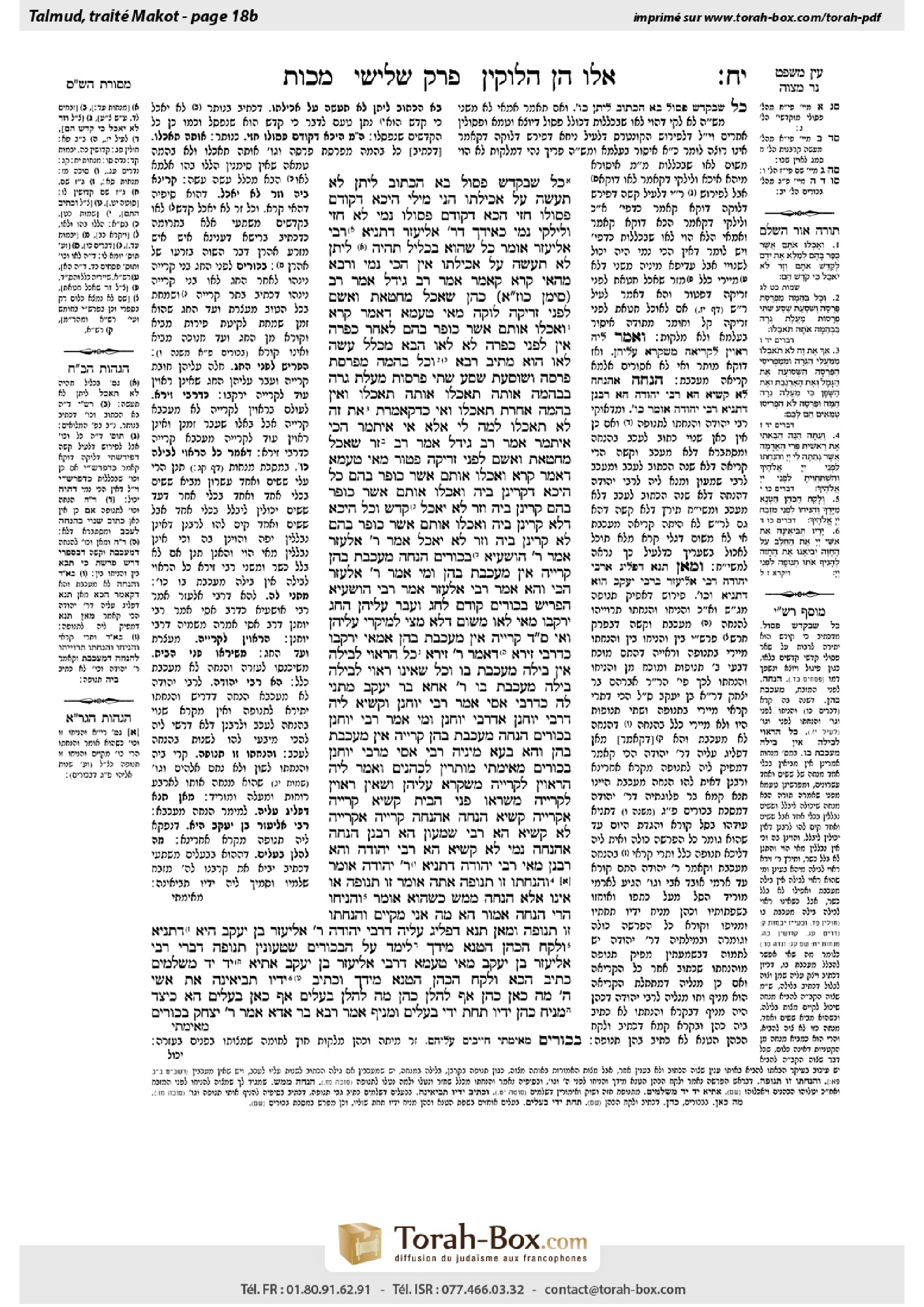
Makkot 18b: Talmud study for Daf Yomi
Daf Yomi is the daily study of one Talmud folio. Explore 37 tractates with scans, Hebrew text, Sefaria English and AI-generated French translations where annotated.
Passage selection and English or AI-generated French translation are available where the scan has annotations. Daf Study is independent of Torah-Box and Sefaria.
Browse Makkot · מכות · All tractatesMakkot 18b text and translations
This page of Makkot includes the Aramaic text, an English translation and an AI-generated French translation, alongside the scan above.
מכות י״ח ב · Aramaic and Hebrew text
כֹּל שֶׁבַּקֹּדֶשׁ פָּסוּל – בָּא הַכָּתוּב לִיתֵּן לֹא תַעֲשֶׂה עַל אֲכִילָתוֹ! הָנֵי מִילֵּי הֵיכָא דְּקוֹדֶם פְּסוּלוֹ חֲזֵי, הָכָא דְּקוֹדֶם פְּסוּלוֹ נָמֵי לָא חֲזֵי.
וְלִילְקֵי נָמֵי כְּאִידַּךְ דְּרַבִּי אֱלִיעֶזֶר. דְּתַנְיָא, רַבִּי אֱלִיעֶזֶר אוֹמֵר: כׇּל שֶׁהוּא בְּ״כָלִיל תִּהְיֶה״ – לִיתֵּן לֹא תַעֲשֶׂה עַל אֲכִילָתוֹ! אִין הָכִי נָמֵי, וְרָבָא – מֵהַאי קְרָא קָאָמַר.
אָמַר רַב גִּידֵּל אָמַר רַב: (סִימָן כּוּזָא) כֹּהֵן שֶׁאָכַל מֵחַטָּאת וְאָשָׁם לִפְנֵי זְרִיקָה – לוֹקֶה. מַאי טַעְמָא? דְּאָמַר קְרָא: ״וְאָכְלוּ אֹתָם אֲשֶׁר כֻּפַּר בָּהֶם״, לְאַחַר כַּפָּרָה – אִין, לִפְנֵי כַּפָּרָה – לָא. לָאו הַבָּא מִכְּלַל עֲשֵׂה, – לָאו הוּא.
מֵתִיב רָבָא: ״וְכׇל בְּהֵמָה מַפְרֶסֶת פַּרְסָה וְשֹׁסַעַת שֶׁסַע שְׁתֵּי פְרָסוֹת מַעֲלַת גֵּרָה בַּבְּהֵמָה אֹתָהּ תֹּאכֵלוּ״, ״אֹתָהּ תֹּאכֵלוּ״ – וְאֵין בְּהֵמָה אַחֶרֶת תֹּאכֵלוּ. וְאִי כִּדְקָאָמְרַתְּ, ״אֶת זֶה לֹא תֹאכְלוּ״ לְמָה לִי?
אֶלָּא אִי אִיתְּמַר הָכִי אִיתְּמַר, אָמַר רַב גִּידֵּל אָמַר רַב: זָר שֶׁאָכַל מֵחַטָּאת וְאָשָׁם לִפְנֵי זְרִיקָה – פָּטוּר, מַאי טַעְמָא – דְּאָמַר קְרָא: ״וְאָכְלוּ אֹתָם אֲשֶׁר כֻּפַּר בָּהֶם״, כֹּל הֵיכָא דְּקָרֵינַן בֵּיהּ ״וְאָכְלוּ אוֹתָם אֲשֶׁר כֻּפַּר בָּהֶם״ – קָרֵינַן בֵּיהּ ״וְזָר לֹא יֹאכַל קֹדֶשׁ״, וְכֹל הֵיכָא דְּלָא קָרֵינַן בֵּיהּ ״וְאָכְלוּ אֹתָם אֲשֶׁר כֻּפַּר בָּהֶם״ – לָא קָרֵינַן בֵּיהּ ״וְזָר לֹא יֹאכַל״.
אָמַר רַבִּי אֶלְעָזָר אָמַר רַבִּי הוֹשַׁעְיָה: בִּכּוּרִים, הַנָּחָה מְעַכֶּבֶת בָּהֶן, קְרִיָּיה אֵין מְעַכֶּבֶת בָּהֶן.
וּמִי אָמַר רַבִּי אֶלְעָזָר הָכִי? וְהָא אָמַר רַבִּי אֶלְעָזָר אָמַר רַבִּי הוֹשַׁעְיָא: הִפְרִישׁ בִּכּוּרִים קוֹדֶם לֶחָג, וְעָבַר עֲלֵיהֶן הֶחָג – יֵרָקְבוּ. מַאי לָאו מִשּׁוּם דְּלָא מָצֵי לְמִיקְרֵי עֲלֵיהֶן? וְאִי סָלְקָא דַעְתָּךְ קְרִיָּיה אֵין מְעַכֶּבֶת בָּהֶן, אַמַּאי יֵרָקְבוּ?
כִּדְרַבִּי זֵירָא. דְּאָמַר רַבִּי זֵירָא: כׇּל הָרָאוּי לְבִילָּה – אֵין בִּילָּה מְעַכֶּבֶת בּוֹ, וְכֹל שֶׁאֵינוֹ רָאוּי לְבִילָּה – בִּילָּה מְעַכֶּבֶת בּוֹ.
רַבִּי אַחָא בַּר יַעֲקֹב מַתְנֵי לַהּ כִּדְרַבִּי אַסִּי אָמַר רַבִּי יוֹחָנָן, וְקַשְׁיָא לֵיהּ דְּרַבִּי יוֹחָנָן אַדְּרַבִּי יוֹחָנָן. וּמִי אָמַר רַבִּי יוֹחָנָן בִּכּוּרִים הַנָּחָה מְעַכֶּבֶת בָּהֶן קְרִיָּיה אֵין מְעַכֶּבֶת בָּהֶן? וְהָא בְּעָא מִינֵּיהּ רַבִּי אַסִּי מֵרַבִּי יוֹחָנָן: בִּכּוּרִים מֵאֵימָתַי מוּתָּרִין לְכֹהֲנִים? וַאֲמַר לֵיהּ: הָרְאוּיִן לִקְרִיָּיה – מִשֶּׁקָּרָא עֲלֵיהֶן, וְשֶׁאֵין רְאוּיִן לִקְרִיָּיה – מִשֶּׁרָאוּ פְּנֵי הַבַּיִת.
קַשְׁיָא קְרִיָּיה אַקְּרִיָּיה, קַשְׁיָא הַנָּחָה אַהַנָּחָה!
קְרִיָּיה אַקְּרִיָּה לָא קַשְׁיָא: הָא רַבִּי שִׁמְעוֹן, הָא רַבָּנַן. הַנָּחָה אַהַנָּחָה נָמֵי לָא קַשְׁיָא: הָא רַבִּי יְהוּדָה, וְהָא רַבָּנַן.
מַאי רַבִּי יְהוּדָה? דְּתַנְיָא, רַבִּי יְהוּדָה אוֹמֵר: ״וְהִנַּחְתּוֹ״ – זוֹ תְּנוּפָה. אַתָּה אוֹמֵר זוֹ תְּנוּפָה, אוֹ אֵינוֹ אֶלָּא הַנָּחָה מַמָּשׁ? כְּשֶׁהוּא אוֹמֵר ״וְהִנִּיחוֹ״ – הֲרֵי הַנָּחָה אָמוּר, הָא מָה אֲנִי מְקַיֵּים ״וְהִנַּחְתּוֹ״ – זוֹ תְּנוּפָה.
וּמַאן תַּנָּא דִּפְלִיג עֲלֵיהּ דְּרַבִּי יְהוּדָה? רַבִּי אֱלִיעֶזֶר בֶּן יַעֲקֹב הִיא, דְּתַנְיָא: ״וְלָקַח הַכֹּהֵן הַטֶּנֶא מִיָּדֶךָ״ – לִימֵּד עַל הַבִּכּוּרִים שֶׁטְּעוּנִין תְּנוּפָה, דִּבְרֵי רַבִּי אֱלִיעֶזֶר בֶּן יַעֲקֹב. מַאי טַעְמָא דְּרַבִּי אֱלִיעֶזֶר בֶּן יַעֲקֹב?
אָתְיָא ״יָד״ ״יָד״ מִשְּׁלָמִים: כְּתִיב הָכָא ״וְלָקַח הַכֹּהֵן הַטֶּנֶא מִיָּדֶךָ״, וּכְתִיב ״יָדָיו תְּבִיאֶינָה אֵת אִשֵּׁי ה׳״, מָה כָּאן כֹּהֵן – אַף לְהַלָּן כֹּהֵן, מָה לְהַלָּן בְּעָלִים – אַף כָּאן בְּעָלִים. הָא כֵּיצַד? מַנִּיחַ כֹּהֵן יָדָיו תַּחַת יְדֵי בְּעָלִים וּמֵנִיף.
אָמַר רָבָא בַּר אַדָּא אָמַר רַבִּי יִצְחָק: בִּכּוּרִים
Makkot 18b · English translation
it is derived that with regard to any item that is sacrificial and disqualified for whatever reason, the verse comes to impose a prohibition upon its consumption. The Gemara explains: This matter applies only in a case where before its disqualification it was fit; here, it is a case where before its disqualification it was not fit either, and therefore the prohibition does not apply.
The Gemara suggests: And let him also be flogged in accordance with the other statement of Rabbi Eliezer, as it is taught in a baraita that Rabbi Eliezer says: With regard to any item that is included in the mitzva: “It shall be burned in its entirety” (Leviticus 6:16), the verse serves to impose a prohibition upon its consumption, as it is written: “It shall be burned in its entirety; it shall not be eaten” (Leviticus 6:16). The Gemara explains: Yes, it is indeed so that according to Rabbi Shimon one is flogged for violating this prohibition as well, and Rava is saying that from this verse he is interpreting that it is derived that one is flogged with five sets of lashes according to Rabbi Shimon.
§ Rav Giddel says that Rav says a statement about a priest [kohen] and another statement about a non-priest [zar]. Before proceeding, the Gemara provides a mnemonic for these statements: Kaf, vav, zayin, alef. Rav says: A priest who ate of a sin-offering or a guilt-offering before sprinkling their blood on the altar is flogged. What is the reason that he is flogged? It is as the verse states with regard to the inauguration offerings, whose halakhic status was like that of sin-offerings and guilt-offerings in that it was permitted only for priests to partake of their flesh: “And they shall eat them, that with which they were atoned” (Exodus 29:33), from which it is inferred: After atonement, yes, they may eat the flesh of the offerings; before atonement, no, they may not eat it. And in Rav’s opinion, the status of a prohibition that stems from a positive mitzva is that of a prohibition, for which one is flogged.
Rava raises an objection based on the verse: “And every beast that splits the hoof and has the hoof cloven in two, and chews the cud among the animals, that, you may eat” (Deuteronomy 14:6), from which a prohibition may be inferred: “That, you may eat,” but there is not any other animal that you may eat. The Torah prohibits eating the flesh of any animal that lacks the indicators that it is a kosher animal. And if it is as you say, that an inference from a positive mitzva entails a prohibition, why do I need the following verse: “This you may not eat” (Deuteronomy 14:7), as it was already inferred from the mitzva? Rather, apparently, the status of a prohibition that stems from a positive mitzva is that of a positive mitzva, and one is not liable to receive lashes for its violation.
Rather, if it was stated, this was stated: Rav Giddel says that Rav says: A non-priest who ate of a sin-offering or a guilt-offering before the sprinkling of their blood is exempt from receiving lashes. What is the reason for this? It is as the verse states: “And they shall eat them, that with which they were atoned…and a non-priest may not eat, as they are sacred” (Exodus 29:33), and it is expounded as follows: Anywhere that we read concerning it: “And they shall eat them, that with which they were atoned,” we read concerning it: “And a non-priest may not eat sacrificial food.” But anywhere that we do not read concerning it: “And they shall eat them, that with which they were atoned,” e.g., in this case, where it is prohibited for priests to partake of the flesh of the offerings before the sprinkling of their blood, we do not read concerning it: “And a non-priest may not eat.”
§ The Gemara resumes the discussion of the halakha that was mentioned in the mishna with regard to the Torah verses that one recites when he brings his first fruits to the Temple. Rabbi Elazar says that Rabbi Hoshaya says: With regard to first fruits, the lack of placement alongside the altar invalidates them, and they may not be eaten by the priest; the lack of recitation of the accompanying Torah verses does not invalidate them.
The Gemara asks: And did Rabbi Elazar say that? But doesn’t Rabbi Elazar say that Rabbi Hoshaya says: If one set aside first fruits before the festival of Sukkot and the Festival elapsed over them while they remain in his possession, they shall be left to decay, as they cannot be rendered fit for consumption. What, is it not that they cannot be rendered fit due to the fact that he can no longer recite the Torah verses over them, as one may recite the Torah verses only until Sukkot? And if it enters your mind to say that the lack of recitation does not invalidate them, why must they be left to decay?
The Gemara answers: Rabbi Elazar holds in accordance with the opinion of Rabbi Zeira, as Rabbi Zeira says a principle with regard to a meal-offering that applies in other areas as well: For any measure of flour that is suitable for mixing with oil in a meal-offering, the lack of mixing does not invalidate the meal-offering. Even though there is a mitzva to mix the oil and the flour ab initio, the meal-offering is fit for sacrifice even if the oil and the flour are not mixed. And for any measure of flour that is not suitable for mixing with oil in a meal-offering, the lack of mixing invalidates the meal-offering. Here too, although failure to recite the Torah verses does not invalidate the first fruits for consumption by the priest, that is referring only to when reciting the portion is possible. After Sukkot, when it is no longer possible to recite the portion, failure to recite the Torah verses invalidates the first fruits.
Rabbi Aḥa bar Ya’akov teaches this halakha that was cited in the name of Rabbi Elazar as the statement that Rabbi Asi says that Rabbi Yoḥanan says, and as a result, an apparent contradiction between one statement of Rabbi Yoḥanan and another statement of Rabbi Yoḥanan is difficult for him. Rabbi Aḥa bar Ya’akov asks: And did Rabbi Yoḥanan say that with regard to first fruits, the lack of placement alongside the altar invalidates them and they may not be eaten; while the lack of recitation of the accompanying Torah verses does not invalidate them? But didn’t Rabbi Asi raise a dilemma before Rabbi Yoḥanan: With regard to first fruits, from when is it permitted for priests to partake of them? And Rabbi Yoḥanan said to Rabbi Asi: It is permitted for the priest to partake of those first fruits that are fit for recitation of the accompanying Torah verses from when he recites those verses over them, and those first fruits that are not fit for recitation of the Torah verses are permitted once they entered inside the Temple.
Rabbi Yoḥanan apparently holds that first fruits that are not fit for recitation are not invalidated. In addition, he did not mention placement of the first fruits, indicating that the lack of their placement does not invalidate them for consumption by the priest. The Gemara notes: The apparent contradiction between one statement of Rabbi Yoḥanan with regard to recitation and another statement of Rabbi Yoḥanan with regard to recitation is difficult; and the apparent contradiction between one statement of Rabbi Yoḥanan with regard to placement and another statement of Rabbi Yoḥanan with regard to placement is difficult.
The Gemara answers: The apparent contradiction between one statement of Rabbi Yoḥanan with regard to recitation and another statement of Rabbi Yoḥanan with regard to recitation is not difficult, as this statement, that when recitation is impossible, lack of recitation invalidates the first fruits, is in accordance with the opinion of Rabbi Shimon cited in the mishna, and that statement, which states that when recitation is impossible, lack of recitation does not invalidate the first fruits, is in accordance with the opinion of the Rabbis. The apparent contradiction between one statement of Rabbi Yoḥanan with regard to placement and another statement of Rabbi Yoḥanan with regard to placement is not difficult either, as this statement, that lack of placement does not invalidate the first fruits, is in accordance with the opinion of Rabbi Yehuda, and that statement, which states that lack of placement invalidates the first fruits, is in accordance with the opinion of the Rabbis.
The Gemara asks: What is the statement of Rabbi Yehuda? It is as it is taught in a baraita: Rabbi Yehuda says with regard to the verse written in the portion of first fruits: “And you shall place it before the Lord your God” (Deuteronomy 26:10), that the reference is not to the placement of the fruits alongside the altar; rather, this is a reference to waving the first fruits. Do you say that this is a reference to waving, or perhaps it is a reference only to actual placement of the first fruits? He explains: When it states earlier: “And the priest shall take the basket from your hand and place it before the altar of the Lord your God” (Deuteronomy 26:4), placement alongside the altar is already stated; how do I realize the meaning of the term “And you shall place it”? This is a reference to waving.
The Gemara clarifies: And who is the tanna who disagrees with Rabbi Yehuda? It is Rabbi Eliezer ben Ya’akov, as it is taught in a baraita with regard to the verse written in the portion of first fruits: “And the priest shall take the basket from your hand” (Deuteronomy 26:4); this verse taught about first fruits that they require waving, this is the statement of Rabbi Eliezer ben Ya’akov. The Gemara asks: What is the reason for the opinion of Rabbi Eliezer ben Ya’akov?
The Gemara explains: The matter is derived by means of a verbal analogy from one instance of the word “hand” written with regard to first fruits and from another instance of the word “hand” written with regard to a peace-offering. It is written here, with regard to first fruits: “And the priest shall take the basket from your hand” (Deuteronomy 26:4), and it is written with regard to a peace-offering: “He who offers his peace-offering to God…his hands shall bring it, the fire of God…to raise it as a waving before God” (Leviticus 7:29–30). Just as here, in the case of first fruits, it is the priest who takes the basket in his hand and waves it, so too there, in the case of the peace-offering, a priest performs the waving. Just as there, with regard to a peace-offering, it is the owner who performs the waving, as it is written: “He who offers…his hands shall bring it,” so too here, the owner waves the first fruits. How so; how can the waving be performed by both the priest and the owner? The priest places his hands beneath the hands of the owner and waves the first fruits together with the owner.
§ Rava bar Adda says that Rabbi Yitzḥak says: With regard to first fruits,
Makkot 18b · Traduction française (IA)
On déduit que, pour tout élément consacré devenu invalide pour quelque raison que ce soit, le verset vient imposer une interdiction de le consommer. La Guemara explique : cela ne s’applique que dans un cas où l’offrande était apte avant de devenir invalide ; ici, elle n’était déjà pas apte auparavant et l’interdiction ne s’applique donc pas.
La Guemara propose : Qu’il soit également passible de coups de fouet conformément à l’autre enseignement de Rabbi Eliezer, car il est enseigné dans une baraïta que Rabbi Eliezer dit : Pour tout élément soumis à la mitsva « Il sera entièrement brûlé » (Lévitique 6:16), le verset sert à imposer une interdiction de le consommer, comme il est écrit : « Il sera entièrement brûlé ; il ne sera pas mangé » (Lévitique 6:16). La Guemara explique : Oui, selon Rabbi Shimon, on est effectivement aussi passible de coups de fouet pour avoir enfreint cette interdiction ; Rava dit que ce verset lui permet d’interpréter qu’on déduit que, selon Rabbi Shimon, on est passible de cinq séries de coups de fouet.
§ Rav Giddel rapporte au nom de Rav un enseignement concernant un prêtre [kohen] et un autre concernant un non-prêtre [zar]. Avant de les exposer, la Guemara donne un moyen mnémotechnique pour les retenir : kaf, vav, zayin, alef. Rav dit : Un prêtre qui a mangé d’un sacrifice expiatoire ou d’un sacrifice de culpabilité avant l’aspersion de leur sang sur l’autel est passible de coups de fouet. Pourquoi ? Car le verset dit au sujet des offrandes d’inauguration, dont le statut halakhique était semblable à celui des sacrifices expiatoires et des sacrifices de culpabilité, puisque seuls les prêtres avaient le droit d’en consommer la chair : « Et ils les mangeront, ceux par lesquels ils ont été expiés » (Exode 29:33). On en déduit : après l’expiation, oui, ils peuvent manger la chair des offrandes ; avant l’expiation, non, ils ne le peuvent pas. Selon Rav, une interdiction qui découle d’une mitsva positive a le statut d’une interdiction passible de coups de fouet.
Rava soulève une objection à partir du verset : « Tout animal qui a le sabot fendu et séparé en deux et qui rumine parmi les animaux, celui-là, vous pouvez le manger » (Deutéronome 14:6). On peut en déduire une interdiction : « Celui-là, vous pouvez le manger », mais aucun autre animal ne peut être mangé. La Torah interdit de manger la chair de tout animal qui ne présente pas les signes d’un animal cachère. Et si, comme tu le dis, une déduction tirée d’une mitsva positive entraîne une interdiction, pourquoi ai-je besoin du verset suivant : « Celui-ci, vous ne le mangerez pas » (Deutéronome 14:7), puisque cela était déjà déduit de la mitsva ? Apparemment, donc, une interdiction qui découle d’une mitsva positive a le statut d’une mitsva positive, et l’on n’est pas passible de coups de fouet pour l’avoir enfreinte.
En réalité, si cet enseignement a été transmis, c’est ainsi qu’il l’a été : Rav Giddel dit au nom de Rav : Un non-prêtre qui a mangé d’un sacrifice expiatoire ou d’un sacrifice de culpabilité avant l’aspersion de leur sang n’est pas passible de coups de fouet. Pourquoi ? Car le verset dit : « Et ils les mangeront, ceux par lesquels ils ont été expiés… et un non-prêtre ne peut pas en manger, car ils sont saints » (Exode 29:33). On l’interprète ainsi : partout où l’on peut lire à leur sujet « Et ils les mangeront, ceux par lesquels ils ont été expiés », on peut aussi lire à leur sujet : « Un non-prêtre ne peut pas manger de nourriture consacrée. » Mais là où l’on ne peut pas lire à leur sujet « Et ils les mangeront, ceux par lesquels ils ont été expiés » — par exemple, dans ce cas, où il est interdit aux prêtres de manger la chair des offrandes avant l’aspersion de leur sang —, on ne peut pas lire à leur sujet : « Un non-prêtre ne peut pas en manger. »
§ La Guemara reprend la discussion sur la halakha mentionnée dans la Michna à propos des versets de la Torah que l’on récite lorsqu’on apporte ses prémices au Temple. Rabbi Elazar dit au nom de Rabbi Hoshaya : Pour les prémices, l’absence de leur présentation à côté de l’autel les invalide, et le prêtre ne peut pas les manger ; en revanche, l’absence de récitation des versets de la Torah qui les accompagnent ne les invalide pas.
La Guemara demande : Rabbi Elazar a-t-il dit cela ? Rabbi Elazar ne dit-il pas au nom de Rabbi Hoshaya : Si quelqu’un a mis ses prémices à part avant la fête de Souccot et que la fête est passée alors qu’elles étaient encore en sa possession, elles doivent être laissées à se décomposer, car elles ne peuvent plus être rendues propres à la consommation ? N’est-ce pas parce qu’elles ne peuvent plus être rendues propres à la consommation, du fait qu’il ne peut plus réciter les versets de la Torah à leur sujet, puisqu’on ne peut les réciter que jusqu’à Souccot ? Et si l’on pouvait envisager que l’absence de récitation ne les invalide pas, pourquoi faudrait-il les laisser se décomposer ?
La Guemara répond : Rabbi Elazar suit l’opinion de Rabbi Zeira, qui énonce un principe concernant une offrande végétale, applicable également à d’autres domaines : pour toute quantité de farine qui peut être mélangée à de l’huile dans une offrande végétale, l’absence de mélange n’invalide pas l’offrande. Bien qu’il y ait, a priori, une mitsva de mélanger l’huile et la farine, l’offrande végétale reste apte à être offerte même si elles n’ont pas été mélangées. En revanche, pour toute quantité de farine qui ne peut pas être mélangée à de l’huile dans une offrande végétale, l’absence de mélange invalide l’offrande. Ici aussi, bien que l’absence de récitation des versets de la Torah n’invalide pas les prémices destinées à être consommées par le prêtre, cela ne concerne que les cas où il est possible de réciter le passage. Après Souccot, lorsqu’il n’est plus possible de réciter le passage, l’absence de récitation des versets de la Torah invalide les prémices.
Rabbi Aḥa bar Ya’akov enseigne cette halakha, citée au nom de Rabbi Elazar, comme l’enseignement que Rabbi Asi rapporte au nom de Rabbi Yoḥanan ; il se trouve donc confronté à une apparente contradiction entre deux enseignements de Rabbi Yoḥanan. Rabbi Aḥa bar Ya’akov demande : Rabbi Yoḥanan a-t-il dit que, pour les prémices, l’absence de présentation à côté de l’autel les invalide et qu’elles ne peuvent pas être mangées, tandis que l’absence de récitation des versets de la Torah qui les accompagnent ne les invalide pas ? Rabbi Asi n’a-t-il pas soumis à Rabbi Yoḥanan la question suivante : À partir de quand les prêtres ont-ils le droit de manger les prémices ? Rabbi Yoḥanan lui a répondu : Le prêtre a le droit de manger les prémices qui peuvent faire l’objet de la récitation des versets de la Torah à partir du moment où il récite ces versets à leur sujet ; quant aux prémices qui ne peuvent pas faire l’objet de cette récitation, elles deviennent permises dès leur entrée dans le Temple.
Rabbi Yoḥanan semble considérer que les prémices qui ne peuvent pas faire l’objet de la récitation des versets ne sont pas invalidées. De plus, il n’a pas mentionné la présentation des prémices, ce qui indique que son absence ne les invalide pas pour la consommation par le prêtre. La Guemara relève qu’il est difficile de concilier un enseignement de Rabbi Yoḥanan concernant la récitation avec un autre enseignement de Rabbi Yoḥanan concernant la récitation ; il est également difficile de concilier un enseignement de Rabbi Yoḥanan concernant la présentation avec un autre enseignement de Rabbi Yoḥanan concernant la présentation.
La Guemara répond : Il n’est pas difficile de concilier les deux enseignements de Rabbi Yoḥanan concernant la récitation : celui selon lequel, lorsque la récitation est impossible, son absence invalide les prémices suit l’opinion de Rabbi Shimon citée dans la Michna, tandis que celui selon lequel, lorsque la récitation est impossible, son absence n’invalide pas les prémices suit l’opinion des Rabbins. Il n’est pas non plus difficile de concilier les deux enseignements de Rabbi Yoḥanan concernant la présentation : celui selon lequel son absence n’invalide pas les prémices suit l’opinion de Rabbi Yehuda, tandis que celui selon lequel son absence les invalide suit l’opinion des Rabbins.
La Guemara demande : Quel est l’enseignement de Rabbi Yehuda ? Comme il est enseigné dans une baraïta : Rabbi Yehuda dit, au sujet du verset écrit dans le passage des prémices, « Et tu le placeras devant l’Éternel, ton Dieu » (Deutéronome 26:10), que cela ne désigne pas la présentation des fruits à côté de l’autel ; il s’agit plutôt de l’agitation des prémices. Dis-tu qu’il s’agit de l’agitation, ou peut-être s’agit-il seulement de la présentation effective des prémices ? Il explique : Le verset précédent dit déjà : « Le prêtre prendra la corbeille de ta main et la placera devant l’autel de l’Éternel, ton Dieu » (Deutéronome 26:4) ; la présentation à côté de l’autel est donc déjà mentionnée. Comment faut-il alors comprendre l’expression « Et tu le placeras » ? Elle désigne l’agitation.
La Guemara précise : Qui est le tanna en désaccord avec Rabbi Yehuda ? C’est Rabbi Eliezer ben Ya’akov, comme il est enseigné dans une baraïta, au sujet du verset écrit dans le passage des prémices : « Le prêtre prendra la corbeille de ta main » (Deutéronome 26:4) : ce verset enseigne que les prémices doivent être agitées. Telle est l’opinion de Rabbi Eliezer ben Ya’akov. La Guemara demande : Quelle est la raison de l’opinion de Rabbi Eliezer ben Ya’akov ?
La Guemara explique : Cette règle se déduit au moyen d’une analogie verbale entre une occurrence du mot « main » concernant les prémices et une autre occurrence de ce mot concernant une offrande de paix. Il est écrit ici, au sujet des prémices : « Le prêtre prendra la corbeille de ta main » (Deutéronome 26:4), et il est écrit au sujet d’une offrande de paix : « Celui qui présente son offrande de paix à Dieu… ses mains la porteront, l’offrande consumée pour Dieu… afin de l’élever comme une offrande agitée devant Dieu » (Lévitique 7:29–30). De même qu’ici, dans le cas des prémices, c’est le prêtre qui prend la corbeille dans sa main et l’agite, de même là, dans le cas de l’offrande de paix, c’est un prêtre qui procède à l’agitation. De même que là, dans le cas de l’offrande de paix, c’est le propriétaire qui procède à l’agitation, comme il est écrit : « Celui qui présente… ses mains la porteront », de même ici, le propriétaire agite les prémices. Comment cela se fait-il ? Comment l’agitation peut-elle être effectuée à la fois par le prêtre et par le propriétaire ? Le prêtre place ses mains sous celles du propriétaire et agite les prémices avec lui.
§ Rava bar Adda dit au nom de Rabbi Yitzḥak : En ce qui concerne les prémices,
Traduction française générée par IA à partir de l’édition anglaise de Sefaria. Vérifie toujours un passage avec le texte source.
Text from Sefaria: William Davidson Edition - Vocalized Aramaic (CC BY NC); William Davidson Edition - English (CC BY NC).