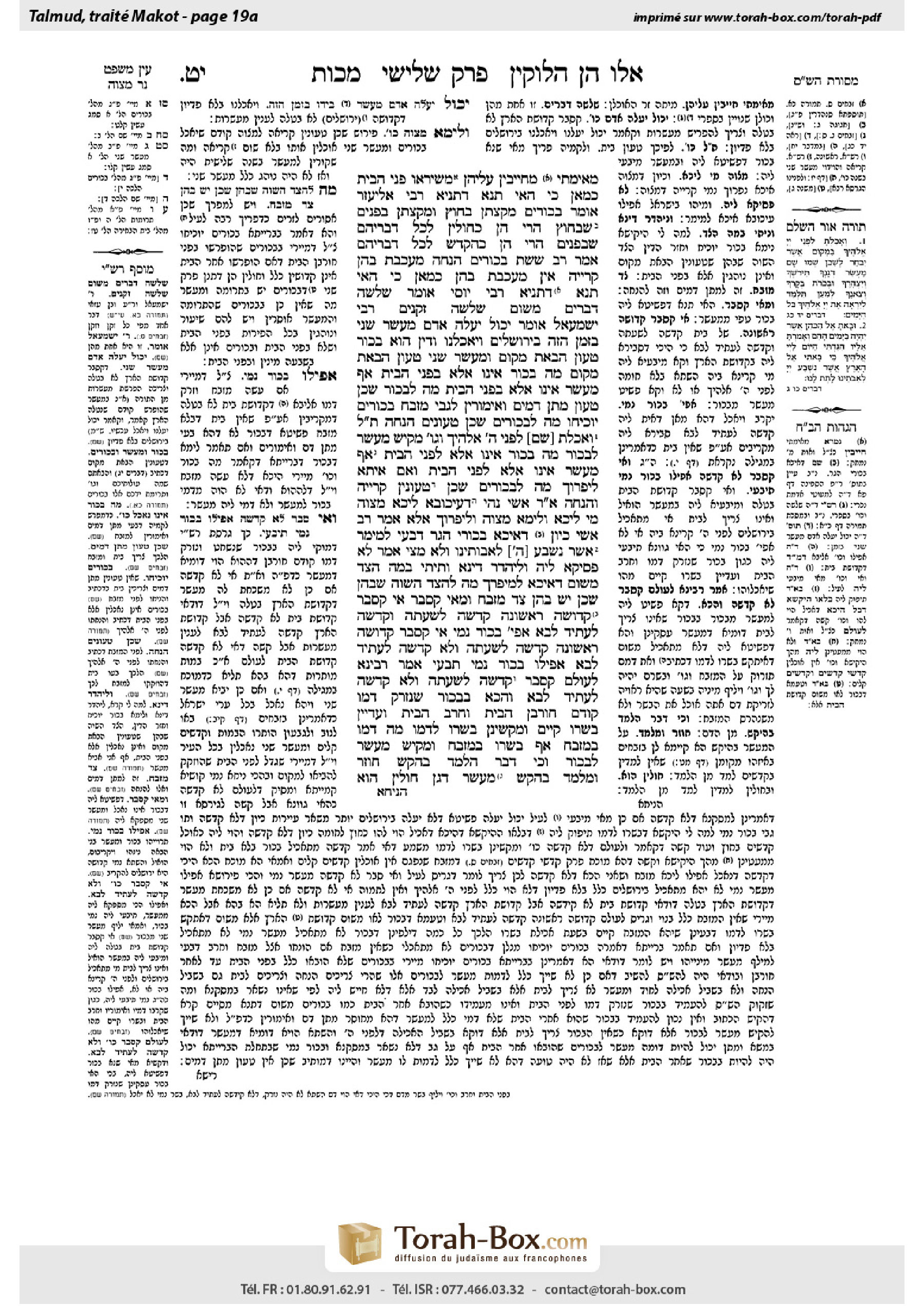
Makkot 19a: Talmud study for Daf Yomi
Daf Yomi is the daily study of one Talmud folio. Explore 37 tractates with scans, Hebrew text, Sefaria English and AI-generated French translations where annotated.
Passage selection and English or AI-generated French translation are available where the scan has annotations. Daf Study is independent of Torah-Box and Sefaria.
Browse Makkot · מכות · All tractatesMakkot 19a text and translations
This page of Makkot includes the Aramaic text, an English translation and an AI-generated French translation, alongside the scan above.
מכות י״ט א · Aramaic and Hebrew text
מֵאֵימָתַי (מ)חַיָּיבִין עֲלֵיהֶם – מִשֶּׁיִּרְאוּ פְּנֵי הַבַּיִת. כְּמַאן – כִּי הַאי תַּנָּא, דְּתַנְיָא, רַבִּי אֱלִיעֶזֶר אוֹמֵר: בִּכּוּרִים מִקְצָתָן בַּחוּץ וּמִקְצָתָן בִּפְנִים, שֶׁבַּחוּץ – הֲרֵי הֵן כְּחוּלִּין לְכׇל דִּבְרֵיהֶם, שֶׁבִּפְנִים – הֲרֵי הֵן כְּהֶקְדֵּשׁ לְכׇל דִּבְרֵיהֶם.
אָמַר רַב שֵׁשֶׁת: בִּכּוּרִים, הַנָּחָה – מְעַכֶּבֶת בָּהֶן, קְרִיָּיה – אֵין מְעַכֶּבֶת בָּהֶן.
כְּמַאן – כִּי הַאי תַּנָּא, דְּתַנְיָא: רַבִּי יוֹסֵי אוֹמֵר שְׁלֹשָׁה דְּבָרִים מִשּׁוּם שְׁלֹשָׁה זְקֵנִים, רַבִּי יִשְׁמָעֵאל אוֹמֵר: יָכוֹל יַעֲלֶה אָדָם מַעֲשֵׂר שֵׁנִי בִּזְמַן הַזֶּה בִּירוּשָׁלַיִם, וְיֹאכְלֶנּוּ? וְדִין הוּא: בְּכוֹר טָעוּן הֲבָאַת מָקוֹם, וּמַעֲשֵׂר שֵׁנִי טָעוּן הֲבָאַת מָקוֹם, מָה בְּכוֹר אֵינוֹ אֶלָּא בִּפְנֵי הַבַּיִת – אַף מַעֲשֵׂר אֵינוֹ אֶלָּא בִּפְנֵי הַבַּיִת.
מָה לִבְכוֹר שֶׁכֵּן טָעוּן מַתַּן דָּמִים וְאֵימוּרִין לְגַבֵּי מִזְבֵּחַ! בִּכּוּרִים יוֹכִיחוּ. מָה לְבִכּוּרִים, שֶׁכֵּן טְעוּנִים הַנָּחָה!
תַּלְמוּד לוֹמַר: ״וְאָכַלְתָּ [שָּׁם] לִפְנֵי ה׳ אֱלֹהֶיךָ וְגוֹ׳״ – מַקִּישׁ מַעֲשֵׂר לִבְכוֹר, מָה בְּכוֹר אֵינוֹ אֶלָּא לִפְנֵי הַבַּיִת – אַף מַעֲשֵׂר אֵינוֹ אֶלָּא לִפְנֵי הַבַּיִת. וְאִם אִיתָא, לִיפְרוֹךְ: מָה לְבִכּוּרִים – שֶׁכֵּן טְעוּנִין קְרִיָּיה וְהַנָּחָה!
אָמַר רַב אָשֵׁי: נְהִי דְּעִיכּוּבָא לֵיכָּא, מִצְוָה מִי לֵיכָּא? וְלֵימָא מִצְוָה וְלִיפְרוֹךְ! אֶלָּא אָמַר רַב אָשֵׁי: כֵּיוָן דְּאִיכָּא בִּכּוּרֵי הַגֵּר, דְּבָעֵי לְמֵימַר אֲשֶׁר נִשְׁבַּע [ה׳] לַאֲבֹתֵינוּ״, וְלָא מָצֵי אָמַר – לָא פְּסִיקָא לֵיהּ.
וְלִיהְדַּר דִּינָא וְתֵיתֵי בַּ״מָּה הַצַּד״! מִשּׁוּם דְּאִיכָּא לְמִיפְרַךְ: מָה לְהַצַּד הַשָּׁוֶה שֶׁבָּהֶן, שֶׁכֵּן יֵשׁ בָּהֶן צַד מִזְבֵּחַ.
וּמַאי קָסָבַר? אִי קָסָבַר קְדוּשָּׁה רִאשׁוֹנָה קִדְּשָׁה לִשְׁעָתָהּ וְקִדְּשָׁה לֶעָתִיד לָבֹא – בְּכוֹר נָמֵי, אִי קָסָבַר קְדוּשָּׁה רִאשׁוֹנָה קִדְּשָׁה לִשְׁעָתָהּ וְלֹא קִדְּשָׁה לֶעָתִיד לָבֹא – אֲפִילּוּ בְּכוֹר נָמֵי תִּבְּעֵי!
אָמַר רָבִינָא: לְעוֹלָם קָסָבַר קִדְּשָׁה לִשְׁעָתָהּ וְלֹא קִדְּשָׁה לֶעָתִיד לָבֹא, וְהָכָא בִּבְכוֹר שֶׁנִּזְרַק דָּמוֹ קוֹדֶם חוּרְבַּן הַבַּיִת, וְחָרַב הַבַּיִת וַעֲדַיִין בְּשָׂרוֹ קַיָּים. וּמַקְּשִׁינַן בְּשָׂרוֹ לְדָמוֹ, מָה דָּמוֹ בַּמִּזְבֵּחַ – אַף בְּשָׂרוֹ בַּמִּזְבֵּחַ. וּמַקִּישׁ מַעֲשֵׂר לִבְכוֹר.
וְכִי דָּבָר הַלָּמֵד בְּהֶקֵּשׁ חוֹזֵר וּמְלַמֵּד בְּהֶקֵּשׁ? מַעְשַׂר דָּגָן חוּלִּין הוּא.
Makkot 19a · English translation
from when is a non-priest who eats first fruits liable to receive death at the hand of Heaven for their consumption? One is liable from when the fruits will enter inside the Temple. The Gemara notes: In accordance with whose opinion is this halakha stated? It is in accordance with the opinion of this tanna, as it is taught in a baraita that Rabbi Eliezer says: With regard to first fruits, some of which are outside and some of which are inside the Temple, the halakhic status of those that are outside the Temple is like that of non-sacred produce for all matters concerning them, and the halakhic status of those that are inside the Temple is like that of consecrated produce for all matters concerning them.
§ Rav Sheshet says: With regard to first fruits, the lack of placement alongside the altar invalidates them; while the lack of recitation of the accompanying Torah verses does not invalidate them.
The Gemara notes: In accordance with whose opinion is this halakha stated? It is in accordance with the opinion of this tanna, Rabbi Yishmael, as it is taught in a baraita that Rabbi Yosei says three statements in the name of three elders, and one of those statements is that which Rabbi Yishmael says: One might have thought that a person would bring second-tithe produce up to Jerusalem in the present, after the destruction of the Temple, and eat it. And ostensibly, it could be derived by means of a logical inference that one may not do so: A firstborn offering requires bringing it to the place, to Jerusalem, and eating it there, and second-tithe produce requires bringing it to the place; just as the firstborn offering may be eaten there only in the presence of the Temple, so too, second-tithe produce may be eaten there only in the presence of the Temple.
Rabbi Yishmael continues and counters: What is notable about a firstborn? Bringing the firstborn to Jerusalem is required only in the presence of the Temple, because it is notable in that it requires placement of its blood and its sacrificial portions upon the altar; will you say the same with regard to second-tithe produce, which requires only that it be consumed in Jerusalem? He then suggests: First fruits will prove that placement of blood upon the altar is not a factor, as they do not require placement of blood upon the altar, and yet they are brought to Jerusalem only in the presence of the Temple. Rabbi Yishmael counters: What is notable about first fruits? They are notable in that they require placement alongside the altar. Perhaps, since second-tithe produce does not require placement at all, even in the present one must bring it to Jerusalem and eat it there.
Rabbi Yishmael concludes: Therefore, the verse states: “And you shall eat before the Lord your God…the tithe of your grain…and the firstborn of your herd and your flock” (Deuteronomy 14:23); the Torah juxtaposes second-tithe produce to the firstborn. Just as the firstborn may be eaten there only in the presence of the Temple, so too, second-tithe produce may be eaten there only in the presence of the Temple. The Gemara explains: the proof of Rav Sheshet’s opinion from the baraita is: And if it is so that the lack of recitation of the Torah verses invalidates the ritual of first fruits, let the baraita refute the derivation by saying: What is notable about first fruits? They are notable in that they require recitation of the Torah verses and placement alongside the altar.
Rav Ashi said: There is no proof from the fact that recitation is not mentioned. Although the lack of recitation does not invalidate the first fruits, is there no mitzva? Everyone agrees that there is a mitzva to recite the Torah verses. And therefore let the tanna say that there is a mitzva to recite the portion; and refute the proof from first fruits in that manner, as in the case of second tithe there is no mitzva to recite Torah verses. Rather, Rav Ashi said that there is a different reason that recitation was omitted from the refutation: It is that there is the case of the first fruits of a convert, who needs to recite: “I have come to the land that the Lord swore unto our fathers” (Deuteronomy 26:3), and since he cannot say it, as the Lord did not swear to give the land to the ancestors of the convert, he brings the first fruits but does not read the portion. Therefore, the obligation to recite the Torah verses is not clear-cut for the tanna and he did not mention it.
The Gemara asks: Why was it necessary for the tanna to derive that second-tithe produce is not brought to Jerusalem at present from the juxtaposition in the verse? And let the derivation revert to its starting point, and derive the halakha through an analogy derived from the common factor of first fruits and the firstborn. Each of the sources neutralizes the significance of the notable factor in the other, leaving the common factor: One must bring them to Jerusalem. From there it may be derived that second-tithe produce, which one must also bring to Jerusalem, need not be brought there when the Temple is not standing. The Gemara answers: The juxtaposition is necessary due to the fact that this analogy can be refuted: What is notable about the common factor that is true of both first fruits and the firstborn? It is notable in that they have an aspect involving the altar, which is not so in the case of second tithe.
The Gemara asks: And what opinion does Rabbi Yishmael hold that led to his initial assumption that one is obligated to bring a firstborn animal to Jerusalem only when the Temple is standing? If he maintains in general that the initial consecration of the Temple sanctified Jerusalem for its time and sanctified Jerusalem forever, and the location of the Temple remains sacred even after the Temple was destroyed, then one should also be obligated to bring a firstborn animal to the place of the Temple and sacrifice it on an altar and eat it. If he maintains that the initial consecration of the Temple sanctified Jerusalem for its time but did not sanctify Jerusalem forever, then he should raise a dilemma even with regard to a firstborn, whether it may be eaten in Jerusalem.
Ravina said: Actually, Rabbi Yishmael maintains that the initial consecration of the Temple sanctified Jerusalem for its time but did not sanctify Jerusalem forever; and why is it obvious to him that the firstborn is not eaten? It is because here, he is stating the halakha with regard to the case of a firstborn whose blood was sprinkled before the destruction of the Temple, and the Temple was then destroyed, and its flesh is still intact. And based on a juxtaposition: “You shall sprinkle their blood upon the altar…and their flesh shall be for you” (Numbers 18:17–18), we compare the status of its flesh to the status of its blood; just as its blood must be sprinkled at a time when the altar is standing, so too its flesh may be eaten only at a time when the altar is standing. And he compares the status of second-tithe produce to the status of a firstborn offering, and derives that one may partake of second-tithe produce in Jerusalem only when the Temple is standing.
The Gemara asks: And does a matter derived via juxtaposition then teach another matter via juxtaposition? The principle with regard to the halakhot of consecrated matters is that a halakha derived via one of the hermeneutical principles cannot serve as the basis for derivation of another halakha; each halakha requires its own source. The Gemara answers: Second tithe of grain is non-sacred produce, and halakhot of non-sacred matters derived via hermeneutical principles may serve as the basis for deriving other halakhot using hermeneutical principles.
Makkot 19a · Traduction française (IA)
À partir de quand un non-prêtre qui mange des prémices est-il passible de mort par la main du Ciel pour les avoir consommées ? Il en est passible dès que les fruits entrent à l’intérieur du Temple. La Guemara relève : Selon l’opinion de quel tanna cette halakha est-elle énoncée ? Selon celle de ce tanna, comme il est enseigné dans une baraïta : Rabbi Eliezer dit que, parmi les prémices, celles qui se trouvent à l’extérieur du Temple ont, à tous égards, le statut de produits profanes, tandis que celles qui se trouvent à l’intérieur ont, à tous égards, le statut de produits consacrés.
§ Rav Sheshet dit : Pour les prémices, l’absence de dépôt auprès de l’autel les invalide, tandis que l’absence de récitation des versets de la Torah qui les accompagnent ne les invalide pas.
La Guemara relève : Selon l’opinion de quel tanna cette halakha est-elle énoncée ? Selon celle de ce tanna, Rabbi Yishmael, comme il est enseigné dans une baraïta : Rabbi Yosei énonce trois enseignements au nom de trois anciens. L’un d’eux est celui de Rabbi Yishmael : On aurait pu penser qu’une personne devait apporter à Jérusalem des produits de seconde dîme à l’époque actuelle, après la destruction du Temple, et les manger. Or, apparemment, un raisonnement a fortiori permettrait de déduire qu’il n’en est pas ainsi : une offrande de premier-né doit être apportée à cet endroit, à Jérusalem, et y être mangée ; les produits de seconde dîme, eux aussi, doivent être apportés à cet endroit. De même que l’offrande de premier-né ne peut y être mangée qu’en présence du Temple, de même les produits de seconde dîme ne peuvent y être mangés qu’en présence du Temple.
Rabbi Yishmael poursuit et objecte : Qu’a de particulier le premier-né ? Il ne doit être apporté à Jérusalem qu’en présence du Temple, car il a ceci de particulier que son sang et ses portions sacrificielles doivent être déposés sur l’autel. Peut-on dire la même chose des produits de seconde dîme, qui doivent seulement être consommés à Jérusalem ? Il propose alors : Les prémices le démontreront, car le dépôt de leur sang sur l’autel n’entre pas en jeu : elles n’exigent pas de dépôt de sang sur l’autel, et pourtant elles ne sont apportées à Jérusalem qu’en présence du Temple. Rabbi Yishmael objecte : Qu’ont de particulier les prémices ? Elles ont ceci de particulier qu’elles doivent être déposées auprès de l’autel. Peut-être que, puisque les produits de seconde dîme n’exigent aucun dépôt, on doit également les apporter à Jérusalem et les y manger à l’époque actuelle.
Rabbi Yishmael conclut : C’est pourquoi le verset dit : « Et tu mangeras devant le Seigneur ton Dieu… la dîme de ton grain… et les premiers-nés de ton gros et de ton petit bétail » (Deutéronome 14:23). La Torah rapproche les produits de seconde dîme du premier-né. De même que le premier-né ne peut être mangé là qu’en présence du Temple, de même les produits de seconde dîme ne peuvent y être mangés qu’en présence du Temple. La Guemara explique que la baraïta prouve l’opinion de Rav Sheshet de la façon suivante : si l’absence de récitation des versets de la Torah invalidait le rituel des prémices, la baraïta pourrait réfuter la déduction en disant : Qu’ont de particulier les prémices ? Elles ont ceci de particulier qu’elles exigent la récitation des versets de la Torah et le dépôt auprès de l’autel.
Rav Ashi dit : Le fait que la récitation ne soit pas mentionnée ne constitue pas une preuve. Même si l’absence de récitation n’invalide pas les prémices, n’y a-t-il pas une mitsva ? Tous s’accordent à dire qu’il y a une mitsva de réciter les versets de la Torah. Le tanna aurait donc pu dire qu’il y a une mitsva de réciter le passage et réfuter ainsi la preuve tirée des prémices, puisque, dans le cas de la seconde dîme, il n’y a pas de mitsva de réciter des versets de la Torah. Rav Ashi dit plutôt que la récitation a été omise de la réfutation pour une autre raison : il existe le cas des prémices d’un converti, qui doit réciter : « Je suis venu dans le pays que le Seigneur a juré à nos pères » (Deutéronome 26:3). Comme il ne peut pas dire cela, puisque le Seigneur n’a pas juré de donner le pays aux ancêtres du converti, il apporte les prémices, mais ne lit pas le passage. Par conséquent, pour le tanna, l’obligation de réciter les versets de la Torah n’est pas clairement établie, et il ne l’a pas mentionnée.
La Guemara demande : Pourquoi le tanna a-t-il dû déduire, à partir du rapprochement dans le verset, que les produits de seconde dîme ne sont pas apportés à Jérusalem à l’époque actuelle ? Que la déduction revienne à son point de départ et que l’on déduise cette halakha par une analogie fondée sur le dénominateur commun des prémices et du premier-né. Chacun de ces cas neutralise l’élément particulier de l’autre, laissant un dénominateur commun : il faut les apporter à Jérusalem. On peut en déduire que les produits de seconde dîme, qu’il faut également apporter à Jérusalem, n’ont pas à y être apportés lorsque le Temple n’est pas debout. La Guemara répond : Le rapprochement est nécessaire, car cette analogie peut être réfutée : qu’a de particulier le dénominateur commun aux prémices et au premier-né ? Il a ceci de particulier qu’ils comportent un aspect lié à l’autel, ce qui n’est pas le cas de la seconde dîme.
La Guemara demande : Quelle opinion Rabbi Yishmael soutient-il pour avoir d’abord supposé qu’on n’est tenu d’apporter un animal premier-né à Jérusalem que lorsque le Temple est debout ? S’il considère, de façon générale, que la consécration initiale du Temple a sanctifié Jérusalem pour son temps et pour toujours, et que l’emplacement du Temple demeure sacré même après sa destruction, alors on devrait également être tenu d’apporter un animal premier-né à l’emplacement du Temple, de le sacrifier sur un autel et de le manger. S’il considère que la consécration initiale du Temple a sanctifié Jérusalem pour son temps, mais pas pour toujours, alors il devrait soulever une question même au sujet d’un premier-né : peut-il être mangé à Jérusalem ?
Ravina dit : En réalité, Rabbi Yishmael considère que la consécration initiale du Temple a sanctifié Jérusalem pour son temps, mais pas pour toujours. Pourquoi lui est-il donc évident que le premier-né ne peut pas être mangé ? C’est qu’ici, il énonce la halakha au sujet d’un premier-né dont le sang a été aspergé avant la destruction du Temple, puis dont la chair est restée intacte après cette destruction. En nous fondant sur le rapprochement suivant : « Tu aspergeras leur sang sur l’autel… et leur chair sera pour toi » (Nombres 18:17–18), nous comparons le statut de sa chair à celui de son sang. De même que son sang doit être aspergé lorsque l’autel est debout, de même sa chair ne peut être mangée que lorsque l’autel est debout. Il compare ensuite le statut des produits de seconde dîme à celui d’une offrande de premier-né et en déduit que l’on ne peut consommer des produits de seconde dîme à Jérusalem que lorsque le Temple est debout.
La Guemara demande : Une question déduite par rapprochement peut-elle donc servir à en déduire une autre par rapprochement ? En ce qui concerne les halakhot des choses consacrées, le principe est qu’une halakha déduite au moyen de l’un des principes herméneutiques ne peut servir de fondement à la déduction d’une autre halakha ; chaque halakha doit avoir sa propre source. La Guemara répond : La seconde dîme du grain est un produit profane, et les halakhot relatives aux choses profanes déduites au moyen de principes herméneutiques peuvent servir de fondement à la déduction d’autres halakhot au moyen de principes herméneutiques.
Traduction française générée par IA à partir de l’édition anglaise de Sefaria. Vérifie toujours un passage avec le texte source.
Text from Sefaria: William Davidson Edition - Vocalized Aramaic (CC BY NC); William Davidson Edition - English (CC BY NC).